Aleutians

Japanese kayakers paddle Aleutian Chain without GPS, rescue radio

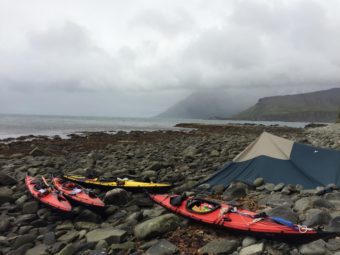
Two Japanese kayakers are traversing the Aleutian Chain without the use of GPS, satellite phones or rescue radio. (Photo courtesy of Takao Araiba)
A group of Japanese kayakers are traversing the Aleutian Chain without the use of GPS, satellite phones or rescue radio. (Photo courtesy of Takao Araiba)

Cold Bay to Unalaska is nearly 200 miles. By plane, it takes about an hour. By kayak, it’s nearly a month. Akio Shinya made the trip — with three others — in 24 days.

“I am an old man — 69 years old,” Akio Shinya said. “So very hard, but now I am happy.”

Over the past 16 years, he has taken six kayak trips to the Aleutian Islands. A place he considers special.

“Kayak was born here,” Shinya said. “Aleutian Island chain. They have big history, so I am interested in the ancient people and Aleutians.”

Shinya lives on Japan’s northern island — Hokkaido — in the village of Niseko where he runs a ski lodge. In the summers, he operates a kayak tour business and occasionally he takes people on expeditions to the Aleutians.

The kayakers are completely self-sufficient. They carry all their own food and camping supplies. They paddle collapsible kayaks designed to be easily transported and assembled without tools. The Japanese prefer these boats because they have an outer skin stretched over an aluminum frame similar to the skin-on-frame kayaks designed and used in the Aleutians for thousands of years. Shinya and his co-leader, Takao Araiba, even use traditional Aleut paddles made by a friend in Japan.

“Every time, always, I use Aleut paddles in Japan and here,” Shinya said. “This paddle is good for Aleutians. Paddling is very smooth.”

They’re wooden with a narrow bridge. Shinya calls himself a student of ancient people. On his trips, he does not use a GPS, satellite phone, or rescue radio because ancient people did not have them.

Although this trip is over, he hopes one day to return to the Aleutians.

“I know, I old man,” Shinya said. “If possible more paddling. My experience of Aleutian is very small”

Coast Guard exchanges halt sales of ‘assault-style’ guns 

coast guard assault rifles 2
Crew members from Coast Guard units throughout Maryland conduct small arms training, Aug. 26, 2014. Throughout the day different members shot handguns, rifles and shotguns to become or retain their qualifications. (Creative Commons photo by Petty Officer 2nd Class David R. Marin/Coast Guard)

Coast Guard exchange stores that sell firearms have stopped selling “assault-style” guns.

The chief operating officer for Coast Guard exchanges, John Riley, said the stores define assault-style weapons as semi-automatic guns with magazines with a capacity of at least 20 rounds.

In Alaska, the decision applies to exchange stores in Kodiak and Ketchikan.

The Kodiak Daily Mirror reports the decision was prompted by the June 12 killing of 49 people at an Orlando, Florida, night club.

Riley said that was the tipping point but the matter was something officials had been looking at.

He said it doesn’t make sense for the Coast Guard to continue selling assault-style weapons based on sales, profit numbers and the scrutiny the stores come under.
Mentoring program in Unalaska nudges young men to Choose Respect

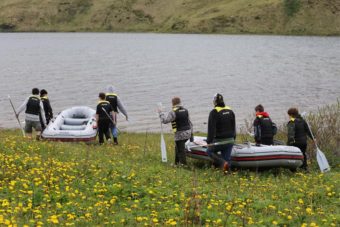
A group of young and adult men outfitted in life vests, huddled together by Iliuliuk Lake on a sunny and windy Saturday afternoon. Off to the side was an inflated rubber raft piled with oars. They appeared ready to go out on the lake, but there was an underlying idea bigger than just the activity of paddling.

“So, what we’re here for, myself, Dimitri, Jeremiah, and there’s a couple of others who you might see in the next trip if you come on the next trip, we’re kind of part of a group called Compass,” said Carlos Tayag.

He’s a recreation coordinator at the Unalaska community center. But at that moment, he was a volunteer.

“Raise your hands if you’ve heard of the Alaska Men Choose Respect campaign,” Tayag said.

Hands go up.

“We’ve taken a pledge to do that, to be mentors and guides for other young men.”

As they inflated a second raft, Tayag explained that last year, a group of men from Unalaska attended a workshop on mentoring, specifically using Compass. Compass is an Alaskan program created in response to requests from various entities for a resource that can be used to guide men in their conversations with youth. The goal was to help Alaska’s young men learn to respect themselves and others. A strategy for this is to engage them in conversation while doing simple and fun activities.

Tayag motioned to the lake to illustrate how the community is surrounded by water, the inspiration for the rafting activity.

“We have a couple of good lakes, so we decided that rafting was a good activity and a bonfire just to hang out and chill,” Tayag said.

Compass Rafting
Compass participants lift rafts to Iliuliuk Lake. (Photo courtesy Dmitri Dela Cruz)

“I’m here because it seems like a fun thing to do,” 15-year-old Amiel Fernandez agreed. “I haven’t been on a boat in the middle of the water a lot.”

The conversations went beyond water safety. The young men were getting guidance from male role models on redefining masculinity and are encouraged to explore healthier, nonviolent models of manhood.
“The message is really simple. I think the whole thing about Compass is just getting guys comfortable with, one, being themselves, and two, talking about who they are and where they come from.” Tayag explained. He added that men typically have a harder time expressing their feelings. The objective was to provide youth a chance to be able to open up without judgement, which Tayag believed was part of coming of age for young men and their quest for identity. “I think that’s the most important for me, is just kind of having those open honest  conversations and letting people be who they are.”

This program is a collaborative effort of Unalaskans against Sexual Assault and Family Violence, Alaska Network on Domestic Violence and Sexual Assault, City of Unalaska Department of Public Safety and the Department of Parks, Culture, and Recreation.

Unalaska explores tax breaks for housing renovations

Unalaska's City Hall building. (Photo courtesy of KUCB)
Unalaska’s City Hall building. (Photo courtesy of KUCB)

Unalaska’s City Council wants to look into expanding tax breaks to encourage renovations that create new housing.

Currently, the city only provides a sales tax exemption to newly constructed residential housing and that does not apply to renovated, former commercial or industrial buildings.

“You know you see this all the time in the big cities where some of the turn of the century brick buildings (in) New York City or Seattle have been turned into nice lofts or fancy living accommodations,” said councilor Frank Kelty. “And I know a lot of those places give tax breaks. So I think this is something to be looked at. I don’t think it is something that will be an overwhelming hurt on our sales tax revenues.”

He says he would be in favor of this.

City Manager David Martinson calls the real impacts of the exemption minimal, if new residential homes can be created.

3 dead, 6 injured after cannery van crashes in Atka

Atka Pride Seafood cannery, pictured in 2013. (Photo by Lauren Rosenthal/KUCB)

Three people have died and six more are injured after a passenger van rolled over in Atka Tuesday night.

Alaska State Troopers say they learned of the single vehicle crash just after six Tuesday evening. The people involved in the accident are employees of Atka Pride Seafood, which is a subsidiary of the Aleutian Pribilof Island Community Development Association or APICDA.

APICDA’s Ellen Krsnak says the accident occurred when they were traveling from the processing plant to the bunkhouse for dinner.

“We are devastated by the news of this accident and will do everything possible for our employees and their families,” wrote Larry Cotter, APICDA CEO in a release Tuesday evening. “Right now the most critical thing is for the injured to receive medical care. We are very grateful to the Atka Village Health Aide, the Village Public Safety Officer and the community of Atka for mobilizing immediately to help the injured.”

The Coast Guard has transported several of the injured passengers to Anchorage. Troopers are in Atka Wednesday investigating the incident.

Names of the injured and deceased are being held until families can be notified.

Governor declares June 3 Dutch Harbor Remembrance Day

Buildings burning after the first Japanese attack on Dutch Harbor, Alaska (USA), 3 June 1942. (Public Domain photo by U.S. Army)

Governor Bill Walker has declared June 3rd to be recognized as Dutch Harbor Remembrance Day. Statewide all flags will fly at half-mast to recognize Japan’s World War II attack on Dutch Harbor.

The 1942 bombing was the first hostile action on Alaskan soil; 25 servicemen were killed.

Later on, Dutch Harbor was attacked again as well as the communities of Adak, Kiska, and Attu.

In response to the June 3rd strike, the United States uprooted Unangan people and sent them to internment camps in Southeast Alaska where they suffered from disease and malnutrition.

Governor Walker hopes Dutch Harbor Remembrance Day will honor the military who served and died defending the United States, and the Aleut people who died while interned.

Site notifications
Update notification options
Subscribe to notifications