Aleutians

Company makes a business out of playing in nature

Two adventurers have turned a hobby into a career and now spend their time traveling the country and recording trails via video so that other people can hike, bike, run and ride them.
This summer, Discover Kodiak hired Trail Genius to record real-time video and collect information about roughly 28 trails in Kodiak, including Termination Point, Pyramid, and Barometer, using ATVs, their own two legs and their equipment.

Jason Manders and his partner, Amanda Campbell, are based in Wisconsin and began the Kodiak project in mid-June.

“We had a really great time,” Manders said. “We were surprised by the rainforest-type environment. The lush plants – that was a surprise and really cool. All the berries and the moss all over the ground. We kept thinking we were in some sort of enchanted forest or something.”

Manders has been biking his entire life and he started recording trails to help other bikers decide whether they wanted to explore that trail or not, he said. He did that as a hobby for two or three years, then he was “discovered.”

“And then we got a call from a large trail entity that has trails all over the world and they asked us to build this interactive experience of their bike trails as far as New Zealand, and that’s when we realized we could actually make money doing this,” Manders said.

Manders and Campbell received business from races, triathlons and other event-holders that cover activities from driving snowmobiles to ATVs.

Campbell, who’s also a graphic designer, said Manders introduced her to biking prior to starting the business.

While on the island, they decided to get married, a ceremony which Discover Kodiak executive director Chastity McCarthy said she officiated.

“They were like, ‘we’ll just come into your office tomorrow and we can do it’ and ‘I’m like, okay, that’ll work,'” McCarthy said. “But once they got in there, I was like well our office is this old wood paneling and it’s not that awesome. Let me go talk to the construction workers outside and see if they’ll us do it on the new pier.”

“So I ran out there, the construction workers walked us through safely because there were still some little spots going on,” she said. “It was funny because I married them within about 10 minutes and then afterwards the construction workers were cheering and we didn’t even know they had been watching.”

McCarthy says Trail Genius might be back next summer to map more trails, but the current progress will be available online in December.

Adventurers will be able to click through the trails, see real-time videos and learn about trails’ heights, elevations and terrains.

Walker visits Unalaska as cable vessel stops in port

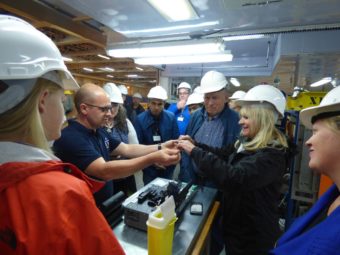
Governor Bill Walker and Donna Walker inspect a section of fiber optic cable aboard the vessel Ile de Sein. (Laura Kraegel, KUCB)

The cable vessel Ile de Sein is on its way to the North Slope, where soon it’ll lay hundreds of miles of fiber optic cable for the Quintillion high-speed internet project.
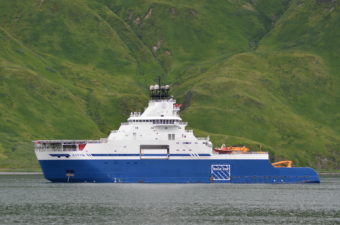
Before shipping out this weekend, though, the vessel stopped in Unalaska to host a group of Quintillion’s investors, industry partners, and other supporters — including Governor Bill Walker.

It was Walker’s first trip to Unalaska in two years. He said he came to get a closer look at one of the ships bringing better internet to rural Alaska.

“Alaska is changing,” said Walker. “Alaska is changing because the Arctic is opening up. So to be able to have this opportunity for Alaska — the connectivity with the rest of the world with the high-speed internet this is going to provide — it’s pretty exciting.”

Walker wasn’t the only high-profile guest. The Ile de Sein also welcomed Alaska Senator Donny Olson, D-Golovin, as well as representatives from the Arctic Slope Regional Corporation, the Calista Corporation and ConocoPhillips.

Quintillion hasn’t confirmed the names of its customers in the telecom industry, but CEO Elizabeth Pierce said representatives from OTZ Telephone Cooperative, TelAlaska, AT&T, and Verizon also toured the ship.

While Quintillion still is focused on finishing the first phase of the cable system this summer, Pierce said her team already is considering where to expand next.

They haven’t made any decisions yet, but she said they’re looking at future Alaska landing sites beyond the original six in Nome, Kotzebue, Wainwright, Point Hope, Barrow, and Prudhoe Bay.

“We’ve gotten the message loud and clear, and we’ll see what we can do to make Dutch Harbor a future landing,” Pierce said.

For now, though, the Ile de Sein is traveling to Wainwright. The ship will arrive toward the end of the week and start laying 1,500 tons of fiber optic cable along the North Slope. Meanwhile, its sister ship — the Ile de Brehat — has finished the landing site at Nome and is now heading north through the Bering Strait.

Pierce said the Quintillion project is still on schedule to deliver high-speed internet in the first quarter of 2017.

Shell returns to Unalaska

The Aiviq in Unalaska. Photo: Sarah Hansen/KUCB

UPDATE, 8/8/16:

A fourth vessel associated with Shell’s Arctic efforts has docked in Dutch Harbor. The Nanuq arrived late Friday evening.

ORIGINAL STORY, 8/5/16: 

Shell is back in Unalaska. Dutch Harbor was a staging area for Shell’s unsuccessful search for oil in the Arctic Ocean last year. This week, three ships — the Aiviq, the Dino Chouest, and the Ross Chouest — associated with Shell’s Arctic efforts arrived in Unalaska on a mission to remove the last signs of that effort.
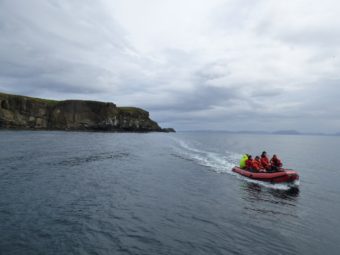
A Shell representative says the vessels are “tasked with retrieving more than 50 anchors from the Chukchi and Beaufort seas” and “completing required environmental science monitoring and reporting.”

Meanwhile, a Coast Guard investigation released this week confirms that inaccurate charts are to blame for one of Shell’s major mishaps last summer. The icebreaker Fennica hit a pinnacle of rock near Dutch Harbor, tearing a three-foot hole in its hull and causing the boat to take on water. The original damage was estimated at $100,000 and repairs set back the Fennica’s arrival in the Arctic Ocean by a month.

Coast Guard Lieutenant Rven Garcia said the charts had last been updated in 1935.

“They did have charts, but the actual water depth was significantly shallower than indicated on the chart,” Garcia said. “So the pilot had the proper tools on board, but the chart wasn’t as up-to-date because the survey had not been conducted for that area.”

After the incident, the National Oceanic Atmospheric Administration conducted a new hydrographic survey to map the area.

YCC: Introducing Alaskan kids to the Aleutians and careers with FWS

What happens when five teenagers pile onto a research vessel and go island hopping through the Aleutians in the name of conservation? Science. Education. And maybe a peek into their futures.

It’s all part of an only-in-Alaska version of the federal Youth Conservation Corps or YCC. The goal is to introduce high school students to a stretch of protected land they’ve grown up near, but may not even know exists — all in the hope that someday these young Alaskans will become its next stewards.

Over the course of a season, the research vessel Tiglax can travel 20,000 nautical miles. For a week, five YCC corpsmembers, ranging in age from 16 to 18, join the crew exploring the vast Alaska Maritime National Wildlife Refuge, which stretches from the western end of the Aleutian Chain to islands like St. Lazaria near Sitka and even further north than Point Hope.

“It’s kind of cool being able to be on this huge vessel and have people teach you how they do it,” Aurora Waclawski, 18,  said. “It’s really interesting and awesome.”

She and the rest of the crew grew up in communities around the refuge, ranging from Homer, where she’s from, to Atka. But for most of them, this is the first time they’ve actually traveled through it.

Waclawski heads to college this fall, where she plans to study environmental engineering. The opportunity to explore the Maritime Refuge through the YCC program has been on her bucket list for years.

“Throughout my life, I’ve loved science and all that stuff and that’s kind of why I wanted to do this,” Waclawski said. “It’s cool seeing how this science that I’ve only really seen on paper actually goes on.” Science like surveying seabird colonies, and tracking the reproductive success of puffins on Aiktek.

During a week on the Tiglax, the YCC members see a sliver of the refuge, which provides essential habitat for 40 million seabirds — not to mention marine mammals and other migratory birds — but isn’t exactly a household name in the communities on is borders.

Take 18-year-old crew leader Marieana Larsen. Growing up in Sand Point, she didn’t know much about sea birds. But when she traveled to Saint Paul Island in the Pribilofs for the YCC, she says she finally understood the importance of the refuge.

“We made like 100 rat traps and I thought, ‘this is kind of pointless,'” Larsen said. “And then I thought about it and I was like, ‘oh wow birds are dying. No, rat traps are important.’ Because one rat gets on the island it could destroy all the seabirds and that’s no tourism and that’s no refuge and then people aren’t going to have their cultural foods.”

Larsen will take what she’s learned back to her community. Alongside the crew, she teaches environmental education classes at the annual culture camp in Sand Point.

“Its really fun to do classes with kindergarten through fourth grade and just kind of teach ’em different scientific things about nature because it’s not like they’re learning about it at culture camp,” Larsen said. “They’re learning about the cultural aspects.”

She hopes to bridge the gap — intertwining science with Alaska Native culture and finding more ways to connect kids to their landscape. The YCC crew are paid an hourly wage, with all their expenses covered.

Tiglax captain Billy Pepper said it’s one of the best ways the refuge spends money.

“If you’re going to try and tell somebody that wildlife and the environment is important, it’s harder to convince somebody in their 40s than in their teens,” Pepper said. “And if they get it in their teens they really become advocates for conservation.”

The experience has changed the course of some kids’ lives — giving their ambitions a real-world road test, he said.

“They come on,” Pepper said. “They think they’re going to do something and they’ve got a lot of ambition to do one thing and they’re seasick the whole time. And one kid was going to be a pilot that was the end of that. He couldn’t handle the movement. He didn’t have the make up to do it.”

For some, the experience is more successful. Larson is one of the youngest crew leaders and now, a youth ambassador with the Arctic Council. Since her first time aboard the Tiglax, Larsen slowly has been wiggling her way into the Fish and Wildlife Service, but she’s not the only one. At least four former YCC members have gone on to work for the refuge. Larsen thinks eventually she might like being a Refuge Information Technician or RIT.

“It’s like you’re the middle man for the people they want to talk to and telling them what they are doing on the refuge like with the communities close to it,” Larsen said.

That’s exactly the kind of middle men the program is hoping to create — liaisons between the refuge and the people who live near it. Right now, there is not a RIT position for the Alaska Maritime National Refuge. Staff members know Larsen is interested and said having her stationed in Sand Point representing the refuge is a possibility.

Lack of water drove Alaska island mammoths to extinction

BERLIN — Scientists say that one of the last surviving populations of woolly mammoths was likely driven to extinction by lack of drinking water.

Mammoths lived on Alaska’s St. Paul Island in the Bering Sea until about 5,600 years ago. They never came into contact with humans, who only arrived on the island in 1787.

Researchers from the United States examined evidence of environmental change and found that the mammoths’ demise coincided with declining freshwater resources caused by rising sea levels and drier climate.

In a study published Monday by the Proceedings of the National Academy of Science, they concluded that mammoths may have contributed to their own demise by congregating around remaining water holes.

By trampling the vegetation these Ice Age giants hastened erosion that further reduced the freshwater supply.

Where are the herring? Unalaska’s seine fishery remains on hold

(Credit Public Domain, US Government work, via Wikimedia Commons.)
Fishermen check out their herring catch. (Credit Public Domain, US Government work, via Wikimedia Commons.)

The commercial herring fishery is on hold in Unalaska — because no one can find the fish.

The herring season opened more than a week ago. So far, fishermen haven’t had any luck, even with a spotter pilot searching from above.

“There’s been no appreciable harvest at all,” said Frank Kelty on the Unalaska Fisheries Report. “The fish appear to be well offshore and in very deep water where the seiners can’t get to them.”

Kelty said three or four seiners are registered to fish this season, while no one has registered to use gillnet gear.

If the herring show up, Dutch Harbor fishermen will be able to harvest 2,166 tons. But until then, the seiners are on standby.

“There hasn’t been any fish around and I think everybody’s decided to just take a break from it and come back later on,” said Lisa Fox, the area management biologist for the Alaska Department of Fish and Game in Sand Point, which manages the herring fishery.

There’s no word yet on when fishermen will try again. Fox said they may have to wait until the salmon season dies down.

Site notifications
Update notification options
Subscribe to notifications