Aleutians

Plankton population and the power of pink salmon

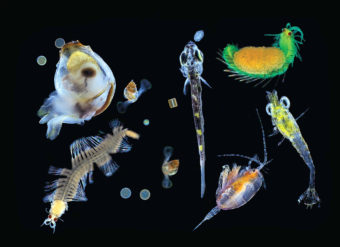
Plankton collected in the Pacific Ocean with a 0.1mm mesh net. Seen here is a mix of multicellular organisms — small zooplanktonic animals, larvae and single protists (diatoms, dinoflagellates, radiolarians) — the nearly invisible universe at the bottom of the marine food chain. Christian Sardet/CNRS/Tara Expeditions
A variety of plankton from the Pacific Ocean. (Christian Sardet/CNRS/Tara Expeditions)

After combing through data from the Aleutian Islands, a scientist has discovered an unexpected relationship between plankton and pink salmon. Although plankton might seem like an ecological afterthought, biological oceanographer Sonia Batten disagrees. She calls them the most important organisms in the ocean.
“They’re the basis of every marine food chain pretty much,” said Batten. “They support directly, or indirectly, the resources that we value.”

That means even if a species isn’t eating the plankton itself, its food source probably is. Scientists consider plankton good indicators of what’s happening in the environment.

“Because they have short life cycles, they have very limited ability to move, and they’re not commercially fished,” she said. “They react very quickly to changes in their environment in a relatively unambiguous way.”

Batten has 15 years of data from plankton pulls in Alaskan waters. That involves dragging a net behind commercial cargo ships. When there are a lot of pink salmon, they eat up a lot of animal plankton. But when pink salmon numbers are low, the animal plankton flourish.

Those impacts permeate the entire food chain — past their immediate prey. And if the pink salmon eat a lot plankton, there may not be much food left for other predators.

In 2013, Batten started seeing something unusual.

“This was the first time that I’ve seen that the fish are actually influencing the plankton,” she said.

2013 was a bumper year for pinks, and the data began to look different. Batten didn’t see that big decrease in plankton. And now she’s left with a question: What changed?

“Pink salmon were supposedly in really high numbers in 2013, so I would have expected to see the same numbers,” she said. “But I didn’t, so that suggests that something’s going on in the environment that I don’t know about yet.”

Batten says it could be that the salmon are eating something else. She’s planning to continue looking for answers.

Correction: A previous version of this story indicated that plankton pulls were done using commercial fishing boats. In fact, scientists used commercial cargo ships.

Researchers developing cheaper, faster monitoring method for paralytic shellfish poisoning

Researchers are developing a field test kit that would make it easier to monitor for paralytic shellfish poisoning.

Project partners include NOAA researchers from the Lower 48 as well as community testers based on Kodiak Island and in the Alaska Peninsula.
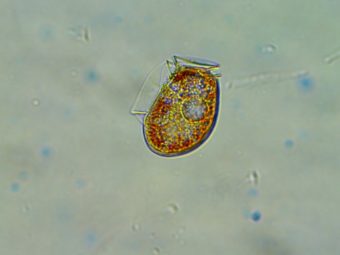
Despite the high level of toxicity found in shellfish in the Kodiak Archipelago, people still harvest them.

Julie Matweyou, who works in the Alaska Sea Grant Marine Advisory Program and has been a long-term researcher of PSP, said a person becomes sick when they eat shellfish that have consumed toxic plankton.

She explains paralytic shellfish poisoning is exactly what it sounds like.

“The PSP toxins can cause tingling of the mouth, paralysis, tingling of the extremities, nausea, headache, people describe a floating sensation,” she said. “And in a severe toxin event, the person would experience paralysis of the limbs, which would progress into paralysis of your diagram, which would cause respiratory paralysis.”

A faster, cheaper way to monitor for PSP could prevent sickness in harvesters and even save lives. The testing also would be helpful in collecting more data about when toxicity peaks and when it declines.

Researchers are in phase one of the three-year project, which began in July and is funded through the North Pacific Research Board.

Pat Tester, a former supervisory oceanographer and current affiliate for NOAA and works in North Carolina, explains that the chemical based methods the state of Alaska uses for testing toxicity are expensive and lengthy. She said for monitoring in the field, researchers would try an anti-body based test.

“We’ve developed antibodies to two of the most potent toxins in the shellfish, and we can give you then a digital readout of those toxins in the shellfish in the field very quickly and very much less expensively than the state does the regulatory testing.”

Some samples will go to researchers in the city of Kodiak for monitoring and, from there, they will be sent to North Carolina for validation via chemical analysis, she said.

Scientists use seismic waves to map Okmok volcano

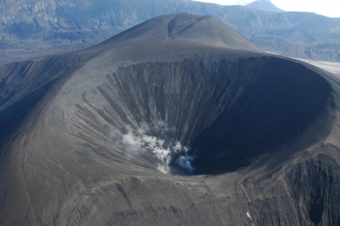
Okmok Volcano CREDIT ALASKA VOLCANO OBSERVATORY, USGS/WIKIMEDIA COMMONS
A team of scientists are using a process like a geological CAT scan to map the the inside of Okmok Volcano. (Photo by Alaska Volcano observatory, USGS/Wikimedia Commons)

In the rich volcanic landscape of the Aleutians, Okmok volcano on Umnak Island has drawn special attention this summer.

Matt Haney, a research geophysicist with the Alaska Volcano Observatory, is part of a team trying to create an image of the inside of Okmok. The process is like a geological CAT scan, mapping the earth rather than the body.

Last summer, the team set out an array of seismometers – sensors that pick up the same seismic waves that characterize earthquakes – on and around the volcano.

The seismometers measure how fast these waves travel through the earth, which gives scientists an idea of what kind of material, like magma, rocks, or groundwater, might make up the inside of Okmok.

Seismic waves travel faster through dense rock, and slower through liquids like magma and water.

“At Okmok, from previous work, we know there’s a shallow magma chamber,” Haney said. “So from these new data, we should see – are there other chambers deeper in the crust? What does it look like really deep?”

Haney hopes a clear image of the inside of Okmok will help us understand future eruptions.

In 2008, Okmok erupted in an entirely new way, breaking a historical pattern and surprising scientists.

The work done by Haney’s team might shed more light on that unusual eruption.

“Maybe by having an image of the deeper structure, we can see what is the driver of this change in eruptive activity,” he said. “Should we expect the next eruption to follow this new pattern, or will it return to the pattern it had before?”

Haney’s work at Okmok is only one of several studies conducted in the area this summer.

There’s also a team studying Mount Cleveland, and another group measuring tectonic tremors, a newly discovered type of earthquake, on Unalaska.

Haney says he hopes data can be shared across projects like these to create a more complete picture of the seismic environment in the Aleutians.

Kodiak National Wildlife Refuge to celebrate 75th anniversary

Kodiak National Wildlife Refuge will celebrate its 75th anniversary this weekend and take the opportunity to acknowledge some of its accomplishments and contributions since its establishment in 1941.

Kodiak Wildlife Refuge is one of more than 560 national wildlife refuges in the country, Refuge Manager Anne Marie LaRosa said.

“So, Alaska has 16 national wildlife refuges and we comprise over 50 percent of the acreage in the national wildlife refuge system, and within that Kodiak is one of those 16 refuges, and those refuges provide a lot of different benefits to wildlife.”

Several guest speakers who will begin presenting refuge’s history at 4 p.m. Saturday in the Kodiak Wildlife Refuge Visitor Center.

The refuge monitors and protects wildlife and provides access for the public – for instance through fishing, hunting, wildlife observation, and photography, she said.

“We get almost 70,000 visitors a year. That’s including visitors to the visitor center, but almost two thirds of those actually visit the refuge itself, which on some days I find pretty amazing considering how difficult it is to get to the refuge from Kodiak town.”

The refuge also caters to residents and contributes to local education. For the last 20 years, kids in grades K-8 have learned about Kodiak’s natural resources and science through Salmon Camp.

Camp director Kari Eschenbacher said this year’s theme was “natural cycles,” which instructors helped teach through stories, lessons and hands-on activities.

“Whether that’s we’re actually being the Earth’s water and having to move our bodies when the moon is going past to kind of understand how tides work with the moon and the gravity of the moon, or we might play a game where we are salmon going through the salmon life cycle and trying to make it through. Salmon have it rough.”

Salmon Camp will celebrate its 20th anniversary alongside the refuge on Saturday.


Aleutian Life Forum brings scientists and community leaders together

Dozens of scientists are descending on Unalaska this week for the Aleutian Life Forum.

The five-day conference will bring together researchers and community leaders as they promote conservation and coastal resilience across the Aleutian Islands in the face of a changing climate.

Mayor Shirley Marquardt encouraged community members during a recent city council meeting to sit it on some of the many public lectures and workshops.

“It’s a really extensive agenda talking about everything from subsistence fishing to ocean acidity to working with elders,” she said. “It’s huge.”

The conference also includes presentations on coastal erosion, endangered species, and the risks of increasing vessel traffic.

The event features speakers from the Qawalangin Tribe, the Aleutian Pribilof Islands Association, the Alaska Sea Grant program, the Aleutian and Bering Sea Islands Landscape Conservation Cooperation, and more.

The Aleutian Life Forum starts Tuesday and runs through Friday. Register at the Grand Aleutian Hotel on Monday from 5-7 p.m. or on Tuesday before the conference kicks off at 8:15 a.m.

Officials celebrate near completion of launch complex

KODIAK — Construction work on the Pacific Spaceport Complex in Kodiak is near completion following a rocket explosion at the facility two years ago.

The explosion, which damaged buildings and left behind debris, occurred following a test launch of a hypersonic weapon in August 2014. Testers destroyed the rocket after they detected an anomaly.

The Kodiak Daily Mirror reports that a ribbon-cutting ceremony was held at the facility Saturday, where officials gathered to celebrate its progress.

The CEO of Alaska Aerospace Corporation, which operates the complex, says the rebuild is “substantially complete.” Craig Campbell says contractors just have to make a few finishing touches, but he expects the work to be complete by the end of the year.

The company has already secured two launch contracts, with one launch expected to occur by early 2017.

Site notifications
Update notification options
Subscribe to notifications