Aleutians

Gov. Walker hits pause on commercial fisheries commission move

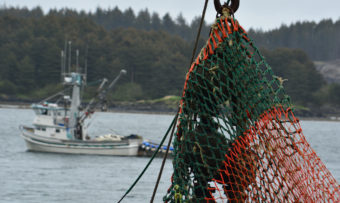
Salmon opener in Kodiak commercial fishing gear
The seiner Jaime Marie sails past other fishing vessels at City Pier 2 in Kodiak on June 6, 2013. (Creative Commons photo by James Brooks)

The Commercial Fisheries Entry Commission will keep most of its functions for now, after commission supporters fought to protect it from losing certain functions to the Alaska Department of Fish and Game.

Gov. Bill Walker put a hold on an administrative order he issued in February, saying he needed more stakeholder feedback.

The commission controls the number of licenses in commercial fisheries to ensure their economic health and stability. An audit last year found the state could save up to $1.2 million dollars by consolidating the commission’s administrative functions in Fish and Game.

Walker said he unfortunately bypassed public engagement in an effort to find cost savings through Administrative Order 279.

Kodiak salmon fisherman Bruce Schactler said he’s pleased Walker issued a moratorium on the order.

“Well, I think it’s a great thing,” Schactler said. “It’s a very governor-like thing to do – to want to involve everybody and to acknowledge that, you know, maybe something got missed.”

An earlier Department of Fish and Game report found a backlog of applications to the commission for permits, with some cases taking more than 15 years to complete. The audit suggested that the state make the three full-time commissioners part-time positions, and hire a full-time executive director to manage daily operations.

Many commercial fishermen have praised the agency for the speed with which it handles annual permit renewals.

And Petersburg gillnetter Max Worhatch said the commissioners continue to do worthwhile work.

“I do feel strongly that CFEC is something that should be protected,” Worhatch said.

Fisherman Robert Thorstenson sued to block the administrative order. While a Superior Court judge ruled in favor of the state government in July, Walker decided he wanted more public input before moving forward.

Fish and Game Commissioner Sam Cotten said the state will engage stakeholders this fall on how to find cost savings at the CFEC.

“Some things are probably going to be pretty easy to agree on,” Cotten said. “For example, I think, even the commissioners last year agreed that they should – could go to part-time. And so that would be a big cost saving. And then the second issue is what kind of administrative functions could we combine with the department so that we could save money and avoid duplication.”

He said the state will begin the engagement process soon.

City investigates vessel found burning in Captains Bay

A vessel caught fire in Unalaska waters last weekend.

The incident is still under investigation, but City Manager Dave Martinson said efforts are already underway to address the damaged boat.

“On Saturday, the vessel Rebecca was found burning at the end of Captains Bay,” he said. “There was a potential hazard, so the Department of Public Safety has worked with Resolve Marine Group and the U.S. Coast Guard. We’re going to execute a $30,000 contract to remove it.”

After finding diesel sheen in water around the boat, the harbormaster deployed oil-absorbent boom to contain the hazard, with help from Resolve and the Coast Guard’s Marine Safety Detachment (MSD) Unit.

MSD officials said they’ve since received reports that Resolve has removed the residue, along with a leaking tank and battery.

While the city is fronting the money for cleanup, Martinson said they’ll eventually try to recover costs from the vessel’s owner.

“We believe it’s important enough not to fight through the process of trying to get him to do it,” he said. “Let’s get this done quick enough that it doesn’t result in something more catastrophic.”

Public Safety Director Mike Holman said the vessel is owned by a local resident. But with a criminal investigation ongoing, he said he can’t share any more information right now.

No one was aboard the vessel when it was found burning.

Retired ‘Prairie Home Companion’ host Garrison Keillor visits Alaska on summer cruise

Retired A Prairie Home Companion host Garrison Keillor, right, signs autographs for fans while visiting Kodiak on August 24, 2016. (Photo by Jay Barrett/KMXT-Kodiak)
Retired ‘A Prairie Home Companion’ host Garrison Keillor, right, signs autographs for fans while visiting Kodiak on August 24, 2016. (Photo by Jay Barrett/KMXT-Kodiak)

The cast and crew of the American Public Media program “A Prairie Home Companion” cruised to Alaska this summer.

The ship they were on, the Maasdam, visited Kodiak on Wednesday.

While downtown was filled with hundreds of “Prairie Home” fans, retired host Garrison Keillor apparently doesn’t often come ashore, preferring to prepare for that night’s show aboard ship.

However, some locals who are ex-pat Minnesotans, eventually lured the lanky radio star from the fictional town of Lake Woebegone, Minnesota, off the ship to chat with locals.

Keillor has been to Alaska a few times.

“The interesting thing about Alaska is not the scenery,” he said. “You can find scenery a lot of different places in the world. The interesting thing to me is the people who are here. And that’s what’s worth coming to see, if you can possibly meet them.”

“But you know, the mountains, meh. I associate mountains with motivational posters, you know, that say things like ‘Dare to Dream;’ ‘All Great Achievements Start with a Single Footstep;’ and I’m old enough to know that’s not true.”

Keillor might have felt otherwise if Kodiak’s mountains weren’t obscured by a low ceiling of clouds during his visit.

Nevertheless, he had quite a bit to say about mountains, almost as if he were formulating his monologue on the spot, which meant a little election-year politics.

“You know, I look at mountains and I think of Henry Thoreau, and I don’t care for Thoreau. He was a great individualist, but he said, ‘Live the life you have dreamed of and you may be successful beyond your wildest hopes.’ And when I think of that, I think of Donald Trump,” Keillor said to the laughter of the crowd.

“So, the mountains, you can have. I’m a flatlander, and I like flat land. Which is majestic in its own way.”

Keillor spent about an hour talking with Kodiak residents who happened by City Dock, posing for pictures, answering and asking questions, and signing autographs.

While Keillor stayed close to the cruise ship, the Maasdam’s passengers came ashore en masse. Many got a quick orientation at the visitor center by Discover Kodiak volunteer of the year Jan Chatto.

“This is Kodiak Island. We are the second largest island in the united states. You can see from the map that Chastity is showing you, Chastity is our director, by the way. We have 112 miles of road on this island. That’s it. The rest is wilderness,” Chattow said. “We just celebrated the 75th anniversary of the refuge. FDR founded the refuge. It’s the jewel of the refuge system, we think. It was founded to protect the brown bears.”

Marilyn and Lewis Tognacci from Arizona have cruised with Keillor before, but this is the first time they’ve been to Alaska.

“It’s so much fun. It’s unreal,” Marilyn Tognacci said. “The man is a genius. He never stops.”

She said there is plenty of opportunity to mingle with Keillor and the “Prairie Home Companion” cast and crew on-board, and there is a wide variety of passenger activities.

“So much is offered, from knitting groups, dancing, history. And the music is so incredible. Opera, jazz, the singing, the picking. It’s just wonderful,” she said. “I can’t rave enough.”

The Maasdam and the “Prairie Home Companion” cruisers will return to Seattle this week via Glacier Bay, Sitka and Victoria, B.C.

Municipal sales tax could dive due to Walker’s PFD veto

Bob Bartholomew, July 30, 2015. (Photo by Jeremy Hsieh/KTOO)
Juneau finance director Bob Bartholomew projected the city would lose $1 million in sales tax revenue from residents having lower Permanent Fund dividends. (Photo by Jeremy Hsieh/KTOO)

Local governments in Alaska that charge a sales tax could have millions of dollars less in revenue this year.

That’s because their residents will have less money to spend than the last few years because of lower Permanent Fund dividends this fall.

Some municipalities, like the City and Borough of Juneau, are preparing for the indirect hit.

Juneau finance director Bob Bartholomew projected Gov. Bill Walker’s dividend reduction of about half will cost the city.

“We had estimated that the reduction of the dividend from $2,000 per person to $1,000 per person would cost us … at the high end about a million dollars of lost sales tax revenue,” Bartholomew said.

That’s out of $44 million of total sales tax revenue that the city projected.

Juneau is one of 107 municipalities in the state that collects sales taxes. These communities raised a total of $233 million in sales tax revenue two years ago. So, if Bartholomew’s projections are applied to the entire state,  then there would be $4 million to $5 million less coming in.

Bartholomew said it’s challenging to estimate how much less money residents will spend. In part, that’s because having less money to spend could lead residents’ behavior to change.

“It could have a ripple effect of just overall reduction in spending that exceeds the pure loss of dollars, just because of the overall just psychological impact on spending,” he said.

Walker has said the dividend reduction was necessary in order to shore up the state’s finances in the long run. Without the cut, Walker said PFDs could disappear entirely in two years, as the state exhausts Permanent Fund earnings.

Each municipality is handling the sales tax effect in its own way.

Kenai Peninsula Borough Mayor Mike Navarre said the borough has never analyzed how residents spend their dividends.

The borough based its projection for sales tax revenue on last year’s spending, and hasn’t made adjustments based on the veto.

“Sometimes it’s difficult to predict exactly what the impacts are going to be,” Navarre said. “In this case … we have proximity to Anchorage, so some people will buy bigger items in Anchorage because they don’t have sales  tax, or because they’re going up there to shop anyway.”

Navarre has a separate concern about how the PFD cut will affect tax revenue.

The borough set its property tax due date to occur after residents receive dividend checks.

Navarre said borough officials will be keeping a close eye on whether residents will struggle to pay their taxes on time if they have less money because of lower dividends.

Other municipalities are taking a wait-and-see approach to falling sales tax revenue.

In Unalaska, city manager Dave Martinson said he has looked at the issue, but decided against lowering the city’s revenue estimates.

“We’re going to take an approach that says we will watch it as we go through the year, to determine whether or not there is something we would need to take to our council,” Martinson said.

Municipal governments were affected by other changes Walker made in his late-June vetoes.

He also cut state payments for schools’ debt, transportation and other funding.

Kodiak schools superintendent named best in the state

The superintendents of Alaska’s many school districts agree: Kodiak’s superintendent is the best in the state.

Kodiak Island Borough Schools Superintendent Stewart McDonald was honored as the state’s Superintendent of the Year Monday night at the school board meeting by Lisa Parady, the executive director of the Alaska Superintendents Association.

Stewart McDonald
Stewart McDonald

“A consistent and positive voice for the needs of education in Alaska,” Parady said. “A person of utmost integrity, fairness, commitment and energy, Stewart McDonald, through his superintendency has been an energetic, professional and fully involved member of ASA, the Alaska Superintendents Association.”

“Stewart McDonald is a respected, reasoned and strong voice within the organization and in the state of Alaska,” she said. “He symbolizes all that is good and true about educators. Most importantly he is recognized for his service to his district, schools and community.”

“He is a leader of leaders.”

School board members praised McDonald for the work that led to the honor.

“A big part of it is your start in special ed and your focus on the individual student, and making that the basis of the district. I think that’s a key of that,”Rick Kniaziowski said. “And your integrity. The fact that you tell me something and I know that’s what it is. And that means a lot within a governance body.”

Katie Oliver told McDonald she knew Kodiak had someone special whenever meeting school superintendents from elsewhere.

“Whenever I travel with you for education advocacy, one of the things I enjoy most is seeing the high regard you’re held in by other superintendents around the state,” Oliver said. “And I’m happy for you getting this recognition. It’s coming at a good time, and congratulations.”

Even a former school board member added her compliments.

“When I heard that he was going to be receiving the superintendent of the year award, I decided I wanted to publicly congratulate him and add that this is an award for the entire community,” said Deborah Kirk. “It indicates that we live in a place that is led by those who who are motivated to put our children first. Something, that despite these challenging times we live in, hopefully will continue long into the future of Kodiak Island.”

Kirk added a personal note from when her children were in Kodiak schools, saying, “What I was most impressed with was the standards promulgated by Mr. McDonald’s administration, from the top down, that encourage responsible behaviors during the school day and beyond the school day.”

The award as Alaska’s top school executive comes at the beginning of McDonald’s last term with Kodiak schools.

He announced his resignation earlier this year.

McDonald and all the other State Superintendents of the Year will be honored in March at the 2017 National Conference on Education in New Orleans.

Alaska group works to let locals test shellfish for toxins

KODIAK — An Alaska group is working to create an at-home tester for detective toxins in local seafood.

The Kodaik Daily Mirror reports that Alaska SeaGrant officials are working on a tester for paralytic shellfish poisoning, an illness that can cause tingling in the lips, tongue, fingers and toes and eventual breathing problems. Officials say testing currently costs $125 per test and has a time delay, as samples need to be sent in to the state.

Researchers have developed an electrochemical tester for PSP inspired by the blood sugar tests diabetics use. Pat Tester with Ocean Tester says the machine currently takes 20 minutes, but that time will hopefully drop to five minutes or less over the next few years.

Site notifications
Update notification options
Subscribe to notifications