In Unalaska, police say the man whose body was found in a creek Monday probably fell to his death.
Gregg Kortesma, 45, was pronounced dead at the scene after a pair of local hikers discovered his body in Ruth Rock Creek at end of Captains Bay, said Michael Holman, Unalaska’s director of Public Safety.
“The body was located at the bottom of a steep cliff and there’s substantial blunt force trauma to the head — all of which consistent with a fall down that cliff into the rocky creek bottom,” he said.
Police still are investigating what caused the fall, but Holman said they do not suspect foul play right now. Kortsema suffered “significant head injuries,” police said.
Kortesma’s body has been sent to the State Medical Examiner Office in Anchorage for an autopsy.
In the meantime, police are trying to piece together his activities during the week before his death.
Police know Kortesma applied for a job at City Hall on September 4th and recently worked on the fishing vessel Alaska Trojan, Holman said.
Kortesma was originally from Wisconsin, but he lived sporadically in Unalaska and Southeast Alaska over the last two decades. Local law enforcement became familiar with Kortesma during his time on the island.
“I think our first contact was probably almost 20 years ago,” Holman said. “He may not have been really well-known throughout town, but we knew who he was.”
Court records show Kortesma had faced a handful of felony and misdemeanor charges in Alaska.
He was arrested on a felony assault charge in 2014 after allegedly pointing a gun at a woman in a Juneau mall.
The charged was dismissed after he was found incompetent to stand trial.
Anyone with information on Kortesma’s whereabouts from Sept. 4 to Sept. 12 is asked to contact the Unalaska Department of Public Safety.
Police are investigating a death after a dead body was discovered Monday in Unalaska’s Ruth Rock Creek at the end of Captains Bay.
The Department of Public Safety has identified the man as Gregg T. Kortesma, 46, who was found with “significant head injuries” by a pair of local hikers.
Kortesma worked sporadically in Unalaska over the last 20 years, most recently on the fishing vessel Alaska Trojan, police said.
They know Kortesma visited the Norwegian Rat Saloon on Sept. 2, but they’re still looking for information about his activities between then and when his body was found.
Anyone with information should contact the Unalaska Department of Public Safety at 581-1233.
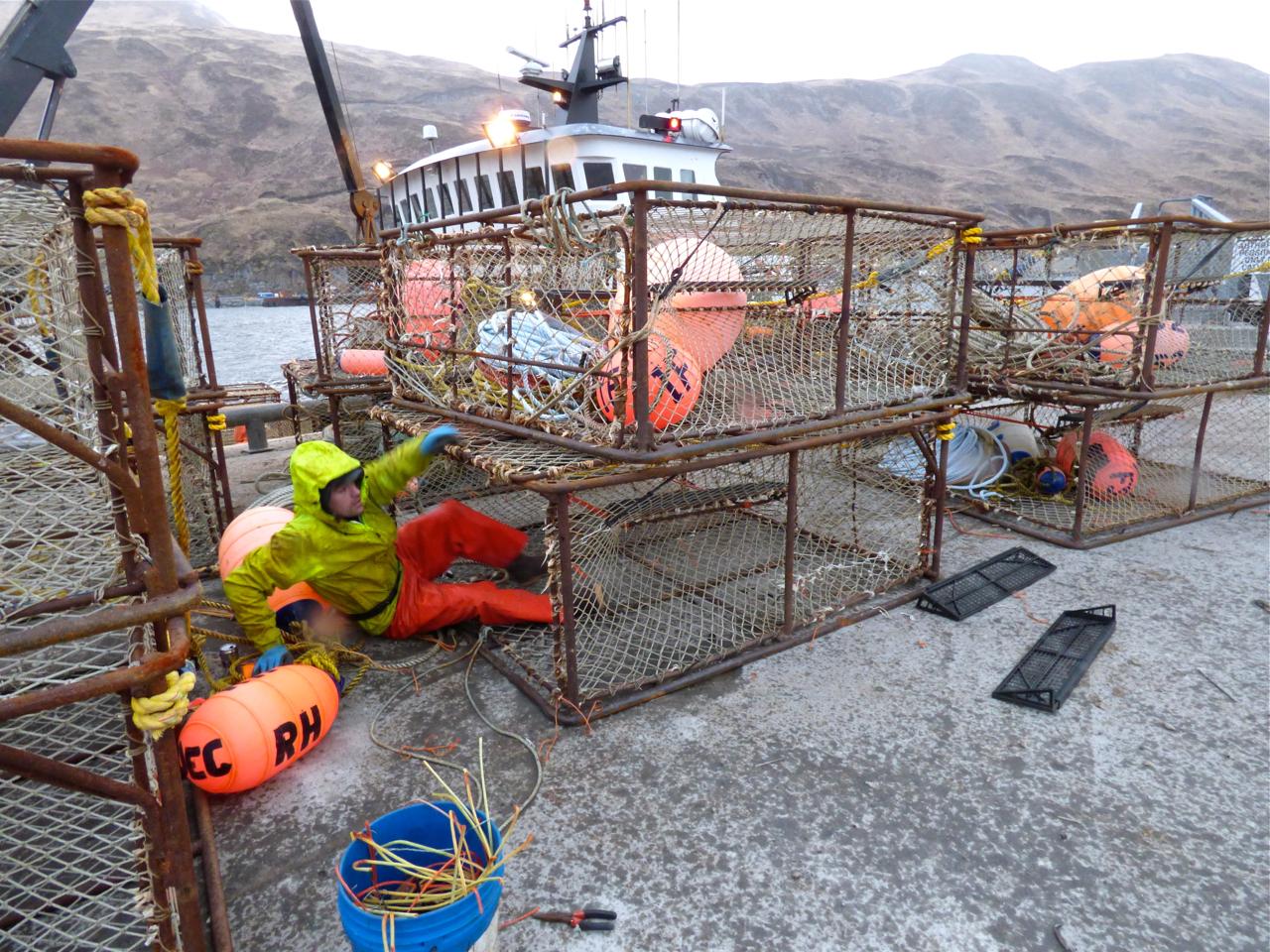
An Unalaska fisherman prepares for tanner crab season. (Photo by KUCB)
This season, the unpredictable tanner crab population isn’t looking so good for Aleutian fishermen.
That’s what the state’s trawl survey indicated this summer.
But the City of Unalaska has joined an emergency petition urging the Alaska Board of Fisheries to take another look.
At a City Council meeting last week, Frank Kelty explained the survey showed low numbers for female tanners.
That’s led the Alaska Department of Fish and Game to consider serious conservation measures.
“The whole fishery could be shut down,” Kelty said.
But the problem isn’t affecting the whole fishery. Kelty said data indicates the eastern tanner stock is struggling with low female biomass, but not the western stock.
That’s why the Alaska Bering Sea Crabbers association is sponsoring an emergency petition — to stop the entire fishery from closing when only half is at risk.
The Unalaska City Council voted unanimously to join the petition. Kelty said tanner season is critical for the community, which earns revenue from the fishery in taxes and fuel sales.
“We already have a snow crab fishery that’s possibly in jeopardy, and if we lose the bairdi fishery too … things are looking very bleak,” he said.
The City of St. Paul has also signed the petition, which was submitted to the Board of Fisheries last week. Now, crabbers will have to wait and see if the state takes public comment on how to manage the tanner fishery this season.
The Museum of the Aleutians has officially reopened after a scandal closed the space for nearly a year.
Last week, new Executive Director Neal Hitch announced the museum has set regular hours for the first time since last fall, when the former director resigned after items from the collection were found in her home.
In his first month on the job, Hitch has reopened the museum gradually — allowing visitors during cruise ship and ferry stops, even though the building’s technically been closed.
So far, he said the museum has had more than 1,500 visitors.
“In the first six weeks of this fiscal year, we’re going to eclipse our visitation numbers for the entire last year,” he said.
The museum has hired two part-time employees to staff the front desk, and Hitch said he’s looking for a full-time collections manager. He’s also applying for grants to fund future exhibits.
The Museum of the Aleutians is now open Tuesday through Friday from 11 a.m. to 3 p.m. and on Saturday from 10 a.m. to 4 p.m.
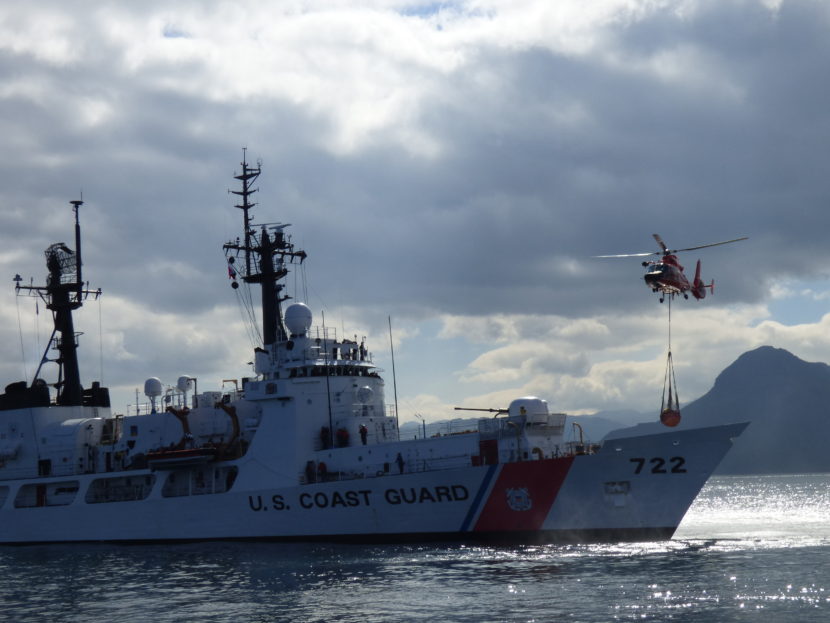
A helicopter practices dropping an Emergency Towing System on the Coast Guard cutter Morgenthau. (Zoe Sobel/KUCB)
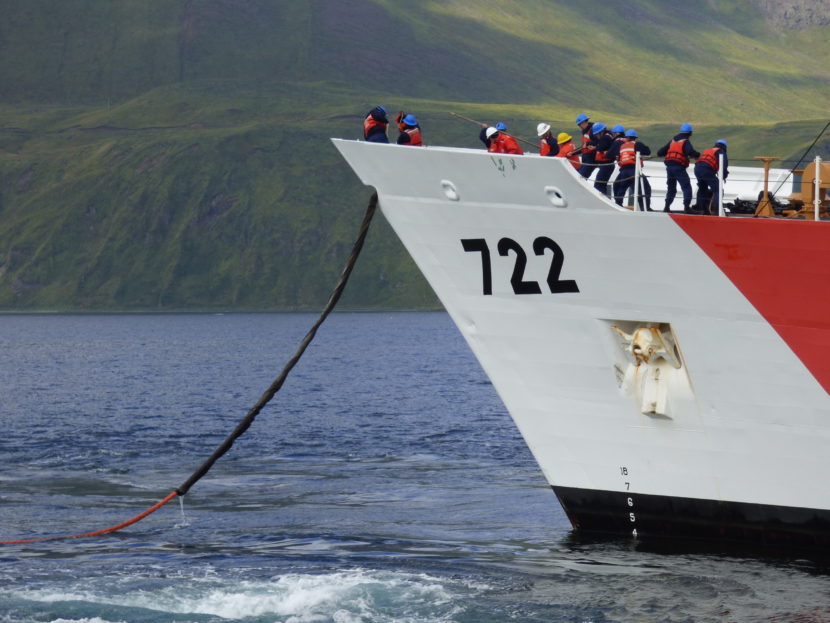
On one of the nicest days of the summer, the Coast Guard cutter Morgenthau needs help. The boat is playing the role of distressed vessel. A local tug slowly approaches its bow while crew members ready the Emergency Tow System. Horns blare and bang. One end of the rope is on the tug and the other on the Morgenthau. On both sides, people scramble to secure the lines for towing.
Coast Guard Lt. Andres Ayure is coordinating the drill. He says the practice helps ensure everything is in working order.
“If you don’t exercise it yearly, then with some time, some of these components could start decaying or start to break down,” Ayure said. “We wouldn’t find out until we have an actual emergency, which is not when we want to find out.”
The city purchased its first Emergency Towing System after the 2004 grounding of the Selendang Ayu. When that ship split in half in rough seas off Unalaska’s coast, six people died and thousands of gallons of oil spilled in sensitive coastal habitat
If you ask conservation biologist Rick Steiner, it’s only a matter of time before the next disaster.
“After that you’ll see all these politicians and people running around in their orange suits, clipboards and hardhats saying we need to do something better,” Steiner said. “All of that will be useless at that point.”
As a member of the Shipping Safety Partnership, Steiner has helped institute some improvements in boating safety since the Selendang Ayu’s grounding. The Marine Exchange of Alaska has added more than 100 monitors to track boats 24 hours a day. Last year, the International Maritime Organization approved shipping buffer zones in the Aleutians to keep vessels further from shore.
But Steiner says there’s still a lot to do. He wants better navigation aids, increased financial liability for shippers, and, most important, all-weather rescue tugs.
Members of the Coast Guard secure the Emergency Towing System. (Zoe Sobel/ KUCB)
“Let’s say you get this portable tow package on the bow of a disabled tanker out at Shemya,” he said. “What then? You don’t have an adequate rescue tug of open ocean, powerful thrust and capability to actually hook it and render ‘a save’ in most scenarios.”
Steiner says the smaller, less busy Prince William Sound has 11 tugs. He’d be happy with three for the Aleutians and he wants to use the $5 billion Oil Spill Liability Trust Fund to pay for them.
It’s impossible to eliminate all risk, but Steiner says preventative measures, like buying tugs, would be economical. Oil spills are expensive to clean up and not very effective.
Ed Page knows about the cost of oil spills firsthand. He spent 30 years in the Coast Guard, three of those cleaning up the Exxon Valdez spill.
“Three years, $2 billion, 10,000 people, picked up 10 percent,” Page said. “That’s not a very good return on investment. So you want to say it’s difficult, yeah, that’s almost an understatement. It’s almost an exercise in futility. You got to give it a shot. Picking up 10 percent is better than picking up nothing, but still, prevention is clearly the way to go. There’s no doubt.”
Cleaning up spills in the Aleutians or the Arctic would be even more costly.
Now Page heads up the Marine Exchange of Alaska which works to improve safety by monitoring the locations of vessels in Alaskan waters. He says the size of Alaska’s monitoring network is massive — 1.5 million square miles — larger than anywhere else in the world.
The statewide tracking system provides automatic alerts anytime a ship slows down or gets too close to shore.
But now Page says, larger vessels, some bigger than the Empire State Building, are traversing Alaskan waters. And he says, there are no boats powerful enough to save them.
“They’ve got 18,000 containers and they carry a tremendous amount of oil,” he said. “If you took the containers off the deck and lined them on the dock end-to-end, they would go 60 miles. If that vessel gets in trouble, there’s nobody who can give them a hand.”
The boats are too big to stop in Alaskan ports. Page says they’re only passing through, just like the Selendang Ayu.
The task of improving maritime safety is ongoing. Page says now they’re working on a new device — a parachute ship arrestor — that would work like a huge sea anchor to slow down and stabilize distressed vessels — providing more time for repairs or a rescue.
Walker said in a letter to House Speaker Mike Chenault that there’s no evidence that some areas are unheard, and that it’s important for board members to respect each area.
He also opposed a provision that required residents to live in an area for two years before joining the board, saying it isn’t consistent with Alaska’s embrace of personal freedom.
Bill sponsor Wasilla Republican Lynn Gattis said she doesn’t agree with Walker’s reasoning.
“Boy, that’s a lot of BS, and you could go ahead and put that on the radio,” Gattis said. “Because I think the bottom line is, the fact that we do have very different regions. That’s why we elect representatives from those different regions. They bring a different flavor to the table.”