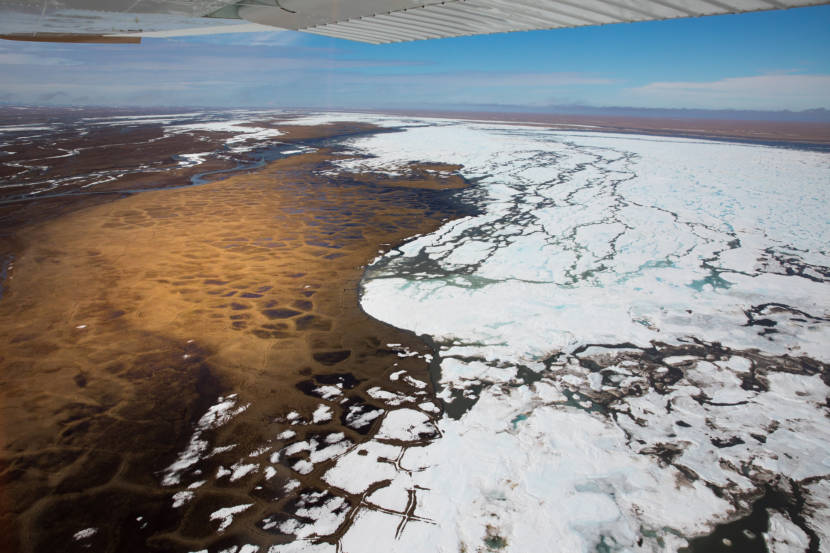
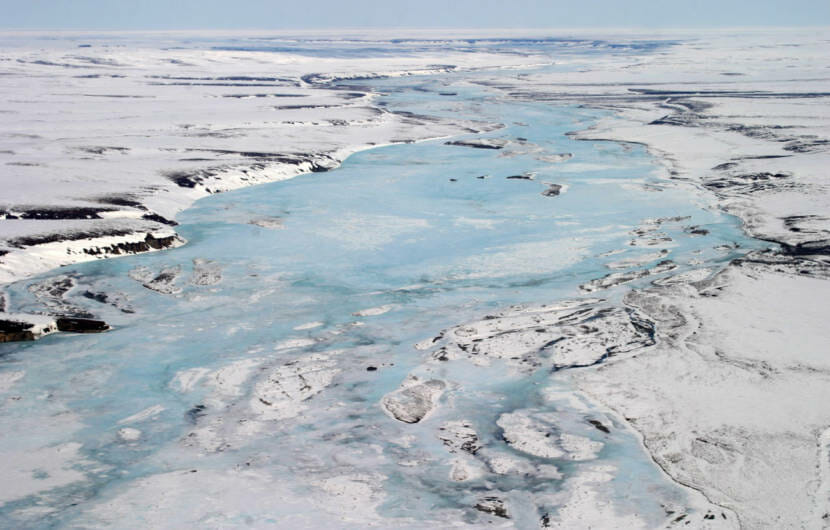
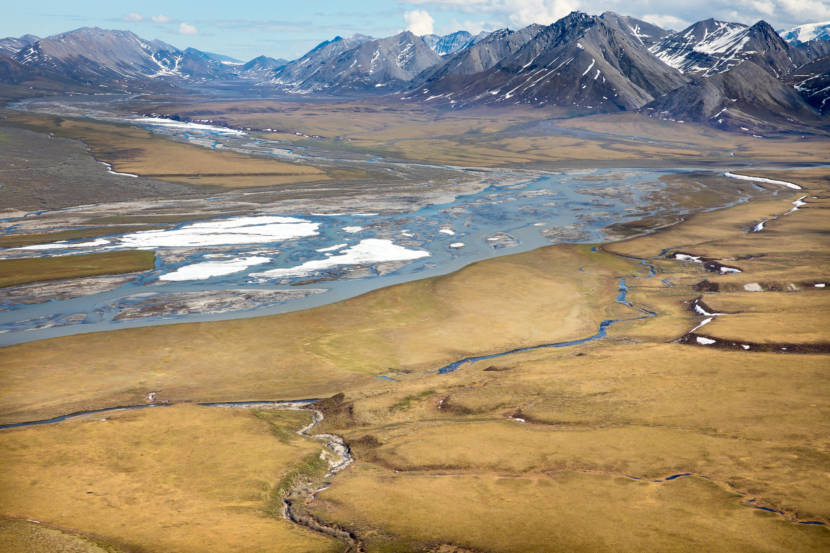
The Canning River and Arctic coastal plain. (Lisa Hupp/USFWS)
With the first-ever oil lease sale in the Arctic National Wildlife Refuge just two days away, a federal judge in Anchorage will consider a request Monday to stop the Trump administration from issuing the oil leases.
U.S. District Court Judge Sharon Gleason will hear oral arguments by videoconference at 1 p.m., in a case brought by the National Audubon Society and three other environmental groups.
The groups argued in a lawsuit filed in August that the federal government failed to follow numerous laws meant to protect wildlife, land, water and people when it crafted its oil-leasing program for the Arctic refuge in northeast Alaska.
The Trump administration is now set to open bids Wednesday in the first-ever lease sale in the refuge. It’s offering drilling rights to 22 tracts of land that cover about 1 million acres in the northernmost slice of the refuge, called the coastal plain.
But whether the oil leases actually go to the highest bidders could be up to Gleason.
The environmental groups are asking her to block the government from issuing the leases until the broader lawsuit is resolved. They’re asking for a decision by Wednesday, and Gleason has said she’ll try to enter a ruling by then.
There are two other similar requests also working their way through the court system.
The groups say the Trump administration is rushing to lock-in oil drilling in the refuge in the president’s final weeks, before the court can determine the legality of its plan.
“Its haste threatens permanent harm by locking in government decision-making and scarring the Refuge in ways that cannot be undone,” wrote lawyers for the National Audubon Society and other environmental groups in their request for a judge to intervene.
The federal Bureau of Land Management is the agency handling the lease sale. It has defended its process, saying it’s following the 2017 tax law, which opened the refuge to drilling after decades of debate. The law says the government must hold the first lease sale in the refuge by the end of 2021.
Each side will have 20 minutes Monday to argue their points in federal court. People can listen to the hearing at 877-402-9757, with access code 1461160#.
The Canning River in the Arctic National Wildlife Refuge. (Randy Brown/USFWS)
Supporters of drilling in the northernmost slice of the Arctic National Wildlife Refuge often point to its oil potential as a reason to develop the remote stretch of land.
But what does the federal government actually know about how much oil sits under the refuge’s coastal plain, which will be put up for sale on Jan. 6?
While geologists say the rock formations, oil seeps and old seismic results seem promising, big questions remain about where the oil is trapped, and exactly how much of it there is.
“We don’t know very much about this area,” said David Houseknecht, senior research geologist for the U.S. Geological Survey and expert on the coastal plain.
“There are a lot of uncertainties that are difficult to quantify in the absence of better quality data,” he said.
What the government does know about the amount of oil in the coastal plain dates back decades.
In 1998, the USGS calculated there’s anywhere from 4 to 12 billion barrels of recoverable oil under the federal lands, which cover an area roughly the size of Delaware.
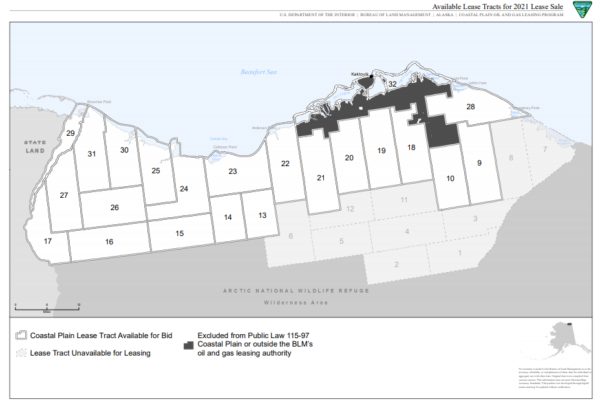
A map of the Arctic National Wildlife Refuge coastal plain shows the tracts of land that will be included in an oil and gas lease sale on Jan. 6. The Bureau of Land Management has removed the numbered tracts shaded gray. (Screenshot BLM document)
That’s a whole lot of oil, said Houseknecht, but also — a wide range.
“That range is so big because there’s been no wells drilled on federal land and because the seismic data is pretty old and low resolution and erratic,” he said.
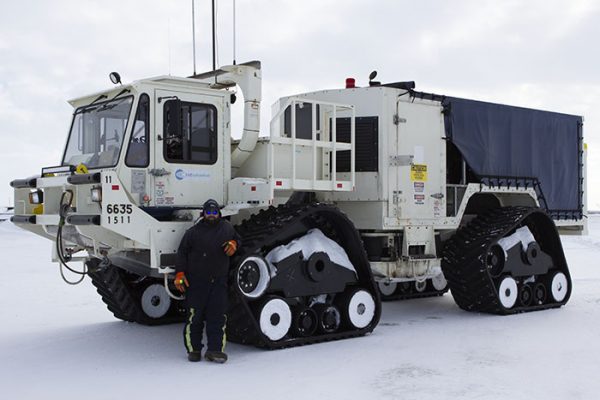
Companies use seismic technology to map underground rock formations, and hunt for oil. The seismic data for the coastal plain is from the mid-1980s.
Technology has come a long way since then, Houseknecht said.
“Going into a lease sale in the coastal plain, with the only data being 35-year-old, 2-D data is quite unusual,” he said.
A worker stands in front of a vibe truck being used as part of BP’s 3-D seismic program at Prudhoe Bay this winter, to the west of the Arctic National Wildlife Refuge’s coastal plain. (Elizabeth Harball/Alaska’s Energy Desk)
Another key piece missing from the USGS assessment is any data from actual wells drilled in the coastal plain in search of oil, Houseknecht said.
That’s because there’s just one, drilled back in the 1980s, on Alaska Native land. And the results are a closely-guarded secret.
“I signed a confidentiality agreement, and it didn’t have an end date on it,” said Mark Myers, a geologist and former commissioner of the Alaska Department of Natural Resources.
Myers is one of the few people who have seen the results from the test well, outside of the big oil companies that paid for it.
“I can’t comment on it, in terms of what I saw,” he said. “Even though it was a lot of years ago.”
But Houseknecht said companies with that well data still have critical knowledge.
USGS interpreted the old seismic data to show most of the oil is likely in the western part of the coastal plain and said the other side didn’t appear to have the right conditions to hold a lot of petroleum.
Houseknecht said those companies with the well results, however, would know a lot more about the rocks underground on the eastern side of the refuge, and their potential.
“Whether that source rock is present or absent, whether that reservoir rock is present or absent, is huge,” he said.
Houseknecht said more is not known about the oil potential of the coastal plain because it wasn’t until late 2017 that Congress decided to open the land to drilling, after decades of protections.
The USGS also had the 1980s seismic data commercially reprocessed a couple years ago, Houseknecht said, which resulted “in a much better resolution than we do internally.”
The agency had planned to conduct a new oil assessment using the reprocessed data, he said, but after the 2017 tax act was passed, the Interior Department called off the work.
Houseknecht said the department did not give a reason why.
Myers, the former commissioner, said even without updated seismic data, he thinks one big selling point for oil companies is the fact that the coastal plain is onshore, making it cheaper to access than offshore prospects.
And, he said, there just aren’t a lot of opportunities for companies to get in early on a potentially massive oil find.
“I would say ANWR falls in that high risk, high potential — not high risk of oil, but high risk of execution,” he said. “When you put it all together, will that attract somebody? I think it will.”
When Myers says high-risk of execution, he means there’s opposition that could derail a company’s project.
Critics of drilling in the refuge say the land should be protected, and they’ve raised concerns about oil development’s effects on ecosystems and the global climate. The coastal plain is home to polar bears, migrating caribou and other wildlife.
Conservation and some tribal groups have already filed several lawsuits that aim to stop the lease sale.
While oil potential will likely be the first thing companies weigh when deciding whether to bid in the sale, Myers said, they’ll also take into account a string of other factors, including the lawsuits, costs and the changing administration.
President-elect Joe Biden has said he opposes drilling in the Arctic refuge.
The coastal plain is the northernmost piece of the Arctic National Wildlife Refuge. It covers about 1.5 million acres, or about 8% of the vast refuge. (Lisa Hupp/USFWS)
Alaska’s state-owned development corporation may bid in the upcoming oil and gas lease sale in the coastal plain of the Arctic National Wildlife Refuge.
The Alaska Industrial Development and Export Authority is asking its board to allow it to spend up to $20 million on the sale.
AIDEA’s director, Alan Weitzner, said if the corporation acquired a lease — or multiple leases — it would then partner with companies that would do the drilling. The goal is to develop the land, he said.
“There’s an opportunity here to really establish some economic growth for the state of Alaska,” Weitzner said in a phone interview Tuesday.
AIDEA’s request comes as speculation looms over whether the oil industry has much interest in bidding in the Jan. 6 lease sale.
A map of the Arctic National Wildlife Refuge coastal plain shows the tracts that will be included in an oil and gas lease sale on Jan. 6. The Bureau of Land Management has removed the numbered tracts shaded gray. (Screenshot BLM document)
The sale is surrounded by controversy and lawsuits and will be held two weeks before President-elect Joe Biden takes office. Biden has said he opposes drilling in the refuge and will take steps to permanently protect the land.
Former Alaska Govs. Bill Walker and Frank Murkowski recently urged the state to submit at least the minimum bid on the oil leases so it can secure the drilling rights in case no one else puts in an offer.
Critics say the corporation did not give enough notice of its proposal to bid.
“AIDEA’s disregard for the public process is evident when providing public notice of meetings only three working days before meeting to discuss and vote on this important and far-reaching resolution,” Veri di Suvero, executive director of the Alaska Public Interest Research Group, wrote in comments to the board Tuesday.
The upcoming lease sale stems from a tax act passed by Congress in late 2017. The bill included a provision that opened the coastal plain to drilling after decades of protections.
Weitzner said if the board approves AIDEA’s proposal, he would then evaluate the remaining 1 million acres and decide on bidding.
He would have until just 4 p.m. on Dec. 31 to submit any offers to the Bureau of Land Management, which will open the sealed bids on Jan. 6.
Weitzner said he was not aware of the corporation submitting bids for federal oil and gas leases in the past.
The $20 million he’s proposing to use to pay for the leases in the refuge would come from the corporation’s Arctic Infrastructure Development Fund, created by the state Legislature.
The Canning River in the Arctic National Wildlife Refuge. (Lisa Hupp/USFWS)
The Bureau of Land Management has eliminated close to 475,000 acres of federal land from its upcoming oil and gas lease sale in the coastal plain of the Arctic National Wildlife Refuge.
The agency started accepting bids for the remaining roughly 1.1 million acres on Monday and plans to hold the first-ever lease sale for the coastal plain on Jan. 6.
The 10 tracts removed from the sale are in the southeastern corner of the coastal plain.
BLM says it decided to cut that land from the sale based on comments it got during a 30-day call for nominations period that ended last Thursday, including concerns about caribou, polar bear and bird habitat.
According to the U.S. Geological Survey, the removed land does not have a high potential for oil.
“Most of the tracts removed from the sale are gas prone and have negligible oil potential,” David Houseknecht, USGS senior research geologist, said in an email.
Those opposed to the lease sale have launched criticism at the government’s timeline.
Looks like BLM Alaska read the tens of thousands of comments submitted by yesterday’s due date overnight to come up with this decision which they then issued late on a Friday. So much for responsive and transparent government. #akleg#ProtectTheArctichttps://t.co/PcyAz5z1da
More than a dozen groups, including the Gwich’in Steering Committee, are trying to block the sale and the government’s approval of any seismic work in the coastal plain. They’ve filed motions for a preliminary injunction, and a federal judge says she’ll make a ruling on the requests by Jan. 6.
The groups argue that the government’s plan to open the coastal plain to drilling is rushed and flawed. They say development in the area will cause irreparable harm to wildlife, the tundra and the climate.
But those who support the sale argue it’s good for the economy, jobs and will create more revenue for the state and federal government.
BLM says it’s accepting sealed bids for the oil and gas leases until Dec. 31. The government plans to open those bids on Jan. 6 and will stream the event online.
President-elect Joe Biden will take office two weeks later, and says he opposes drilling in the refuge.
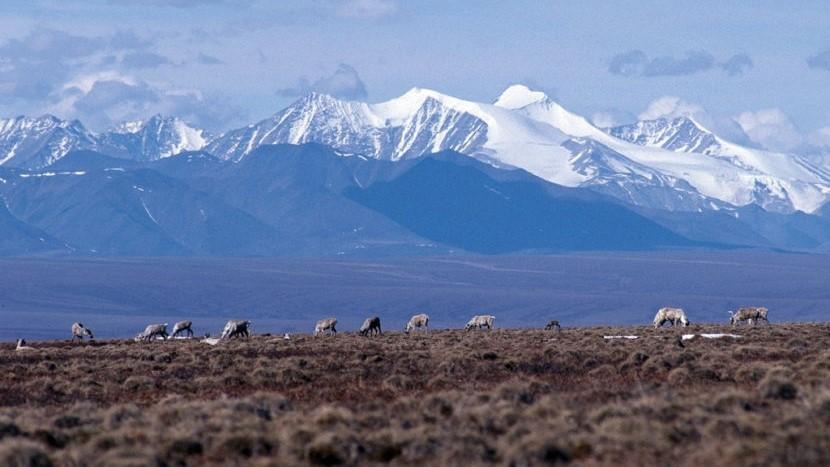
Caribou graze on the coastal plain of the Arctic National Wildlife Refuge, with the Brooks Range as a backdrop in October 2010. (Public domain photo by U.S. Fish and Wildlife Service)
Gov. Mike Dunleavy wants the state government to sever its ties with financial institutions that won’t finance oil and gas development in the Arctic.
Dunleavy announced in a news release Monday that his administration will introduce a bill during the upcoming legislative session that would require state departments and agencies to end any existing relationships with the businesses.
The proposed move by Dunleavy follows a string of announcements from major banks and lenders that say they won’t invest in oil and gas projects in the Arctic. Those companies include Wells Fargo, Bank of America, Goldman Sachs and JPMorgan Chase.
Environmental groups trying to block drilling in the Arctic National Wildlife Refuge have lobbied the banks to rule out investing in Arctic oil development.
Monday’s news release from the governor’s office said the proposed legislation would “protect Alaska’s economy.”
“It makes no sense for Alaska to allow financial institutions to benefit handsomely from Alaska’s financial activities on one hand, while working against our interests on the other,” Dunleavy said.
The exact impact Dunleavy’s proposal would have on state agencies wasn’t immediately clear.
Jeff Turner, the governor’s spokesman, said the scope of the change would be included in the draft legislation, and he said that document was not yet available Monday. He also said he did not have a list Monday of the financial institutions that the proposal would bar state agencies from using.
Alaska Wilderness League, a vocal opponent of drilling in the Arctic, swiftly criticized Dunleavy’s plans to introduce the bill, saying the governor is missing the broader point that “speculative, high cost projects in places like Alaska’s Arctic are no longer attractive to investors, especially with the realities of climate change and as more lucrative opportunities in renewable energy or unconventional oil plays down south exist.”
The federal government plans to hold its first-ever oil and gas lease sale in the Arctic refuge’s coastal plain on Jan. 6.
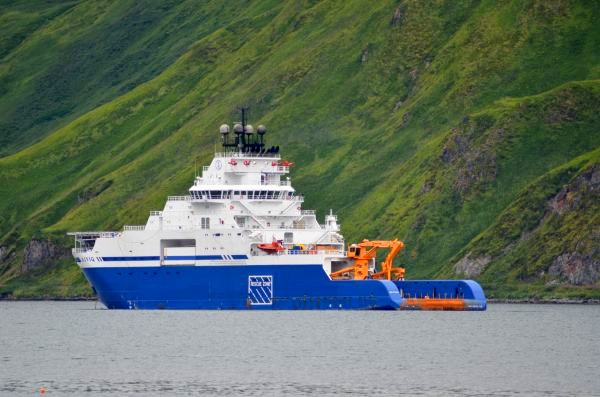
The Aiviq anchored in Unalaska in August 2016. (Sarah Hansen/KUCB)
The Trump White House is racing to lease an icebreaker, and one of the candidates is a ship with a notorious Alaska past owned by a Republican mega-donor.
Sen. Dan Sullivan said he spoke to the White House national security advisor and learned the administration is considering leasing a medium-weight icebreaker for the Coast Guard to use. It may happen soon, Sullivan said at a Senate hearing last week, “like hopefully as early as the end of this month.”
Sullivan likes the idea of leasing to fill the “icebreaker gap.” He said the U.S. needs a persistent presence in the Arctic to hold off adversaries.
The White House is considering ships in Finland, Sullivan said at the hearing, or “there’s another icebreaker that’s in Florida, I guess. Not really sure what it’s really doing in Florida.”
That could only describe one ship: The Aiviq, owned by Edison Chouest Offshore. It’s the only privately owned medium-weight icebreaker in the U.S., by the Coast Guard’s listing. Vessel-tracking websites show it’s docked in Tampa.
That name may sound familiar. In 2012, the Aiviq was the vessel towing an offshore drilling rig for Shell that went aground near Kodiak.
Louisiana-based shipbuilders Edison Chouest built the Aiviq specifically for Shell’s offshore Arctic drilling project. When Shell pulled the plug on the program, the $200-million Aiviq was suddenly unemployed. Chouest pitched it to the Obama administration and to the Canadian Coast Guard to no avail.
The company’s owner and president, Gary Chouest, is a prolific campaign contributor. He and his wife have given millions to candidates — mostly Republican — and to the Republican Party.
Alaska Congressman Don Young is among the beneficiaries of that largesse. Young has received about $300,000 from the Chouest family and company executives over the years.
At a 2016 hearing, Young aggressively pushed the Coast Guard to hire the Aiviq. The Coast Guard’s second-in-command at the time insisted it wouldn’t work.
“Sir, our current opinion is that ship is not suitable for military service without substantial refit,” Coast Guard Admiral Charles Michel told Young, twice.
Young called that answer “Bull—-.”
“Military service?” Young bellowed at the hearing. “I’m talking about moving ice!”
But that was in 2016. A lot can change in four years.
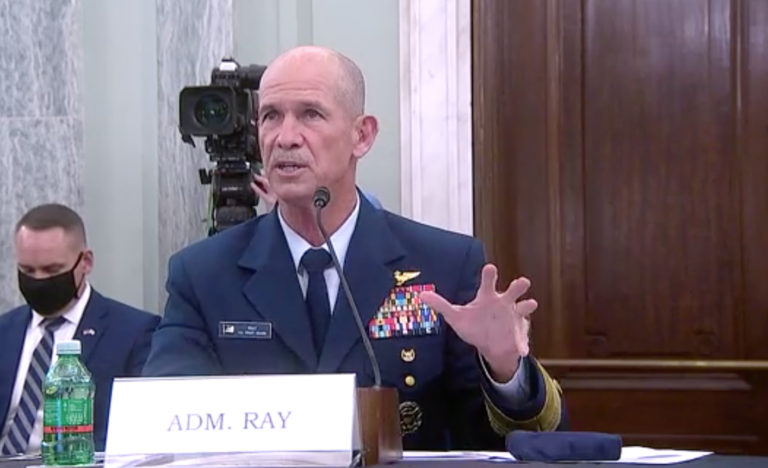
Michel’s successor, Coast Guard Admiral Charles Ray, told Sen. Sullivan at Tuesday’s hearing that the Coast Guard studied the concept, following a directive from President Trump. Ray agreed with Sullivan that a leased icebreaker might serve temporary duty.
Coast Guard Vice Commandant Charles Ray testifies at a U.S. Senate hearing Dec. 8, 2020. (Alaska Public Media)
“Any leasing arrangement would not be in lieu of building our own icebreakers. This would be in addition to,” the admiral said.
“I fully agree,” Sullivan said. “In addition to, as a bridge. Couldn’t agree more.”
Sullivan did not promote any particular ship at the hearing. Sullivan spokeswoman Amanda Coyne said he had “no idea” which ship in Florida the White House was considering when he mentioned it, nor who owned it.
The Chouest family and company executives have contributed to all members of Alaska’s congressional delegation. They gave Sullivan $30,000 in 2016.
At the hearing, Sullivan also made the case that icebreakers, leased or government-owned, should be homeported in Alaska.
Close
Update notification options
Subscribe to notifications
Subscribe
Get notifications about news related to the topics you care about. You can unsubscribe anytime.