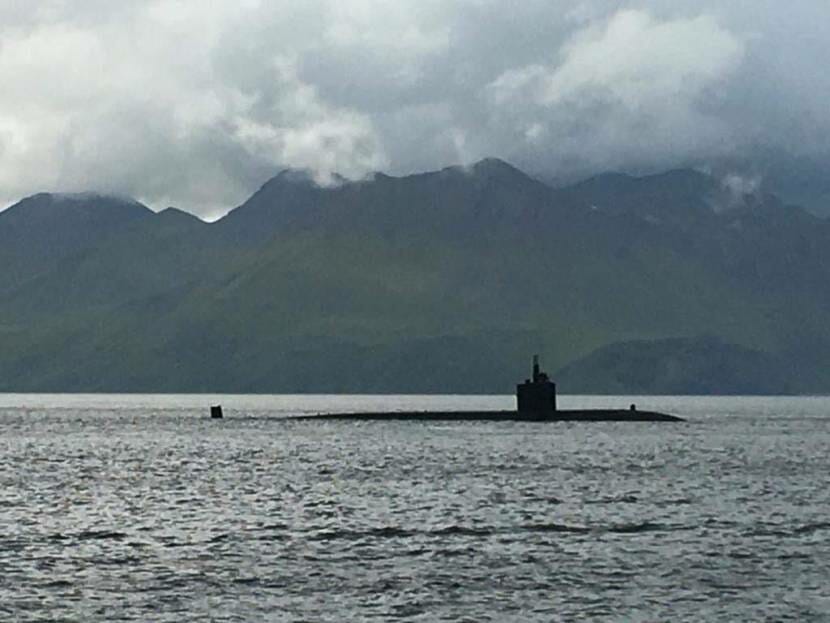
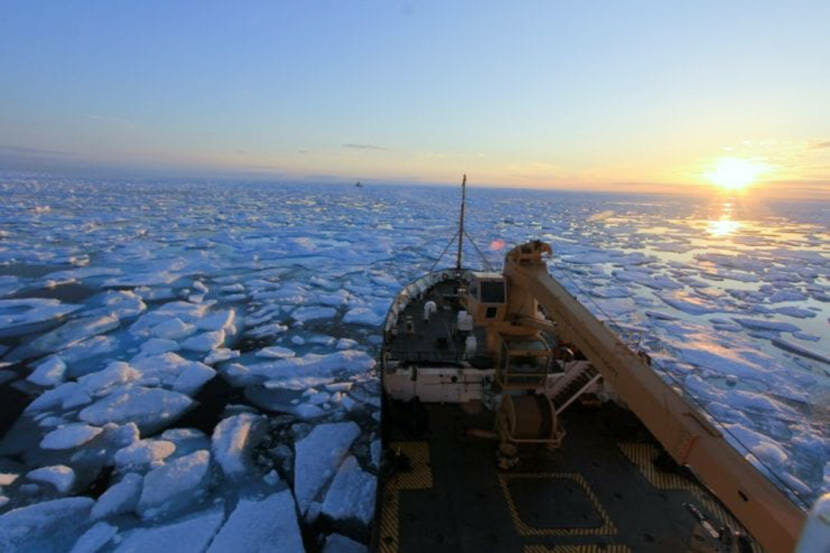
This photo from August 2020 appears to show a Russian submarine surfaced not far from Alaska’s St. Matthew Island, in the Bering Sea. (Photo courtesy of Mike Fitzgerald)
The second-in-command of the U.S. Coast Guard shouldered some of the blame on Tuesday for incidents in August in which the Russian military intimidated Bering Sea fishermen out of American waters.
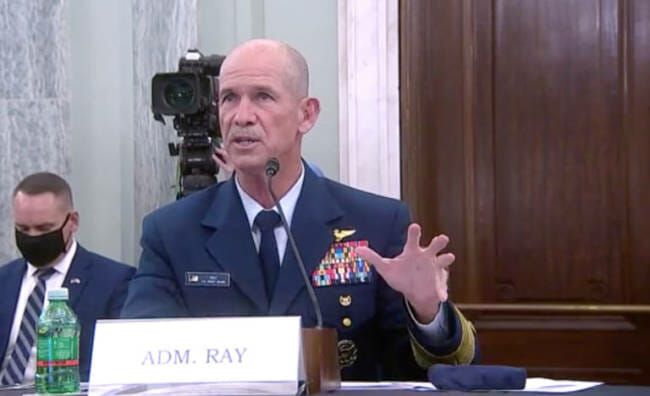
Admiral Charles Ray told a U.S. Senate panel the Coast Guard knew Russia was conducting a military exercise in the area and failed to tell the Bering Sea fishing industry.
“This was not our best day, with regards to doing our role to look after American fishermen — the U.S. Coast Guard,” Ray said. “I’ll just be quite frank: We own some of this.”
Coast Guard Vice Commandant Charles Ray testifies at a U.S. Senate hearing Dec. 8, 2020. (U.S. Senate)
At-sea Processors Association Director Stephanie Madsen said fishermen fear being caught in the crossfire as Russia and the U.S. vie for dominance in the Arctic.
Madsen described for the Senate Commerce Subcommittee on Security a harrowing scene on the fishing grounds.
“In the first such incident, the Northern Jaeger was harassed by members of the Russian military over the course of five hours,” she said. “A Russian warplane flew overhead for two hours, issuing warnings and threats via radio in broken English.”
A nearby Russian warship then issued a series of escalating threats until, Madsen said, the captain of the Northern Jaeger felt he had no choice but to comply and sail five hours south.
In the second instance, Russian planes repeatedly buzzed two American vessels and warned of live missile fire. Those ships, too, left the area. One captain had to cut loose his fishing gear to flee faster. Madsen said the financial loss to the companies that own the ships is in the millions.
Sen. Dan Sullivan said the Arctic is the next arena of great military power competition, and Russia has built up a lot more infrastructure on its side.
“Without further investment in our polar capabilities, our adversaries’ influence will grow,” warned Sullivan, who chaired the hearing. “And if that happens, we risk our ability to protect U.S. vessels conducting commerce, to enforce international law, and to defeat threats to our national security.”
Sullivan said Congress is already advancing Arctic projects to catch up. These include a deep-draft port at Nome, which Sullivan said should be the first in a series. Congress has also funded one new icebreaker, with plans for five more.
Admiral Ray said the Coast Guard now holds regular meetings with the Bering Sea fishing industry to avoid dropping the ball on communications again.
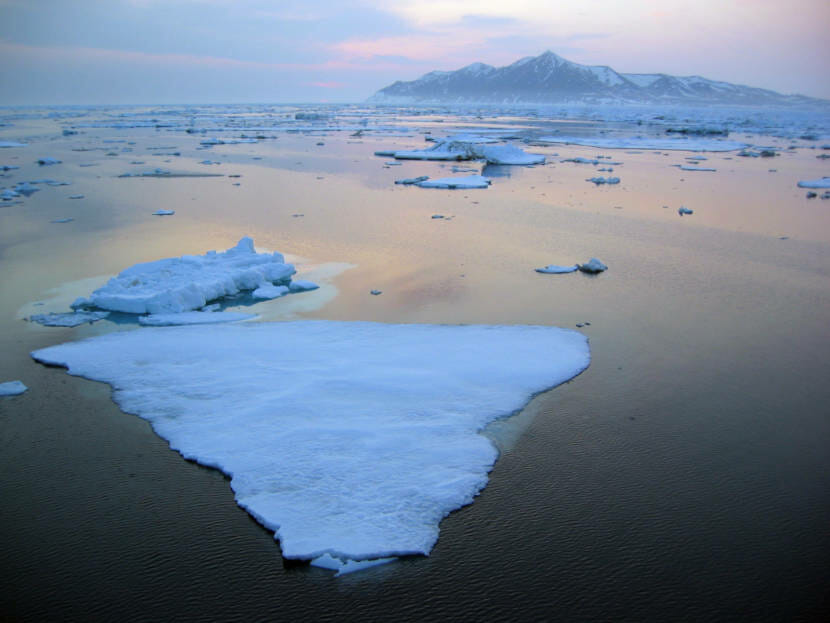
Sea ice floats in the Bering Strait off Cape Prince of Wales. (UAF photo by Gay Sheffield)
The 2020 Arctic Report Card is out, and the results show the Arctic continues to warm at an accelerated rate. This year was the second warmest on record in the Arctic, with impacts to sea ice, erosion and marine ecosystems.
In 2006, the National Oceanic and Atmospheric Administration released its first Arctic Report Card, laying out a timely snapshot of what the coldest parts of the world looked like as the climate warmed.
Rick Thoman is a climate specialist with the University of Alaska Fairbanks.
“Things were starting to change rapidly enough that folks were interested in this near-real time update of a variety of the different parts of the Arctic system,” Thoman said.
Fifteen years later, Thoman is the lead editor of the 2020 Arctic Report Card. He says even though Alaska didn’t have very extreme weather patterns, the Arctic as a whole was impacted.
“Some place in the Arctic every year has some extreme. It varies place to place,” Thoman said. “This year, Siberia, especially Western Siberia was the focus of the warmth, the very early snow melt, the wildfires, some of which were overwinter fires, zombie fires. Last year was Alaska. A couple years ago it was Greenland.”
Thoman says even though Alaska was impacted a little less this year by the warming climate, it still follows the recent trend.
“Whatever the trend is, there’s always going to be years above and years below that,” Thoman said. “We’re at the point now though, for instance with erosion, it wasn’t as much as last year, but it’s always going to be more than it was in the 1950s.”
One of the facets of the Arctic most impacted by a warming climate is sea ice. Thoman says this year followed a trend of shrinking sea ice in the Arctic.
“The lowest it got at any point was the second lowest [on record]. Only the 2012 minimum extent was lower,” Thoman said. “And in the winter, the maximum extent it got on any one day was the 12th lowest.”
Low sea ice extent impacts much of the arctic ecosystem, forcing marine mammals like walruses and seals to haul out on tiny patches of land rather than the thick rich sea ice they’d been accustomed to. Thoman says that bowhead whales in Alaska waters are in a slightly better position than other marine mammals, due to their ability to swim much farther to get to the zooplankton that they eat.
“If their food supply is very far north one year because that’s where the ice is, they have the ability to go and get that food, unlike other species which have a much shorter range,” Thoman said.
While that works well for the whales, Thoman says new feeding routes have the potential to upset subsistence whale harvests from Alaska’s northernmost Indigenous populations.
“From a whale perspective, if they have to go 600 miles of the Alaska coast to find food, for a bowhead that’s not a problem,” Thoman said. “At what point it becomes the whales are there but they’re not accessible for Alaskans, that’s a different question.”
Basically, Thoman says what was once abnormal or unusual in terms of Arctic climate is now normal. The Arctic is transforming, and populations will have to adapt.
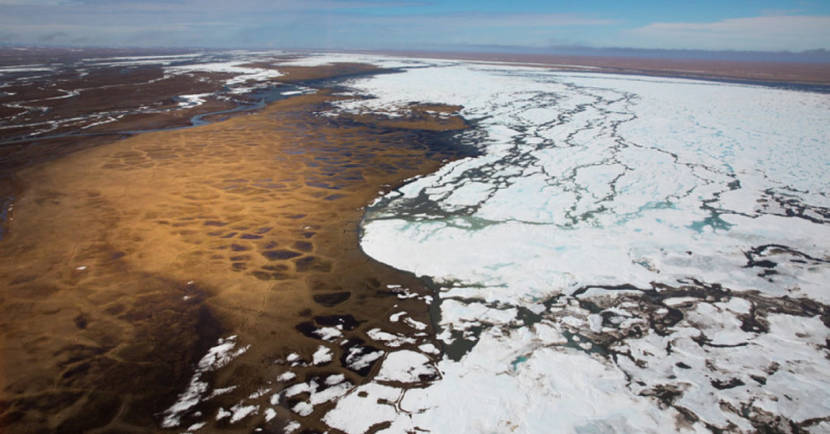
The Arctic Coastal Plain (Department of Interior Photo)
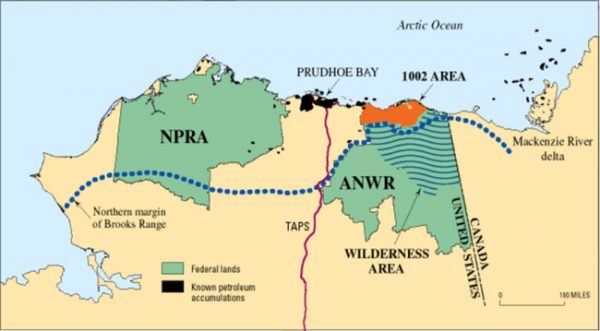
The Trump administration intends to auction off drilling rights in all federal lands of the Arctic National Wildlife Refuge’s coastal plain in its upcoming oil and gas lease sale. That’s according to the government’s 83-page document released Monday that details the terms of the first-ever lease sale in the northeast Alaska refuge, which is scheduled for Jan. 6.
The controversial sale will follow decades of fighting over whether to drill for oil and gas in the coastal plain.
Monday’s document says oil companies and other interested parties will be able to bid on tracts that cover the coastal plain’s nearly 1.6-million federal acres, an area about the size of Delaware that makes up about 8% of the refuge.
Supporters of the sale, including Alaska’s Congressional delegation, say it’s good for jobs and the economy. But those opposed, including conservation and some tribal groups, raise concerns about impacts to wildlife, the climate and Indigenous people. They also continue to blast the Trump administration for rushing to lock in oil drilling in the refuge before the swearing-in of President-elect Joe Biden, who opposes development there.
“What you see is agencies rushing, disregarding science, disregarding human rights in an effort to turn over the entire coastal plain of the Arctic refuge to oil and gas companies,” said Brook Brisson, senior staff attorney at Trustees for Alaska, an Anchorage-based environmental law firm that has filed one of the lawsuits that aims to block oil and gas development in the coastal plain.
Brisson and others opposed to drilling in the refuge point out that Monday’s sale announcement comes with 10 days still left in the “call for nominations” process. That’s a 30-day window when oil companies and other interested parties can tell the federal Bureau of Land Management which blocks of land within the coastal plain they’re most interested in bidding on — a step designed to guide the government’s decisions about which tracts to include in the auction.
The Arctic National Wildlife Refuge’s coastal plain is shown in orange. The area covers about 1.6 million area, roughly the size of Delaware, and makes up about 8% of the refuge. (USGS map)
Typically, that confidential comment period closes before the date of a sale is announced.
The BLM, which is conducting the lease sale, has defended its timeline, saying it has been working toward a sale since the tax law was passed in late 2017. It said it’s allowing for each step in the process to take place, and it says it will still consider the comments received after Monday.
“What’s important to note there is we reserve the right to amend that detailed statement of sale,” Kevin Pendergast, BLM’s deputy state director for resources in Alaska, said in an interview last week. “It may change, it may not.”
The agency will not accept bids until after the comment period closes, said Lesli Ellis-Wouters, a spokeswoman for BLM Alaska.
According to the statement of sale posted online Monday, the minimum bid will be $25 per acre. Companies can submit their sealed bids to BLM between Dec. 21 and Dec. 31. Those bids will be unsealed at the 10 a.m. auction on Jan. 6, which will be broadcast online.
It’s unclear which companies will show up to a drilling rights auction for the refuge. So far, oil companies aren’t talking publicly about it.
Conservation groups have vowed to keep up the pressure to try to deter companies from bidding. Already, multiple lawsuits have been filed challenging the government’s environmental reviews of drilling in the coastal plain, and an array of big banks have said they won’t finance oil development in the refuge.
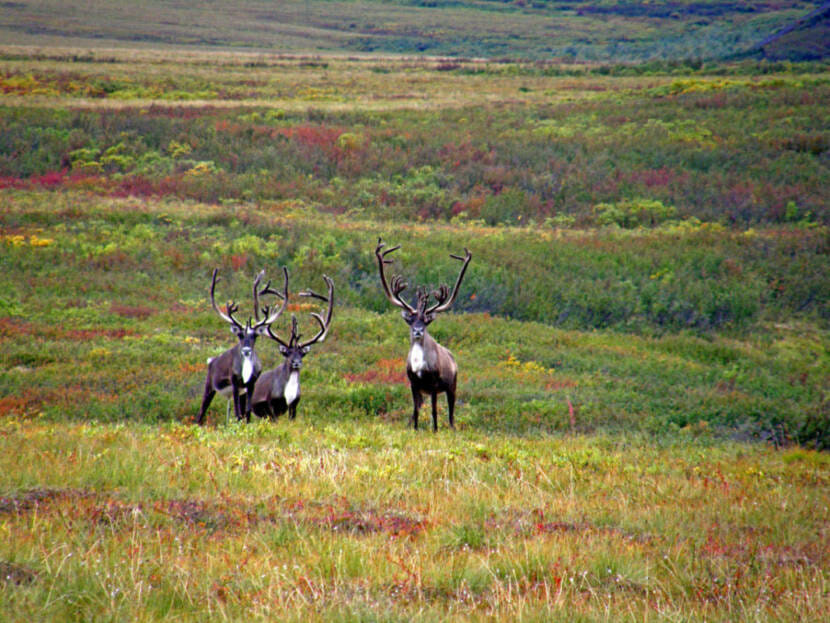
Caribou from the Porcupine Caribou Herd in 2007. The herd often calves on the Arctic Coastal Plain. (Andrew Ramey/USGS)
In a letter to Interior Secretary David Bernhardt on Monday, three Democrats in the U.S. House of Representatives pledged to work with Biden, to “undo any illegal steps the Trump administration is taking to rush these leases out the door.” They also said they’d fight to repeal the move to open the coastal plain to leasing that Congress included in a 2017 tax bill.
That massive bill — the Tax Cuts and Jobs Act — opened the area to drilling after decades of protections. It also required two lease sales within seven years, with the first to include at least 400,000 acres of the coastal plain and to be scheduled by the end of 2021.
Asked why the government decided to offer all roughly 1.5 million acres of federal land in the January sale, BLM Alaska spokeswoman Lesli Ellis-Wouters said, “Currently, there is no reason to exclude tracts from this lease sale.”
“The BLM has the right to withdraw tracts from leasing after nominations and comments are received and bids will not be accepted until after the nomination and comment period closes,” she wrote in an email.
Alaska’s Congressional delegation strongly supports opening the refuge to drilling, saying it will provide jobs and benefit the economy.
A line visible from seismic testing conducted in the mid-1980s pictured here in 2007 (Image from U.S. Fish and Wildlife Service)
The proposal would allow for the “harassment” of up to three polar bears that could occur during the seismic exploration program, including possible disruption to “migration, breathing, nursing, breeding, feeding, or sheltering.”
That move was swiftly criticized by environmental groups.
This is a developing story. Check back for updates.
Last year, the state of Alaska partnered with several North Slope entities to write the petition, arguing that keeping the ringed seal listed as endangered could negatively impact economic opportunities for the state, as well as subsistence rights.
“Although we provided substantial new information to the service, they argued that information was considered in other ways, even though that information wasn’t available previously,” said Chris Krenz, a wildlife science coordinator for the state. “We are disappointed that they took that tact with this petition.”
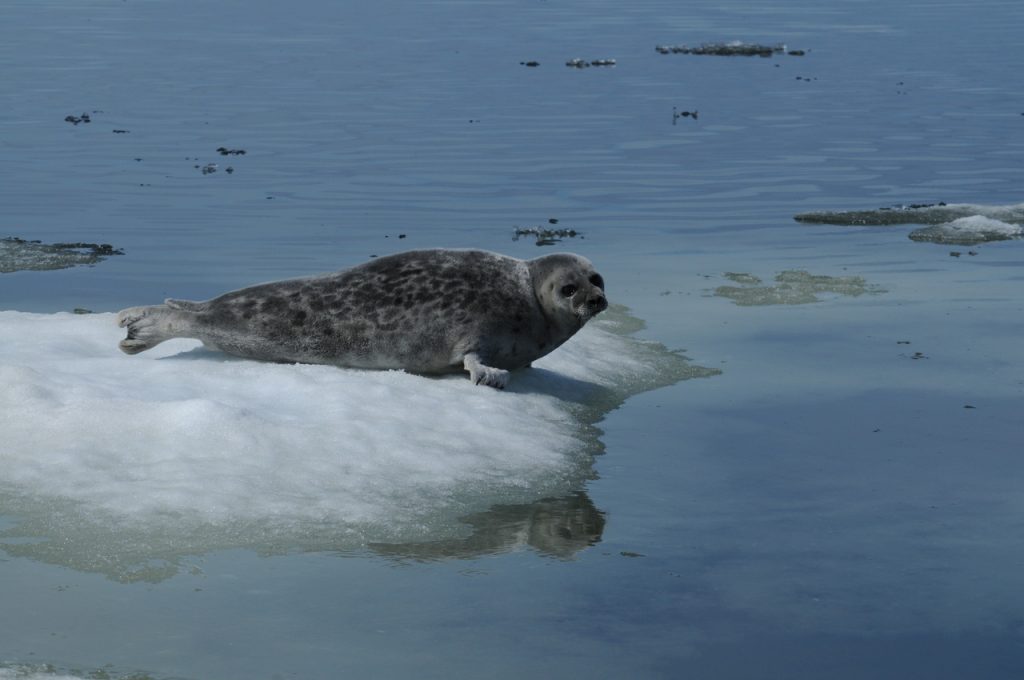
Krenz says the state believes that the ringed seal isn’t threatened. Officials noted the ringed seal population is in the millions, despite measurable losses in sea ice. Though climate scientists with the National Marine Fisheries Service predict that by the year 2100, there will be little to no sea ice in the Arctic, Krenz argues that looking that far ahead doesn’t constitute the foreseeable future.
“There is way too much uncertainty to really understand how ringed seals will adapt or not to changes in our environment,” Krenz said. “We’ve also documented additional information that indicates ringed seals may have higher resilience than initially anticipated.”
The Obama administration listed the Arctic ringed seal under the Endangered Species Act in 2012, citing the effects of climate change on the ringed seal’s sea ice habitat.
Kristen Monsell with the Center for Biological Diversity agrees with the federal ruling.
“The best available science shows that within the foreseeable future, so much of their habitat will be destroyed — it will just melt away from greenhouse gases — that the species will not be able to withstand that loss,” she said.
Monsell says the fact that the ruling came from the Trump administration underscores the need for federally protecting the Arctic ringed seal.
National Marine Fisheries Service will soon begin a five-year review of the Arctic ringed seal to determine whether or not the species should still be listed under the Endangered Species Act. Krenz with the state of Alaska says this will provide an opportunity for the state to continue to make their case for delisting.
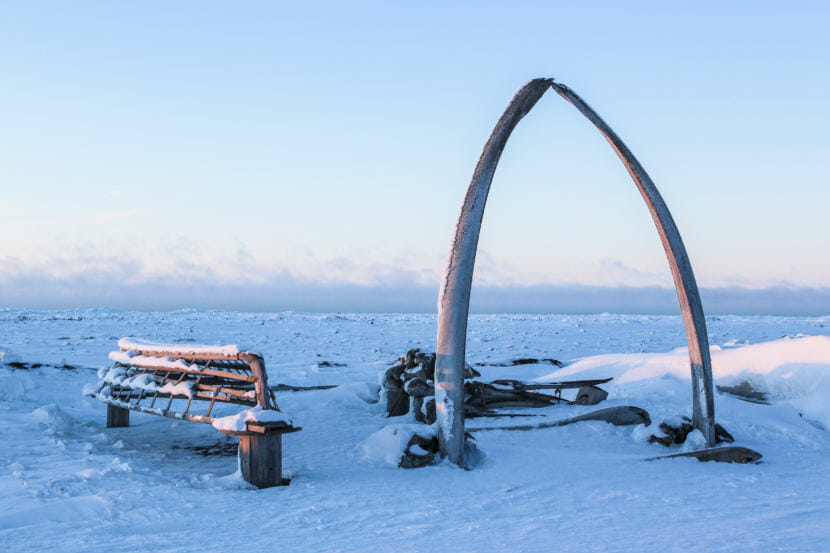
The bone arch in Utqiaġvik, made of bowhead whale jawbones. This year, Alaska whalers got a rule change they were hoping for in how their whaling quota is renewed. (Arctic Council Secretariat / Kseniia Iartceva)
The North Slope city of Utqiagvik passed several new COVID-19 restrictions at a Wednesday city council meeting that included a unique punishment for rule-breakers: producing public service announcements on the dangers of the coronavirus.
Mayor Fannie Suvlu said there are several reasons the city chose that punishment. The first is the recognition that some residents aren’t educated on the reasons for coronavirus precautions. The PSAs can take the form of voice recordings for radio, video clips, or flyers, which would help educate the rule-breaker and the public.
“If you do a flyer regarding it, that’s not only educating the person that violated it, but once we hang the flyer up … you’re spreading that within the community,” Suvlu said.
Another reason is the tradition of public-facing punishment in the majority-Inupiat community.
Suvlu says that traditionally, people who committed sexual offenses were marked so that they were identifiable. More recently, rule-breakers who are banned from public buildings are forced to face a public reckoning.
“Whether it’s a child or if it’s an adult, they come to the city council meeting and publicly apologize. So it was kind of along those lines that we were looking at,” she said.
Suvlu noted that if the rule-breakers choose to make flyers, they won’t necessarily have their name revealed. But for videos and voice recordings, she said the public disclosure could play a powerful social role.
For the second violation, rule-breakers have to perform community service. For subsequent violations, they could be subject to fines.
The new ordinance changes many of Utqiagvik’s existing recommendations about masking and quarantining into mandates. People who arrive in Utqiagvik are required to quarantine for 14 days, and masks are required in all public places.
Utqiagvik is experiencing a rapid uptick in cases in recent days. According to the Arctic Slope Regional Association, 12 cases were reported in Utqiagvik between Wednesday and Thursday at noon.
Warming rivers play an increasingly important role in melting sea ice and rising air temperatures in the Arctic, according to a new study published Nov. 6 in the journal Science Advances.
Using complex modeling techniques, a team of international researchers found that heat from rivers melted as much as 10% of Arctic sea ice between 1980 and 2015.
University of Alaska Fairbanks researcher Igor Polyakov is one of the study’s authors.
“Because of increase of surface area temperature over continents, the riverine water becomes warmer. This warmth is carried by river water into the Arctic,” he said.
The warmer river water then flows beneath sea ice, causing it to melt. That triggers a cycle where newly open ocean absorbs heat from the atmosphere, warming the ocean temperature even more and melting sea ice further.
“What we showed is that this positive feedback mechanism almost doubles the effect of original heat carried by rivers. So it’s multiplication of causes and effect in this system,” Polyakov said.
The Arctic is warming at almost twice the rate of the global average, and the impact of climate change there is well-documented. But the impact of river heat on sea ice loss and ocean and atmospheric temperatures is not. Polyakov said their research identified a previously overlooked piece.
“Our study is just one element of a big puzzle of Arctic or global climate change, but it’s an important element,” he said. “It creates a more complete, more interesting picture of multi-disciplinary changes in the Arctic in general.”
The effect is especially pronounced in places with larger rivers like Siberia and Canada’s Mackenzie River, but smaller rivers in Alaska play a role, too.
Close
Update notification options
Subscribe to notifications
Subscribe
Get notifications about news related to the topics you care about. You can unsubscribe anytime.