Arctic

A flurry of lawsuits aim to stop drilling plans in Alaska’s Arctic. So what’s next?

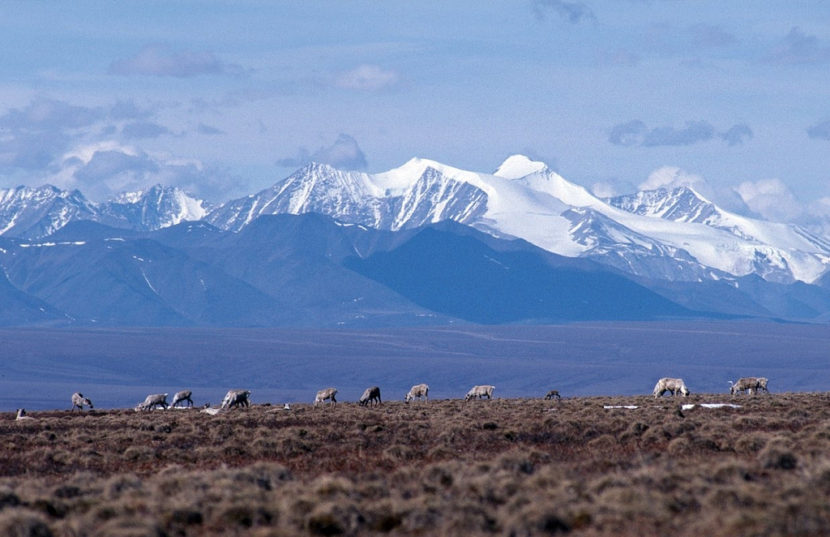
Caribou graze on the coastal plain of the Arctic National Wildlife Refuge, with the Brooks Range as a backdrop in October 2010.
Caribou graze on the coastal plain of the Arctic National Wildlife Refuge, with the Brooks Range as a backdrop. (Public domain photo by U.S. Fish and Wildlife Service)

Alaska Native groups, environmental groups and, most recently, a coalition of 15 states have filed a flurry of lawsuits over the past month that aim to derail drilling plans for Alaska’s Arctic National Wildlife Refuge and National Petroleum Reserve.

These are separate lawsuits over separate pieces of land — a lot of land — and it’s a lot to keep track of.

Listen to the interview or read the transcript of Alaska Public Media’s Tegan Hanlon and Casey Grove trying to sort through it all.

[GROVE]: Well, let’s just get right into it. Can you briefly summarize what triggered these lawsuits?

[HANLON]: Yes. So there have been two big, recent developments when it comes to oil and gas drilling on Alaska’s North Slope.

Number one: The Trump administration announced in August its official plan for opening up part of the Arctic Refuge to oil and gas development. It’s an area called the coastal plain, and it sits to the east of Prudhoe Bay. The coastal plain makes up about 8% of the whole refuge. But the whole refuge is massive, so 8% of it is about the size of the state of Delaware.

It’s a place believed to hold billions of barrels of untapped oil, but it’s also an area where caribou migrate, polar bears den and migratory birds feed. And environmental groups have long fought to keep drilling rigs out.

And so, this official plan for oil and gas development on the land comes out in August, and Interior Secretary David Bernhardt says that the federal government could auction off drilling rights in the coastal plain to oil and gas companies by the end of the year. (Once leases are issued, it will be harder for a future president to reverse course.)

All of it is a very big deal.

[GROVE]: OK. I got that part. So, what’s number two.

Significant development number two: On the other side of Prudhoe Bay, to the west, sits Alaska’s National Petroleum Reserve, also called the NPR-A. There’s already some oil and gas development going on in the NPR-A, but there’s also land that is off-limits to drilling under the current Obama-era plan for the reserve.

But the Trump administration is working on a new management plan for the reserve, and it released its final environmental impact statement for that plan in June. The proposal would make about 80% of the NPR-A open to drilling instead of the current 50% or so. And that includes opening up the Teshekpuk Lake area — in the reserve’s northeastern corner — to drilling.

The next step is the government issuing what it calls a record of decision — or you might hear it referred to as a “ROD” — basically it’s just the final decision.

Again, all of it is also a very big deal.

And, like the Arctic Refuge, the NPR-A is also thought to hold billions of barrels of oil but it’s also an important habitat for birds and caribou and other wildlife. In both areas, there’s also concerns about impacts to subsistence, the climate and the land.

[GROVE]: And then came the lawsuits, right?

[HANLON]: Yes! And then came an avalanche of lawsuits.

Actually, two of the lawsuits related to development in the Arctic Refuge’s coastal plain were filed Wednesday.

One by a tribal government and two village councils and another by a coalition of 15 states including New Jersey and New York and Washington, but not including Alaska.

Taken together, the lawsuits are hundreds of pages.

At the most basic level the claims very broadly boil down to alleging that the federal government glossed over the impacts that oil and gas development could have on the land, wildlife, climate and subsistence. And, they say, the government failed to follow numerous environmental laws when developing the plans.

Here’s how EarthJustice attorney Kate Glover summarized the claims in one of the Arctic Refuge lawsuits:

“The problem is that BLM is pushing prioritizing oil and gas over all other purposes… all of the claims in the lawsuit are targeting their failure to take into account the impacts on Indigenous communities, wildlife, subsistence and recreational wilderness values of the refuge.”

The Bureau of Land Management counters that its actions are lawful and based on the best available science.

[GROVE]: So what’s the status of the lawsuits currently?

Well, they’re all in U.S. District Court in Alaska, so federal court. We’ve got the two just filed. And there are at least four others that are still really early on in the process.

Lawyers say the NPR-A lawsuits will likely start moving through the court process once the federal government issues its final decision on a management plan.

And, lawyers who filed two other Arctic Refuge lawsuits say they’re now waiting on the federal government to answer the complaint. One lawyer I spoke with said a ruling from the judge may not come for a year or so.

[GROVE]: Can the federal government move ahead with a lease sale with lawsuits ongoing?

[HANLON]: The short answer is: Right now, yes.

The Bureau of Land Management says “there is no legal prohibition” right now for it to move forward with a lease sale, in the case of the Arctic Refuge, or a final decision on a management plan, in the case of the NPR-A.

Then if a judge rules in a way that makes the lease sale or the management plan invalid, well, that’s a whole other conversation for us to have.

Also: I was curious if the filing of the lawsuits would have any impact on oil companies’ decisions on where to drill.

Lawyers who filed the lawsuit are hopeful that’s the case.

But Kara Moriarty who leads the Alaska Oil and Gas Association says she doubts it. She says the lawsuits aren’t surprising.

“Lawsuits have just become a way of life. And it was not surprising to us. If the industry was concerned about lawsuits these days, they’d probably never invest in Alaska anymore in the oil and gas industry. Trying to use lawsuits to keep resources in the ground has become a tried and trued page out of a playbook by groups.”

[GROVE]: Well, to close out: Any ETA at this point on a lease sale or official decision on the NPR-A management plan?

[HANLON]: No, no set date announced publicly at this point. That’s the million-dollar question.
Pink salmon could prosper in warmer Arctic, new study finds

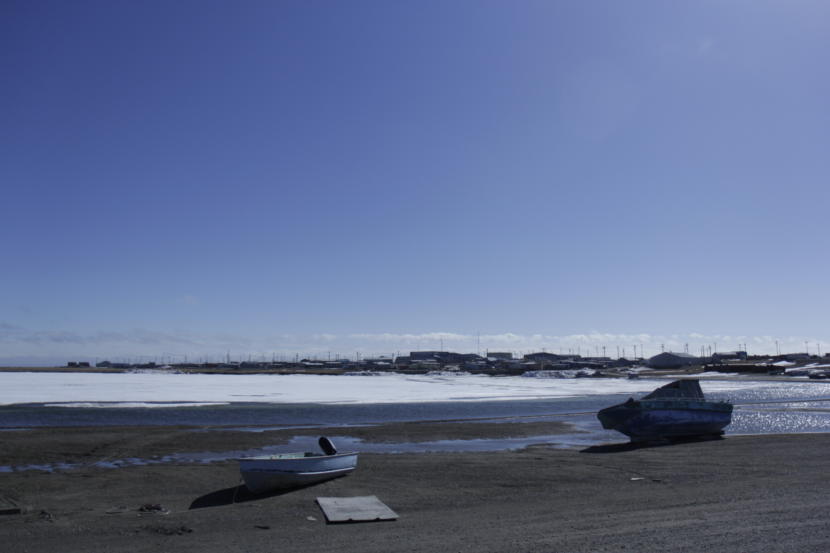
Kaktovik sits on an island in the Arctic Ocean on Alaska’s northeast coast. Some Arctic residents are already changing their fishing techniques to target what they say are the increasing numbers of pink salmon arriving on their shores. (Photo by Nat Herz / Alaska’s Energy Desk)

Scientists like to say that climate change is creating winners and losers in Alaska: Some species will struggle, while others could benefit from warmer habitats.

One of those climate change winners could be pink salmon in the Arctic, according to a new paper published by U.S. and Canadian scientists in a journal called Deep Sea Research Part II.

The study provides new evidence that global warming could produce higher numbers of pink salmon in the region by making previously too-cold rivers and streams more hospitable for spawning.

The findings bolster reports by Alaska subsistence fishermen that the species’ numbers have been increasing as the Arctic warms at more than double the rate of the rest of the globe.

“Maybe in the past, they’d see a few adult pink salmon here and there every few years. Now they’re seeing them every year,” said Ed Farley, a federal fisheries scientists who works at the Auke Bay Laboratories in Juneau. “And so, the question becomes: Is this a signal for what might be happening for pink salmon in terms of their production for the future?”

Some Arctic residents are already changing their fishing techniques to target what they say are the increasing numbers of pink salmon arriving on their shores.

On Alaska’s North Slope, in the village of Kaktovik on the Beaufort Sea, Sheldon Brower said he normally fishes for Dolly Varden, a type of char; the mesh in his net is too small to catch salmon.

Next year, he said, he’ll use a net with larger mesh in hopes of snagging more pinks. Brower said he doesn’t normally eat much salmon, but he’s eager to catch some.

“I’ve had some salmon strips and smoked salmon — I want to start trying to make that,” he said. “So, I want to try to catch as much as I can.”

Farley’s paper examined temperature observations in the hub town of Nome, on the Bering Sea.

And the scientists found that when it’s warmer, young pinks do better — which in turn makes it more likely for a larger number of adult fish to spawn the following summer.

Nome is more than 500 miles southwest of Kaktovik, near the Bering Strait, where pink salmon are actually spawning. That’s not happening yet where Brower is catching them — those salmon are just “straying” up there periodically, Farley said. But, he added, that could change.

“It’s likely in the future we could see successful spawning — when that happens, you’re going to see more pink salmon in the High Arctic,” Farley said.

While Farley’s paper documents one particular species faring better in the Bering Sea as global warming continues, other populations have suffered.

Farther south, in the Gulf of Alaska, the marine heat wave known as “The Blob” hurt salmon and cod stocks. Farley said he thinks that farther north, there’s more room for ocean temperatures to warm before fish are harmed.

“The Bering Sea was a little cooler than the Gulf of Alaska, and with this warming, we seem to be moving into a sweet spot for salmon,” he said. “Whereas when we got really warm in the Gulf, we exceeded that sweet spot.”

Even in the Bering Sea, other species of salmon are not faring as well — namely, chinooks, Farley said.

The number of adult chinooks in the Bering Sea has declined over the past couple of years; there’s no obvious scientific explanation, but one possibility is that warming has negatively impacted a smaller fish called capelin that are an important prey for the chinooks, Farley said.

Farley said scientists are continuing to study warming in the Bering Sea, and their next focus is looking at how changes in the abundance of prey could lead to more salmon growth.

While Brower, the Kaktovik fisherman, said he’s looking forward to catching more pink salmon, he also said he doesn’t see the warming happening in the region as entirely positive. Residents of the coastal village are seeing foggier and rainier summers that are making hunting more difficult and pushing caribou farther away, he said.

“We used to see the big Porcupine herd going by right along the coast, but we rarely see that now,” he said. “We have to go a lot farther to hunt caribou — we’ll have to go inland.”

As walruses haul out near Point Lay, locals ask visitors to leave them alone

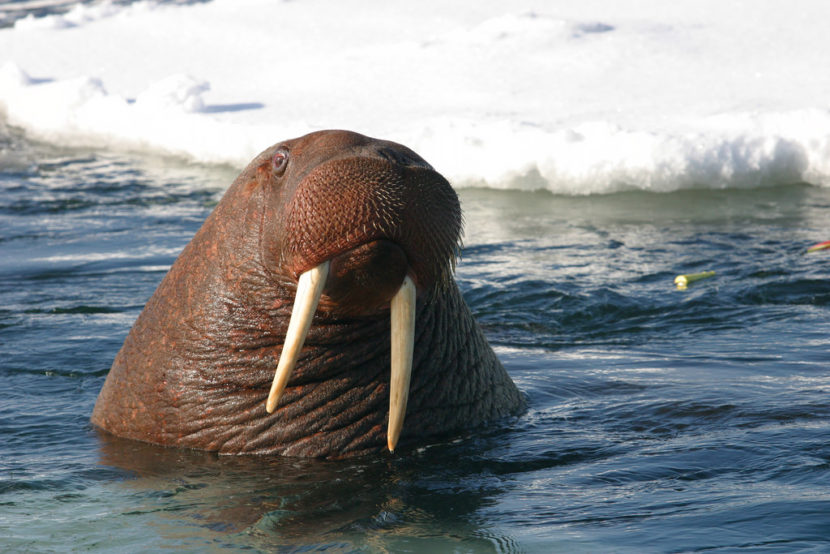
A young Pacific Walrus bull in coastal Alaska waters. (Photo by Joel Garlich-Miller/USFWS)

Point Lay and the nearby beaches of Cape Lisburne might seem like popular spots for walruses, but the haulouts there are a recent phenomenon.

“We had a few times that they gathered,” Point Lay resident Allen Upicksoun told U.S. Fish and Wildlife workers in 2018. “They’d say, ‘lots of walrus up north.’ But there were 10 to 12, not 40,000.”

Since 2007, walruses have been hauling out on land between their hunts. Before then, they’d populate sea ice patches throughout the Arctic. Fish and Wildlife spokeswoman Andrea Medeiros says that sea ice hasn’t been as reliable in recent years.

“As the ice has retreated further north in the summer times, the walruses have been hauling out on land in larger numbers and for longer periods of time,” Medeiros said.

And Upicksoun of Point Lay wasn’t exaggerating about the numbers. Medeiros says that upwards of 50,000 walruses have been hauling out on Arctic shores since the decline in sea ice.

And that’s led to myriad new issues, especially due to the walruses’ temperaments. Medeiros says in the past, the ice allowed for safe respite for the marine mammals.

“They can just, if something disturbs them, drop off into the water,” Medeiros said. “So when they’re on land, they tend to be skittish.”

If 10 or 12 walruses were hauling out on shores, being skittish wouldn’t be that big of a deal. But the average pacific walrus weighs more than a ton, and when 50,000 of those heavy animals panic in a tight space, Medeiros says there’s a high risk for mortality among the smaller ones.

“They’ll stampede into the water, and in that process, any weak animals — any animals that are young and small — can get trampled and severely injured and sometimes are killed,” Medeiros said.

For Point Lay locals like Julie Itta, this is a risk to those who rely on the walrus as part of their subsistence diet. She told Fish and Wildlife interviewers in 2018 that the people of Point Lay have a traditional connection with the animals that spans generations.

“That’s something that this village has always been strong in, is that spirituality we have with our animals. Because they provide for us,” Itta said. “So if you’re not taking care and respecting them in the way that you’re supposed to, they won’t give themselves to you.”

Point Lay residents sometimes are able to harvest the animals that are trampled due to stampedes, but only if they’re able to get to them in time. For them, a better solution is to prevent disturbances in the first place. That means constantly monitoring the walruses to make sure they’re alright and penalizing those who get too close.

Last year, two pilots were fined $3,000 for disrupting a haul out in 2017. It was deemed a violation of the Marine Mammal Protection Act.

Upicksoun says it’s all a way to make sure that the life cycle for both the residents in the village and their marine mammal neighbors can remain fruitful.

“Walrus are important because of the animal chain,” Upicksoun said. “They go down and harvest small animals, and the small animals depend on them. We depend on them. It’s all part of the animal chain.”

Fish and Wildlife officials expect the walruses to haul out on the shores near Point Lay through October.

Podcaster, journalist collaborate on Indigenous-centered climate change project

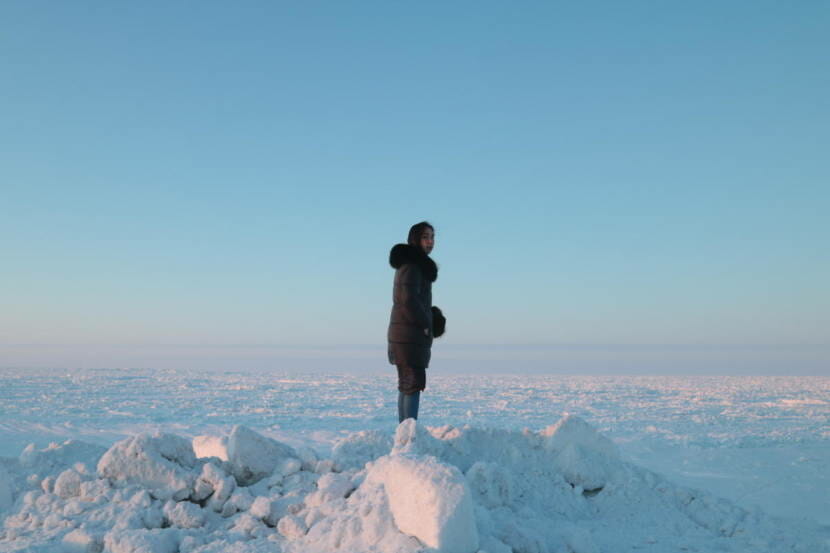
Coffee & Quaq podcast host Alice Qannik Glenn overlooks the frozen Arctic Ocean in February. (Photo by Jenna Kunze)

At a time where virtual platforms are becoming the norm, many Alaska Natives are entering a new era of content creation. Recently I sat down with Alice Qannik Glenn and Jenna Kunze to talk about their new Indigenous-centered project on climate change.

You may know Glenn from her podcast “Coffee & Quaq,” but she’s recently partnered with Kunze, who is a journalist by trade, to create an audio-and-print collaboration that investigates climate change on the North Slope.

“Jenna and I flew up to Utqiaġvik for a couple of weeks to interview community members about climate change and the adaptability and resilience of the Iñupiat in the face of climate change.”

“Alaska Natives on the Front Line” was funded by a grant from the Pulitzer Center. Kunze, who is not Alaska Native, reached out to Glenn to see whether she wanted to sign on.

At first Glenn was nervous about the prospect.

“It’s not some place on a map, it’s my hometown,” Glenn said. “I felt very particular about that. I kind of wrote back like, ‘first of all, this is what I’m concerned about,’ then if she wasn’t going to receive that in a way that I wanted, I was going to be like, ‘OK, moving on.’ But she was really gracious, and she was open to learning, so I felt so much more comfortable after that first interaction.”

Kunze’s written part of the project — an article titled “What Choice Do We Have?” — is an overview of the work the two accomplished.

“Alice’s accompanying piece will be the audio,” Kunze said. “We did eight interviews together, and then I did some additional interviews in my remaining time there. I think it will be a really good pair, because you can read the written piece and then you can listen to the audio. It’s a very interesting way to approach a journalistic piece, because you are seeing the bare bones.”

While doing preliminary research for the project, Kunze came across Elizabeth Arnold’s work, which examines the language mainstream media has used to talk about the Arctic over a five-year period.

Arnold found that most stories about climate change in the Arctic weren’t about Indigenous people at all, and if they were, people were often portrayed as disappearing or victims.

Kunze calls that kind of reporting frequent and damaging.

Glenn says “Alaska Natives on the Front Line” actively works against the vanishing Native stereotype by going directly to the community.

“I think it’s just irresponsible,” Glenn said. “It’s irresponsible to talk about people in that way and not think that it’s going to affect them. Jenna and I were just really excited to talk to residents, and to people who are involved or have opinions, because it is straight from the community.”

The project reframes discussions about climate change and places Indigenous voices from America’s northernmost city at the forefront.

“Yes, there are changes,” Glenn said. “Yes, it’s happening rapidly, but we’ve undergone change already. So this isn’t anything new to the Iñupiat. We’re going to be here. We’re going to be able to meet challenges head on. We are adaptable. And we are resilient.”

Alaska Native people have entered a new age and now have many outlets to share our contemporary voices. The collaboration between Glenn and Kunze is a good example of bringing voices from the Arctic forward.

“I just hope that people can understand and start to think about the people that are actually undergoing the change, rather than just think of it as some kind of phenomenon that’s happening in the world,” Glenn said. “It’s easy to be removed from something that you can’t see, or if you don’t know the people, but Jenna and I want to provide that human side of climate change.”

For information about “Alaska Natives on the Front Line” go to the Pulitzer Center’s website or coffeeandquaq.com.

‘Wipe the slate clean’: Environmentalists sue Trump administration Ambler Road approval

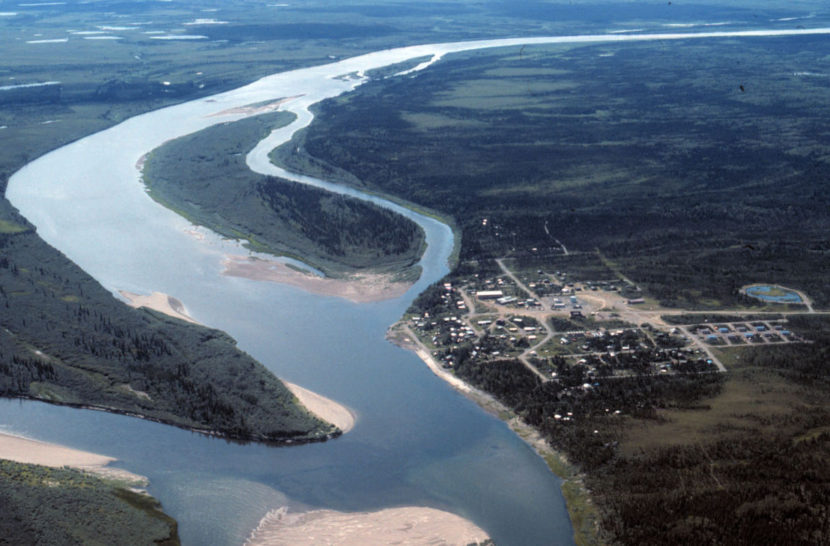
Aerial view of Ambler and the Kobuk River in the summer. (Photo courtesy of the National Park Service via UAF Gates of the Arctic Research Portal)

Nine environmental groups are suing the Trump administration for approving the 211-mile Ambler Road project.

“The agencies don’t have enough information to be issuing these permits in the first place,” said Bridget Psarianos, an attorney representing the plaintiffs. “And this environmental review process should never have even been allowed to move forward.”

On July 23rd, the Bureau of Land Management approved a route for the controversial project, a private-access gravel road that would extend from the Dalton Highway to the Ambler Mining District in Northwest Alaska, through Gates of the Arctic National Preserve.

In a lawsuit filed in the U.S. District Court for Alaska Tuesday, plaintiffs wrote that federal agencies failed to comply with several acts — including the Alaska National Interest Lands Conservation Act, the Clean Water Act and the National Environmental Policy Act — when pushing the project forward.

The nine plaintiffs in the case are the Northern Alaska Environmental Center, Alaska Wildlife Alliance, the Center for Biological Diversity, Earthworks, the National Audubon Society, the National Parks Conservation Association, the Sierra Club, the Wilderness Society and Winter Wildlands Alliance.

The Alaska Industrial Development and Export Authority (AIDEA) has been pushing the project along with federal agencies for several years. The state agency is in charge of making investments and providing loans to various business interests across the state.

Psarianos says permits were issued for the project at different stages of the road’s design, and should be voided.

“We’re asking the court to completely vacate and set aside these permits and pretty much wipe the slate clean and send AIDEA and the agencies back to the drawing board,” Psarianos said.

Mining companies hope to use the road to access deposits of copper and other metals in the Ambler mining district, then to truck ore out. The road has drawn concerns from environmentalists and tribal governments over impacts to wetlands and subsistence hunting in the region.

In a brief email statement, AIDEA spokesman Karsten Rodvik wrote that the state agency is aware of the lawsuit and “the matter is under review and consideration.”

This story has been updated.

U.S. House advances bill that would hobble development in ANWR and Tongass

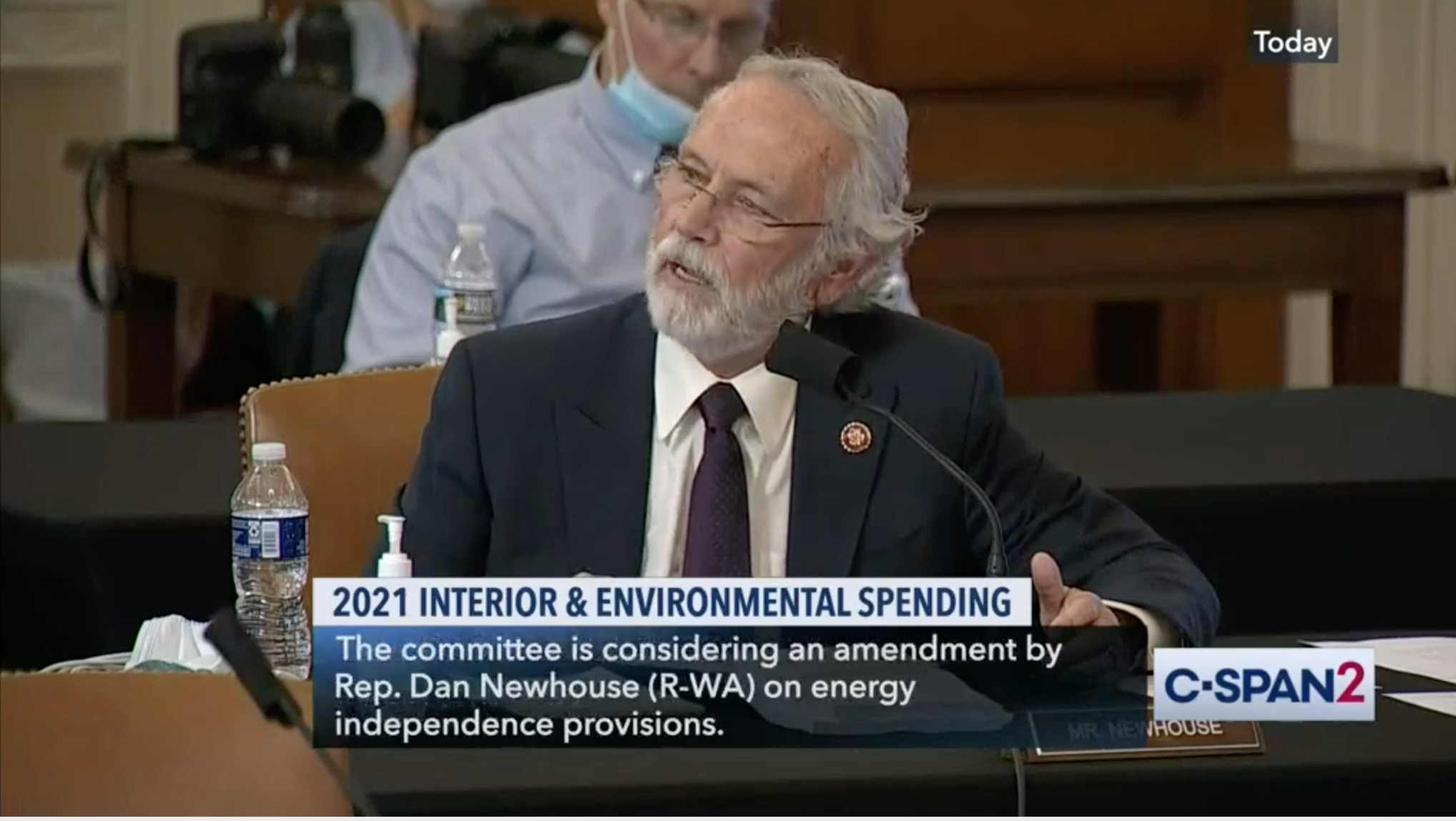
Video still showing Rep. Dan Newhouse at a House Appropriations Committee hearing
Still from video of House Appropriations hearing July 10, 2020. The committee approved a bill that would erect barriers to oil development in the Arctic National Wildlife Refuge and logging in the Tongass National Forest.(C-SPAN)

The U.S. House Appropriations Committee approved a bill Friday that would erect barriers to oil development in the Arctic National Wildlife Refuge (ANWR) and logging in the Tongass National Forest.

The provisions are tucked into the Democrats’ appropriations bill for the Interior Department and the Forest Service. The Republican-led Senate is sure to block them, so the measures serve primarily as a statement of Democratic values and to draw attention to what environmentalists view as endangered land in Alaska.

One provision says the government can only auction off drilling rights on the Coastal Plain of the Arctic Refuge with a minimum bid of half a billion dollars.

The Interior Department is expected to announce an ANWR lease sale soon. Alaska’s delegation in Congress wants to see the area developed. But Alaska’s sole House member isn’t on the appropriations committee, so it fell to Rep. Dan Newhouse to try to remove the ANWR provision.

“In addition to creating new jobs in Alaska and across the nation, opening this minuscule area to oil exploration, empowers the United States to reduce our dependence on foreign sources of oil and expand our domestic energy supply,” Rep. Newhouse, R-Wash., said during the House Appropriations Committee’s session on the bill.

Newhouse’s amendment also aimed to remove a sentence in the bill to block new logging roads in the Tongass.

Rep. Mike Quigley, D-Ill., was among those who argued against the amendment.

“One of the provisions in the bill that this amendment seeks to strip would end millions of dollars of taxpayer subsidies to the timber industry in Alaska and stop the irreparable damage to the Tongass National Forest, a treasured part of our unique national heritage,” he said.

The Newhouse amendment failed, leaving the anti-development measures for the Tongass and the Arctic Refuge in the bill. The legislation next goes to the full House, where it will likely pass.

The Senate is working on its own bill. As Newhouse acknowledged during the debate, the Alaska provisions don’t stand much chance in the conference committee where the two bills will be reconciled.

Site notifications
Update notification options
Subscribe to notifications