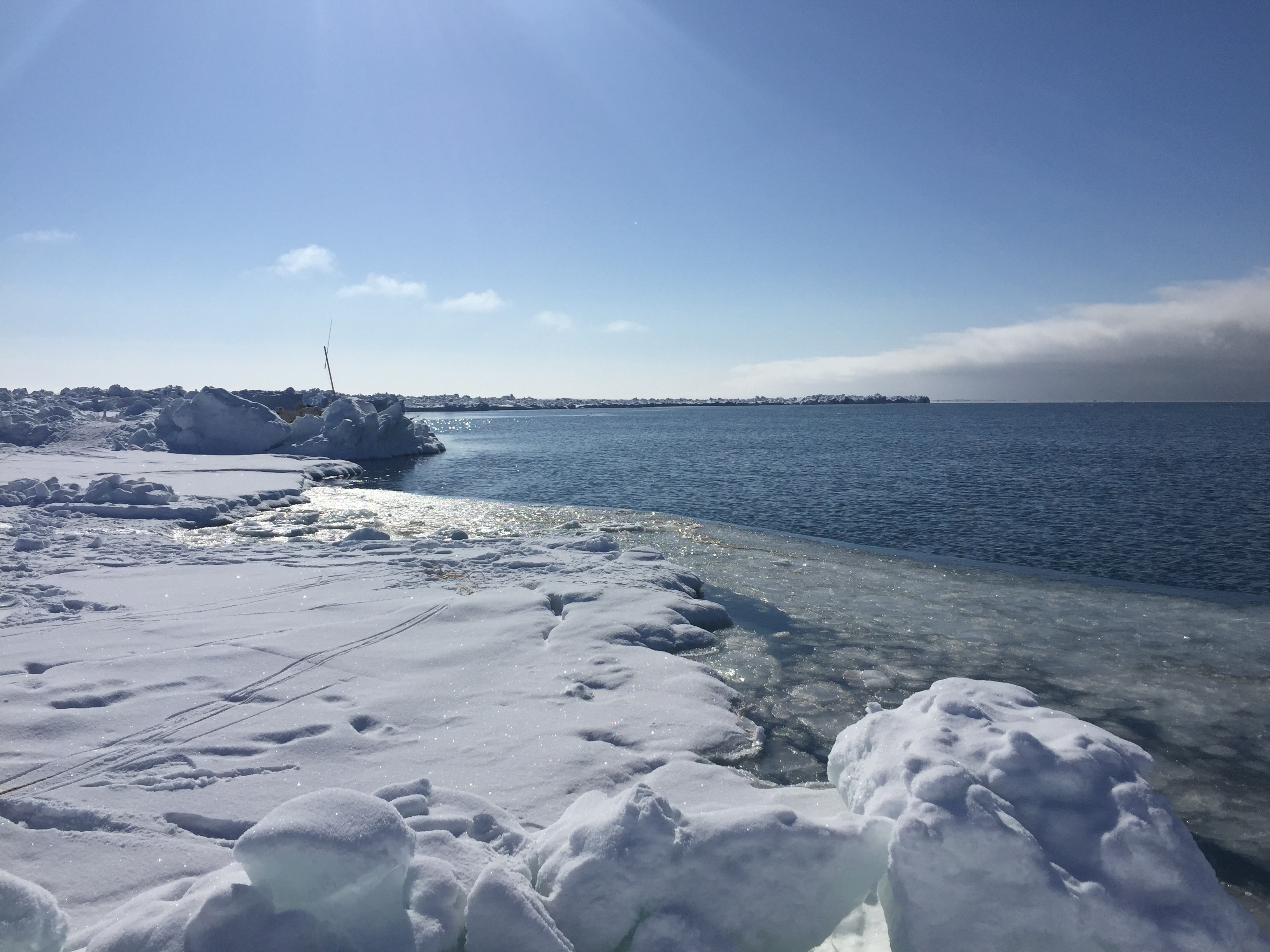
The shorefast sea ice off Utqiaġvik, which local whalers use as a platform for their spring hunt. April 21, 2019. (Photo by Ravenna Koenig/Alaska’s Energy Desk)
For the first time since 2007, Alaska’s northernmost city has recorded a record low daily temperature reading.
On Wednesday morning, temperatures in the North Slope hub community of Utqiaġvik reached 20 degrees below zero, a record low for April 29.
Rick Thoman, a climatologist with the International Arctic Research Center in Fairbanks, said that Utqiaġvik saw all of the ingredients for a cold day on Wednesday.
“At Utqiaġvik, there was some wind, and it’s the direction the wind needs to get really cold, and that’s an offshore wind — kind of a southeast breeze helping pull in some of that cooler air from the inland to the coast,” Thoman said.
In a tweet, Thoman said Wednesday was also the latest date in the season for a temperature of 20 below or colder in the area. The previous record was a low of minus 24 on April 28, 1964.
Thoman said that the frigid Wednesday temperature doesn’t represent the month of April as a whole for the North Slope, however.
“Of course, the record low is really just one day,” Thoman said. “For April as a whole, this was the sixth-warmest April in the last century at Utqiaġvik.”
Thoman said that while this is the first record low day in Utqiaġvik in just over 12 years, there have been overwhelmingly more record high temperature days in the area.
“One hundred and twelve daily record highs have been set or tied,” Thoman said. “So in a football game, if the score was 112 to nothing, or 112 to one, that would really be quite remarkable.”
Thoman said that current models from the National Oceanic and Atmospheric Administration call for a higher chance of warmer-than-normal temperatures for Utqiaġvik in the month of May.
The North Slope Borough is backing out of a tentative deal to rent RavnAir Group’s Utqiaġvik hangar and is reasserting its right to use Ravn’s assets to support air service to its communities during the coronavirus emergency.
On Monday, an agreement between Ravn and the North Slope Borough was filed in federal bankruptcy court in Delaware, spelling out that the borough would pay Ravn $100,000 a month in rent for use of Ravn’s hangar at the Wiley Post-Will Rogers Memorial Airport in Utqiaġvik.
But in a press release on Wednesday evening, borough Mayor Harry Brower wrote that negotiations on that agreement were “not fruitful.”
Earlier this month, the borough issued an emergency order saying that it was “commandeering” all of Ravn’s assets in the borough in order to provide vital air service to its communities, which are off of the road system, after Ravn announced it was stopping all operations and filed for bankruptcy. The company said the coronavirus pandemic had led to a 90% drop in ticket bookings.
In a new emergency order released Wednesday, Brower wrote that thanks to other air carriers who stepped in immediately after Ravn’s bankruptcy, the borough would not have to commandeer “all” of Ravn’s assets and was in the process of determining what assets would be needed in order to continue air service.
But the borough did reassert its right to seize assets under borough code and Alaska state statutes. The borough points to state statutes that say that in an emergency, local officials can enter public and private property when it’s “reasonably necessary to actually alleviate or prevent the disaster,” in order to “take them and to perform work and take measures that are appropriate without the consent of the owners of the land or buildings.”
Last week, however, the state’s attorney general wrote that the borough’s emergency order commandeering Ravn’s property was “void” because the property belonged to the bankruptcy estate.
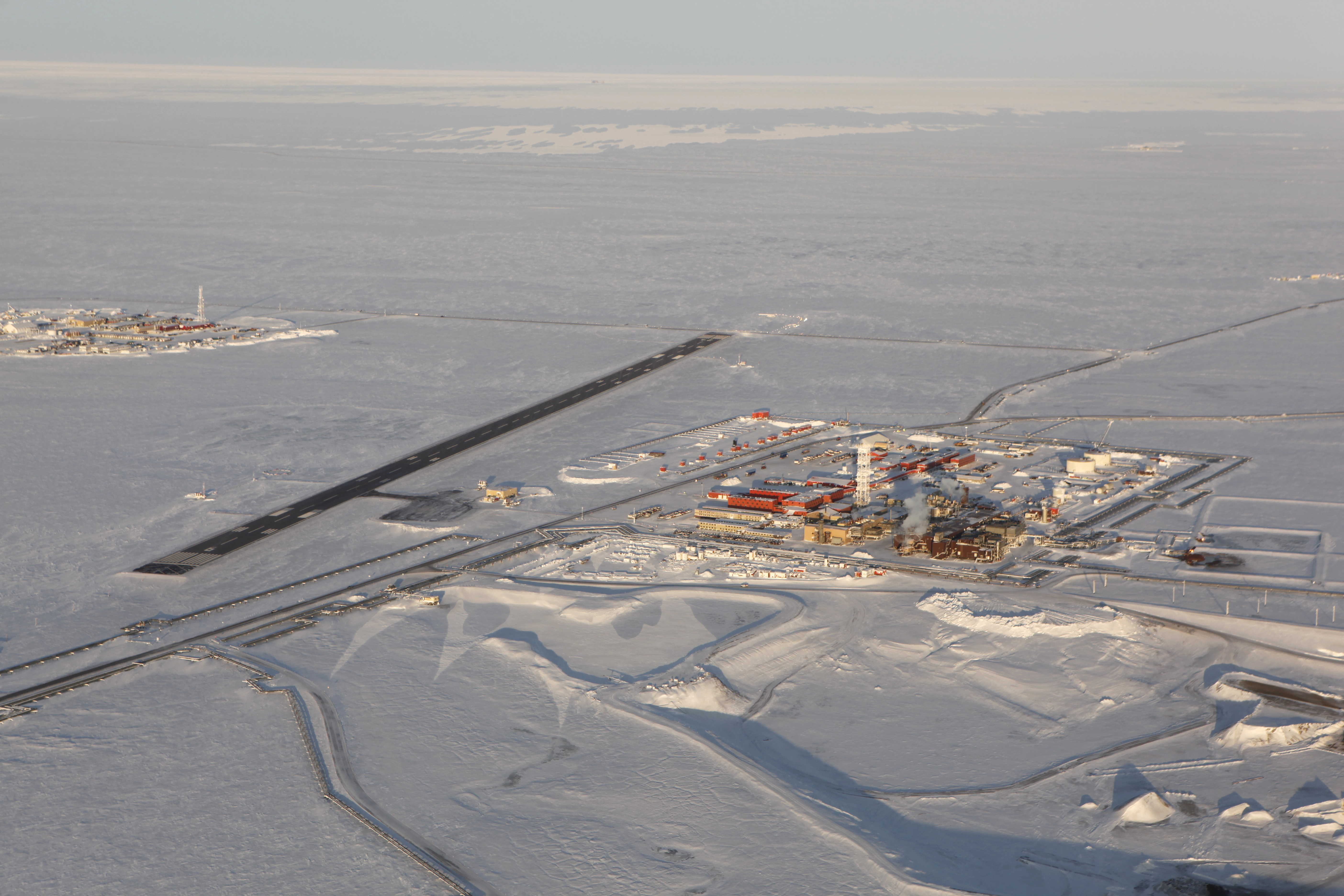
The main camp at the Kuparuk field. (Photo courtesy ConocoPhillips)
Oil giant ConocoPhillips announced Wednesday that it’s shutting down its drill rigs on the remote North Slope oil fields, and placing them into long-term storage, to protect its employees and contractors during the coronavirus pandemic.
This winter was supposed to be Conoco’s largest exploration and construction season ever in Alaska. In a statement, Conoco spokesperson Natalie Lowman said the company is significantly reducing its workforce on the Slope because of the heightened risk of COVID-19, the disease caused by the coronavirus.
“The health and wellbeing of our workforce, along with mitigating the spread of COVID-19 is our top priority,” Lowman said. “The preventative actions we’re taking in Alaska are primarily due to the remoteness and complexity of operating on the North Slope during the COVID pandemic.”
Lowman said she didn’t have additional information Wednesday on workforce impacts, including any layoffs and how many fewer employees and contractors will be on the Slope. In a letter, the president of Doyon Drilling, a subcontractor, said the impact of the decision will be “severely felt” by all of its employees and Alaskans, The Anchorage Daily News reported.
Wells in production will continue to produce oil, Lowman said. Development and exploration drill rigs will be demobilized. That includes its massive rig nicknamed “The Beast” that was expected to begin drilling this month.
“Given the high degree of uncertainty on how the situation plays out, we can’t say how long these measures will be in place,” Lowman said.
The oil industry is not only dealing with the coronavirus, but also a historic drop in oil prices. In early March, Alaska North Slope crude sold for roughly $50 a barrel. On Tuesday, the price fell below $20.
So far, there has been one confirmed case of COVID-19 on the Slope oil fields, where employees live and work in close quarters. BP announced last week that a Prudhoe Bay worker had tested positive for the disease.
In response, BP also said it would limit its activity at Prudhoe Bay “to safety critical and regulatory compliant activity.” It ended this year’s development drilling.
Asked if any Conoco workers on the Slope had tested positive, Lowman said in an email, “I can’t share information on workforce health matters.” The state is the primary source of information on COVID-19 cases, she said, and had only confirmed one case.
The number of cases across Alaska continues to grow, reaching 226 by the end of the day Tuesday.
Oil companies, including Conoco, have reported an array of efforts to keep the virus off the Slope including longer shifts, health screenings and increased sanitation.
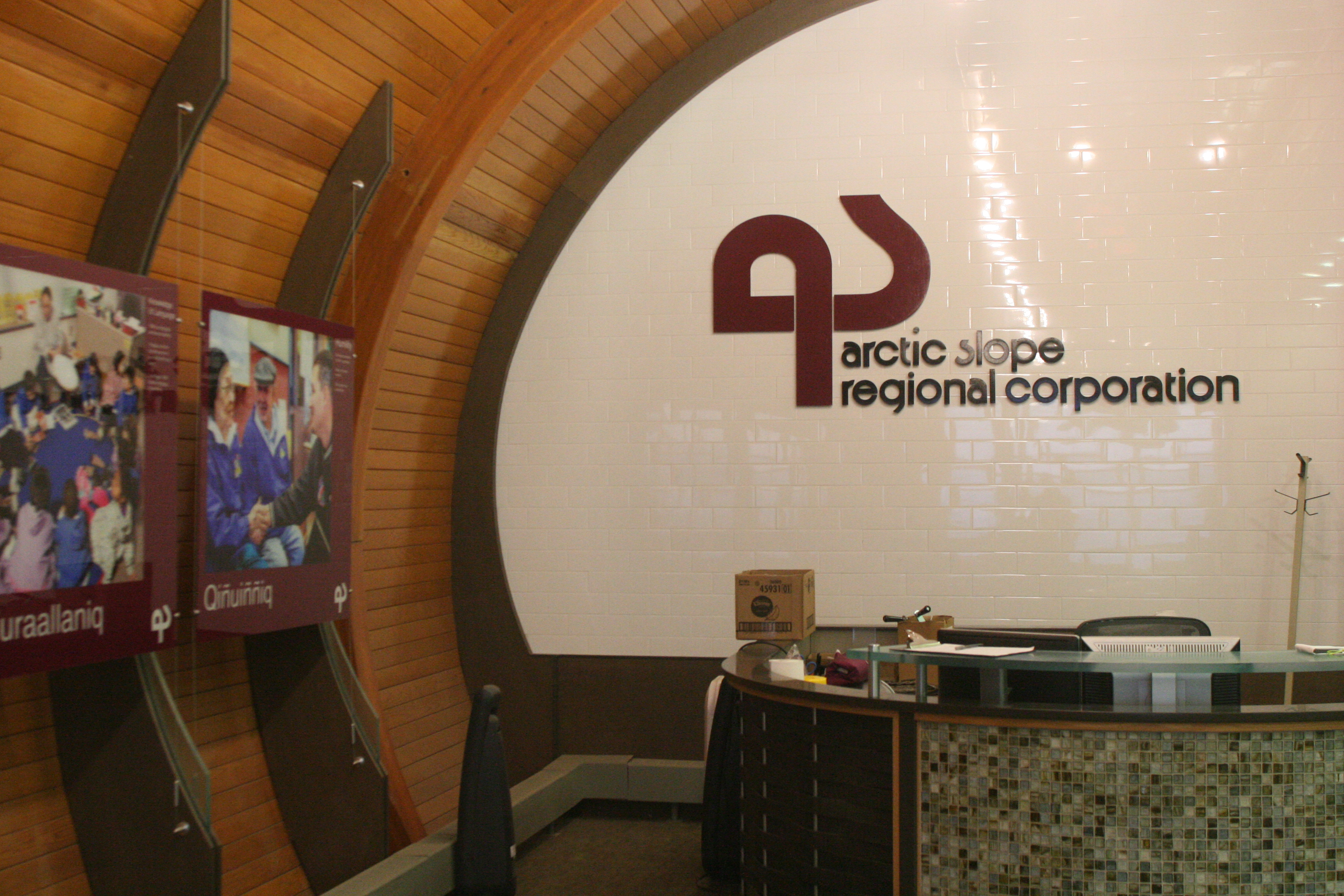
The Arctic Slope Regional Corp. headquarters in Utqiaġvik, January 2018. (Photo by Ravenna Koenig/Alaska’s Energy Desk)
Alaska’s largest private-sector employer, Arctic Slope Regional Corp., has laid off employees and cut charitable giving due to the collapse in oil prices and the economic shutdown caused by the global coronavirus pandemic.
That’s according to an April 3 letter from the chair of ASRC’s board of directors, Crawford Patkotak, to the company’s 13,000 shareholders. An ASRC spokesperson would not say how many employees were let go.
ASRC’s letter to shareholders said the corporation had cut “many of the charitable programs in our region,” eliminated all corporate bonuses and incentives for executives, and reduced the board of directors’ compensation — in the form of a stipend — by 30%.
“It’s a challenging time for a lot of businesses right now, and let’s hope we can all weather the storm and get back to a new normal soon,” ASRC spokesperson Ty Hardt wrote in an email.
Hardt declined to answer any further questions about the cuts.
“Unfortunately, the total impact of the COVID-19 response (and low oil prices) isn’t quite known yet and it could get worse before it gets better,” Hardt wrote, referencing the disease caused by the coronavirus.
Hardt said ASRC has 15,000-plus employees in Alaska and the Lower 48, and in its most recent available annual report, from 2018, it reported revenues of more than $3 billion.
The Alaska Native corporation is heavily invested in oil and gas, including ownership of an oil refining business, and represents residents and descendants of Iñupiat communities on Alaska’s North Slope, from Point Hope to Kaktovik.
ASRC paid out dividends of $7,000 to each shareholder with 100 shares in 2018, according to its report for that year.
In its letter to shareholders this month, ASRC said it was cutting spending in areas that were not generating revenue the corporation needs to pay shareholder dividends.
“In 2020, it is likely we will have to decrease the amount of the ASRC dividend disbursements, but we do not yet know by how much or for how long,” the letter says.
The letter says ASRC will continue plans to expand into the Lower 48 and diversify its investments away from oil and gas.
Commenters on a private Facebook group for ASRC shareholders had mixed responses. Some felt the corporation’s board was too highly compensated and had not done enough to cut at its higher levels of management. A few vowed to vote out the current board members.
Others thanked the board for making difficult decisions to keep the corporation afloat during tough economic times.
Alaska’s Energy Desk reporter Nat Herz contributed reporting to this story.
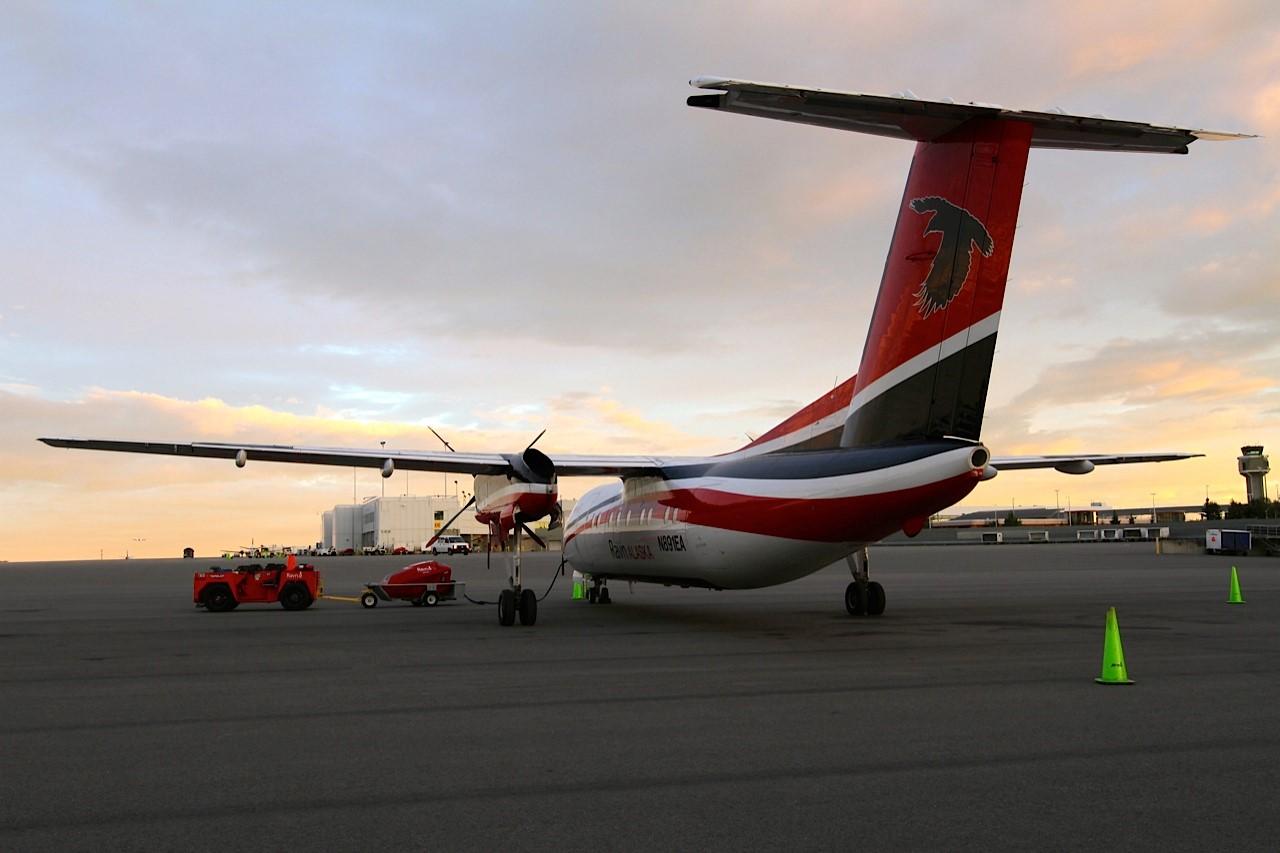
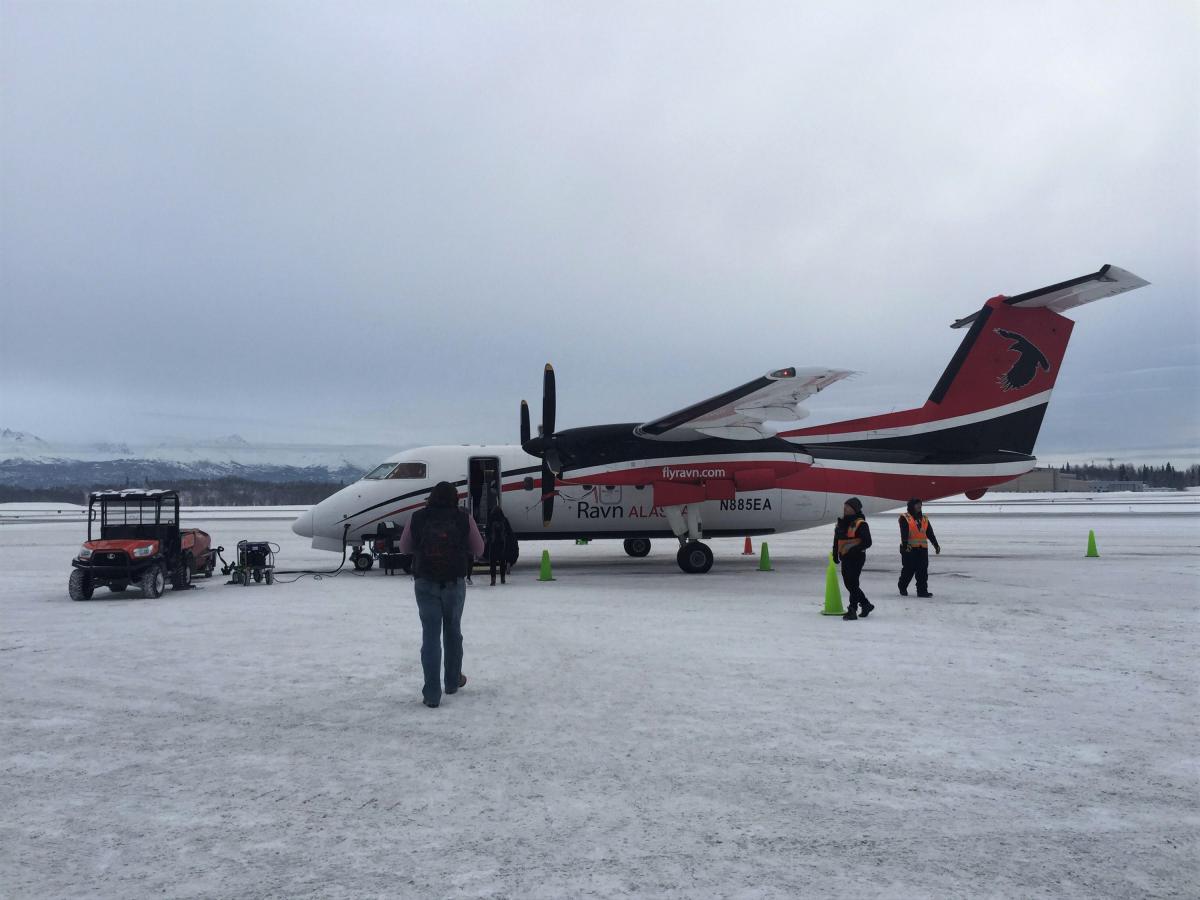
In Anchorage, passengers board a RavnAir Group flight bound for Unalaska. Ravn and Alaska Airlines suspended their partnership for the Unalaska-Anchorage route following Ravn’s fatal PenAir plane crash on Oct. 17, 2019. (Photo by Laura Kraegel/KUCB)
Alaska’s largest rural air carrier, RavnAir Group, says it’s cutting its service by 90% amid a coronavirus-driven crash in revenue — a move that could leave dozens of rural villages with deeply diminished air service for passengers and no other reliable link to the road system.
The company, until this week, served 115 communities across nearly the entire state, from the North Slope to the Yukon-Kuskokwim Delta to the Aleutian Islands.
In a prepared statement, RavnAir Group said it’s shrinking its fleet of planes from 30 to three.
“RavnAir Group today announced that due to the dramatic and continuing 90% reduction in passenger revenue bookings resulting from the COVID-19 coronavirus, it has been forced to take further actions to drastically cut costs,” the statement said.
In a prepared statement. Gov. Mike Dunleavy said that “the aviation industry is working cooperatively to ensure essential passenger service, bypass mail and freight service is maintained to their communities during these uncertain times.”
“This morning, I also spoke with officials from the United States Postal Service and they assured me they are working with contract carriers to maintain scheduled service to rural areas,” he said. “The importance of the supply chain to rural Alaska communities is a priority for my administration.”
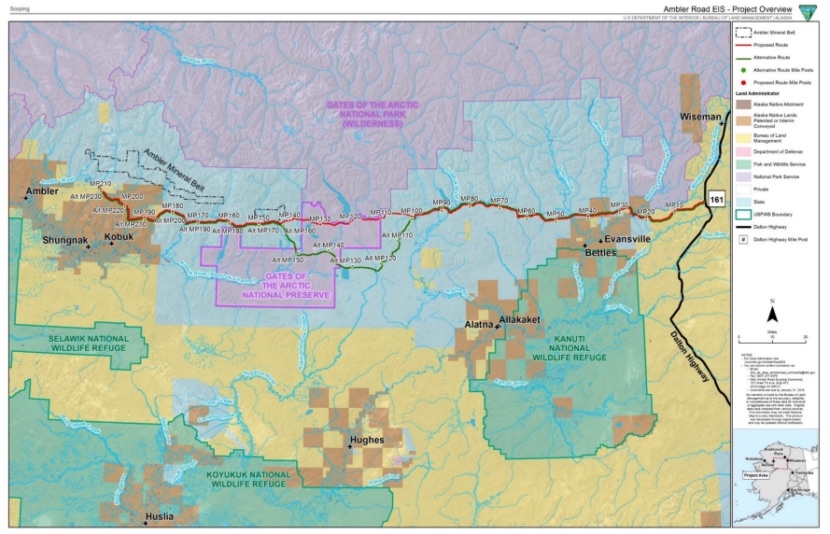
A map of the proposed Ambler Road project. (Graphic Courtesy of HDR for the Bureau of Land Management)
The Alaska Industrial Development and Export Authority board received overwhelming critical public testimony at a board meeting last Friday.
The backlash didn’t stop the board from putting $35 million toward the controversial Ambler Road project. People who testified questioned the timing of the action, amid the coronavirus pandemic.
Susan Georgette of Kotzebue summed up the biggest concern from the public: The coronavirus health crisis is no time to put money into the Ambler Road project.
“The Northwest Arctic Borough is under a shelter-in-place directive right now. The state and country are in the midst of a pandemic and an economic crisis,” Georgette said. “And it’s outrageous, as others have said, that AIDEA is considering these actions right now.”
AIDEA scheduled the emergency meeting to allow themselves to waive certain regulations on their loans, with the intent of getting money out faster to businesses across the state strained by the coronavirus.
The money would go toward contracting with engineers, lawyers, advisers and others in the Ambler Road’s predevelopment phase.
For two hours, Georgette and others testified to the board — almost exclusively against the funding for the project. Many of them took issue with the timing of the meeting. The board scheduled the meeting with three days notice, and some felt there wasn’t time for the public to weigh in on the motions. Public testimony per person had also been reduced from the listed three minutes down to two, which Georgette criticized.
“It does look like AIDEA is using the current crisis to forge ahead with an unpopular project,” Georgette said.
The Ambler Mining District Industrial Access project, known as the Ambler Road project, would stretch from the Dalton Highway to the Ambler Mining District northeast of Kotzebue, crossing into Gates of the Arctic National Park and Preserve.
The road has drawn criticism from environmental groups who don’t want a new road through a national park.
Several village governments, including the village of Kotzebue, have also publicly come out against the project.
“Many people here are more concerned with long-term impacts on caribou, fish and water quality than on the shorter-term economic benefits of the road,” Georgette said.
The Army Corps of Engineers released its final environmental impact statement on the road on Friday. They say all three suggested road routes, including one that doesn’t cross through a national park, could impact air and water quality, wildlife migration and erosion in the region.
Despite the largely negative input from the public, the board ultimately voted unanimously to support the resolution, which categorizes the Ambler Road project as an Arctic Infrastructure project, and also adds $35 million to the fund for those projects. The board would have to take further action to actually put the money into the road.
Board president Dana Pruhs said the investment in the Ambler Road project is important as the state looks past the current health crisis to the economy post-coronavirus.
“I respect the public, and I really respect what they had to say today,” Pruhs said. “But they have to know that we have to look after the future of the state also.”
Board members estimate that the project could bring 100 to 200 jobs to the state.
AIDEA is a public Alaska state corporation tasked with making investments and providing loans to various business interests across the state.
The AIDEA board also voted to grant the Blood Bank of Alaska a six-month reprieve from paying back loans, though the blood bank had requested nine months and an additional $2.5 million in credit, which was not granted.