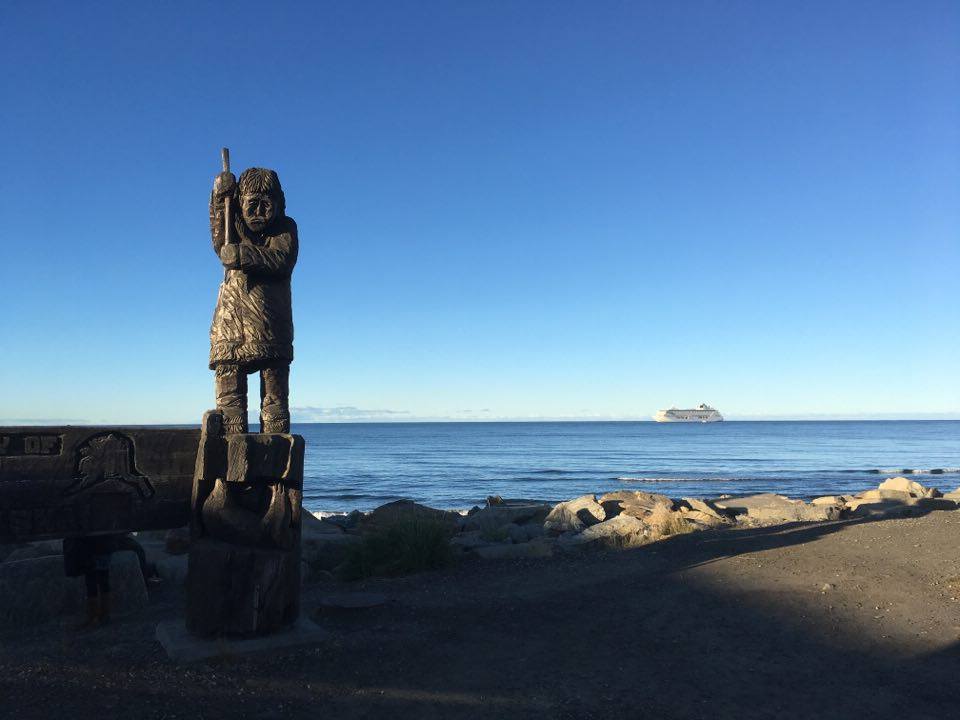
The cruise liner Crystal Serenity anchored offshore at Nome in 2017. (Photo by Gabe Colombo/KNOM)
There will be no cruise ships coming into Nome in 2020 after recent federal and international travel regulations have made those Arctic trips impossible.
As of late June, there were three voyages of the National Geographic vessel Orion still holding out to stop in Nome during the coming months. But now, Nome’s Port Director, Joy Baker says no cruise ships will be docking here this year.
“For the first time since the early 90s we are without a cruise ship for the summer and it’s unfortunate because the city [of Nome] was hoping to see at least a few before the end of the year after all the COVID requirements were worked out,” she said.
This year would have been a big year for cruising in Nome with fourteen ships originally scheduled to make port. But then the Centers for Disease Control and Prevention extended their international no-sail order until July 24. And most of the ships coming to Nome have to stop in Canada as part of their itinerary, but Canada has banned ships with more than 100 passengers until at least October 31.
Baker says that Nome’s local travel regulations have nothing to do with the canceled ships. She reiterated that it was, “completely out of our [Nome’s] hands.”
While most cruises around Alaska have long been canceled or postponed, Nomeites still had some hope for the local cruise season because it looks so different in Western Alaska than in other parts of the state.
The cruise ships coming to this region tend to be smaller luxury adventure cruises that stop in Nome either in August or September. That timeframe potentially allows tourists a glimpse at sea ice as they travel through the Northwest Passage or the Chukchi Sea.
Despite the disappearance of cruise traffic, Baker says other summer businesses in Nome have been booming.
“The cargo, gravel and fuel industry are moving along as if nothing has changed. We’ve been extremely busy with gravel. We’ve had a few more cargo vessels than normal and the fuel just started coming in. We’ve got more fuel coming next week,” she said.
Research vessels coming into Nome this summer have slowed and most of those have been canceled for the year, but Baker says there are some vessels that have made arrangements to continue working safely during the COVID-19 pandemic.
Fishing seems to be slower Baker notes, but she suspected fishing vessels might return in greater numbers when the halibut fishery opens. Norton Sound Seafood Products is not buying Norton Sound Red King Crab this summer and that could be another reason there are fewer fishers on the water.
Baker is hopeful that cruises will resume their stops in Nome for the summer of 2021.
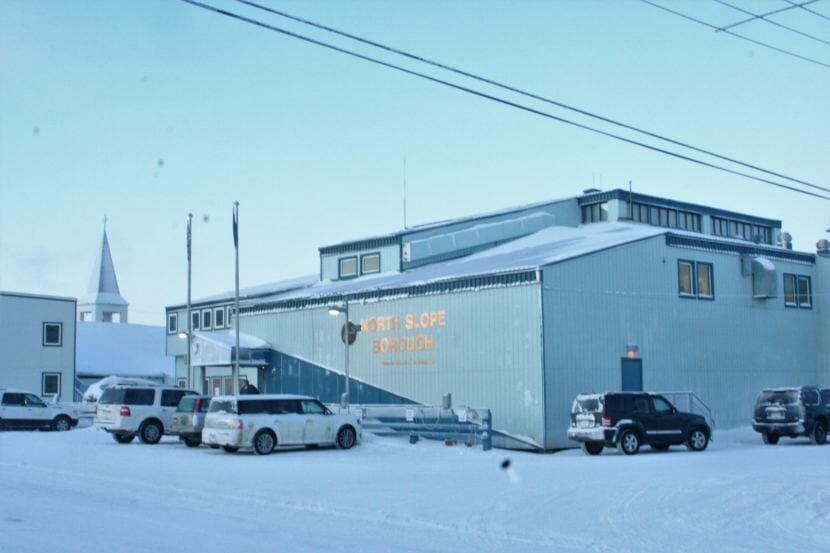
The North Slope Borough’s main building in Utqiaġvik. (Ravenna Koenig/ Alaska’s Energy Desk)
A resident from the North Slope Borough has tested positive for COVID-19. This is the first positive case in the region.
According to a release from the Arctic Slope Native Association, the patient had been tested at the Samuel Simmonds Memorial Hospital in Utqiagvik on May 22. The patient had been in Anchorage, before traveling to Utqiagvik and then on to their home community. For the patient’s privacy, the name of the community was withheld.
Samuel Simmonds Hospital is preparing a team of medical officials to go to the patient’s community to provide testing to anyone who may have come in contact with the individual.
While this is the first case for a resident of the North Slope, a BP worker at Prudhoe Bay tested positive for the virus in March.
The case is one of more than 400 positive cases of COVID-19 across Alaska.
This is a developing story and may be updated when new information becomes available.
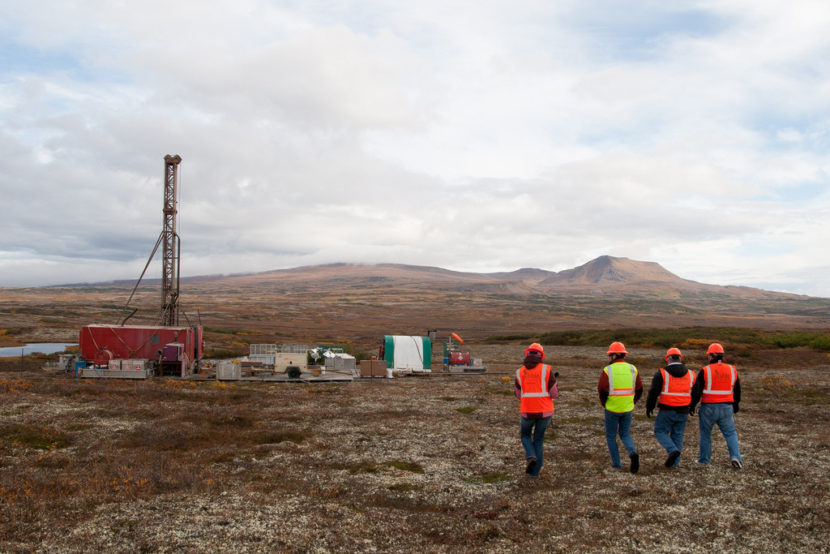
Members of the media walking to an exploratory drill rig at the Pebble Mine Exploratory site in 2013. (Photo by Jason Sear/KDLG)
Pebble Mine opponent Lindsey Bloom thought she had the goods.
When she saw a video showing an executive from Pebble’s parent company make a pitch to potential investors, she considered it proof of what fishermen and environmental groups have been warning – that Pebble is minimizing the scope of the project, but that ultimately it expects to build a more damaging operation.
“One of the ways you ensure you can get a permit is you de-risk it by taking something modest and conservative into the permitting process in the first place. And we did that,” Northern Dynasty Vice President Doug Allen says on the video, filmed at a conference in Toronto in late February.
“Because for whatever reason, cyanide has a bad reputation in the environmental community. And so we have forgone about 12% of our gold recovery, because we don’t have a secondary gold-recovery circuit,” he said. “That’s not necessarily gold lost. We hope it’s gold deferred, because we at a subsequent date will get a permit to add a secondary gold-recovery circuit.”
Lindsey Bloom opposes the Pebble Mine on behalf of the group Commercial Fisherman for Bristol Bay. (Joyanne Bloom)
Bloom, who works for Commercial Fisherman for Bristol Bay, believes that to be evidence of Pebble’s duplicity.
“Who are you lying to, Alaskans or investors? Because you can’t have it both (ways),” she said. “It can’t be a small mine and a big mine. You can’t use cyanide and not use cyanide.”
Bloom thought the video would make headlines. She sent a transcript to multiple new outlets more than a week ago. And then … crickets.
“I haven’t been hearing anything back from reporters. You’re the first one I’ve talked to,” she said. “And I just think that, I don’t know, the airwaves are so crowded right now. So much going on in the world.”
Environmentalists say the Trump administration is taking advantage of the coronavirus pandemic to advance Pebble as well as other Alaska projects and anti-conservation policies, while the public and the press are distracted. Until COVID-19 poses less of a threat, they’ve asked the government to hit the pause button on a host of issues:
An auction of drilling rights in the Arctic National Wildlife Refuge
Rolling back restrictions on hunting and trapping in National Preserves
Allowing brown bear baiting in the Kenai National Wildlife Refuge
The plan to develop Willow, a site in the National Petroleum Reserve-Alaska, near the village of Nuiqsut, that could have as many as 250 oil wells
Nicole Whittington-Evans, Alaska director for Defenders of Wildlife, says she’s disturbed the Bureau of Land Management chose to proceed with public meetings last month on the Willow development. She says people can’t provide meaningful input now.
Instead of the in-person meetings in a series of communities, the BLM had eight Zoom sessions. Whittington-Evans says it suppressed public comment.
“It really switched the power dynamic, incredibly, during these hearings, in terms of who had the control, who would be allowed to speak when when you could actually ask questions and not ask questions,” she said.
One man’s microphone was muted as he was providing his opinion, Whittington-Evans said. He was swearing, she acknowledged, and if it was an in-person meeting he probably would have been asked to leave. But, she said, he would not have been muted.
“You can’t just, like, hold your hand over somebody’s face in a public hearing,” she said.
BLM spokeswoman Lesli Ellis-Wouters said muting was employed once. She said the agency has a responsibility to keep the session suitable for all ages.
Zoom can’t replicate an actual meeting, but it allows for social distancing, and it has some big advantages when it comes to discussing Arctic projects, Ellis-Wouters said.
“One that stuck with me, I think it was our very first meeting, we had participation from Southeast, which had never been done at an in-person meeting before,” Ellis-Wouters said. “And we also, on that same call, we have somebody from Utqiagvik. There’s 1,000 miles in between those two communities, and they were able to come to the same meeting. So we were getting perspectives from people that we traditionally have not heard from before.”
The eight Zoom sessions on Willow drew about 400 unique views, plus another 2,000 views on Facebook live, Ellis-Wouters said. That suggests that far more people tuned in than attended the original set of community meetings that took place pre-pandemic, she said.
In the Zoom sessions, a lot of the Willow opponents said the format, or proceeding at all during a pandemic, was unfair. Project supporters, on the other hand, described it as a brilliant way to do public engagement.
As for Pebble, spokesman Mike Heatwole declined to be interviewed, but he said in an email that Pebble has no current plans to use cyanide. He also pointed out the public input period on the mine ended last year.
At this phase, the U.S. Army Corps of Engineers is working with its cooperating agencies on the final phases before it decides on issuing permits.
One of those cooperating agencies is the Curyung tribe of Dillingham, but its leaders say they have no time to co-operate.
“All of our tribal focus right now has become COVID and maintaining the health and safety of our people here in Bristol Bay,” said tribal administrator Courtenay Carty.
Thousands are flooding into the area to work in the fishery, and the first positive test has already emerged. Carty said she can’t keep up with the Pebble documents or attend the biweekly meetings of cooperating agencies now.
“And so we’re really disenfranchised at this point in time,” she said. “To (not) be able to focus on something as important as the Pebble permitting process, that we’ve dedicated over a decade to, to have it come to decision essentially over summer, in the midst of a global pandemic is unfathomable.”
The executive from Pebble’s parent company told potential investors they expect to have a federal permit by August.
Teshekpuk Lake. (Photo courtesy Bureau of Land Management)
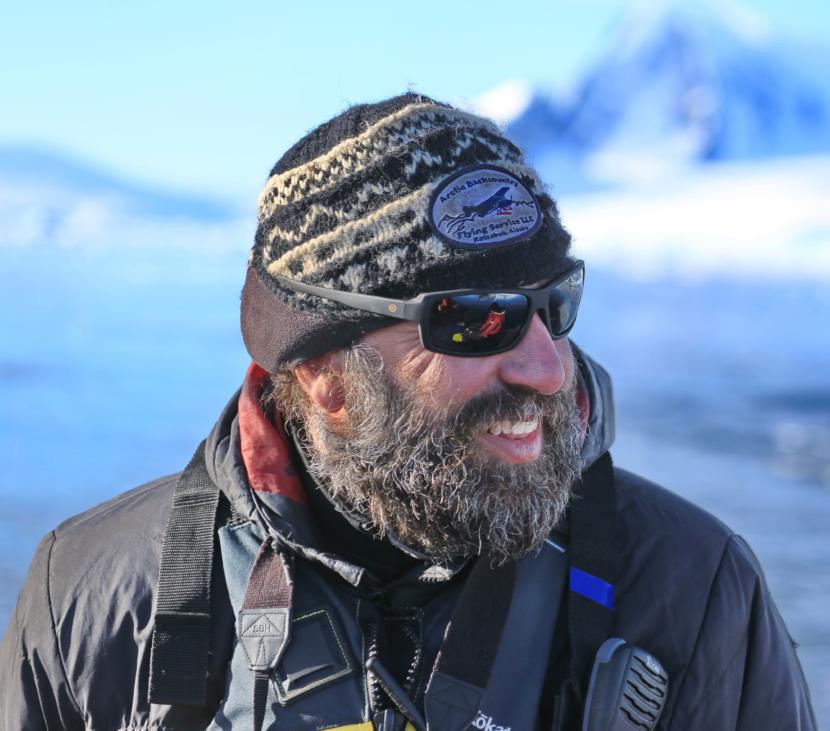
The pilot of a charter plane is dead after crashing near Teshekpuk Lake southeast of Utqiagvik Thursday night.
The North Slope Borough Search and Rescue Department received a distress signal between 9 p.m. and midnight, says spokesperson D.J. Fauske. Fauske says pilot Jim Webster of Fairbanks charter company Webster’s Flying Service died in the crash.
Fauske says Search and Rescue found one passenger alive: Ben Jones, a researcher with the University of Alaska Fairbanks Institute of Northern Engineering. A rescue helicopter brought Jones to Utqiagvik.
“Ben is recovering in Utqiagvik at our hospital there, with multiple fractures,” Fauske said. “(He’s) expected to recover, but obviously severely injured.”
Fauske says Jones and Webster were the only two on the plane. UAF spokeswoman Marmian Grimes says Jones was conducting research at the Teshekpuk Lake Observatory. Jones’s research primarily deals with permafrost and arctic water systems. Grimes didn’t know if Jones was heading towards or away from the research site when the crash occurred.
Fauske says the National Transportation Safety Board is coordinating an investigation into the crash with the North Slope Borough. And he says flying conditions were very bad and foggy when the distress beacon was received.
Fauske says it was important that Webster had a special international beacon that was compatible with the borough’s search and rescue equipment.
“They were able to locate them because of that device,” Fauske said. “Without that device, it was still bright out since it’s that time of year, but it would be very difficult.”
North Slope Borough Mayor Harry Brower thanked search and rescue for recovering Jones, and he sent prayers to Webster’s family.
Michael Wald owns the guiding company Arctic Wild, which runs trips each summer to Alaska wilderness destinations like the Arctic National Wildlife Refuge and Katmai National Park and Preserve. (Photo courtesy Michael Wald)
Since late March, Arctic Wild has been in a deep freeze.
The guiding business normally takes clients to some of Alaska’s most spectacular wilderness destinations, like the Arctic National Wildlife Refuge and Katmai National Park and Preserve.
“People aren’t going to come to Alaska and sit in a hotel room for two weeks to go on a 10-day vacation,” Wald said. “That’s a nonstarter.”
Public health experts have credited measures like the quarantine order with holding Alaska’s COVID-19 case count below every other state in the country, and at least one warns that revoking it could cause a flare-up.
Dunleavy’s order was set to expire May 19. On Friday, the governor announced the required two-week quarantine for people arriving in Alaska will remain in place through June 2.
Tourism advocates and leaders in industries like oil and gas and fishing, which depend on out-of-state workers, say they have not actively lobbied Dunleavy to drop the order; they say the decision is best left to public health officials. But they also note that the quarantine mandate has come with major costs for businesses.
Wald’s business has already lost 40% of his yearly income, and may have to return clients’ deposits, he said. And, Wald added, he’s eager for more details from the state about what kind of tourism will be possible in Alaska over the remainder of the season.
“We’re really anxiously awaiting some guidance from the state,” Wald said. “I’ve got clients calling and emailing every day: ‘Hey, what’s going on with our trip?’ And I don’t have an answer for them.’”
A spokesperson for Dunleavy did not respond to a request for an interview. An Alaska health department spokesman, Clinton Bennett, declined to make officials available for an interview, saying the state is evaluating data and aims to announce any changes this week.
The state has good reasons to proceed cautiously.
One of the hallmarks of COVID-19’s spread across the world has been travel, said Jared Baeten, an epidemiology professor and vice dean at University of Washington’s School of Public Health.
“The most connected places in the world — New York, for example — have had the most substantial outbreaks,” Baeten said. “The places that have been more isolated, particularly ones that have been able to seal themselves off, often have been able to contain the virus.”
If Alaska officials loosen the quarantine requirements, Baeten said, they should be simultaneously standing up different tools for containing the coronavirus and monitoring for its presence.
That could include systems like ramped up contact tracing, which is a technique to track who’s been exposed to infected people. Another option is fever screenings for people arriving in Alaska, or possibly some testing of incoming travelers, Baeten said.
Then, officials should assess the data every week to see if or how cases rise. They should also set thresholds ahead of time that, if crossed, would prompt the state to pull back.
“You’ve got to lay out all the public health strategies that can have impact, and then try to layer them together,” he said.
Some health care professionals remain skeptical about changing the quarantine mandate.
If it’s dropped, residents should expect a jump in cases, given a lack of capacity for widespread COVID-19 testing and contact tracing, said Ben Shelton, an Anchorage doctor who works with an advocacy group for emergency room physicians.
“We’re going to introduce it into the community,” he said. “And the way Alaskans are handling this, not wearing masks and not being cautious, it is going to flare up again.”
Officials in two major Alaska industries that rely on seasonal and out-of-state workers said that companies haven’t been pushing to have the quarantine mandate lessened, in spite of the fact that it’s added substantial costs to their operations.
Oil companies have been housing workers at Anchorage hotels during their two-week quarantines before they fly to shifts on the North Slope.
“It’s just the reality of the situation,” said Kara Moriarty, president of the Alaska Oil and Gas Association.
Seafood processing businesses have been going a step further, placing their workers under the watch of security guards to make sure they abide by the two-week quarantine.
Some companies are spending millions of dollars to comply with Alaska’s health mandates, but they see the quarantine as an important precaution and will keep it regardless of any changes to the state’s requirements, said Nicole Kimball, vice president at the Pacific Seafood Processors Association. The state has indicated that quarantine requirement specific to the processing industry will more likely be tightened than loosened, she added.
“I don’t see the seafood sector removing that part of their plans,” Kimball said. “It’s necessary to keep communities safe.”
Wald, with the guiding company, said the challenge for his business has been the uncertainty. He said he’s used to scheduling each day of his summers more than a year in advance, and now he can’t plan even two weeks ahead right now.
He said he’s waiting anxiously to see whether the two-week quarantine is going to stretch into the summer. And he also said he’s frustrated by how the country hasn’t used the past two months of social distancing measures to set up better alternatives to contain the virus, like widespread testing.
“If you could get people tested before a trip, you could operate, and then the economy would be functioning,” he said. “As it is, we can’t responsibly take people out, and it seems like a real failure of leadership. So I’m angry.”
This story has been updated to reflect that the governor’s mandate requiring a two-week quarantine for travelers arriving in the state has been extended until June 2.
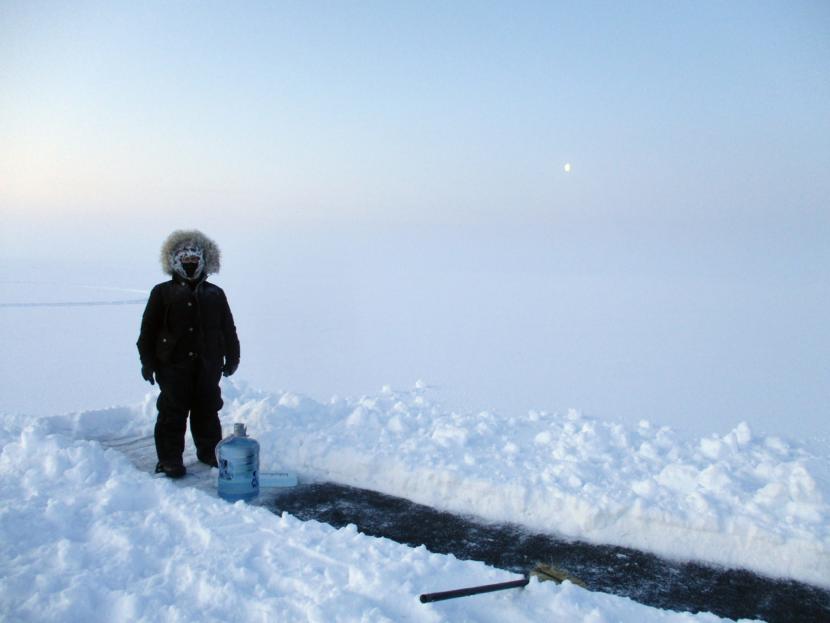
Ph.D. student Natalie Tyler stands next to a bubble survey transect in winter 2019. (Photo courtesy Melanie Engram/University of Alaska Fairbanks)
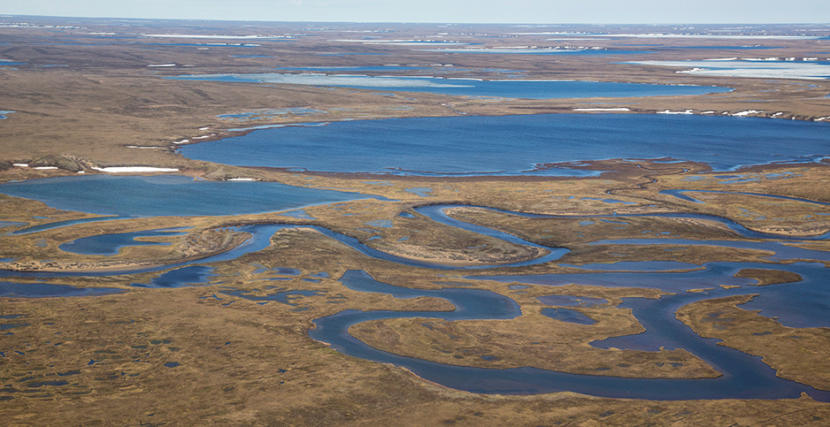
One of the many greenhouse gases that is contributing to global warming is methane. Methane is emitted a lot of ways, including from lakes across Alaska.
However, studies on how much methane flows up from those lakes into the atmosphere haven’t always been very accurate.
New research from the University of Alaska Fairbanks utilizing radar instruments positioned on satellites has led to a breakthrough in lake methane emission research. That research could help climate scientists better see how Alaska’s lakes contribute to the world’s methane emissions.
As permafrost under lakes begins to break down, it releases carbon, which is broken down by tiny microorganisms, which in turn, release methane.
“Sometimes you’ll sit on the edge of the lake and you can see a little pop,” said Melanie Engram, a researcher with the University of Alaska Fairbanks Water and Environmental Research Center. “And you might think ‘oh hey, it’s a fish.’ But it could also be a little methane bubble that’s coming out.”
Since methane is an odorless, colorless gas, it can be difficult to monitor how much is released by lakes. But not when they’re frozen.
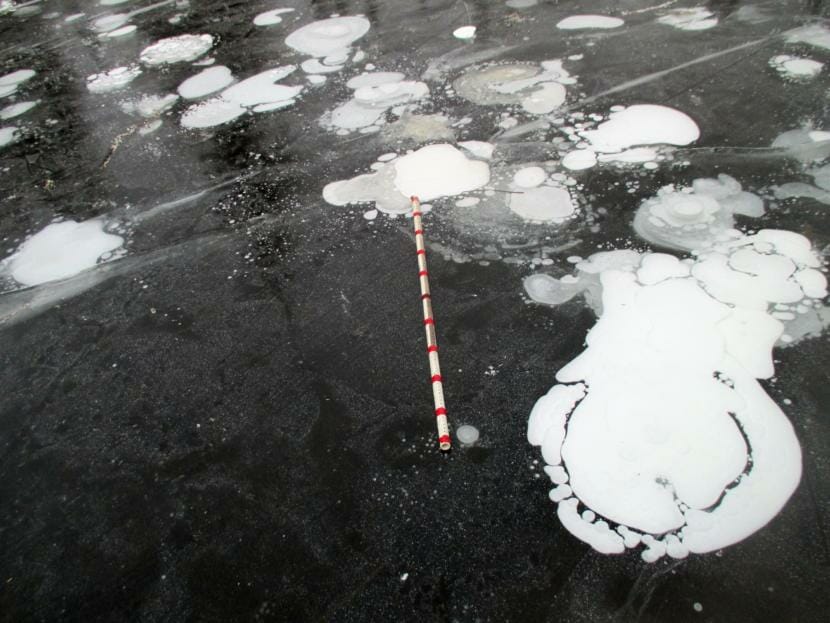
“The ice forms around the bubbles; more bubbles are released and [ice] forms around the bubbles,” Engram said. “And the ice creates a time-lapse freeze frame, pardon the pun. It’s a freeze-frame historical record of the methane bubbling.”
To study these methane bubbles, Engram and other researchers use small bubble traps to make micro-measurements of methane and then scale them up to the full area. However, she says, those aren’t super accurate.
“The bubbling is very spatially erratic and it’s sporadic; you’ll see a big stream of bubbles and then it will shut off for a while,” Engram said.
Methane ebullition bubbles form in early winter lake ice in Interior Alaska. A yard stick is included for scale. (Photo courtesy Melanie Engram/University of Alaska Fairbanks)
Now, UAF researchers have begun to use what’s called a synthetic aperture radar, or SAR, to better map methane being released from lakes. Basically, a satellite sends a pulse down to a lake. A portion of that pulse bounces back to the satellite in what’s called a backscatter. Backscatters range in luminosity from kind of dim to very bright.
“The radar return was brighter in lakes that had more methane, and it was dimmer or lower in lakes that had less methane,” Engram said.
Engram and other researchers used SAR to map methane emissions from 48 lakes across five regions of Alaska, including the northern Seward Peninsula near Kotzebue, lakes near Atqasuk — south of Utqiagvik — and the Fairbanks area.
Of course, researchers still had to go out to the lakes that SAR was mapping to make sure it actually worked. To Engram’s delight, it did.
“It was really exciting for me to go out to a lake that was really bright in SAR, and to snowmachine out to it and dig down in the snow, and there were just bubbles everywhere in the ice,” Engram said. “I was excited. I said, ‘This is working! Yay, it works!’”
Engram says the success of using SAR to map out methane emissions in Arctic lakes means the system can monitor thousands of lakes across the state. And that’s not just exciting from a research perspective. Engram says that there isn’t a lot of global data on methane release from lakes, and use of the SAR can help create a baseline to track in the future. That will be useful to climate scientists tracking changes in the atmosphere.
“People measure methane in the atmosphere and they say how much comes from anthropogenic sources like oil fields and automobiles and agriculture and dairy cows,” Engram said. “They try to divide it up so we can see the different sources. And this will help [balance] the global methane budget.”
Studies show that methane is about 30 times stronger than carbon dioxide as a heat-trapping gas. And while methane is naturally emitted from these lakes, Engram says the amount is drastically dwarfed by the amount produced from those anthropogenic sources.
Engram’s research using SAR to track methane emissions in arctic lakes was the subject of a UAF research paper that was published this month in the scientific journal Nature Climate Change.
Close
Update notification options
Subscribe to notifications
Subscribe
Get notifications about news related to the topics you care about. You can unsubscribe anytime.