Interior

Groups sue to declare Fairbanks air out of compliance

ANCHORAGE — Two Alaska groups want the Environmental Protection Agency to formally declare that Fairbanks is seriously out of compliance with federal air pollution standards.

Citizens for Clean Air and the Sierra Club on Tuesday sued the EPA, claiming the agency missed a June deadline for declaring the Fairbanks

North Star Borough a “serious non-attainment area.”

That designation would kick in stricter pollution control requirements.
The EPA in November 2009 designated Fairbanks a moderate a non-attainment area for fine particulate.

Fine particulate is linked to heart attacks and decreased lung function.
In cold winter months, levels of particulate outside Fairbanks have reached the highest levels in the nation, far above levels allowed under federal law.
EPA spokeswoman Suzanne Skadowski says the agency in general does not comment on active or pending litigation.

Fairbanks man escapes from halfway house for second time

FAIRBANKS — Authorities are looking for a halfway house resident who escaped from a van that was transporting him back to the Fairbanks Correctional Center.

The Fairbanks Daily News-Miner reports that Byron Alvin Toovak, 24, jumped out of the van last week while being driven to the jail at the request of his probation officer.

The incident marked the second time Toovak has escaped from the halfway house in eight months.

He reportedly walked away from the North Star Center in February while serving time for a felony drug conviction. He was arrested a month later and pleaded guilty to an escape charge in July.

Toovak was jailed and transferred to the halfway house in August.
He was last seen wearing a black jacket, gray hat and blue jeans.

Conoco aims to up North Slope production with new drilling rig

06ConocoDrillRig_Harball
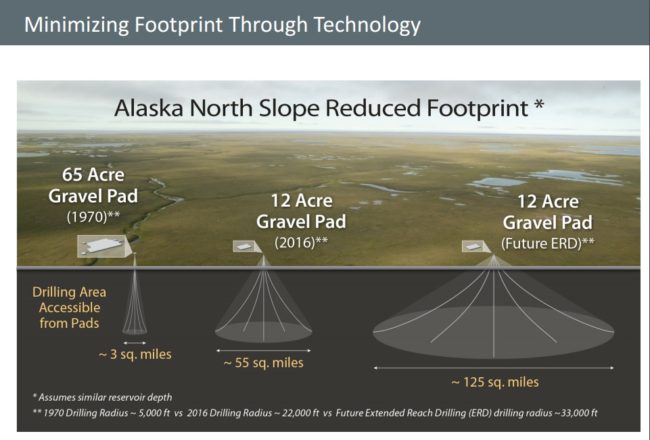
Conoco’s new Extended Reach Drilling Rig will allow the company to access more from a single drill site (Image courtesy ConocoPhillips Alaska)

ConocoPhillips Alaska has announced plans for a new drilling rig on the North Slope that will more than double the area it can develop from a single drill site.

The company is calling it a “potential breakthrough” and said the rig will increase production by making development possible in areas that are currently hard to reach.

It will allow Conoco to access an undeveloped field, Fiord West, from existing infrastructure. Fiord West was discovered in 1996.

Conoco spokeswoman Natalie Lowman said the state would not have extended the company’s Fiord West leases without the contract for the new rig.

“In order to retain our leases, such as those around Fiord West, we have to be able to develop them, and the (extended reach drilling) rig allows us to do that,” Lowman said in an email.

Gov. Bill Walker said in a statement, “I applaud ConocoPhillips and Doyon for their work to spur production during fiscally challenging times. This is welcome news, as it fulfills lease terms for Fiord West.”

ConocoPhillips signed a contract with Doyon Drilling, which is under the Fairbanks-based regional Native corporation, to build the new rig.

It will arrive in Alaska in 2020.

Lowman said under the terms of the contract with Doyon, the company can’t release the rig’s total cost.

Proposed Donlin Gold Mine runs afoul of the Iditarod dog mushing community

The historic Iditarod Trail took center stage during a Tuesday meeting held by the Army Corps of Engineers on the proposed Donlin Gold mine.

The route has been changed, but not far enough to suit some longtime mushers.

Proposed Donlin Gold mine runs afoul of the dog mushing community.

The Iditarod Trail is a National Historic Trail; there is no getting around that.

After Donlin Gold’s original proposal for a natural gas pipeline through Rainy Pass raised a storm of objections from some in the dog mushing community, the route of the proposed buried gas line from Cook Inlet now swings north over the Alaska Range through Jones Pass.

This route was used to avoid Rainy Pass, but it does not go far enough, according to Dan Seavey, one of the pioneer mushers who created the last Great Race and worked hard to get the trail its National Historic Trail designation.

He notes that the gas line would still follow the trail route from Skwentna to Finger Lake.

“I don’t see any mitigation. I see selecting an alternate to the historic trail,” Seavey said.

Many other mushers weren’t at the meeting, because there is a gag order on those who plan to run the race.

Donlin is a major sponsor of the Iditarod.

The Army Corps of Engineers is trying to find ways to mitigate the problem posed by the gas line and other parts of the huge mine project.

Sheila Newman, with the Alaska district of the Army Corps, thinks that with enough people at the table, a solution can be found. She hopes that the Seavey family will continue to be involved.

“It was good he was here to talk about what his concerns are and continue the conversation about, you know, what, if anything, can be done to help address some of them,” she said.

Donlin points to community archeological projects like the one recently conducted at Crooked Creek, the nearest village to the mine site, as a method to help mitigate problems.

But as far as moving the pipeline right-of-way off the trail route, Enric Fernadez, senior environmental coordinator for Donlin Gold, says the reason it runs along the Iditarod Trail to the Alaska Rage is because of the geography of the region.

“It offers the best geo-technical conditions to place a pipeline, which is coincidentally the reason why the Iditarod Trail is there,” Fernadez said.

There are those who say the company needs to build connections between its proposed gas line and nearby villages.

David Gililak Sr. from Akiak says he doesn’t see any reason to build it if it does not improve the infrastructure to the point that affordable natural gas will be available to local residents.

“They shouldn’t actually build a pipeline if it’s not going to benefit Calista region, because we’re the most economically, electrically, socially depressed region in the state,” he said.

Calista Corporation owns the subsurface rights for the proposed mine site.

June McAtee, vice president of Lands and Shareholder Services for Calista, said the Donlin Gold project is not a social service, but it would provide an economic boost to the region, and Donlin’s proposed pipeline would bring affordable natural gas that much closer to the Yukon Kuskokwim Delta.

“The prices of fuel and power and everything else in the region are very high, and there’s no way they’re ever going to come down unless you build something. That’s where we’re coming from, and we think this project has the potential to help us get things built in the region.”

But even if all these issues are resolved, some village residents worry that the pipeline will open remote areas to outside hunters.

Gililak said the temporary road used to build the gas line won’t stay temporary, even if the company tries to close it, and that would have consequences for Akiak.

“They will be coming in from all over the world. It is a whole lot cheaper to drive than to fly,” Gililak said. “I mean we’ll have a lot of traffic in that area, eventually to the point where the state will have to call it a road.”

The Army Corps of Engineers plans to hold another meeting on the issue in Bethel by the end of the month or early November.

To cut costs, UAF merges journalism and communications majors

One of numerous cost saving realignments within the University of Alaska system, the University of Alaska Fairbanks Journalism and Communications departments have merged.

Professor Charles Mason said the merger should save money, and shore up the journalism department, which has seen a declining number of majors in recent years.

”The point of this merger is to have, probably, a smaller core faculty over the long run, but increase the number of majors in the two programs together so that it’s a single department with a reasonable number of majors and a pretty large number of students,” Mason said. “And the savings will come in through that.”

Mason says the combined journalism-communications program has more than 60 majors, and a dozen graduate students.

He said the merger, which includes plans for co-location at a single facility, has resulted in the elimination of an administrative job, but that no other cuts are currently planned.

He noted that the department hopes to hire for an open journalism professor position.

Online fundraiser nets nearly $50K for erosion-control project at Delta-area park

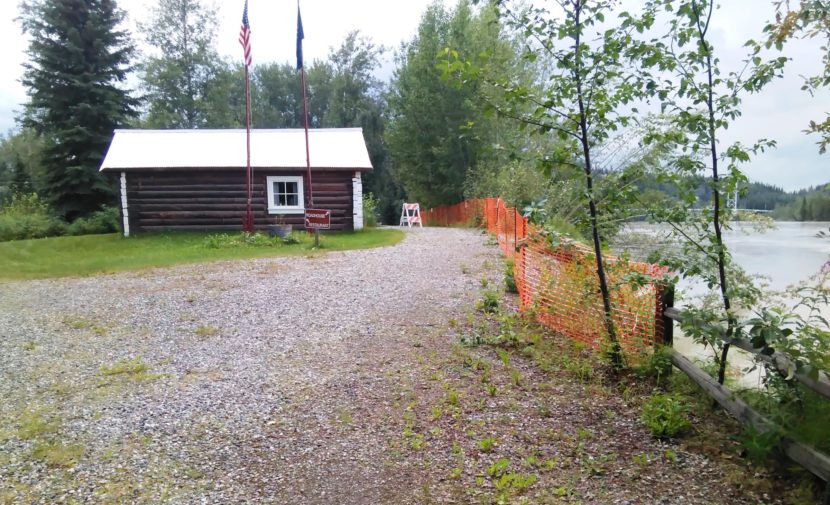
Alaska State Parks is trying to raise money for a riverbank-stabilization project that would halt the Tanana River from washing away the bank that's already been eroded to within 13 feet of this historic cabin at Big Delta State Historical Park. (Photo by Monica Gray/ Alaska State Parks )
Alaska State Parks is trying to raise money for a riverbank-stabilization project that would halt the Tanana River from washing away the bank that’s already been eroded to within 13 feet of this historic cabin at Big Delta State Historical Park. (Photo by Monica Gray/ Alaska State Parks )

Donors gave nearly $50,000 to an online fundraiser last month to help pay for a project to prevent the Tanana River from washing away the bank that runs along Big Delta State Historical Park near Delta Junction.

Alaska State Parks will use the donations as a match for further fundraising to pay for a bank-stabilization project riverbank to prevent further erosion.

Alaska State Parks Superintendent Brooks Ludwig said Monday the online crowdfunding drive that ended late last month went well, but fell just a bit short its $50,000 goal.

“We’re at about $48,200, I think, at the last count,” he said. “And actually, the donations are continuing to come in.”

Ludwig says State Parks will continue to accept donations through February while the agency applies for grants and other funding to pay for work to stop the Tanana River from washing away more of the south bank that runs along the Big Delta State Historical Park.

The Tanana cut deeply into the bank last summer after rains raised the level of the river to near flood-stage, and the high water undercut a bluff on which an historic cabin was located. The bluff collapsed to within 13 feet of the structure before State Parks jacked it up in August and moved it away from the river.

“We’re working to see what we can do with the state funding and the private donations,” he said. “Maybe we can leverage that for some federal funding for bank stabilization and some habitat work.”

Ludwig says 87 people donated to the cause, along with several private- and public-sector donors that kicked in big bucks and in-kind donations of materials such as boulders and “root wads,” or the big, gnarly bundles of tree roots that’re yanked out when land is cleared and that are useful in building aquatic habitat.

“If we can find some root wads, that’d be very beneficial because it’d be really nice to incorporate that in the bank restoration to preserve the salmon habitat there,” Ludwig said in an interview Monday.

He says engineers are surveying the bank now to develop a design for the project, which he says will get under way in the spring.

“We’re going to get at it in April, while the water is still very low,” he said, “and get in there and harden the bank before the water starts coming back up again.”

Site notifications
Update notification options
Subscribe to notifications