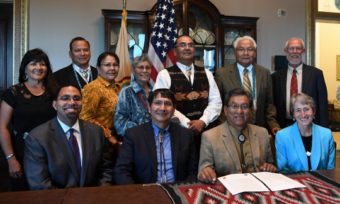
The White House Tribal Nations Conference convenes leaders from the 567 federally recognized tribes to interact directly with high-level federal government officials and members of the White House Council on Native American Affairs (Public Domain photo courtesy of the U.S. Department of the Interior)
Interior Secretary Sally Jewell addressed AFN Friday. Jewell announced a new secretarial order that requires the Department to include Native communities and traditional ecological knowledge in land management decisions.
Earlier in her talk, Jewell reviewed gains made in recent years which have brought federal managers and tribal leaders closer together in collaboration on resource issues, specifically pointing to working toward greater tribal engagement in subsistence issues.
“I’m announcing today a new secretarial order, which encourages collaborative agreements between Interior Department’s land managers and federally recognized tribes,” Jewell said.
“The purpose is to provide guidance to our nation’s public land and water managers to make sure that when we share resources with a special geographical, historical and or cultural connection with tribes, that Natives have a meaningful and substantive role in their management.”
She cited an example of federal managers working with tribes in the Ahtna region on solutions to hunting pressure on moose.
Jewell said her new secretarial order provides guidance to managers that native communities have a meaningful and substantive role in decisions.
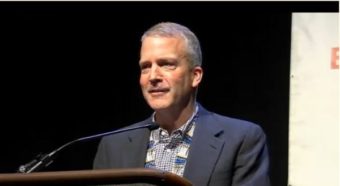
Sen. Dan Sullivan addresses the 2016 AFN on Oct. 21, 2016. (Courtesy of the Alaska Federation of Natives)
U.S. Sen. Dan Sullivan spoke at AFN Friday afternoon about improving water and sewer access in rural Alaska and about helping Alaska Native veterans.
Sullivan said that he is working to raise awareness in Congress about the more than 30 villages that still don’t have running water or sewers.
The federal government will give $1.4 Billion dollars nationwide to build new systems, but Sullivan says they need to start putting the money to work.
“The bottom line is we have to get our federal agencies to stop studying these issues and start helping us build these important infrastructure projects that are going to help our communities.”
Sullivan is also working on a bill addressing military veterans who missed the opportunity to apply for native allotments because they were on active duty. The bill would give the veterans and their families the chance to apply now.
Representatives of the Alaska Federation of Natives and the National Congress of American Indians met Wednesday in Fairbanks to discuss a range of topics, including opioid and heroin addiction in rural Alaska.
Alaska State Trooper Sgt. Kevin Blanchette with the western Alaska Drug Enforcement unit was among several presenters on the issue.
Blanchette said prescription pain killers and heroin have become a top priority for the unit.
“Right now, the opioid addiction problem is just as prevalent as the alcohol use and abuse problem,” Blanchette said. “And what we’re seeing now is a lot of these are overlapping. A lot of people are prescribed these medications.”
“They’re not only drinking an excess amounts of alcohol every day,” he said. “They also take in an excess amount of pain pills. And when you fix this high level of alcohol with these opiates, you have a very real chance of death or overdose.”
Addiction to prescription pain killers often leads to heroin use.
This summer, an especially potent batch of heroin that caused several overdoses and a death in the village of Quinhagah resulted in a village dealer turning himself in, Blanchette said.
”The people, let’s say in Quinhagak or in Bethel who are maybe low level dealers, what needs to happen to get the ball rolling in their treatment is sometimes an arrest or to be charged with crimes,” Blanchette said.
Drug interdiction efforts generally focus on opioids coming into Alaska from outside and through hub communities, but Blanchette highlights the need for information from village residents to help piece together the drug trafficking puzzle.
He also points to a new public outreach effort in villages to educate kids about the dangers of opioids.
“And if we can get the message to them, so they grew up to not be users and the medical field can change their practices, maybe we can stop this new generation from becoming addicted to this drug,” Blanchette said.
Dr. Joshua Sonkiss, medical director at Fairbanks Community Mental Health said opioids were increasingly prescribed in recent decades as regulations required more aggressive treatment of pain.
Over-prescribing resulted in the current addiction problem, he said.
A Fairbanks Four banner at the 2015 Alaska Federation of Natives Conference. (Photo by Mikko Wilson/KTOO)
The Alaska Federation of Natives board and convention attendees made an impassioned plea to Gov. Bill Walker last year for the release of the Fairbanks Four — four men who were imprisoned for 18 years for a murder they say they did not commit. Two months later in December, the three men who were still in jail were released.
In comments to the AFN convention Thursday, Fairbanks Mayor John Eberhart called on the City of Fairbanks and the State of Alaska to compensate the men for wrongful imprisonment.
“There’s serious questions about the case and the truth and I urge the state and the city to consider an ex gratia or voluntary payment to the Fairbanks Four,” Eberhart said.
Eberhart, who previously worked for the Tanana Chiefs Conference, said the city was working with the organization on a Department of Justice process called collaborative reform. The DOJ touts the process as a “holistic strategy that identifies issues within an agency that may affect public trust.”
Bill Oberly is the director of the Alaska Innocence Project and was active in efforts to free the Fairbanks Four. Oberly was one of the recipients of the Denali Award, the highest award given by AFN to a non-Native.
A 29-year-old man has been arrested in the shooting of a Fairbanks police officer. Anthony George Jenkins-Alexie was taken into custody by Fairbanks police Tuesday morning in connection with the shooting of police Sgt. Allen Brandt.
Jenkins-Alexie has been charged with first degree attempted murder, first degree assault, vehicle theft and tampering with evidence.
Fairbanks acting police chief Brad Johnson said the suspect has a “lengthy criminal history and has previously made threats against law enforcement.”
Jenkins-Alexie was arrested while out taking a walk.
Johnson said at a news conference Tuesday afternoon that the suspect posed “a serious threat to everyone.”
Jenkins-Alexie is accused of opened fire on Brandt on Sunday. Brandt was struck four times in the lower part of his body and once in the chest. Brandt was wearing body armor that protected his chest area, but his legs were badly injured and he sustained shrapnel in his left eye, Johnson said.
“He is awake, alert and in stable condition,” Johnson said.
Brandt remains in stable condition at an Anchorage hospital.
The court is hearing arguments Wednesday in a case between Robert Riddle, who hauls septic tank waste for a living that he stores and uses on Fairbanks-area farmland he owns, and Eric Lanser, a neighboring landowner and homebuilder.
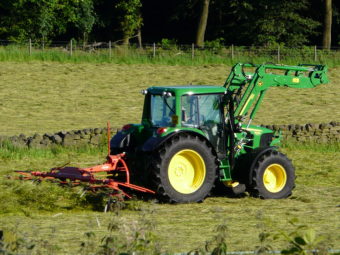
While it sounds like a classic nuisance case, it’s atypical because Robert Riddle’s defense invokes a 1986 law known as Alaska’s Right to Farm Act. The law gives existing farms that meet certain conditions immunity to private nuisance complaints, like the smell of sewage sludge drifting across property lines.
A key question the Supreme Court must decide is whether Riddle is entitled to the act’s protections – does his land and the sewage lagoons on it meet the law’s definition of a farm?
The lower court judge sided with the developer, Eric Lanser, and ordered Riddle to cut the odors. Some of the rhetoric around deciding if Riddle’s land was a farm had to do with its finances and the idea of “commercial production.” Riddle’s farm doesn’t do much business. He makes his living hauling septage.
The attorneys in the case declined to comment ahead of their day in court, but farming interests in the state are watching this case closely.
Bryce Wrigley is a working farmer — he has a flour mill in Delta for cereal, couscous and the like — and he’s the president of the Alaska Farm Bureau. Wrigley said the farm bureau, an advocacy organization, hasn’t taken an official position on the case itself, but it is concerned about broader potential impacts.
“Setting a precedent and a litmus test by saying, this is not a farm because they haven’t sold anything or they haven’t sold enough is a dangerous thing, we believe. And we believe it undermines the integrity of that right to farm law,” Wrigley said.
He said peony farms, for example, could take three to five years to produce flowers for sale.
“So that was troubling. Especially where I had been out there. … There’s no question in my mind that he had a farm. I saw his crops, I saw equipment, I saw that he had harvested, he had animals out there. I mean, there’s nobody in their right mind that could say he didn’t have a farm. … Man, it just blew my mind that anybody could consider that not a farm,” Wrigley said.
According to the Fairbanks Daily News-Miner, Riddle has tried growing peonies, as well as sod, hay and potatoes. He’s also sharecropping.
Wrigley said whether farming is a side business or not should be immaterial to the case. He said lots of farmers work separate day jobs.
Gavel Alaska is providing live streaming and television coverage of the Supreme Court’s hearing on the case at Colony High School in Palmer. Coverage begins at 9 a.m. on 360 North television, or stream it here.
Close
Update notification options
Subscribe to notifications
Subscribe
Get notifications about news related to the topics you care about. You can unsubscribe anytime.