Interior

As Climate Changes, Meteorologists Relying Less on ‘Using the Past to Inform the Future’

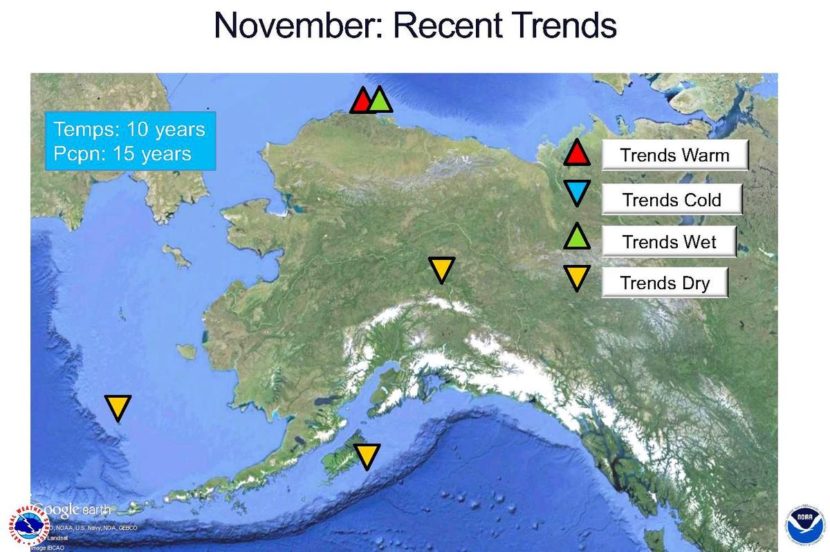
The National Weather Service has kept records for than a century on Alaska's weather, but Thoman relies on more recent trends for his 2016-17 winter forecast: the past 10 years of temperature data and 15 years of precipitation data. The data suggest there will be less precipitation next month in the Interior but more along the Arctic Ocean coast, and warmer temperatures..
The National Weather Service has kept records for than a century on Alaska’s weather, but Thoman relies on more recent trends for his 2016-17 winter forecast: the past 10 years of temperature data and 15 years of precipitation data. The data suggest there will be less precipitation next month in the Interior but more along the Arctic Ocean coast, and warmer temperatures.
(Courtesy National Weather Service)

National Weather Service meteorologist Rick Thoman predicts more snow, more cold snaps – more normal winter weather – in Alaska this year now that the El Niño phase that helped make last winter so mild has moved on and been replaced by a La Niña.

At least, that’s what’s happened in previous years. But he says climate change has made forecasting in the Arctic more challenging.

“Well, that is the big problem with using the past to inform the future,” Thoman said.

Experts such as John Walsh, chief scientist with the University of Alaska Fairbanks’ International Arctic Research Center, say climate change always must be taken into consideration when analyzing weather in the far north.

“No weather event is completely independent of climate change,” Walsh said in an interview last year.

Thoman says the weather service has pretty good data collected over the past 65 years on the so-called Pacific Decadal Oscillation, or PDO, cycle that drives El Niños and La Niñas.

But he says meteorologists are relying on data from recent years because climate change is a more recent phenomenon that’s made older data, collected before the Arctic began to warm so quickly, less relevant.
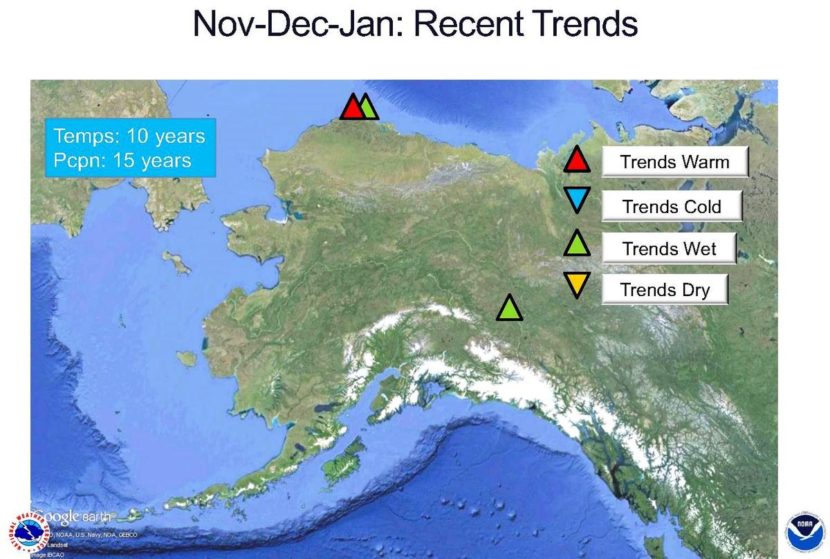
Thoman's "mid-winter" forecast, for November through January, also is based on more recent temperature and precipitation data. It calls for above-average snowfall in the Interior and continued above-average temperatures and snowfall along the Arctic Ocean coast.
Thoman’s “mid-winter” forecast, for November through January, also is based on more recent temperature and precipitation data. It calls for above-average snowfall in the Interior and continued above-average temperatures and snowfall along the Arctic Ocean coast.
(Courtesy National Weather Service)

“So it does shorten our record, and that’s bad, because then we wind up with fewer, say, La Niñas winters to develop these kinds of averages,” he said. “But the tradeoff is that we’re not including winters that are not really appropriate for what we have today.”

The size and location of a large body of warm water in the equatorial Pacific Ocean drive the transition from El Niño to La Niña. And Thoman says researchers are studying other phenomena that occur in lower latitudes that may play a role in La Niña. But he says in the Arctic, it’s the local factors that exert a more powerful influence on the region’s weather.

“The changes are happening so fast in the Arctic – with sea-ice loss, with increased time of no snow cover – that that’s really the driving feature. And the lower-latitude factors are being swamped those big cryosphere changes,” he said.

And because sea ice is sparse around Alaska, and snow comes later and melts sooner, Thoman says this winter is likely to be cooler and snowier than the past few winters. Still, he says it’ll be a relatively mild winter, compared with La Niña winters of years past, because the climate overall is warmer now.
Denali’s dogs: Protecting the environment and preserving heritage

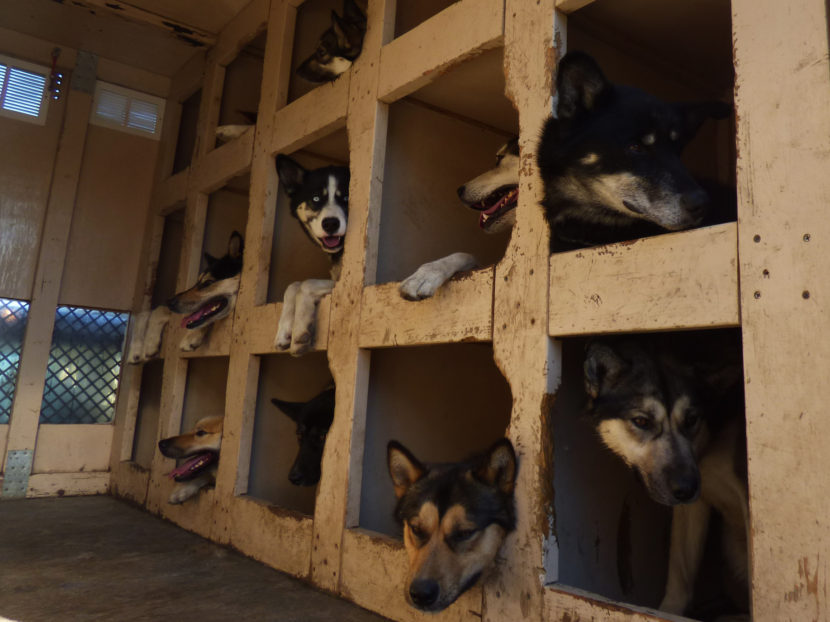
In the winter, Denali's sled dogs ferry park employees through areas closed to motorized vehicles. (Zoë Sobel/KUCB)
In the winter, Denali’s sled dogs ferry park employees through areas closed to motorized vehicles. (Zoë Sobel/KUCB)

Early on a crisp, fall morning a large white truck sits alone in a dirt parking lot at Riley Creek Campground.

Denali kennel manager Jennifer Raffaeli takes six huskies out of the van, fits them in harnesses, and hooks them to a line attached to a green metal cart that looks like a dune buggy. Raffaeli fastens her helmet.

On the trail, the only sound is the wheels whirring along the ground. The six-dog teams pull two humans around trails that wind in and around the campground.

On this day, each team is running about five miles, and then it’s back to the kennel. By the start of the winter season, the dogs will be doing 20-mile days. Over the course of the winter, they will log around 1,500 miles each.

It may seem backward, but Raffaeli says winter is the easiest time to move cargo through the park.

“Swamps and bogs and thick brush are the norm across Alaska,” said Raffaeli. “That’s challenging and slow going, especially if you are trying to move big heavy objects. When the park is covered with snow and rivers are frozen, you can carry huge loads because you’re not trying to carry them on your back. You’re sliding them over snow and ice, and that’s no problem for these guys.”

Pound-for-pound, Raffaeli says sled dogs are the strongest draft animals on the planet. That makes them the perfect tools for transportation through Denali’s designated wilderness — areas of the park that prohibit motorized vehicles.

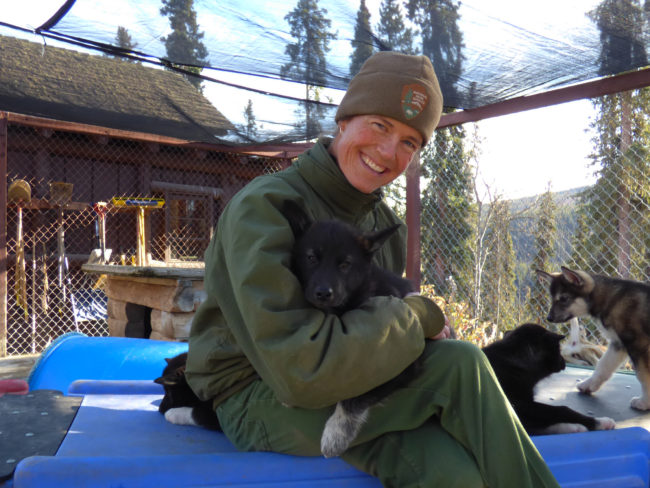
Jennifer Raffaeli plays with the kennel's newest members. (Zoë Sobel/KUCB)
Jennifer Raffaeli plays with the kennel’s newest members. (Zoë Sobel/KUCB)

Dogs have been a part of Denali for the entire history of the park. In 1921, Harry Karstens was hired as the park’s first superintendent and insisted on having dogs.

“It made perfect sense as you created a two-million-acre park, which is a huge area to try and cover as one person. You were going to need some dog teams to cover that,” she said.

Back then, Raffaeli says dogs were the only way rangers could traverse the park and protect wildlife, like caribou and Dall sheep, from poaching. But over the years, the role of Denali’s sled dogs has changed.

In 1980, the Alaska National Interest Lands Conservation Act, or ANILCA, labeled the original two million acres of Denali as wilderness — the highest level of federal land protection — and gave renewed purpose to the park’s sled dogs.

The Wilderness Act requires that land managers look at the minimal tool for the task at hand,” Raffaeli said. “We’re always asking: Can we accomplish this project with dog teams?”

And if they can, they will. Over the winter, the teams are out for up to five weeks at a time. They haul supplies, support glacier research, and monitor man-made noise.

Plus, Raffaeli believes meeting a dog team in the field adds to the wilderness experience for park users.

“To encounter only a dog team on the trail — no snow machines, no other forms of motorized transport — is a form of peace and quiet and wildness that’s getting more and more rare,” she said. “It’s more and more valuable that we continue that heritage here.”

That’s a heritage that in many ways is fading. Denali’s huskies aren’t just the best method of winter transport. They help preserve what many people remember as daily life in Alaska.

But in a rapidly changing climate, Raffaeli is uncertain about the future of the dogs.

“If we start to get warmer winters with less snow, how does that affect the dogs?” Raffaeli said. “How do we evolve to face that new environment? I think those are really valid questions. But at the core of it all, I hope the dogs are always part of the story because they are such a special part of it.”

Back on the trail, the dogs are finishing their 30-minute morning workout. Raffaeli pulls into the campground parking lot and eases the team to a stop.

She jumps off and ladles water into one tin dog bowl after another. The dogs lap it up. When they are done, they go back in the van. It’s time for Raffaeli to get the next team ready for its five miles on the trail.

There’s no question, the dogs love their job.

Video: Below ground in the Fairbanks permafrost tunnel

Ancient microbes, unusual ice structures, mammoth bones — there’s a lot happening below the surface in the Fairbanks Permafrost Tunnel Research Facility. The underground laboratory, operated by the Army Corps of Engineers, is kept at a constant 27 degrees Fahrenheit. Environmental science researcher Dr. Andrew Balser leads a tour of the facility and discusses the research taking place there.

A week after return to duty, Fairbanks police chief back on leave

Fairbanks city police Chief Randall Aragon is on administrative leave again.

A week after outgoing Mayor John Eberhart returned Aragon to duty, newly sworn in Mayor Jim Matherly reversed the order Tuesday and put the chief back on paid leave.

The decision is because an independent investigation into whether or not a private security business operated by the chief constitutes a conflict of interest, is still pending, Matherly said.

“It’s my responsibility to see the report, present it to the council and then decide what the next action should be,” Matherly said. “But I wanted to send a message that whether you’re the chief or somebody else in city hall, you need to be held to the same standard of at least getting in the report and then finalizing it that way.”

Aragon was first placed on leave in mid-September, when allegations were initially leveled.

In bringing the chief back last week, former Mayor Eberhart cited several reasons, including an internal city investigation that found nothing requiring corrective or disciplinary action.

Deputy Chief Brad Johnson has resumed the role of acting chief.

Concerns over tribal, corporate affiliation prompt candidate to withdraw AFN leadership bid

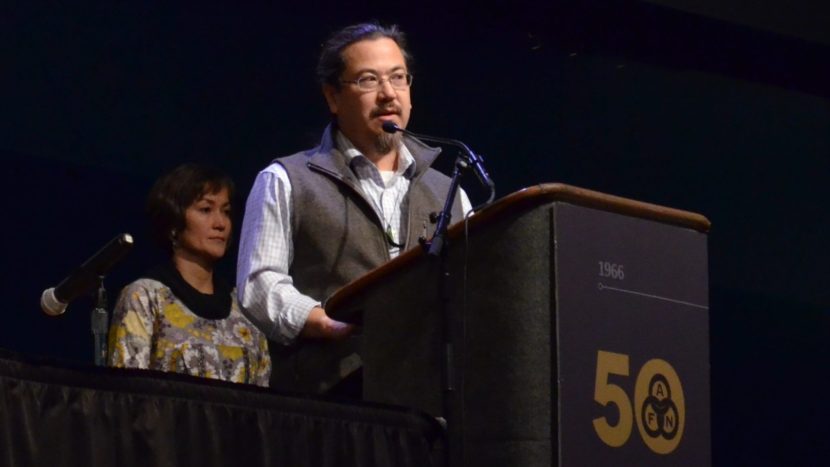
Joe Nelson withdrew his candidacy for co-chair of the Alaska Federation of Natives board at the 2016 convention. Behind him is co-chair Ana Hoffman. (Photo by Jennifer Canfield)

Southeast’s Joe Nelson withdrew his bid for a leadership position on the Alaska Federation of Natives board citing concerns from some in the delegation that the spot should go to a tribal representative. 

Nelson took the stage Saturday to explain to the convention his withdrawal, calling it a “very tough decision.”

“There’s a view that this seat is a tribal seat, a very strongly held view by a good contingent of our AFN population. So, in that sense, you could say maybe this election is rigged, since I’m not being viewed as a tribal person for this purpose right now,” Nelson said to laughter from the crowd. “I have such respect for the tribes and faith in the tribes that I am going to respect that and not push this to a vote this afternoon.”

Outgoing co-chair Jerry Isaac announced on the first day of the convention that he would not seek another term. Isaac, according to his bio on the AFN website, is president of the Copper River Native Association, a tribal nonprofit. The other co-chair, Ana Hoffman, is president and CEO of the Bethel Native Corp.

Nelson said he wanted to unify the delegation by supporting Will Mayo, a former president of the Tanana Chiefs Conference in Fairbanks. Mayo thanked Nelson for the withdrawal.

“Those are the comments of a leader and the heart that he brings to this is a very humble heart. I have found that that kind of a heart is the one that people can follow,” Mayo said.

Nelson, who serves on the AFN board, is a Sealaska Corp. board member and vice chancellor of University of Alaska Southeast. He lives in Juneau and is a member of the Yakutat Tlingit Tribe.

Presbyterian Church apologizes for role in forced assimilation of America’s indigenous population

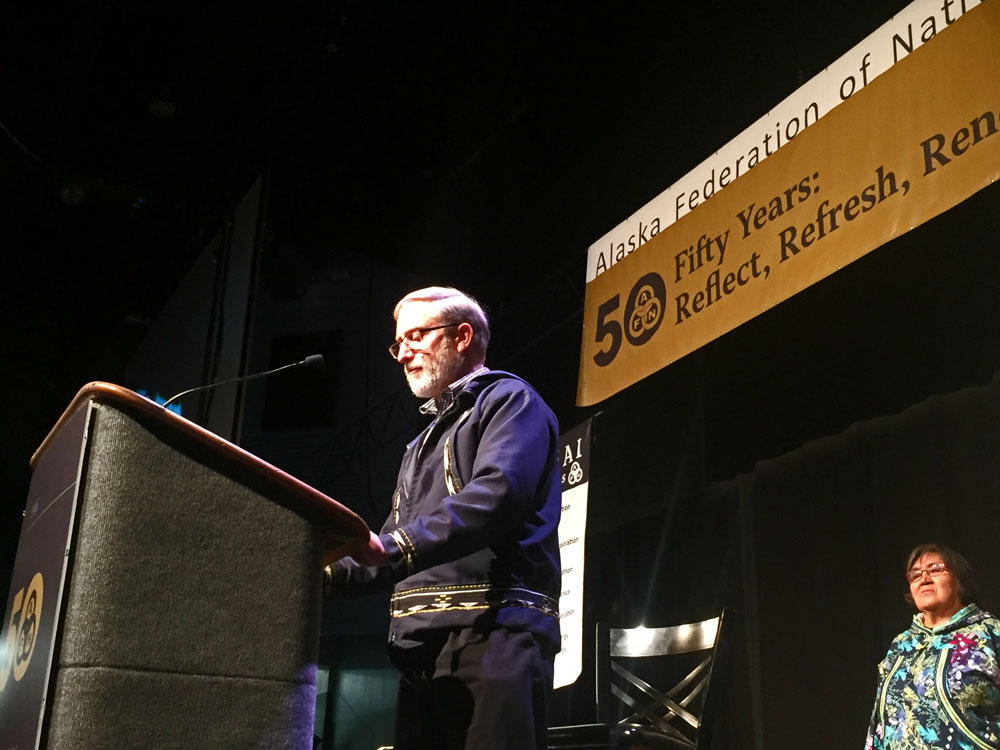
The Presbyterian Church's Curt Karns read an apology before hundreds gathered for the Alaska Federation of Natives Convention in Fairbanks, Alaska. (Photo by Emily Schwing/Northwest News Network)
The Presbyterian Church’s Curt Karns read an apology before hundreds gathered for the Alaska Federation of Natives Convention in Fairbanks, Alaska. (Photo by Emily Schwing/Northwest News Network)

The Presbyterian Church officially apologized to indigenous people across the country during a gathering of Alaska Native people this weekend at the Alaska Federation of Natives Convention in Fairbanks.

For decades the church took part in the forced removal of children from their homes and families.

Some of those children came from the Nez Perce tribe.

From 1879 to 1940, they were sent by train to a government boarding school in Oregon, where their braids were cut off and they were forced to wear military uniforms.

Presbyterians missionaries taught at that school and ran others in Idaho as well.

Curt Karns, an executive priest in the church’s Yukon region, read the apology before hundreds of attendees at the 50th annual convention of the Alaska Federation of Natives.

“You did nothing wrong,” Karns said. “You were and are the victims of evil acts that cannot under any circumstances be justified or excused.”

Jerry Isaac, a well-known Alaska Native leader, thanked the Presbyterian church, but also asked for more.

“I sure wish that other entities that were so guilty, come forward and do the same, including the U.S. government,” Isaac said.

The church’s apology is similar to one made last spring for what it called “racist actions” during the civil rights era in the 1960s.

Site notifications
Update notification options
Subscribe to notifications