Interior

Alaskapox a subject of scientific intrigue while world copes with more dangerous monkeypox

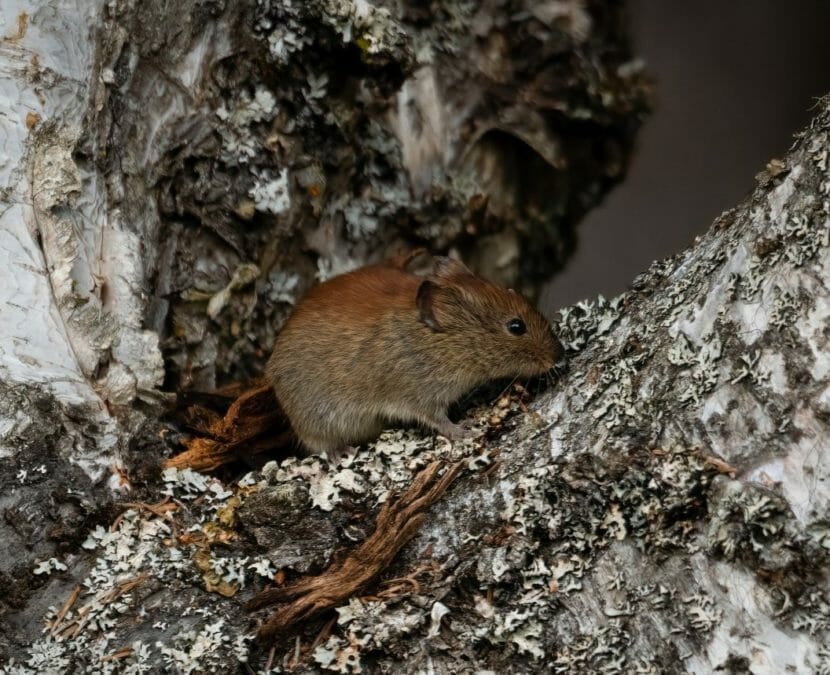
A lone vole
A northern red-backed vole scampers through a forested area of the Kenai Peninsula. Voles and other small mammals are the likely reservoirs of Alaskapox virus, a recently identified and much more rare relative of the monkeypox virus. (Photo by Colin Canturbury/U.S. Fish and Wildlife Service)

Monkeypox, a potentially deadly disease caused by a virulent strain of a virus in the Orthopoxvirus genus, is spreading at an alarming rate, with over 1,800 U.S. cases identified as of mid-July in all but seven states.

Farther north, there is a much rarer, much more recently discovered and apparently much more benign cousin of monkeypox: Alaskapox.

From all indications, the reservoir for the Alaskapox virus is small mammals — as is the case with monkeypox, which contrary to its name, appears to be maintained in rodent populations.

No cases of monkeypox have been detected in Alaska, even though the state Department of Health has urged residents to be on the lookout for it.

As of now, only four people are known to have ever been infected with Alaskapox, three women and one child, all in the Fairbanks area. Since then, investigators have tracked the virus to tiny voles and similar animals that scurry around the region’s boreal forest.

The first human case was in 2015 and discovered by Dr. Zachary Werle of Fairbanks, who treated a patient with what seemed like a spider or insect bite, along with some other illness symptoms that included fatigue and swollen lymph nodes. Werle took a sample, sent it off for analysis, and it was ultimately identified by the Centers for Disease Control and Prevention as a new-to-science strain in the Orthopoxvirus family. It got named for the state where it was discovered.
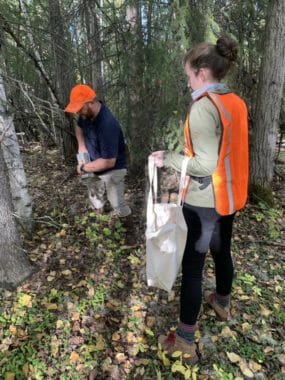
Two people collecting samples in a boreal forest
Katherine Newell, a CDC Epidemic Intelligence Service officer assigned to the Alaska Department of Health, works with colleague Clint Morgan in the Fairbanks area to collect small mammals that might be carrying the novel Alaskapox virus. The trapping campaign, conducted in September of 2021, found about three dozen small animals with signs of past viral infection or carrying the virus itself. Most of the affected animals were red-backed voles. (Photo by Dr. Florence Whitehill/CDC)

The second case was in 2020, and two more cases emerged last year. Among the four patients, three were in households with pet cats or dogs or both, which might have been the links between the wild populations and people. There is no evidence that Alaskpox can be spread between people.

While the symptoms have been uncomfortable, Alaskapox has been nothing like its more serious relatives: smallpox, which was present for thousands of years and is believed to have killed more than 300 million people in the 20th century alone but was eradicated globally by 1980, and monkeypox, which causes milder smallpox-like symptoms but nonetheless can cause fatalities, especially among young children, according to the World Health Organization.

Alaskapox does not seem to pose much of a threat to people — at least, not yet.

“It’s difficult to know how a new virus will behave in a population when we only have four cases. We can’t say that it affects all individuals in a population in the same way because we just don’t have the data,” said Katherine Newell, a CDC Epidemic Intelligence Service officer assigned to the Alaska Department of Health. “We don’t know how it might affect, for example, immunocompromised individuals or individuals with serious underlying health conditions because we haven’t seen those population groups affected.”

It is possible that more people have been unknowingly infected, as the symptoms are “pretty non-specific,” Newell said. “A lot of people might just think it’s just a spider bite and feel slightly under the weather and not think much more of it,” she said. Hence the public education campaign by state health officials, she said.

Discovery grabs attention and raises questions

As a newly identified zoonotic disease – meaning a disease that can pass between species – it has gotten a lot of attention from scientists at the CDC and elsewhere. “As with any emerging infectious disease, the CDC is always going to be very interested in finding as much as we can about the virus,” Newell said.

A key question is: How broadly is this spread in the environment?

After last year’s two cases were identified, Newell and colleagues from University of Alaska Fairbanks and the CDC fanned out into the boreal forest around Fairbanks last September to try to get some answers. They trapped 209 small mammals to get tissue and blood samples. The results: 32 of the animals, mostly red-backed voles but also flying and red squirrels, had antibodies showing exposure to some type of Orthopoxvirus, and seven red-backed voles were carrying Alaskapox virus, as shown by DNA analysis.

None of those animals appeared to be affected by Alaskapox or any related virus. “We didn’t find any lesions and they didn’t look sick,” she said.

Another question to be answered: How long has Alaskapox been in the environment?

Newell and her colleagues discovered that Alaskapox predates the discovery of human infections by at least a couple of decades. Tests of animal tissue samples stored at the University of Alaska Museum of the North revealed signs of the virus in red-backed voles dating back to the 1990s, she said.

That compares to monkeypox, which was discovered in 1958 in captive monkeys in Denmark, with the first human infection recorded in 1970 in a baby boy in the Democratic Republic of Congo. So far, the current outbreak has resulted in about 22,500 documented cases globally, according to the CDC.

Discoveries show importance of often-neglected small mammals

To Falk Huettmann of UAF’s Institute of Arctic Biology, the recent Alaskapox discoveries carry lessons about environmental health and zoonoses.

There are all sorts of viruses and diseases running through animal populations, such as the current highly pathogenic avian influenza, Huettmann said. The vast majority are unknown to people, he said.

“The issue is about detection. You need to detect to confirm,” he said. When zoonotic diseases are discovered, it’s either by random chance or when there’s a problem “so big that you can’t ignore it,” he said. “In the meantime, there is a lot of stuff out there that we don’t know.”

Another lesson is the importance of small mammals, which are critical parts of entire ecosystems. “They get overlooked,” he said. “Small mammals are not well understood. They’re not well-studied. We do not understand what are the dangers.”
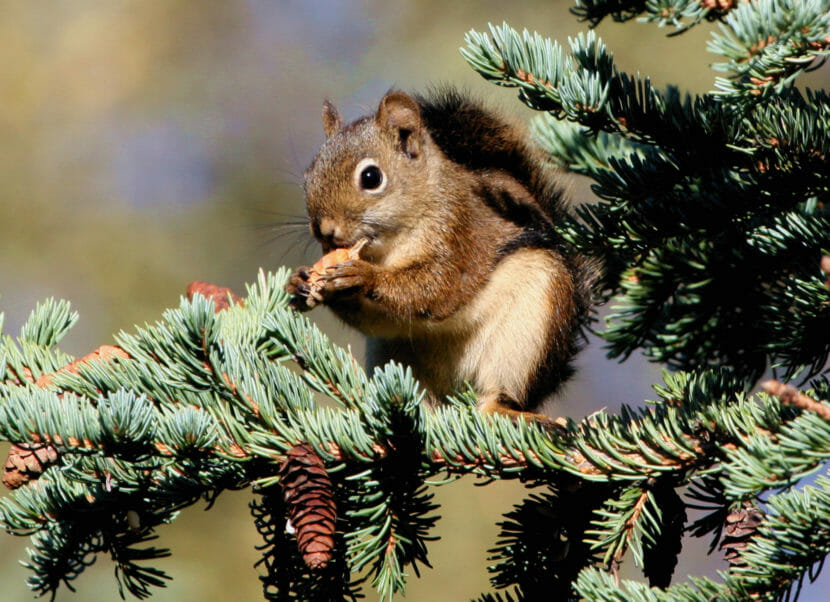
A squirrel in a conifer, nibbling on a cone
A red squirrel nibbles a spruce cone in the BLM Campbell Tract in Anchorage in 2005. Tests of small mammals trapped in the Fairbanks area found some red squirrels with antibodies showing evidence of exposure to some type of Orthopoxvirus, though not necessarily Alaskapox. That newly discovered virus has been circulating among small mammals in Interior Alaska. (Photo by Donna Dewhurst/U.S. Fish and Wildlife Service)

To illustrate his point, Huettmann pointed to budgeting decisions at the state level. The Alaska Department of Fish and Game’s Division of Wildlife Conservation has over 200 staffers, including several biologists managing and studying animals like moose, caribou and bears, but only five positions for biologists devoted to study of non-game species.

A third lesson is about how people can disrupt nature and the natural wildlife population cycles, he said. Those disruptions include human-caused climate change and introduction of vectors through travel and transportation. “All these cycles are really off,” he said. “I think the human system has overruled the natural cycles.”

Alaskapox is not the only new Orthopoxvirus discovered in recent years.

In the nation of Georgia, a new virus was discovered in 2013 in lesions on the skin of a pair of cattle herders. Further investigation found the virus, named Akhmeta after the town where it was discovered, among small mammals like mice.

In Italy in 2015, a new Orthopoxvirus was found in captive monkeys at a sanctuary, 12 of which died. Follow-up testing found signs of that virus, named Abatino, in small rodents.

Correction: This story has been updated to reflect the number of division biologists assigned to the study of small animals. In addition, a caption for a photograph has been updated to correctly identify a CDC investigator as Clint Morgan.
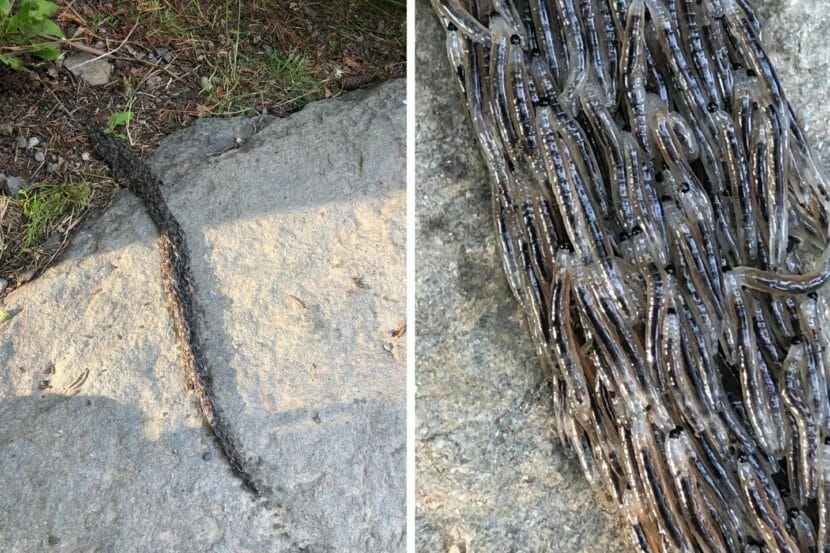
A creeping mass of insect larvae near a Denali lodge raises the question: ‘Am I hallucinating?’

Two photos, one a close-up, of a mass of larvae moving together like a snake
A Camp Denali staff member spotted this column of gnat snakeworm larvae on July 8. (Photos courtesy Jenna Hamm)

Elaina O’Brien ran back to staff housing on a busy morning at the Camp Denali lodge last Friday to grab the radio she’d forgotten at her cabin.

She looked down at the flagstone path, and what she saw made her think: “Am I hallucinating? Did I have some kind of psychedelic mushroom for breakfast? What. Is. That?”

Was it a slug? A desiccated animal body?

“But it was right on the staff trail!” she said. “And I looked and I was like, ‘Oh my God, am I seeing this for real? Like, it’s just a million bugs, being herded by these other bugs, in this slimy trail.”

O’Brien is the housekeeping and serving coordinator at the lodge, which is in the Kantishna area at Mile 89 of the road that cuts through Denali National Park and Preserve.

It turned out she was looking at a new, yet-to-be-named species of a type of fly called a gnat snakeworm. In that moment, they were traveling together as larvae in a “rare phenomenon,” said Derek Sikes, curator of insects and professor of entomology at the University of Alaska Museum of the North and the University of Alaska Fairbanks.

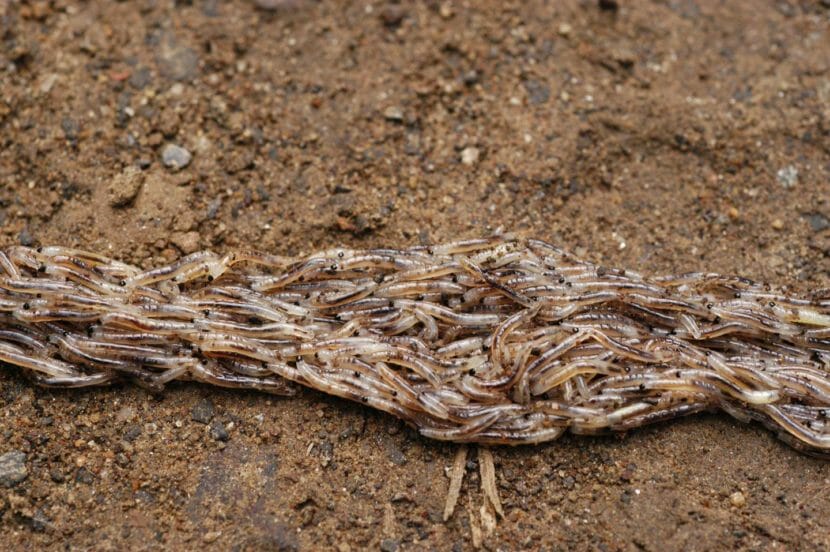
Hundreds of larvae, each almost a centimeter long, form the crawling column. Columns of larvae can stretch up to 2 or 3 feet, and they may gather in that formation only for a few hours, Sikes said.

Sikes has been studying these Alaska insects since a docent at the Museum of the North brought in a picture of the larvae and some specimens back in 2007.

“It was completely ‘X Files’ to me — I had never heard of or seen this phenomenon before,” he said.

And he wasn’t the only one. Despite how conspicuous the formation looked, longtime naturalists hadn’t seen it in the state either, Sikes said.

Since then, gnat snakeworms in this column-like formation have been reported near Fairbanks, in Katmai National Park and Preserve and in Kenai Fjords National Park. But the Denali National Park-area sighting was a first, Sikes said.

Many, many, work-like larvae forming what looks like a braided rope on the ground
Hundreds of larvae, each almost a centimeter in length, form a crawling column. Photographed July 13, 2007. (Photo by Derek Sikes / University of Alaska Museum of the North)

He then raised some of the larvae into adult flies, which allowed him to figure out what type of flies they were. By looking at their DNA and studying their anatomy years later, Sikes determined these gnat snakeworms were a new species, distinct from their closest relatives in Europe — which are also known to move in a similar mass procession.

“Some people find it sort of visually repulsive because it does look a little strange, but it’s not harmful to people,” Sikes said. “These things are not a problem for anybody. They’re not invasive. There’s nothing to worry about with them.”

It’s not yet known why there weren’t observations of these snakelike formations in Alaska before 2007, Sikes said. It’s likely someone would have reported it, but there’s no evidence of that, he said.

But even why the insects do it is a mystery.

“Nobody really knows exactly why they migrate in these great numbers together and also why they take this particular shape of a long column,” Sikes said.

There are a couple ideas about why they travel like that, Sikes said. It may be that since the larvae tend to live in moist, dark and cool areas, they try to stay closer together on a road or trail that’s exposed to sunlight so they lose less moisture.

Or, Sikes said, they might be traveling that way because it makes them look like a larger animal.

“It’s just a fascinating piece of nature that most people have never experienced or seen before,” Sikes said. “Even for most entomologists, it’s a really rare phenomenon.”

Sikes and colleagues plan later this year to publish their research on the insect and name the new species.

At the lodge on Friday, O’Brien said she “got way down close” to look at the gnat snakeworms and realized other people needed to see. She ran to the staff room and urged the guides to come and take a look. The group watched as the insects edged off the path.

And then, after it had materialized, the line of larvae soon disappeared without a trace.

“When we went to go back a couple hours later, there wasn’t even, like, a slimy slug trail or any, like, bits and pieces left behind,” O’Brien said.

This story was originally published by the Anchorage Daily News and is republished here with permission.

Flood damage along Richardson Highway disrupts trucking, limits internet and cell service

A photo from above showing a washed-out bridge and a muddy, swollen stream
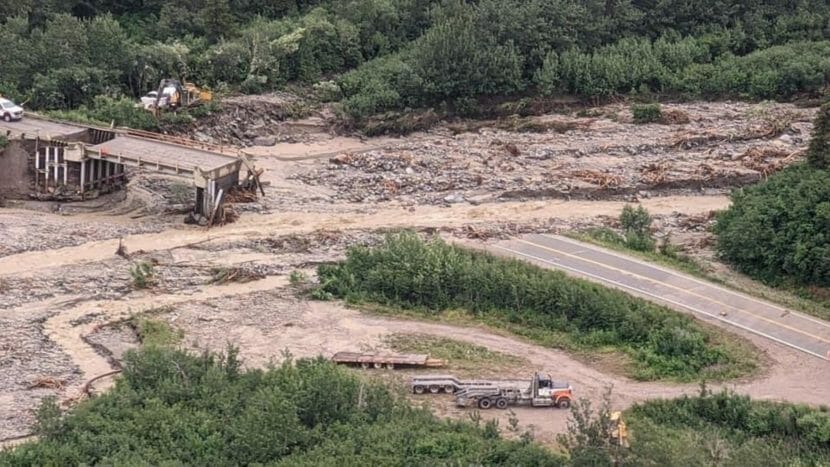
The flash-floods triggered by recent heavy rains tore out most of the Bear Creek bridge over the Richardson Highway, and damaged six others in a stretch from milepost 218 and 234. (Alaska Department of Transportation photo)

A stretch of the Richardson Highway south of Black Rapids remains closed today after heavy rain over the eastern Alaska Range Monday triggered mudslides and flash-flooding that washed-out one bridge and damaged six others.

The flooding also damaged a fiber-optic cable, limiting cellphone and internet service throughout the region.

The National Weather Service has for days now been advising that runoff from snow melt in higher elevations is filling rivers in the eastern Interior to bankfull. And when a storm dumped up to 5 inches of rain around Black Rapids on Monday, the creeks that channel all that runoff spilled over their banks, blowing out the Bear Creek bridge and damaging six others.

“There’s a lot of damage, and we’re still assessing it,” said Danielle Tessen, a state Department of Transportation spokesperson.

Tessen said Tuesday that the flooding damaged bridges over Boulder Creek, Lower and Upper Suzy Q Creeks and Falls Creek.

“But the big damage is really at Darling, Gunnysack and then Bear Creek, where the whole bridge washed-out,” she said.

Tessen says DOT has sent about 20 workers and several pieces of equipment into the area from both the north and south approaches to assess damage and begin repairs. But with more rain forecast over the next several days, she says that stretch of the Richardson will remain closed.

“There will be no travel between milepost 218 and 234 for the public through the weekend,” she said.

Tessen says the state is detouring traffic around the closure onto the Alaska Highway and the Tok Cutoff. “It’s going to add an hour and a half to your drive, but at least you can get from Point A to Point B,” she added.

Alaska Trucking Association Executive Director Joe Michel says that means it’s likely products being brought up the Rich may be arriving late for the next several days.

For example, he said, “There is quite a bit of fuel that comes out of Valdez that is heading up the Richardson up to Fairbanks.”

The washout at Bear Creek also damaged a fiber-optic cable that runs along the Richardson. throttling internet and cellphone service for customers throughout the eastern Interior. Alaska Communications spokesperson Heather Marron said the company’s customers are being affected, because it uses some of a Valdez-based telecom’s cable bandwidth.

“Copper Valley Telecom’s infrastructure, along with other telecom providers, has been impacted by flooding,” she said, reading from a prepared statement. “Alaska Communications purchases capacity on this fiber, so therefore some of our customer services are impacted.”

Delta Junction-based Vertical Broadband is one of those telecoms affected by the damaged cable. Company officials didn’t return a call Tuesday, but a recorded message says Vertical Broadband has had to re-route its service through a different cable.

“There’s now one fiber path for all of Delta Junction to connect to the Internet. This is through Fairbanks. This means that most of Fairbanks now has one fiber path to the Internet, as well,” the message stated.

Alaska Communications said in a written statement that the damage and its ripple effects have significantly reduced the company’s capabilities. The statement says the problem will slow internet service for all customers of telecoms that used the now-damaged cable. And it says it doesn’t have an estimate on when full service will be restored.

The Clear Fire burned one year-round home and several cabins last week

A view down a dirt road of a large wildfire burning on the other side of a line of trees
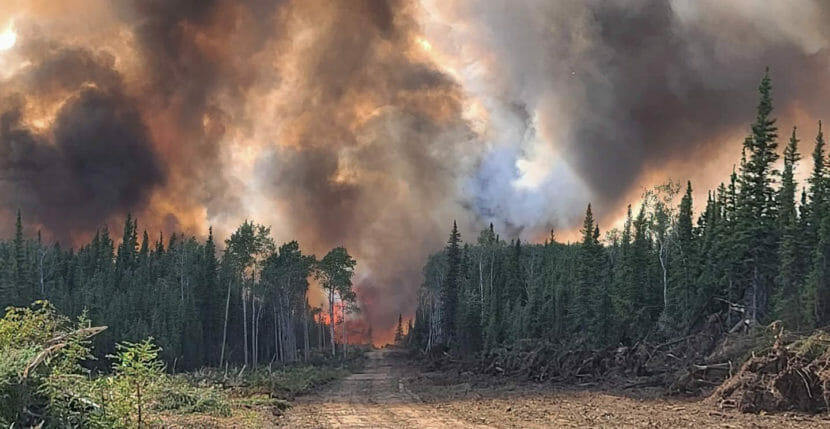
The Clear Fire burns in the Kobe Ag subdivision on July 6, 2022. (Eric Kiehn/Task Force Leader with Northwest Team)

The Clear Fire burned one year-round home and a number of other buildings when it made a wind-driven run through the Kobe Road area last week.

Denali Borough Mayor Clay Walker says a preliminary report lists 15 affected properties.

“One year-round residence lost and seven different cabins lost, and then on seven other properties there are outbuildings, garages, sheds — sometimes, its trailers and equipment and even connexes filled with building materials lost as well,” he said.

Walker says the borough is working with the fire management team and the state to refine the loss and damage assessment and is also seeking the public’s input to identify the owners of some fire-damaged properties. The fire, now estimated at 70,000 acres, is burning near the Interior Alaska communities of Clear and Anderson.

Walker says the Red Cross is coming down from Fairbanks to conduct its own assessment, and the borough is talking to the state about a possible disaster declaration.

“There’s not much you can say for sure in terms of assistance, other than our local non-profits and just local donations and efforts are really making a difference for the couple who lost their home,” he said.

Barbara Walters, with the Denali Borough area non-profit group Neighbor to Neighbor says local people responded generously to a call to meet the couple’s most immediate needs..

“I was there when we were unloading clothes,” she said. “There was a gift certificate and there was another gift card and there was another card and there was a check — and really they were touched and moved to tears.”

Walters says cash or gas cards are a good way to support the couple because they are staying with friends and do not have a place to store many things.

The Castner Glacier ice cave is collapsing and gushing meltwater

An ice cave mostly plugged by a huge chunk of ice, with water gushing out of it.
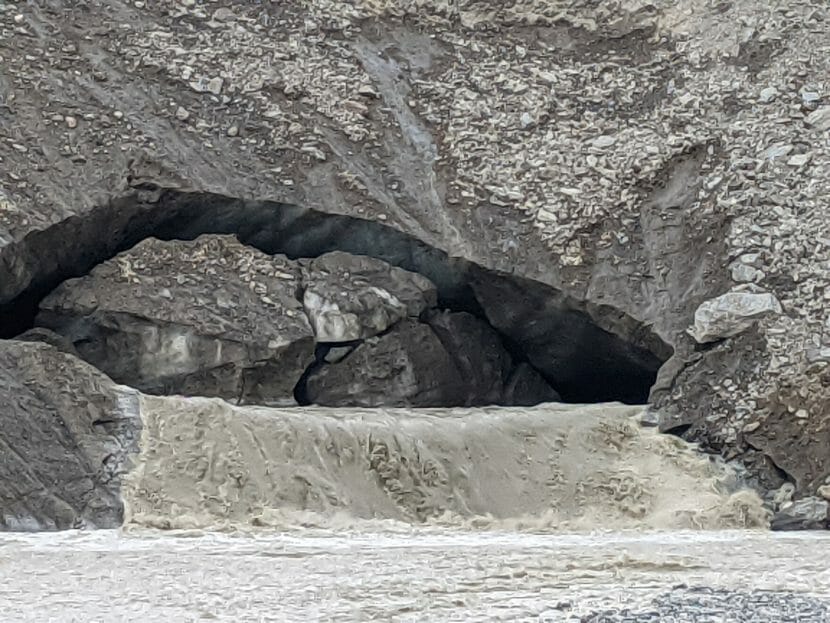
A torrent of meltwater gushes around big chunks of ice at the mouth of the Castner Glacier ice cave and dumps into Castner Creek. The torrent has widened the cave opening near the terminus of the glacier, which is covered by rocks and gravel and, on top, vegetation. (Photo by Tim Ellis/KUAC)

The Castner Glacier ice cave off the Richardson Highway near Black Rapids attracts some 8,000 people annually. But federal officials and a University of Alaska professor are advising hikers to be careful around the ice cave because it’s gushing meltwater and slowly collapsing.

Chuck and Allison Hohnbaum drove down from North Pole on a hot and sunny day last week to take the 45-minute hike up to terminus of the Castner Glacier and check out the ice cave there.

“Been here a couple of times in the winter, where you can walk into the cave,” Chuck said, “and we figured we’d try it during the summer.”

Hohnbaum’s party parked their rig along with about a dozen others at a pull-off at the Richardson Highway bridge over the meltwater-swollen Castner Creek at milepost 217. They said they hadn’t heard there’s a torrent of water several feet deep running through the cave, and that it’s slowly collapsing. But Allison says that didn’t discourage them.

“No, we’re super-stoked!” she said. “This will be kind of cool, seeing it with the river gushing out of it.”

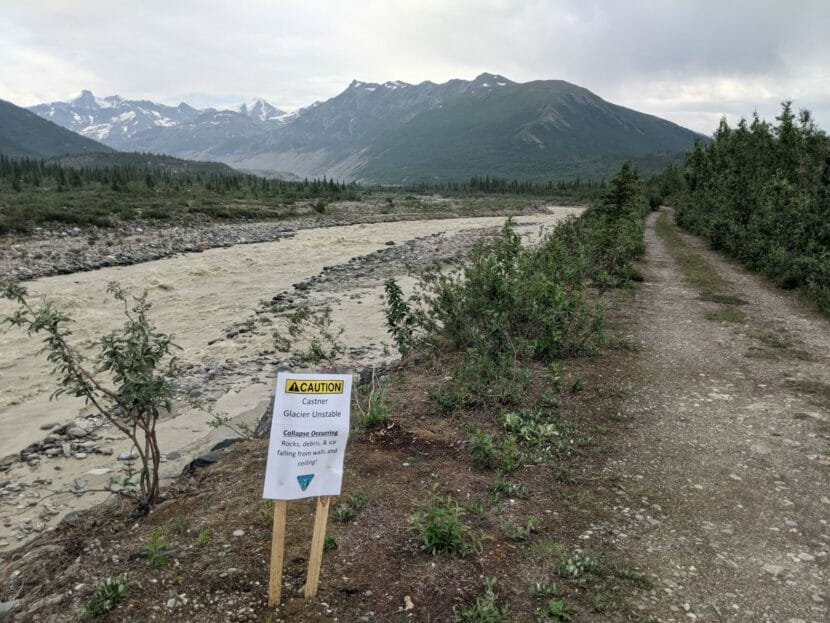
It is indeed gushing out of the roughly 10-by-20-foot opening at the mouth of the cave. And it’s ejecting rocks and chunks of ice — some as big as washing machines — before they’re carried downstream to melt. That’s why the federal Bureau of Land Management has posted signs on the trail leading to the glacier urging hikers to be careful when approaching the ice cave.

“You can still hike and see the Castner Glacier. The area is not closed,” says Scott Claggett, a spokesperson for the federal Bureau of Land Management. “We just want to make sure that people are aware and are being safe.”

Claggett says this year’s surge of runoff and meltwater is the heaviest in recent memory. And that’s why a snow and ice expert with the University of Alaska Fairbanks is urging caution for those who hike to the cave, especially if they want to take a look inside.

“People should be very aware that any tunnel in ice is temporary and there’s potential danger in it collapsing or having rocks that are in the ice above collapsing,” said Matthew Sturm, a geophysics professor with the UAF’s Geophysical Institute who heads up its Snow, Ice and Permafrost Group.

A sign on a trail warning people that the glacier is unstable
A sign at the trailheads of paths on the north and south sides of the creek advise hikers to be careful around the ice cave. (Photo by Tim Ellis/KUAC)

Sturm says meltwater created the ice cave, and now it’s causing it to collapse.

“Water that enters the glacier on the sides and above tends to want to work underneath the glacier at the bottom to get into a single channel,” he said in an interview last week. “And it emerges from the tip of the glacier, the terminus, leaving a tunnel.”

Sturm says that dynamic process is ongoing in all Alaskan glaciers, especially those in the eastern Alaska Range, all of which are melting and receding. He says that so-called “down-wasting” is being accelerated by the warming climate and unusually warm summer weather. But he says the gravelly material the glacier that’s piled up onto its terminus helps slow the melt.

“All of the glaciers that I know of in the Alaska Range have this debris in the lower end,” he said, “and that actually is saving them from the worst of climate change because it serves as a protector and insulator against these warmer temperatures.”

Sturm also discourages those who trek up to the glacier from crossing Castner Creek, both because of the heavy flow and because of the ice chunks and other debris it’s carrying.

Flash flooding closes stretch of Richardson Highway

A brown, raging creek seen from a bridge
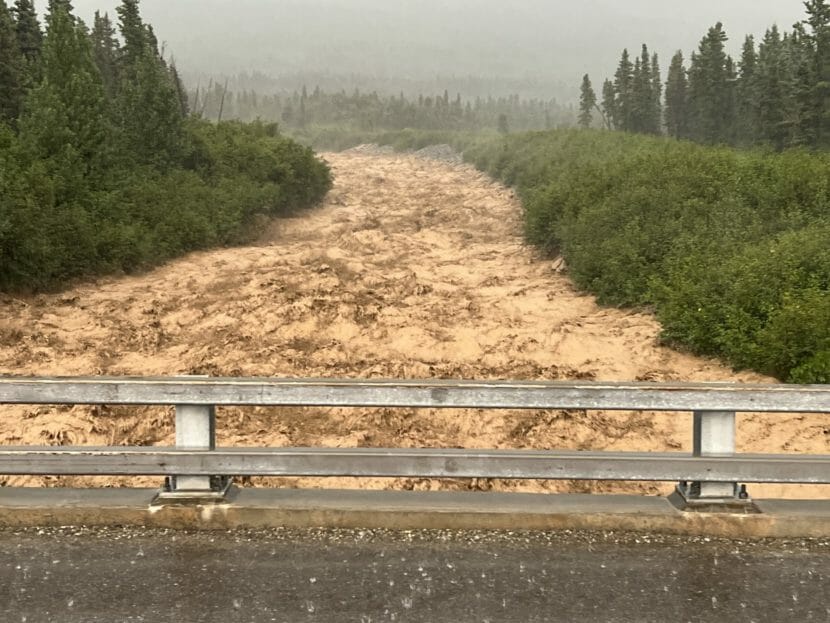
High water levels at Ruby Creek, where flash flooding occurred. (Alaska Department of Transportation & Public Facilities staff)

Flash flooding has closed a stretch of the Richardson Highway in the eastern Alaska Range.

The State Department of Transportation’s 511 site lists the highway as closed between Mile 218 and 234, in the Black Rapids area, south of Delta Junction. The department says the road is likely to remain closed through the weekend, depending on weather.

There are multiple damaged areas in need of repairs due to high waters that washed out bridges. Rain is in the forecast for the next few days, and mudslides are also a concern in some areas, according to the transportation department.

A video posted online by the department shows water gushing under bridges and a collapsed roadway.

A National Weather Service statement says snow melt caused by high freezing levels in the Alaska Range combined with heavy rains are resulting in high water. It says glacier-fed rivers like the Nabesna, Chisana and Tanana are running full and warns of possible flooding in low lying areas along the Tanana, including the Rosie Creek subdivision in Fairbanks.

Site notifications
Update notification options
Subscribe to notifications