Interior

At open house, scientists explain what HAARP can — and can’t — do

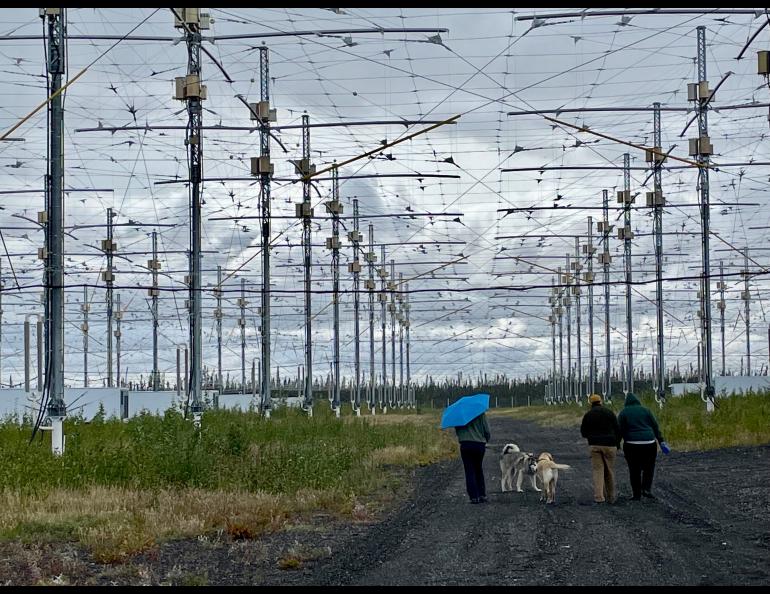
Three people walk two huskies down a gravel road flanked by
During a recent open house, visitors walk their dogs beneath an antenna field used to heat the upper atmosphere during space physics experiments at a facility known as HAARP between Glennallen and Tok. (Photo by Ned Rozell.)

In this wild place where dump truck drivers once tipped load after load of gravel onto the moss to make roads and building pads, scientists rolled open an iron gate one recent Saturday afternoon.

They invited in conspiracy theorists, reality-TV hosts and salmon fishermen from Chistochina to the grounds of a mysterious antenna field. It’s a facility that some claim has caused caribou to walk backward. It has been rumored to activate earthquakes and to hold human souls in a sort of northern purgatory.

Scientists were a bit to blame for all the allegations of weirdness out here between the Copper and Gakona rivers. First off, they used an acronym to name it — HAARP, which stands for High-frequency Active Auroral Research Program.

That acronym added to the mystery of the field of antennas, which can heat a region of space far above our heads with radio waves powered by five powerful diesel generators, each the size of a fuel truck.

The science of studying a region we can’t see by perturbing it with enough electricity to power a small city — located in a place where wolves and bears pad along silently across its few gravel roads — is hard to wrap your head around.

A few people really do understand HAARP, though. They were standing on those smoothed piles of gravel that Saturday, when the foreboding metal gate clicked open.

My former boss, Sue Mitchell (now retired), initiated this “open house” a few years ago. She was there again in 2022, greeting people at the first table of the first building visitors walked into. I asked her why.

“So we could be as transparent and open as possible,” she said. “Throw open the gate, and show people what’s here.”

When she worked at the Geophysical Institute, Mitchell took the considerable hit of answering phone calls about the HAARP facility. She had no answers for people who were sure the antenna field was somehow controlling their minds.

“My hope has been, by showing people what really goes on, the facts will speak for themselves,” she said. “That doesn’t always work. People sometimes make decisions emotionally, not always based on the facts.”

It doesn’t help when the facts are so hard to understand. Here’s a try:

The antenna field at this 5,408-acre site, far from any Alaska town, was first a chunk of black-spruce forest and wetlands that U.S Air Force officials purchased from the Native corporation Ahtna in 1989. The idea was to use the location to build an over-the-horizon radar that would allow technicians to observe bombers or missiles that might be headed for America over the pole.

Due to the end of the Cold War, that radar was never built. Instead, Air Force workers installed a field of 18 antennas that broadcast high-frequency waves up to the ionosphere, the region of space that is home to the aurora.

The antenna field over the years grew to 180, each powered by two transmitters. A researcher has called it the world’s largest ham radio.
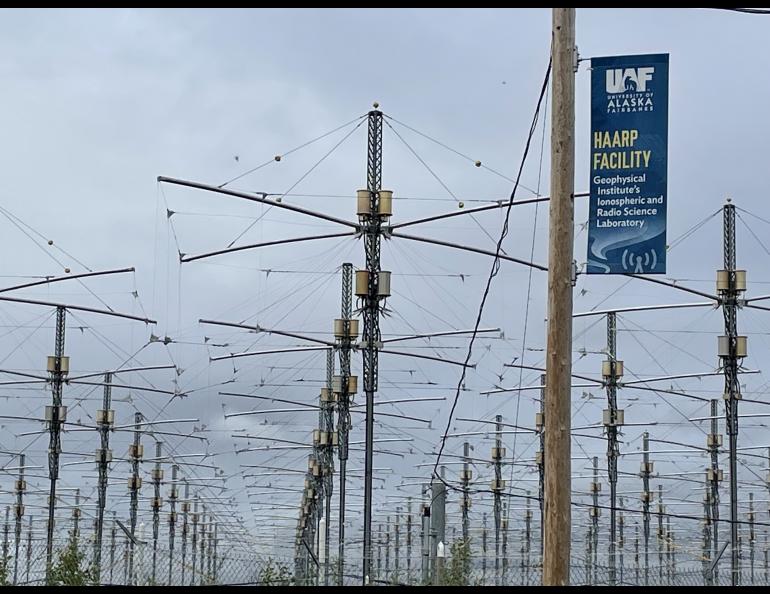
A University of Alaska banner on a pole in a the HAARP antenna field
The upper atmosphere-heating facility named HAARP is located on about 5,000 acres between the small Alaska towns of Glennallen and Tok. (Photo by Ned Rozell.)

HAARP is a group of high-frequency radio transmitters (in the ham-radio band) powered by five diesel generators — four from tugboats and one from a locomotive. When activated, the transmitters send a focused beam of radio-wave energy into the ionosphere, 50-600 miles overhead.

Since it opened in 2003 with funding the late Sen. Ted Stevens helped secure, HAARP has hosted many scientists doing basic science on the auroral zone.

Others used it to do applied research for the military. In one study, researchers used the antenna array to heat a part of the ionosphere that in turn acted as a low frequency antenna that could send an ocean-penetrating signal to a submarine. That ping could tell a submarine captain to surface in order to receive conventional radio communications.

This place almost fell to bulldozers in 2012, when the Department of Defense wanted to get out from under the cost of running the facility — which includes about $250,000 each year just to heat the dozens of transmitter buildings in the winter.

About then, Bob McCoy, the director of the Geophysical Institute and a space physicist himself, lobbied for the institute to take over the site. Scientists rallied around him, as did the university president at the time.

At the same time, leaders of the National Research Council held a workshop about HAARP. They wrote a 70-page report on science that could be accomplished with the facility.

“Even though it’s esoteric and hard to understand, it’s the best,” McCoy said in 2015.

The university administration gave McCoy a loan to keep HAARP running. He gambled that he could pay it back by drumming up business from scientists. They would use the transmitters and pay for it with grants from funding agencies. That gamble is paying off, with a new 5-year grant from the National Science Foundation.

McCoy was there at the entrance to HAARP, too, answering questions from people like Michael Lewis of Anchorage.
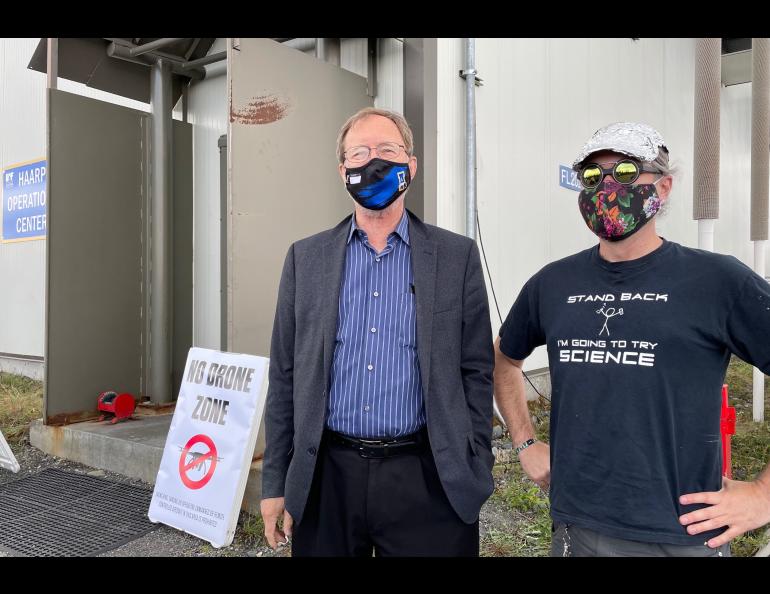
A man in a suit stands next to a man wearing a tinfoil hat
Geophysical Institute Director Bob McCoy poses with visitor Michael Lewis from Anchorage during a recent open house of the ionosphere-heating facility known as HAARP between Glennallen and Tok. (Photo by Ned Rozell.)

Lewis, who wore a baseball hat he had covered with tin foil (apparently for fun), said he had always wanted to see the facility. McCoy posed for a photo with him.

Visitors were allowed all over the grounds of the facility during the open house. Swampy ground limited them to driving and walking the few miles of road and gravel pad, including the dormant transmitter array.

Scientists and engineers were stationed at strategic points to explain what the complicated equipment did when it was on. A few guests were ham-radio enthusiasts, but most seemed to be just curious people.

After the five-hour open house ended, the black gate shut behind the final car. Then, HAARP reverted to what it is most of the year: a silent pile of gravel sprouting with antennae. There, songbirds on their way south flitted through the spruce and on the ground beneath the antenna masts.
Legendary Alaska musher Lance Mackey dies at 52

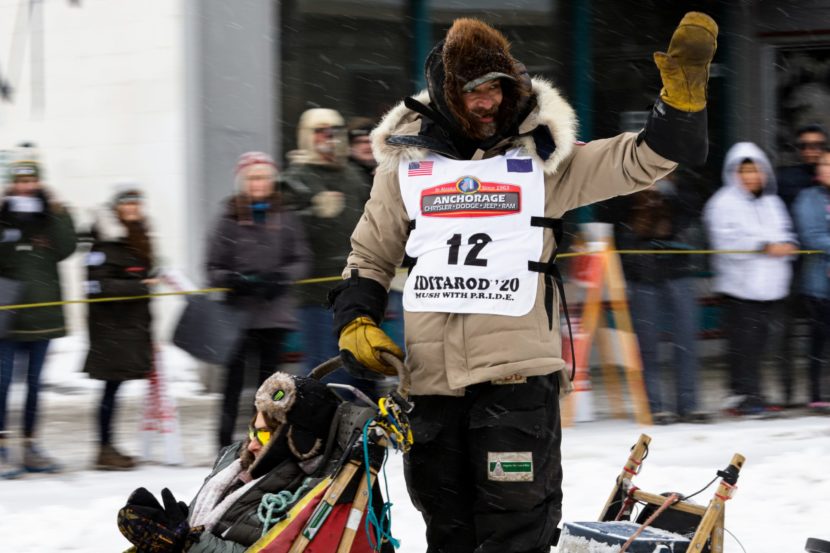
Lance Mackey waves from a dogsled
Iditarod musher Lance Mackey at the 2020 Iditarod Trail Sled Dog Race ceremonial start in Anchorage. (Photo by Joey Mendolia/Alaska Public Media)

Alaska sled dog mushing icon Lance Mackey has died at the age of 52.

Mackey’s Comeback Kennel announced on its Facebook page that he passed away Wednesday evening after a long battle with cancer. Despite surviving a bout with throat cancer 20 years ago, Mackey announced last year that he had been re-diagnosed with the disease.

Mackey, who lived in the Fairbanks area, has been a fixture in long-distance sled dog racing for many years. He won the Yukon Quest four years in a row, starting in 2005. He’s also the only musher to win the Iditarod four straight years. The 1,000-mile races are held just a month apart. He became the only musher to win both races in the same year in 2007. And then he did it again the next year.

In a Facebook post on Aug. 5, Mackey wrote that he had been going through cancer treatments, and the past several months were the worst part. He said he was in the hospital, with 24-hour care. He said he wanted to thank his friends and family, and tell them how much he loved them.

“Fully believe it is not my time yet,” he wrote, “and I’m still doing pretty good but I’m going to have a lot of things to get done in my life.”

The mushing world mourned Mackey’s passing overnight on social media, with Iñupiaq musher Apayauq Reitan sharing a memory of Mackey helping her during the 2019 Iditarod.

In a statement on its Facebook page, the Iditarod said Mackey “embodied the Spirit of the Race, the tenacity of an Alaskan musher, displayed the ultimate show of perseverance and was loved by his fans.”

Mackey lost his partner, Jennifer Smith, in 2020. She died in an ATV accident. Mackey had been raising the couple’s two young children alone after surviving a serious car crash last year.

Michigan man wounded in bear mauling north of Glennallen

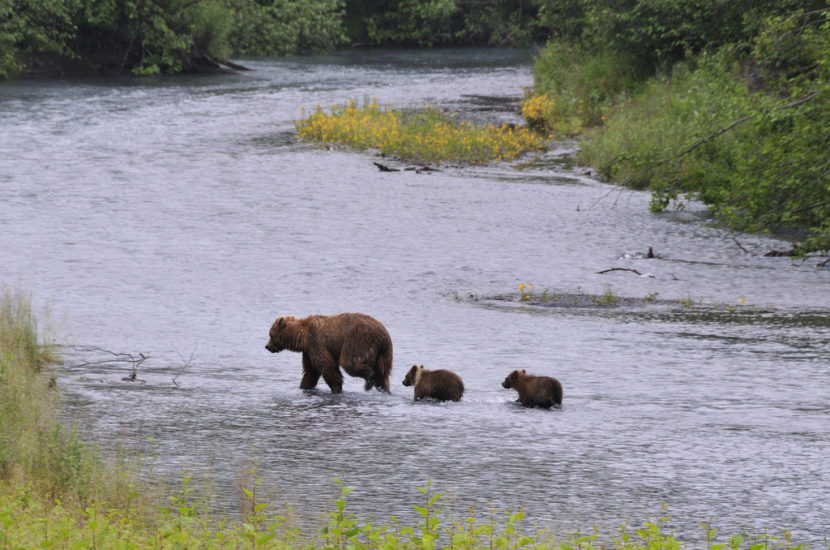
A brown bear sow with two cubs crossing the Resurrection River near mile 3 of the Seward Highway. Seward, Kenai Peninsula, Alaska. (Photo by Dan Logan/Flickr CC)

A Michigan hunter suffered severe injuries when he was mauled by a grizzly bear during a hunting trip near Glennallen on Tuesday, according to Alaska State Troopers.

Word reached Alaska Wildlife Troopers shortly after 5 p.m. of the attack on 33-year-old Nicholas Kuperus. The mauling occurred along the upper east fork of the Indian River, about 60 miles north of Glennallen.

“(Kuperus) and his hunting partners surprised a sow grizzly bear with three cubs,” troopers said in a statement on Wednesday. “Kuperus was attacked by the sow and received serious puncture wounds to his arms but was able to deter and stop the attack using bear spray.”

Wildlife troopers were able to contact Kuperus with a satellite communication device. Troopers used a state-owned small plane to land on a nearby ridgetop and pick Kuperus up, flying him to Glennallen for medical attention.

The Anchorage Daily News reported last week that another hunter was mauled by a brown bear near Ship Creek, up the valley from Joint Base Elmendorf-Richardson. The man had shot the bear and thought it was dead, but when he approached it charged.

A fishing guide from Fairbanks is poised to fill a spot in Alaska’s US House election

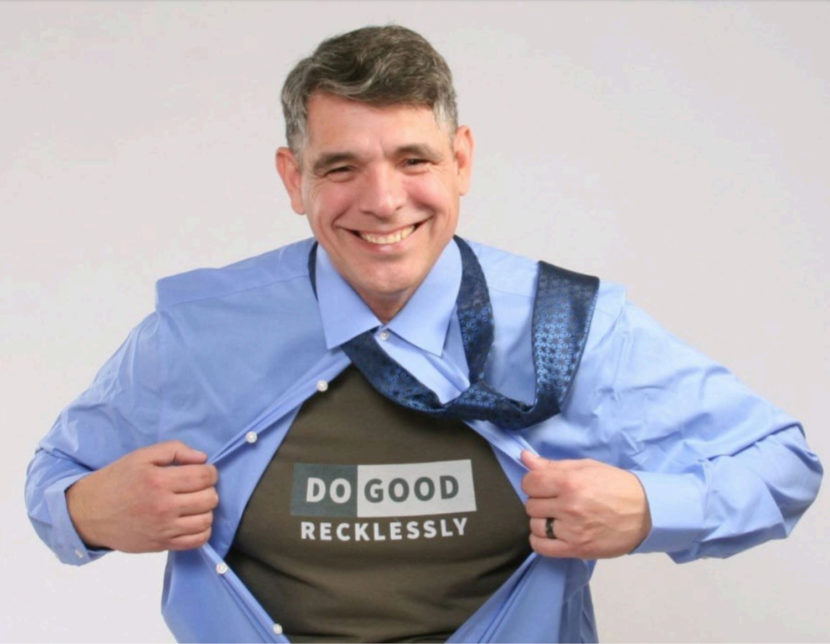
A grinning man tears open his button down shirt to reveal a t-shirt that says "do good recklessly" on it
Chris Bye, the Libertarian candidate for Alaska’s U.S. House seat, is seen in an undated campaign photograph shared with the Alaska Division of Elections. (Division of Elections photo)

In Chris Bye’s preferred campaign photo, the Libertarian U.S. House candidate is ripping open his dress shirt to reveal a T-shirt that says, “Do Good Recklessly.”

After Republican fourth-place candidate Tara Sweeney abruptly withdrew from Alaska’s November U.S. House race, Bye will fill a spot in the state’s top-four primary election, an act that will put him alongside Democratic candidate Mary Peltola and Republicans Sarah Palin and Nick Begich III in the race for a two-year term in the House.

Bye, a fishing guide from Fairbanks, spoke about his campaign on Friday while waiting to take his next client fishing. He said his picture encapsulates his message.

“I mean, we don’t have to be Superman to do good. I mean, I can just be a fishing guide and pick up garbage along the way. This isn’t complicated,” he said.

Bye, a former U.S. Army officer with deployments in the Afghanistan and Iraq wars, said he isn’t wealthy and doesn’t have a traditional political background, but that doesn’t mean he can’t do the job as Alaska’s lone delegate in the U.S. House of Representatives.

Born in Oxford, England, to an Air Force family, Bye said he “moved every two to three years” while growing up and went to two different high schools before joining the U.S. Army and going to college.

He served in a variety of roles, including as an infantryman, in armor, and as a cavalryman before his career took him to Alaska with the 172nd Infantry Brigade.

While deployed to Iraq, he said he wrote to Alaska’s congressional delegation frequently.

“I’d be like, ‘Why am I in Iraq? Like, can someone please tell me why you voted to send us here? Because there is absolutely no constitutional emergency for us to be here,’” he said.

He said he was disillusioned by the “really dumb, canned responses” he got.

“I just knew that I didn’t fit in either (Republican or Democratic) party,” he said.

On a subsequent fishing trip with a fellow officer, the other man gave him a copy of Ron Paul’s book, “Liberty Defined.”

Paul was the Libertarian Party nominee for president in 1988 and has espoused a philosophy of limited government intervention. Reading Paul’s book “absolutely changed the way I look at governance,” Bye said. “Overnight, I realized I had been part of the problem by settling for the lesser of two evils.”

Bye retired from the military in 2017 and stayed in Fairbanks but didn’t run for office until this year. The decision came with a high cost: Bye had to give up a civilian job on Fort Wainwright because federal employees aren’t permitted to run for office.

The inspiration behind his decision, he said, was the passage of the federal infrastructure bill, known as the Infrastructure Investment and Jobs Act.

Bye was dissatisfied by the cost of that measure, which was supported by former Congressman Don Young. He briefly considered running as a Republican or Democrat but decided to run as a Libertarian after receiving an email from the party.

“They welcomed me with wide arms, even though we’ve got some differences,” Bye said.

An example, he said, is drug policy. Bye favors continued restrictions on some controlled substances, such as fentanyl.

Answering a candidate questionnaire from the Beacon, Bye praised the U.S. Supreme Court’s decision overturning Roe v. Wade but said contraception and other medicines should be available “for all people without a doctor’s prescription.”

He has advocated restrictions on deep-sea trawling and the gradual elimination of the practice in order to reduce salmon bycatch.

Answering questions from Ballotpedia, he said his “top goal,” if elected, is to accelerate the transfer of federal land to individuals and the state.

On his website, Bye advocates a 10-15% cut in federal spending and a 15% cut in the number of federal employees.

By phone, Bye said that if elected, instead of the hunting trophies and memorabilia that adorned the office of former Congressman Don Young, he would “go down to IKEA … and we’re going to get the biggest damn table — because we represent Alaska — and we’re going to put as many seats around that table as possible, and everybody, every Alaskan is invited to sit at that table.”

“Because I’m not just a representative for the people that voted for me, but for everybody, even those who have conflicting views,” he said. “I mean, if we can’t be courageous in front of people who have different views, our future generations, they’re going to be sucking.”

Bye acknowledged that he faces an uphill campaign toward November. He’s received little media attention to date, his competitors have raised significantly more money for advertising, and he’s on pace to finish with less than 1% of the vote in this month’s primary election.

Still, he said, it’s important for him to not only run but also be considered a candidate on the level of the Republicans and Democrat who also are finishing in the top four.

“I’m just a fishing guide, but if we don’t have normal people in there, Alaskans are stuck with the status quo,” he said. “And the status quo so far has failed us, failed miserably.”

Arctic Road Rally aims to show electric vehicles’ potential in Alaska

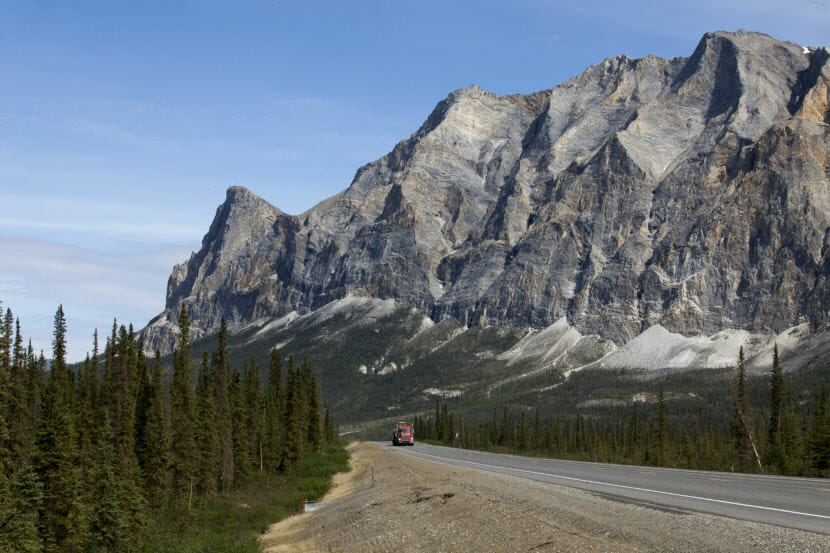
A truck makes its way south on the Dalton Highway near Coldfoot, Alaska. (Photo by Rashah McChesney/Alaska's Energy Desk)
A truck makes its way south on the Dalton Highway near Coldfoot, Alaska. (Photo by Rashah McChesney/Alaska’s Energy Desk)

Ten electric vehicles set out Friday from Fairbanks on a thousand-mile journey up the Dalton Highway and back. The Arctic Road Rally is intended to demonstrate the ability of electric vehicles to operate in the far north.

Organizers say the rally also will showcase EV technology and promote efforts to enable the vehicles to drive anywhere on the state’s road system.

“With this event, we’re showing that it’s possible to electrify even the most remote parts of Alaska very quickly and cost-effectively,” says Dimitri Shein, the executive director of the Alaska Electric Vehicle Association. AKEVA is one of the main supporters of the rally, along with Launch Alaska, an Anchorage-based startup-business accelerator.

Shein, one of the organizers of the rally, says he’ll be one of those traversing the remote stretch of the Dalton between Fairbanks and Oliktok Point — the farthest-north point in North America accessible by road.

“I’ll be driving my wife’s Tesla, and I hope she forgives me for driving her car down this stretch of road,” he said.

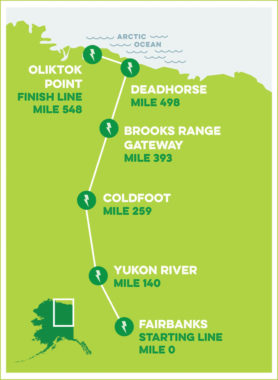
A map showing the locations of charging stations installed on the Dalton Highway for the rally
The 2022 Arctic Road Rally course and charging station locations. (Alaska Electric Vehicle Association)

The federal Department of Energy also is supporting the event, along with the Alaska Energy Authority, Sandia National Laboratories and the Center for Technology and the Environment, a Georgia-based nonprofit that promotes electrifying the nation’s transportation system.

The state Department of Transportation is providing power for an electric-vehicle fast charger at the Yukon River crossing, the first of four charging stations on the route. The others are at Coldfoot Camp, Trans-Alaska Pipeline Pump Station 4 and Deadhorse.

“This will the most advanced charging network and highway in Alaska,” he said in a recent interview.

Shein says the arrangement is only temporary, but he says the infrastructure that’ll be built-out at the four sites will remain after the rally ends. He says that would enable charging stations to be permanently set up those locations, once the state gets around to the Dalton as part of its plan to enable EVs to travel throughout the road system.

“We’re pro-charging anywhere in Alaska,” he said. “So, I mean, that would be a great outcome.”

That’s one of the objectives of the rally, says Tim Leach, who heads up Launch Alaska’s transportation program.

“We’re interested in increasing the awareness and adoption of electric vehicles here in the state of Alaska,” he said. “We want to make sure that electric vehicle savings and emissions benefits are accessible to all folks who are interested in electric vehicles.”

Leach says the rally will bring together manufacturers of EVs and charging-station suppliers, and startups that will use the lessons learned from the rally to understand how to make more EVs and the facilities needed to power them available to Alaskans, wherever they live in the state.

“Some of this technology demonstration that we’re undertaking here at the Arctic Road Rally will help us identify what technology solutions are suitable both on the vehicle and the charging side for some of these communities that have different sets of infrastructure,” he said.

Electric vehicle owner and advocate Phil Wight says he hopes the rally also will help Alaskan’s understand the benefits of converting to an electric vehicle.

“The electrification of transportation can save Alaskans ultimately billions of dollars,” he said.

Wight is an assistant professor of history and Arctic and Northern Studies at the University of Alaska Fairbanks, and he’s a policy analyst with the Alaska Public Interest Research Group. He says wasn’t able to sign up in time to enter his Chevy Bolt in this year’s rally, but hopes to next year.

Wight hopes Alaskans will pay attention to the event because it will demonstrate the billions in savings for would come in the form of keeping money Alaskans keeping the money they pay local utilities for transportation here, instead of the corporate offices of oil companies Outside.

“We spend, I think, one billion dollars every year paying for oil. We do not get a hometown discount for our oil.”

Wight says the other savings come in the form of health benefits that come from breathing cleaner air — an especially important consideration for people who live in the Fairbanks area.

“Local air pollution — right? There is a significant chunk of air pollution which emanates from light- and heavy-duty vehicles,” he said.

The 2022 Arctic Road Rally got under way at 11 a.m. Friday, Aug. 12. The starting line was at the Golden Valley Electric Association’s headquarters on Illinois Street in Fairbanks. The 1,096-mile rally isexpected to wrap up on Tuesday.

‘She wasn’t afraid of adventure’: Alaska author Lael Morgan dies at 86

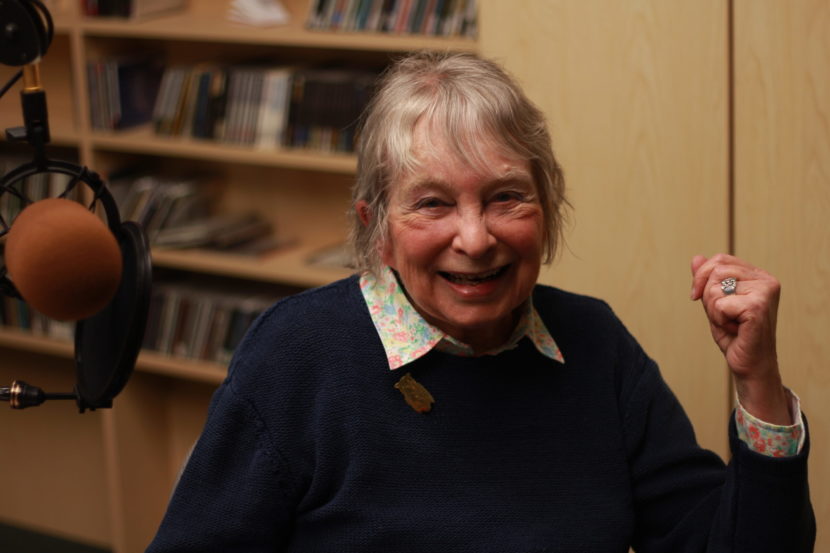
Lael Morgan photographed in a radio studio
Lael Morgan appears on Talk of Alaska on June 14, 2016. Morgan passed away on July 26, 2022. (Photo by Wesley Early/Alaska Public Media)

Longtime Alaska journalist, author and historian Lael Morgan died last week at age 86. Morgan led an unconventional life, telling the stories of others and creating her own.

She came to Alaska from New England with her husband in 1959, said her adopted daughter, Diana Campbell of Fairbanks. Campbell said Morgan wanted to earn money to sail around the world — an adventure she half completed before returning to Alaska and embarking on a journalism career that took her around the state and beyond.

“The Juneau Empire, the News-Miner, Jessen’s Weekly, the Los Angeles Times and then the Tundra Times, which was probably one of her most important things,” said Campbell.

Morgan’s work at the Tundra Times gave her insight into some of Alaska Native people’s pivotal fights to protect their way of life.

“She really had a front row seat to land claims,” said Campbell. “The Tundra Times covered land claims. They also covered the Rampart Dam project, plus Project Chariot.”

Morgan wrote a book about Inupiaq carver and Tundra Times founder Howard Rock, “Art and Eskimo Power,” as well as many others, including an acclaimed history of Gold Rush-era prostitution, “Good Time Girls of the Alaska-Yukon Goldrush,” published by Epicenter Press, a company she co-founded in 1988.
Morgan’s many other pursuits included freelance photography and writing for publications like the New York Times and National Geographic, a stint as a private detective in Los Angeles and retracing Jack London’s travels in the South Pacific.

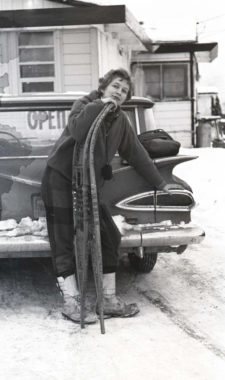
A black and white photo of a woman posing with long, willow snowsheos
A young Lael Morgan. (Lael Morgan collection)

“She was nomadic in that way, and she wasn’t afraid of adventure,” said Campbell. “She wouldn’t say she was a women’s libber, but she didn’t think that being a woman held her back from anything. She was always working. She never retired.”

Another Morgan project brought attention to the buried history of Black soldiers who built the Alaska Highway.

“We had two reunions of Alaska Alcan veterans and they had personal photos,” Morgan told KUAC in a 2017 interview. “We made a museum show and took it all around. And then Colin Powell took it to the Pentagon.”

Morgan pushed for the history to be taught in Alaska schools.

Campbell said she first met Morgan when she had her as a journalism instructor at the University of Alaska Fairbanks, and was initially intimidated by Morgan’s no-nonsense style.

“I was terrified of her,” said Campbell. “She scared the dickens out of me.”

But they eventually formed a bond.

“Native people were important to her. Of course, I’m Alaska Native myself, and she wanted to see an Alaska Native do well in journalism,” said Campbell.

Campbell said the connection deepened and Morgan, who had no children of her own, informally adopted her.

“She said, ‘I’m going to be your mother.’ And I said, ‘OK,’” said Campbell.

Campbell underscored that Morgan was not all about work.

“She also collected people, oddball people, and would sometimes see things in other people that other people did not see,” said Campbell.

A memorial service for Morgan is being planned for Anchorage around Labor Day but Campbell said Morgan’s ashes will be buried at Fairbanks Birch Hill Cemetery.

“She’s actually going to be buried next to Georgia Lee, a woman she found out about through her book, ‘Good Time Girls,’” said Campbell. “Georgia Lee was maybe Fairbanks’ most famous good time girl.”

Lael Morgan’s burial will be followed by a celebration of life event.

Site notifications
Update notification options
Subscribe to notifications