Juneau

High school sleep-out raises $3,000 for homeless youth

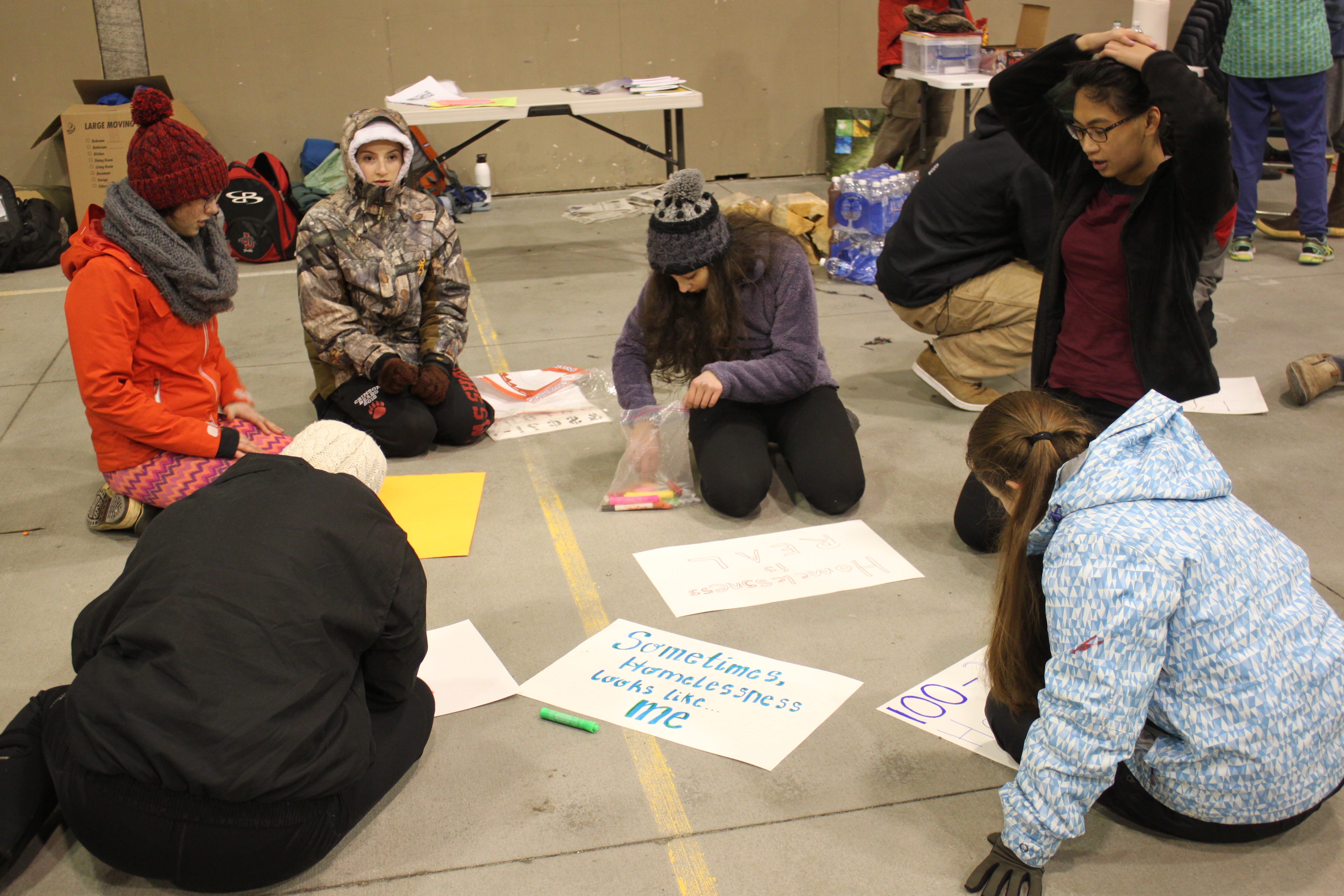
During the sleep out, students made signs about youth homelessness that they waved outside Mendenhall Mall and Safeway. (Photo by Lisa Phu/KTOO)
During the sleep-out, students made signs about youth homelessness that they waved outside Mendenhall Mall and Safeway. (Photo by Lisa Phu/KTOO)

About 200 kids and teenagers in Juneau are homeless. There are students without adequate or regular housing in every school in the district.

This past weekend, high school students slept out in the cold to raise awareness of the mostly invisible issue.

Between Saturday night and Sunday morning, temperatures dropped to the low to mid-30s. Two dozen high school students participating in the sleep-out were prepared with sleeping bags, big winter coats, blankets and extra layers.

Reilly Walsh, 17, is a senior at Juneau-Douglas High School. She and other students built makeshift shelters out of cardboard boxes and duct tape under the outdoor covered area at Riverbend Elementary School. The goal was to bring attention to their friends and fellow students who are homeless.

“Because it’s something that you can’t really tell always if someone is struggling with homelessness, so we’re just trying to spread the word that it does occur and you might not be aware of it.”
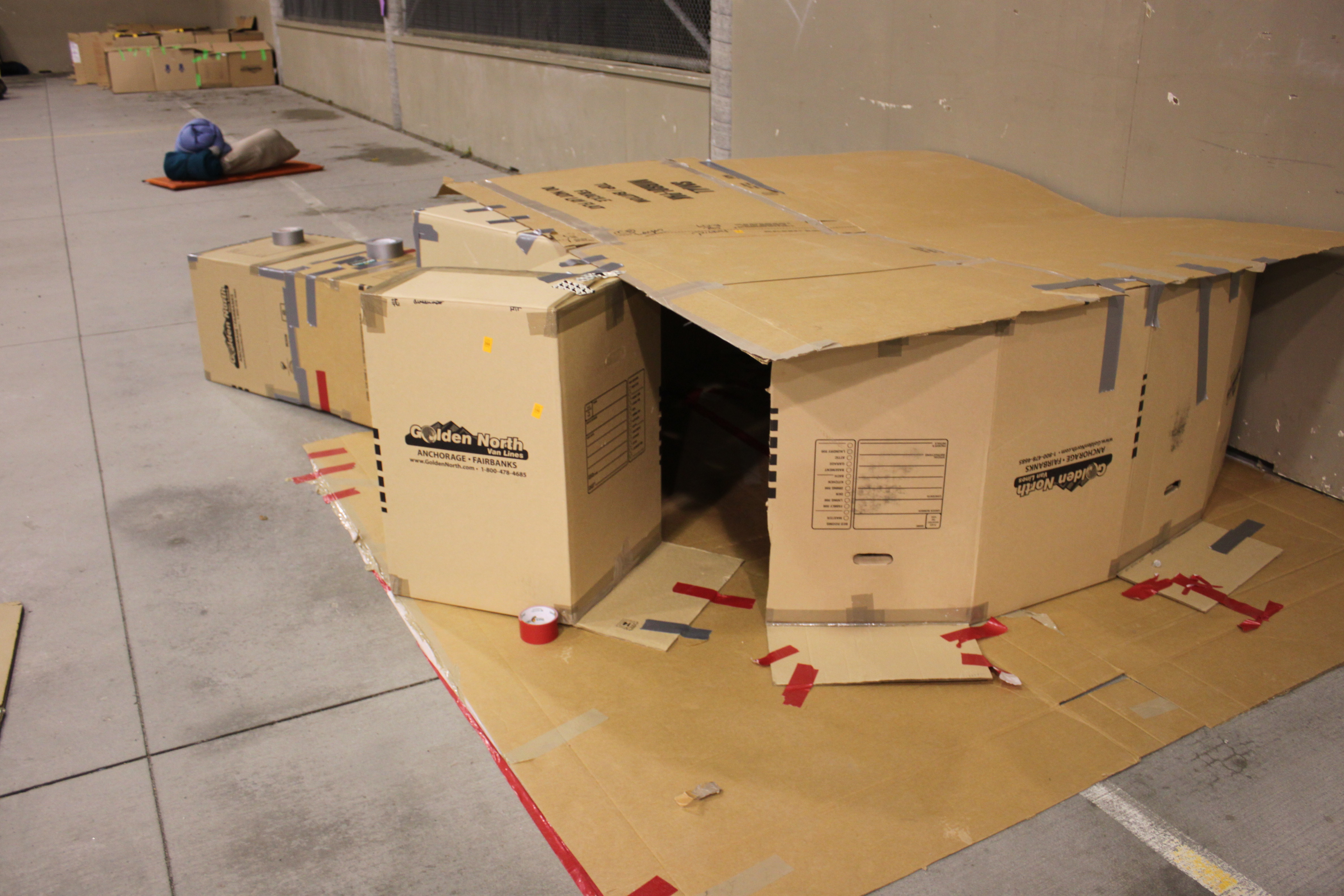
Students slept in makeshift shelters under the outdoor covered area at Riverbend Elementary School. (Photo by Lisa Phu/KTOO)

The cardboard structures are largely symbolic. Kids in Juneau who don’t have permanent housing aren’t typically sleeping outside. Gabi Kito, a 16-year-old junior, said they’re more likely to be hopping from couch to couch.

“People – when they think of homeless(ness) – they think of them sleeping outside and in boxes rather than sleeping in a house and different houses each night.”

Some homeless youth stay with families at shelters through St. Vincent de Paul or AWARE. Others turn to Juneau Youth Services, which offers a 10-bed emergency shelter at Cornerstone Residential Facility.

JYS offers counseling for mental health, substance abuse and family reunification.

The organization plans to reopen its transitional living program early next year, executive director Walter Majoros said. It’ll house six individuals ages 16-21.

Majoros said some kids and teens are homeless due to family discord and instability.

“There may be family violence going on. There may be sexual abuse. There may be alcoholism or drug abuse in the family. There may be a single-parent family that creates some instability. Oftentimes there’s a parent that is incarcerated.”

Another resource is the Zach Gordon Youth Center in downtown Juneau. It’s open every day except Sunday. Manager Jorden Nigro said homeless kids come regularly.

“We have showers here so they can take showers, and we help connect them to resources and we feed a lot of kids here,” Nigro said. “We have kids that come and get their after-school snack here and lots of kids who stay for dinner.”

Besides offering activities and services — such as basketball, tutoring and arts and crafts — Nigro said staff members work hard to build relationships.

“If kids have meaningful connections with adults, they do better in every aspect of their life and that impacts kids whether they’re homeless, whether they’re not homeless and also can help kids who are on the cusp,” Nigro said.

At school, homeless students are offered help with transportation, free meals and snacks, clothing and shoes, toiletries and assistance with activities fees.

Dixie Weiss is the faculty adviser of the service club Interact at Juneau-Douglas High School. Interact has helped organize the annual sleep-out since 2004. Besides raising awareness, the sleep-out also raises money. Weiss has seen first-hand how the funds help.

“Time and time again these kids are giving you these big bear hugs because they never imagined they’d get that yearbook or that senior hoodie or the support,” Weiss said.

The sleep-out also teaches an important lesson, “that sitting next to them in a class, day in and day out, there’s this kid that is, against all odds, making it; that they have courageous peers and this is a way to support that courage,” Weiss said.

So far, the students have raised about $3,000 and are accepting donations through the end of November. Half of the proceeds will go to the school district and the other half to the Zach Gordon Youth Center.

Youth experiencing homelessness can contact Juneau Youth Services at 789-7654, 24 hours a day, seven days a week.

How to revive an endangered language in the age of social media

In Alaska, the number of fluent Haida speakers has dwindled down into the single digits. It’s been called an endangered language. But in Juneau, one group is trying to change that. Haida Language Learners is using YouTube, Snapchat and Instagram to reach a wider audience.

Emily Rose Edenshaw-Chafin shows me her phone. She’s been using a flashcard app to practice Haida. It’s totally customizable. She can create the cards and share them with teachers and friends. On one of the cards is a picture of a horse grazing in a field, and it’s broken down into cuts of meat — labeled Gyuudáan Kiʼíi eehl Hl ʼwáadaagang.

Haida Language Learners use the app Snapchat to connect with others. The app deletes shared videos after a few seconds, which they say is perfect for practicing the language.

“And then the second one is a cartoon, the one in English that says ‘I have horse meat for sale.’ It’s a picture of a horse head inside a burger,” Edenshaw says.

Not a real horse head, part of a costume.

“For me, it makes it funny and it makes it more interesting,” she says.

The Haida arrived in Southeast a few hundred years ago. Some left their ancestral home of Haida Gwaii, which is now part of Canada. They settled in villages on Prince of Wales Island. Edenshaw says the Haida language’s grammar structure is similar to Spanish. And like Spanish, it can sound like a foreign language.

“And being Native you’re disappointed that you don’t know your own heritage and language. It’s hard to work past that sometimes,” she says.

Edenshaw has practiced Haida for over a decade. Her family moved to Hydaburg when she was a kid, and she started picking words up.

“You know, like thank you: Háw’aa. Hágwsdaa: hurry up. You hear that one a lot.”

But she says it was hard to learn more complex phrases. In college, she was able to take a free class taught by a linguist.

“I really fell in love with the language. I wanted to write poetry in Haida. I wanted to dream in Haida, so I continued to practice with it.”

She says part of that meant finding someone to speak Haida with, to use words and phrases that are relevant in conversation today. Edenshaw met Susie Lee Edwardson in Haida class.

In their YouTube video, a picture of Grumpy Cat flashes on the screen. You know, Grumpy cat. The feline celebrity meme. Edwardson repeats the word híndaa or “go away.”

It has more than 200 views. Their YouTube Channel has about 145 subscribers, which may not seem like a lot. But remember, Alaska’s fluent Haida speakers are in the single digits. Edwardson has only been studying it for about three years, and says she didn’t grow up speaking the language. Her parents spoke a word here and there.

“It didn’t really connect with me as it was a part of me,” Edwardson says. “But when I got into college and I started learning the language with my family, it felt really good and it felt like you were going into a community that you were a part of all your life.”

The number of fluent Haida speakers has been declining for the past 100 years. Many boarding schools run by the federal government and missionaries enforced strict bans on Native languages. Edwardson says it’s a serious topic, but they’re trying to make learning Haida fun. It’s involved some compromise.

She took down one of their YouTube videos because some found it offensive. In that video, she says the Haida word for penis. OK, maybe they went a little farther and said “tiny penis.” But Edwardson says they don’t want to offend anyone.

Emily Rose Edenshaw-Chafin and Susie Lee Edwardson plan out their next YouTube video. (Photo by Elizabeth Jenkins/KTOO)Emily Rose Edenshaw-Chafin and Susie Lee Edwardson plan out their next YouTube video. (Photo by Elizabeth Jenkins/KTOO)
Emily Rose Edenshaw-Chafin and Susie Lee Edwardson plan out their next YouTube video. (Photo by Elizabeth Jenkins/KTOO)

“Like the little radical in me is like, ‘it’s the language,'” Edwardson says. “But at the same time we want it to be accessible. And if families are going through the YouTube videos and there’s something they don’t want them to learn yet, I don’t want them to stay away from the language.”

Then there’s also the issue of finding ways to express modern notions. But Edenshaw says that’s totally doable.

“We ask the elders what would make this work. What can we do to translate this into Haida?” Edenshaw says. “So we’ll all understand it and then we can use just Haida vocabulary and our thoughts and what we’re doing nowadays.”

The Haida phrase for computer literally means “the box that knows everything.” A cellphone is a “purse phone” or “wallet phone.” Spinach is “iron leaf.”

And she says having the web to connect with others has been huge. Haida Language Learners has received messages from a teenage fan in New York. They’ve helped people in remote communities say goodbye to a loved one at a funeral in Haida.

Edenshaw recently quit her day job to focus on language revitalization full-time. She wants people to know Haida isn’t dead.

“We can bring back the language. We can’t bring back every single part of the culture but we can bring back the important parts that will make us feel whole and make us feel right in the world.”

She hasn’t dreamed in Haida yet. But she is writing poetry.

Correction: A previous version of this story said that Edwardson had been studying the language for about one year. She’s actually been studying it for three years. We regret the error. 

Chilkat robe returning to Southeast

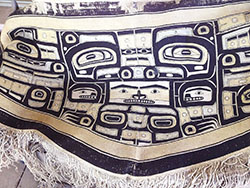
Sealaska Heritage Institute has acquired a Chilkat robe that was to be auctioned off on eBay on Wednesday. After the seller learned the robe was a sacred item, he allowed SHI to purchase it at the reserve price of $14,500. There were already multiple bids.

The Chilkat robe is a Raven design and measures just over five feet wide. (Photo by
The Chilkat robe is a Raven design and measures just over five feet wide. (Photo by George Blucker)

Typically, these objects can fetch upwards of $30,000.

The seller, George Blucker, bought the robe at an Illinois flea market 25 years ago. He thought it was a fake, but that seller told him it was purchased at an estate sale and had been brought back sometime after the Yukon gold rush.

The clan of origin is unknown. The robe is a Raven design and appears to be funerary object.

In a statement, Blucker said when he learned the robe had “religious significance” and a “spiritual presence,” he knew it needed to return home.

SHI expects the robe to arrive in Juneau later next week.

Recovering from addiction: We are the solution

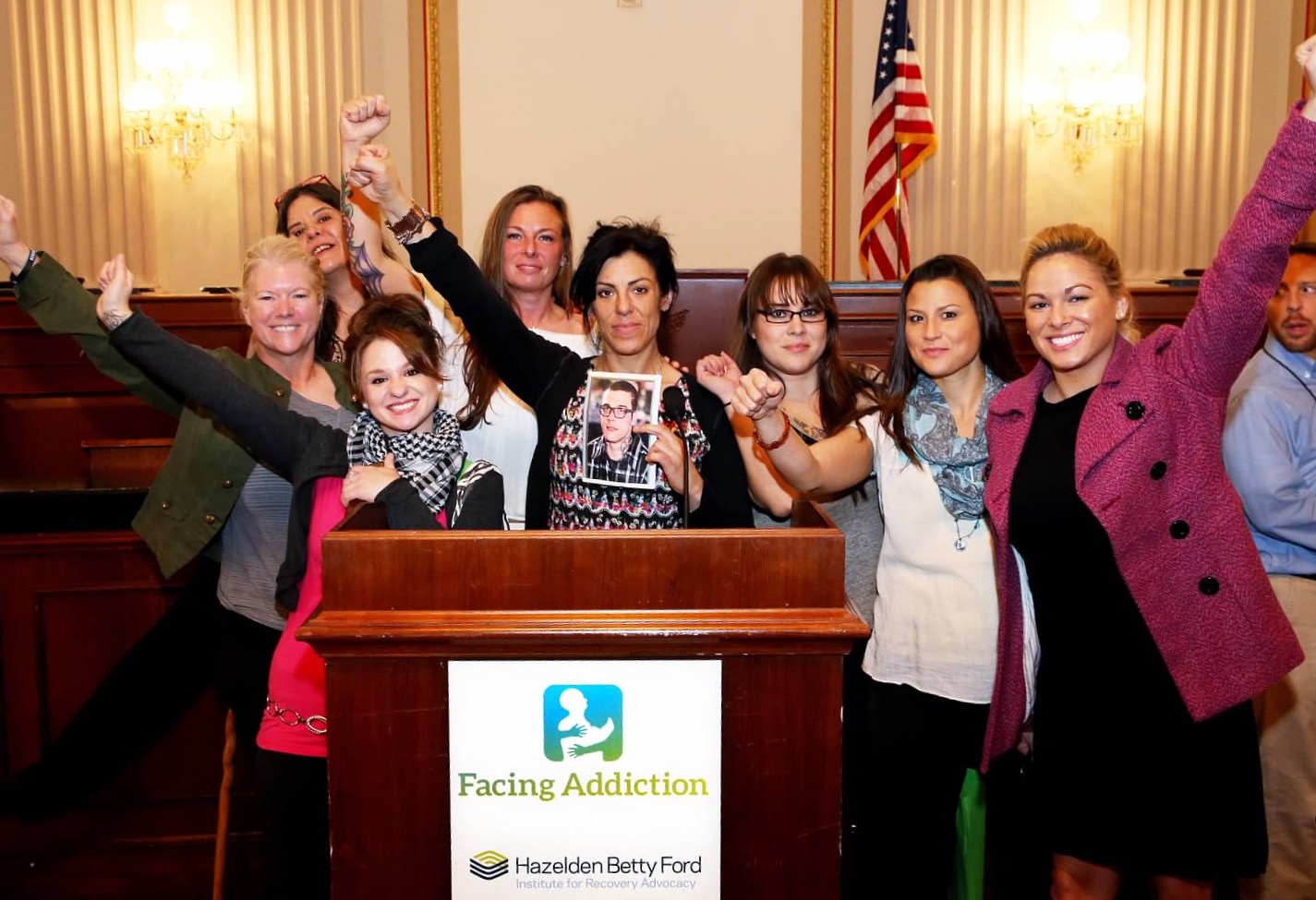
Alaskans were part of the UNITE to Face Addiction Rally in Washington, D.C.: Kim Whitaker, Julee Douglas, Samantha Garton, Terria Walters, Kara Nelson, Delia Williams, Jennifer Mcallister and Christina Love inside a congressional office building in D.C. in October. Nelson is holding a picture of Christopher Seaman, the son of Walters who was murdered in Mat-Su in June. (Photo courtesy Kara Nelson)
Alaskans were part of the UNITE to Face Addiction Rally in Washington, D.C.: (left to right) Kim Whitaker, Julee Douglas, Samantha Garton, Terria Walters, Kara Nelson, Delia Williams, Jennifer Mcallister and Christina Love inside a congressional office building in D.C. in October. Nelson is holding a picture of Christopher Seaman, the son of Walters who was murdered in Mat-Su in June. (Photo courtesy Kara Nelson)

Alaska’s capital city is battling addiction. The Juneau community continues to face substance-related deaths and near deaths.

Three women came to KTOO recently to talk about addiction, long-term recovery and a rally that gave them hope.

Christina Love, Kara Nelson and Julee Douglas are all in recovery. At different times in their lives, they’ve been addicted to different substances.

Love is an advocate at the AWARE shelter in Juneau. She said her addiction started out with Adderall in college. Cocaine was next.

“Then we went to crack cocaine, and alcohol is always there. The hangovers were bad, so we went to pills, then we went to oxys, and then we went to heroine, and then benzos. And really it’s anything that’s in front of you at any given point,” Love said.

Love detoxed in Fairbanks and became sober. Then she started treatment and is in long-term recovery.

“Once you have this disease, you suffer it for the rest of your life, and it can’t be stopped,”  Love said. “But it can be arrested.”

Love and Kara Nelson met on the recovery journey about four years ago. They’d been anonymous in meetings held in churches and basements before they started speaking and advocating publicly.

Last month, they and six other women from Juneau and Anchorage represented Alaska in the UNITE to Face Addiction Rally in Washington, D.C. They marched in the National Mall with close to 30,000 people involved in the recovery movement, including other recovering addicts and those who’ve lost people to addiction.

Nelson is the director of Haven House, a faith-based transitional home for women recently paroled or released from prison. Haven House provides peer-to-peer support for women who’ve faced addiction and incarceration. She organized the trip to D.C.

“As a person in long-term recovery and as someone who has an extensive history in our criminal justice system and continuously sees my friends, our neighbors, our people incarcerated and then the effects of that and then getting out and having even more issues than being in prison itself, this was a very personal thing for myself to be a part of,” Nelson said.

The rally was aimed at changing the conversation around addiction and treating it as a health crisis. Nelson said recovery is a lifelong journey, not aftercare for a month.

“If you have any other kind of illness or disease, you’re going to have these check-ups and you’re going to continuously be checking in to every symptom, right? That’s exactly how substance use and mental health should be treated as well,” she said.

At one of the rally events, people wore T-shirts and carried posters with photos of loved ones who had passed away from addiction. Julee Douglas said being surrounded by that helped her and the others come to terms with the wreckage of their past.

“Any one of us could have been a poster or a T-shirt for sure,” Douglas said.

Douglas also works at Haven House as the house manager. She said offering peer support to the residents gives her support to heal from her alcohol addiction.

During the rally, the group visited Alaska’s congressional delegation to lobby for bills related to the recovery movement, like the Comprehensive Addiction and Recovery Act. The CARA bill will help bring money to grassroots recovery organizations.

Love said it was empowering to be at the D.C. rally and advocate with people who share experiences of feeling rejected, discriminated against and suicidal.

“I’ve said a million times over and over, ‘I’m a person in long-term recovery.’ That’s one of my favorite things about myself and it’s one of my favorite things about the people that I help because it stands for something so completely opposite from what the rest of the world thinks,” Love said. “They see an addict, but I see a person who’s resilient and a fighter.”

Nelson helped form the Juneau Recover Community two years ago. It’s people in recovery helping others through support and social events, like Recovery Fest. But she says more needs to be done.

“We’ve been able to educate ourselves to really be in a position where we are the ones that are the solution.”

Nelson and Love, both recovery coaches, plan to work with local agencies to form a community plan focused on recovery, and are actively meeting with Juneau organizations to try to establish a detox facility.

Dangerous form of heroin enters Juneau

Heroin powder
Heroin powder. (Photo courtesy Drug Enforcement Administration)

The Juneau Police Department recently received an anonymous tip that a dangerous form of heroin has entered the city. Lt. Kris Sell said it’s called “China white,” and the police have been told it may be laced with fentanyl, a prescription drug used for pain management.

“The fentanyl being mixed with the heroin could be a game changer,” she said. “They might misestimate what their dosage would be. What people have been telling known users in the community is to have a friend around, use lightly.”

Five heroin overdoses occurred over the weekend. One of the cases also involved meth. Emergency responders found that China white was involved in two of the overdoses, Sell said.

Sell said typically this type of heroin isn’t found in the city.

“Usually in Juneau we see a black tar heroin that is a more crudely processed form of heroin and usually comes from Mexico,” Sell said.

China white is in powder form and comes from Asia. Sell said the police haven’t been able to confiscate the drug yet. Capital City Fire/Rescue was able to administer lifesaving Narcan to three of the overdose patients.

This year, seven people have died in heroin-involved deaths.

12 to 18 inches of snow expected in Juneau

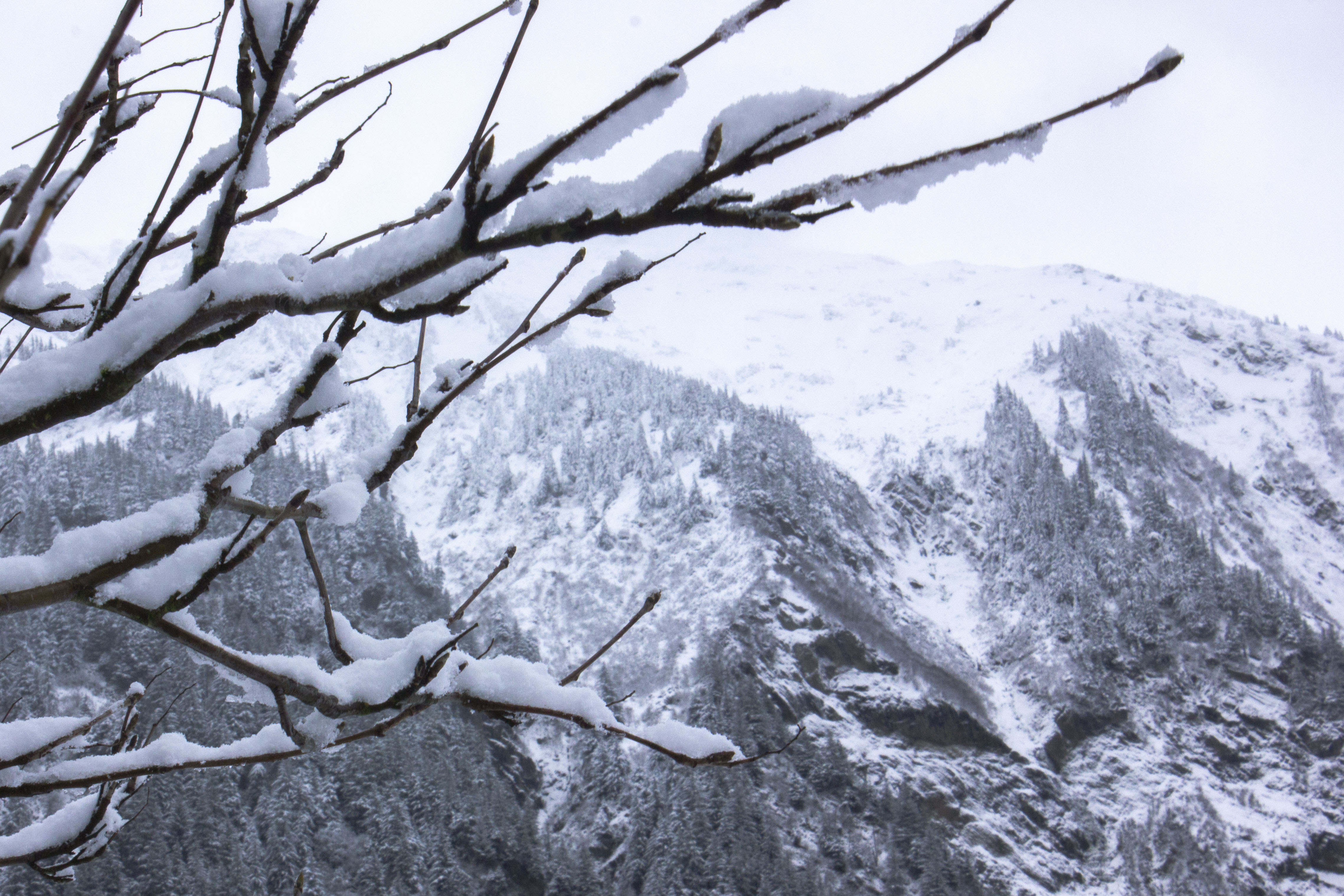
Recent snowfall in downtown Juneau (Photo by David Purdy/KTOO)

Juneau could receive up to 18 inches of snow by Wednesday afternoon. The National Weather Service issued a winter storm warning for the borough, which is in effect until 4 p.m. Wednesday.

Jonathan Garner with the National Weather Service office in Juneau says snow showers will move east across Juneau.

“Heavy snow showers with a short period of lighter snow or even maybe no snow, and then another shower will move across and we’ll get another period of heavy snow,” Garner said. “We’re expecting 12 to 18 inches of total snow fall accumulation through Wednesday afternoon.”

Garner says Juneau could get another snow event on Thursday.

Eaglecrest Ski Area is reporting 40 inches of snow accumulation to date.

Editor’s Note: A previous version of this story overstated the amount of snow at Eaglecrest.

Site notifications
Update notification options
Subscribe to notifications