The Juneau Assembly voted Monday to extend a moratorium on permitting marijuana establishments in Juneau. There were no dissenting votes and no one from the public testified.
The ordinance extends the moratorium to Dec. 31 and gives the city more time to adopt new land use regulations following last fall’s successful ballot measure to legalize marijuana.
Inside the burned out Gastineau Apartments. (Photo by Lisa Phu/KTOO)
The Gastineau Apartments won’t be coming down until April. That’s according to city Engineering Director Rorie Watt, who delivered an update at Monday’s Juneau Assembly meeting.
Originally, the city wanted a demolition plan by August and bids solicited by September.
“However, what we’re hearing from contractors is that we’re giving an inadequate amount of time for the completion of the project,” Watt said. “We’ve seen major commercial contractors who would be suited for this kind of work pick up the bid documents, steer away. Call us up and say, ‘Too much risk. Not enough time. Not interested.'”
Now, the bidding process will extend into October with awards announced later that same month.
NorthWind Architects previously expressed concern that rainy fall weather would make the demolition more difficult, especially with respect to erosion of the hillside behind the apartments and managing stormwater pollution.
Assembly member Karen Crane said an extension could save the city money, but the building needed to be gone by spring.
“There can’t be any more slop over from that date because you know, then we’re running into tourist season and then there’s a big problem,” Crane said. “So the contract needs to be written pretty tightly that’s it’s down by the 30th of April or else something drastic.”
Although it’s taken months to formalize the plans, the demolition should only take three to four weeks.
The city has appropriated$1.8 million for the entire project, which it hopes to recoup through a lien against the property owners.
Gov. Bill Walker plans to call a special session of the Alaska legislature this year, focused on issues surrounding the development of a natural gas pipeline from the North Slope.
Walker made the announcement Monday evening on a television appearance on KTVA. His communications director, Grace Jang, said more details would be released later this week.
Alaska — along with three oil producers and a pipeline company — is in the process of developing a huge gas pipeline project from the North Slope. A special session this fall to address specific aspects of the project, like property taxes, has been under discussion for months.
State law requires Walker to give lawmakers 30 days of advance notice, so the special session will not begin until late October at the earliest. Walker told KTVA that he wants the special session to conclude before Thanksgiving.
Asked whether the special session would be held in Anchorage or Juneau, where the state Capitol has been undergoing renovations, Jang said in an email that Walker “is working with legislative leadership on the location, but he prefers that legislative sessions be conducted in the state capital of Juneau.”
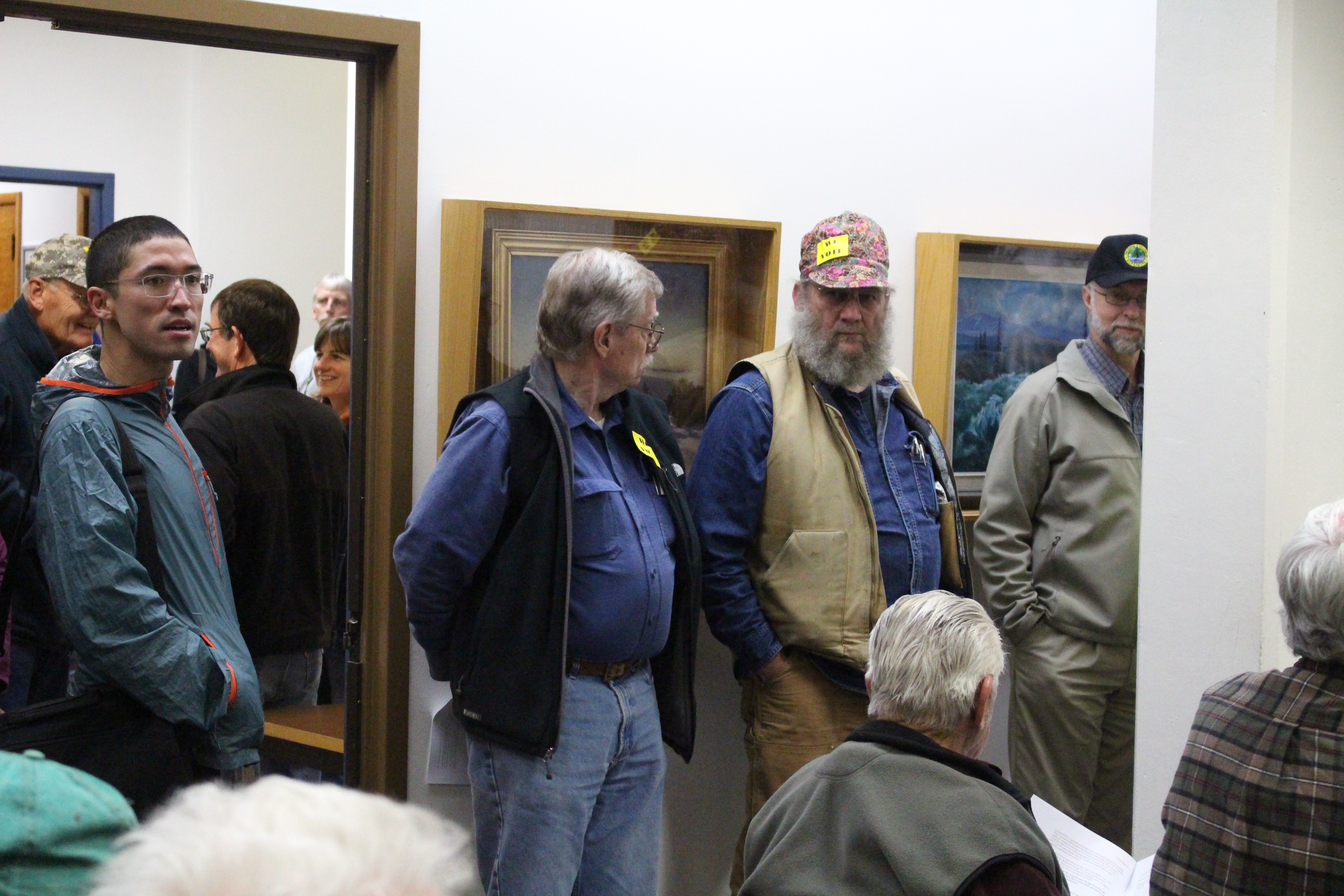
Seniors in assembly chambers wear bright yellow pins that say “We vote.” (Photo by Elizabeth Jenkins/KTOO)
Despite pleas from a packed house, the Juneau Assembly voted 7-2 Monday to scale back the senior sales tax exemption.
Low-income seniors will remain exempt from Juneau’s 5 percent sales tax. Other seniors will have to pay, unless they’re purchasing essential items like food, heating fuel, electricity and city water and sewer utilities. The assembly also voted to exempt garbage removal and recycling services.
More than 40 people gave passionate testimony on the issue. Nora Laughlin said when she retired, the sales tax exemption helped her stay in Juneau. She stressed seniors do a lot to give back to the community.
“The amount of hours we put in and give to this city are phenomenal. And you want to balance the budget on our backs. Come on!” she said. “I do free taxes for people: seniors and low-income during tax season. And I volunteer at nonprofits. I’m not the only one. That’s what seniors do. We are valuable assets.”
A handful of testifiers said middle-income families were suffering more. But others worried what effect the change would have on local businesses.
Melissa Highfill, the owner Seaside Yarns, said seniors with exemption cards make up 10 percent of her sales.
“I can’t afford to lose up to 10 percent of my business by people shopping online,” Highfill said. “Having things delivered for free and not paying sales taxes. I try to educate people to see it here, buy it here and keep me here. Seniors know the value of that.”
Assembly member Kate Troll pointed out that the city’s senior population has doubled since the sales tax exemption was created and that number is projected to go up.
Troll said by making these “modest” changes now, the program could remain sustainable.
“It’s only a matter of time before the question really comes, do we do away with the exception at all?” Troll said. “As many people here have said, we know the state’s fiscal situation isn’t very rosy. And we need to make sure we keep the programs and services the seniors depend upon.”
Mayor Merrill Sanford and assembly member Mary Becker were the only no votes.
Overturned dumpsters in the alleyway between Tracy’s King Crab Shack and Diamonds International on Sunday morning. (Photo by Heather Holt)
It’s that time of year again. Bears have descended on Juneau dumpsters and garbage cans, which mean people have to be extra responsible about how they dispose of trash.
When employees of Tracy’s King Crab Shack went into work Sunday morning, they were greeted by cardboard boxes, trash bags and crab bisque containers scattered all over the alleyway. Three dumpsters had been overturned.
For the past couple of weeks, manager Tina Degarimore has gotten used to this.
“There seems to be one bear that terrorizes South Franklin Street with the garbages,” Degarimore said.
In June, the business tried to secure their two dumpsters properly.
“We did put a fence up. Well, the bear decided he didn’t like the fence so he did break the fence. We’re definitely going to be looking at different solutions and trying to find something more bear-proof,” she said.
In the meantime, Degarimore said the staff is securing the dumpsters with carabiners and doing what it can when a bear does get in.
“Clean it up, put the cans back up and continue on with our day,” Degarimore said.
That bear terrorizing South Franklin Street is getting ready to den. As summer comes to an end, bears try to pack on as much fat as they can.
“They’re certainly driven by their stomachs and they’re going to find food wherever they can and a lot of the time, that brings them into town,” said Stephanie Sell, wildlife biologist with the Alaska Department of Fish and Game.
Last week, a bear with a plastic container stuck on its head was walking around Cope Park. Sell says Alaska Department of Fish and Game immobilized the bear, got the container off and moved it out of town. The bear is now marked with a red ear tag. (Photo courtesy Bob Dilley)
By not securing our trash properly, Sell said we’re training bears to have bad behaviors.
“Unfortunately every time a bear gets into garbage, it remembers that. It remembers that it’s gotten food there and it’s going to remember the source. Whether it be a garbage can or a dumpster or just bags of trash that are out, they’re going to remember that and from year to year, they’re going to look for that,” Sell said.
The city requires you to keep your garbage can in a garage or shed until 4 a.m. the morning of trash pick-up day. If you do not have a garage or shed, get a bear-resistant can like a Bearsaver, Toter or Kodiak Can. The gray garbage can with a black lid and red lock that many residents have are not bear proof or bear resistant. Another option is freezing food scraps until trash pick-up day.
Sell said Fish and Game has had to euthanize two bears this year – one in July and one earlier this month. On average, Sell says the agency puts down three to four each year and relocates the same amount.
Juneau’s Community Service Officer Bob Dilley said the city’s bear attraction nuisance law had a big rewrite in 2004.
“The year before the ordinance was rewritten, there was 23 bears that were shot and killed that year and that really got people fired up. Twenty-three in a summer is a lot of bears,” Dilley said.
Around this time of year, Dilley said Juneau police are giving out one to two bear citations a day. Those carry a fine from $50 to $300.
“It seems like this many years into the ordinance and trying to get people to do the right thing, I would have hoped we would’ve been further along with having less interactions with bears and people and their garbage,” Dilley said.
Dilley doesn’t think Juneau will ever completely solve its problem with garbage bears, but he says we can do better.
Close
Update notification options
Subscribe to notifications
Subscribe
Get notifications about news related to the topics you care about. You can unsubscribe anytime.