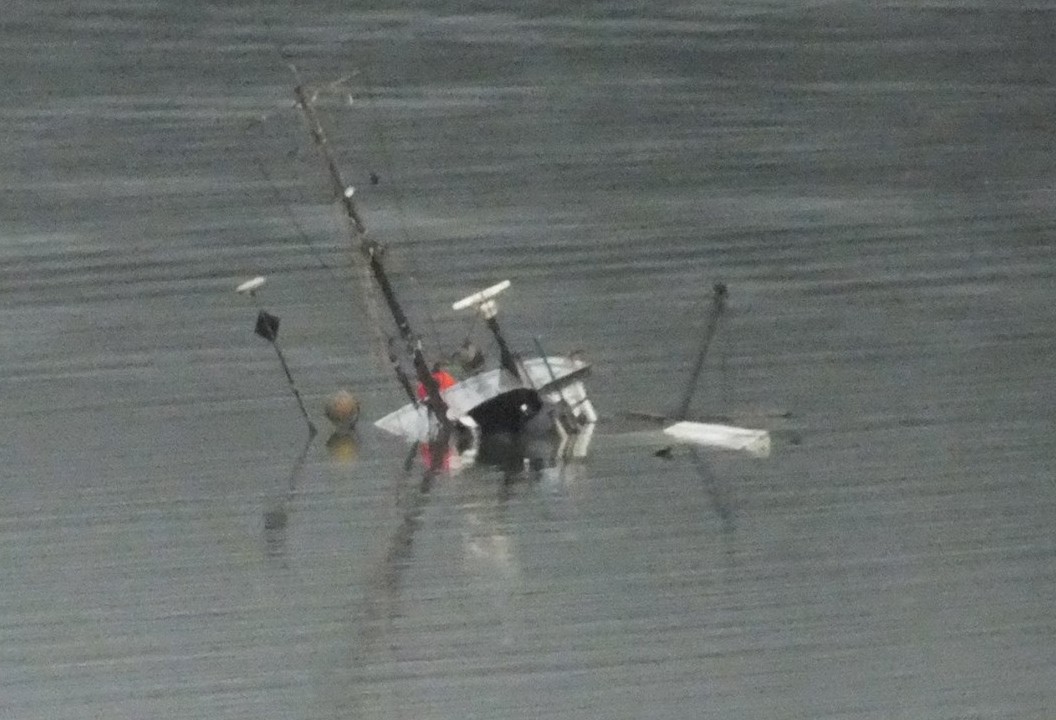
The top of the Challenger still protrudes above the water (Photo by Matt Miller/KTOO)
Update | Sept. 13, 12:09 p.m.
The Coast Guard response team is applying boom to the water Sunday morning to contain any fuel leakage from the sunken tugboat. A minimal amount of fluid was found to be on board. The Coast Guard will be working throughout the week to coordinate a salvage operation.
The Challenger was built in 1944 for the U.S. Army and later used as a “bunk and breakfast” in Seattle. Around 2002, the tugboat made its voyage to Juneau and was eventually sold to local artist R.D. Robinson.
Original story:
A tugboat, known as Challenger, sank near Aurora Harbor around 3 p.m. on Saturday. Coast Guard Petty Officer Geno Kludt said the 96-foot wooden vessel was engulfed by water in about fifteen minutes.
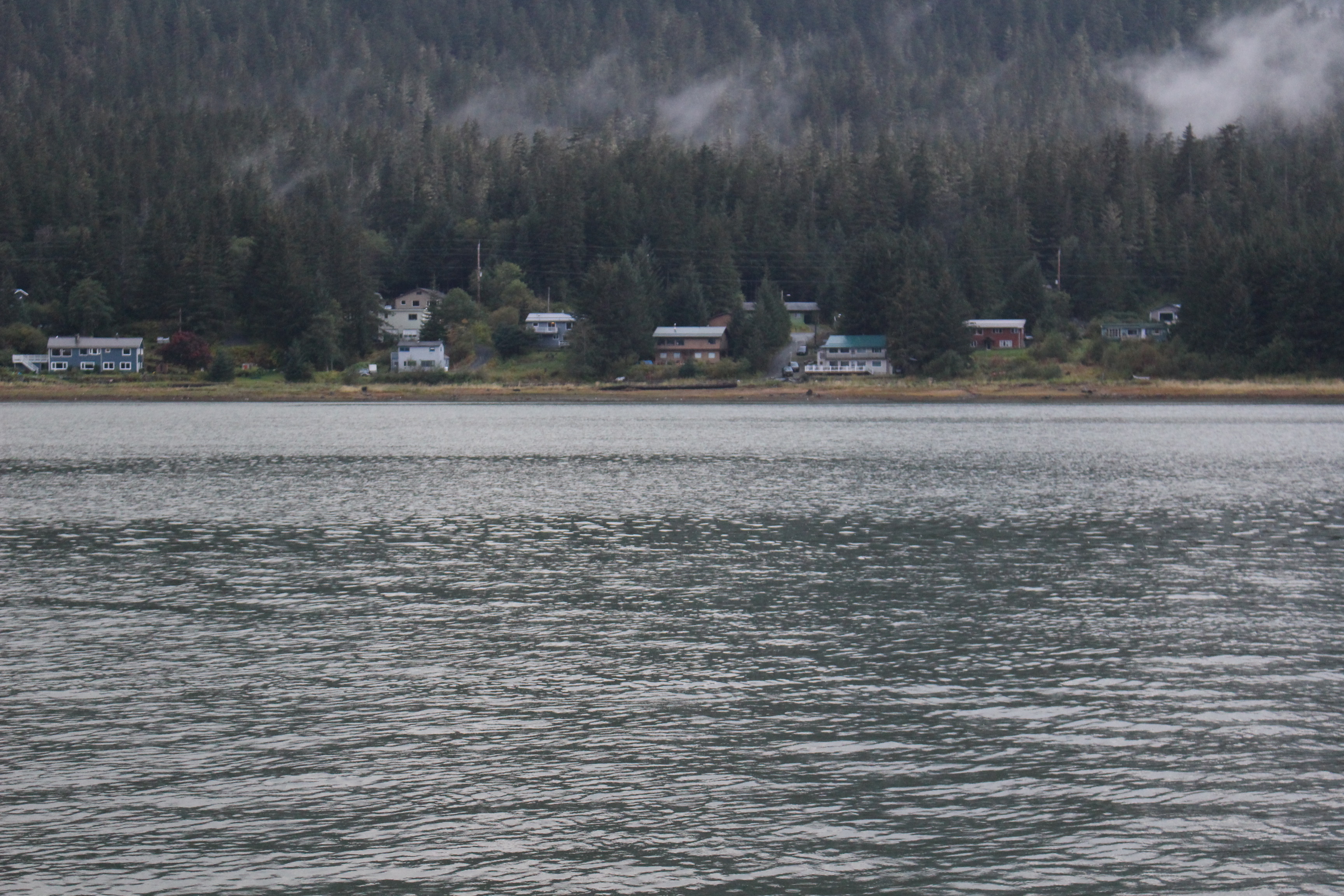
(Photo by Elizabeth Jenkins/KTOO)
No one was suspected to be on board.
“Basically, it’s one of those fixer upper type boats that’s been anchored up in Gastineau Channel. It just finally took on enough water and sank,” he said.
Kludt warned boaters to watch out for debris and the vessel’s mast sticking up. He said there are plans to assess the damage but raising it might be complicated.
“It’s ultimately the owners responsibility to coordinate the salvage efforts,” he said. “However, if he’s not able to take action on it, that’s when the Coast Guard may have to help with the salvage efforts to raise the vessel.”
There’s no word on when that might take place. For now, Kludt said boaters should proceed with caution through the site.
Editor’s Note: The story has been updated to reflect the correct size of the Challenger and to clarify that the Coast Guard used boom to contain possible fuel leaks, not a chemical solution.
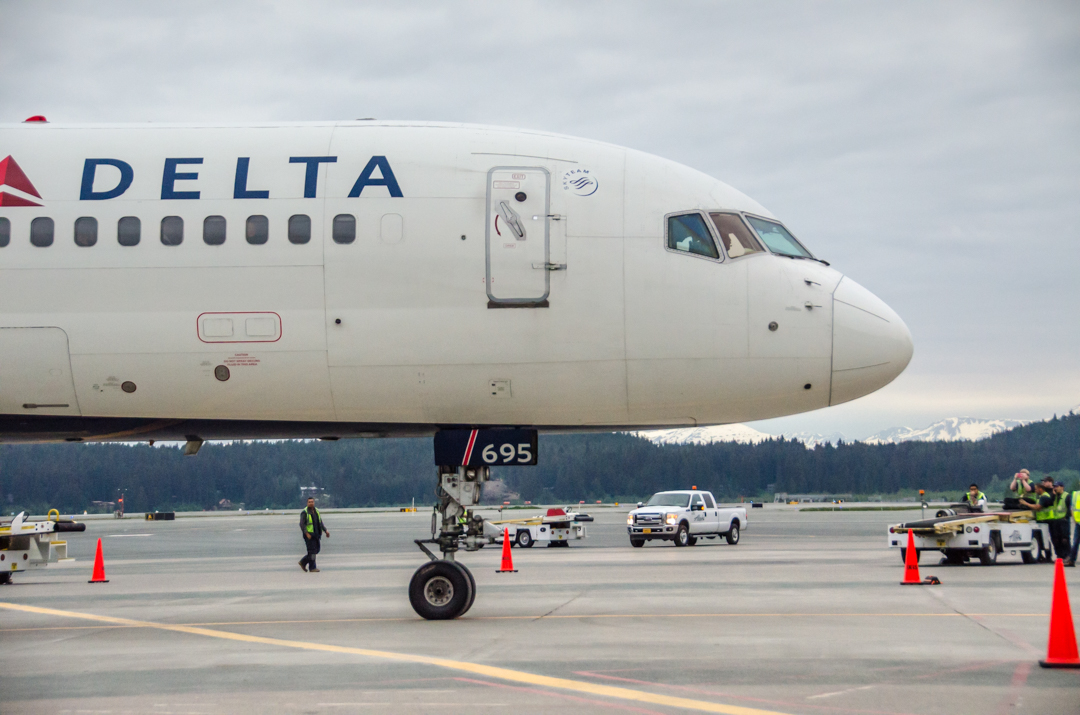
Delta Air Lines year-round service means more competitive fares. (Photo by Heather Bryant/KTOO)
The end of summer signals a few things – goodbye cruise ships, superfluous jewelry stores and many food trucks. One thing that is sticking around this fall and winter is Delta Air Lines. That means more affordable ways to leave the capital city.
Delta Air Lines started seasonal flights in Juneau the summer of 2014. Last January, the airline announced it would introduce year-round service, so this is the first fall Juneau will see competitive air fares to the Lower 48.
“Delta is making a play to really make an impact on this market,” said Scott McMurren, a travel analyst based in Anchorage.
He’s a loyal Alaska Airlines flyer, has MVP Gold status and usually gets upgraded.
“But Delta does a fine job, too. They’re world class. So people can make their own decisions and now they can save some money in the process,” McMurren said.
Between Juneau and Seattle, you can fly roundtrip for as low as $190 on both Alaska and Delta. For other cities like Portland, Las Vegas, Phoenix and Boston, Delta has the edge.
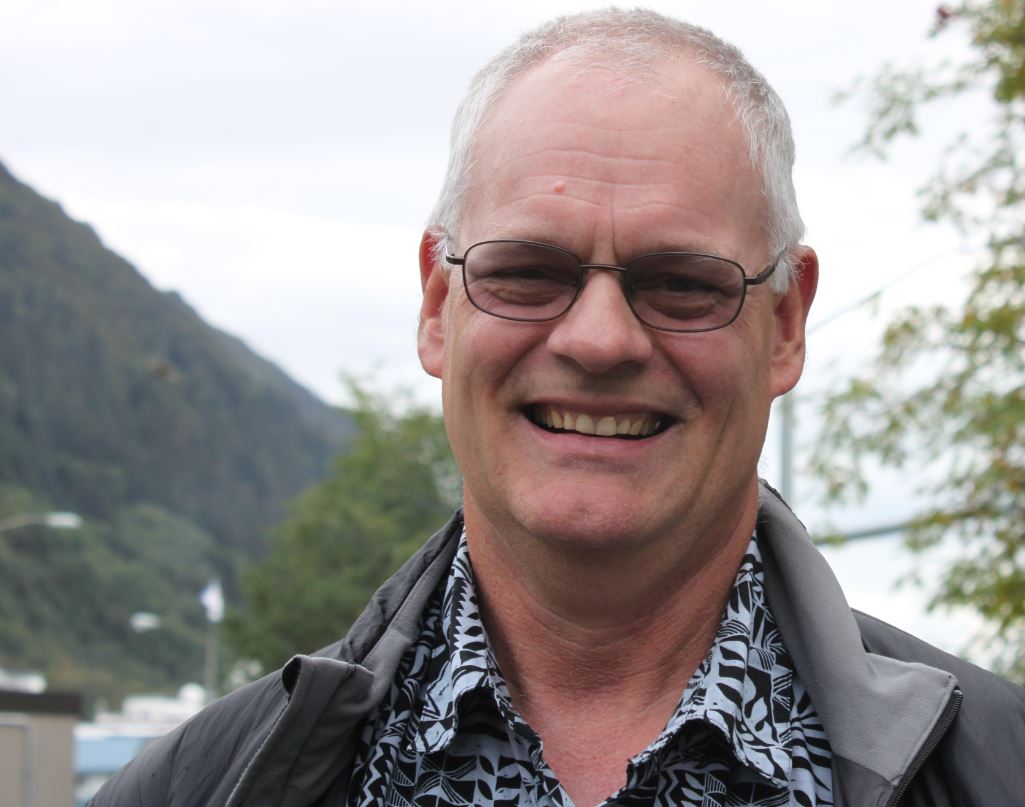
Scott McMurren is a travel expert based in Anchorage. (Photo by Lisa Phu/KTOO)
“Alaska has reacted by lowering its prices but not all the way and not on every flight and not on every day. For example, between Juneau and L.A., Alaska is sitting in there at $330 round-trip. So it’s lower, but not quite as low as Delta, $240 round-trip.”
McMurren anticipates Alaska will ultimately match the low prices if its passenger loads aren’t meeting expectations, “but I don’t know how long it’s going to take.”
McMurren encourages flyers to take a holistic approach to flying. Don’t just take the base fares into account. Also look at checked baggage costs, mileage, schedule of the flights and type of aircraft. Alaska offers free checked baggage to its Club 49 members, whereas Delta only offers that if you join its mileage program.
“But if you got a family of four and you’re going to L.A. and it’s a hundred dollars apiece difference, I think that people are really going to take a second look,” McMurren said.
McMurren says he will always prefer flying Alaska, but it’s worth checking the competition.
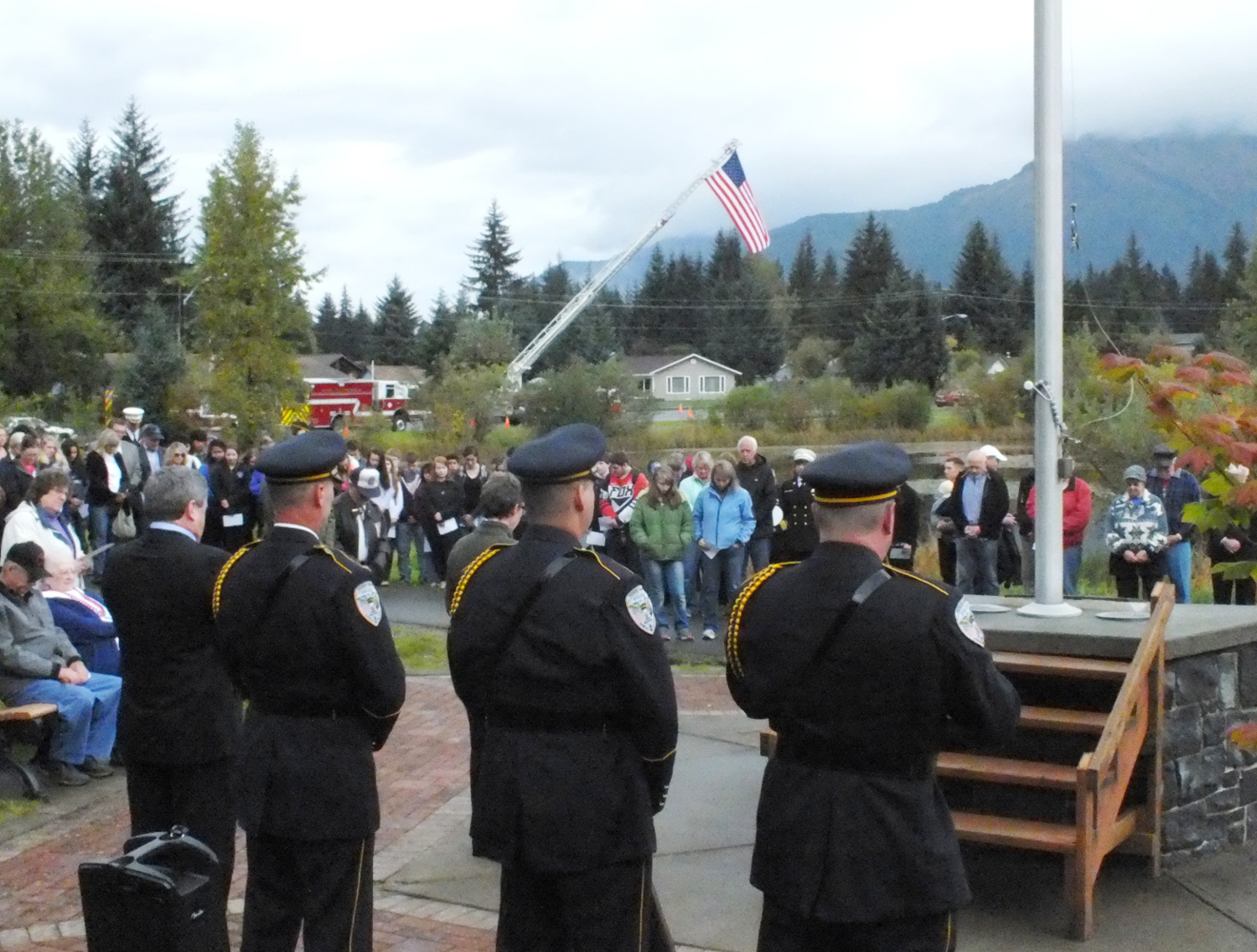
A moment of prayer before the raising of the American flag to half mast at Riverside Rotary Park. (Photo by Matt Miller/KTOO)
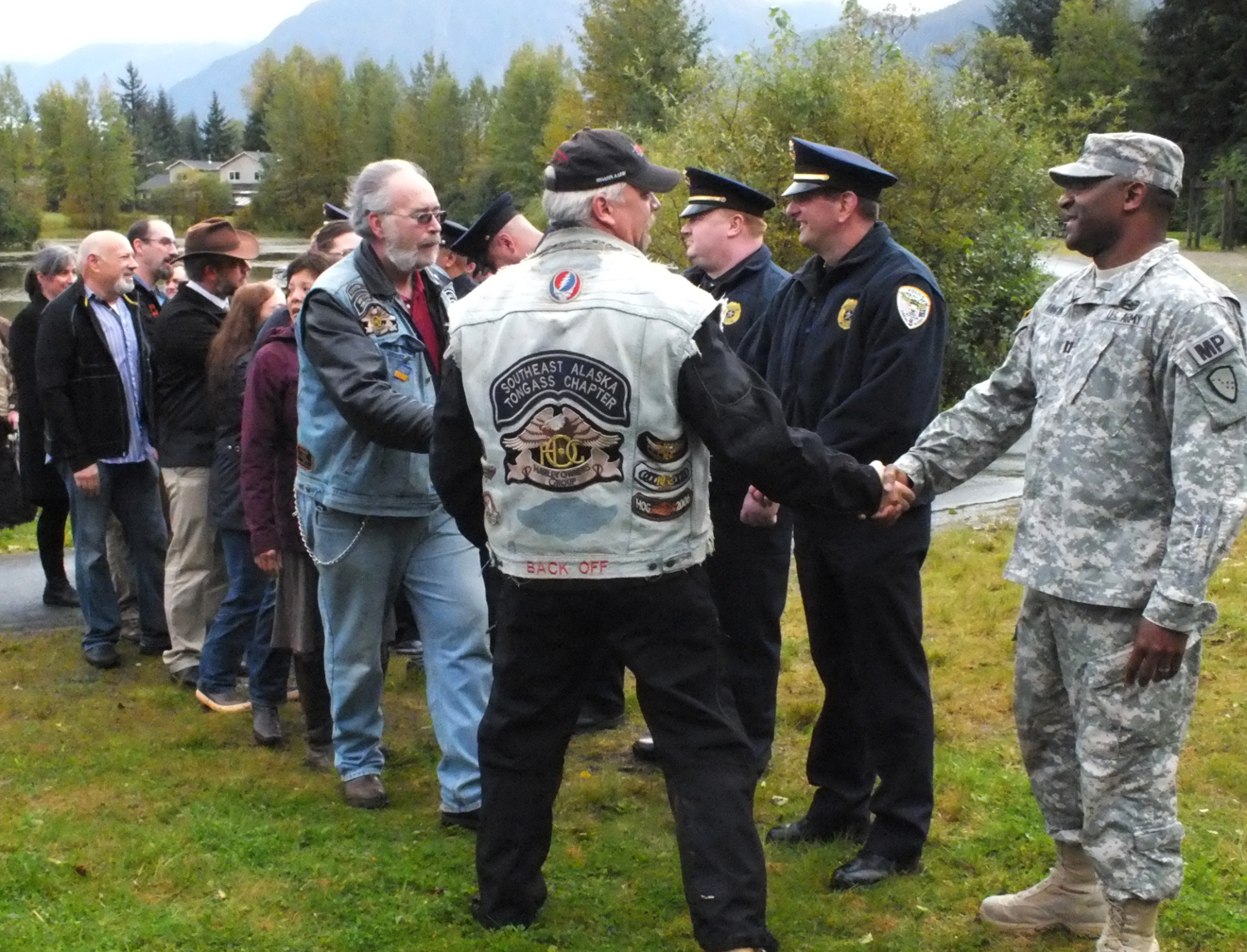
Juneau residents get to know first responders and service members during a short break in the observance. (Photo by Matt Miller/KTOO)
Juneau residents paused for a few minutes on Friday morning to remember those who lost their lives on Sept. 11, 2001 in New York, Washington D.C., and Pennsylvania. The 9/11 observance was held at Riverside Rotary Park in the Mendenhall Valley.
In remarks during the observance, George Riefenstein, retired special teams captain for Capital City Fire/Rescue, said they wanted to remember the 2,973 people who died on September 11. He also said they wanted to honor 1,400 additional people — rescue workers who have since died because of health issues related toxin exposure at the World Trade Center site.
“The healing goes on, as does as the commitment to serve with integrity and compassion that honors the memory of the fallen,” Reifenstein said. “We will never forget their sacrifice.”
“We all saw through the horror of that day what it means to be human. That, our connection to one another is as close as the manifestation of kindness and selflessness within the human spirit. By celebrating those unique qualities, we triumph over intimidation and we are guided forward with the knowledge that we will prevail.”
Listen to the entire 15 minute ceremony:
Abigail Zahasky sings The Star-Spangled Banner. (Photo by Matt Miller/KTOO)
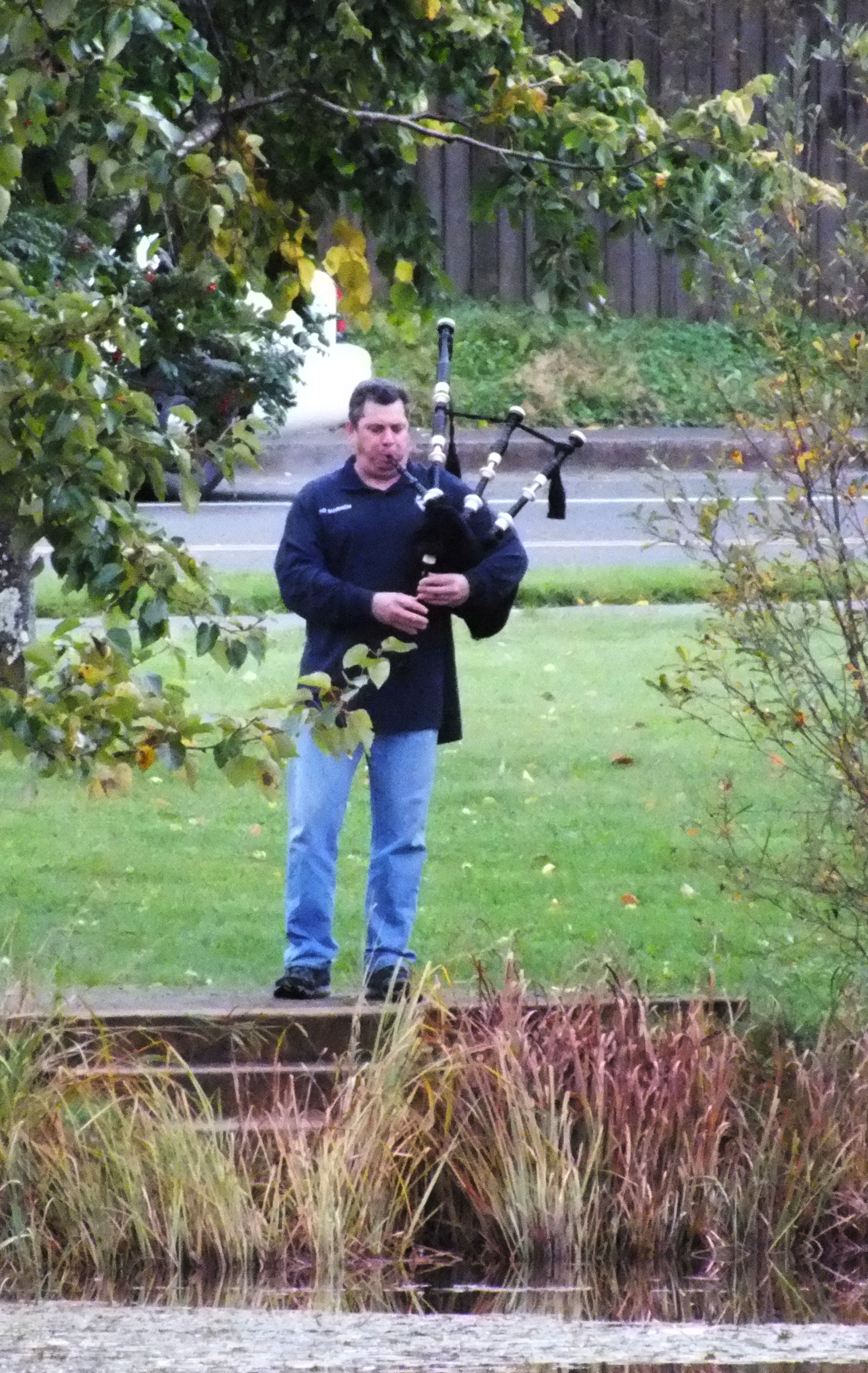
Scott Marnon of the City of Juneau Pipe Band (Photo by Matt Miller/KTOO)
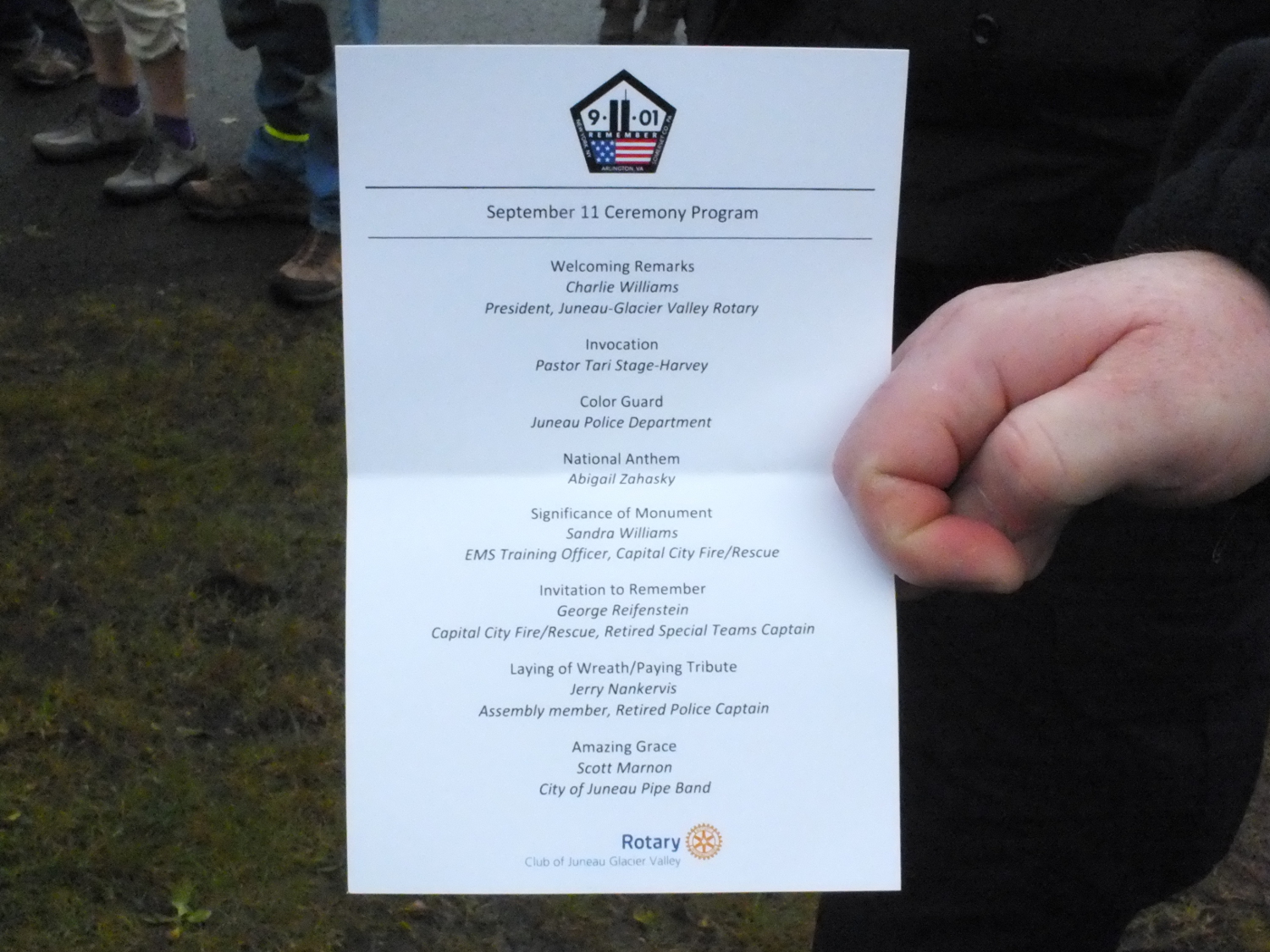
Click to enlarge photo of program (Photo by Matt Miller/KTOO)
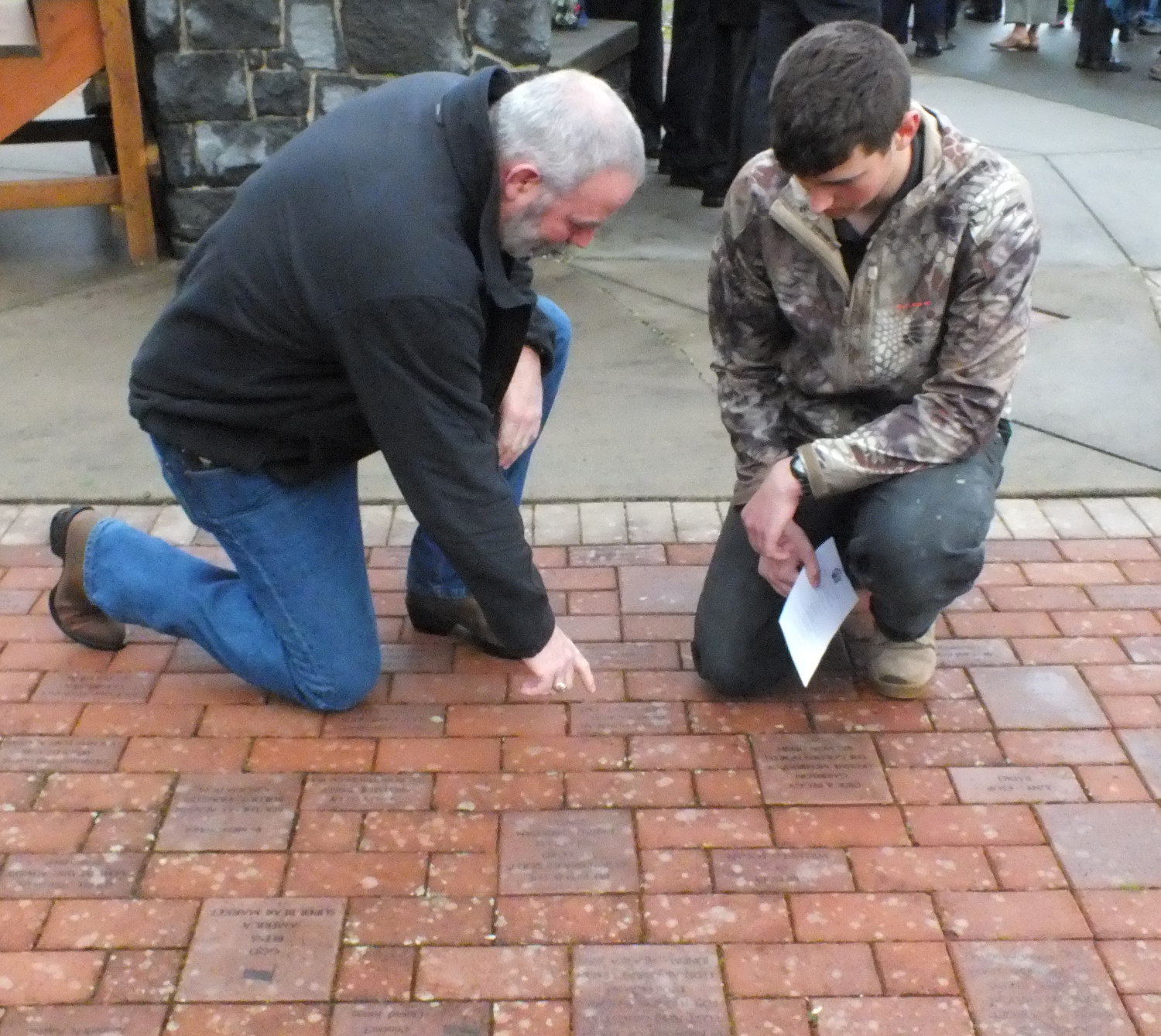
Juneau residents remember first responders whose names have been engraved in bricks at Riverside Rotary Park. (Photo by Matt Miller/KTOO)
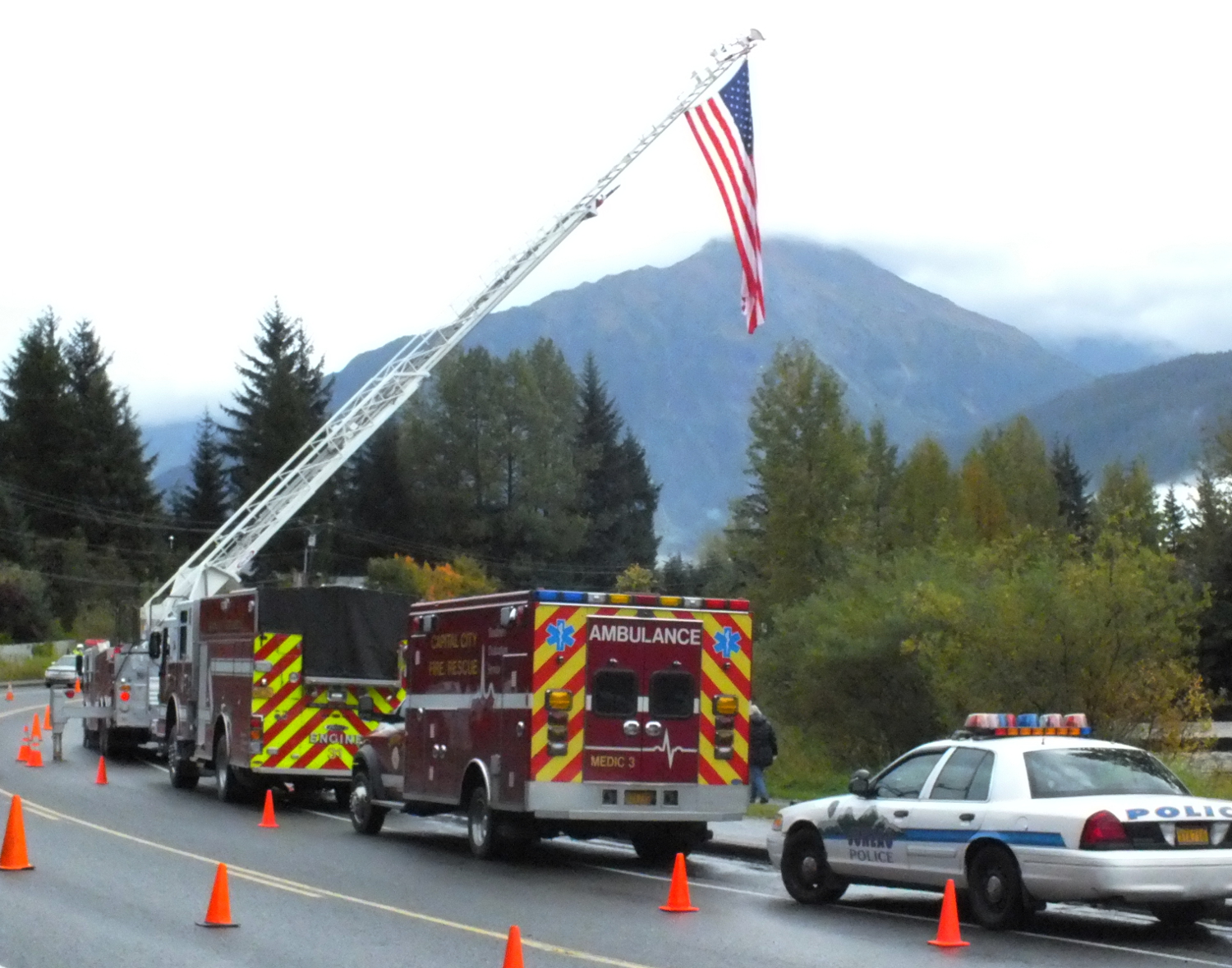
Juneau Police and Capital City Fire/Rescue were among those attending the 9/11 observance. (Photo by Matt Miller/KTOO)
Tim Steffen, meteorologist at the Juneau office, says a strong weather front has moved into the area that has remnants of tropical moisture from former typhoons. But it does not include the former tropical storm Ignacio that was earlier headed for the Alaska Panhandle.
“Ignacio moved to the south of Southeast Alaska earlier this week,” Steffen says.
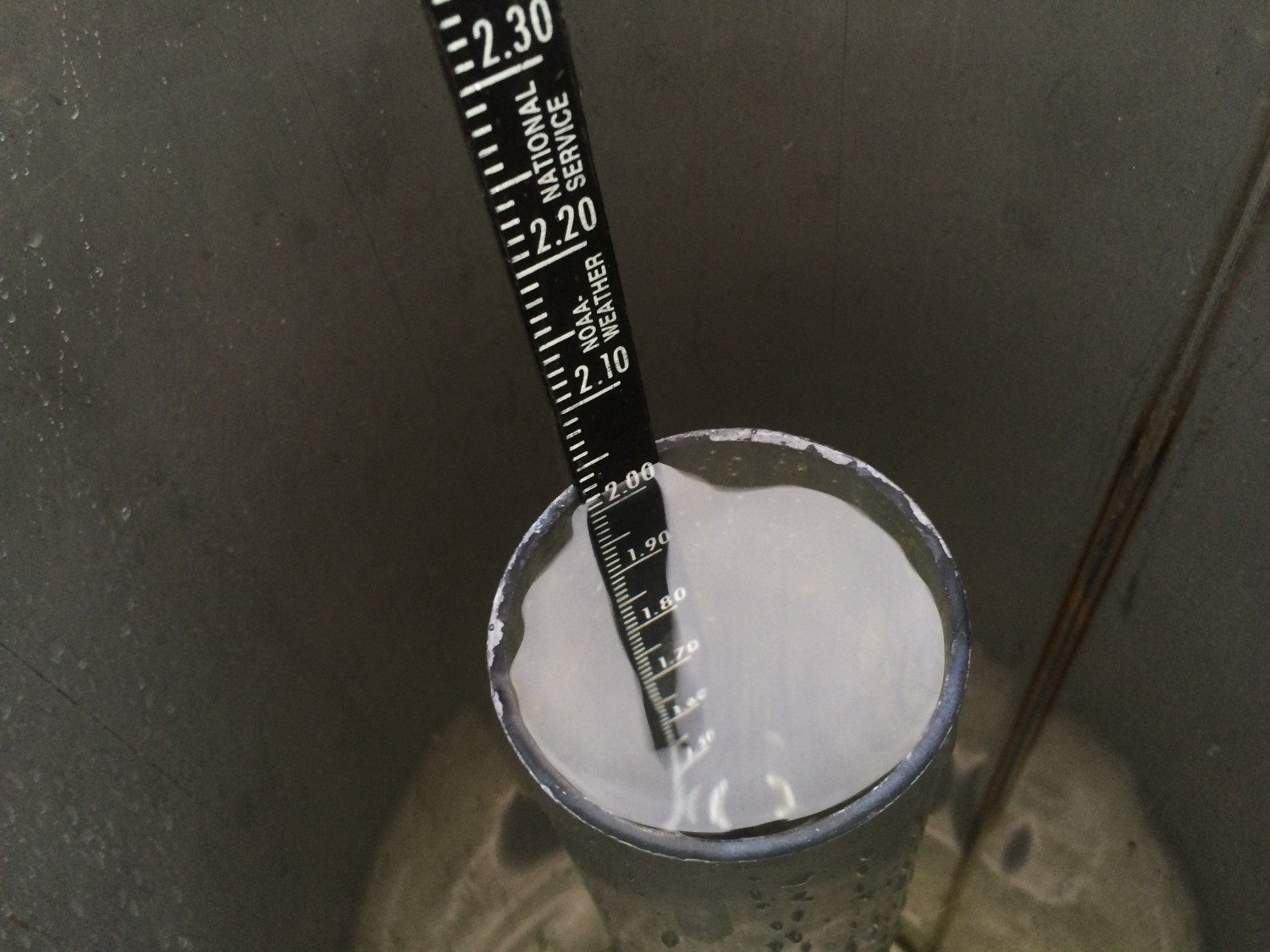
As of 5 a.m. Thursday, Steffen says they recorded an inch of rain that fell in downtown Juneau and south Douglas over the previous 12 hours. About three-quarters of an inch of rain fell at National Weather Service offices on Back Loop Road.
Steffen says they expect Jordan Creek and Montana Creek to become bank full with the recent rain.
Listen to National Weather Service’s Tim Steffen on KTOO’s Morning Edition on Sept. 10:
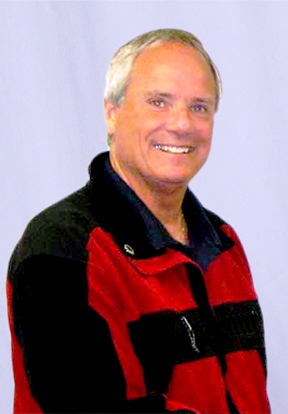
Mike Coffey takes over as Department of Transportation and Public Facilities Southcoast Region director Oct. 1. (Photo courtesy DOTPF)
A longtime Department of Transportation manager will soon be in charge of the agency’s Southeast Alaska operations.
Mike Coffey takes over Oct. 1 as director of the department’s Southcoast Region. It includes Kodiak Island, the Alaska Peninsula and the Aleutian and Pribilof Islands, as well as Southeast.
He says changes in Alaska’s climate are posing new challenges for the department. He cited mudslides in Sitka, Kodiak and other communities, as well as fires.
“I think, we’re becoming experts in dealing with natural disasters, unfortunately, because we’re seeing them a lot,” he says.
Coffey has been in charge of the transportation department’s statewide maintenance and operations. Much of his 33-year departmental career has been in Southeast. He’s also worked on projects on the Alaska Peninsula and the Aleutians.
He takes over from Central Region Director Rob Campbell, who has been filling in since March. Gov. Bill Walker removed the prior Southeast director, Al Clough, in January during a conflict over the Juneau Access road.
Walker froze that and other large projects, saying they were too expensive. But he allowed work to continue on a supplemental environmental impact statement.
Coffey says he’ll follow the governor’s approach.
“Let’s move Juneau Access to this logical spot. Finish the environmental document and by doing that, that finalizes all the information that we need to make a decision,” he says.
As Southcoast regional director, Coffey will have minimal involvement in the Alaska Marine Highway System, which is overseen by a deputy commissioner.
He says part of his new job will be to look for efficiencies, including snow-removal equipment.
“I think a good example, and we use this here in Juneau, is the tow plow. Basically, one operator, one piece of equipment doing the job of two people and two pieces of equipment,” he says.
Coffey says the state’s revenue shortfall will continue to limit what the department can do. That will affect roads, airports, ferries and state buildings.
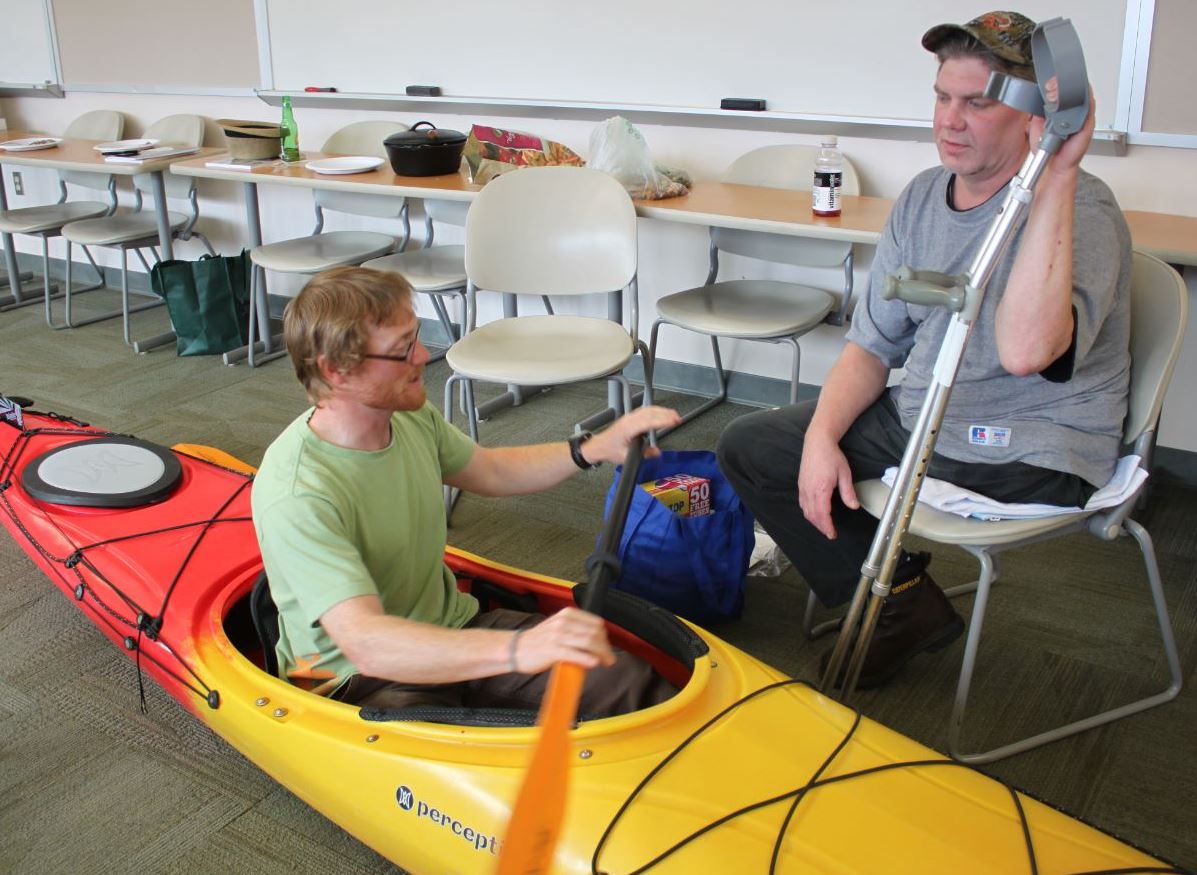
Above and Beyond Alaska employee Corey Denton explains kayak basics to J.C. Terrill during an ORCA adaptive kayak training. (Photo by Lisa Phu/KTOO)
A spinal cord injury or amputation doesn’t have to stop someone from being active on the water. A few Juneau instructors now have the know-how to modify kayaking equipment for people of all abilities after a training that wrapped up Tuesday.
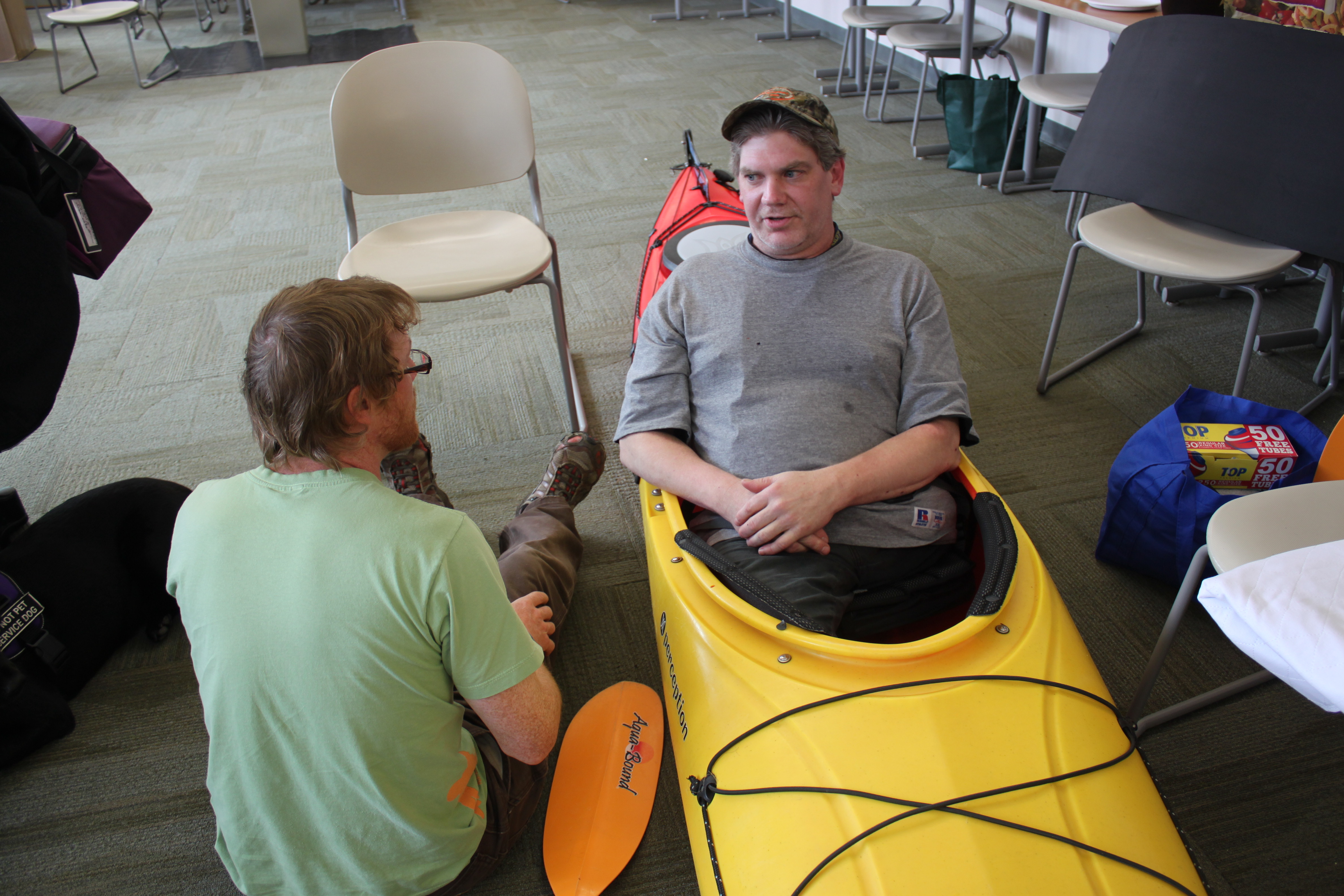
J.C. Terrill gets into a kayak that’s sitting on a classroom floor. ORCA volunteer Jerad Spencer and an Above and Beyond Alaska employee are helping him get familiar with the kayak, how it works and how it might be modified to accommodate his needs.
Terrill’s left leg was amputated about 10 years ago after he was diagnosed with cancer. He said he had a volley-ball sized tumor on his spinal cord.
“It sucks, but you can’t keep dwelling on it. That’s no fun,” Terrill said.
Terrill is 44 years old and a stay-at-home dad.
“I miss a lot of things though that I can’t do, like snow skiing, working, construction. I loved it. I worked in fab shops, oil companies, chemical companies, didn’t matter. Go out to the field, got to travel. It’s not meant for everybody, but I liked it,” Terrill said.
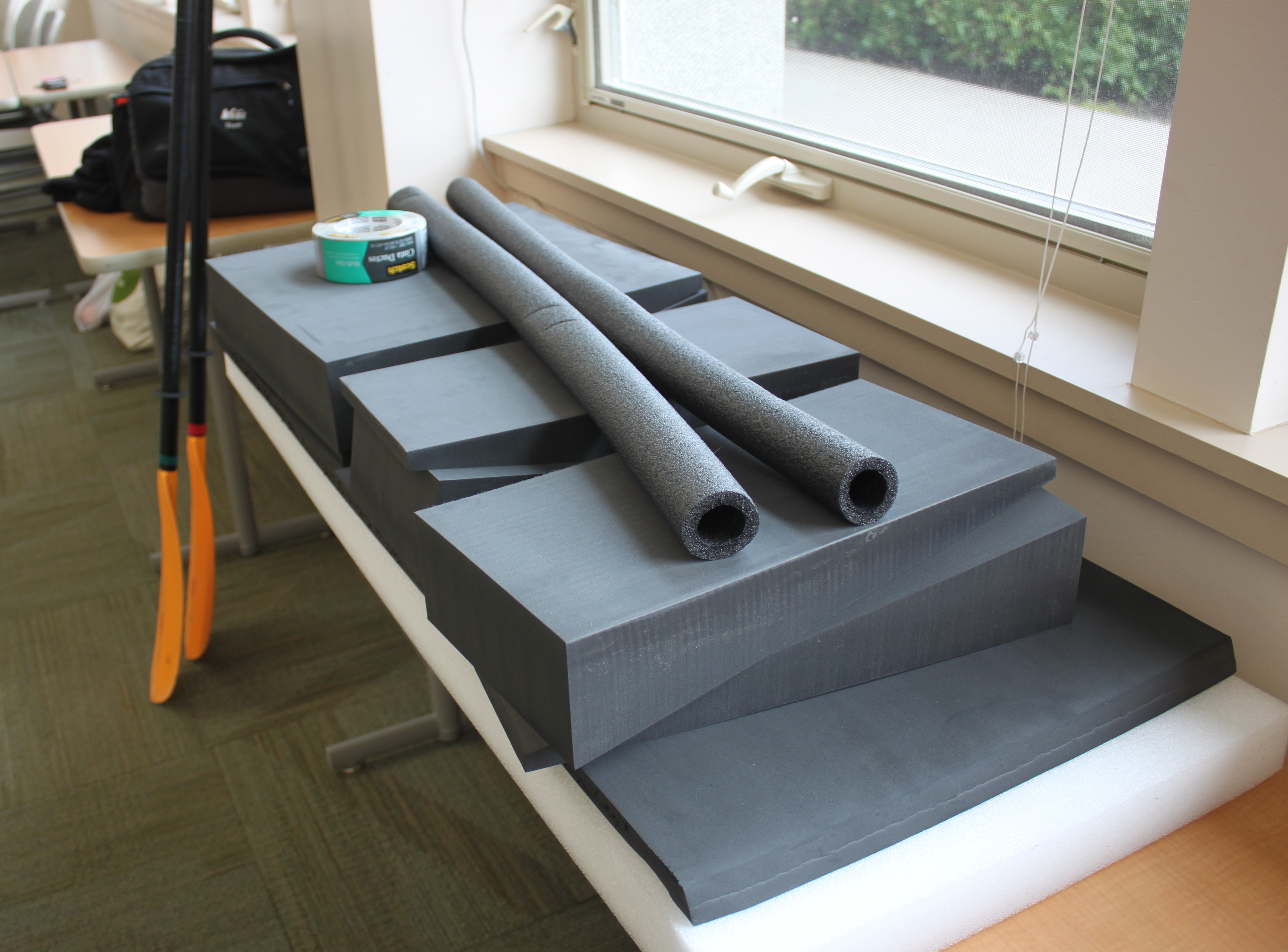
Trainees use different kinds of foam and basic tools to modify a kayak. (Photo by Lisa Phu/KTOO)
Being a part of this adaptive kayaking workshop is Terrill’s first experience with ORCA, the recreation program of Southeast Alaska Independent Living. ORCA staff contacted Terrill about being a part of it and the opportunity to kayak.
“As soon as they said that, I was thinking, ‘Yep, I’m going to take lightweight gear and go catch some trout,'” Terrill said.
With basic tools, the trainees have made a foam wedge, which they’ll attach under the seat with duct tape.
Without his left leg, Terrill is constantly keeping his weight on the right side of his body. Spencer said it will make Terrill more comfortable.
“So that when he sits in there, he’s level. The seat’s nice and comfortable for him, but without it being shimmed, he’s listing,” Spencer said.
They may also attach water jugs on the left side of the kayak for weight distribution.
“If we put two gallons of water over here and we tie it on to the side of the boat, then it compensates for the missing leg,” Spencer said.
J.C. Terrill says sitting in a kayak is more comfortable than sitting in a chair. (Photo by Lisa Phu/KTOO)
Modifying a kayak allows individuals of all ability levels to learn the same skills. Jeremy Oyen is an adaptive paddling educator for the American Canoe Association. He’s leading the training.
“When you’re out on the water, if they do it really well, you can’t tell that the boat’s been outfitted. We’ve always said that the water is the ultimate equalizer because when everyone’s out there paddling, we’re all just paddlers. It doesn’t matter if somebody uses a wheelchair or crutches or they have a cognitive disability. When they’re out there and they’re paddling and they’re having fun, we’re all just part of that paddling community,” Oyen said.
Oyen finds the process inspiring. He said it can change lives.
To get involved with adaptive paddling or other sports, contact ORCA by calling 586-0104.
“It lets people get back to an activity that they thought they couldn’t do anymore, or just getting people out recreating and realizing that they can do this wonderful thing and go paddling in the ocean or the lake and see eagles and get back to just being and just really enjoying the outdoors,” Oyen said.
After sitting in the kayak and hearing about the modifications, Terrill said he’s excited.
“Yeah, this will work out. I didn’t think so. I never thought of it. I didn’t think I could be in a kayak,” he said.
Terrill said it’ll give him something to do in the summer with his son or friends.
“I can’t sit in the sun and just sunbathe, I got to do something, like fish. I don’t even have to catch any fish to have fun, just to be outside. I’ve always been like that,” Terrill said.
Later that day, Terrill tried out the modified kayak in a pool. He capsized a few times, but remains undeterred.
Close
Update notification options
Subscribe to notifications
Subscribe
Get notifications about news related to the topics you care about. You can unsubscribe anytime.