The Juneau Police Department has released video surveillance footage of someone smashing the window and burglarizing Thibodeau’s Home Liquor in downtown Juneau.
The footage is from about 1:10 a.m. Monday. The burglar smashes a glass window with a heavy object, climbs in and fails to open a pair of cash registers, then takes a box full of American Spirit cigarette cartons worth about $3,600. The window was valued at $1,000.
The burglar, who is hooded and masked, is in and out of the store in about 60 seconds.
You can report tips to JPD at 586-0600 or at juneaucrimeline.com. You may be eligible for a reward.
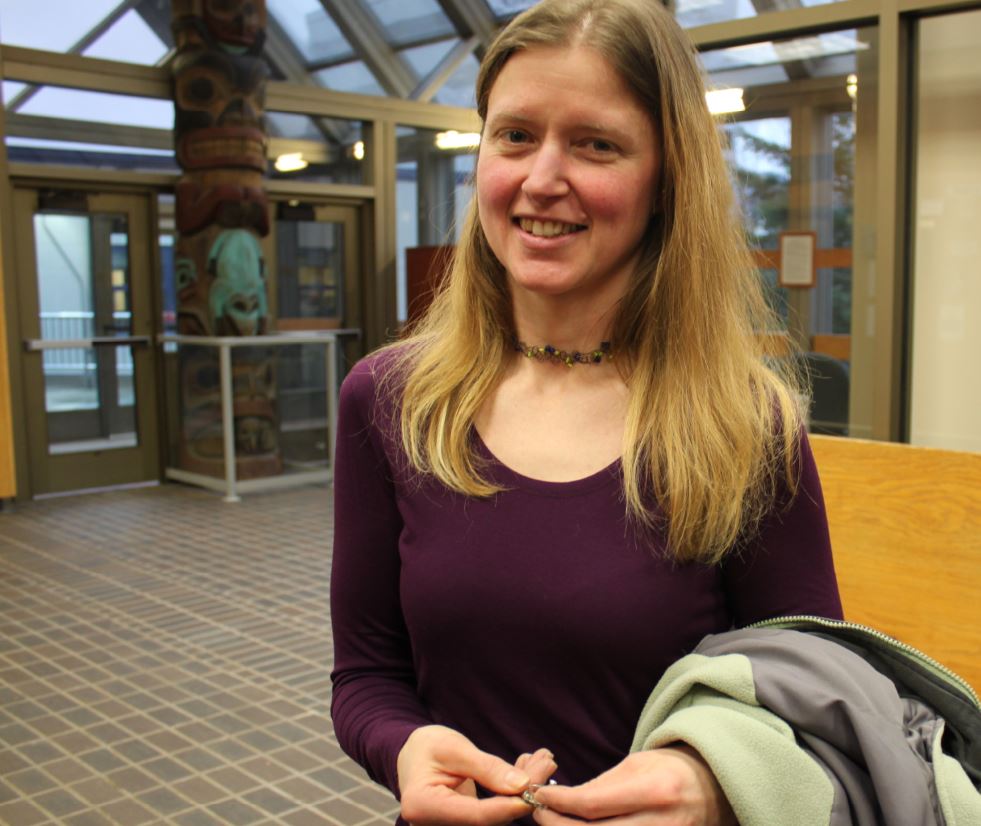
Kathleen Turley encountered this eagle stuck in two traps Dec. 24, 2014. She freed the eagle and tampered with other legally set traps in the area. She’s now being sued. (Photo courtesy Kathleen Turley)
The woman who freed a trapped eagle and was cited for springing other traps is heading back to court. In January, the State of Alaska dropped its case against Kathleen Turley. Now, the trapper is suing her for damages in small claims court.
Pete Buist is a past president and board member of the Alaska Trappers Association. He’s now its spokesman. Buist doesn’t know the Juneau trapper, John Forrest, but understands why he’s suing. He says if it were him, he’d do the same thing.
“I say bravo for the trapper. The state won’t do what’s right. He should do what’s right,” Buist says.
Forrest, who’s suing Kathleen Turley for at least $5,000, declined to comment.
In January, Turley (formerly Kathleen Adair at the time of the events) says she sprang three traps on two separate days out of concern for the safety of dogs and hikers. She also freed an eagle that was caught in two traps. Despite her efforts to save the eagle, it was later euthanized.
Alaska Wildlife Troopers cited Turley for tampering with traps that Forrest had legally set, not for freeing the eagle. Hindering lawful trapping is a violation of state law that carries up to a $500 fine and 30 days in jail.
Buist says members of the trappers association weren’t happy.
“I can fully understand why the lady rescued the eagle. I don’t have any problem with that whatsoever. And I think if she had just rescued the eagle, the trappers would’ve supported that. But she didn’t. She went back and tampered with the traps and broke the law,” Buist says.
Shortly after the State of Alaska dropped its case against Turley, Buist says several members of the trappers association complained to the attorney general’s office.
“And basically we were summarily dismissed as the fringe element and it fizzled after that,” Buist says.
Forrest has a lawyer, though it’s not required in small claims court. Attorney Zane Wilson is no stranger in the trapping community. He helped win a high profile case involving wildlife biologist Gordon Haber who freed a wolf from a snare in Tok in 1997. The biologist was being funded by an international animal advocacy organization. The trapper sued and the Tok jury awarded him $190,000.
Wilson is with Fairbanks firm Cook Shuhmann & Groseclose. He relayed through an employee he was “not authorized” to speak to me. Wilson is a lifetime member of the trappers association. Buist says Wilson’s uncle is Dean Wilson, a well-known trapper and fur buyer who’s been called the state’s patriarch of trapping.
A fellow Juneau trapper and a state wildlife biologist have said Forrest partially relies on trapping for income. The most targeted species in the Juneau area is marten. In the 2012-2013 season, the average price for raw marten fur was about $140. A state report says one even fetched $1,300. In Southeast, trappers also target mink, otter, wolf and beaver, among other animals.
Kathleen Turley in the Dimond Courthouse after the State of Alaska dismissed the case against her. (Photo by Lisa Phu/KTOO)
Turley, who freed the eagle and sprung the traps, doesn’t think she owes Forrest anything. She says she’s never been contacted by him. Until she received the complaint in the mail in July, she didn’t even know his name.
“I was very surprised and confused. … I hadn’t heard anything about it. I had no idea that he felt there was money owed,” Turley says.
Turley is Alaska-raised and has lived in Juneau for 30 years. She grew up fishing and hunting and shot a bear at age 16. As an avid outdoors person, she’s seen traps before, but had never tampered with any before the eagle incident. Turley says she’s not against trapping, but thinks it’s better suited for other parts of the state.
She says she didn’t damage the traps when she sprung them. Turley hasn’t been on the Davies Creek Trail where she found the eagle since.
“I’ve completely avoided that area, which is a beautiful area, a very nice trail, but I haven’t gone anywhere near it. I don’t want anything do to with it,” Turley says.
She says the whole incident and the lawsuit have caused her a lot of stress and grief.
The trial is scheduled for Oct. 12. Turley doesn’t have a lawyer yet.
Are you part of an arts organization? Need a grant? Three very important people in the national and state arts advocacy community recently talked about what they are looking for on A Juneau Afternoon.
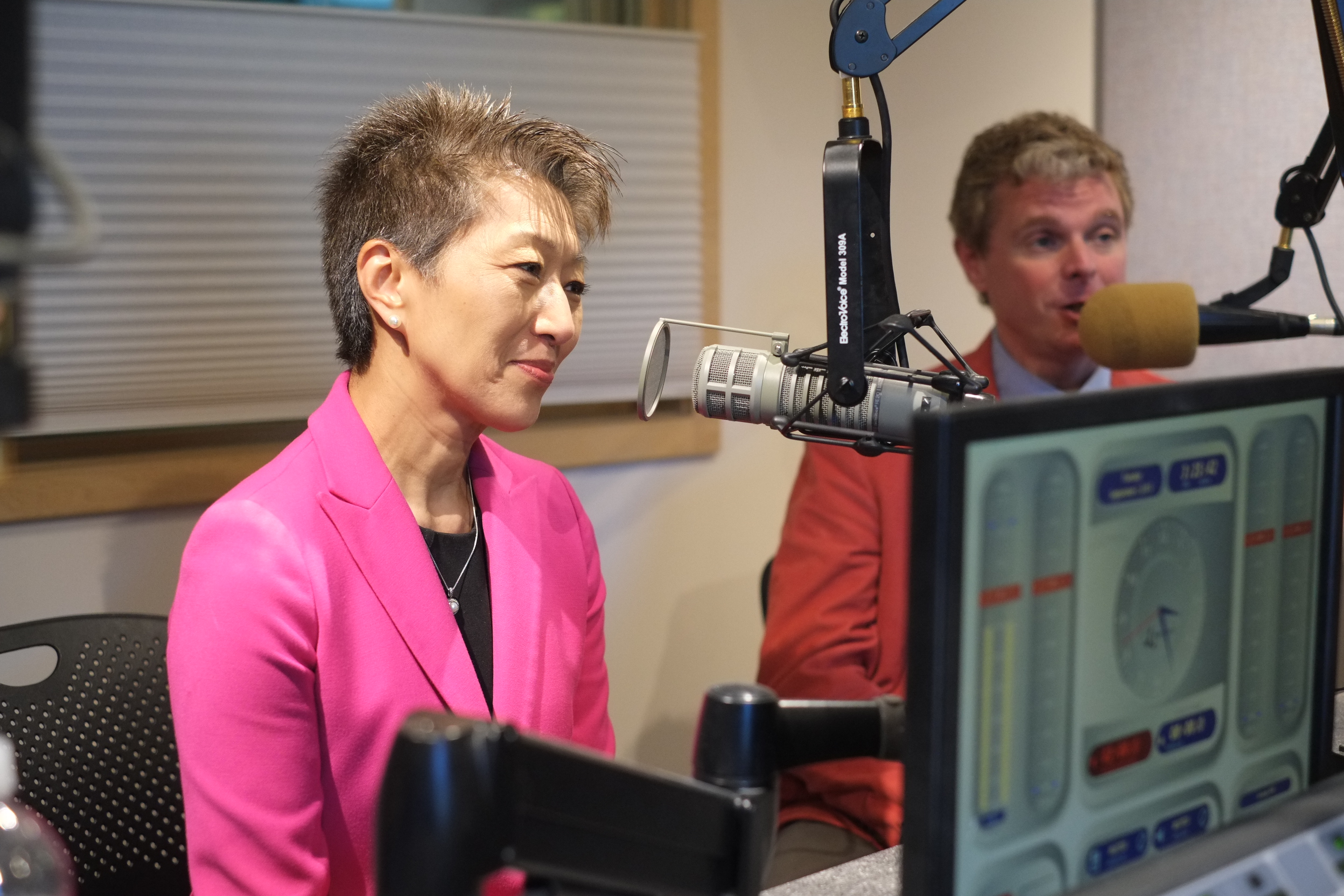
National Endowment for the Arts Chairman Jane Chu listens as Alaska State Council on the Arts Chairman Ben Brown speaks about Alaska’s art scene. (Photo by Annie Bartholomew/KTOO)
As part of her visit to Alaska, National Endowment for the Arts Chairman Jane Chu visited Juneau on Tuesday. She met with staff and actors at Perseverance Theatre, visited the Sealaska Heritage Institute, and attended a reception at the Juneau Arts and Culture Center.
She also joined Alaska State Council on the Arts Chairman Ben Brown and Executive Director Shannon Daut for an interview on A Juneau Afternoon. Here are some highlights:
Jane Chu on her impression of the state’s arts scene: “The arts community is thriving in Alaska. And one of the things I’ve noted the most is they have a wonderful way, the Alaskan artists, have a wonderful way of honoring the long established traditions of Alaska and at the same time looking forward to the future as well.”
Jane Chu on how the arts have impacted her: “It’s really been there for me, a gift to me for expressing my own self and really connecting to other people and understanding them too.”
Ben Brown on what his organization looks for in potential grantees: “Collective impact is probably what we are all looking for. Which is, don’t just do something in isolation. Have a concert, have a play. OK, people went and enjoyed it and that’s the end beneficial result. And not that that’s a bad thing, but it’s possible to target resources, target artistic activity in collaboration with other agencies, other individuals that are trying to accomplish things—so whether that’s helping wounded servicemen recover from post-traumatic stress disorder—I think that’s something we’re looking at, and I think that’s something the NEA is looking at as well.”
Jane Chu on what her organization looks for: “If we can show through hard evidence the connections of arts to our everyday lives, where it might be the beauty of art itself, or it might be the results of how the arts affect and help academic performance in our students and achievement as well as healing, and other aspects — economic, it’s s strong economic driver. … When we are able to send out the message that the arts belong to all of us, that they’re not a frill, and they’re not off in a corner, but they’re really for everybody in all kinds of different ways—that’s a measure of success.”
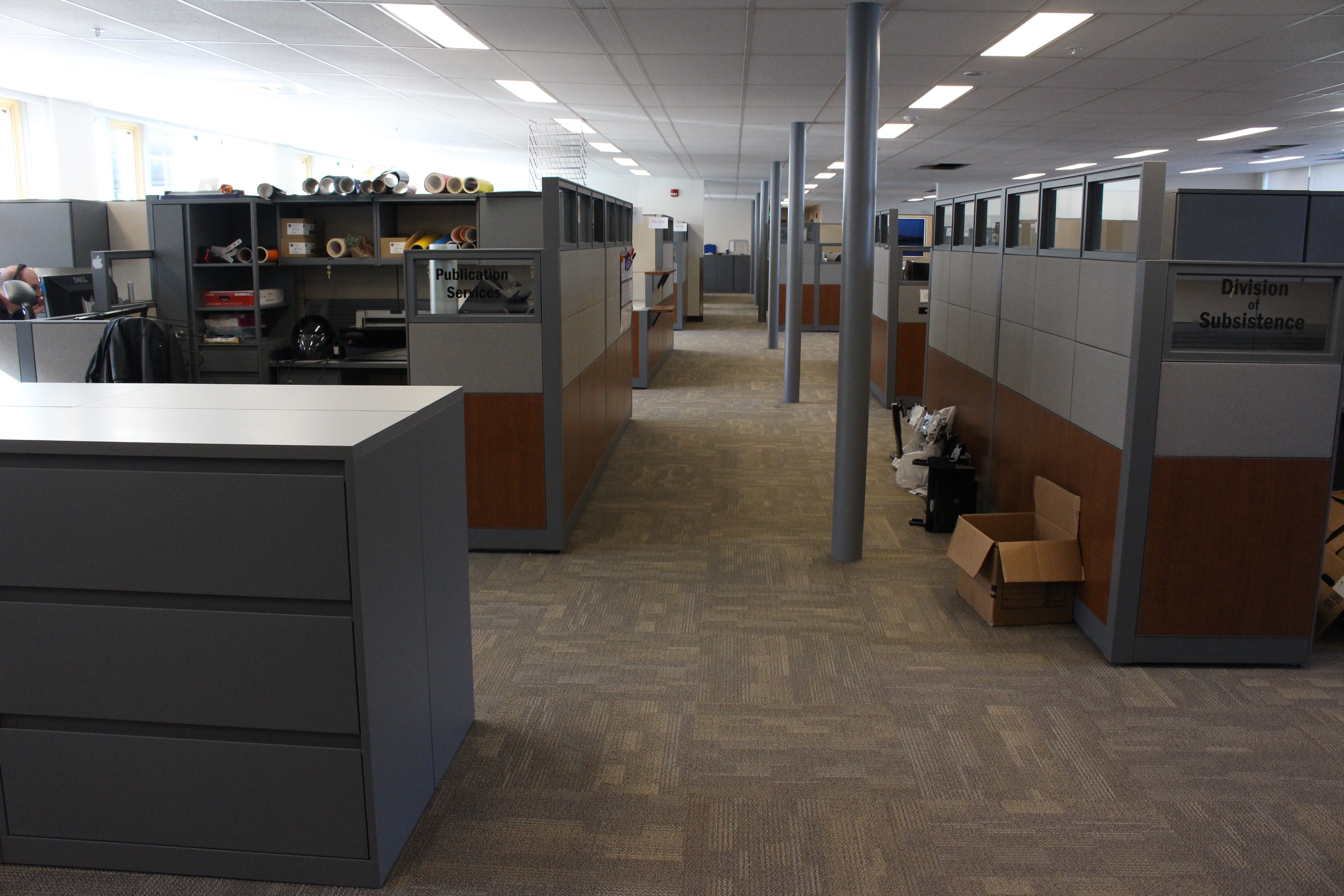
The state’s newly renovated offices in Douglas follow the universal space standards. Note the angled ceiling. (Photo by Elizabeth Jenkins/KTOO)
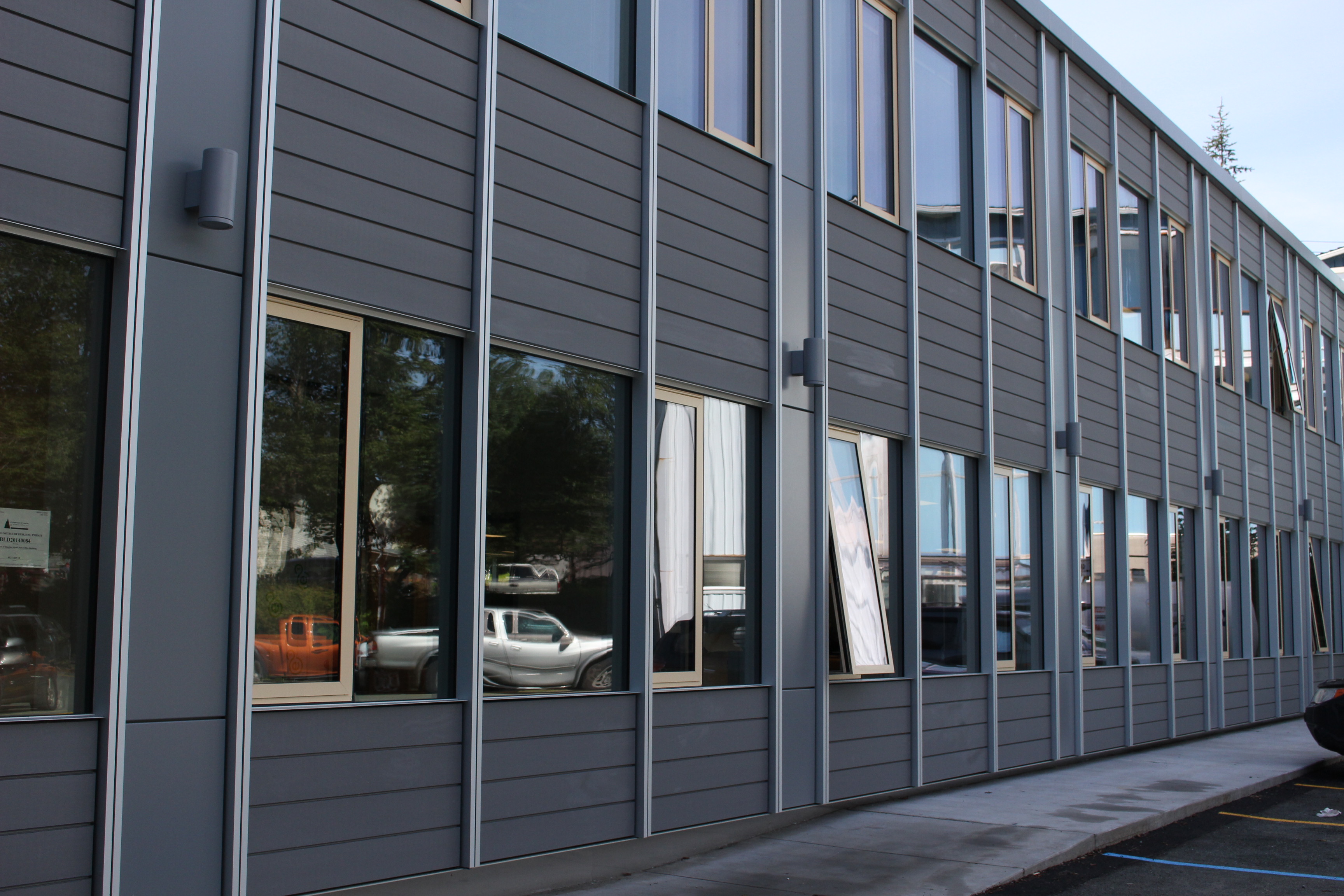
After a class action grievance, a regime change, a year of renovations and buying hundreds of $8,000 workstations, state employees are finally moving into their new offices in Douglas. Although the dust has settled, concerns over the new layout have not gone quiet.
Brian Frenette is the regional supervisor for sport fish. He recently moved back into the renovated building and likes how the new space is flooded with light. Gone are tall cubicle partitions and dark hallways.
“Certainly is a lot brighter, there’s no question,” he said.
But there are some design choices Frenette says employees find puzzling, like how the ceiling bows toward the middle.
“Lower in the center, higher on the walls and I don’t know what that is for. Other than to maybe give the impression that more light is being drawn to the center of the building.”
He said people think it’s a mistake but it’s intentional.
“I don’t understand it. Some people look at it awhile and say it’s making me nauseous. After a while you just get used to it.”
Some changes employees may not get used to. As a supervisor, Frenette gets his own office but most won’t.
The building has been redesigned for universal space standards, a cost and space saving plan implemented by then-Gov. Sean Parnell. Some work stations were whittled down to about half the square footage. Each cost the state more than $8,000.
“Well there were a number of concerns our members had. Reduced space for them to work, less privacy,” said Jim Duncan, the executive director of the Alaska State Employees Association.
The union filed a class action grievance over the state office layout about two years ago, citing safety and health concerns for its members. But eventually reached an understanding with the Walker administration.
“The arbitration is still in place, we are just not moving it forward,” said Duncan. “We had an agreement, an understanding from the administration that they would complete the projects that were underway under the previous administration.”
The exterior of the state’s newly renovated Douglas Island Office Building. (Photo by Elizabeth Jenkins/KTOO)
The changes have already happened in Anchorage’s Atwood Building and a floor of Juneau’s State Office Building. Douglas now has 32 vacant spaces.
Andy Mills, a spokesperson, says the Walker-Mallott administration is evaluating if new standards are worth it. And he realizes if it continues, it could affect him.
“The space standards would actually entail me not having an office,” Mills said. “I certainly think that when you’re looking at difficult budget times, I think most folks understand you want to look at everything possible when it’s a decision between programs, people or space. But at the same time you need to be fair and respectful to the employees.”
He said some of the sacrifices, he wouldn’t mind. His floor of the state office building has outdated furniture and a tiny break room with no seating.
“If you came and saw it, it’s a fairly small room. It’s the size of a closet.”
The renovated offices, on the other hand, come with roomier break rooms and updated kitchen appliances. It’s designed to increase collaboration. But Mills says “universal space standards” does sound a bit drab.
“It sounds like it’s a gray box that might be uninviting. But the customizability of the systems furniture when folks get a chance to look at it is probably a little more versatile what they would have first thought,” Mills said.
With the push of a button, Brian Frenette demonstrates how he can raise his desk to work in a standing or sitting position.
He said the new layout has bit of learning curve. The front counter is intermingled with Wildlife Conservation and Sport Fish to provide easier access for the public. The Department of Corrections moves in this week.
But for some employees, he said there have been concerns.
“I think what most people will probably tell you what they’re having to give up is separation–from their coworkers in order to get work done and not be disturbed,” he said. “Whether or not that comes to light as being a big issue or a small issue we’ll see as time goes.”
Frenette says they’re looking at white noise machines as a possible solution. The state has no immediate plans to roll out more universal space standards offices.
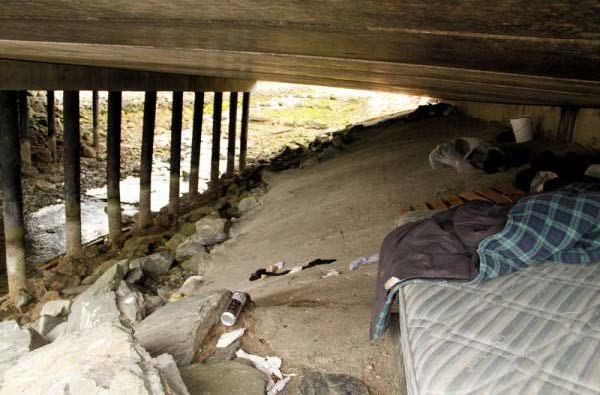
Belongings and litter under the Gold Creek overpass. (Photo courtesy The Glory Hole)
Three years ago, a group of volunteers hit the streets and interviewed some of Juneau’s most vulnerable homeless, those at the greatest risk of dying prematurely. An estimated 60 individuals fall into that category.
Juneau’s shelter and soup kitchen, The Glory Hole, is trying to find out what has changed by doing another survey.
“How many people who were on our Vulnerability Index Survey in 2012 are still on the survey? How many of them are still alive? And what happened to their lives since then?” said Mariya Lovishchuk, director of the shelter. “Also, it’ll be interesting to see if new people are now part of Juneau’s chronically homeless population,”
Many surveyed this year will likely be residents of Juneau’s 32-unit Housing First facility, which is scheduled to open June 2017.
The Glory Hole needs 40 volunteers to help conduct the survey. That entails going to where homeless people sleep in the wee hours of the morning.
“It really helps to have good manners because we are waking people up. And then the interviewers ask folks very intrusive questions about their income levels, about their history, about demographic factors, criminal history, health,” Lovishchuk said.
The experience can be profound, she said. Lovishchuk helped survey homeless people in 2012 and said it was eye opening, even for her.
“A lot of people who worked a lot of their lives lost everything and just were never able to recover. And I know those people as people who are patrons of The Glory Hole who are chronically homeless and I never pictured their life before, as not homeless,” she said.
Lovishchuk said several of the people who were surveyed in 2012 have died. But the survey also helped connect vulnerable people to social services. She hopes it can do that again.
“Winter is coming and last winter I think we had four people die, and so we really want to create this connection prior to the cold coming so people know that we are there,” Lovishchuk said.
This year’s Homeless Vulnerability Index Survey is on Sept. 29 and 30. To volunteer or for more information, contact Trevor Kellar at The Glory Hole, email tghoutreach@gmail.com or call 907-660-7466.
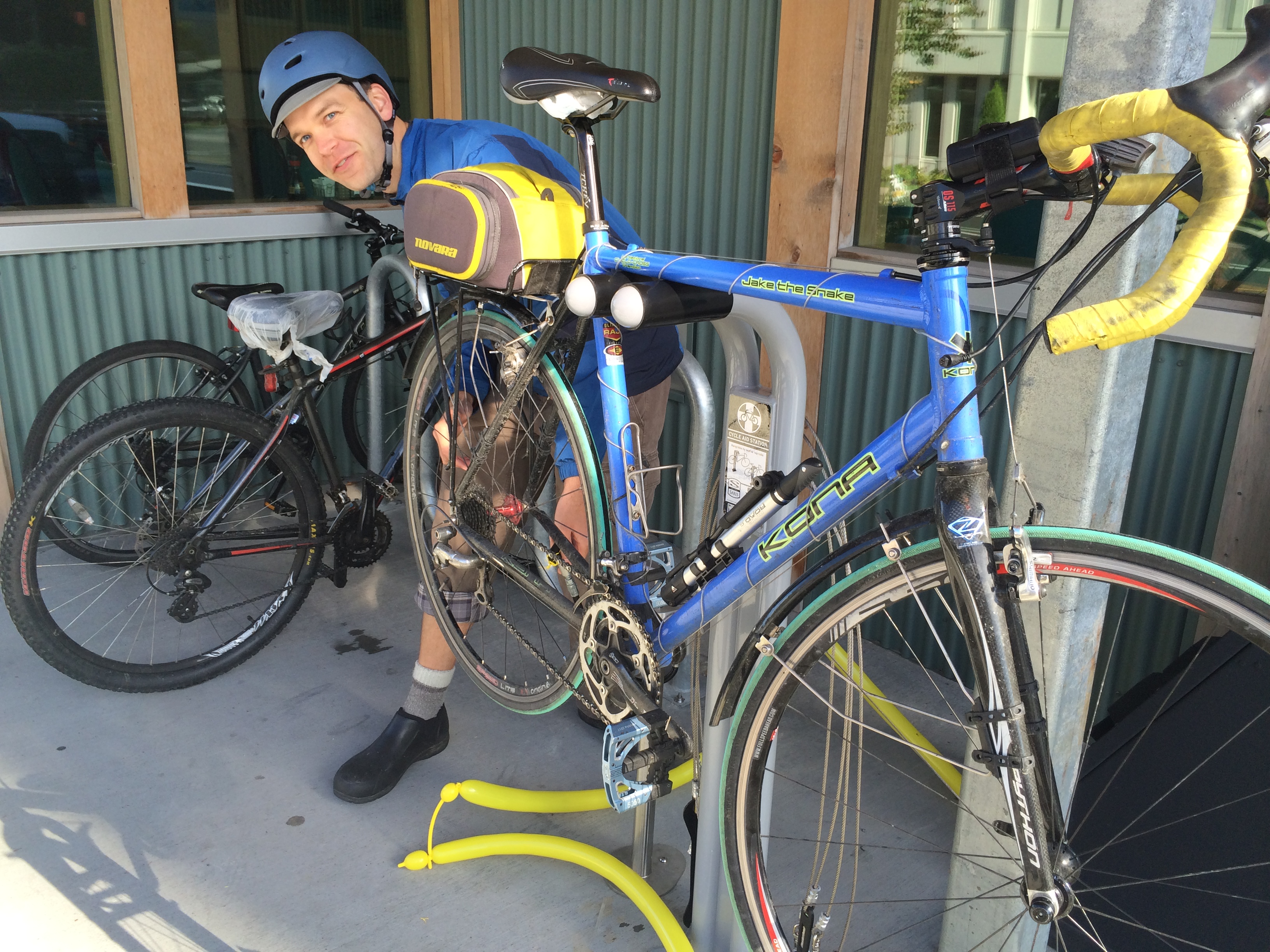
Corey McKrill uses the new bike station’s stand, tools and pump to work on his bike. (Photo by Scott Burton/KTOO)
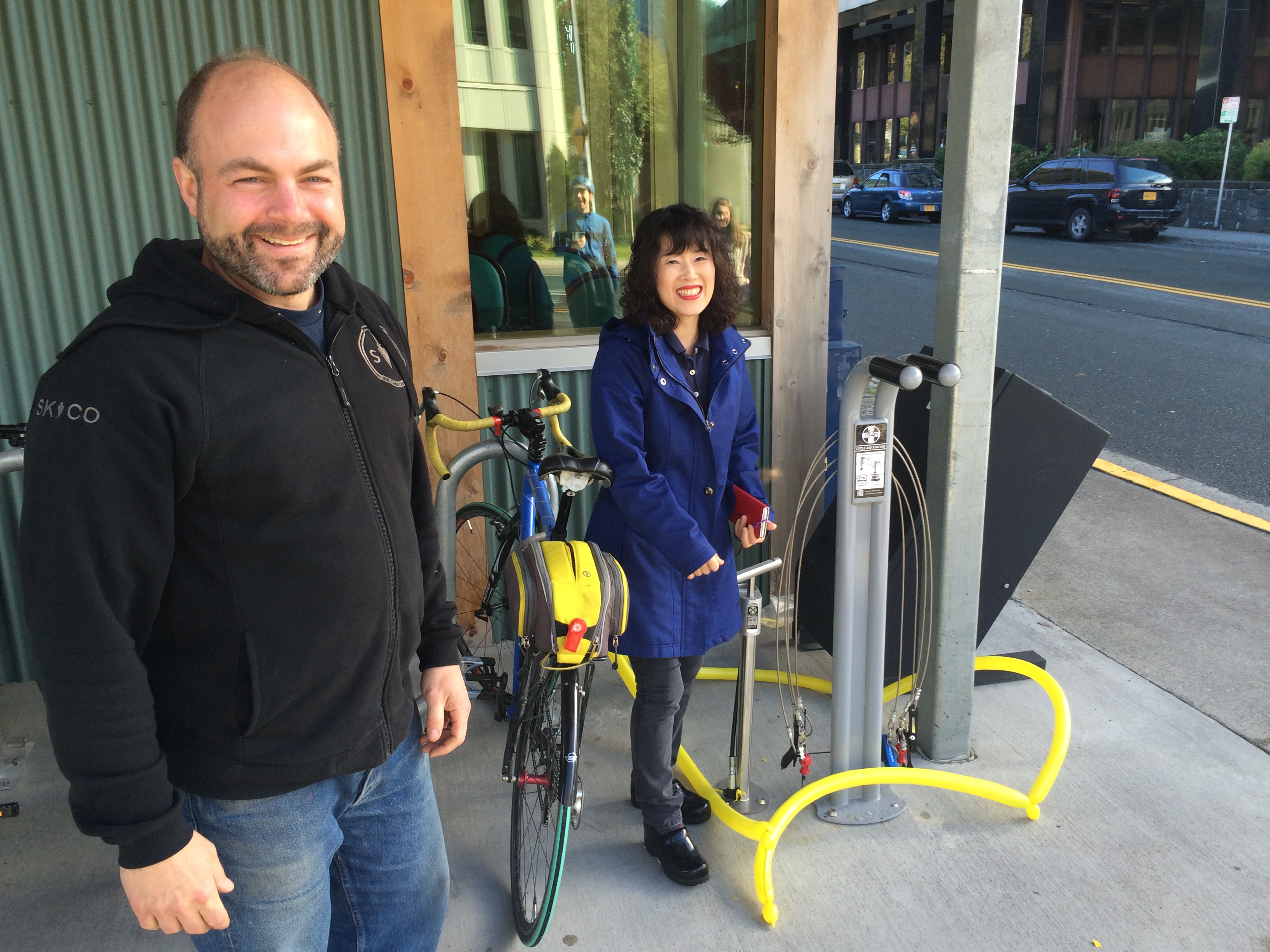
About a dozen people gathered this morning at the corner of West Ninth Street and Glacier Avenue for a balloon popping at a new bicycle repair station.
Instead of a ribbon cutting, project organizers Marc Wheeler and Jeong Kim used the new bike station’s pump to pop a balloon. (Photo by Scott Burton/KTOO)
The free, 24-hour station includes a bike rack, a bike stand, a pump and an array of tools. Corey McKrill, who is a founder of the bike advocacy group Juneau Rides, put his bike on the stand to try it out. He lives in the flats and thinks it will be a useful to him as a commuter and for neighborhood kids.
“Here’s a tire lever so if I needed to replace the tube in my tire I could use this to get the tire off and get into the bike tube. And here’s the pump I can use to inflate the tube after I replace it,” said McKrill.
The fix-it station was organized by neighborhood businesses and residents including Marc Wheeler of Coppa, Jeong Kim of Seong’s, Todd Mace of Pixel & Plume Design Co., Lacey Godkin of Capital Brew and John McConnochie of Cycle Alaska.
The public stations are trending; there’s one at Cycle Alaska, two are being installed at the University of Alaska Southeast and one is planned for the new Mendenhall Valley Public Library.
Close
Update notification options
Subscribe to notifications
Subscribe
Get notifications about news related to the topics you care about. You can unsubscribe anytime.