Local officials are recommending the City and Borough of Juneau handle all of its financial transactions with marijuana businesses in cash, and to take extra precautions to protect it.
Since marijuana is illegal under federal law, most banks cannot directly handle marijuana businesses’ money. That’s not an issue for the city government though, and once it is the city’s cash, it’s OK for banks to take it.
The extra cash on hand means there’ll be more in the city’s vaults, more trips to the bank, more security concerns, more staff to reduce the chance of skimming, more paperwork to document transactions – even a small banking surcharge for cash deposits.
The state plans to take marijuana business permit applications beginning in February.
While some marijuana businesses elsewhere have managed to establish checking accounts, Bartholomew and Winther say those tend to get shut down, hence the cash-only recommendation.
The cash issue is on the agenda for the city’s next marijuana task force meeting. It meets at 6 p.m. Thursday at City Hall.
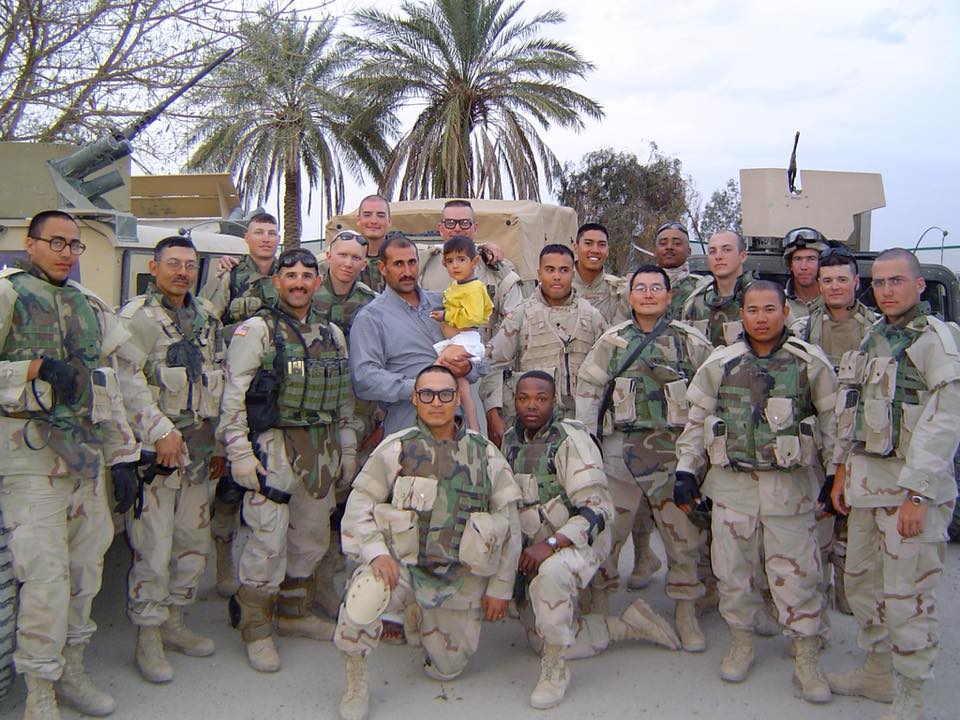
Joseph Murphy (from left, first man kneeling) served in the Iraq War. The squad was led by Ed Irizarry (standing to the left above Murphy). Mike Mercer (far right) was a gunner with Murphy. (Photo courtesy Ed Irizarry)
Earlier this month, 49-year-old Joseph Murphy died at Juneau’s prison 12 hours after being booked on noncriminal charges.
Among other things, Murphy was an Iraq War veteran. His squad commander says it changed him forever. I spoke to some of the men Murphy served with.
Mike Mercer joined the Alaska Army National Guard in the summer of 2001.
“That’s where I met Murphy,” he says.
Mercer and Spc. Joseph Murphy both lived in Juneau.
“Murphy taught me how to march. Murphy taught me all the really basic stuff – how to shine my boots, how to stand at the position of attention, the position of parade rest,” Mercer says.
One weekend each month, they saw each other for training. Then in 2005, Mercer and Murphy and many others in the Alaska National Guard were sent to war for one year.
“When we went to Iraq, we all got different little nicknames and Murphy got Eskimo Joe,” Mercer says.
Murphy’s wife of many years could not be reached for comment. According to a paid obituary in the Juneau Empire, Murphy was born in Anchorage, but grew up in Emmonak.
Mercer and Murphy were both gunners, each conducting patrols from a gun turret of a Humvee.
“Murph just worked harder than everybody else it seemed like, just because he was always giving as much as he could give. He definitely took care of the guy to his left and to his right. If somebody needed more water, if somebody needed somebody to talk to, if somebody needed some help with anything, Murph was really supportive of people,” Mercer says.
Ed Irizarry says Murphy put his life in jeopardy looking out for others. Murphy was part of the squad Irizarry led in Iraq. During patrols, “we encountered other vehicles that were blocking roads that were suspicious. Could be a car bomb,” Irizarry says.
Irizarry recalls times when, “I was going to walk up to it and Murphy, you know, ‘No, I’ll go do it sergeant.’ He takes off running and he comes back and he says, ‘All clear.’ So what do you tell a man that has just went out there and could give his life for you? What do you tell that guy? A thank you doesn’t seem to be enough.”
Irizarry was deeply sad when he heard Murphy died, “Joe was living with a lot of demons as the rest of us are.”
He mentions a specific car bombing in Iraq, but doesn’t give details.
“He had to witness something a human should never have to see. And I think that damaged him. You take a 40-year-old man who’s never seen anything like that in his life. And he’s got such a big heart, family oriented, do anything for anyone, happy-go-lucky, and then he sees that hell. That changes a man,” Irizarry says.
Irizarry lives in Ketchikan and retired from the military after 22 years, including time in four combat zones.
He says Murphy experienced post-traumatic stress disorder and sought help. More than 40 percent of National Guard members who served in Iraq or Afghanistan have symptoms of PTSD, according to the National Center for PTSD.
Murphy’s obituary says he also battled depression and struggled with substance abuse. But Irizarry wants Murphy to be remembered as the funny, kind man he was.
“You could crack a joke on him or tease him about something and he would laugh so hard at himself and just never got upset. He’d just kind of shake his head, ‘OK, you got me.’ So he was just like a young kid and you couldn’t help but fall in love with him,” Irizarry says.
Mike Mercer also experienced symptoms of PTSD, although he’s never been clinically diagnosed. Before Iraq, Mercer says he was a people person. When he returned to Juneau in 2006, he was apprehensive of large groups. He had bad dreams. He couldn’t watch July Fourth fireworks and had trouble driving close to other cars.
“All of us have had problems here and there. Some stuff fades, some stuff doesn’t,” Mercer says.
The last time Mercer saw Murphy was about five years ago at Fred Meyer.
“It doesn’t matter how long we go without seeing each other. Could’ve been another 10 years before I saw Murph, we’d still embrace each other as if we’d just seen other yesterday,” he says.
When you serve in war together, Mercer says, you’re brothers.
“It’s just a bond. You can’t break that. Time ain’t going to break it. I guess even the death of one of your brothers can’t break that either. Murph will always be my brother,” Mercer says.
Murphy was in the emergency room of Bartlett Regional Hospital the night of Aug. 13. Juneau Police transferred him to Lemon Creek Correctional Center on a 12-hour protective hold. A police spokesman says alcohol was a factor. Murphy died in a holding cell the next morning of an apparent heart attack.
The obituary says Murphy will be buried in Emmonak.
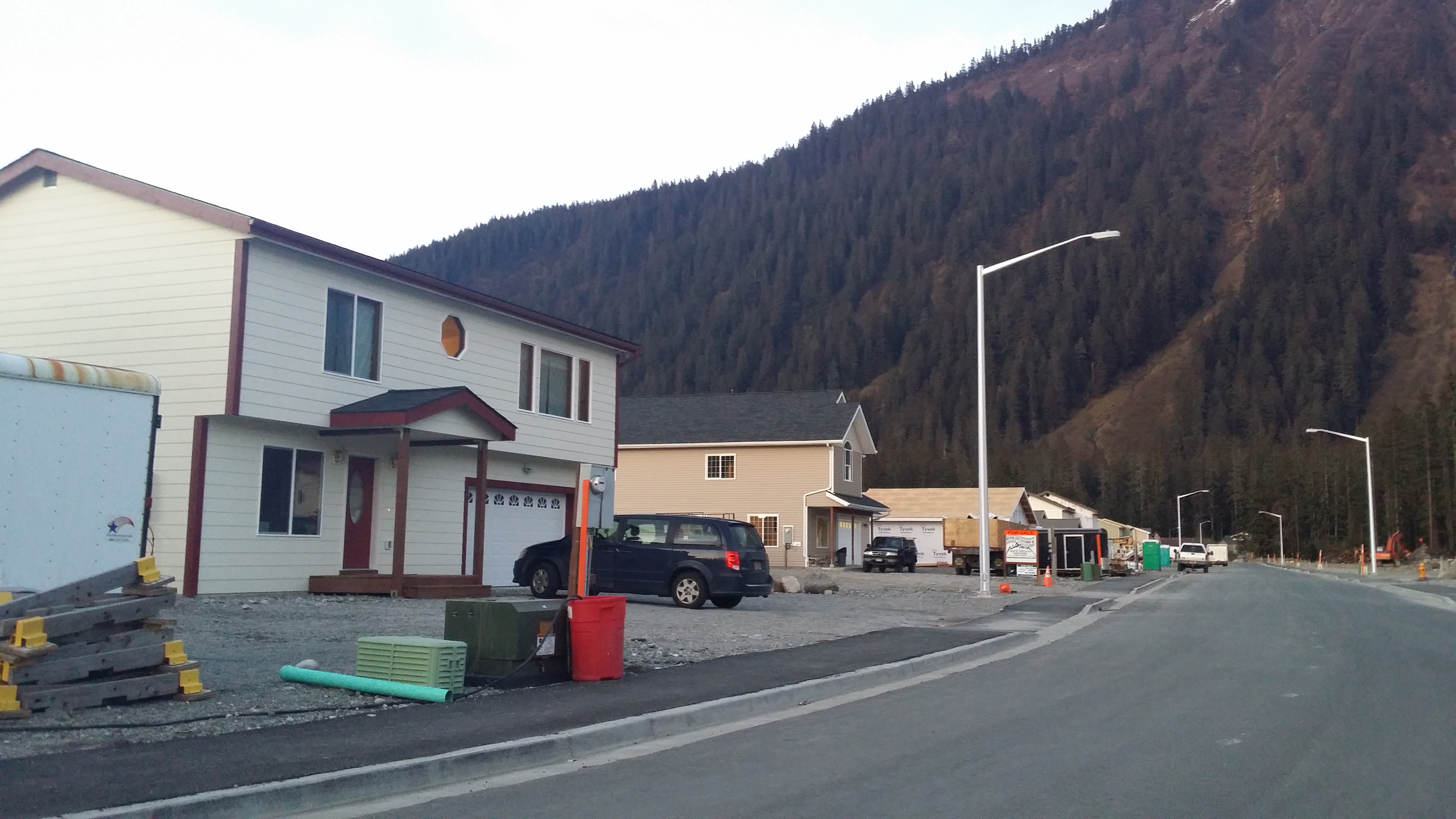
A Mendenhall Valley subdivision under construction in May. (Photo courtesy Hal Hart/CBJ Community Development Department)
The Juneau Assembly wants to draft ordinances creating new property tax breaks that incentivize denser development and redevelopment of blighted properties.
The assembly discussed it Monday in committee and also wants input from the Downtown Business Association and city staff.
Assemblymember Karen Crane asked if the redevelopment ordinance would do enough. It would allow for property tax exemptions or deferments for major building overhauls and demolition.
“When I first read this, I don’t see the incentives there for the development of housing,” she said. “I’d like to have some more discussion along that line, too. It’s one of the conclusions everyone has come to that has studied what we need downtown.”
City Finance Director Bob Bartholomew said it comes down to what level of public investment Juneau wants to make.
“It’s in addition and outside the scope of this. This could help in one little piece. But there’s a lot of other things out there,” he said.
A second ordinance would allow for property tax breaks after subdividing land for five years.
But some assembly members questioned the length of time–wondering if they could be giving tax exemptions for developers not motivated to sell. Assemblymember Debbie White said that’s often not the case.
“It’s really not as much time as you think and by the time you get the subdivision recorded and you start advertising and marketing these properties and then you design homes and then you have to take plans to permits center, five years is not that long,” she said.
White, a real estate broker, called the Montana Creek West subdivision successful and said it took about six years to develop.
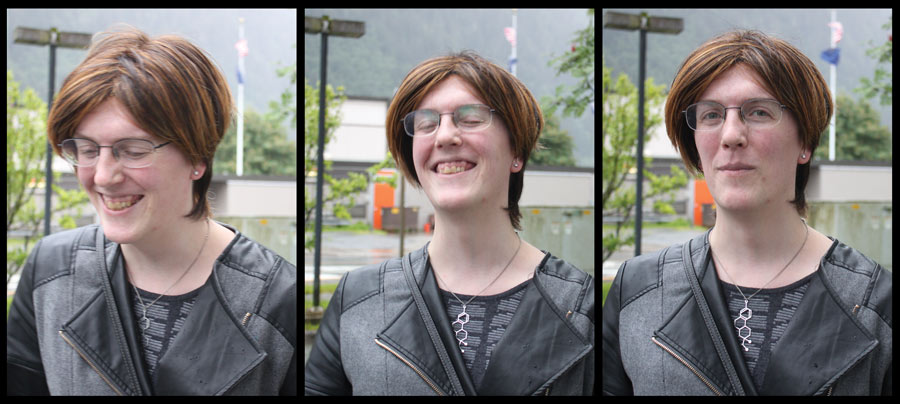
In the past, Jennifer Fletcher refused to believe transitioning would make her happy. “I’m very pleased to note that I was absurdly wrong,” she says. (Photo composite by Lisa Phu and David Purdy/KTOO)
It’s been a year since Juneau resident Jennifer Fletcher started to publicly present herself as a woman, less than two years since she first started to shed her male identity and rebuild herself as female. But the inner journey to get to that point began long before then.
Jennifer Fletcher used to spend up to five hours a day escaping reality. She’d play games on the computer, visit websites for the transgender community, “Pretty much anything I could do to not focus on the present, not focus on how things actually were so I could actually at least attempt to function throughout the rest of the day,” she says.
She’d go through binge and purge cycles of cross dressing. She regularly thought about suicide. Fletcher was severely depressed.
“I was continuously hiding who I was and trying to quite literally leave no mark on the world,” she says.
Fletcher is 33 and moved to Juneau as a teenager.
On any given Friday night now, you can almost always find her at social night run by SEAGLA, the Southeast Alaska lesbian, gay, bisexual and transgender organization in Juneau.
But it took her a long time to realize she was transgender, even though signs throughout her life pointed to it.
“Let’s just say that I had consistently wished from the time I was about 12 on every star, on every birthday that I’d wake up as the female version of myself,” Fletcher says.
As an adolescent, she’d wear her mother’s clothes when she was home by herself, taking items from the laundry so no one would notice.
Fletcher was 14 when she first tried to castrate herself. She tried again when she was 15.
“I was actively envying all the girls who were going through their own puberties, their own processes and just not very happy with what was going on. While I have occasionally, temporarily, appreciated having things like facial hair or greater strength or things of that sort, they just aren’t me,” Fletcher says.
But in her teens, she refused to consider she was transgender. Fletcher went to high school in Juneau, but was born in Laramie, Wyoming, where gay college student Matthew Shepherd was murdered in 1998. She learned being different wasn’t safe.
She saw transgender individuals on talk shows where they were mocked and laughed at.
“At that point in time, society was teaching individuals like myself that no, it’s not OK to be. That if you wanted to actually have any chance of happiness that you had better suppress what’s going on and you had better hope that you aren’t really,” Fletcher says.
She says finally deciding to transition almost two years ago didn’t stem from courage, but from an utter sense of fear.
“I was faced with what I thought were basically two alternatives – death or transition. Whether it would’ve been death by suicide or by the slow gradual path of alcoholism or whatever other coping mechanisms I attempted to use that would’ve inevitably failed,” Fletcher says.
She chose transition. Fletcher dropped what she calls the male mask and started rebuilding herself. She came out to close family and friends and started dressing as a woman at social functions. Fletcher eventually started the medical process and taking hormones. At each step, she was so afraid of rejection.
“Almost all of the hurdles I’ve experienced in my transition have been self-imposed. They’ve all been fears that may have had a legitimate base, but had invariably been blown completely out of proportion into these vast monsters that seemed like I’d be incapable of standing against,” Fletcher says.
When I ask Fletcher what her prior first name was, she doesn’t tell me, “Not particularly relevant, I don’t think.”
She says there tends to be an overemphasis on who people once were or appeared to be.
“I had been looking at some old photos of myself and actually opted to post some of them on Facebook just to kind of show how very different a person I am now. One of my friends actually said outright that they felt they were looking at a dead person, which I think actually sums up how I was feeling in those photos as well,” Fletcher says.
She does a lot of things she used to do before she transitioned, like rock climb, play board games, read. But she says her priorities have shifted.
“Before I actually started this process, I was merely existing in the world and, to be honest, waiting to die. Now I am actually alive and the difference is quite amazing,” Fletcher says.
And she wants to make a difference. Fletcher helps run a transgender support group in Juneau called the Trans* Alaska Pipeline. She wants to make finding medical and professional resources easier. She wants to help others avoid some of the internal conflict she had and help them face their fears, one monster at a time.
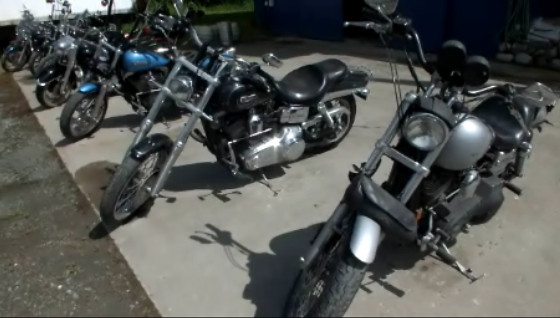
Harley Davidson motorcycles are lined up before a recent event at the Panhandlers MC clubhouse. (Photo by Matt Miller/KTOO)
The Panhandlers Motorcycle Club has their annual Toy Run this weekend. It’s a benefit to round up toys for children at Bartlett Regional Hospital.
“People around the community have helped us so much. With open arms, they welcome the Toy Run, says Craig Fowler, president of the Panhandlers. “If you have a kid that goes into the hospital or in an ambulance and has any kind of fear, they say “What do you like? You like Barney? You like dinosaurs?” We always stockpile them every year.”
The toy run starts Sunday at 1 p.m. with the motorcycle line-up at McGivney’s and will proceed to the Douglas Fire Hall. There, ribs and pulled pork sandwiches will be served up from 2 to 4 p.m.
You can participate by donating a new stuffed toy worth at least $10 or make an equivalent cash donation.
Stuffed toys can also be dropped off at Louie’s in Douglas or the Triangle in downtown Juneau.
Close
Update notification options
Subscribe to notifications
Subscribe
Get notifications about news related to the topics you care about. You can unsubscribe anytime.