Juneau

Pizza v. Adobo: How outdated zoning led to neighbor beef

A neighborly dispute over property lines in the Willoughby District has escalated to chainsawing a tree, police calls and an unwelcome alteration of Twilight Cafe’s award-winning storefront.

When Catherine Cristobal and her husband Ariel bought their business in 2008, they told the previous owner they would name the cafe in his honor.
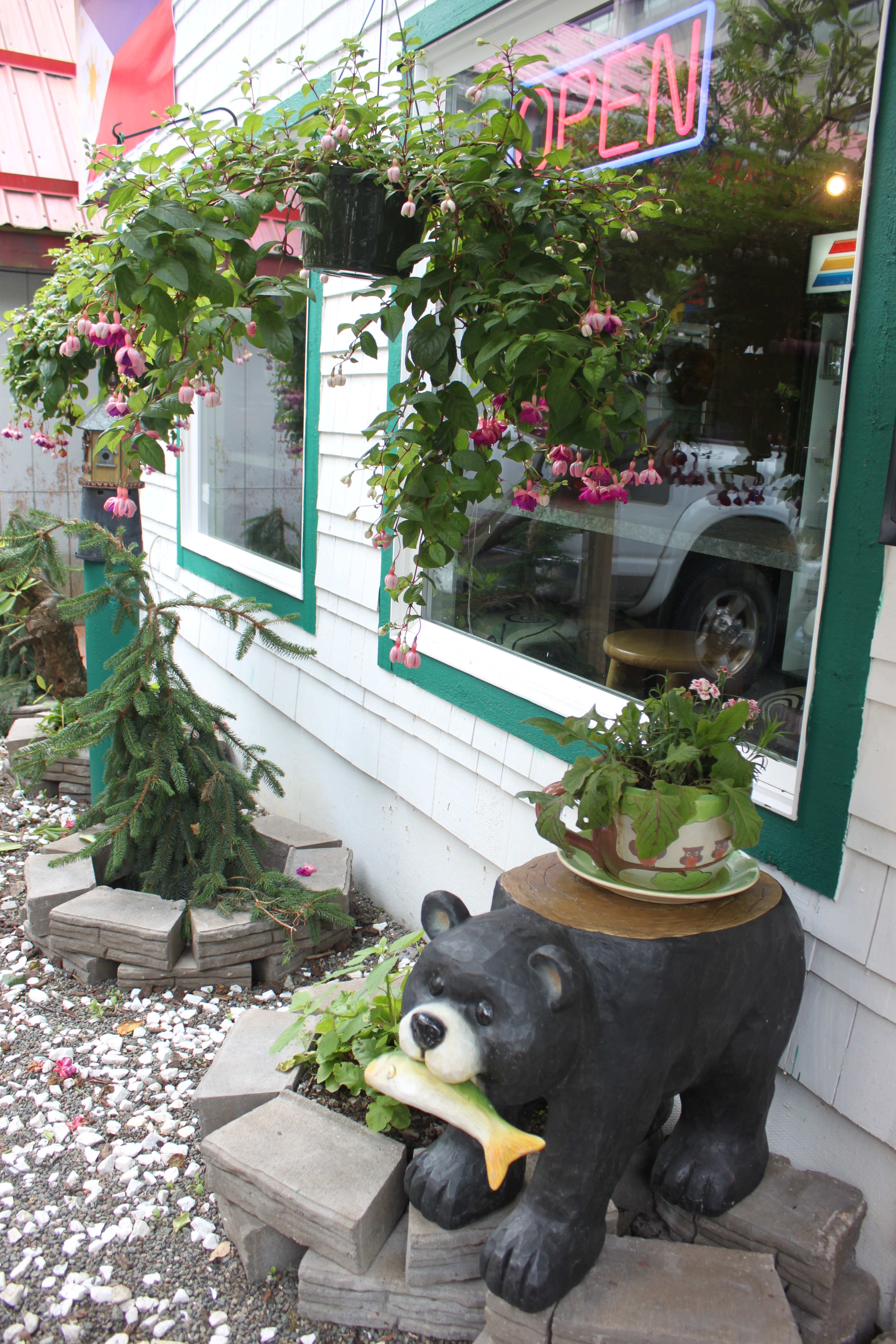
Twilight Cafe won Storefront Stars last year. (Photo by Lisa Phu/KTOO)
The winning storefront. (Photo by Lisa Phu/KTOO)

“I will name my cafe Sonneman’s Cafe.  He said, ‘Don’t use my name. Just don’t cut my tree,'” Catherine Cristobal says.

Joe Sonneman used the small house as a business and residence. He has since passed away but the rhododendron tree outside, according to Twilight’s owners, was alive. Catherine says she had a sentimental attachment to it.

“When we were remodeling this, we’re debating to cut it down or what. I said, ‘No. I want that tree there in respect of Joe.'”

The cafe serves coffee, smoothies and adobo, a popular dish in the Philippines. As the new business grew, so did the tree, which their neighbor says was part of the problem.

The Willoughby District is a bit of a hodgepodge with zoning you wouldn’t see today. The cafe is boxed in by city-owned parking and property belonging to Bullwinkle’s Pizza.

“A warm, family place to be. People can bring their kids here and run amok and throw popcorn all over and play video games,” says Mitch Falk.

He’s owned the local chain for about seven years. The parking lot in front of Twilight Cafe is his, including a 500-gallon tank in the back.

“I poured a new concrete base for the propane tank back there. If you look back and look at it, their family handprints are in my concrete. I said go ahead and do that,” Falk says.

Mitch Falk's office walls are adorned with pictures of goats and wildlife. He enjoys goat hunting when he gets the chance. (Elizabeth Jenkins/KTOO)
Mitch Falk’s office at Bullwinkle’s Pizza is decorated with pictures of goats and wildlife. (Photo by Elizabeth Jenkins/KTOO)

Both owners say the relationship was civil, but this is where their stories start to differ.

Since Twilight Cafe is pretty much boxed in, a path cuts through Bullwinkle’s property. This kind of arrangement is called an easement.

“They came to me and asked if they could move the access from this side to the other side,” Falk said.

Catherine Cristobal disagrees.

“Mitch Falk is the one who asked my husband to switch the easement. Not us. Because he wanted the tank to stay.”

A notarized document signed by both owners in 2014 shows that the easement was switched in exchange for the propane tank staying in its place. Who asked for it and why is up for debate.

Catherine Cristobal says Mitch Falk verbally assured her that the rhododendron tree wouldn’t be cut, per their agreement. Its roots are on Twilight’s property, the overhang on Bullwinkle’s. She thought the tank was a safety hazard but she was willing to let it slide.

“He drafted the agreement. We sign it and for the very first time we shake hands. We’re happy. I can’t wait to say hi to him when I come to the store,” says Cristobal.

That neighborly feeling was short-lived. About a month ago, Mitch Falk cut down Joe Sonneman’s tree.

Greg Chaney, a lands and resource center manager at the city, says with historic properties like this, issues come up.
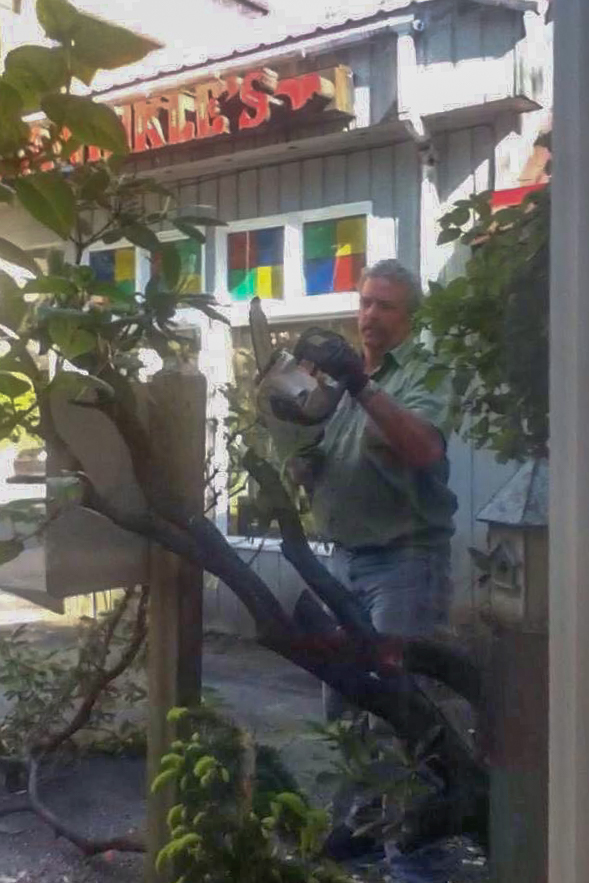
Bullwinkle's Pizza owner Mitch Falk cuts down Twilight Cafe's tree. (Photo courtesy Ariel Cristobal)
Mitch Falk chainsawing the rhododendron. (Photo courtesy Ariel Cristobal)

“I’ve seen what we call grandfathered situations or inherited situations from previous subdivisions that didn’t comply with our code and when that happens, people don’t get along,” Chaney says. “And access issues generally causes strife. It’s kind of designed to fail.”

Chaney says zoning can create harmony or discord. The subdivision ordinance now requires direct, practical access and parking.

“Specifically because these types of situations cause neighbor disputes and sometimes the neighbor disputes can be extremely acrimonious.”

When Mitch Falk cut down the tree, Ariel Cristobal watched from inside the cafe.

“I just (took) a picture … and I called the police because, you know, I’m scared. I don’t know what he (was) going to do,” he says.

There have been at least two calls to Juneau police regarding the dispute.

Falk says there was no verbal agreement and it was nothing personal. The rhododendron’s overhang was damaging his car.

“Oh, yeah. I’ve got deep scratches in my truck. You can look at it right now. It’s down there,” Falk says.

He spent $3,000 to have custom snow barricades placed between the parking lot and Twilight Cafe. They also double as flower planters.

But to Catherine Cristobal, the outside is unrecognizable. It doesn’t look like what won her the Storefront Stars award last year.

“I feel like I’m trapped. I cannot enjoy my back(yard) because of that big ugly tank. I cannot enjoy my front because of all these things,” she says. “I don’t know what to do anymore. It’s coming from both ends.”

She says she’s thought of selling the business, but there’s too much invested. Customers have been bringing her flowers to make up for the tree’s loss.

Twilight Cafe’s attorney recently issued a letter to Mitch Falk asking him to remove the concrete snow barricades. The letter says it’s unsafe for customers and violates a previous verbal agreement.
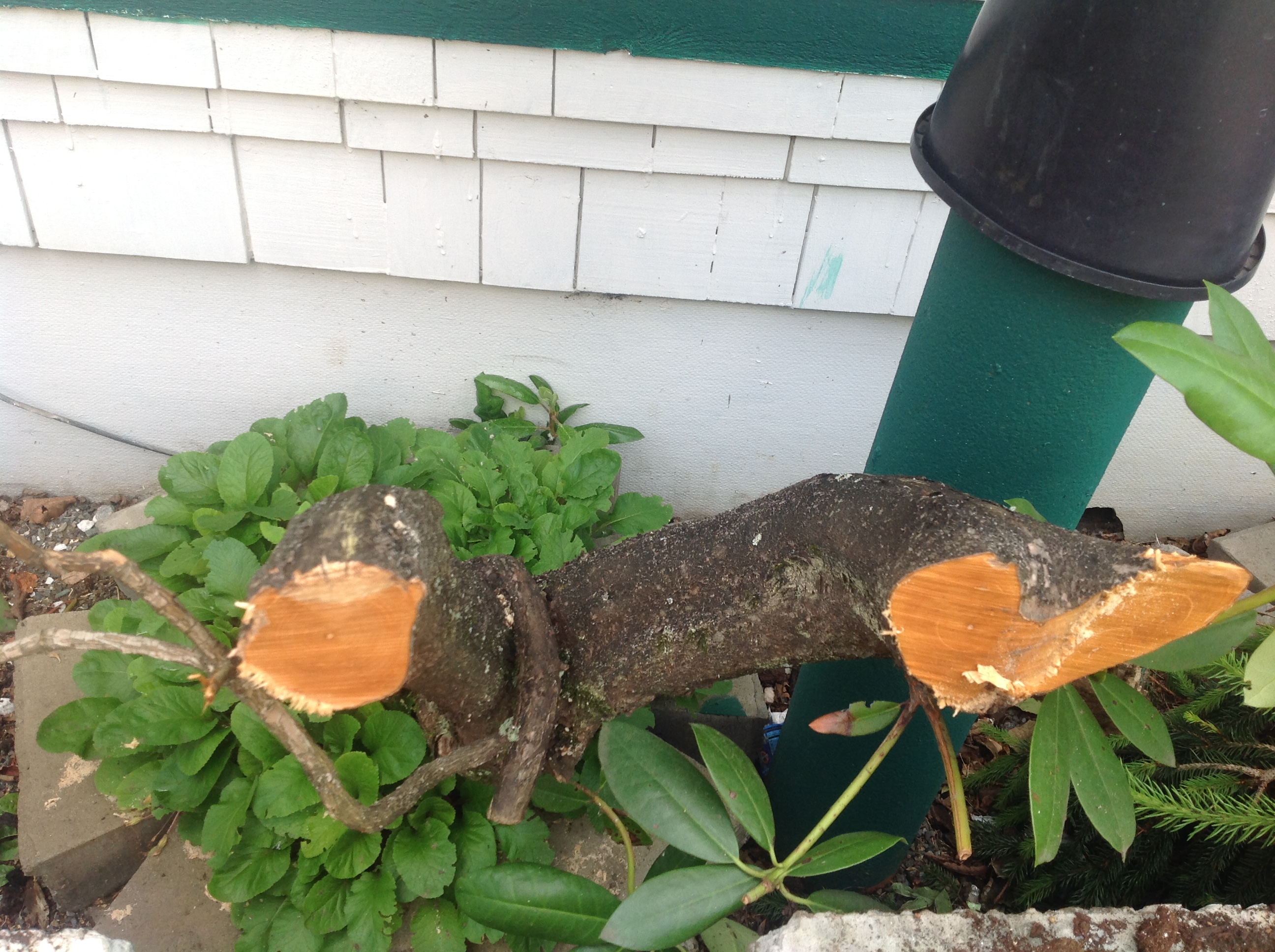
What's left of the tree. (Photo by Ariel Cristobal)
What’s left of the tree outside Twilight Cafe. (Photo courtesy Ariel Cristobal)

Gardentalk – Pickling

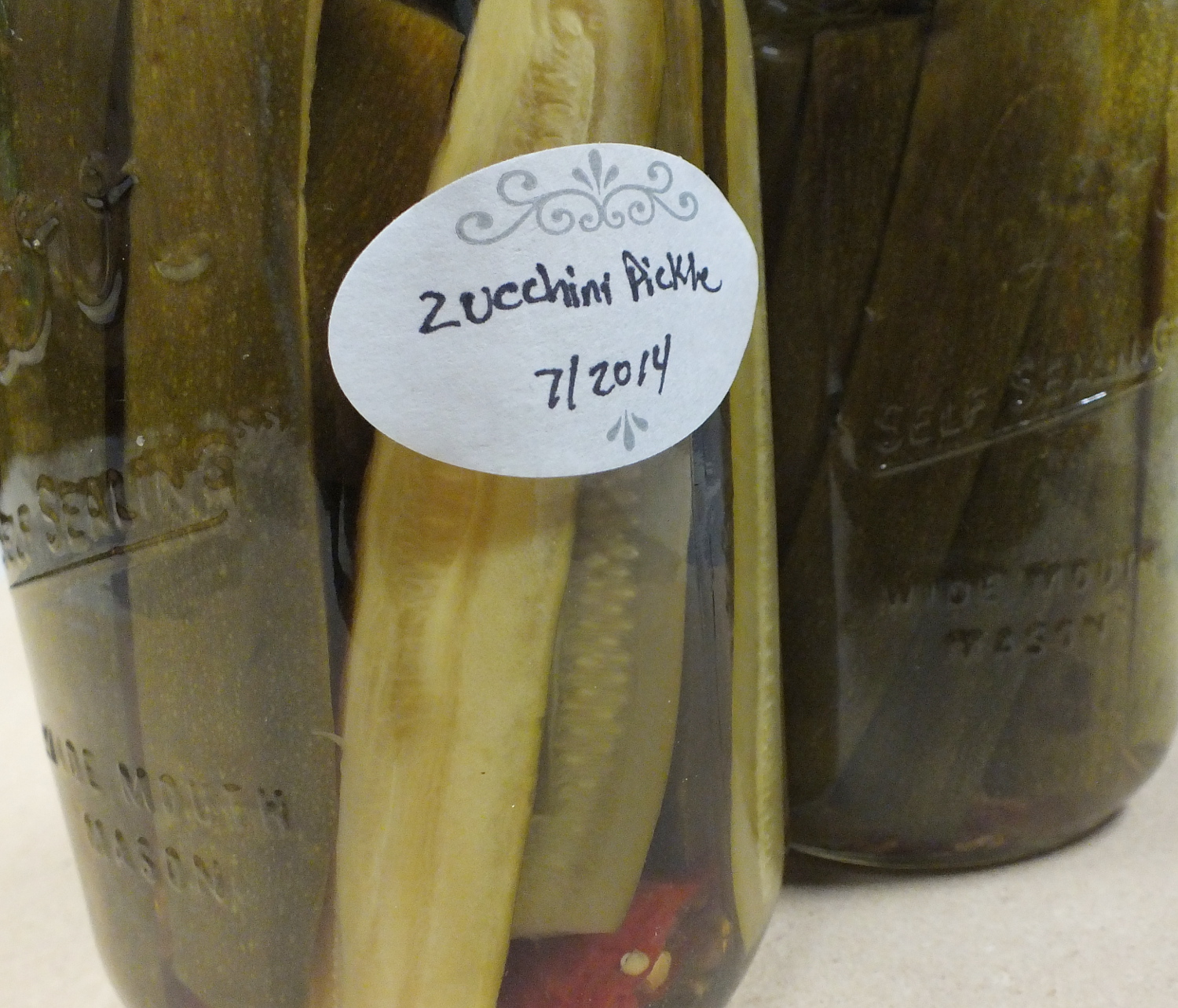
Zucchini pickles
Going fast: Only two jars left of last season’s zucchini pickles. (Photo by Matt Miller/KTOO)

Master Gardener Ed Buyarski provides a primer on pickling various vegetables from our garden in the July 30 edition of Gardentalk on KTOO’s Morning Edition, and divulges his mother’s brine recipe.


Ed’s Mom’s pickling brine

1/2 cup plain salt, not iodized
1 quart white vinegar
2 quarts water

Bring to a boil

Add a flower head of dill and at least 4 to 6 garlic cloves to each large jar
Pack each jar tight with cucumbers or other pickling vegetables
Add 1/8 teaspoon of powdered alum

Optional: Cherry leaves on top for the holidays

Fill with warm brine
Screw on clean rings and lids to jars
Put jars into boiling water bath for 10 minutes processing

Wait at least two weeks before sampling for best flavor

Also, a reminder: Don’t forget to pick your garlic this weekend.

Related links:

UAF Cooperative Extension Service publication on Pickles and Relishes
UAF Cooperative Extension Service publication on Preserving Juneau’s Bounty
Publication on Storing Vegetables and Fruits at Home available via UAF Cooperative Extension Service website

Assembly considers $1 million hit to Juneau seniors’ sales tax perk

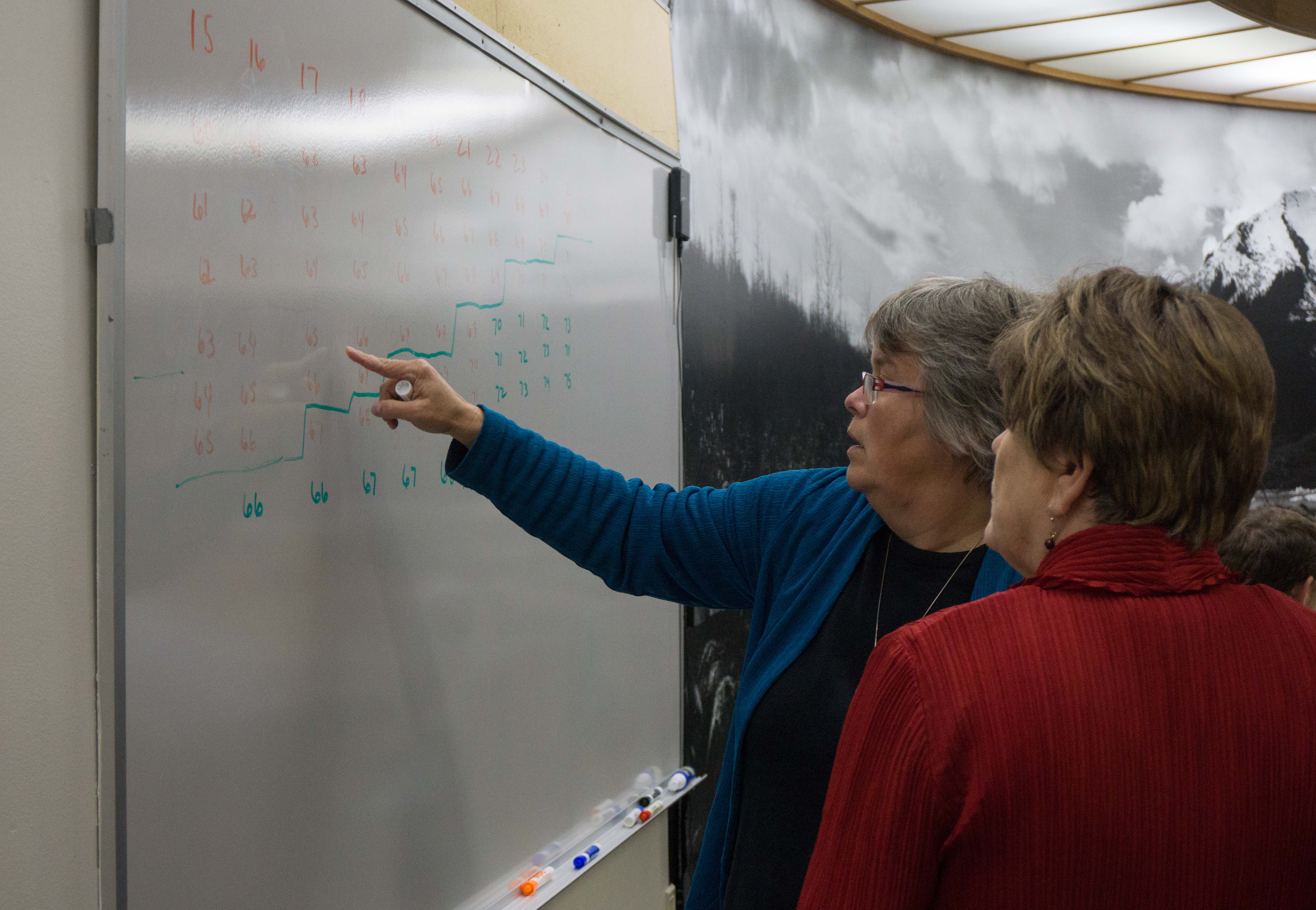
City Manager Kim Kiefer charts out one solution to gradually raise the eligibility age for the senior sales tax exemption with Assemblywoman Mary Becker. (Photo by Jeremy Hsieh/KTOO)

The Juneau Assembly advanced a series of policy changes Thursday that would leave lower-income seniors entirely exempt from paying city sales tax, while reducing wealthier seniors’ benefit. Several other sales tax proposals failed.

The city’s finance officials forecast the changes will raise an extra $1 million a year from local seniors. Currently, all resident seniors are eligible for exemption from Juneau’s 5 percent sales tax.

The package the Assembly backed Thursday would keep the exemption in place for seniors with incomes below 250 percent of the federal poverty level. That cut off varies from year to year and by household size. For a single senior this year, it works out to $36,800.

Wealthier seniors would still be eligible to skip sales tax on essentials: food, residential electricity, heating fuel and municipal water and sewer fees.

“The low-income seniors, those on fixed income, are also protected by the measure we just took,” said Assemblywoman Kate Troll. “So the seniors have been very well taken care of.”

The sales tax changes were considered at the committee level and are not final. They still must be drafted as an ordinance, presented in a public hearing, and read and voted on twice by the Assembly.

Two other sales tax changes were considered that failed. Mayor Merrill Sanford proposed increasing the eligibility age of the senior sales tax exemption from 65 to 70 over five years. The phase-in was intended to soften the blow, and the Assembly initially backed Sanford’s motion in a 5-4 vote.

But, over the next 25 minutes, they worked out a logical problem with that phase-in; since we all age on pace with the phase-in, no one would actually be phased in.

They’d already moved on to other changes when Assemblywoman Karen Crane said, “They’re not getting a double whammy, they’ve had a total whammy. Nothing for the next five years.”

With a fresh, multicolored chart by City Manager Kim Kiefer on the white board, the Assembly voted unanimously to reverse on raising the eligibility age.

Another net-positive sales tax proposal by Assemblyman Loren Jones failed by one vote. He sought a ballot question asking voters to exempt everyone from paying sales tax on food while raising the overall sales tax rate to 6 percent.

Assemblywoman Debbie White voted no.

“There’s talk about an upcoming state sales tax. We’re going to increase the cost of living for everybody by doing that. And right now, I don’t see this getting past the voters.

Assembly members on both sides of the vote agreed that taxing food was regressive, meaning it puts a disproportionate burden on the poor.

Assemblyman Jesse Kiehl was the swing vote. He was sympathetic to eliminating the tax on food, but said raising the overall sales tax rate would put Juneau service providers and retailers at a greater disadvantage, particularly against tax exempt online retailers.

“I don’t want to push people any faster toward buying outside than we have to,” Kiehl said.

Next year, Kiehl said he intends to propose less capital spending so the sales tax can be lowered to 4 percent.

15-year-old plane crash survivor receives U.S. Coast Guard recognition

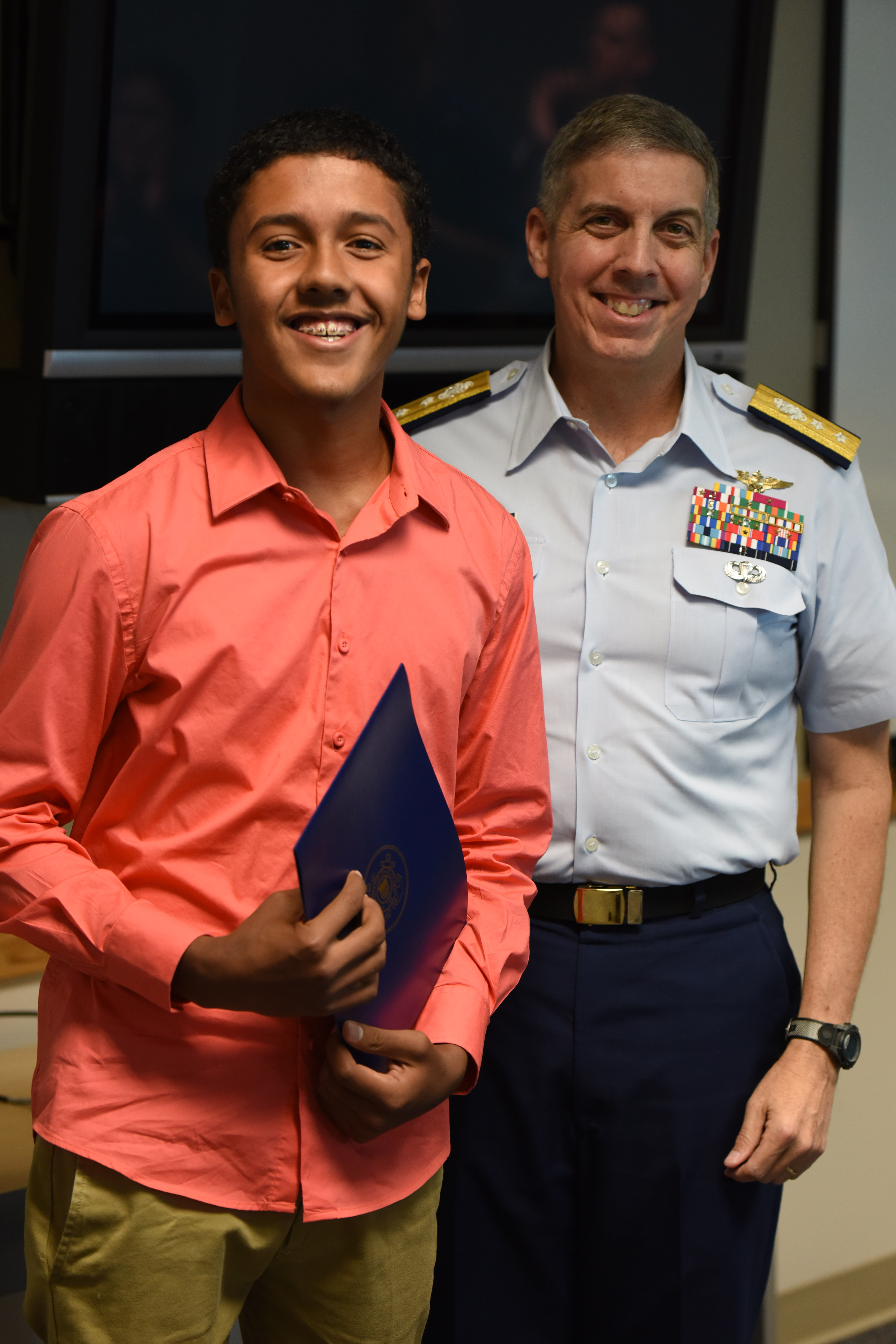
The 15-year-old survivor of a plane crash near Juneau was recognized by the U.S. Coast Guard Thursday for helping to save the other three passengers despite his own injuries.

Jose Vasquez and U.S. Coast Guard Rear Admiral Dan Abel on Thursday. (Photo courtesy U.S. Coast Guard Alaska)

Jose Vasquez was on the Wings of Alaska Cessna that crashed into a mountain 18 miles west of Juneau, killing the pilot. Vasquez lives in Puerto Rico and was in Juneau visiting his godparents. All three and another passenger were traveling to Hoonah.

Coast Guard spokesman Grant DeVuyst says Vasquez used survival skills he learned as a Boy Scout.

“He had multiple injuries but he still went through many steps to make sure the other passengers got the help they needed,” DeVuyst says.

Vasquez had broken ribs and a collapsed lung, according to his godfather.

Vasquez put layers of clothing around his godmother Sandra Herrera Lopez to preserve body heat. He lifted cargo boxes that had fallen on another passenger, Ernestine Hanlon-Abel of Hoonah.

DeVuyst says Vasquez then found three cell phones and called 911. He used a phone app to determine the latitude and longitude of the crash site and passed them on to emergency operators.

“When he heard one of the first helicopters from Temsco nearby, he started using smoke signals and then later when the Coast Guard helicopter arrived on scene, he started waving a silver thermal blanket to attract attention and that successfully vectored them in for what was the rescue of the passengers,” DeVuyst says.

He says Vasquez’s efforts accelerated the search and rescue.

“There was the emergency beacon aboard the aircraft, but without his precise location, because of how heavily wooded everything was, it would’ve taken longer for rescue crews to locate them,” DeVuyst says.

The Coast Guard honored Vasquez during a ceremony closed to media at Juneau’s Federal Building. DeVuyst says about 50 people were there, including family and friends, and Coast Guard personnel. His godfather Humberto Hernandez, another passenger on the flight, is a Coast Guard doctor.

Hernandez says he’s getting physical therapy. He has a swollen leg, back pain and will have to have some teeth removed. Wife Sandra Herrera Lopez had been medevaced to Harborview Medical Center in Seattle. He says she had several fractures to her head, arm, ankle, collarbone and ribs. She’s since been transferred to another hospital in Seattle.

Hoonah resident Ernestine Hanlon-Abel is still at Harborview. Her husband Tom Abel says she’s undergone multiple operations and has both legs in casts. He hopes she’ll be able to leave the hospital soon, but will likely stay in an assisted living facility before returning to Hoonah.

Vasquez is awaiting clearance from his doctor before going home to Puerto Rico.

Editor’s note: The U.S. Coast Guard mistakenly identified the first helicopter on scene at the crash site as being from Temsco Helicopters. In fact, the helicopter was from Coastal Helicopters. We regret the error.

Instrument data ‘another piece of the puzzle’ in fatal plane crash

The National Transportation Safety Board released a preliminary report on the fatal plane crash that occurred 18 miles west of Juneau on July 17.

Wings of Alaska flight 202 crashed into a mountain about 15 minutes after departing Juneau on its way to Hoonah, killing the pilot Fariah Peterson. All four passengers survived.

Chris Shaver is the NTSB investigator in charge. He says there were no reported problems at takeoff.

“In the only communication that the pilot had with air traffic control, which would’ve been at takeoff, she didn’t relay any issues,” Shaver says.

The plane is certified to fly under visual flight rules, which means it has to stay out of the clouds and maintain a visual reference with the ground for navigation. Shaver says weather conditions at the Juneau and Hoonah airports at the time fit visual flight rules. To determine what conditions were like in between, he says he’s pulled images from seven weather cameras.

Shaver says the plane’s electronic system had a feature that gives visual and audio warnings if the aircraft is approaching terrain. The plane split in two when it hit a large spruce tree at an elevation of about 1,300 feet above sea level.

“Where the separation happened probably played some factor in the survivability of the passengers,” Shaver says.

The engine is being sent to Anchorage for further inspection and the plane’s visual display units are being sent to NTSB headquarters in Washington, D.C. A chip inside the display units will hopefully offer flight data, like air speed and altitude.

“We hope that we’ll get data all the way up until 1 to 2 seconds before the accident,” Shaver says. “It’s not going to answer the question of why did something happen, but it’s going to give us a much clearer picture of what exactly happened, at least, with the flight path of the airplane. So it’s another piece of the puzzle.”

Shaver says the final report determining probable cause of the Wings of Alaska crash won’t come out for another 12 to 18 months.

So far, only one newcomer in Juneau’s fall elections

voter at the JACC
A primary voter fills out a ballot at the Juneau Arts and Culture Center on Aug. 19, 2014. (Photo by Jeremy Hsieh/KTOO)

Local voters could elect up to six new members to the Juneau Assembly and School Board this fall — if candidates step up.

The filing period for candidates in Juneau’s regular municipal election opens at the end of next week. Election day is Oct. 6.

So far only one newcomer has formally declared his candidacy.

Juneau Assembly

Merrill Sanford
Merrill Sanford

On the nine-member Juneau Assembly, the mayor and two others are up for re-election.

Mayor Merrill Sanford says he is seeking a second term.

“With the budget coming down from the State of Alaska and our budget situation, it could be very interesting, what we have to try to do to make our budget balance, for sure,” Sanford says.

He says he also wants to follow through with the city’s economic development plan. For now, he’s                                                              unopposed.

Jesse Kiehl
Jesse Kiehl

District 1 Assemblyman Jesse Kiehl shot down rumors from a political blog that intimated he was running for mayor.

“Nope, no plans to do that. I’m very happy serving in my current seat,” Kiehl says.

He won reelection to his second term on the Assembly unopposed last year.

Incumbent District 1 Assemblyman Loren Jones could not be reached for comment                                                                                              by press time. However, Jones filed a letter of intent in March to run again.

Loren Jones
Loren Jones

The only other candidate to formally file so far is newcomer Jason Puckett, who would face incumbent Jerry Nankervis in District 2.

“I figured it was time, cause we’re going through a lot of changes right now,” Puckett says. “Especially with, you know, tourism season is bigger and bigger every year, there’s a lot of new businesses downtown. Economy isn’t the best it’s ever been. We import most of our workers from other places as opposed to having people that live here have those jobs. So jobs are a big issue, affordable housing is a big issue for me.”

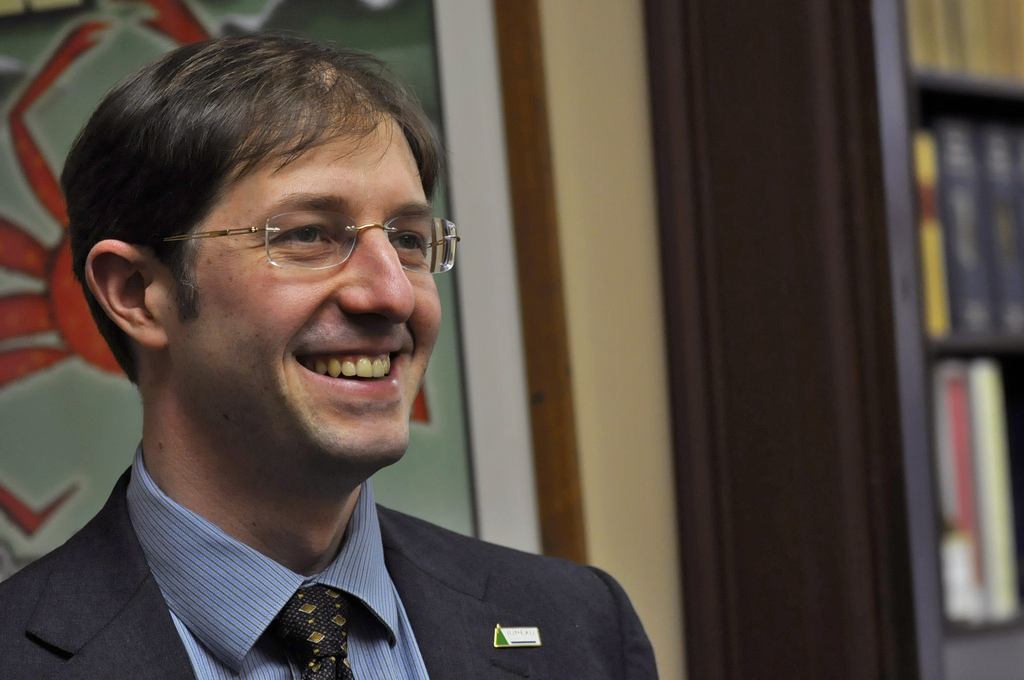
Jason Puckett. (Photo by Jeremy Hsieh/KTOO)
Jason Puckett

He also says he can help with the transition to legalized marijuana in Juneau. He says he lived in Colorado during the transition there, and saw what worked and what didn’t.

Puckett has lived in Juneau for about 2 years. He’s a GCI retail store manager, marshmallow entrepreneur and has served in the U.S. Marine Corps.

Jerry Nankervis could not be reached for comment.

Juneau School Board

School Board candidates Michelle Johnston, Phyllis Carlson, and Andi Story answer questions posed during a Chamber of Commerce candidates forum on Sept. 20, 2012. Photo by Matt Miller/KTOO News
Phyllis Carlson

Three incumbents on the Juneau School Board are finishing their fourth term.

Board President Phyllis Carlson says she hasn’t decided if she’ll run again.

“I do have time, but I do have grandkids,” she says. “And I just have things that I, that my family would probably like me around for more, but I am still also very passionate about our district and our public education system.”

Destiny Sargeant is also undecided. She cited concerns about caring for an elderly relative.

The final incumbent, Andi Story, is seeking her fifth term. She’s also finishing up a one-year term as president of the Association of Alaska School Boards.

“We really have to have a good budget process and plan at the state level so we can plan, you know, effectively at the local level, and so I’m really committed to keep working on that,” she says. “We’ve made some headway over the years. ”

More candidates?

Election info

For more information about Juneau’s municipal elections and how to run, visit www.juneau.org/clerk/elections/.

Candidates for Juneau Assembly and Juneau School Board must collect at least 25 qualified voters’ signatures and turn them in to election officials by Aug. 17. Candidates also must file a letter of intent, a financial disclosure and campaign finance paperwork with the Alaska Public Offices Commission.

Write-in candidates have until Oct. 1 to file their paperwork.

Assembly and School Board members serve 3-year terms. The mayor is paid $30,000 a year and regular Assembly members paid $6,000. School board members are paid a monthly stipend that amounts to $3,240 a year.

To vote in Juneau’s local elections on Oct. 6, you must be registered by Sept. 6.

Site notifications
Update notification options
Subscribe to notifications