North Slope

Hilcorp, BP want many of their answers to state regulators’ questions kept confidential

Hilcorp’s Innovation drilling rig on the North Slope. (Photo courtesy of Hilcorp)

As oil and gas company BP presses ahead with the sale of its Alaska business to privately-held Hilcorp, questions loom around how low oil prices are impacting the deal.

On Monday, the companies released answers to a state agency that’s scrutinizing a key piece of the transaction, but with a catch: The companies and their affiliates want to keep much of the information out of public view, including whether plummeting oil prices have affected Hilcorp’s ability to borrow money to pay the $5.6 billion price tag.

That answer and others are redacted in the public version of the companies’ response to questions posed by the Regulatory Commission of Alaska. The commission received the responses in full, but the companies are asking it to keep the answers confidential that they have blacked out in the public version of the 1,377-page document.

(Screenshot of a section from the 1,377-page document that BP and Hilcorp affiliates filed with the RCA on Monday, May 4, 2020.)

The document is the latest development in the commission’s months-long review of Hilcorp’s plan to purchase BP’s entire Alaska business. It’s one of the largest oil industry deals in state history, and would launch Hilcorp into the position of second-largest oil producer in Alaska.

The sale includes BP’s stake in the massive Prudhoe Bay oil field and the trans-Alaska pipeline. The commission is reviewing the slice of the deal involving pipeline assets.

The information the companies want to keep confidential in the review ranges from risk assessments to insurance policies to minutes from pipeline operator meetings. They also don’t want several pipeline studies to be made public, or a copy of a revised sales agreement that the companies announced last week, according a separate, 39-page petition for confidential treatment filed with the commission on Monday.

The companies argue that the information includes trade secrets, and releasing it publicly would harm their businesses, and provide their competitors with an unfair advantage. Hilcorp and its affiliates are privately-held, the companies’ petition says, and “forcing public disclosure of this otherwise private information” would negate their competitive advantages.

“Such a decision would essentially saddle the Hilcorp Entities with the disadvantages of being a publicly-held company without conveying any of the advantages,” the petition says.

But some, including Philip Wight, a policy analyst for the Alaska Public Interest Research Group, are pushing back against the companies’ confidentiality request. He described it as “alarming.” The consumer advocacy organization has argued that Hilcorp must publicly disclose its finances to prove it has the money to operate the assets it wants to buy, and to respond to any costly oil spills.

“What these requests for confidentiality reveal is that Hilcorp really has no desire to be open and honest with the Alaskan people, and they really have no desire for this to be a public input process,” Wight said. “They really just want to do things behind closed doors.”

Wight said the public deserves to have the information, so it can weigh in on the sale, “in order to protect our environment and to make sure that we’re getting a good deal for the sale and monetization of our resources.”

BP and Hilcorp declined to comment outside of the RCA filings.

The companies’ public answers filed Monday include information on reportable oil spills and some information on prior pipeline repairs. The commission will ultimately decide whether the information currently redacted from the public version can stay confidential.

The commission has already approved prior requests from BP and Hilcorp to keep certain financial statements confidential during its review process. The City of Valdez is currently challenging the commission’s decision in court.

BP confirmed last week that the sale of its entire Alaska business to Hilcorp is still on, but under revised financial terms that reflect the turmoil in the oil industry amid a pandemic-driven crash in demand for fuel.

BP said it expects to complete the sale in June. If the commission’s process takes longer, it said, it could close part of the deal this summer, and the pipeline portion later on.

The Alaska Department of Natural Resources also continues to review a portion of the deal.

After a warmer-than-normal April, Utqiaġvik sees first record low since 2007

The shorefast sea ice off Utqiaġvik, which local whalers use as a platform for their spring hunt. April 21, 2019. (Photo by Ravenna Koenig/Alaska’s Energy Desk)

For the first time since 2007, Alaska’s northernmost city has recorded a record low daily temperature reading.

On Wednesday morning, temperatures in the North Slope hub community of Utqiaġvik reached 20 degrees below zero, a record low for April 29.

Rick Thoman, a climatologist with the International Arctic Research Center in Fairbanks, said that Utqiaġvik saw all of the ingredients for a cold day on Wednesday.

“At Utqiaġvik, there was some wind, and it’s the direction the wind needs to get really cold, and that’s an offshore wind — kind of a southeast  breeze helping pull in some of that cooler air from the inland to the coast,” Thoman said.

In a tweet, Thoman said Wednesday was also the latest date in the season for a temperature of 20 below or colder in the area. The previous record was a low of  minus 24 on April 28, 1964.

https://twitter.com/AlaskaWx/status/1255564927579779072

Thoman said that the frigid Wednesday temperature doesn’t represent the month of April as a whole for the North Slope, however.

“Of course, the record low is really just one day,” Thoman said. “For April as a whole, this was the sixth-warmest April in the last century at Utqiaġvik.”

Thoman said that while this is the first record low day in Utqiaġvik in just over 12 years, there have been overwhelmingly more record high temperature days in the area.

“One hundred and twelve daily record highs have been set or tied,” Thoman said. “So in a football game, if the score was 112 to nothing, or 112 to one, that would really be quite remarkable.”

Thoman said that current models from the National Oceanic and Atmospheric Administration call for a higher chance of warmer-than-normal temperatures for Utqiaġvik in the month of May.


ConocoPhillips to cut Alaska oil production by 100,000 barrels per day

A unit at the edge of ConocoPhillips’ Kuparuk oil field on Alaska’s North Slope in 2016. (Photo by Rachel Waldholz/Alaska Public Media)

ConocoPhillips announced Thursday that it will cut oil production in Alaska by about 100,000 barrels per day for the month of June in response to “unacceptably low oil prices.”

That’s about half of Conoco’s daily production in the state, and roughly a fifth of the crude that typically flows down the trans-Alaska pipeline.

“It’s incredibly significant,” said Kara Moriarty, chief executive of the Alaska Oil and Gas Association. Conoco is Alaska’s largest oil producer.

“It will have an impact on state revenue, royalties, production tax,” Moriarty said.

The coronavirus pandemic and an oil price war have bludgeoned the oil and gas industry, and Thursday’s announcement from Conoco is the latest fallout. The oil and gas company announced sharp curtailments in production across the country, and a loss of $1.7 billion in its first quarter of 2020.

The cuts in Alaska will impact the Kuparuk River, Mooses Tooth and Colville River units, ConocoPhillips Alaska said in a statement.

“The curtailment will essentially leave the oil stored in the reservoirs, available for resumption of production at a later date,” it said.

Conoco will not shut in the fields entirely “because of the cost and complexity of a total field shut down,” wrote Conoco Alaska spokesperson Natalie Lowman in an email. “We want to be able to respond quickly if market conditions improve.”

In its statement, Conoco said the cuts to production underscore “the extraordinary challenges currently facing the oil and natural gas industry in Alaska and elsewhere.”

The pandemic has destroyed demand for fuel as cruise lines cancel sailings, and people drive less and book fewer flights. That paired with the oil price war has led to a glut of crude rapidly filling storage tanks. Oil prices have plummeted.

“It’s a very painful reminder today that Alaska is part of a global oil industry that is reeling from dynamics no one ever could foresee,” Moriarty said.

Last week, the estimated value of a barrel of North Slope crude dropped to an unprecedented negative $2.68 and crawled back to $10.67 by Wednesday — still the lowest price since the late 1990s.

Oil producers, including Conoco, have already announced cuts to spending in the state, and oilfield service companies are laying off dozens of workers.

Conoco is the first major producer to announce significant cutbacks to production in Alaska related to the current oil prices.

Hilcorp said in a statement that it currently has two drill rigs operating on the North Slope and one in the Cook Inlet. At this time, it said, it has “no announced production cuts other than following Alyeska Pipeline’s proration directive.”

Alyeska Pipeline Service Co., the company that runs the trans-Alaska pipeline, announced last week plans to cut oil flow by about 50,000 barrels a day, or about 10%.

Exxon Mobil declined to comment on its plans for production in Alaska ahead of its Friday announcement of first quarter financial results. A spokesperson for BP said the company does not comment on day-to-day operations.

Conoco says it will start ramping down production in late May.

“Any extensions of the curtailment beyond June will be determined on a month-to-month basis,” the company said.

Conoco did not announce any layoffs in Alaska on Thursday. It said the cuts will not impact the trans-Alaska pipeline.

In a statement Thursday, the co-chairs of the Alaska Legislature’s House Resources Committee said Conoco’s cutbacks are another troubling reminder of the economic challenges the lie ahead for Alaska due to the pandemic.

“This news deals a blow to the state’s widening deficit and underscores the need for a comprehensive strategy to address Alaska’s financial crisis,” said the statement from Rep. John Lincoln, I-Kotzebue, and Rep. Geran Tarr, D-Anchorage.

During the first quarter of 2020, ConocoPhillips says its daily production in Alaska totaled 218,000 net equivalent barrels of oil per day.

This story has been updated.


‘The first glance at what’s coming’: Oilfield service companies alert state of more than 250 layoffs in Alaska

ConocoPhillips’ CD5 drill site. (Photo by Elizabeth Harball/Alaska’s Energy Desk)

Four oilfield service companies have alerted the state of sweeping layoffs at their North Slope operations as the coronavirus crushes demand for fuel, oil prices crash and drilling activity declines.

The job cuts announced in Alaska include 63 layoffs at Baker Hughes, 81 at the Schlumberger Technology Corp., about 80 at Halliburton Energy Services and more than 50 at the Peak Oilfield Service Co., according to the companies’ notices sent to the state over the past month, the most recent filed Monday.

“I think that’s just the first glance at what’s coming,” said Rebecca Logan, chief executive of the Alaska Support Industry Alliance, an oil and mining trade group.

Across the country, companies that provide oilfield services and equipment are cutting jobs and bracing for bankruptcy as the pandemic launches the oil and gas industry into a tailspin. Baker Hughes, Schlumberger and Halliburton have dismissed workers and slashed spending at their operations across the globe.

Logan described the past few months as a “double whammy” for service companies on the Slope. First came the virus and travel restrictions that complicated the typical two-week rotations. Companies also slimmed down to essential functions to reduce the number of workers at camps.

Then came the rapid drop in oil prices.

“That pretty much took the wind out of everyone’s sails,” Logan said. “Now there’s not really work to go back to.”

Oil giants including ConocoPhillips have cut spending in Alaska and reduced drilling on the Slope. The company that runs the trans-Alaska pipeline also recently cut North Slope oil production by 10% as the world wrestles with a glut of oil that’s filling up storage tanks.

According to the service companies’ notices to the state, the layoffs include heavy equipment operators, engineers, technicians, mechanics and others.

In the notice dated Monday, a representative for Baker Hughes wrote that the pandemic poses unprecedented challenges.

“These unforeseeable business conditions and the COVID-19 natural disaster have suddenly, dramatically and negatively impacted the market and reduced the overall need for the services and products provided by Baker Hughes,” the notice said.

Alaska had an estimated 6,350 oil industry service jobs in 2019, according to Neal Fried, an economist at the state Department of Labor and Workforce Development.

The department is still tabulating how the pandemic has impacted the state’s workforce numbers in March and April, with the new data expected to be released in May.

Fried said he anticipates the data will show more job losses in the oil and gas sector than what’s revealed in the notices filed with the state. Only certain factors trigger a notice such as plants closing and mass layoffs.

Logan said she doesn’t expect the downturn to end anytime soon. Neither does Tom Walsh, board president of the Alaska Support Industry Alliance and managing partner at Petrotechnical Resources of Alaska, an oil and gas consulting firm.

“The workload is going to diminish further,” he said. “I think this is the beginning of the downturn and I think it will be far more impacting than what we’ve seen so far.”

Walsh said he expects his company’s workload to decrease by at least 30% over the next few months. The company doesn’t employ many full-time workers, he said, so they haven’t gone through layoffs but, without work to do, some have filed for unemployment.

Last week, the estimated value of a barrel of North Slope crude dropped to an unprecedented negative $2.68 on Monday and crawled back to $11.60 by the end of the week — still the lowest price since the late 1990s. By Monday, it had fallen again, dipping to $8.97.

Walsh said the price collapse comes as the industry is just starting to recover from the last downturn.

The total number of oil and gas jobs in Alaska plummeted from about 15,300 in late 2014 to 9,100 three years later, rising back to an estimated 10,500 jobs by this February.

‘We’ve never really clawed back any margins,” Walsh said. “And now this hits and, it’s like, there’s just no more room to squeeze anything out of the costs of doing business up here.”

BP says sale to Hilcorp is still on, but under revised terms

BP’s operations center at Prudhoe Bay. (Elizabeth Harball/Alaska’s Energy Desk)

Oil and gas company BP says it expects to complete the sale of its Alaska business to Hilcorp in June, but under revised financial terms.

In a statement late Sunday, BP confirmed its commitment to close the multi-billion dollar sale. It says the June timeline is subject to regulatory approvals. The statement follows reports that the deal was in jeopardy as the coronavirus has crushed demand for oil and oil prices have collapsed.

The two companies have renegotiated the financial terms of the deal, BP says. The price is still $5.6 billion, but the structure and phasing of the payments have changed.

“The agreed revisions respond to market conditions while retaining the overall consideration,” William Lin, BP chief operating officer of upstream regions, said in the statement.

Originally, Hilcorp had to pay $4 billion in the near term, and $1.6 billion later. Hilcorp paid BP a $500 million deposit last year.

The revised agreement includes lower payments this year, plus “new cash flow sharing arrangements over the near-term, interest-bearing vendor financing and, potentially, an increase in the proportion of the consideration subject to earnout arrangements,” BP’s statement says.

It says the two companies have developed detailed transition plans.

Hilcorp President Jason Rebrook said in a statement Monday that the company is excited about its future in Alaska, “and we look forward to continuing to safely develop Alaska’s natural resources.”

“In the weeks ahead, we will continue to work with BP, the State of Alaska, and others to ensure a seamless transition process as we complete this transaction,” he said. “We are proud of the work we have done in Alaska over the last eight years, and plan on being an important part of the Alaska economy and community for many years to come.”

The deal includes BP’s stakes in the massive Prudhoe Bay oil field and the trans-Alaska pipeline. The Regulatory Commission of Alaska is still reviewing a key piece of the deal involving pipeline assets. The state regulators have asked Hilcorp to disclose whether and how the pandemic-driven crash in oil prices will affect its ability to close the deal, and the company’s response is due by May 4.

BP Alaska President Janet Weiss said in a statement late Sunday that the company will continue to work with regulators “and demonstrate that BP remains committed to completing the sale, even in these volatile and difficult market conditions.”

“If necessary due to timing of approvals, we will complete part of the deal in June, transferring the upstream business to Hilcorp, while continuing to work with regulators for approval of the sale of the midstream,” Weiss said.

“The future will be tough,” she said, “and I believe the best thing for a more rapid economic recovery for Alaska is the timely completion and approval of this deal, enabling more competitive oil down TAPs.”

The sale is part of BP’s plan to divest $15 billion by mid-2021.

This is a developing story. Check back for updates.

Alyeska imposes 10% cut to North Slope production as COVID-19 hammers oil demand

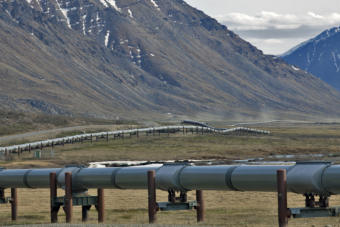
An above-ground section of the Trans-Alaska Pipeline System near the Toolik Lake Research Station in the North Slope Borough. (Photo by Rashah McChesney/Alaska's Energy Desk)
An above-ground section of the Trans-Alaska Pipeline System near the Toolik Field Station in the North Slope Borough. (Photo by Rashah McChesney/Alaska’s Energy Desk)

The company that runs the trans-Alaska pipeline announced a 10% cut to North Slope oil production Friday, amid a global oversupply of crude caused by the COVID-19 pandemic.

North Slope producers have pumped an average of 500,000 barrels a day into the pipeline this month, according to state data, so the 10% reduction amounts to some 50,000 barrels. That lost production is worth about $575,000 at Thursday’s price of $11.55 a barrel.

Alyeska Pipeline Service Co., which operates the pipeline on behalf of owners BP, ExxonMobil and ConocoPhillips, can store some 6.6 million barrels of oil at the end of the pipeline in Valdez, where tankers pick it up and deliver to West Coast refineries. Friday’s decision to pro-rate North Slope production is aimed at averting a storage crunch that Alyeska expects at the end of May, said spokesperson Michelle Egan.

The 10% reduction is the only one planned for now, she added.

“With all the information we have about oil coming in and the movement of tankers visiting the terminal in Valdez, this is the pro-ration needed to manage through the month of May,” she said. “If information changes, the pro-ration rate might change.”

Alyeska isn’t directly involved in hiring the tankers that pick up the oil from Valdez, so Egan said she wouldn’t speculate about the specific factors causing the crunch or how connected it is to the crash in demand caused by COVID-19. Similar cuts have been imposed in the past, and sometimes at higher levels, she added.

Nonetheless, the decision to pro-rate comes as global markets are awash in crude. April demand was expected to be 30% less than the year before, according to the International Energy Agency. And dozens of tankers filled with crude are currently anchored off the California coast, with nowhere to sell the oil.

Experts say that Alaska’s oil production is somewhat less susceptible to market turmoil because major producers own their own refineries and sell North Slope crude farther in advance because of its distance from markets.

The market value of a barrel of North Slope oil was as high as $57 just two months ago, according to state figures, before crashing to negative territory earlier this week.

Friday’s announcement is the latest blow to Alaska’s oil industry, whose companies have already announced spending cuts and delayed projects as prices have plummeted. Oil-field service companies have laid off workers, and lower prices and production also translate into less revenue for the state treasury.

“It’s disappointing for Alyeska and people who work for us, and we also understand what the implications are for the state of Alaska,” Egan said. “We try to avoid these situations with every tool that we have in our tool belt, and the tool that we’re able to use at this time is to do a lighter pro-ration for a longer period of time and watch for changing circumstances.”

Site notifications
Update notification options
Subscribe to notifications