North Slope

Oil prices fell to a historic low Monday. Here’s what that means for Alaska.

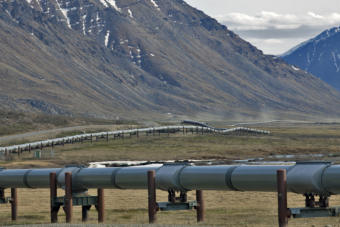
Pipelines stretch toward the horizon in the National Petroleum Reserve-Alaska. (Photo by Elizabeth Harball/Alaska’s Energy Desk)

For the first time ever, prices for a key U.S. oil benchmark went into the negatives on Monday.

The rapid crash of West Texas Intermediate crude is linked to the intricacies of the futures market, and underscores the volatility in prices as the coronavirus pandemic crushes demand and storage capacity dwindles.

“This is an unprecedented event in the oil market,” said Dan Stickel, chief economist for the Alaska Department of Revenue. “There’s an extreme oversupply and an extreme curtailment of demand and it’s led to significant volatility in pricing.”

While crude prices have continued to plummet in recent weeks, and oil companies have announced spending cuts, Monday’s price meltdown for the Lower 48 benchmark was particularly staggering.

“I almost didn’t believe the headline. Like, ‘What? How is that possible,’” said Kara Moriarty, chief executive of the Alaska Oil and Gas Association. “It’s this massive convergence of some crazy world dynamics that no one anticipated.”

The price of a barrel of West Texas Intermediate for May delivery sunk far below $0 on Monday, collapsing to almost negative $40. That effectively means sellers must pay that much to have someone take the crude off their hands.

It was unclear late Monday what price Alaska North Slope crude would close at. The Department of Revenue typically posts the price a day later.

Stickel, however, cautioned that Monday’s negative prices may not heavily impact Alaska oil producers, who sell most — if not all — of their crude farther in advance because of their distance from the market, and are already focused on June deliveries.

“They’ve already firmed up their May plans and they’re saying, ‘Okay, where are we going to sell our oil production in June?’” Stickel said.

BP and Exxon also have their own refineries, said Larry Persily, a long-time observer of the oil and gas industry.

“Today’s panic prices are not reflective of what Alaska North Slope producers are going to get for what they’re delivering to their West Coast refineries this month,” Persily said. “But it’s still a kick in the head for the entire industry.”

Alaska North Slope crude prices have also already fallen from about $70 at the start of the year to $15.42 on Friday, nearly $3 under West Texas Intermediate on that day and the lowest price in more than 18 years.

“At current prices, the producers in Alaska are not covering their costs of operations,” Stickel said.

Production taxes and royalty payments in Alaska are based on the monthly average of the prices, he said.

At a Monday evening news conference, Gov. Mike Dunleavy described the plunging oil prices as stunning and another challenge for Alaska. Oil is the backbone of Alaska’s economy and fuels the state budget, he said.

“We expect oil prices to rebound, but we don’t expect necessarily to see them at the price that Alaska needs to balance its budget,” he said.

Monday’s oil free fall is nuanced, and has to do with a specific contract for a specific supply of oil.

The contracts for the May delivery of West Texas Intermediate crude expire Tuesday. Traders who have waited until the last minute to unload the contracts are desperate to find buyers.

And supply is far outpacing demand as the coronavirus pandemic keeps people at home. They’re driving cars less often. They’re not taking flights. Concerns continue to mount about the shrinking storage capacity for the oil that’s being produced and not used — a glut that the oil price war also helped create.

“If you’ve got a contract… you’re just going to get out and take your losses because you sure as hell really don’t want physical delivery of that oil,” Persily said.

Persily said he doesn’t expect the negative prices for West Texas Intermediate crude to last long. The June delivery price was just over $20 a barrel on Monday, still low but not below zero.

Stickel said he expected the June delivery prices to better reflect the price of a barrel of oil.

“As far as the true value of Alaska oil, I think the June deliveries are what actually matter for the revenue that we’re going to get and the money that flows back to the producers,” he said.

Still, Persily said, Monday’s drop highlights the uncertainty in the industry, and the underlying problem remains: “There are millions and millions of barrels a day of production around the world that don’t have a buyer.”

Earlier this month, several nations ended the oil price war with an agreement to cut output, but the supply reductions haven’t hit the market yet, Persily said.

Moriarty said she also has concerns about the impact the below-zero prices may have on financing.

“Even a futures price kind of chills the hearts of investors,” she said.

Questions also surround what low prices will mean for oil production in Alaska. Persily said he expected Alaska to see long-term impacts as companies cut costs by spending less on exploration and developing new oil fields.

“So we’re going to see a delay in that new production that we hoped would maintain the flow out of the North Slope,” Persily said.

North Slope Borough backs out of deal with Ravn, reaffirms right to commandeer assets in emergency

(Photo courtesy of Ravn Alaska)

The North Slope Borough is backing out of a tentative deal to rent RavnAir Group’s Utqiaġvik hangar and is reasserting its right to use Ravn’s assets to support air service to its communities during the coronavirus emergency.

On Monday, an agreement between Ravn and the North Slope Borough was filed in federal bankruptcy court in Delaware, spelling out that the borough would pay Ravn $100,000 a month in rent for use of Ravn’s hangar at the Wiley Post-Will Rogers Memorial Airport in Utqiaġvik.

But in a press release on Wednesday evening, borough Mayor Harry Brower wrote that negotiations on that agreement were “not fruitful.”

Earlier this month, the borough issued an emergency order saying that it was “commandeering” all of Ravn’s assets in the borough in order to provide vital air service to its communities, which are off of the road system, after Ravn announced it was stopping all operations and filed for bankruptcy. The company said the coronavirus pandemic had led to a 90% drop in ticket bookings.

In a new emergency order released Wednesday, Brower wrote that thanks to other air carriers who stepped in immediately after Ravn’s bankruptcy, the borough would not have to commandeer “all” of Ravn’s assets and was in the process of determining what assets would be needed in order to continue air service.

But the borough did reassert its right to seize assets under borough code and Alaska state statutes. The borough points to state statutes that say that in an emergency, local officials can enter public and private property when it’s “reasonably necessary to actually alleviate or prevent the disaster,” in order to “take them and to perform work and take measures that are appropriate without the consent of the owners of the land or buildings.”

Last week, however, the state’s attorney general wrote that the borough’s emergency order commandeering Ravn’s property was “void” because the property belonged to the bankruptcy estate.

RavnAir Group could not be reached for comment.

ConocoPhillips cuts spending in Alaska by another $200M as oil prices sink

The ConocoPhillips building in downtown Anchorage, December 2019. (Photo by Joey Mendolia / Alaska Public Media)

ConocoPhillips said Thursday that it will cut capital spending in Alaska by another $200 million as demand plummets and oil prices tumble to an 18-year low. That’s on top of a $200 million reduction the oil giant announced last month.

“The combination of COVID-19 and the oil market downturn has been difficult on industry and on stakeholders everywhere,” Ryan Lance, Conoco’s chief executive, said in a statement on Thursday that detailed the company’s massive cuts to oil production and its budget.

While Conoco is slashing oil production in the Lower 48 and Canada, it did not announce any cuts to production in Alaska or any layoffs on Thursday, said company spokesman John Roper.

“We continue to monitor the market situation,” he said in an emailed statement. “But at this time, based on our current outlook, we chose to maintain organization capacity so we can resume programs in the future.”

In total, the $400 million cut to capital spending in Alaska represents about a 25% reduction from what the company had expected to spend on capital in the state this year, Roper said, citing budget plans from February.

In a conference call on Thursday, Matt Fox, Conoco’s chief operating officer, said the company is cutting costs in Alaska, at least in part, by reducing drilling, including shutting down traditional and coiled tubing drilling activity.

“And we’ve elected not to start up the extended-reach drilling rig we mobilized to the North Slope last year,” Fox said. Also, he added, the company has ended its winter exploration program early to minimize the risk of COVID-19.

He didn’t provide additional details about the Alaska cuts in the call, and Roper said the company wasn’t providing more specifics.

Conoco had expected this winter to be its largest exploration and construction season ever in Alaska. Citing concerns about the coronavirus, the company announced last week that it planned to shut down development drilling, and reduce its workforce at the remote North Slope oil fields. It said wells in production would continue to produce oil.

Across its operations in the Lower 48 and Canada, Conoco said Thursday, it will slash oil production by 225,000 barrels a day, nearly a fifth of its global production. The Financial Times described it as the biggest coronavirus-related production cut of any U.S. energy producer. Across the company, Conoco is cutting more than $5 billion in spending.

On the conference call, Lance said the company expected oil prices to remain “weak and quite volatile” over the next several months.

“We’re just not going to sell our crude for these kinds of prices,” he said.

Alaska North Slope Crude sunk to $16.65 a barrel on Wednesday, the lowest price since early 2002, as the coronavirus pandemic crushes demand and an oil-price war ravaged the industry.

Related: Why does a barrel of Alaska oil cost less than a pizza?

Don Wallette, Conoco’s chief financial officer, said on Thursday’s call that Alaska is “in the mix” as a place Conoco would consider curtailing production, “at least the portion we operate on the western North Slope.” But, for now, he said: “Alaska is sold a little bit further forward than Lower 48 is and so the pricing is still acceptable to us.”

“So we don’t plan to curtail Alaska in May,” he said. “And as far as future production projections, we’re not going to be in a position to provide that with all the uncertainty that we’re under.”

Other oil companies have also announced reductions in Alaska: BP said last month it was ending its two-rig drilling program on the North Slope, and OilSearch has said it’s cutting about $70 million in spending in the state.

Despite the cuts, the amount of oil flowing down the trans-Alaska pipeline so far this month has remained similar to last year’s average production.

Update: Why does a barrel of Alaska oil cost less than a pizza…and a cheap six-pack?

The Trans-Alaska Pipeline runs alongside the Dalton Highway near the Toolik Field Station on June 9, 2017, in the North Slope Borough. (Photo by Rashah McChesney/Alaska's Energy Desk)
The trans-Alaska Pipeline runs alongside the Dalton Highway near the Toolik Field Station on June 9, 2017, in the North Slope Borough. (Photo by Rashah McChesney/Alaska’s Energy Desk)

Updated story — April 10, 2020

Pick one: a pizza or a barrel of Alaska North Slope crude. For less than $20, you could have had either one Tuesday.

Prices have rebounded since then– sort of. Now you’d have to buy a pizza and a cheap six-pack before you got into the $25-ish range where Alaska North Slope Crude is hovering now. None of this is exactly ideal for Alaska’s bottom line.

What happened? The $18.21 price per barrel was a mistake. The Department of Revenue has revised it’s report and that price bumped up to $24. But state analysts are expecting prices to drop into the teens next week.

Dan Stickel, Alaska’s chief economist, says there are a few reasons why prices are so low right now.

The first is supply: There’s too much oil on the global market. Russia and Saudi Arabia stopped limiting their production and the price war between the two countries has triggered a major drop in the price of oil.

The second is demand: The COVID-19 pandemic has upended everything. In a time of social isolation and quarantine people just aren’t driving or flying as much as they used to. The U.S. Energy Information Administration reported this week that gasoline consumption could go down by 25% in the next few months. And that it could take 18 months for domestic fuel demand to return.

And, there’s another wrinkle in the supply chain: There’s less demand on the West Coast refineries that process Alaska’s oil. But even if they wanted to produce more, Stickel says they have other problems.

“We’ve heard of coronavirus infections in the refineries that are reducing their ability to work,” he said. “Everyone’s sick with coronavirus; you can’t refine oil.”

There’s another reason for that sudden price drop, but is a bit tricky to pin down because there aren’t a lot of details about exactly what happened.

There is no spot price for Alaska North Slope Crude. Instead, the daily prices are estimated by comparing it to these other types of crude.

“The way that the oil market works is there’s benchmark crude which are widely traded crudes with a known location and quantity and quality,” said Stickel.

West Texas Intermediate has been the most followed benchmark crude in the Americas for a long time. Another one is Brent Crude, which comes from the North Sea. The state compares Alaska’s crude to that one a lot because they’re similar types of crude and they’re transported the same way.

So when people buy and sell Alaska’s crude they do it against these benchmarks. And there are assessment services that monitor all of the transactions and then they publish estimates of the prices for some of the lesser traded crudes like Alaska’s.

What happened when we ended up at $18 per barrel is that someone, somewhere sold some Alaska North Slope Crude at a huge discount, dragging the price down.

But, we’ll probably never know who did that, or why. Stickel says that information is typically held pretty tightly.

What is clear is that there is a ton of volatility in the oil markets right now and because Alaska North Slope Crude prices are estimated this way, it’s getting harder for assessment services to figure out the clear value of Alaska’s oil. So, we can expect to see prices jump up and down for a while.


Original story — Published April 9, 2020

Alaska North Slope oil prices tumbled to $18.21 a barrel on Tuesday.

On Wednesday, economists at the state’s Department of Revenue were working to identify what drove the price down and what they could expect going forward.

Chief economist Dan Stickel says there are a few reasons why prices dropped that quickly.

First, there’s a glut of oil on the global market. Russia and Saudi Arabia stopped curtailing their production. The price war between the two countries has triggered a major drop in the price of oil. That glut also means that Alaska North Slope crude is seeing new competition in the West Coast markets it traditionally serves.

Second, the COVID-19 pandemic has caused a huge drop in demand. In a time of social isolation people just aren’t driving or flying as much as they used to. The U.S. Energy Information Administration put out a forecast on Wednesday that showed a 25% decline in motor fuel use in the first quarter of 2020. That decline is expected to continue.

Stickel says refineries on the West Coast are also producing less, in part because many refinery workers are sick with COVID-19.

He hopes this is a temporary drop and that prices will rebound to what the Department of Revenue forecast on Monday. But that report has oil prices expected to stay under $30 a barrel through June.

This is a developing story. Check back for updates.

Correction: A previous version of this story said oil prices tumbled on Monday — they fell to $18.21 on Tuesday. 

BP’s sale of its Alaska business is in jeopardy, The Wall Street Journal reports

BP’s operations center at Prudhoe Bay. (Elizabeth Harball/Alaska’s Energy Desk)

BP’s sale of its entire Alaska business to Hilcorp is in jeopardy, The Wall Street Journal reported on Thursday. As oil prices crater, banks are hesitant to finance the $5.6 billion deal, the newspaper says.

It’s the largest deal in the world involving oil and gas production assets that has yet to close, the WSJ reports. It includes BP’s stakes in the massive Prudhoe Bay oil field and trans-Alaska pipeline.

BP and Hilcorp have said they expect the deal to close this summer.

However, citing people familiar with the deal, the WSJ reports a group of banks led by JP Morgan Chase & Co. have become uncomfortable providing a loan as oil prices collapse in response to the coronavirus pandemic and declining energy demands.

The WSJ also said it reviewed a recording of a call between Hilcorp management and bond investors. Management said whether the deal moves forward or doesn’t, the goal is to stay amicable with BP, the newspaper reported.

Hilcorp spokesman Luke Miller declined on Friday to comment on the WSJ report, including whether the deal was at risk and how the company plans to finance it.

In response to questions, BP spokeswoman Megan Baldino said the company isn’t commenting outside of its market update from early April. The update says BP expects the sale to Hilcorp to be completed this year, “subject to regulatory approvals.”

Last year, BP announced its plans to sell its Alaska assets to Hilcorp. At that time, Alaska North Slope crude sold for about $60 a barrel.

Larry Persily, a longtime observer of Alaska’s oil industry, said he’s not surprised to read about banks balking at financing the sale.

“Any banker in the world is going to pick up the phone and say, ‘Hey, Mr. Hilcorp, you got to come in. We got to talk about the terms on this because we’re not feeling as comfortable as we used to feel,’” Persily said.

But, Persily said, BP still wants to exit Alaska, and some of its employees have already left the company. He said he expects BP and Hilcorp to make the deal work — somehow.

“As painful as it may be to change the terms, it would be more painful to unwind the deal and put a for sale sign back up at Prudhoe Bay because there are no other buyers out there,” he said.

The Regulatory Commission of Alaska continues to review a critical piece of the deal, and asked Hilcorp last week to disclose whether and how the historic drop in oil prices will affect its ability to finance the deal. The company must respond by May 4.

This story has been updated.


ConocoPhillips shuts down North Slope drilling over coronavirus concerns

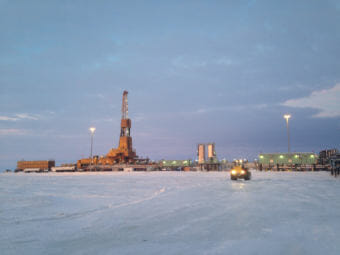
The main camp at the Kuparuk field. (Photo courtesy ConocoPhillips)

Oil giant ConocoPhillips announced Wednesday that it’s shutting down its drill rigs on the remote North Slope oil fields, and placing them into long-term storage, to protect its employees and contractors during the coronavirus pandemic.

This winter was supposed to be Conoco’s largest exploration and construction season ever in Alaska. In a statement, Conoco spokesperson Natalie Lowman said the company is significantly reducing its workforce on the Slope because of the heightened risk of COVID-19, the disease caused by the coronavirus.

“The health and wellbeing of our workforce, along with mitigating the spread of COVID-19 is our top priority,” Lowman said. “The preventative actions we’re taking in Alaska are primarily due to the remoteness and complexity of operating on the North Slope during the COVID pandemic.”

Lowman said she didn’t have additional information Wednesday on workforce impacts, including any layoffs and how many fewer employees and contractors will be on the Slope. In a letter, the president of Doyon Drilling, a subcontractor, said the impact of the decision will be “severely felt” by all of its employees and Alaskans, The Anchorage Daily News reported.

Wells in production will continue to produce oil, Lowman said. Development and exploration drill rigs will be demobilized. That includes its massive rig nicknamed “The Beast” that was expected to begin drilling this month.

“Given the high degree of uncertainty on how the situation plays out, we can’t say how long these measures will be in place,” Lowman said.

The oil industry is not only dealing with the coronavirus, but also a historic drop in oil prices. In early March, Alaska North Slope crude sold for roughly $50 a barrel. On Tuesday, the price fell below $20.

Conoco previously announced it was cutting its capital spending in Alaska by roughly $200 million due to low oil prices.

So far, there has been one confirmed case of COVID-19 on the Slope oil fields, where employees live and work in close quarters. BP announced last week that a Prudhoe Bay worker had tested positive for the disease.

In response, BP also said it would limit its activity at Prudhoe Bay “to safety critical and regulatory compliant activity.” It ended this year’s development drilling.

Asked if any Conoco workers on the Slope had tested positive, Lowman said in an email, “I can’t share information on workforce health matters.” The state is the primary source of information on COVID-19 cases, she said, and had only confirmed one case.

The number of cases across Alaska continues to grow, reaching 226 by the end of the day Tuesday.

Oil companies, including Conoco, have reported an array of efforts to keep the virus off the Slope including longer shifts, health screenings and increased sanitation.


Site notifications
Update notification options
Subscribe to notifications