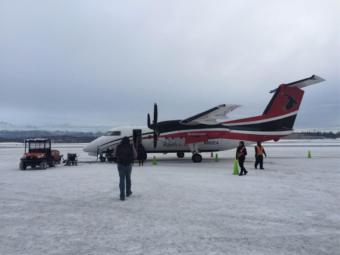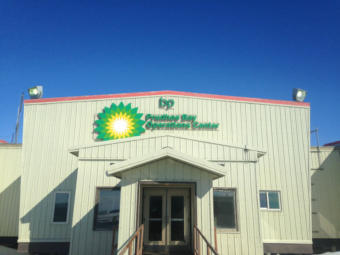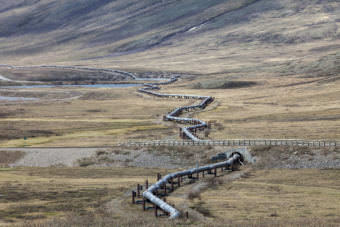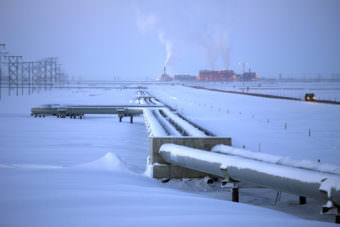
Pipelines lead to one of BP’s facilities on the North Slope. (Photo courtesy BP)
Alaska’s major oil companies are screening workers for fevers before they fly to remote operations on the North Slope, in an effort to fight the spread of coronavirus.
The companies met last week and agreed to start screening all of their workers when they check in in Anchorage, says Heidi Hedberg, Alaska’s public health director.
BP operates the North Slope’s largest oil field, Prudhoe Bay, and is conducting those screening measures, a spokeswoman says. Another major North Slope operator, ConocoPhillips, is checking passenger temperatures as they board planes headed north, a spokeswoman says.
The companies are also reviewing their contingency plans in the event a case is discovered on the North Slope.
The North Slope’s oil patch employs thousands of workers in an isolated area nearly 400 miles north of Fairbanks, the nearest big city. Most workers travel there by plane, and live and eat in shared spaces.
The major companies operating in the area have released few specifics about how they’re working to prevent a coronavirus case there, or how they’d respond if one was discovered. A BP spokeswoman said in an email last week that the company is closely monitoring the spread of the virus, along with the guidance from the World Health Organization and the U.S. Centers for Disease Control and Prevention.
Both BP and ConocoPhillips say they’re prioritizing the safety and well-being of their employees.
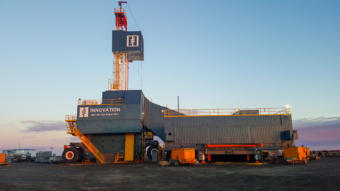
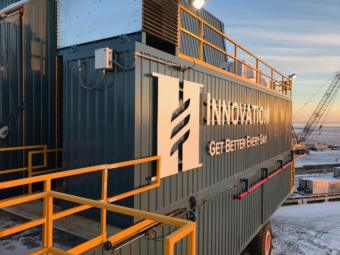
Hilcorp has used its Innovation drilling rig as part of its program to revitalize oil production at the Milne Point field on Alaska’s North Slope. (Photo courtesy of Hilcorp)
For three decades, the overarching story of Alaska’s big North Slope oil fields has been one of decline, with production gradually sinking as companies pumped out the most easily-accessible crude.
But over the past few years, at one of the basin’s oldest developments, something unusual happened: Production actually increased, and not just by a little.
In 2018, the Milne Point field pumped slightly less than 21,000 barrels a day. In January, it was up to nearly 32,000 barrels daily — a difference that, at today’s prices, is worth an extra $3.5 million a week.
The architect of that turnaround is Hilcorp, the privately-owned oil company that bought a 50% stake in Milne Point in 2014. Now the company is poised to acquire a much bigger prize as part of its $5.6 billion deal with BP: a piece of the massive Prudhoe Bay field.
The oil industry is the biggest private-sector driver of Alaska’s economy, and the source of one-third of the state’s revenue. That means observers of the industry will be closely watching to see if Hilcorp can engineer the same turnaround at the much larger Prudhoe Bay field as it did at Milne Point — where it says it created hundreds of jobs and invested more than a half-billion dollars.
“This is a big leap for a company of this size,” said Mark Myers, a former Alaska natural resources commissioner.
Myers, a petroleum geologist, said that redevelopment opportunities exist at Prudhoe Bay. But because of the “size of the prize” there, Prudhoe Bay’s owners have been more aggressive about extracting oil, he added, compared to the history at Milne Point before Hilcorp took over.
An oil rig contracted by BP looms on the horizon at Prudhoe Bay. (Photo by Elizabeth Harball/Alaska’s Energy Desk)
“Prudhoe has been worked a lot harder. So I think those opportunities are going to be more difficult,” he said. “They’re bigger in scale, but they’re more difficult.”
Prudhoe Bay is the largest field on the North Slope and remains one of North America’s most productive, pumping about 230,000 barrels of oil daily. When the deal closes, Hilcorp will assume BP’s 26% stake in the development and take over as operator.
It’s too soon to say whether the company will be able to boost production at the field, said Jason Rebrook, Hilcorp’s president. But he noted that Prudhoe Bay’s geology and structure are similar to Milne Point’s, which gave the company confidence in striking its deal with BP.
“We’re in the process of looking at the field hard. But our goal is always the same,” Rebrook said in an interview. “It is the biggest legacy field that we know of. And our goal is to come in there and extend the field life.”
Both Prudhoe Bay and Milne Point have been producing oil for more than 30 years, making them attractive targets for Hilcorp.
The major companies that built those fields have higher overhead costs and more layers of management, which can be helpful in bringing a big new project online on schedule and under budget. But those same qualities can make it harder to efficiently deliver the smaller projects and incremental improvements needed to wring more oil from fields where production has already peaked.
Hilcorp, a so-called “independent” oil business, has become known for reviving aging infrastructure that’s no longer attracting investment from its original developers. In its first Alaska business deal in 2012, it bought out Chevron assets in Cook Inlet, near Anchorage, that included decades-old offshore oil platforms.
Milne Point, about 25 miles northwest of Prudhoe Bay, was developed in the mid-1980s, with BP taking over as operator in 1994. Within a few years, the company was pumping more than 50,000 barrels a day. But decline quickly set in by the mid-2000s, with production down by more than half over the following decade.
A BP spokesperson declined to comment. But the company has, in the past, described technical challenges at the field, like poor pump performance in some of its wells. It has also said that some of the projects contemplated for Milne Point wouldn’t have paid off well enough to merit investment.
(Map by Hannah Lies/Alaska Public Media)
For Hilcorp, BP’s challenges presented an opening.
“It’s a large field. It hadn’t had as much capital spent on it,” Rebrook said. “We had a pretty good sense that there was a lot of upside there.”
Hilcorp has drilled new wells, reworked existing ones and ultimately created a new drilling platform called Moose Pad.
Hilcorp says the pad was the first one built at the field since 2002, and it took half the time and cost one-third as much as traditional pads on the North Slope.
BP, having kept a 50% stake in the field, also invested in those projects, saying that Hilcorp’s leaner business model made the proposals more attractive.
“We saw them deliver a new pad faster, more efficiently and more effectively than, frankly, we would have — or than we did for many years,” Damian Bilbao, a BP executive, said at a legislative hearing last month.
While Hilcorp has tested unconventional extraction techniques at Milne Point and focused on different pools of oil, its overall strategy at the field was not especially innovative, according to industry experts and its own executives.
Much of Hilcorp’s success there comes from the basics: drilling new wells and building the new pad. Between 2006 and 2013, BP drilled 30 wells, according to data from the Alaska Oil and Gas Conservation Commission. Hilcorp has drilled 61 in the past five years, including 24 in 2019.
“The biggest impact has been with the drilling of new wells, and developing the reservoir into areas that hadn’t been developed,” said Steve Moothart, an Alaska Department of Natural Resources petroleum geologist.
Hilcorp’s work at Milne Point has brought money and jobs to the state: The company says it has spent $700 million at the field, and grown the workforce to as many as 400 from 90 when it took over.
“We feel pretty confident that we can maintain that, and look to grow that over time,” said Rebrook.
Next, the company will turn its attention to Prudhoe Bay. Hilcorp will be working with two other partners in ExxonMobil and ConocoPhillips, which each own a roughly one-third stake in the field.
(Graphic by Nat Herz/Alaska’s Energy Desk)
Those companies will have to agree to pay their share of any of Hilcorp’s proposed projects.
ExxonMobil didn’t respond to a request for comment. In a prepared statement, ConocoPhillips spokesperson Natalie Lowman said the company is looking forward to working with Hilcorp.
“Hilcorp has a reputation and strong track record in Alaska of reducing operating costs and increasing production in older fields,” Lowman said. “We will be working with Hilcorp, much as we did with BP, to manage the field and develop investment opportunities.
Rebrook, Hilcorp’s president, said Prudhoe Bay will take time for the company to study, and he noted that its deal with BP still hasn’t been approved by regulators. But the company does aim to boost the number of drilling rigs working there, he added.
“Our goal is to come in there and extend the field life,” he said. “We obviously think there’s a lot more opportunities to drill and develop.”
The remains of the polar bear shot by Chris Gordon sit in the Kaktovik dump, as shown in a prosecutors’ memorandum filed in federal court. (Photo courtesy of U.S. Attorney’s Office)
At the southern edge of Kaktovik, a tiny village on Alaska’s North Slope, the polar bear came around Chris Gordon’s yard on a winter night in 2018. He’d left whale meat out that was being prepared for a village feast — a common practice.
The bear wouldn’t go away. Gordon shot and killed it. Polar bears are a federally-protected marine mammal listed as “threatened” under the Endangered Species Act.
“Got put down tonight,” Gordon wrote in a Facebook post, which showed the bear’s carcass lying in his yard next to a snowmachine. He added later: “I did what I know is right. I can’t let a bear feast on what’s going to be shared.”
An image from a Facebook post by Kaktovik resident Chris Gordon showing the dead polar bear that he shot outside his house, where it was trying to eat frozen bowhead whale meat. (Image courtesy of U.S. Attorney’s Office)
On Feb. 28, a federal judge sentenced Gordon, 36, to pay a $4,500 fine and serve three months in prison — not for killing the bear, but for what he did afterward.
As a coastal-dwelling Alaska Native, Gordon was entitled to kill the bear by the Marine Mammal Protection Act, but only if he did so without wasting the animal. But instead of harvesting its meat or salvaging the bear’s skin, Gordon left the carcass in his yard for five months before having it moved to the village dump and burned, he acknowledged in a plea agreement filed in December.
“We know that the parties were preparing muktuk in the traditional fashion. That’s all part of village life, and that’s fine,” Judge Ralph Beistline told Gordon at sentencing on Feb. 28. “We’re not criticizing shooting the bear. We’re criticizing the manner in which it was dealt with once killed.”
Gordon’s criminal prosecution, for a single violation of the Marine Mammal Protection Act, is unusual. But his case underscores the tensions that arise as polar bears increasingly disrupt village life in Kaktovik, where climate change is melting nearby sea ice and driving the bears ashore.
Some villagers have capitalized on the bears’ presence by becoming tour guides, charging visitors thousands of dollars to travel to Kaktovik and see the bears from the safety of boats. But other residents argue that the tourism boom is making the bears more comfortable around people, and risking everyone’s safety.
In the last tourist season, there were two “close encounters” with polar bears that “almost killed some people,” Edward Rexford, the president of Kaktovik’s tribal government, told Beistline at the sentencing hearing.
“We are getting a lot of negative impacts from that tourism. Polar bears are getting habituated to humans and causing human health and welfare problems,” Rexford said. “This is a very dangerous community that we live in.”
Gordon’s case, which grew out of a late December evening in 2018, underscores some of those dangers, even as his response drew community condemnation.
In addition to his federal prison sentence, Kaktovik’s tribal government and a polar bear management council jointly imposed additional penalties on Gordon: three years of probation, $1,000 in restitution, 300 hours of community service, a public apology to the village and a year-long ban on subsistence polar bear hunting.
Chris Gordon, center, sits during a meeting about polar bear management in Kaktovik in June 2019. (Photo by Nat Herz/Alaska’s Energy Desk)
Gordon, a captain of one of Kaktovik’s whaling crews, had left small portions of bowhead whale meat spread around his yard in the sub-zero temperatures. Bowhead is an important subsistence food source for Kaktovik; Gordon was preparing the meat for a village feast in a traditional style that keeps the chunks from freezing together, his attorney wrote in a sentencing memorandum last week.
The North Slope’s borough government runs a polar bear patrol program in Kaktovik. But that night, members weren’t working, Gordon and Rexford both said at the Feb. 28 hearing. Gordon also said he tried called an emergency number.
“I didn’t want to kill it. Really,” Gordon said. But he’d run out of nonlethal ammunition and, Gordon added: “That thing just kept coming back.”
Prosecutors noted that Kaktovik has bear-resistant food storage lockers available that Gordon chose not to use.
After the shooting, a member of the U.S. Fish and Wildlife Service, which manages the nearby Arctic National Wildlife Refuge, told Gordon “multiple times” that he needed to tag and report the bear. But he did neither, according to prosecutors.
Gordon told USFWS agents in an interview that he didn’t harvest the bear’s meat because he didn’t want to spill its blood around the frozen whale, prosecutors said.
“I did what I wanted to do to stop it from eating my muktuk,” Gordon said, according to prosecutors’ sentencing memorandum. “I asked a few people if they wanted it, they said ‘no.’”
As the dead bear languished in Gordon’s yard, it drew attention and dismay from other Kaktovik residents — including one unnamed witness who posted a video about it on Facebook. At the sentencing hearing, prosecutors played the clip, in which a woman describes the scene outside Gordon’s house over the sound of an idling four-wheeler.
“Here we have a dead nanuq (polar bear), because this family refused to put their food away properly and be shepherds of this blessing. I am so upset right now. Kaktovik, we need to come together and stop this,” the woman said. “This is not okay, and it’s crossed a line.”
After the woman posted the video, prosecutors said that the Alaska Eskimo Whaling Commission — a group that Gordon belongs to — pressured her to take down her post. The group told her it “could potentially harm their subsistence and whaling rights,” prosecutors said.
The commission’s executive director, Arnold Brower, did not respond to a request for comment.
A few weeks after the bear was killed, it was hit by a snow removal vehicle, ripping off one of its paws. Then, in May, Gordon had another village resident take the carcass to the village dump, where workers were burning trash. USFWS agents later found the bear’s “charred remains” there, prosecutors wrote in their sentencing memorandum.
“The single paw, ripped off by the snow removal vehicle, remained on defendant’s lawn,” prosecutors wrote in their sentencing memorandum. “The next day, the defendant told federal agents that they could take the polar bear’s paw because it would ‘save me a trip to the dump.’”
Parts of the polar bear killed by Kaktovik resident Chris Gordon, as shown in a prosecutors’ memorandum filed in federal court. (Photo courtesy of U.S. Attorney’s Office)
In Gordon’s own sentencing memorandum, his attorney, Brian Stibitz, argued that the federal government’s case against him demonstrated a misunderstanding and ignorance of Alaska Native “custom and cultural practices” — in particular, by suggesting that Gordon was irresponsible for leaving the bowhead meat in his yard. That method “is a traditional method of preparing muktuk, and is encouraged among whaling captains,” Stibitz wrote.
Stibitz’s argument echoes a separate one also made by village residents: That USFWS, which manages the neighboring Arctic Refuge, prioritizes the well-being of polar bears and tourists over the safety of Native people who live in Kaktovik.
“We know and respect the interest that the urban people seem to have in protecting the endangered species of animals and plants here. What about us?” Fenton Rexford, a Kaktovik elder, asked USFWS officials at a June community meeting.
Federal authorities said they did not pursue the case against Gordon lightly, or out of a lack of sensitivity to the impact of polar bears on his village. Gordon’s violation of the Marine Mammal Protection Act, prosecutors argued in their sentencing memorandum, was “brazen.”
In a prepared statement, a top USFWS official said that the agency has been “working closely with Kaktovik residents, leaders, and other partners for over a decade to address human-bear conflicts.”
“We understand the challenges bears pose to the community,” the statement quoted Steve Berendzen, the Arctic Refuge manager, as saying. “Together, we’ve taken some positive steps, including food-storage locker installation and local polar bear patrols. We’ll keep working with our partners to look at additional solutions.”
Supporters of the initiative to raise oil taxes pose for a photo on Jan. 16, 2020. From left to right: Les Gara, Jane Angvik, Robin Brena, David Carter and Harry Crawford. (Photo by Nat Herz/Alaska Public Media)
An initiative that would raise taxes on Alaska’s largest oil fields has enough valid signatures to go before voters, election officials say.
The proposed initiative, called the Fair Share Act, needed 28,501 signatures from registered Alaska voters to get on a statewide ballot. It also needed a minimum number of those signatures to be from at least 30 House districts.
It has met both of those requirements, according to Gail Fenumiai, director of the Alaska Division of Elections.
Fenumiai said the division will continue to review the remaining names, and then forward the information to Lt. Gov. Kevin Meyer.
“He certifies the initiative for placement on the ballot,” Fenumiai said.
When the initiative would appear on a ballot depends on when the Alaska Legislature wraps up its work. If the current legislative session ends by April 19, the initiative would go on the August primary ballot. If it ends later, it would appear during the next scheduled election, Fenumiai said.
Also, if the Legislature passes a bill that is “substantially similar” to the proposed initiative, then it would not appear on the ballot, she said.
The proposed ballot initiative would raise the minimum tax and eliminate oil tax credits for Alaska’s largest legacy fields: Prudhoe Bay, Kuparuk and Alpine. It would also require oil companies to publicly report their revenues and costs from those fields.
Supporters of the initiative say oil companies aren’t paying enough in taxes. They say the initiative could bring in another $1 billion in production taxes. But those opposed to the initiative say it would hurt the industry and make investing in the state less attractive.
The group OneAlaska was formed last year to oppose the initiative. It has raised about $2 million, including a pair of nearly $800,000 donations from both Hilcorp and ExxonMobil in mid-February.
The group supporting the initiative, Vote Yes for Alaska’s Fair Share, reports raising about $340,000, much of it from Robin Brena, an Anchorage-based oil and gas lawyer and primary sponsor of the initiative.
Wells Fargo says it will not “directly finance oil and gas projects in the Arctic region, including the Arctic National Wildlife Refuge.”
The language leaves open the possibility that the bank could indirectly fund Arctic projects by lending money to oil companies that operate in the region.
The Gwich’in Steering Committee, the Sierra Club and other environmental groups have been campaigning for banks to divest from Arctic fossil fuels.
In the 2017 tax bill, Congress ordered the government to auction off drilling rights in ANWR. The Interior Department has not announced dates for those lease sales.
Sea ice floats in the Bering Strait off Cape Prince of Wales. (Photo courtesy of Gay Sheffield/University of Alaska Fairbanks)
Arctic Ocean temperatures are rising at rates faster than previously thought by the scientific community.
That’s the finding of a new study from the University of Alaska Fairbanks, which shows warming waters having an effect on everything from sea ice growth to marine ecosystems.
One researcher says now is a key time for studies on Arctic Ocean conditions, before the hotter temperatures become the new normal.
For UAF oceanography professor Seth Danielson, the record low sea ice and record high ocean temperatures of the last couple years came as a shock.
“It was a bit surprising, because we felt like it came a couple decades too early,” Danielson said.
Danielson is part of a team of researchers that authored a paper discussing the changes to Pacific Arctic ecosystems from warmer ocean temperatures. It lists several observations of the area, including weaker winter sea ice and an early melting period.
More open water conditions mean that there is likely to be an increase in vessel traffic through the region, which Danielson said could have an impact on subsistence. Low sea ice could also change migratory patterns.
“The time of the year that some hunting activities can take place may need to change,” Danielson said. “I think we’ve seen some indications of that already. And the species that people are hunting and fishing for may change as well.”
Katrin Iken, a professor at UAF’s College of Fisheries and Ocean Sciences, measures a brittle star. That data is part of an assessment of the seafloor community, which has shown signs of decreasing biomass in recent years. (Photo courtesy of Seth Danielson/University of Alaska Fairbanks)
Danielson said one of the findings of the paper is that new groundfish species, like Pacific cod, are showing up further north and have the potential to disrupt the native Arctic cod populations — and send ripples up the food chain.
“They’re a focal point through which energy flows to a lot of different components,” Danielson said. “For instance, they’re eaten by the seals. They’re eaten directly by people. The seals are eaten by people and polar bears.”
Danielson said that researchers expected that: As temperatures in the region got warmer, these effects could happen. He said research models show that the heat waves caused by global warming have become more prevalent in the wake of industrial advancement.
“You can be fairly confident in attributing these types of unusual events to human-induced causes,” Danielson said.
Danielson said that the rapid changes to Arctic marine ecosystems are happening in real time, as researchers are studying them. He said these changes likely aren’t going anywhere.
“It’s not gonna be too long before these extremely low-ice years that we’ve just had in the last couple years will be what we consider to be the norm,” Danielson said.
Historically, Danielson said there wasn’t a lot of scientific observation of Arctic waters four-to-five decades ago. He said the rapid warm changes to the environment mean now, more than ever, is the right time to keep tabs on Arctic waters.
“We’re at this interesting spot now, where we know things are changing incredibly rapidly, and now is the best chance for us to go out and make some additional observations,” Danielson said.
Danielson’s research was part of a coalition of scientists with the Arctic Integrated Ecosystem Research Program. The paper was published this month in the Nature Climate Change scientific journal.