North Slope

Anxiety creeps into oil-dependent Alaska as banks step back from Arctic investment

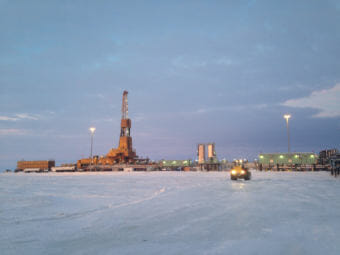
A ConocoPhillips drill site within the National Petroleum Reserve in Alaska in January 2017. (Photo by Elizabeth Harball/Alaska’s Energy Desk)

As he pitches a new North Slope liquefied natural gas project to investors, Mead Treadwell, the businessman and former Alaska lieutenant governor, is keenly aware of his project’s location.

Development in the Arctic is booming as the global climate warms and ice melts. But environmental opposition has come along with it, making some big banks more reticent about investing.

Barclays and Goldman Sachs, for example, have effectively ruled out investments in new Arctic oil and gas projects, after environmentalists raised concerns about impacts on ecosystems, indigenous people and the global climate.

Many other investors remain. But an aggressive advocacy campaign against their involvement in Arctic oil means that Treadwell’s company, Qilak LNG, and others like it face more obstacles to raise the cash they need.

Qilak has adapted to this new investment climate by playing up the fact that its LNG project would connect to infrastructure that already largely exists on the North Slope — not to new oil fields, which conservation groups say would extend the world’s dependence on climate-warming fossil fuels.

Qilak is also making the case that LNG often displaces dirty coal-fired power plants, though the environmental benefits of that change are disputed by some scientists. And it’s highlighting the jobs the project would create for indigenous residents of the North Slope and other areas of Alaska.

Mead Treadwell says he would draw from his business and government experience if he's elected governor. (Photo by Wesley Early/Alaska Public Media)
Mead Treadwell. (Photo by Wesley Early/Alaska Public Media)

“I still believe that we will have billions of dollars in annual investment in the Arctic. But I will say that we’re an easier target, because it’s easier to show up at an annual meeting in some place like London or Brussels wearing a polar bear suit — there’s not a similar symbol for Louisiana or Texas,” Treadwell said. “We definitely have to be aware of that, and make sure we’ve got a good story.”

Alaska’s economy is driven by the production of the fossil fuels that contribute to global warming, which makes the state especially vulnerable to the campaign to transition away from oil. And Alaska policymakers and oil executives say they’re getting increasingly concerned as advocates turn their focus to forcing big financial institutions out of the industry.

The movement has been targeting Arctic oil and gas projects in particular, with groups arguing that development in the area poses unique environmental and social risks. The release of Goldman Sachs’ new environmental policy in December — which said the bank would refuse to finance drilling in the Arctic National Wildlife Refuge and elsewhere in the Arctic — underscored the stakes for Alaska. But the campaign doesn’t end there.

Last month, 15 Democratic U.S. senators wrote to 11 more banks asking them to follow Goldman’s lead by “shifting toward a U.S. financial sector that effectively analyzes and plans for climate risks.”

A similar letter followed Thursday from more than two-dozen House Democrats. On Friday, environmental organizations touted a new policy released by a big British bank, Lloyds Bank, that rules out financing of oil and gas exploration and production in the Arctic, and in the Arctic Refuge in particular.

On Tuesday, megabank JPMorgan Chase was set to announce its own restrictions on investment in Arctic drilling.

Andy Mack DNR Commissioner
Former Alaska Natural Resources Commissioner Andy Mack at a press conference in Anchorage on June 28, 2016. (Photo by Graelyn Brashear/Alaska Public Media)

“One position by one large company I don’t think changes a lot,” said Andy Mack, a former Alaska natural resources commissioner who helped lead the state’s push to open the Arctic Refuge to drilling. “But if you see two or three or four large companies make these types of announcements, it’s certainly something that (oil) companies will all have to take into account. And that’s why the state needs to pay attention.”

Several big Arctic oil projects are still under development on Alaska’s North Slope. But there’s a growing acknowledgment among Alaska oil industry players that environmentalists’ lobbying of financial institutions is having an effect.

“‘Arctic’ seems to have turned into a four-letter word, in the minds of a lot of these financial institutions,” said an Alaska oil executive, who asked not to be named to avoid drawing attention to his particular company.

To understand the anti-Arctic campaign’s challenge to Alaska’s oil industry, residents can look to Alberta. There, financial institutions and major insurers have distanced themselves from projects in the province’s oil sands.

One reason environmental advocates have focused their opposition on Alberta is that historically, extraction from oil sands generated more greenhouse gases than conventional oil production.

Earlier this month, BlackRock, the world’s largest asset manager, announced it would exclude companies with oil sands projects from a fast-growing, sustainability-oriented fund that it runs.

In December, The Hartford, a major insurer, said it would stop investing in and insuring companies that generate a large share of their revenues from tar sands.

Alaskans who follow the oil industry have noticed.

“Alberta is the canary in the coal mine,” said Brad Keithley, a retired oil and gas attorney who closely watches Alaska politics.

Alberta’s premier, Jason Kenney, has responded forcefully, launching a $30 million “energy war room” to rebut criticism of Canada’s oil industry.

Gov. Mike Dunleavy, R-Alaska, speaks to reporters in the Capitol in Juneau, Jan. 31, 2020. (Photo by Andrew Kitchenman/KTOO and Alaska Public Media)
Gov. Mike Dunleavy speaks to reporters in the Capitol in Juneau, Jan. 31. (Photo by Andrew Kitchenman/KTOO and Alaska Public Media)

In Alaska, Gov. Mike Dunleavy reacted to Goldman Sachs’ announcement by firing the company from a group of Wall Street firms it had chosen to help the state borrow money. The decision could cost Goldman Sachs between $200,000 and $300,000 in compensation, state officials said.

In an interview, Dunleavy suggested another way to punish banks that refuse to invest in Alaska oil projects: cutting them off from managing the assets of the $67 billion, state-owned Alaska Permanent Fund, which was originally created with oil revenue. Goldman Sachs manages some $400 million for the fund, which paid the firm a total of $17 million in fees over the past three years.

“Some of these groups that don’t want to do business in Alaska still want Alaska business,” Dunleavy said. “They probably are going to come out a loser on that one.”

The Alaska Permanent Fund is run by an independent board. Earlier this month, Chair Craig Richards said board members were not interested in making its choices of investment managers subject to political considerations.

But Dunleavy said he thinks the subject will be unavoidable for the board.

Alaska Permanent Fund Chair Craig Richards at a state legislative committee hearing in June 2016, when he was the state’s attorney general. (Photo by Jeremy Hsieh/KTOO)

“I have to believe that the board members and those that are running the permanent fund have seen what some of these lending institutions have said about Alaska,” he said. “And I’m sure they’re having discussions in their boardroom as to how they should approach this.”

In Washington, D.C., the members of Alaska’s GOP Congressional delegation have sent their own letters to banking executives, asking them to disregard the Democratic lawmakers’ request that they avoid investing in the Arctic Refuge.

U.S. Sen. Dan Sullivan also dispatched personal letters to his Democratic colleagues saying he was disappointed that they didn’t discuss the issue with him directly before writing to financial institutions.

“I can tell you for a fact I have never signed on to a letter that would specifically target investment opportunities in another colleague’s state, to shut that down,” U.S. Sen. Lisa Murkowski said in an interview.

Sen. Lisa Murkowski at a Senate committee hearing. (Photo by Liz Ruskin/Alaska Public Media)

She and other Alaska politicians note that there’s support for continuing Arctic oil development among the North Slope’s indigenous Iñupiat leaders. The North Slope Borough’s mayor, Harry Brower, wrote his own opinion piece in the Wall Street Journal criticizing Goldman Sachs’ new investment policy — he called it “subtly racist,” and argued that blocking drilling would have the effect of denying modern amenities to the region’s isolated villages.

Representatives of the groups fighting Arctic oil development say their biggest focus is investment in projects in the Arctic National Wildlife Refuge — not as much on Alaska projects more broadly. And they note that their advocacy campaign around the Arctic Refuge is aligned with the Gwich’in, a different indigenous group that opposes development there because of risks to the caribou that they subsist on.

“The community has specifically been a part of the advocacy work, saying they do not want the continued drilling,” Ruth Breech, who organizes corporate accountability campaigns for the Rainforest Action Network, said in an interview. “But I do agree that there is a broader piece around Arctic oil, and there could be more engagement and discussions about what that means for the different impacts on the communities throughout Alaska.”

Keithley, the retired attorney, said there’s a new argument that Alaska leaders could use to make their case to financial institutions: The state’s oil industry uses comparatively little energy to produce its fossil fuels, according to a newly-presented analysis from the Climate Leadership Council, an international group pushing a carbon fee and dividend program as a way to reduce emissions.

Officials from the council visited Anchorage this month and told a policy group that producing oil in the state is “really carbon cheap” compared to other major oil-producing regions, the Alaska Journal of Commerce reported. That’s in part because of Alaska’s restrictions on flaring natural gas and the industry’s “consolidated and efficient infrastructure” in the state, spokesperson Carlton Carroll said in an email.

The group hasn’t released details of its analysis yet, saying it’s not complete. But if its calculations are accurate, Keithley said, Alaska’s carbon advantage is a “story that’s not being well-told.”

“And it’s a story that needs to get out there,” he said.

Those who are working to push financial institutions out of the oil industry, meanwhile, argue that Alaska’s political leaders should be doing more to prepare the state for an economic future that’s less dependent on fossil fuels.

“There’s an opportunity to plan ahead,” said Breech. “That’s why the leadership is important now.”


Alaska representative for North Slope and Northwest Arctic says he’s not running for reelection

Rep. John Lincoln, D-Kotzebue, takes an oath during his swearing-in ceremony in the Alaska House of Representatives on Jan. 31, 2018.
Rep. John Lincoln, I-Kotzebue, takes an oath during his swearing-in ceremony in the Alaska House of Representatives on Jan. 31, 2018. On Thursday, Lincoln announced via Facebook that he would not seek reelection. (Photo by Skip Gray/KTOO)

The Alaska representative who represents the Northwest Arctic and North Slope boroughs says he will not run for reelection.

In a Facebook post, John Lincoln, an independent from Kotzebue, wrote, “I’m at a stage in life – as a husband and father of young children – that makes it extremely important for me to be present and to provide for my family.”

https://www.facebook.com/RepJohnLincoln/posts/2909052379155316

He said he plans to return to work for NANA Regional Corp. after his term ends.

Lincoln has served in the Alaska House of Representatives since 2018, when he was appointed to replace Dean Westlake of Kiana. Westlake resigned after multiple sexual harassment allegations were made against him from legislative aides and other women.

Initially a Democrat, Lincoln dropped his party affiliation late last year. He serves in the bipartisan House Majority, and is co-chair of the House Resources Committee.

So far, Ely Cyrus of Kiana is currently the only person who has filed to run for House seat 40.

The deadline to file to run for Lincoln’s seat in June 1, 2020.

Alaska regulators say they need more time to weigh Hilcorp’s request to keep its finances confidential

Regulatory Commission of Alaska Chair Robert Pickett at a February meeting in downtown Anchorage about the proposed BP-Hilcorp deal. (Photo by Tegan Hanlon/Alaska Public Media)

The state regulatory commission overseeing a major part of Hilcorp’s proposal to purchase BP’s entire Alaska business says it needs more time to weigh Hilcorp’s request to keep its finances confidential. It’s the second delay this year.

In the order issued Tuesday, the Regulatory Commission of Alaska said it will extend its deadline to March 12 to decide on Hilcorp’s request to shield its financial statements from public view. It’s asking the private oil company for more information.

Meanwhile, the RCA also granted a less-controversial request from Hilcorp and BP: The companies’ purchase and sale agreement for BP’s pipeline assets will remain confidential during the commission’s review process.

The RCA is charged with overseeing the portion of the pending $5.6 billion deal that includes BP’s stakes in the trans-Alaska pipeline. The oil companies announced the sale in August. It’s one of the state’s largest oil industry deals, and needs to clear several regulatory hurdles.

In RCA filings, BP and Hilcorp are arguing that the public release of their financial information during the commission’s review process would damage their businesses and give their competitors an unfair advantage.

In public comments, however, some Alaskans have demanded financial transparency from Hilcorp. They say they want assurance that the company has the resources to operate the assets it wants to buy, and also that it has the money to respond to any costly oil spills.

The RCA, in its order Tuesday, said that the argument made by Hilcorp and BP in support of their requests for confidentiality of their financial information isn’t as strong as their argument about the purchase and sale agreement.

The commission is asking Hilcorp and BP to file an explanation of the specific harm that would result from the disclosure of the financial statements they’ve already submitted to the commission. It also wants to know whether any of the financial records must be filed with a federal agency.


‘We will rebuild’: Kaktovik prioritizes getting kids back to class following school fire

Smoke fills the air in the North Slope village of Kaktovik. A fire destroyed much of the community’s only school on Feb. 7. (Photo courtesy of Amanda Kaleak)

The village of Kaktovik is still clearing the rubble after a Friday morning fire destroyed much of the only school in town. The community plans to rebuild the school, but the timeline is still unknown.

Kaktovik Mayor Amanda Kaleak said the first priority is restoring a sense of normalcy for the students as they resume school.

“We have a five-plex that we’re going to be using for classrooms,” she said. “Just getting everything to where the kids don’t have to fall back, and so we don’t have to extend the school year any longer.”

Kaleak said the city hopes to get kids back into classes next week.

Currently, the city building’s internet bandwidth isn’t set up to accommodate the needs of the students, so that is something Kaleak said is being worked on. Additionally, the building will need more power to adjust to the students.

Kaleak said the North Slope Borough met with Kaktovik officials over the weekend to discuss the long-term plans for replacing the school. While the building was insured, she said, the borough doesn’t yet know how long it will take to build a new school.

“There’s still all that rubble and all the frames and stuff of what was once our new gym and our school that are still there,” Kaleak said. “We still have the fire marshal here investigating. So after they have that all turned over, then we will be able to demo all that and go from there.”

“We will rebuild,” Kaleak continued. “That’s our plan. Everyone’s in high hopes.”

Kaleak said the students and the community are still in shock over the loss of the school. She said about 20 students were away at a basketball tournament in the village of Atqasuk when the fire started last week. They returned home to a huge loss.

“We had all our banners from every award that we ever won, from the ’70s and ’80s, all the trophies,” Kaleak said. “All those memories. It’s kinda hard to think about it.”

When they do end up rebuilding the school, staff will be able to decorate with the sportsmanship trophies the boys and girls won during their weekend tournament.


Conoco shelves proposal to build a temporary island after criticisms from North Slope

An aerial view of one of the exploration pads and wells that ConocoPhillips drilled during the 2018 exploration season at its Willow prospect. (Photo courtesy of Judy Patrick Photography/ConocoPhillips Alaska)

ConocoPhillips has made a big change to its development plans for its massive oil discovery on Alaska’s western North Slope.

Instead of building an entire, temporary island as a staging area to move its infrastructure to the remote Willow site, the oil company has abandoned that plan and now proposes to rely more heavily on ice roads.

The change is in response to criticism from North Slope residents and groups, including those in the small, Arctic village of Nuiqsut, who opposed construction of the island, according to Connor Dunn, Conoco’s development manager for the Willow project. They were worried about pollution and impacts to subsistence activities and wildlife.

“We wanted to take those concerns seriously and took the opportunity to try and find a way to get the support of the community for a different option to bring these modules to the North Slope,” Dunn said.

The pivot demonstrates the influence that the North Slope’s indigenous people and groups can exercise over multi-billion-dollar oil companies like Conoco. In the past 15 years, the company has also changed its plans for bridge construction and power generation in response to local feedback.

The decision on Willow comes in the middle of the U.S. Bureau of Land Management’s environmental analysis of the proposed project. It’s significant enough to prompt BLM to push back its final decision on the project, the agency announced last month.

“This is very indicative of how public comments can help shape best decisions,” said Lesli Ellis-Wouters, a spokesperson with BLM in Alaska.

The Willow prospect is located in the National Petroleum Reserve in Alaska and, if built, would be the North Slope’s westernmost oil field. And that lends itself to unique logistical challenges. At the center: How to transport the giant pieces of the facility needed to process the oil that will come from the new field.

Conoco’s original island pitch

For the first time in about two decades, Conoco wants to send an oil processing facility to the North Slope, Dunn said.

Dunn is leading the effort to move the Willow project from an oil find to an oil producing field.

A processing facility filters out sand and other unwanted materials from crude oil before it’s sent down the trans-Alaska pipeline. It also handles water and natural gas.

Dunn said Willow wouldn’t be able to use an already-existing processing facility because of its size and location

“We haven’t had anything as big as this really in about 20 years,” Dunn said.

At its peak, Conoco says, Willow could produce more than 100,000 barrels of oil a day. That’s compared to the roughly 500,000 barrels a day that currently flow down the whole trans-Alaska pipeline.

Dunn said the prefabricated pieces of a processing facility can weigh more than 3,000 tons. That’s like hauling more than two dozen large bulldozers.

The pieces are too heavy to drive them up the Dalton Highway to the North Slope, Dunn said. So Conoco needs to send the pieces by sea.

“The plan is that we’ll barge those up to the North Slope and offload them,” Dunn said. “And then the complex aspect is: How do we get them to this relatively remote location of Willow?”

At first, Conoco proposed building the temporary island out of gravel in the shallow waters of Harrison Bay, off the coast of the petroleum reserve. It would have measured about 13 acres — or roughly ten football fields.

The company said in the summer, when sea ice receded from shore, barges would carry the pieces of the processing facility to the island. And in the winter, the company would move the pieces to Willow by ice road.

Conoco said once it was done with the island, it would slowly wash away.

A pivot to roads

But, not everyone liked that plan.

Gordon Brower, a top land management official with the North Slope Borough, said the borough had concerns about the island’s impact on subsistence activities, including fishing.

He also said he didn’t think it made sense to use so much gravel for a temporary island. North Slope communities need gravel for roads and other projects, and it’s not an abundant resource in the region, he said.

“You really don’t want to waste any of it and allow nature to reclaim it,” he said. “You want to use it in a way that’s beneficial and I think that’s our approach.”

The tribal and city governments of the nearby village of Nuiqsut also raised concerns about the island, as did the usually pro-development Arctic Slope Regional Corporation (ASRC).

In a letter, ASRC told the federal government there was firm local opposition to the proposed island. It said community members had raised “valid concerns the gravel island would cause sedimentation of subsistence use areas and pollution from the sandbags used to secure the island in place.”

Environmental groups criticized the proposal too.

Andrew Hartsig, the Ocean Conservancy’s Arctic program director, said the proposed island would have had substantial impacts. The area is “a hotspot for marine birds,” he said. “And it’s also important feeding and denning habitat for polar bears.”

After a series of meetings with North Slope residents and other public comments, Conoco decided to shift directions, Dunn said.

That’s where more ice roads come in.

Conoco is now proposing to barge the pieces of the oil processing plant to an existing dock farther east on the North Slope. It would then move them along about 90 miles of gravel and ice roads to Willow.

Dunn said the drive would take weeks, but he doesn’t expect it to impact the project’s overall timeline.

So far, Dunn said, Conoco is hearing positive responses to the change.

“I think it’s a good call in, maybe, just responsible planning,” Brower said.

The revised proposal would use less gravel and reduce the amount of mining activity, according to Conoco.

North Slope residents and environmental groups, however, have also raised other concerns with Willow, apart from the island. Those include the project’s potential impacts to air quality, caribou and hunting.

BLM expects to release the supplement to its draft environmental analysis on the proposed Willow project this spring. It will also open a new public comment period.

Conoco estimates first oil production from Willow by late 2025 or early 2026.


Fire in North Slope village of Kaktovik engulfs school overnight

A fire engulfs the school in the North Slope village of Kaktovik on Feb. 7. (Photo courtesy of Melvin Jack Kayotuk)

The school in the North Slope village of Kaktovik is a “total loss” after a fire burned Thursday night into early Friday morning, according to local officials.

North Slope Borough Mayor Harry Brower Jr. said there were no injuries to report. He said the weather, which dipped to -35 degrees, made fighting the fire difficult for first responders. Western winds between 16-18 mph had hit the community all morning.

Kaktovik resident Wayne Kayotuk said he brought his son to the gymnasium at the Harold Kaveolook School on Thursday night.

“When I brought my son there and let him play, I could smell something in the air,” said Kayotuk. “But I thought it was just smoke from the landfill burning.”

That was around 6 p.m. By around 8 p.m., Kayotuk said the building was on fire. By midnight, it was engulfed.

In a Facebook message posted at about 3:30 a.m., the North Slope Borough School District wrote that everyone had been evacuated from the school and fire departments were trying to contain the fire.

According to Kaktovik City Clerk Katheryn Aishanna, officials had a heater going at the school to thaw frozen pipes, and the heater ignited a fire. She wrote that Kaktovik Mayor Amanda Kaleak says the school is a “total loss.”

Local residents posted video and photos of the fire, showing tall, bright-orange flames across the dark early morning sky.

https://www.facebook.com/melvin.kayotuk/videos/1840980236032488/

https://twitter.com/katzyn/status/1225766422179020800

The school was a gathering place for the 250-person village, and it was connected to a recently-opened $16 million basketball gymnasium.

“We lost a community place,” said Kaktovik resident Marie Rexford. “It’s where everyone goes to for their gym nights. What are they going to do now? What are the kids going to do now? What is the community going to do now?”

She said the whole town is feeling immense sorrow.

“A lot of the community members are crying,” Rexford said by phone. “Our kids got no more school. How long is it going to take to build our school?”

Kaktovik is the easternmost village in the North Slope Borough, about 50 miles north of the Brooks Range. It’s the only village within the boundaries of the Arctic National Wildlife Refuge.

Reporter Nat Herz with Alaska’s Energy Desk contributed reporting from Anchorage.

This story has been updated.

Site notifications
Update notification options
Subscribe to notifications