North Slope

On warming North Slope, one flood response last year cost pipeline operator $10M

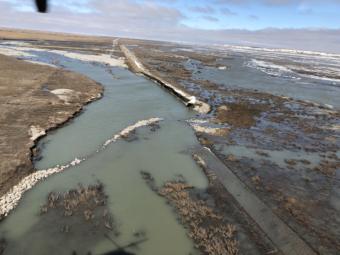
This photo shows damage along the trans-Alaska pipeline corridor during a spring 2019 flood of the Sagavanirktok River on the North Slope. (Photo courtesy Alyeska Pipeline Service Co.)

As winter turned toward spring last year, a potential problem popped up about 25 miles into the trans-Alaska pipeline’s 800-mile route, where it sits alongside the Sagavanirktok River on the North Slope.

The company that runs the pipeline, Alyeska Pipeline Service Co., notified the Alaska Department of Natural Resources.

“They saw the ice was building up and it looked like it was going to go over the top of their flood control structures,” said Tony Strupulis, DNR’s state pipeline coordinator.

The ensuing flood cost more than $10 million to fix; the damage is still being repaired. And as the North Slope has become wetter and warmer, its rivers have been running at record high levels.

Scientists say they expect those types of trends to continue as Alaska’s climate changes. But they also say there’s still some uncertainty around some of the data on snow and rainfall, and they add that the degree to which climate change will affect the pipeline is still not clear.

“I don’t know the near-term future or long-term future. But the effort to maintain the pipeline will have to improve — they’ll have to spend money to protect it,” said Horacio Toniolo, a civil engineering professor at University of Alaska Fairbanks who’s studied the Sagavanirktok River.

The pipeline system is a robust piece of infrastructure. Adjusting for inflation, it cost $35 billion to build, and the damaged stretch was mostly buried underground. But there’s an unavoidable threat that runs alongside it on the broad, flat area of the North Slope south of Prudhoe Bay: the Sagavanirktok, or Sag River.

Last spring, the river’s normal channel filled up with something called aufeis — basically sheets of layered ice that divert its normal flow. The aufeis, plus an unusually warm spring and quick melt, sent the Sag River toward the pipeline, eroding away Alyeska’s protective barriers.

“It was a pretty broad swath, a new channel that came in and actually scoured away enough material so that there was a section of pipe that was uncovered,” Betsy Haines, Alyeska’s senior vice president for operations and maintenance, said in a phone interview.

The erosion exposed about 90 feet of pipe to the river’s flow — a serious problem that increases the risk of a puncture or spill, though that didn’t happen in this case. Repairing the damage and building taller barriers will cost Alyeska between $10 million and $15 million, Haines said.

The event comes as the North Slope is undergoing some major changes connected to global warming. The region has seen a temperature increase in the past half-century of more than 6 F — by far the largest of anywhere in Alaska.


Map with temperature trends across the state over 50 years
(Graphic courtesy of the Alaska Center for Climate Assessment and Policy)

Precipitation rose by 10 percent over the same period, and scientists expect those trends to continue. But Haines said Alyeska hasn’t observed effects on the pipeline that will force big-picture changes in the way the company handles the risk posed by the Sag River. And she added that the pipeline’s design for resisting floods was solid.

“Might we change it in the future? (We) might,” she said. “But it would go back to collecting the data, working it across the different industries and educational institutions, and really trying to draw through that analysis things that can be a little bit more substantiated or predictable.”

She added: “We don’t call it climate change or global warming. What we’re dealing with are hard facts, and from an engineering perspective, trying to understand those.”

Alyeska doesn’t deny that climate change is happening, and Haines said the company — owned by BP, ExxonMobil, ConocoPhillips and UnoCal — has, over the past few years, put more effort into understanding what’s happening with the permafrost under areas of the pipeline. But she said it’s still too early to draw any conclusions.

The average flow in the Sag River, meanwhile, has been increasing. And the past two years were its highest on record.

(Graphic courtesy of U.S. Geological Survey)

But because there have long been large year-to-year swings in rain and snow on the North Slope, scientists say the recent increases aren’t enough to establish a “statistically significant” trend. The change could still be just random variation, said Rick Thoman, a climatologist at the Alaska Center for Climate Assessment and Policy.

“For temperatures, by any measure, those have increased beyond all doubt,” Thoman said. For precipitation, he added, “the noise, if you will, is large — much larger than with temperature. So, it takes a much stronger trend or over a much longer period of time.”

Flooding from the Sag River has caused damage in other spots along the pipeline corridor in recent years — most notably in 2015, when it forced the closure of the Dalton Highway used to haul supplies to the North Slope’s oil fields. The damage, according to reports at the time, stemmed from heavy rains the previous summer, a deep winter freeze and rapid spring thaw with record temperatures.

Research led by a scientist at the American Association for the Advancement of Science predicts climate change could cause more than $5 billion in damage to Alaska infrastructure.

Alyeska, which ships the fossil fuels that scientists say are the main driver of global warming, does not have a position on policy measures that could reduce carbon emissions, like the Paris climate agreement, Haines said.

An Anchorage attorney made a fortune fighting Big Oil in Alaska court. Now he’s funding the campaign to raise their taxes.

Anchorage attorney Robin Brena sits at a meeting of the citizens initiative campaign to raise taxes on Alaska’s largest oil producers on Thursday, January 16, 2020. (Photo by Nat Herz / Alaska’s Energy Desk)

Robin Brena made a fortune as an attorney fighting Alaska’s biggest oil companies. But for nearly three decades, he largely stayed away from politics, investing money in his commercial real estate business instead.

Then, in 2013, the Legislature passed an industry-supported rewrite of Alaska’s oil tax laws – with help from the votes of two senators employed by ConocoPhillips.

A year later, opponents of the measure tried to repeal the bill at the polls through a referendum, but they lost the public vote to a multi-million dollar, industry-backed campaign.

Brena, 64, supported the repeal effort and since then has donated hundreds of thousands of dollars to like-minded political candidates, in hopes of getting what he describes as Alaska’s “fair share” in production taxes from the state’s largest oil-fields.

But that effort has so far failed to produce a tax overhaul, and a frustrated Brena is now chairing a citizens initiative to raise oil taxes. He’s also the effort’s top funder, contributing more than $100,000 so far.

“All you need for something bad to happen is the people that know better remain silent,” Brena said in an interview at his law office, inside a building owned by his real estate firm. “I’m an Alaskan first and foremost, and I’m going to stand up for Alaska. And I want to be sure that Alaska gets a fair deal for their oil.”

The initiative targets some of Alaska’s oldest and largest oil fields, and it would levy what Brena’s side estimates as an additional $1 billion in taxes on the state’s biggest producers: BP, ConocoPhillips and ExxonMobil.

Brena has made a career of battling those same companies in court.

Robin Brena’s company, RSD Properties, owns Brena’s law offices near downtown Anchorage. (Photo by Nat Herz / Alaska’s Energy Desk)

In some of those cases, Brena represented the public, working for Alaska municipalities that were seeking more property tax revenue from the companies, which are the primary owners of the trans-Alaska pipeline.

But in other cases, Brena’s clients were actually oil companies. Among them was Tesoro, the large, independent oil refiner that was disputing fees the pipeline owners charged to ship crude from the North Slope to the port of Valdez, 800 miles away.

Between just those two areas of work, Brena won hundreds of millions of dollars from the owner companies for his clients. And his legal victories, according to friends, were also worth millions of dollars to Brena himself.

Now, Brena is taking that money and putting it into a fight against those same oil companies — this time at the ballot box.

“I believe Alaskans don’t know all the details perhaps, because they can’t be known,” Brena said. “Because we’re treated like mushrooms – you know, we’re kept in a dark room, and we’re fed cow manure.”

Brena’s work has won him praise from his clients, but it has not endeared him to the major players in Alaska’s oil industry.

Officials and attorneys currently working with those companies did not want to speak publicly about him. But Dick Rabinow, a former president of ExxonMobil’s pipeline company, described Brena as a persistent thorn in the industry’s side.

“It was pain, to deal with him,” Rabinow, who’s retired from the pipeline company, said in a phone interview from Houston.

Rabinow didn’t work with Brena directly. But he was familiar with his work, which directly affected ExxonMobil and the other companies.

The legal fights in Alaska that Brena was involved in extended over many years and an array of cases, which Rabinow said was different from the rest of the country. Arrangements between companies and landowners in the Lower 48 were more stable, Rabinow said.

In Alaska, “you think you’ve spent a lot of time and money to work something out,” Rabinow said. “And next year and the year after and the year after, people are coming back at you. It’s very frustrating, and it costs money.”

Brena, for his part, relished the opportunity to take on the major oil companies and their teams of lawyers in court. Many of the industry attorneys he litigated against were specialists from the Lower 48, and he described his experience as like “a farm boy given the chance to compete in the NBA.”

Brena grew up in the tiny Southeast Alaska gold rush town of Skagway, where his father ran a bar called the Pack Train Inn.

His father died when Brena was 12, and Brena worked on the White Pass & Yukon Railway to support his family, he said. The railroad was one of the town’s major industries, moving ore from mines in Canada to Skagway’s port.

“I started when I was 17, in high school, working as a janitor in the roundhouse,” he said. “If there’s a job on the railroad, I’ve done it.”

After high school, many of Brena’s friends worked construction on Alaska’s oil pipeline. Brena went to college, then spent a decade accumulating graduate degrees: a master’s of business and finance, a law degree and a master’s of real estate and finance law.

Then he started work as an attorney back in Alaska, and by the mid-1980s was working on complicated oil and gas litigation.

Ultimately, Brena got involved in a series of big cases against Alaska’s major oil companies, with proceedings before the Regulatory Commission of Alaska, state courts and the Federal Energy Regulatory Commission.

As an attorney for the Fairbanks North Star Borough and the City of Valdez, Brena argued that the value of the pipeline, for property tax purposes, was billions of dollars more than its owners asserted. In one of a set of cases, a Superior Court judge set the pipeline’s value at $10 billion, more than 10 times the $850 million that the companies had asserted. The Alaska Supreme Court upheld the ruling.

In another set of cases, working for Tesoro, Brena successfully argued that the pipeline’s owners had charged “unjust, unreasonable” rates to ship oil from the North Slope to Valdez.

“When it comes to pipeline rate cases, there’s probably not a better lawyer on the planet than Robin Brena,” said Alaska Attorney General Kevin Clarkson, a former law partner of Brena’s. “The owners of the pipeline — those companies hired the best they could find, across the country, and they brought them to Alaska to litigate against Robin Brena. And he beat them every time.”

Those cases helped Brena build his real estate company, RSD Properties. The “R” is for Robin; the “S” and “D” are for the names of his children. All three letters are bolted to his law offices, as well as the downtown Anchorage building that houses the oil tax initiative’s headquarters.

RSD owns nine office buildings in Anchorage, and it’s now developing what’s called a “co-working” business, a type of shared workspace.

Over the past decade, though, Brena has also become increasingly involved in Alaska politics.

He’s contributed roughly $500,000 to state-level candidates and causes since 2012, according to public records. He was a major financial supporter of former independent Gov. Bill Walker. And after Walker, also an attorney, was elected governor in 2014, Brena bought Walker’s law firm.

Last year, after losing his re-election bid, Walker became a partner at Brena’s firm.

Brena and his friends describe the 2013 passage of Senate Bill 21 – the last major rewrite of Alaska’s oil tax regime – as a galvanizing moment. The bill passed the Legislature with votes from Republican state Sens. Peter Micciche of Soldotna and Kevin Meyer of Anchorage, both of whom worked for ConocoPhillips. Meyer is now lieutenant governor.

Brena calls the legislation a “giveaway,” and he said he was particularly frustrated by the millions of dollars that oil companies spent fighting the repeal campaign. The state’s current oil tax structure, he argues, doesn’t bring in enough money to sustain what he calls a “modern Alaska.”

Nonetheless, Brena says he’s pro-oil and pro-development, arguing that his work for Tesoro boosted the value of Alaska’s petroleum by reducing the fees charged by the pipeline owners for the shipment of oil.

Critics argue that Brena’s campaign ignores the downsides of higher taxes. Jason Grenn, a former Anchorage independent representative, said the oil tax initiative overlooks the risk of lower oil company investment, less oil production and fewer jobs.

“It’s painting a really great picture,” Grenn said. “But in six or seven years, if we have more job loss, more property taxes gone, that will hurt worse than any gains that will be brought through.”

Brena described himself as a counterweight to those arguments, which he’s worried will otherwise go unchallenged.

He wouldn’t say exactly how much he’ll ultimately spend on the initiative, in the face of what will likely be a multi-million dollar opposition campaign from Alaska’s major oil producers. Instead, he offered a hint: “My personal commitment to Alaskans is I’m going to do everything I can to give you a choice about your own future.”

Agency overseeing BP-Hilcorp deal will hold public hearing, denying companies’ request

An above-ground section of the Trans-Alaska Pipeline System near the Toolik Lake Research Station in the North Slope Borough. (Photo by Rashah McChesney/Alaska's Energy Desk)
An above-ground section of the Trans-Alaska Pipeline System near the Toolik Field Station in the North Slope Borough. (Photo by Rashah McChesney/Alaska’s Energy Desk)

The Regulatory Commission of Alaska, which is overseeing Hilcorp’s purchase of BP’s stake in the trans-Alaska pipeline, plans to hold a six-hour public hearing on the deal in February, denying a request by the companies to approve the transaction without one.

The commission announced the hearing Jan. 17, saying it had received public comments both supporting the deal, and registering concerns.

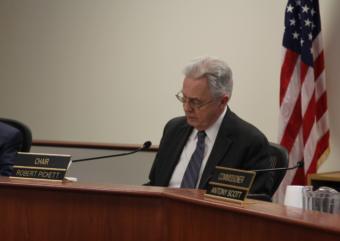
The hearing, scheduled for 3 p.m. Feb. 4 in downtown Anchorage, will “allow additional comment on the applications,” the RCA said in a one-page notice, signed by Chairman Robert Pickett.

BP and Hilcorp, in a written filing last month, had asked the RCA to approve the deal without holding a public hearing. The companies cited concerns about delays and said that the agency had not held hearings while scrutinizing other “major transactions.”

A BP spokeswoman, Meg Baldino, declined to comment. Hilcorp officials didn’t immediately respond to a request for comment.

RelatedAlaska utility regulators ask Hilcorp, BP for more details on $5.6B deal

Legislative group recommends clarifying village public safety officer role

Thirteen officers graduated from Rural Law Enforcement Training at Yuut Elitnaurviat in Bethel on June 14, 2019.
Thirteen officers graduated from Rural Law Enforcement Training at Yuut Elitnaurviat in Bethel on June 14, 2019. (Photo by Katie Basile/KYUK)

In 2019, U.S. Attorney General William Barr declared a public law enforcement emergency for rural Alaska after his visit to the state. Alaska lawmakers then formed a working group to fix the Village Public Safety Officer program, a key state service which has battled budget cuts, high turnover and an evolving job description.

Now the working group has come up with a list of recommendations that lawmakers hope will solve some of the issues with the program.

First on the list is to revise the state statute that details what the Village Public Safety Officer program is supposed to do.

Rep. Chuck Kopp, an Anchorage Republican who co-chairs the working group, said the program was supposed to help with wildlife management and search-and-rescue efforts.

Rep. Chuck Kopp, R-Anchorage, speaks during a House floor session, March 11, 2019. (Photo by Skip Gray/360 North)

“It had much less emphasis on law enforcement — you know, keeping the law, apprehending violators and keeping people safe. But then the program kind of just dramatically evolved,” Kopp said.

According to Kopp, the program’s evolution is not reflected in the state statute. He said that the feedback that the working group received suggests that revising it will make it easier to fix other problems in the VPSO program, like funding and the lack of flexibility for VPSOs to cover other communities in addition to the ones they are assigned.

Kopp said it could also help with high turnover rates.

“The way the program is structured, there is no real flexibility for the people who are the boots on the ground,” Kopp said.

VPSOs are usually the only law enforcement in a remote community, and are first to act during an emergency. It can take hours and sometimes days for an Alaska State Trooper to get to a community, usually because of weather.

But there are roughly 40 VPSOs covering the entire state of Alaska, leaving many communities without any kind of law enforcement. Only four VPSOs are currently based in four communities the Yukon-Kuskokwim Delta, according to Azara Mohammadi, the director of communications for the Association of Village Council Presidents. AVCP compacts with 56 tribes for services, like the VPSO program.

But AVCP is working to hire more. Mohammadi said they have one application currently in the hiring process and eight more applications waiting to be reviewed.

Since August, the working group has held eight meetings — usually listening sessions around the state to gather feedback, including the one in Anchorage this week.

Among the feedback is the need to create more flexibility with funding for the nine nonprofits and one borough that oversee VPSO programs throughout the state.

Sen. Donny Olson, D-Golovin, speaks during a Senate floor session in Juneau on March 13, 2019.
Sen. Donny Olson, D-Golovin, speaks during a Senate floor session in Juneau on March 13, 2019. (Photo by Skip Gray/360 North)

The working group also wants to establish a formal government-to-government consultation process at the state level that would consult tribes before any changes are made to training or regulation. The Alaska Department of Public Safety will continue to advise and train VPSOs.

Sen. Donny Olson, D-Golovin, also co-chairs the working group. He hopes that this time, with this list of recommendations, the solutions will be permanent.

“In the next five to 10 years, I don’t want to hear these same issues coming back at me,” Olson said. “And I plan to be here.”

The working group plans to finalize the recommendations by the end of the month. Kopp said they will focus on revising the statute during the 2020 legislative session, which starts on Jan. 21 in Juneau.

Federal judge rejects North Slope tribe’s challenge to Conoco drilling program

Nuiqsut in June 2018. The village is near a growing number of oil developments in the western Arctic.
Nuiqsut in June 2018. The village is near a growing number of oil developments in the western Arctic. (Photo by Elizabeth Harball/Alaska’s Energy Desk)

U.S. District Court Judge Sharon Gleason has rejected a legal challenge to the Trump administration’s approval of oil drilling and other industrial activity near Nuiqsut.

The North Slope village sits at the eastern edge of the National Petroleum Reserve in Alaska, and it’s become increasingly surrounded by oil development.

The local Alaska Native village corporation, Kuukpik Corp., has negotiated deals with oil companies, and residents have been rewarded with cash payments and cheap natural gas for heating. But some residents say that they have growing concerns about the oil industry’s impacts on subsistence wildlife and air quality.

In March, Nuiqsut’s tribal government joined with five national environmental groups to sue the Bureau of Land Management. They alleged that the agency failed to perform an adequate environmental review of ConocoPhillips’ exploration work that was authorized for the previous winter, which included drilling at up to eight sites, building 100 miles of ice roads and snow trails, creating 23 ice pads and an airstrip and installing temporary housing

Gleason upheld the environmental review in a 73-page decision released Thursday. She ruled that the review did not violate the National Environmental Policy Act or the Alaska National Interest Lands Conservation Act, as the tribal government and environmental groups alleged.

BLM spokesperson Eric Tausch declined to comment. The tribal government’s administrator and ConocoPhillips officials did not immediately respond to requests for comment.

Opening the Arctic Refuge brought Alaska’s largest Native corporation $22.5M from BP and Chevron

Arctic Slope Regional Corp. leaders and supporters held a press conference outside an Anchorage public meeting on oil leasing in the Arctic National Wildlife Refuge on Feb. 11, 2019. (Photo by Elizabeth Harball/Alaska’s Energy Desk)

The Alaska Native regional corporation for the North Slope collected $22.5 million from a pair of oil companies after Congress opened the Arctic National Wildlife Refuge’s coastal plain to drilling in 2017, according to corporate documents.

Arctic Slope Regional Corp., whose 13,000 Alaska Native shareholders own the oil rights to 140 square miles along the coastal plain, has long been one of the most aggressive advocates for opening the refuge to oil development. The payment, referenced in ASRC’s latest annual report, underscores just how much the corporation had to gain from the congressional action. It stands to benefit further if the oil companies, BP and Chevron, ultimately find and produce petroleum on its property.

ASRC’s 92,000 acres, along with the 1.6 million acres of federal lands in the coastal plain, were all off-limits to drilling until late 2017, when Congress passed the tax overhaul that opened the area to development. ASRC previously confirmed that a payment had been made under an existing, decades-old lease agreement with the oil companies, but it declined to reveal the amount.

ASRC is the largest Alaska-owned business, with annual revenues exceeding $3 billion and more than 15,000 employees inside and outside the state.

The corporation is heavily invested in oil and gas, with its own refineries and an oil-field services business; it also collects royalties from oil production on some of its lands outside the Arctic Refuge.

Those holdings have proven valuable to its owners: ASRC’s most recent annual dividend was $7,000 for each shareholder with the standard 100 shares. But the corporation’s pro-development position has recently caused tensions with other Alaska Native groups, whose members say they’re threatened by global warming. And ASRC recently withdrew its membership from the Alaska Federation of Natives.

ASRC spokesperson Ty Hardt declined to comment on the payment from the two oil companies. A Chevron spokesperson, Veronica Flores-Paniagua, and a BP spokesperson, Meg Baldino, each confirmed that the payment had been made, but declined to comment further. Officials at Hilcorp, which is acquiring BP’s stake in the Arctic Refuge lease in a pending business deal, declined to comment.

ASRC’s shareholders are descendants of the Iñupiat people who originally inhabited the North Slope, and the corporation acquired roughly 5 million acres of land through the 1971 Alaska Native Claims Settlement Act. The act granted a dozen Alaska Native regional corporations a total of $960 million and 44 million acres, or a little more than 10% of the state’s total area. In exchange, Alaska Native groups set aside their aboriginal land claims, which had delayed construction of the trans-Alaska oil pipeline.

When the act passed, ASRC was barred from claiming potentially valuable oil-bearing lands in the Arctic Refuge and the National Petroleum Reserve in Alaska, because those areas had already been set aside by the federal government. But a decade later, ASRC struck a deal with President Ronald Reagan’s administration to trade 101,000 acres of the corporation’s land within Gates of the Arctic National Park for 92,000 acres of subsurface rights within the refuge — around the village of Kaktovik.

The land trade set the stage for a 1984 lease between ASRC, BP and Chevron, and it also gave them the right to drill the only exploratory test well ever placed in the Arctic Refuge. The results from the well are still one of the oil industry’s most tightly-guarded secrets, though a New York Times report last year suggested that they were not promising.

After the well was drilled, both the corporate and federal lands along the coastal plain remained closed to actual oil production until Congress’ 2017 vote. ASRC had allowed Chevron and BP to suspend their lease payments while the closure remained in place, said Teresa Imm, an ASRC resource development executive, in an interview last year.

ASRC was a major participant in the lobbying campaign to open the refuge to oil development, nearly doubling its federal lobbyist spending in 2017 to $590,000, according to figures compiled by the Center for American Progress, a Washington, D.C.-based liberal advocacy group.

ASRC’s lands along the coastal plain are far from existing oil infrastructure, meaning development there could still be decades away. But drilling opponents are already questioning how the ASRC-controlled area fits into the Trump administration’s plans to open the refuge’s federal lands to development, and they want to know what environmental safeguards will apply.

“ASRC lands potentially being open to oil and gas is a major change in private land use that must be clearly addressed,” a coalition of more than two dozen opponents wrote in a March comment letter to the Bureau of Land Management, which is leading the environmental review in advance of drilling in the refuge. The groups added: “BLM must be clear on this point.”

BLM officials pointed to the agency’s written response to the letter, which was published as part of a 2,100-page document that addressed the thousands of unique public comments on the Trump administration’s draft environmental review.

That review, BLM wrote, “is not intended to address ASRC’s management of oil and gas exploration and development on its lands.” Restrictions and environmental safeguards adopted by BLM, the agency added, “will only apply on federal lands within the coastal plain.”

Any development on ASRC’s land would still have to comply with national environmental laws like the Clean Water Act and Marine Mammal Protection Act, which could trigger permitting and other requirements for individual projects. And the 1983 land trade also gave the U.S. Fish and Wildlife Service authority to review proposed oil development on ASRC lands, and includes a list of specific environmental safeguards that companies must follow.

Site notifications
Update notification options
Subscribe to notifications