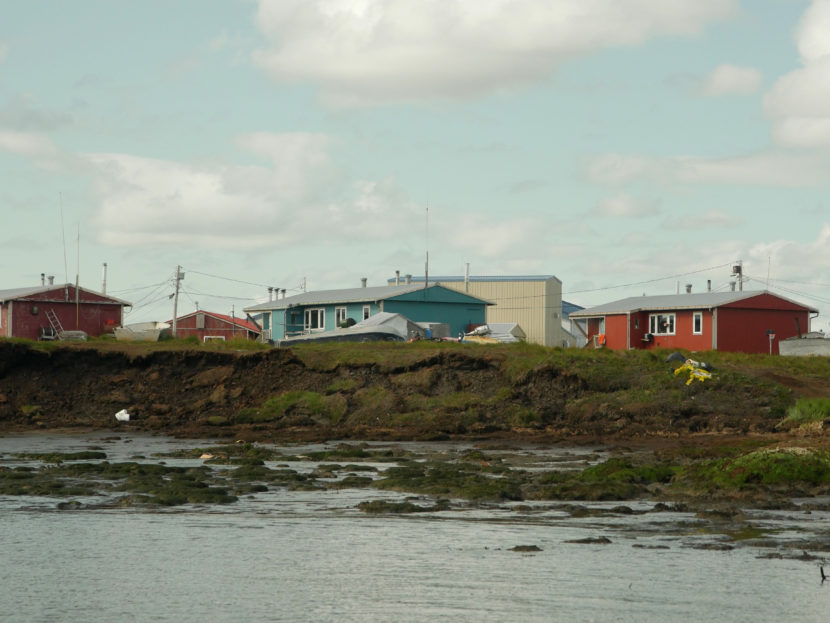
The Western Alaska village of Newtok in August 2016. Because of encroaching erosion, the village is in the process of relocating. (Photo by Eric Keto/Alaska’s Energy Desk)
Ten years ago, the Army Corps of Engineers released a report that detailed the impacts of erosion in Alaska Native communities.
Don Antrobus is the program manager for the Denali Commission’s Village Infrastructure Protection Program. He helped guide an updated report that documents three environmental threats facing the communities: erosion, thawing permafrost, and flooding.
Antrobus said those environmental threats are made worse by climate change.
“In order for communities to develop good solutions, they need to fully understand the site-specific threat,” Antrobus said.
The Army Corps and researchers at the University of Alaska Fairbanks conducted the research and wrote up the report at the behest of the Denali Commission. It took three years and $700,000.
Antrobus said that more specific information is needed to fully understand the threats.
“One of the approaches that we’re taking, to try to kind of paint a bull’s-eye around what those additional data collection needs are, is to not only say that you need additional information, but to identify these are the specific types of communities, specific vulnerability analyses that are necessary,” Antrobus said.
This report examines 187 communities, most of them in Western Alaska near or right on the coast or near a river. It ranks them according to how bad the threat is endangering their infrastructure.
The rankings are complex. The report separates the three threats and ranks each community under each threat. Then the report combines all three for each community and ranks the communities that are in the biggest trouble.
“There is a little bit of uncertainty based on that availability of data, so it shouldn’t be taken as hard and fast,” Antrobus said.
The top two most threatened communities are Shaktoolik and Shishmaref, both close to the Bering and Chukchi seas.
“We were looking at flooding, erosion, and permafrost degradation threats to community infrastructure. And so I think it’s natural that a lot of … the greatest flooding threats that we’re gonna see are gonna be along the coast,” Antrobus said.
These villages have endured catastrophic erosion and storms, and the dwindling sea ice means that there is less protection for the shoreline. The ocean is nibbling closer to communities, forcing some, like Shishmaref, to consider relocation.
Other communities sit right next to a riverbank, like Napakiak and Newtok in the Yukon-Kuskokwim Delta. Newtok is relocating entirely, while Napakiak wants to move its school.
Antrobus said that the report could help communities figure out their biggest threat. For some, erosion is the biggest. For others, it’s flooding. He said this report is just a one-time effort, but he hopes government agencies and villages can fill in the gaps in data, and apply for funding to do so.
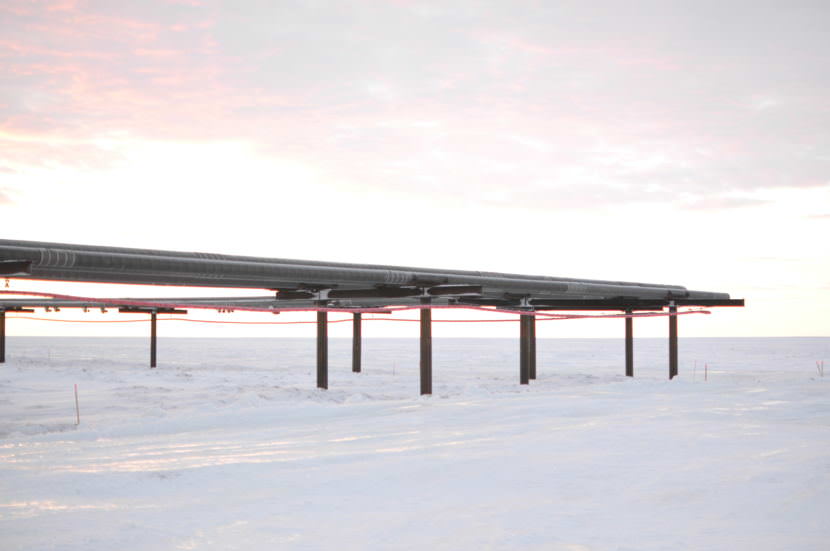
A flow line curves above the horizon on the western North Slope. (Photo by Elizabeth Harball/Alaska’s Energy Desk)
Oil company Hilcorp and one of its drilling contractors each paid more than $25,000 in penalties earlier this year after a worker was killed last December on one of Hilcorp’s rigs on the North Slope.
Shawn Huber, 36, died at the Milne Point field when the rig’s operator accidentally opened a set of hydraulic jaws and dropped a 700-pound, 31-foot section of drilling pipe that struck Huber in the head, according to the companies’ internal investigation subsequently submitted to state workplace safety regulators. The operator was distracted, according to the investigation, because he was training a colleague.
Some six months later, Hilcorp paid $25,000 in state-assessed fines for violating a pair of safety regulations — one that says employers shouldn’t allow rig workers to stand or pass under “suspended loads,” and another that requires appropriate disinfectant to be used after a blood spill. A Hilcorp supervisor instructed rig workers to clean up after the accident, and some of them weren’t wearing gloves, exposing them to bloodborne illnesses, according to a state investigator’s report.
Hilcorp’s contractor, Kuukpik Drilling, paid its own $30,000 fine for five violations — two that were the same as Hilcorp’s, two more that had to do with unsafe use of a stepladder, and another for the company’s failure to protect Huber from the hazards of his job.
Huber, who was working for Kuukpik, had more than 10 years of drill rig experience, and was married with three children, according to his obituary.
Public interest in Hilcorp, a privately owned company, has risen sharply since the company announced in August that it would buy BP’s assets in Alaska for $5.6 billion. If approved by state regulators, the purchase would give Hilcorp a major stake in two of the highest-profile assets in Alaska’s oil industry, the Prudhoe Bay field and the trans-Alaska pipeline.
The details of Huber’s death and the subsequent penalties were laid out in a pair of inquiries conducted by the state’s workplace safety agency, Alaska Occupational Safety and Health, and released in response to a public records request. The agency, known as AKOSH, found both Hilcorp and Kuukpik Drilling responsible for the accident, which appears to be the first worker death on the North Slope’s oil fields since 2012.
Officials at Kuukpik Drilling referred requests to parent company Kuukpik Corp., whose chief executive, Lanston Chinn, declined to comment.
A Hilcorp spokesperson, Justin Furnace, responded to a request for an interview with a prepared statement that called Huber’s death “a tragic event for the entire Hilcorp Alaska family.”
“We have worked closely with AKOSH on their investigation, as well as our own,” Furnace said. “We have reviewed the findings of this work closely to determine how we can apply lessons learned to improve workplace safety with both our employees and with contractors that provide services to us in the field. The safety of our personnel and anyone associated with our operation is always our top priority.”
The accident took place at the aging Milne Point field, northwest of Prudhoe Bay, which Hilcorp co-owns with BP.
Huber’s 11-person crew began their work shift at midnight Dec. 7 after 18 hours off-duty, according to the internal investigation written by officials from Hilcorp, Kuukpik Drilling and a third company, Aurora Drilling. After a short safety meeting, workers started “normal drill rig activities,” pulling segments of drilling pipe out of the well, the investigation said.
Two hours later, Huber was on the rig floor, walking around a piece of drilling pipe that was coming out of the well. He was spray painting it, to indicate that the end was damaged.
The drill’s operator was working from a console, controlling a set of hydraulic jaws used to pull the 31-foot sections of pipe from the well, then lower them off the floor. At the same time, he was describing his actions to another worker that he was mentoring, the investigation said.
As the drill operator lowered a piece of pipe that had previously come out of the ground, he was describing how to open the jaws and release it when he accidentally took the two steps required to do so, according to the investigation and a separate memo written by state regulators.
When he realized what was happening, the operator tried to reverse himself by pressing a “close” button on his joystick, “while also yelling over the intercom to alert the crew,” the investigation said.
Two other workers on the rig floor heard the operator’s yell and reacted, the investigation said. But Huber did not appear to respond, and he was hit by the top end of the pipe as it fell an estimated 28 feet. Trained medical responders arrived within three minutes, and a nurse practitioner arrived within nine minutes, but Huber was pronounced dead roughly an hour later at Milne Point’s clinic, according to the companies’ investigation.
The investigation identified two “root causes” for the accident — first, that the drill operator was “performing two tasks at the same time” by operating and mentoring. And second, there were “contradictory requirements” when it came to workers’ exposure to overhead loads. The companies had “safe work practices” in place to limit exposure, the investigation said, but employees were still sometimes exposed when they were working.
Kuukpik Drilling’s safety manager, Sonny Kula, told a state regulators that “the procedure that was being followed was normal operating procedure.”
After the accident, the companies said they’d put several safeguards in place to correct the workplace safety violations.
First, at the request of a Hilcorp drilling superintendent, a technology company changed the rig’s controls to block the operator’s normal two-step procedure from opening the hydraulic jaws within a specific range of heights, unless the operator took a special third step to override the restriction. That system was tested within three days of the accident.
Second, Hilcorp and Kuukpik Drilling sent regulators a diagram that set out a “restricted work area,” and a list of tasks that are barred while the rig is operating, like the one Huber was doing. “Workers with essential operations are permitted within the fall zone, but not directly under the load,” Kula wrote in a memo to state regulators.
And third, Kuukpik Drilling required all its workers to retake a bloodborne illness training program.
The companies’ assessment of the accident’s root cause — the driller’s distraction and the “contradictory requirements” around overhead loads — appears to be “thoughtful and thorough,” said Deb Kelly, who spent three years supervising AKOSH as a top official at the Alaska Department of Labor.
But it’s the companies’ responsibility to make sure that when workers do make mistakes like the rig operator’s, the results aren’t catastrophic, added Kelly, who reviewed the state’s case files at Alaska Public Media’s request.
“An employer should never put employees in a position where a moment’s inattention will cause a fatality,” she said. “You have to have as many layers of safety as you can practically apply, so that a lot of things have to go wrong before someone gets hurt.”
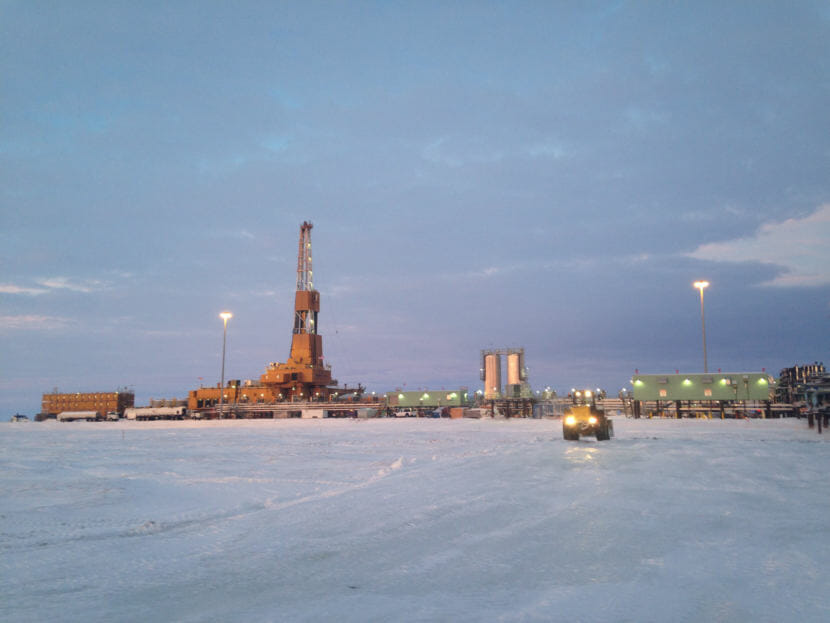
ConocoPhillips’ CD5 drill site, which is linked to its Alpine development that opened in 2000, is 9 miles from the North Slope village of Nuiqsut. (Photo by Elizabeth Harball/Alaska’s Energy Desk)
A major proposed North Slope oil project is running into local opposition from residents of the village of Nuiqsut, who are already partially surrounded by development and wary of more.
After hearing residents’ concerns at a North Slope Borough planning commission meeting that ran past midnight earlier this month, the commissioners declined to support a rezoning proposed for the Nanushuk project — a development that could produce 120,000 barrels of oil a day at its peak, or about one-fourth the amount that currently flows through the trans-Alaska pipeline.
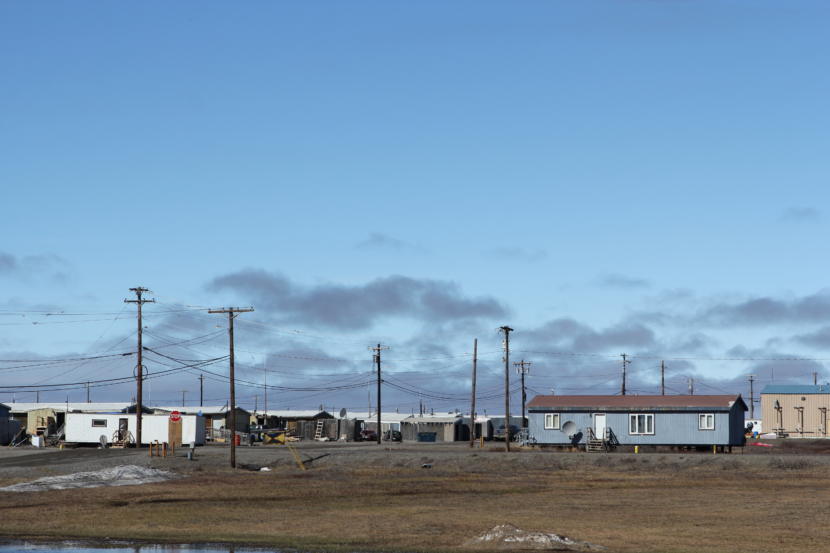
The 4-2 vote isn’t binding, and the borough Assembly will take up the question at a meeting next month. But the decision highlights how the balance between development and subsistence is becoming increasingly fraught in Nuiqsut, a village of 450 that’s found itself in the middle of the oil industry’s resurgence on the North Slope.
Eight miles north of the village is ConocoPhillips’ Alpine project, a $1.3 billion development that opened in 2000 and is still expanding, with sites to the south and west. Another big new Conoco project, Willow, proposes to establish a gravel mine 7 miles west of Nuiqsut, with as many as 250 wells at the site of the development farther away.
Then there’s Nanushuk, pushed by Papua New Guinea-based Oil Search. The company plans to build one of its drill sites 7 miles northeast of Nuiqsut, with a processing facility — to separate out oil from natural gas and water — farther away.
Some of Alaska’s elected leaders have touted the developments as a major boost to the state’s oil-dependent economy. And many Nuiqsut residents support continuing oil development, citing the ample financial benefits and quality-of-life improvements the industry has brought to the village’s residents — particularly those who are shareholders in the village’s Native corporation.
But Sam Kunaknana, Nuiqsut’s representative to the borough and an outspoken critic of oil development’s impacts on the village, said that the other commissioners — who represent different North Slope communities — were persuaded to vote against the Nanushak resolution by testimony from Nuiqsut residents.
People are concerned about development’s impacts on the fish they’re catching and the caribou they’re hunting, Kunaknana said in a phone interview. Already, oil development has affected as much as one-third of Nuiqsut’s traditional subsistence range, according the local Native village corporation.
“It’s not just one project,” Kunaknana said. “It’s everything that’s going on around this area.”
Oil Search’s Nanushuk project and Conoco’s Willow project could, if built, together produce 250,000 daily barrels of oil at their peak, or roughly half the amount of oil that currently flows down the trans-Alaska pipeline. The companies’ management would have been watching the planning commission’s meeting closely, said Tim Bradner, a former BP employee and journalist who’s long followed Alaska’s oil industry.
“And they would be very concerned about making sure that their relationships are good with the local people up there,” he said. “Because unlike in a lot of places, the North Slope is a place where the local people really do have clout.”
Oil Search has been expanding its footprint in Alaska and recently hired Joe Balash, formerly a top official in the U.S. Interior Department; the company recently moved into office space in BP’s Midtown Anchorage headquarters. Spokesperson Amy Jennings Burnett declined to comment.
The planning commission’s vote comes as the Trump administration pushes to loosen restrictions on oil and gas development in the area. Later this week, the Bureau of Land Management plans to release an environmental review of a new land-use plan for the National Petroleum Reserve in Alaska, where the Willow project and others are located — and it’s expected to revoke some of the environmental safeguards contained in a previous, Obama-era version.
The challenge of balancing resource extraction and subsistence exists across the North Slope, but that tension has escalated in Nuiqsut amid the increasing development nearby.
“I can’t think of anywhere in the state where the juxtaposition of these issues comes to roost as it does in Nuiqsut,” Bradner said. “You have to feel some sympathy for the people — they’re surrounded by all this and they worry about their community kind of becoming a truck stop for the industry. On the other hand, there are people in the community who see a lot of upside to this.”
Nuiqsut sits in the biologically-rich delta of the Colville River, just south of where it flows into the Beaufort Sea, and it was founded amid passage of the Alaska Native Claims Settlement Act in the early 1970s. At the time, the oil industry’s focus was 50 miles east, where the Prudhoe Bay field had been discovered. But in the decades since, development has crept steadily west.
Since Alpine opened in 2000, Conoco has linked its central facility with several additional sites, with pipelines and roads now stretching nearly 180 degrees around Nuiqsut; a new connected drill site, Greater Mooses Tooth 2, is under construction.
The village of Nuiqsut in June 2018. (Photo by Elizabeth Harball/Alaska’s Energy Desk)
Oil Search’s Nanushuk development is proposed northeast of Nuiqsut. And Conoco’s new proposed Willow project, to the west, is currently undergoing federal environmental reviews.
Conoco has a “long-term relationship with Nuiqsut, which goes back over 20 years with our Alpine development,” spokesperson Natalie Lowman said in an emailed statement.
“We are actively engaged with the community on our Willow project to identify concerns and seek collaborative solutions,” she said. “It is our goal to assist the community and ensure the North Slope Borough and all the NPR-A villages have the opportunity to benefit from our activities in the NPR-A.”
In February, Nuiqsut’s tribal government sued the federal government over its approval of Conoco’s exploratory drilling program for the previous winter.
But Nuiqsut’s Native village corporation, Kuukpik Corp., has taken a different approach, often partnering with the oil industry to bring cash and infrastructure improvements to shareholders and residents.
Kuukpik’s shareholders receive as much as $30,000 a year in dividends, thanks in part to royalties from oil pumped from some of Kuukpik’s lands that are part of the Alpine project. Alpine also is the source of a natural gas line that runs directly to Nuiqsut, allowing residents to heat their homes for a fraction of the cost in other rural Alaska villages.
Kuukpik has fought for, and received, concessions from oil companies to protect the village’s subsistence harvests and health. For one project, Conoco agreed to move the location of a proposed bridge away from an area where residents fish; for another, it used lower-emission generators to power a drill rig, reduced noise levels and boosted air and water quality monitoring.
The Nanushuk project also included a list of mitigation measures in the resolution that the planning commission rejected this month.
Oil Search, the company pushing the project, would have been required to hire a “subsistence representative” and conduct an array of studies on fish, caribou and the “cumulative impacts” of development in the area. It also would have been required to host an annual job fair in Nuiqsut, and to the extent possible, involve local students in their studies and hire local boat and snowmachine drivers.
The company has also agreed to build a boat ramp on the Colville River, along with a road to it, to improve residents’ access for subsistence.
“The corporation still thinks that Oil Search will be a genuine and viable partner in the Colville delta,” Lanston Chinn, Kuukpik’s chief executive officer, said in a phone interview this week. “And we’ll see where it goes from there.”
The North Slope Borough Assembly is scheduled to consider the Nanushuk rezoning at its meeting Dec. 3. The borough’s chief administrative officer, Deano Olemaun, said he could not comment on the project “until all the final processes have been completed.”
Bradner, the journalist, said he expects the Assembly to balance the planning commission’s position with the project’s potential to add to the North Slope’s tax base. Most of the borough’s $400 million budget is paid for with property taxes on oil infrastructure, and “as the industry matures on the North Slope, its existing tax base is depreciated,” he said.
“They need new projects to keep their tax base active and renewed, to maintain all the public services that they support up there,” said Bradner. “So there’s two sides to this issue, and it’s a complicated question.”
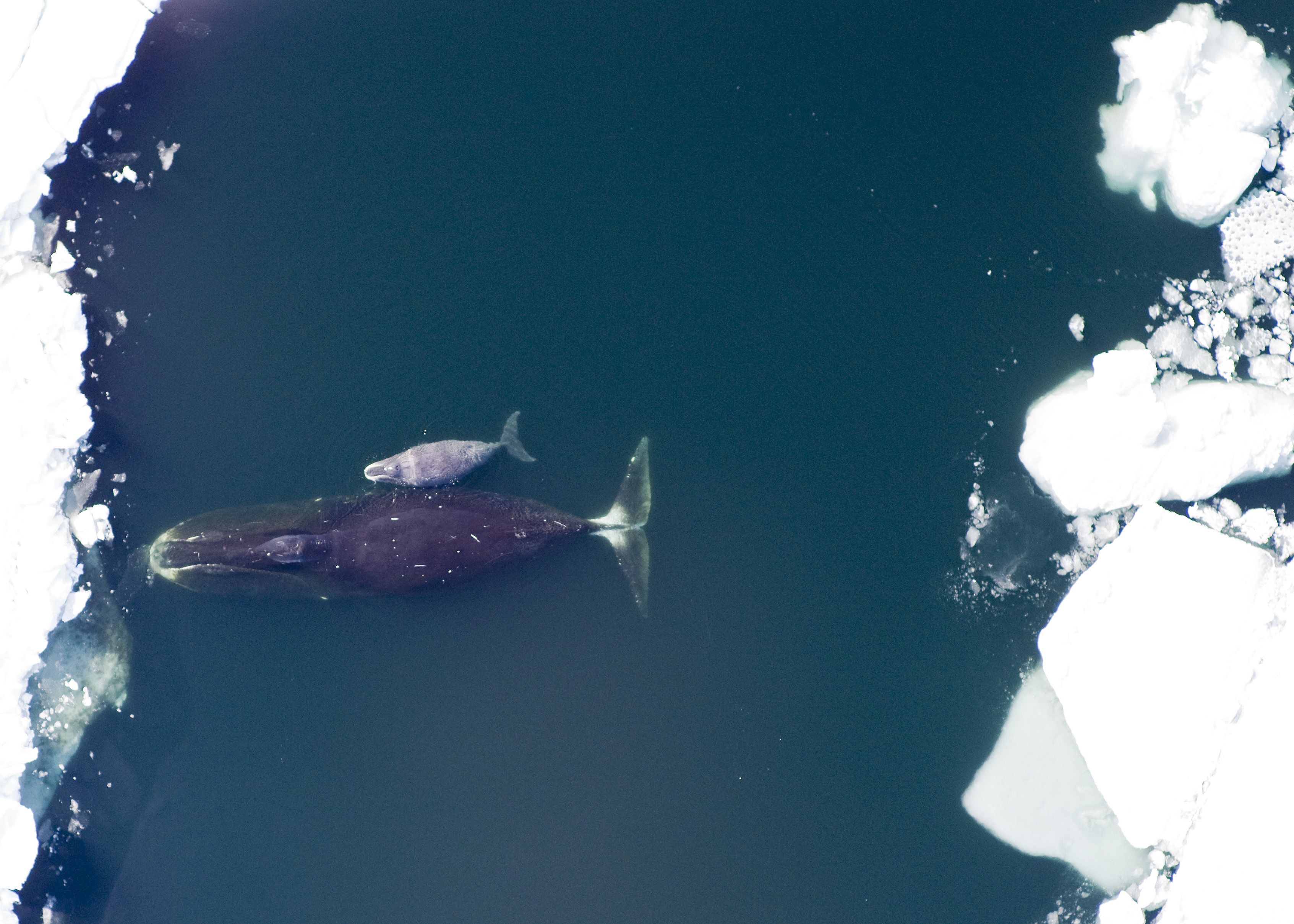
A bowhead whale and a calf in the Arctic on May 29, 2011. (Photo by Corey Accardo/NOAA)
Whalers in Alaska’s northernmost town of Utqiaġvik have finally landed their first bowhead of the season, after what some veterans said was an unprecedented absence of the marine mammals amid record-setting air and water temperatures.
Social media postings from the North Slope hub community show members of the successful crew standing in the dark in front of the 25-foot bowhead.
Utqiaġvik’s whalers weren’t even spotting bowheads early in the season, and scientists flying aerial surveys found bowheads much farther offshore than their normal range — although other North Slope villages farther east did manage to land whales.
Utqiaġvik and the ocean that surrounds it have experienced record warmth this past summer and fall. Experts, including whalers and scientific researchers, theorize that the whales may have moved offshore in search of food or cooler water.
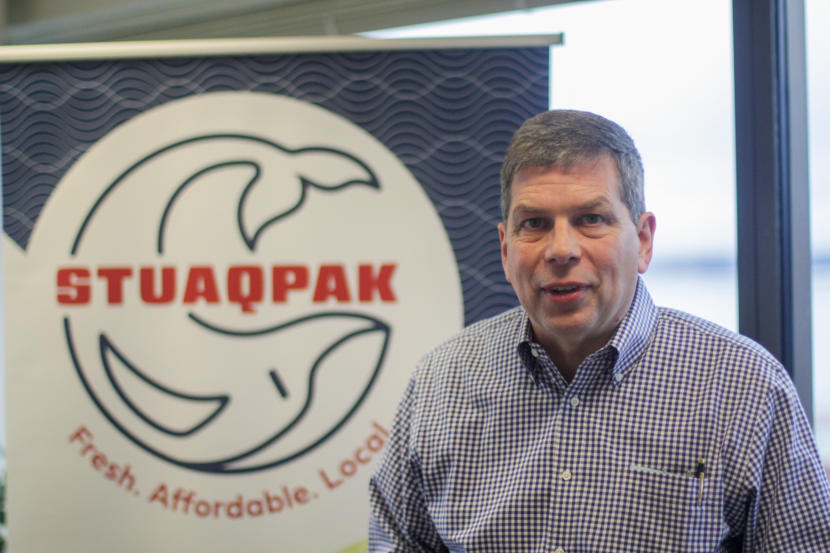
Mark Begich poses for a photo in his Anchorage office last week. Begich, the former U.S. senator, is working with a company that’s taking over management of Utqiaġvik’s big grocery store. (Photo by Nat Herz/Alaska Public Media)
When Mark Begich was a U.S. senator, he took visiting dignitaries on trips to rural Alaska. Every time, he said, he’d drag them into the village store, to show just how much residents had to pay for laundry detergent or a gallon of milk.
“Universally, among all of them: shock. They would look at a head of lettuce that might be seven, eight, nine dollars and they’re looking at you, like, ‘What?’” Begich said. “They’re trying to understand: How does that happen?”
A year after losing his campaign for governor, Begich is working in the private sector, where he’s now trying to solve that same problem. This week, a company he runs is assuming management of the big grocery store in Utqiaġvik, the North Slope hub town of 4,500 people.
In an interview in his Anchorage office last week, Begich said his company, Stuaqpak Inc., will offer lower prices and better products, and be more accountable to residents than the North West Co., the publicly traded Canadian corporation whose subsidiary ran the store previously.
“We think we are doing something that is transformational to rural Alaska on a basic issue, which is survival on a food product that can be affordable,” Begich said.
But Begich’s business is launching an untested model, and it will still face competition from North West, whose subsidiary, Alaska Commercial Co., has already reopened in a different spot.
AC welcomes the competition, said Walt Pickett, the company’s general manager.
“If there’s any learnings that come out of this, I’m excited about that,” Pickett said. “If they found a better mousetrap, let’s figure out that mousetrap and replicate it.”
To some degree, expensive groceries in rural Alaska are inescapable: Dozens of villages across the state are disconnected from the road system, meaning that goods have to be boated or flown in.
But there’s also a persistent sense that AC takes advantage of the lack of competition in Bush communities like Utqiaġvik, said Elise Patkotak, a longtime resident who now lives in Anchorage.
Sometimes, she said, those frustrations are justified.
“And other times it is just a matter of, you’re so tired of how much they’re making you pay,” she said. “It’s just kind of a way of life — you have no other alternative, so all you can do is bitch.”
AC has 33 locations in Alaska, from the North Slope to Southeast, and nearly all of them have competition, Pickett said. That includes Utqiaġvik, where there were two other grocery stores before Begich’s company arrived.
“We do everything in our power to minimize costs,” Pickett said. “We are pretty good experts at what we do. And at the end of the day it’s just an expensive effort to move product into these remote communities.”
AC was originally formed in the 18th century as the Russian American Trading Company, then purchased and renamed in 1867 by a pair of San Francisco merchants. The North West Company acquired it in 1992.
The company has 950 employees in Alaska, with revenues of some $240 million a year — roughly $20 million of which come from Utqiaġvik, according to Pickett. It occupied its most recent building since the late 1990s, he said.
AC’s landlord in that location was Ukpeaġvik Inupiat Corp., the Alaska Native village corporation for Utqiaġvik. When AC’s lease came up for renewal, UIC put out a request for proposals and picked Begich’s group out of the three respondents, said Nagruk Harcharek, a UIC official.
“I think we’re all excited at the opportunity to hopefully make the cost of living for this community a little bit more affordable,” Harcharek said.
Begich is president of the company, Stuaqpak, that’s taking over the Utqiaġvik store; other investors include Begich’s nephew Nicholas Begich III and Jason Evans, an Iñupiat businessman. Stuaqpak is also working with a separate consulting firm run by Begich, Northern Compass Group.
Stuaqpak took possession of the store late Thursday,and Begich and others are now in Utqiaġvik preparing to reopen it as soon as this week, with what he describes as several improvements.
First, Stuaqpak is working with a wholesaler, JB Gottstein, that Begich said will allow the store to sell basic goods at lower prices. Second, he says his Alaska-owned company will be more responsive to feedback than AC and its parent corporation, North West, which is based in Canada. When people in Utqiaġvik have complaints, “I’ll get the message, I guarantee you,” Begich said.
Third, Begich’s group is making physical changes to the store, in an effort to turn it into more of a gathering place. It’s planning to redo an area that Alaska Native artists sell their work on consignment, and it’s also bringing in what Begich calls a “high-quality Alaskan coffee roaster” — he won’t say which, but think Steamdot or Kaladi Bros.
“Our goal is, at the end of the day, it’s a place that people can see as a destination,” Begich said.
Patkotak, the longtime Utqiaġvik resident, said her friends in town are taking a “wait-and-see” approach. Begich isn’t the first businessman to come to the community with big promises about groceries, she said — she remembers similar hype around the opening of the store under AC’s management two decades ago.
“There was a big brouhaha about how everything was going to be more wonderful,” Patkotak said. “And eventually it just settles back into, you know, you can buy this avocado for $20 and hope to God it ripens before it rottens.”
If Begich’s model works, it could expand to other communities in rural Alaska, he said.
AC isn’t going away, though. It was expecting to renew its lease for the Utqiaġvik building and planned to make its own improvements there, said Pickett, the general manager. “It was a shock” when Begich’s company won the bid, he added.
AC spent the past six weeks remodeling the new building it purchased, but the company sees the space as a short-term solution, Pickett said. Ultimately, AC expects to have a bigger footprint in Utqiaġvik, whether that’s through an addition, a different space or a second store, he said.
“We want to continue to provide for the people in that market on the North Slope,” Pickett said. He added: “We’re looking at all options.”
Alaska Gov. Mike Dunleavy meets with President Donald Trump on Air Force One during a layover at Joint Base Elmenorf-Richardson in Anchorage, June 26, 2019. (Photo by Sheila Craighead/White House)
President Donald Trump took to Twitter on Wednesday to support Gov. Mike Dunleavy. The president helped raise funds to oppose a recall of Dunleavy by tweeting a link to an anti-recall group.
Trump posted that Democrats are trying to recall Dunleavy “because his agenda is the Economy, Jobs, and protecting our Military, 2nd Amendment, Energy, and so many other things that the Democrats don’t care about.”
Trump also tweeted a link to the website for Stand Tall With Mike, an organization opposing the recall. Within six hours of the first tweet, it was liked nearly 37,000 times.
…our Military, 2nd Amendment, Energy, and so many other things that the Democrats don’t care about. Please stop the Dems from hurting a very good and hard-working man!https://t.co/uUnWOtVxBV
The conservative blog Must Read Alaska reported Trump met with Dunleavy in the Oval Office on Wednesday.
Dunleavy has talked about previous meetings with Trump in recent national media appearances. Dunleavy told Breitbart News earlier this month that he and Trump share an interest in developing the state’s natural resources, like oil in the Arctic National Wildlife Refuge.
“He wants to get all of America back to work, and it’s been nothing short of an economic miracle what he’s been able to do,” Dunleavy said. “So, with Alaska, he’s been helping us out as well, to try and get back on its feet, and as you know, under the tax bill that was passed, ANWR was opened up.”
In response to Trump’s tweets, Recall Dunleavy chair Meda DeWitt said most of the people who signed the recall application aren’t Democrats, with undeclared voters the largest group. She also said veterans and active-duty personnel support the recall, and that the Second Amendment is both secure in the state and not an issue in the recall.
She said the president should stay out of state politics.
“They’re trying to fleece the American people, so that they can bring in more money,” DeWitt said. “And I think that he brings these other issues on board as a ruse.”
DeWitt said Dunleavy is looking for financial help outside of Alaska because he doesn’t have it inside the state.
“I think that the governor should be in the state, working on state politics and actually trying to talk to Alaskans, actually trying to engage broad, bipartisan constituents, and actually doing his job,” DeWitt said.
Sen. Shelley Hughes, R-Palmer. (Photo by Skip Gray/360 North)
Palmer Republican Sen. Shelley Hughes said Dunleavy has been meeting with constituents of all political stripes.
Hughes said she’s disagreed with some of the actions of both Trump and Dunleavy, but she also agrees with them on many issues. And she sees a similarity between the impeachment investigation of Trump and the recall.
“When we begin to set a precedent that when we don’t like the outcome of an election, we don’t like the agenda of a person elected, and we begin to work to unseat them, that really disrupts and introduces chaos into our system,” Hughes said.
Stand Tall With Mike chair Lindsay Williams said she doesn’t have any comment on the president’s support for Dunleavy.
Dunleavy spokesperson Jeff Turner said no state funds were used on Dunleavy’s trip to Washington, D.C. He said he doesn’t have any other information on the trip, since it was personal.
State Division of Elections Director Gail Fenumiai has asked the Department of Law to review the legality of the recall application by Monday.