North Slope

A month into Utqiaġvik’s whaling season, none have been landed

Three bowhead whales swim in the Beaufort Sea in July 2019. (Photo courtesy of Kate Pagan/National Marine Fisheries Service)

Each fall, captains from Alaska’s northernmost community, Utqiaġvik, drive their powerboats 10 to 20 miles offshore to hunt whales. And usually, by this point in the season, successful crews have towed dead bowheads back to town, divided up the meat and shared it with friends and family, who eat it through the winter until the whales return on their spring migration.

But this year, a month into the fall hunt in Utqiaġvik, the bowheads still haven’t shown up.

Whaling crews have not landed a single one, which some residents say is unprecedented for a town that last fall captured nearly 20. And federal scientists say their airborne surveys have shown bowheads much farther offshore than their usual range.

Also unprecedented are this year’s temperatures: It was the warmest May through September on record in Utqiaġvik, and there’s never been less ice offshore in the combined Chukchi and Beaufort seas at this point in the year, according to Rick Thoman, a climatologist with the Alaska Center for Climate Assessment and Policy. And some in the village think the environmental changes are connected to the whales’ behavior.

https://twitter.com/AlaskaWx/status/1185948991776706560

“This is a very important food source to us, and we have nothing to date,” said Eugene Brower, a retired whaling captain with a son who’s been hunting bowheads “constantly,” without success.

“We’re being heavily impacted up this way,” Brower said. “This is the first time we ever encountered a season with no whales being sighted.”

Last fall, Utqiaġvik’s whalers landed 19 bowheads by Oct. 23; this year’s fall harvest opened Sept. 21, and none have been captured since then.

Crews were still on the water Thursday, though, and some experts said there’s still time left in the season.

“It is not unusual for Barrow whalers to be hunting into the month of November,” Arnold Brower, executive director of the Alaska Eskimo Whaling Commission, said in an email, using the old name for the town before it was changed in 2016. He added: “Patience is usually the best strategy.”
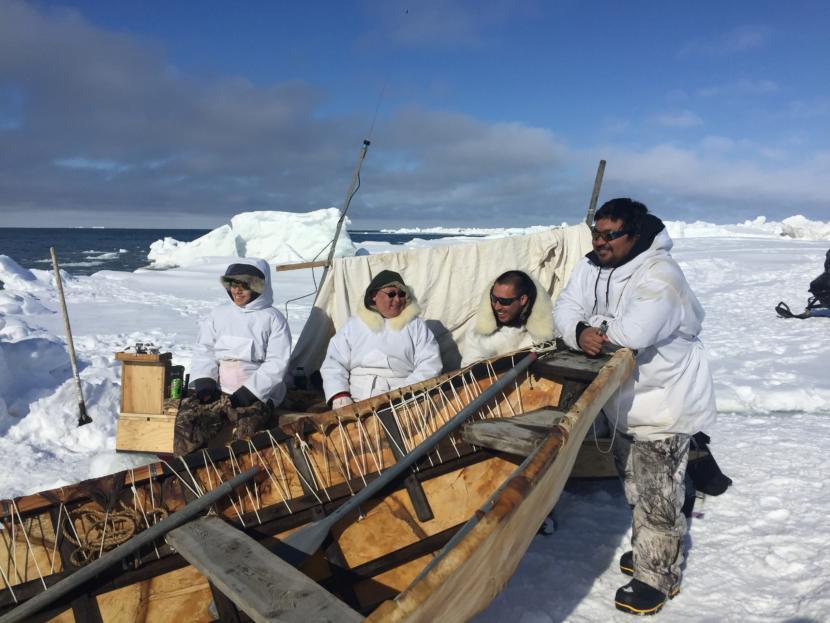
Utqiaġvik whalers stand on the ice during this year’s spring hunt, which still uses many traditional tools, including the sealskin boat, or umiak. (Photo by Ravenna Koenig/Alaska’s Energy Desk)

The bowhead whale hunt is an essential cultural and subsistence tradition for the Iñupiat of Alaska’s North Slope. It dates back at least 1,500 years, and annual harvests can supply families with hundreds of pounds of meat. There are several dozen crews in Utqiaġvik.

Other North Slope villages have had successful hunts this fall, east of Utqiaġvik in Kaktovik and Nuiqsut. But whalers haven’t even been spotting bowheads near Utqiaġvik, said Brower, a former president of the Barrow Whaling Captains Association.

“It is the way of our life, and it’s why we are who we are,” said Deano Olemaun, a top official at the North Slope Borough.

“They spotted some gray whales out there,” he said. “But no bowhead.”

The whalers’ experiences align with those of federal scientists, who flew in small planes this summer and fall doing aerial surveys of the Chukchi and Beaufort seas.

Megan Ferguson, a National Marine Fisheries Service research biologist, spent up to five hours at a time in the air, plotting whale sightings on a chart, as the plane flew in long lines about 20 miles apart, as far as 150 miles offshore.

Near Kaktovik, where whalers were successful, bowheads were observed farther offshore than in typical years. But there were also still “a good number of whales,” close to shore, Ferguson said.

But as the flights started moving west of Kaktovik, toward Utqiaġvik, “everything was shocking,” she said. The whales were far offshore compared to where scientists usually see them.
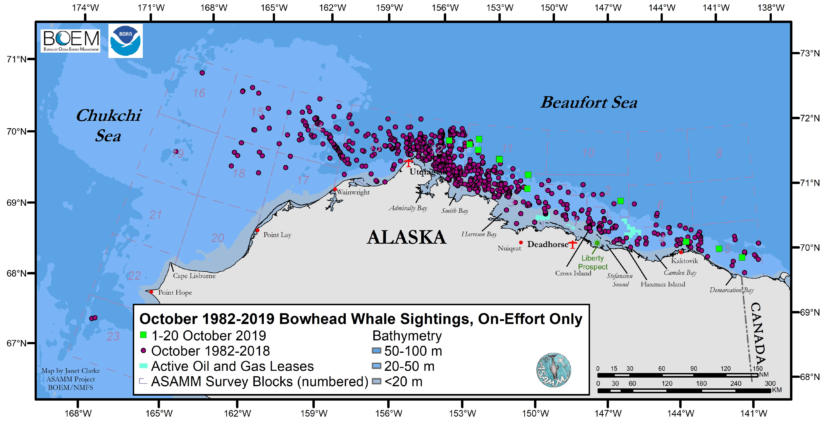
A chart from Ferguson’s research shows how bowhead spottings during surveys this October (the green squares) were farther offshore than most of the other bowhead spottings from October surveys dating back to 1982 (the purple circles). (Graphic courtesy NOAA/BOEM)

“Having the map right in front of me, it was pretty striking,” Ferguson said. She added: “We don’t have anything close to shore.”

The change comes as the region experiences “unprecedented” environmental conditions, said Thoman, the climatologist.

“There’s no doubt that the ocean climate has never been like this, that we know of,” he said.

This year, Utqiaġvik had its longest-ever recorded stretch, 85 days, with temperatures staying above freezing. Water temperatures north of the village are the warmest on record for this time of year, Thoman said.

https://www.facebook.com/NWSFairbanks/posts/566418880853816

But up until this fall, the bowheads’ migration past Utqiaġvik had been relatively steady in spite of the dramatic environmental changes happening in the area, said Craig George, a longtime North Slope Borough wildlife biologist. The spring migration has been trending earlier, but the fall harvest has been relatively stable until this year, he said.

“It’s pretty abrupt,” he said.

Whalers and scientists both said the bowheads’ location might have to do with where they’re finding their food, plankton. Whalers also said the winds have kicked up waves that have made bowheads more difficult to spot.

Another hypothesis is that the water closer to shore is warmer than the whales can tolerate, so they’ve moved farther offshore.

George, the borough biologist, said he’s perplexed and concerned by the change. But he also said it appears that this year was a strong one for bowhead calves, which is generally a good indicator of the species’ overall health.

One thing that’s clear to Brower, the retired whaler, is that unless things turn around, there won’t be a lot of whale meat stored away in Utqiaġvik this winter.

“Whatever muktuk you’ve got, whale meat, that’s going to be scarce,” he said. “It’s going to be a commodity that’s going to be hard to get.”

New proposed LNG project would ship gas from North Slope to Asia on icebreaking tankers

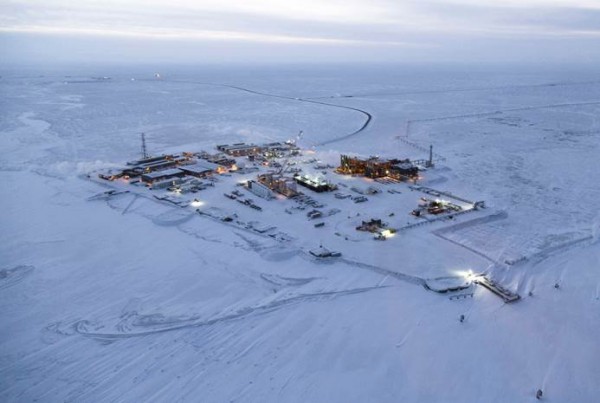
Construction on Exxon Mobil’s Point Thomson field in December 2015. (Photo courtesy of Exxon Mobil/MSI Communications)

A new company headed by former Alaska Lt. Governor Mead Treadwell has announced a project that would ship liquefied natural gas from the North Slope to Asia markets. Qilak LNG made the announcement Wednesday that it plans on shipping gas on icebreaking tankers from fields in Point Thomson.

The company is a subsidiary of Dubai-based Lloyds Energy, a company that’s been focused on LNG since forming in 2013. Treadwell serves as CEO of Qilak.

Since the 1980s, there have been dreams of shipping LNG through Arctic waters, but climate change has made the prospect more feasible in recent years.

“Over the last three and a half decades, we’ve seen a significant reduction in the amount of sea ice,” said Qilak President David Clarke. “And also in the nature of that ice. There’s much less multi-year ice and a lot more first-year ice in the Arctic.”

Clarke, a former longtime BP project manager, says the Russian Yamal LNG project has had success since beginning their gas exports two years ago. Since then, they’ve sold gas to markets in both Europe and Asia, and that gives Qilak confidence that the Alaska project would be financially feasible. Clarke also says Qilak’s project would be much cheaper than the proposed Alaska LNG pipeline project.

“By eliminating the 800-mile pipeline, we can reduce the cost to about two-thirds,” Clarke said.

The proposed state Alaska LNG pipeline was a major construction goal of former Gov. Bill Walker, but the project has stalled since the election of his successor, Gov. Mike Dunleavy.

Clarke says that the major costs of the project will be construction of a liquefaction plant and the offshore structure. He says they plan on leasing the icebreaker tankers, a plan Clarke says was similar to what the state planned on doing with its project.

At an Anchorage press conference Wednesday, Qilak announced that they have partnered with Exxon Mobil, who will supply at least 560 million cubic feet of their Point Thomson field for LNG mining.

“And that’s enough to generate four million tons a year of LNG, over a 20-year period,” Clarke said.

Clarke says the project is much smaller in scale than the Alaska LNG pipeline project, which estimated 20 million tons of LNG a year. Clarke says he’s open to gas from Exxon’s other partners, but he wants the project to show viability at a smaller scale before expanding.

“It makes it a lot more manageable in terms of matching supply and demand for the LNG and also a lot less capital has to be raised for the initial phase,” Clarke said.

As far as benefits to the state, Clarke says that LNG project would generate revenue for the state and North Slope Borough from Exxon as it expands in the region.

“We won’t generate as many jobs as building a pipeline, but we will generate jobs,” Clarke said. “Exxon will generate jobs doing their expansion, and we will have about 200 permanent staff at the liquefaction plant.”

He says that the company plans on reaching out to local communities to reduce impacts to whaling and subsistence in the area. Additionally, he says that LNG spills on tankers are much rarer than other fuel spills. The tankers don’t run on heavy fuel oil and are instead mostly powered by LNG, which evaporates when spilled into the ocean. He says that creates a minimal pollution risk for the Arctic, though LNG emissions do still affect the atmosphere.

Clarke says Qilak has already completed an initial feasibility study for the project, with a more detailed one to start next year. He says, ideally, the project would begin exporting LNG in the mid 2020s.

Attorney general explains his opinion on the Alaska Hire law

Attorney General Kevin Clarkson reads summaries of three constitutional amendments proposed by Gov. Mike Dunleavy to reporters at a press conference in the Capitol in Juneau on Jan. 30, 2019.
Alaska Attorney General Kevin Clarkson reads summaries of three constitutional amendments proposed by Gov. Mike Dunleavy in January. On Friday, he explained a legal opinion he released on Thursday that holds that the Alaska Hire law is unconstitutional. (Photo by Skip Gray/360 North)

Alaska Attorney General Kevin Clarkson on Friday explained his legal opinion released a day earlier that the Alaska Hire law is unconstitutional.

Clarkson said the opinion is in response to a lawsuit challenging the law.

“We took a hard look at it, and we determined that, you know, there was no way for the statute to survive a constitutional challenge that was being made,” Clarkson said in a phone call with reporters. “And so, rather than expend … limited state resources defending a law we knew was going to be struck down again, we issued a decision to that effect.”

Clarkson referred to the 1972 U.S. Supreme Court decision Hicklin v. Orbeck and two Alaska Supreme Court decisions — Robison v. Francis in 1986 and State v. Enserch Alaska in 1989 — that had invalidated earlier versions of Alaska Hire. The law requires private contractors working on state-funded projects to hire qualified Alaskans as a percentage of their workers.

“The governor and his administration certainly encourage and promote the hiring of Alaskans for jobs in Alaska,” Clarkson said. “But the problem is that the U.S. and Alaska constitutions make it clear that you cannot have a law that mandates the hiring of Alaskans in preference over others.”

Colaska Inc., doing business as SECON, sued the state’s Department of Labor and Workforce Development on July 12 to bar it from enforcing the law. Colaska is a subsidiary of the French road-building company Colas Group.

Alaska Hire supporters have said the law was crafted to comply with court decisions.

David Guttenberg is a retired laborer who represented a Fairbanks area seat in the Alaska House of Representatives for 16 years. He also served as political director for the Fairbanks Central Labor Council and said the Alaska Hire issue brought him into politics.

“I wish the attorney general and the governor were finding reasons to hire Alaskans, instead of not hiring Alaskans,” he said.

Guttenberg said Clarkson and Dunleavy are union busting.

“Nobody benefits (from) this except the extreme right-wing, anti-worker agenda,” he said.

Clarkson said it will be up to other state departments to decide how to use his opinion. The state hasn’t announced whether it will stop enforcing the law.

As BP exits Alaska, 1,600 employees are waiting to find out what’s next

BP employee Joe Miller in his Anchorage home with his children Hadley, 5, and Liam, 8. (Photo by Elizabeth Harball/Alaska’s Energy Desk)

On Aug. 27, BP engineer Josh McFarland entered a packed conference room, where company leaders addressed everyone simultaneously via video conference: “Sort of like watching the finale to a TV show,” McFarland said.

That day, BP announced it intends to sell its entire Alaska business to Hilcorp for $5.6 billion. McFarland said he and his colleagues were stunned.

“A lot of people’s reaction, including mine, was emotional at first — it was sort of awestruck,” said McFarland, who has worked at the oil company for four and a half years. “Because it was like, ‘Man, what is Alaska like without BP?’”

BP has operated in Alaska for over half a century and has long had a hand in running the state’s biggest oilfield, Prudhoe Bay. The company’s plans to exit the state has left hundreds of workers like McFarland in limbo.

Today, many BP employees are waiting to learn if they will get a job offer with Hilcorp, the company buying BP’s Alaska business, or if they will get an offer to work for BP outside Alaska. They have been given the choice to pursue those opportunities or they can take a severance package up front.

BP engineer Josh McFarland has worked at the company for four and a half years. (Photo by Elizabeth Harball/Alaska’s Energy Desk)

Employees seeking jobs with BP and Hilcorp have been told they will learn what their options are by late December.

Of the roughly 9,900 people who work directly in Alaska’s oil and gas industry, more than 1,600 work for BP. And it’s widely accepted that Hilcorp, an oil company with a reputation for cutting costs, will not be hiring back all the BP employees who are currently working there.

So now, as they find themselves in the middle of one of the biggest industry transitions in the state’s history, BP’s Alaska employees are all trying to figure out what’s next.

“I think I’m feeling trepidation,” said Abbie Barker, a BP employee of nearly 13 years.

“There are so many choices, and there are good things about each choice,” Barker said. “But some of those options come with sacrifices, you know? Or wholesale changes.”

Barker, a drilling engineer, described getting a job at BP as getting a “golden ticket.” She was hired from outside the industry, and BP provided her with coursework and training so could get the job she has today, a drilling performance analyst.

Barker has looked BP jobs in Houston, Texas, but as someone who grew up in Alaska, she said it’s hard to imagine living there.

“It’s so different from Anchorage,” Barker said. “Bugs, spiders, traffic — not just Glenn Highway traffic, but real traffic — hurricanes.”

But Barker is thinking about much more than just spiders, traffic and hurricanes. She has a family here: two small children and a husband who is a lifelong Alaskan with a good job at the Alaska Railroad.

“The thing I get caught up in is, ‘OK, if I make this choice, what else changes? What does that mean for my husband’s work? What does that mean for how we live today?” Barker said.

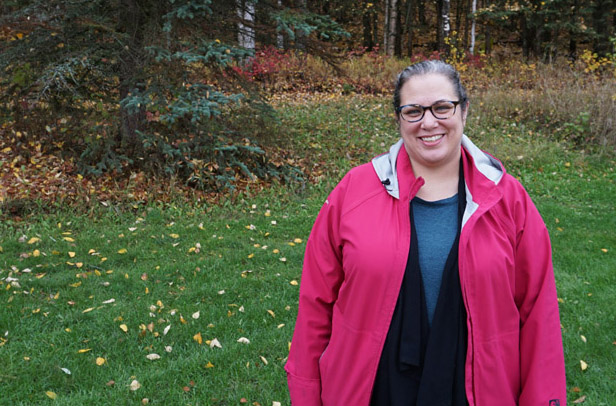
Abbie Barker has worked for BP for over a decade. “There are so many choices,” she said. (Photo by Elizabeth Harball/Alaska’s Energy Desk)

Barker feels many Alaskans haven’t realized the transition is bigger than just BP and the oil industry.

“This is a change in ways we can’t even begin to appreciate, that will take years to really, fully understand. There’s a whole lot of people that have a lot of things to decide in the next few months…for a lot more people than just BP employees.”

Barker emphasized she doesn’t think the change is necessarily bad. She said she’s impressed with what Hilcorp has done with the oilfields it operates. It’s more that it’s an uncertain time for a lot of people, she said, from the caterers who feed Prudhoe Bay workers to the people at the daycare who look after her children.

Another person living with that uncertainty is Joe Miller. Miller was just months into a new job at BP when the announcement landed — his first day was March 3. He said he’s feeling “cautiously optimistic.”

“One thing about the oil and gas industry is it’s taught me to deal with or manage change much better than others,” Miller said.

Miller also has two kids: a son, Liam, who is 8, and a daughter, Hadley, who is 5.

In Miller’s tidy blue house in downtown Anchorage, Liam and Hadley ate an after-school snack as their father described how they are his top priority as he weighs what’s next.

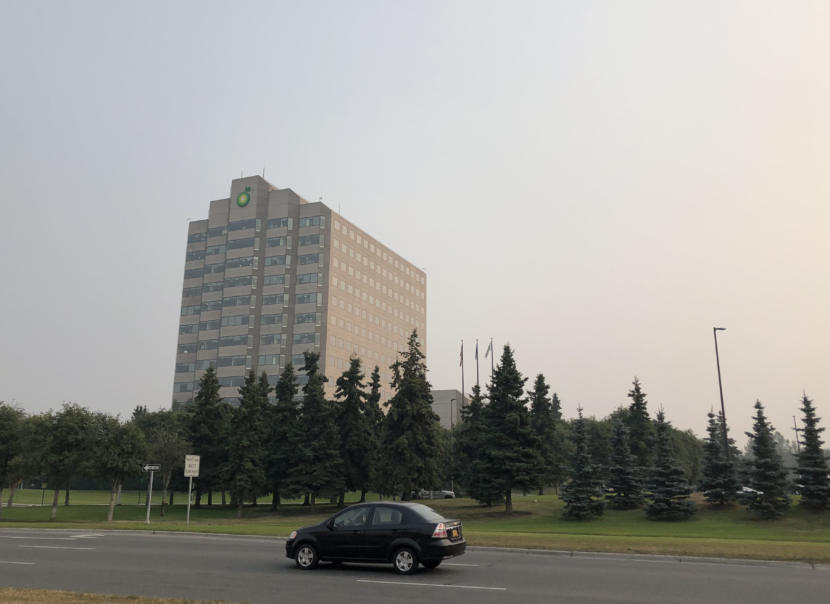
BP’s office building in Anchorage. (Photo by Elizabeth Harball/Alaska’s Energy Desk)

“Alaska is home for me and our family, we have both sides of the family here,” Miller said. “We’re very fortunate. So I’d say we are looking for Alaska opportunities.”

Miller said the day BP dropped the news was an “emotional roller coaster” for him. It happened to be Hadley’s first day of kindergarten. When he went to pick her and Liam up from school, they already knew what had happened.

“The kids were in the back, and (Hadley) had heard about the announcement and said how concerned she was and that, ‘Dad, everything is going to be OK.’” Miller said. “And I just wanted to start crying. It was a good reminder that everything with the Millers is good. We have a solid family, we are going to be OK.”

McFarland is also trying to stay positive. He’s 29 years old and doesn’t have a family here. And while he was happy to get a job with BP in Alaska — he likes the outdoors and enjoys how quickly he can get to trails and rivers from Anchorage — he sees the transition as an opportunity for change.

“At my age, I don’t know how many people get these choices,” McFarland said. “Do you want to redefine your career path? Do you want to go and work for a much smaller company? Do you want to stay and work elsewhere with BP? Do you want to just not do any of it?”

But McFarland recognizes that for others at BP, the situation is harder.

“You sort of see all the different reactions based on the different circumstances for everybody,” he said.

And for the next few months, at least, Miller, Barker, McFarland and hundreds of other BP employees in Alaska won’t know exactly what lies ahead.

Alaska attorney general says Alaska Hire violates state, federal constitutions

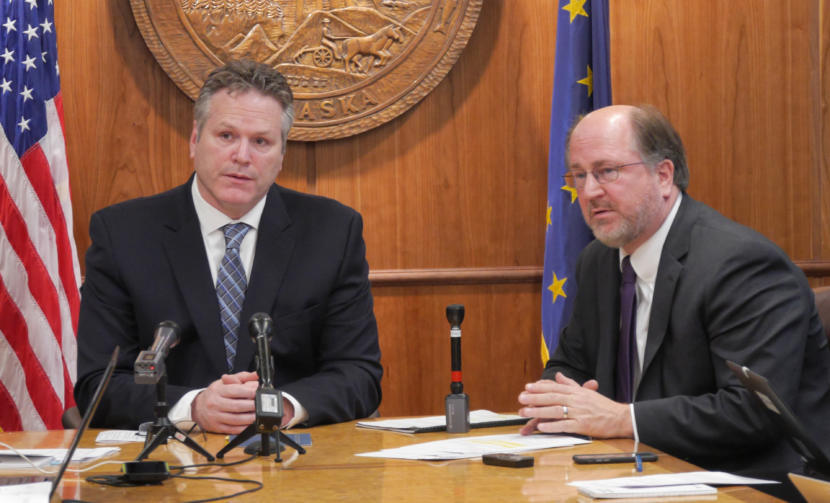
Alaska Gov. Mike Dunleavy and Attorney General Kevin Clarkson discuss the governor’s proposed budget and Permanent Fund Dividend related constitutional amendments in January. On Thursday, Clarkson wrote a memo to Dunleavy saying the Alaska Hire law is unconstitutional. (Photo by Skip Gray/360 North)

Alaska Attorney General Kevin Clarkson has written that the Alaska Hire law is unconstitutional. 

Clarkson wrote in a memo in response to a question from Gov. Mike Dunleavy that a provision of state law requiring some private employers to hire Alaskans violates both the state and federal constitutions. He said the state should stop enforcing it. 

Clarkson wrote in the 11-page document that excluding nonresidents isn’t a legitimate purpose under both constitutions. He noted that both the U.S. and Alaska supreme courts have struck down previous versions of the Alaska Hire laws because the state couldn’t provide a legitimate reason justifying discrimination against nonresidents.

About 300 BP union employees will keep their jobs — for now

BP’s operations center at Prudhoe Bay. (Photo by Elizabeth Harball/Alaska’s Energy Desk)

About 300 BP union workers at Prudhoe Bay will remain in their jobs, at least through the end of their current contract.

That’s according to Hilcorp, the oil company set to take over BP’s entire business in Alaska.

But the leader of the union representing those workers said he remains uncertain about Hilcorp’s relationship with labor going forward.

“We haven’t had any formal meetings with them yet,” said Kristjan Dye, president of United Steelworkers Local 4959.

“Until we really sit down and talk to them, I don’t know for sure,” Dye said.

Prudhoe Bay is split, in terms of workers. On the west side of the oilfield, BP Alaska has about 300 United Steelworkers employees. On the east side, all employees are at-will. That’s a legacy from when Prudhoe Bay was owned by two separate oil companies, before BP purchased Arco in 2000.

Dye said his union negotiated its latest contract with BP in January, and it includes an agreement that the 300 workers have jobs for three years, even if BP sells to another company.

Which is, of course, exactly what happened in August, when Hilcorp announced it intends to buy all of BP’s Alaska business for $5.6 billion.

In an emailed statement, Hilcorp spokesperson Justin Furnace said, “Hilcorp will honor the existing labor contracts governing union employees associated with the acquisition.”

But Dye said he still feels uncertain about union workers’ long-term prospects with Hilcorp.

“The interesting time may come when the contract has to be renegotiated. Then, we’ll just have to see what happens,” he said.

Hilcorp did not respond to emailed questions about what happens after the contract with United Steelworkers ends, or if the company currently employs any union laborers.

Dye said he doesn’t know if the union’s relationship with Hilcorp will be much more difficult than its relationship with BP. United Steelworkers sued BP last year over a contract dispute. And, he said, some workers were frustrated that BP wasn’t exploring for oil more aggressively.

“Right now, people have kind of mixed emotions because on one hand, they realize we’re getting a new employer and that they aren’t really union friendly,” Dye said. “But on the other hand, they would like to start making oil again and Hilcorp does have a reputation for making oil.”

BP’s sale also included the company’s interest in the trans-Alaska pipeline. Harvest Alaska, a Hilcorp affiliate, will take BP’s place at the owner’s table when the sale is finalized.

And Alyeska now employs a blend of union and non-union employees, according to Michelle Egan, a spokesperson for Alyeska Pipeline Service Company.

“Changing a TAPS owners does not change the union make-up of our workforce or the workforce of our contractors,” Egan said in an email.

Hilcorp’s Harvest Alaska will be part of the group of owners that approves contracts going forward, which also includes affiliates of ConocoPhillips, ExxonMobil and Unocal.

In a follow-up email, Egan said, “I can’t speculate about what might happen in the future,” and described Ayeska as “agnostic” on unions, adding, “we don’t dictate the terms of any contractor’s relationship with their employees.”

Other BP employees may be leaving Prudhoe Bay much sooner than their union counterparts. They have been given three options — to apply for jobs with BP outside Alaska, to request to leave BP with a severance package or to apply for a job with Hilcorp.

Site notifications
Update notification options
Subscribe to notifications