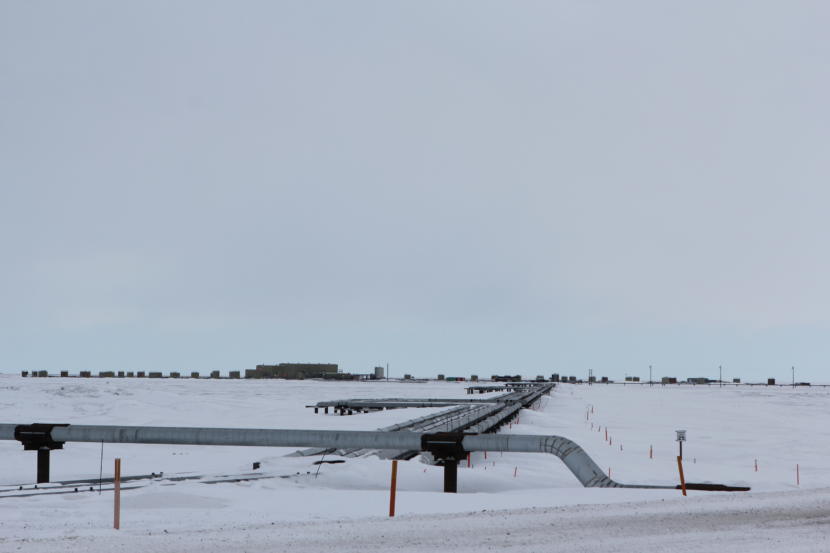
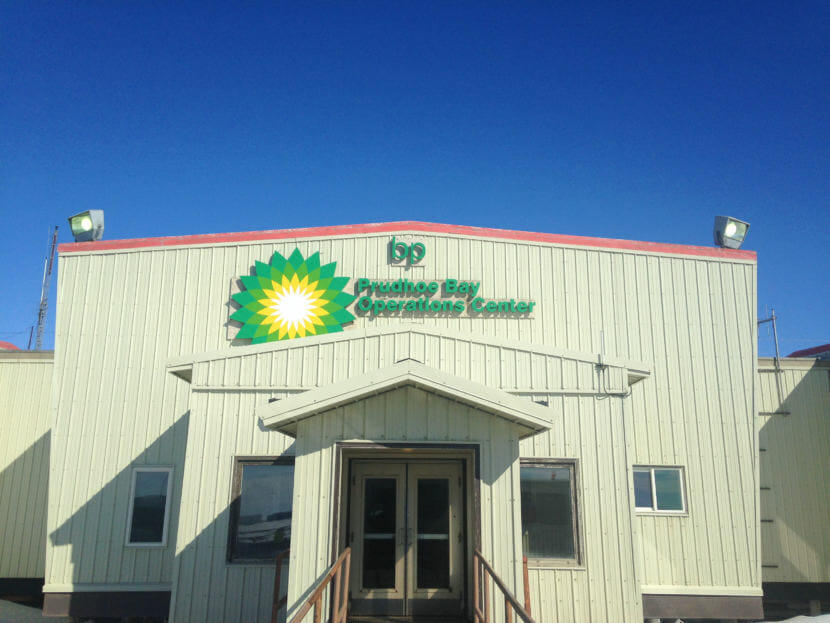
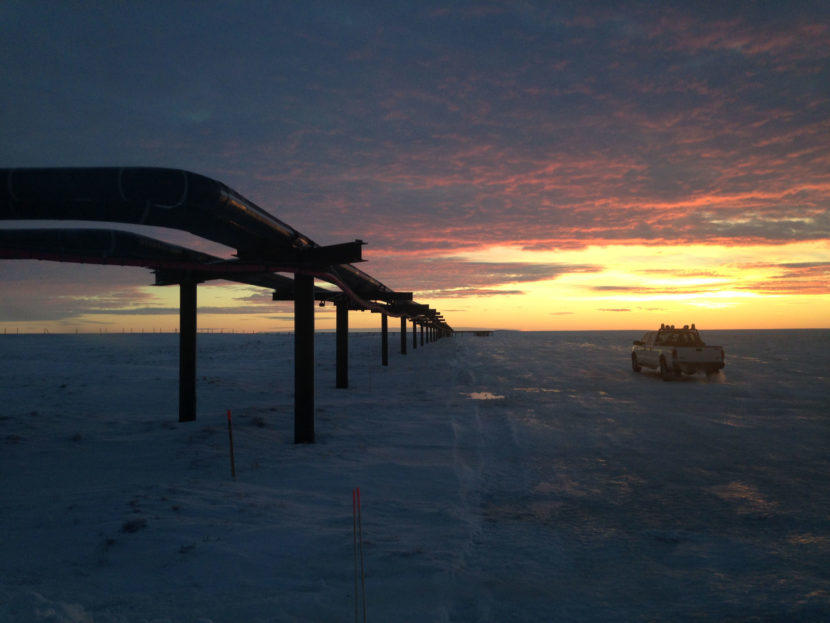
BP employees will continue operating Prudhoe Bay for the next 6-12 months, but their jobs may not be guaranteed beyond that time. (Photo by Elizabeth Harball/Alaska’s Energy Desk)
A leaked internal email brings uncertainty to how many of BP Alaska’s employees will retain their jobs, following the $5.6 billion dollar deal to sell all the company’s assets in the state to Hilcorp.
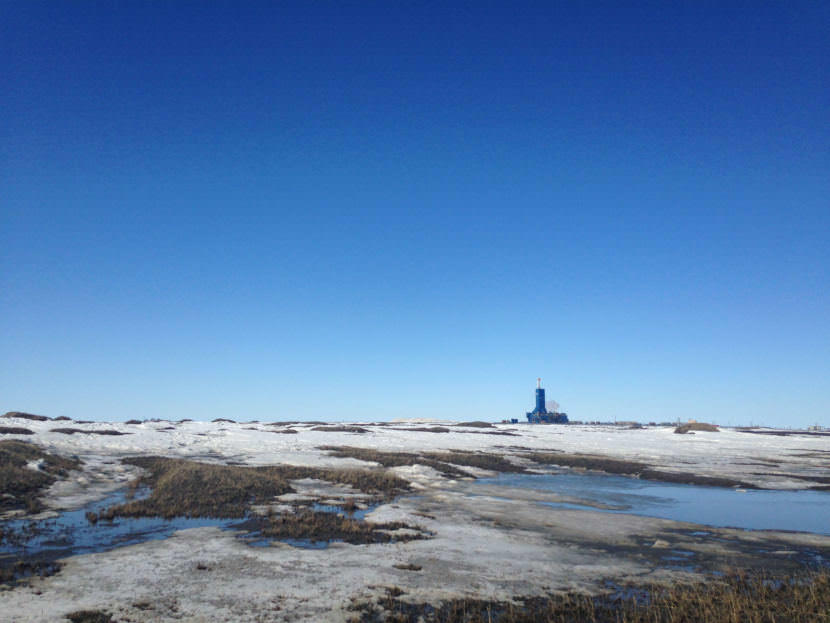
An oil rig contracted by BP looms on the horizon at Prudhoe Bay. (Photo by Elizabeth Harball/Alaska’s Energy Desk)
The $5.6 billion BP-Hilcorp deal has huge implications for Alaska’s petroleum industry. But if you don’t work for an oil company, you might be wondering: Why should I care? And why does this matter?
The acquisition raises an array of questions about what will happen when BP, which has deep roots in Alaska, finalizes the sale of its assets to Hilcorp, a privately-owned company that’s operated in the state for less than a decade.
Hilcorp’s leaders will make many of those decisions, but the company is notoriously press-averse and did not make its executives available for interviews Tuesday. In an email, spokesperson Justin Furnace said it would take time before the company releases details about its plans for workers, like how many could be laid off.
“BP’s workforce on the North Slope is obviously vital to the operation. Our plans for that workforce will develop as we determine how we will integrate the acquisition into Hilcorp’s existing operations and we receive a list of eligible employees from BP so we can begin the interview process,” Furnace said. As for Hilcorp’s vision for its new stake in the Prudhoe Bay field, which produces $17 million of oil each day, Furnace said: “We will be working to evaluate new opportunities at Prudhoe, but this process will take many months.”
Without many details from Hilcorp, we turned to experts to help answer four of the biggest questions raised by the acquisition.
1. Should Alaskans be worried about Hilcorp investing less money in workers and infrastructure, since the company has a reputation for cost-cutting?
Not necessarily, said Bill Popp, president of the Anchorage Economic Development Corp. (Editor’s note: Popp is also on the board of directors of Alaska Public Media.)
Popp said he thinks there may be initial job losses as a result of the deal. But many of those positions could be replaced with contractors, he added.
And, Popp said, it’s possible Hilcorp will make new investments in Prudhoe Bay to try to boost oil production, while BP might not have. Hilcorp is known for reviving oil fields that were previously in decline.
“On the face of it, not knowing what Hilcorp’s detailed plans are yet, I still believe that in all likelihood we are going to see a net increase in economic activity in the coming years, after the transition is completed,” Popp said.
2. What does the Hilcorp deal say about Alaska’s oil-fueled economy more broadly?
Alaska’s economy has run on oil since the trans-Alaska pipeline switched on in 1977. But production has been steadily declining since the 1980s, and some analysts said they saw BP’s departure as another sign of the decline of fossil fuels’ importance in the state.
But that’s not the only way to interpret Tuesday’s news, said Mouhcine Guettabi, an economist at the University of Alaska Anchorage Institute of Social and Economic Research. BP is leaving the state, he said, but there’s also an interested buyer at the other end of the sale.
“To me, that was the thing: Rather than view it as, ‘BP no longer sees Alaska as attractive,’ maybe BP found somebody that’s willing to pay a handsome price for these fields,” Guettabi said. “I don’t know that this is the definitive statement to the decline in the importance of oil in Alaska’s economy.”
3. BP is known for its philanthropic presence in Alaska. Will Hilcorp continue that tradition?
BP said it gave away more than $4 million last year to Alaska organizations, and it has its own community meeting center that nonprofits can use for free.
Tuesday’s news is likely to cause anxiety in Alaska’s nonprofit world, especially given how much turmoil recent state budget cuts have caused for organizations, said Diane Kaplan, president of the Rasmuson Foundation, Alaska’s largest private grantmaker.
“I think it’ll be unsettling to the nonprofit community to have that change on top of all the other changes going on,” she said.
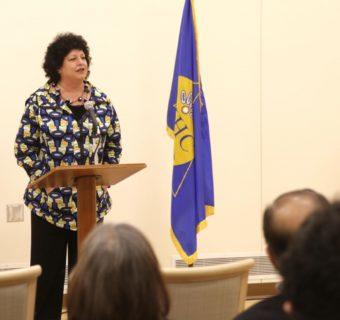
Diane Kaplan, president and CEO of the Rasmuson Foundation, addresses a crowd in Bethel. (Photo by Dean Swope/KYUK)
Kaplan pointed out that Hilcorp has a program where it sets aside $2,500 in a charitable giving account for each new employee, then matches donations of up to $2,000 a year. And she said she’s hopeful that the company is serious about establishing a strong philanthropic presence in Alaska.
One reason for that, Kaplan said, was a meeting that a group of senior Hilcorp executives requested with her a few weeks ago, before the sale took place. They wanted to discuss charitable giving, she said, though they wouldn’t address the then-swirling rumors of the possible purchase of BP’s assets.
“It was a very good meeting. We were really happy, especially now that we know what the outcome of the discussions with BP were, that they took the time at a busy time to come and talk about philanthropy,” Kaplan said. “I’d say that’s a very good sign.”
Furnace, the Hilcorp spokesman, said in an email that “giving back to the communities where we live and work is very important to Hilcorp and to our employees.” He pointed to more than $2 million in past contributions by the company and its employees to Alaska-based charities – they totaled nearly $315,000 last year – as well as money set aside for scholarships.
4. What about Hilcorp’s environmental and safety record?
The company has had multiple accidents since it started operating in Alaska in 2012. State regulators levied fines against Hilcorp in 2017 after three North Slope workers nearly died from inhaling nitrogen during a well cleanup.
The same year, one of its pipelines in Cook Inlet, not far from Anchorage, leaked natural gas for weeks, prompting Hilcorp to temporarily shut down an associated oil platform after discussions with then-Gov. Bill Walker.
In an email, Furnace said “if we can’t do a project safely and responsibly, we will not undertake that project.”
“While we have not been incident-free, Hilcorp has focused intently on achieving high standards of safety and environmentally responsible operations throughout our Alaskan operations,” he said. “We do this through close coordination with local, state, and federal agencies that work to enhance public safety, improve emergency preparedness and protect the environment. And just as importantly, we do this through the continual building of a company culture that upholds and rewards integrity, accountability and responsibility.”
But environmental advocates quickly raised questions about the deal.
“Hilcorp’s business model is to come in to old fields and to bring out the profits. And to do that, it has to cut corners with worker safety and environmental protection,” said Bob Shavelson, advocacy director at Cook Inletkeeper and a strident Hilcorp critic. “And we’ve seen that time and time again in Cook Inlet.”
But that’s not the only reason experts aren’t surprised about the company’s $5.6 billion deal with Hilcorp to sell off its interest in the Prudhoe Bay oil field, the trans-Alaska pipeline and the rest of its Alaska assets.
“When you’re BP and you’re a massive company and you’ve got assets all over the world, it’s hard for Alaska to compete with allocations in investments,” said Rowena Gunn, a research analyst for Alaska with Wood Mackenzie. “With BP being so large, often the majors aren’t quite so good with the mature, late-life fields because they’ve got such large overheads.”
At this point, Alaska represents just around 2% of the company’s global portfolio, Gunn said. In other words, while BP is big for Alaska, Alaska is no longer big for BP.
The company had largely stopped looking for new oil in Alaska, and in recent years, it sold its interests in other major North Slope assets to Hilcorp and ConocoPhillips. During that time, BP focused its efforts on stemming the decline of oil production at Prudhoe Bay.
In a statement accompanying the announcement, BP’s chief executive Bob Dudley said, “Alaska has been instrumental in BP’s growth and success for well over half a century.”
“However,” Dudley added, “we are steadily reshaping BP and today we have other opportunities, both in the U.S. and around the world, that are more closely aligned with our long-term strategy and more competitive for our investment.”
BP’s departure is part of a larger pattern in the oil industry, experts said.
“There is a natural order of progress in terms of operators in Alaska and elsewhere as the majors tend to do big, complicated megaprojects … and then they tend to transition to smaller operators, particularly private or private equity-backed operators as you enter late-life and efficiency is very important,” said Cody Rice, research director with Wood Mackenzie.
Hilcorp is known for buying older oil and gas fields and reviving production by streamlining operations. That’s exactly what the company has done in Cook Inlet since it arrived in the state in 2012 — it is now by far the biggest oil and gas operator there.
“We are in a transition in Alaska from maybe what we call the legacy companies into a situation where we have a couple of legacy companies — they would be Conoco and Exxon — with a handful of these newer types of companies that have come in to pick up where other companies are leaving,” said Andy Mack, Alaska Department of Natural Resources commissioner under former Gov. Bill Walker. He added: “This is what we see today.”
Hilcorp founder and executive chairman Jeffery Hildebrand has “proven that he can develop and wring out of oil fields lots of production that previously was not available,” Mack said.
Industry insiders in Alaska said they long suspected the news was coming.
“People have known for a while there was going to be some kind of a change with regards to operation of the Prudhoe Bay unit,” said Rebecca Logan, chief executive of the Support Industry Alliance, an oil and mining trade group.
Since oil prices dropped in 2015, Logan said she has been paying attention to myriad oil company mergers and acquisitions on both a national and international level.
“I think people have to recognize this is the trend in the industry,” Logan said.
Logan said it’s likely jobs will be lost as BP transfers its assets to Hilcorp. But she added that the overall industry in Alaska got used to changes long ago.
“We are coming off a horrible three years for our industry. Our members laid off close to 6,000 people, and nobody ever thought we would gain all of those jobs back,” Logan said. “And so people are pretty fluid right now and pretty efficient — they had to be. And so I think they are prepared to continue working in that environment.”
Representatives from both BP and Hilcorp did not have firm answers Tuesday on the fate of the more than 1,600 employees who work for BP Alaska.
In an emailed statement, Hilcorp spokesperson Justin Furnace said Hilcorp’s plans for BP’s North Slope workforce “will develop as we determine how we will integrate the acquisition into Hilcorp’s existing operations and we receive a list of eligible employees from BP so we can begin the interview process.”
“We will be working to evaluate new opportunities at Prudhoe, but this process will take many months,” Furnace said.
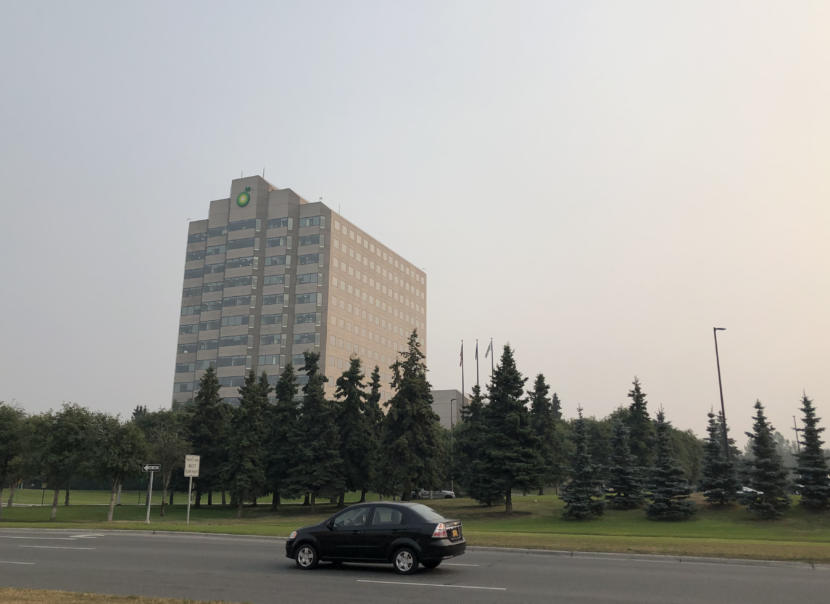
BP’s headquarters in midtown Anchorage on Aug. 19, 2019. BP sold the building in 2016. (Photo by Elizabeth Harball/Alaska’s Energy Desk)
One of Alaska’s “Big Three” oil companies is stepping entirely away from its major role in the state, leaving its position as the company that oversees Prudhoe Bay and its partial ownership of the trans-Alaska pipeline.
BP announced Tuesday it is has reached an agreement to sell its entire business in Alaska to the private, Texas-based Hilcorp Energy Company for $5.6 billion.
In a statement, Bob Dudley, BP group’s chief executive, said, “We are extraordinarily proud of the world-class business we have built, working alongside our partners and the State of Alaska, and the significant contributions it has made to Alaska’s economy and America’s energy security.”
But Dudley added, ”We are steadily reshaping BP and today we have other opportunities, both in the U.S. and around the world, that are more closely aligned with our long-term strategy and more competitive for our investment.”
The sale is still pending state and federal regulatory approvals.
BP’s exit from Alaska has been rumored for years, but the gossip intensified in the weeks leading up to the announcement, appearing on internet message boards and the trade publication Petroleum News.
Larry Persily, a longtime observer of Alaska’s oil industry, said the move is not surprising for an international company like BP.
“My guess would be it’s just a matter of looking at their portfolio and saying, ‘We have a finite amount of money and a finite amount of management attention. Where is it going to be most profitable to devote that money and attention for the next 20-to-30 years?” Persily said.
The company had largely stopped exploring for more oil in Alaska, instead focusing its efforts on stemming the decline of oil production at Prudhoe Bay. It did conduct a massive 3D seismic survey of Prudhoe Bay this winter, seeking more “pockets of oil” to help keep the field producing longer.
In 2014, BP turned four other North Slope oilfields over to Hilcorp to operate, selling off the Endicott, Northstar and much of its interest in Milne Point, as well as the not-yet-developed Liberty Project.
Hilcorp is both the largest private oil company in the state and among the biggest private oil companies in the world. The company has been operating in Alaska since 2012.
In a statement, Jason Rebrook, president of Hilcorp, said, “Hilcorp has a proven track record of bringing new life into mature basins, including Alaska’s Cook Inlet and the North Slope, and we have a clear understanding that an experienced local workforce is critical to success.”
The Willow oil development would be located in the federally-managed National Petroleum Reserve-Alaska, west of Prudhoe Bay and the village of Nuiqsut.
It would be a significant addition to the region, where ConocoPhillips already has built a series of other oil developments. The company hopes to construct a new oil processing facility, up to five drill sites, about 40 miles of permanent roads, a gravel mine and hundreds of miles of pipelines and seasonal ice roads.
ConocoPhillips estimates Willow could produce up to 130,000 barrels of oil per day. That would be a notable boost — this year’s average daily throughput down the trans-Alaska pipeline has been just over 500,000 barrels per day.
Natalie Lowman, a spokesperson for ConocoPhillips in Alaska, said the company is “encouraged” by the release of the draft analysis, calling it “a key milestone in the environmental permitting process for the project. ”
BLM anticipates the project would support hundreds of jobs — an estimated 350 direct positions once completed, and well over 1,000 during peak construction — and provide billions in tax dollars to the state, the federal government and the North Slope Borough.
“Nuiqsut’s core subsistence use area has shifted west over time due to the development in Prudhoe Bay,” the BLM’s draft analysis states. “The BLM expects that limitations to subsistence access and the reduced resource availability attributable to development of the Project would result in an extensive interference with Nuiqsut hunter access.”
“BLM will be allowing development that is likely to pose a serious threat to critical and irreplaceable habitat,” Karlin Itchoak, Alaska state director for The Wilderness Society in Anchorage, said in a statement.
Itchoak also criticized the length of the public comment period, which ends Oct. 15.
Early on, the Trump administration made expanding oil development in Alaska’s federal lands and waters a priority, with former Interior Secretary Ryan Zinke proclaiming “the only path for energy dominance is a path through the great state of Alaska.”
Earthjustice, Grafe said, “is built for this moment.”
“We’re there to stop them by making sure that the laws that are meant to protect those areas, that are meant to allow the public to be involved in those decisions — that they’re upheld,” Grafe said.
The offshore drilling case highlights the key role of the courts as the Trump administration pursues its vision for Alaska. Two and a half years into this administration, when it comes to the “path for energy dominance,” lawyers in Alaska like Grafe have proven to be significant impediments.
But now, they’re gearing up for the most high-profile court battle yet: oil development in the Arctic National Wildlife Refuge’s Coastal Plain. The first major opportunity for groups to sue will come this fall, when Interior is slated to release its final environmental analysis on a planned oil lease sale there.
Legal teams working for environmental groups have been preparing for this fight from the minute Trump took the White House, according to Brook Brisson, a senior staff attorney at Trustees for Alaska.
Brook Brisson, an attorney with Trustees for Alaska, in the Arctic Refuge near the Kongakut River and Brooks Range foothills in 2012. (Photo courtesy Brook Brisson)
Drilling in the Refuge may now be legal, but it still must comply with a bevy of other laws, like the National Environmental Policy Act, the Endangered Species Act and the Alaska National Interest Lands Conservation Act, to name a few.
“The tax law did not wipe any of those off the books,” Brisson said. “What we do in our work now is to make sure that whatever program they are going to try to put in place complies with the law, and if they don’t, our role will be to hold them accountable.”
Environmental groups and their lawyers have been critical of the work Interior has done so far. In March, they sent an over 400-page letter to the Bureau of Land Management picking apart the agency’s draft environmental analysis for oil leasing on the Coastal Plain.
“BLM’s draft EIS is so lacking and its analysis so flawed that bringing it into compliance with legal mandates will require significant revisions,” the letter stated.
Another criticism often lodged against Interior’s efforts to hold an oil lease sale in the refuge has been speed.
“You just can’t create an oil and gas leasing program, much less analyze fully a potential lease sale in an area that hasn’t had a history of that in two years or even less, really. You’re not going to make the right call on that,” said Peter Van Tuyn, a longtime environmental attorney in Alaska. “When you have that kind of rush, you’re guaranteeing litigation — that’s no surprise to anybody. I also think you’re increasing the likelihood of being reversed in court.”
In response to that charge, Interior officials have asserted they are not cutting corners, claiming that because the Coastal Plain oil lease sale is a top priority, more staff time and resources are being devoted to the project.
As with the dispute over Arctic offshore drilling, the courts will likely determine who is right. And to be sure, lawyers on both sides acknowledge lawsuits over Arctic Refuge drilling are virtually guaranteed, no matter how long Interior works on it.
In response to an interview request for this story, Interior spokesperson Molly Block declined to comment on litigation directly. In an email, Block said, “Congress has given the Department clear direction to establish and administer a competitive oil and gas program on the Coastal Plain.”
Eric Fjelstad, a partner at the law firm Perkins Coie in Anchorage who often represents oil, gas and mining companies, cautioned against giving lawyers too much credit for influencing the fate of the Trump Administration’s plans in Alaska. Economics are key, he said.
“From my perspective in the trenches, the markets, what’s happening with the economics of a project, its marketability, its ability to get financed — those are still the outsize issues that primarily drive whether things happen or not,” Fjelstad said.
But Fjelstad acknowledged litigation “plays, certainly, a real role in things here” due to the vast amount of federal land in the state.
In Alaska, the pro-oil development side frequently points out that big green groups that sue to halt oil drilling are often based out of state. For that reason, environmental litigation is often cast as the work of interlopers, set on shutting down one of the state’s primary economic drivers, and who don’t have Alaska’s best interest at heart.
Grafe lives and works in Anchorage, but Earthjustice is a national group, headquartered in San Francisco. Still, he rejects that narrative.
“We are no more interlopers than the oil companies, for example, which are multinational corporations, after all, interested in extracting resources, which by its definition means taking wealth from the state, out of the state,” Grafe said.
Grafe added that public lands belong to all Americans, not just Alaskans.
And no matter what the White House’s agenda is — whether it’s to halt oil drilling to deal with climate change, or to pursue “energy dominance” — all Americans have a right to challenge that agenda in court.
Close
Update notification options
Subscribe to notifications
Subscribe
Get notifications about news related to the topics you care about. You can unsubscribe anytime.