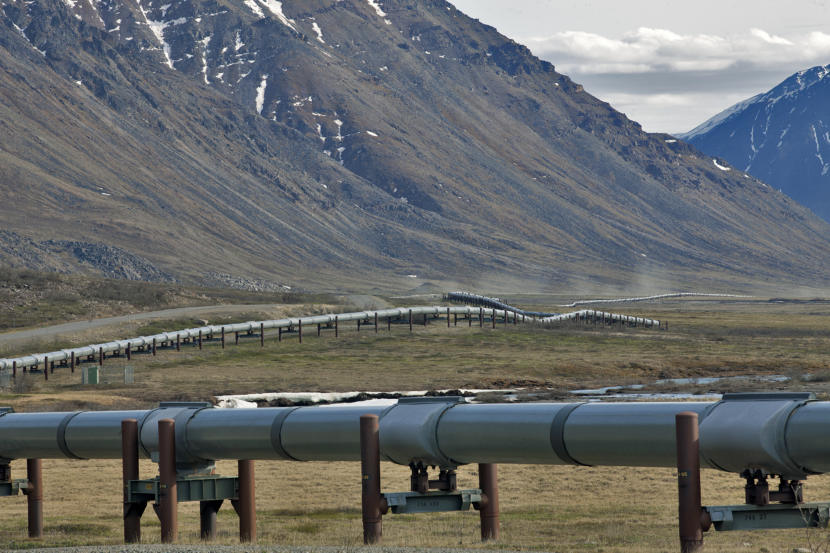
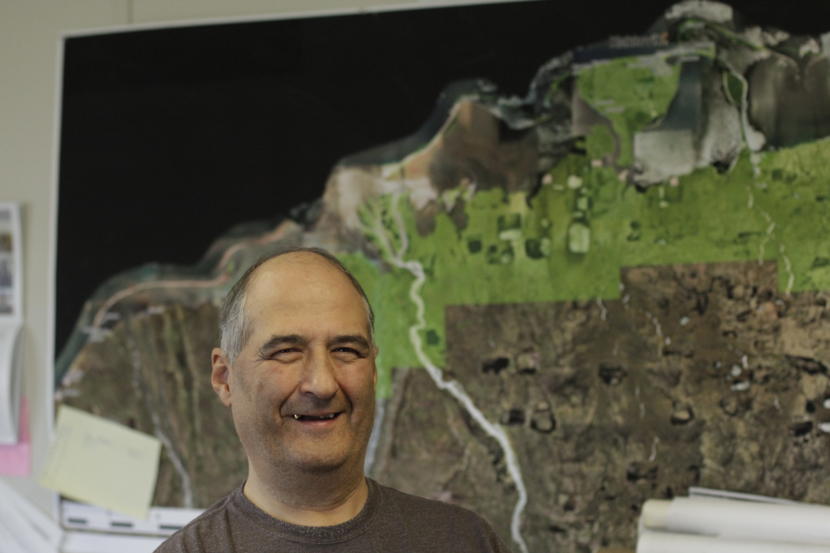
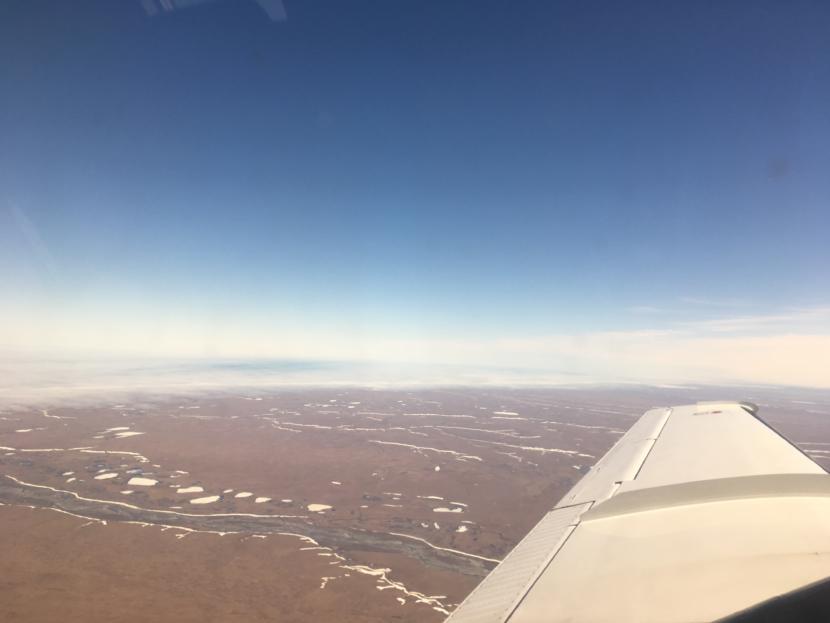
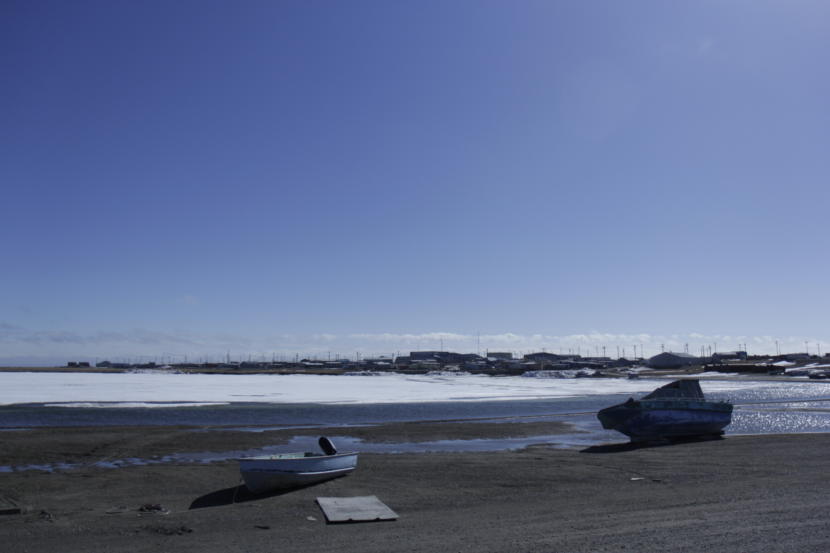
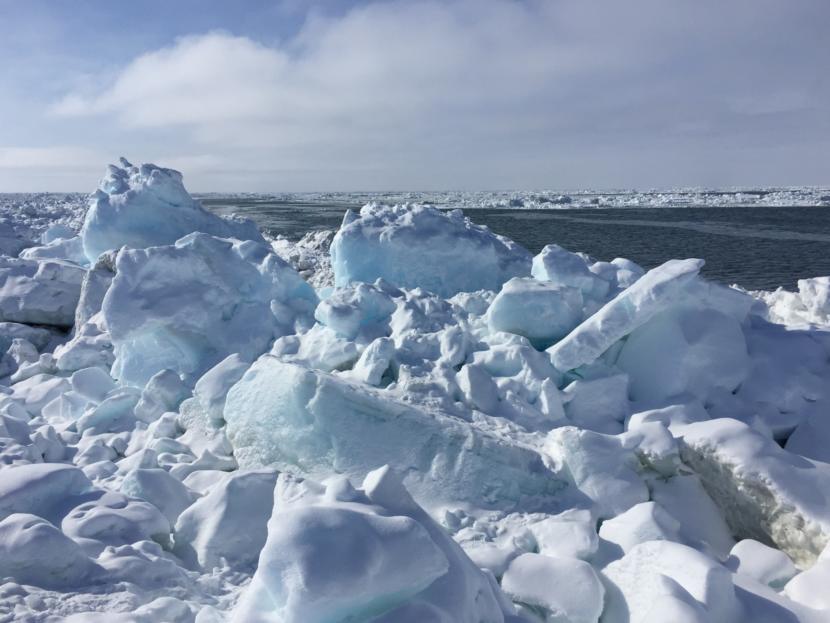
An above-ground section of the Trans-Alaska Pipeline System near the Toolik Lake Research Station in the North Slope Borough. A proposed initiative would increase state taxes on major North Slope oil fields. (Photo by Rashah McChesney/Alaska’s Energy Desk)
A group has proposed an initiative that would raise state taxes on the largest oil companies. An application was submitted on Friday for legislation that would be called the Fair Share Act. If it’s certified and is supported by enough petition signatures, it would be on the ballot next year.
Anchorage lawyer Robin Brena, a primary sponsor of the initiative, said the state receives less as a share of gross oil sales than it has historically.
“We’re too low from any perspective,” he said. “We would be getting a far higher share if we were in Norway, if we were in North Dakota, if we were in any place, pretty much.”
The initiative would raise the minimum tax from 4% to between 10% and 15%, based on the price of oil. And it would eliminate oil tax credits for the Prudhoe Bay, Kuparuk and Alpine fields.
“There is no reason for Prudhoe Bay, the largest conventional oil field in North America and the crown jewel of Alaska that has been in production for almost 50 years, to be getting credits,” said Brena.
The initiative would require all of the major producers to publicly reveal their revenues and costs in the state.
Kara Moriarty, president of the Alaska Oil and Gas Association, said fairness is in the eye of the beholder, and that the initiative would hurt the industry.
“I don’t know how any industry in Alaska can sustain a billion-dollar-plus increase in taxes and not have an impact on investing and spending, which then of course trickles down to production, which then trickles down to jobs,” she said.
Moriarty said more fields would be hit by tax hikes as they’re developed in the future.
BP Alaska spokeswoman Megan Baldino said the the company is still reviewing the initiative, but its initial analysis shows a $1 billion to $2 billion increase to industry.
“These costs will stunt investment and make Alaska far less competitive,” she said in an emailed statement.
Lt. Gov. Kevin Meyer has 60 days to decide whether to certify the initiative application. If it’s certified, the initiative petition would require more than 28,000 signatures for the initiative to be placed on the ballot.
Elizabeth Harball of Alaska Public Media contributed to this report.
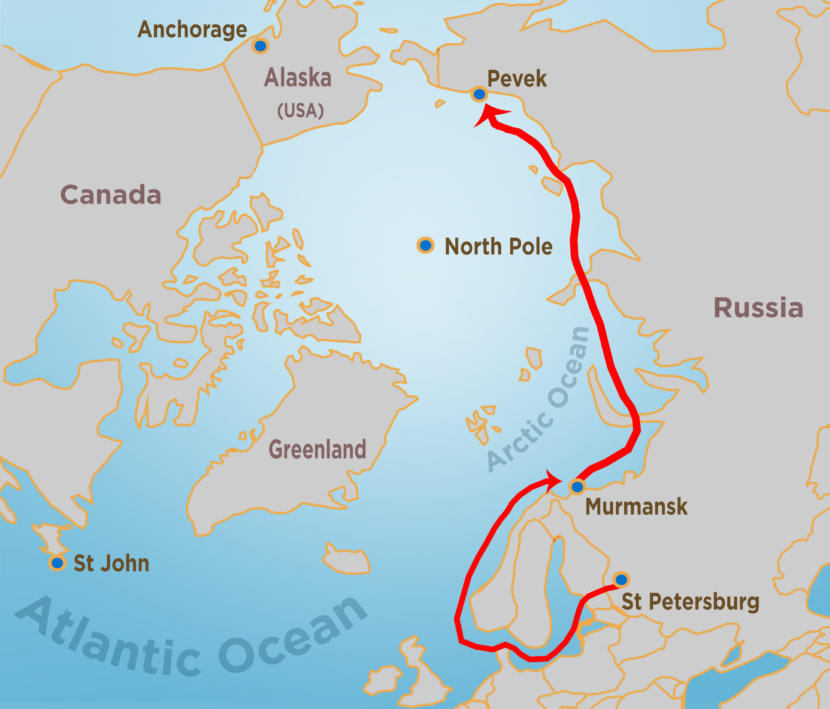
The red line shows the route of the Akademik Lomonosov, the floating nuclear power plant that will travel the entire Northern Sea Route. The barge is expected to begin producing power for Chukotka in December. (Map by Shiri Segal/Alaska Public Media)
Russia has produced the world’s first floating nuclear power plant.
A barge mounted with nuclear reactors is expected to begin traversing the Arctic Ocean this month, bound for the Chukotka Peninsula. Across the Bering Strait, Alaskans are worried about radiation, though one Arctic security expert also sees room for optimism.
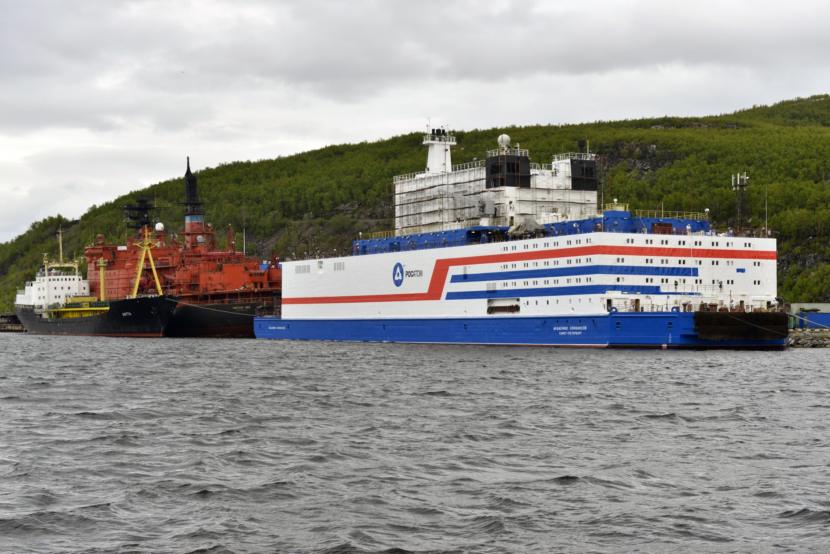
Russia hasn’t been keeping this project a secret. Reporters have documented the fanfare, at the vessel’s launch in St. Petersburg and its stop in Murmansk where it picked up nuclear fuel, along with a new paint job. It’s now white, red and blue — the colors of the Russia flag.
Journalists have been allowed to tour the barge-mounted facilities, which include a sauna, a swimming pool and gym.
“Some facilities, like the engine room, are fully automatic. It’s been tested, and it operates perfectly,” chief construction officer Andrei Talus told Russia24, a state-owned TV network.
The 472-foot barge is called the Akademik Lomonosov. Environmental groups like Greenpeace call it “Chernobyl on ice.”
Each of its twin nuclear reactors is capable of powering a city roughly the size of Fairbanks. The government-owned nuclear power company Rosatom says the plan is to dock at the city of Pevek, in northeastern Siberia, and provide heat and power to the mining region.
At the launch event, chief engineer Viktor Yelagin told Russia24 reporters the design combines elements from the transport power units used in nuclear icebreakers and the designs of stationary nuclear power plants. He said it has a state-of-the-art security system.
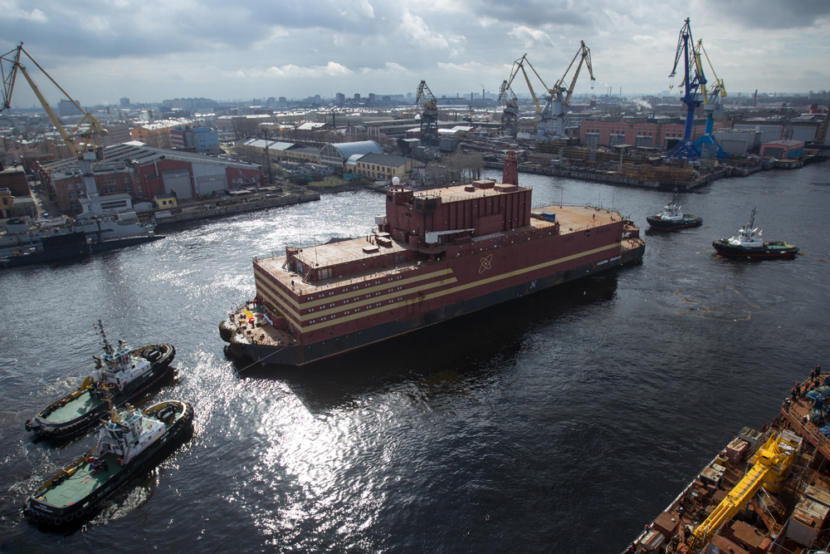
It takes a fleet of tugboats to maneuver the Akademik Lomonosov, a barge-mounted nuclear power plant. (Photo courtesy of Rosatom)
But many remember that Japan used to promise its Fukushima nuclear power plant was safe, too. Then a tsunami struck in 2011, causing meltdowns and radioactive emissions. Bering Sea villagers learned this spring that radiation was detected in sea water samples they collected — though Alaska state epidemiologists said the radiation levels are very low and are not a health concern.
“It’s small. you know, not dangerous. But traceable to Fukushima,” said Austin Ahmasuk, a marine advocate for Kawerak, the Native nonprofit serving the Bering Straits area.
He said the nuclear barge feels like one more source of potential danger to track in a region that’s warming at an alarming rate. He’s especially worried about cumulative effects.
“Radiation effects, environmental effects — we’ve been worried about for quite some time in this era of increased shipping, less sea ice,” Ahmasuk said.
Bering Straits Native Corporation CEO Gail Schubert said the barge is a big worry for her.
“It’s personally really concerning to me,” she said at an Arctic conference in Washington, D.C., last month. “I appreciate that they want to bring power to some of their coastal villages in the Chukotka region. But I think that a lot of folks in my region are not excited about having a floating nuclear power plant brought into the region itself.”
The Akademik Lomonosov, a floating nuclear power plant, got a new paint job and acquired nuclear fuel in Murmansk. (Photo courtesy of Rosatom)
Russia’s nuclear track record does not inspire a ton of confidence, said Rebecca Pincus, an Arctic security expert at the U.S. Naval War College in Rhode Island. There was the Chernobyl meltdown in 1986, of course, but a quick Google search reveals other worrying incidents, too.
“‘Mysterious cloud of radioactive particles detected above much of Europe in 2017,’” Pincus said, reading from her computer screen. “‘Dramatic radiation surge. Denials at the time by Russian authorities.’ Right?”
On the other hand, Pincus said there’s reason to believe the Russians will do their best with the nuclear barge, because they have a lot of national pride on the line. Pincus said they strive to be the frontrunner in Arctic development.
“The Russian authorities are developing the Arctic because its of tremendous importance to them. And they recognize that it’s happening in a fishbowl,” she said. “You know, the world is watching what’s going on in the Russian Arctic. And so I think there is a tremendous amount of scrutiny and pressure to ensure that nothing goes wrong.”
And if it goes right? Well, the Alaska delegation to Congress has for years explored the idea of small nuclear reactors for their own off-grid communities. Pincus said maybe one day Arctic Council countries will discuss ways to replicate Russia’s nuclear barge success story.
“This would be a perfect opportunity to say, ‘Hey … we find what you are doing interesting. We would like to learn more,’ and try to make it sort of a positive avenue for information sharing,” she said.
The Akademik Lomonosov is expected to begin producing power for Chukotka in December.
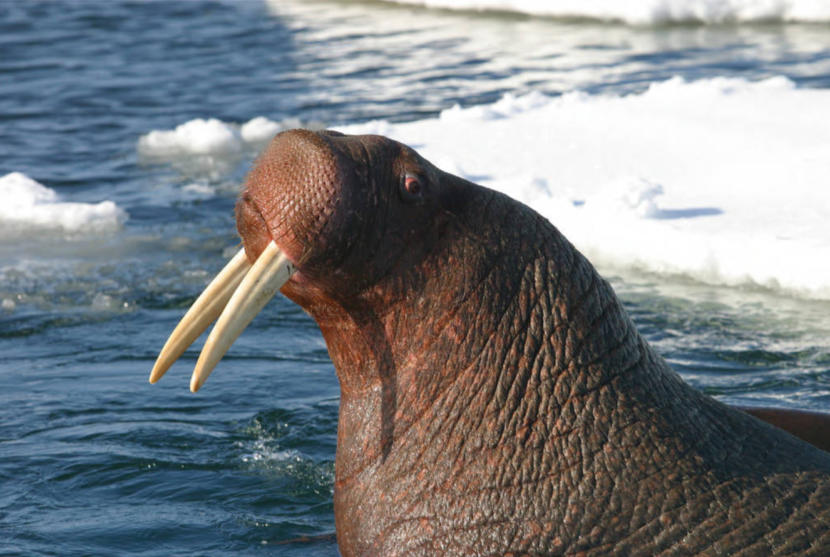
A Pacific walrus bull. Due to declining sea ice, walrus started hauling out in 2007. (Public domain photo by Joel Garlich-Miller/U.S. Fish and Wildlife Service)
The U.S. Fish and Wildlife Service today confirmed that walrus are again gathering on the shores of a barrier island near the Native Village of Point Lay.
It’s the earliest walrus haulout since it began happening in 2007, according to the federal agency.
The haul-outs are associated with declining sea ice due to climate change. This summer, the Chukchi Sea saw the lowest ice extent on record for July, according to the Alaska Center for Climate Assessment and Policy.
When the sea ice is low, the walrus instead come to shore to rest.
Fish and Wildlife spokesperson Andrea Medeiros said a Point Lay resident spotted the walruses while boating and estimated there are several thousand of the animals on the island. Medeiros said an official count won’t happen until September at the earliest.
One of the biggest concerns with the haulouts is that walrus are skittish onshore, so disturbances can be dangerous for them.
“If they hear a plane, they are going to likely react and stampede into the water, which leads to the deaths of animals, frequently,” Medeiros said.
Fish and Wildlife, the Eskimo Walrus Commission and the Native Village of Point Lay are sending out notices to pilots, mariners and others in the area to keep a safe distance from the animals to minimize disturbance.
Members of the public with questions about the haulout can call 1-800-362-5148.
The magazine Politico has obtained leaked documents suggesting the Department of the Interior has altered the work of at least two agency scientists as it presses to finish the environmental reviews on drilling in the Arctic National Wildlife Refuge. Alaska Public Media’s Liz Ruskin spoke to the reporter who wrote the story for Politico, Adam Federman.
Can you summarize for us what your findings were?
I think it’s worth pointing out that the process has been rushed from the beginning. I mean, the department has made it clear that they want to have a lease sale before the end of this year… So the process has been expedited. And in the course of rushing this forward, the department has actually modified and altered some of the findings of its own scientists conducting the evaluation of impacts.
Can you provide an example?
Probably the most revealing example is a change made to a wildlife biologist’s assessment of potential impacts on polar bears… She had basically concluded that seismic surveys would have impacts on polar bears, or could potentially have impacts on bears. And after the assessment made its way up the chain – according to emails we obtained, it underwent solicitor and state office review – her conclusions were changed to say the opposite, that impacts on bears would be “less than significant.” And, you know, she was not happy about that. And she voiced her concerns, and in very clear language, said that she did not agree with that conclusion.
As you know, there are likely to be lawsuits over all of this. Environmentalists are likely to sue. Is it weird to be reporting something that is so relevant to what someone is going to sue over?
Well, I felt that that was part of the reason why this story needed to come to light now. I mean, this was a critical decision for the state of Alaska, for the country. And the documents, I think, are an important part of that story. And before any sort of final decision is made, you know, the public has a right to sort of see how the department was handling the review process behind the scenes.
The polar bear assessment Federman spoke of was to evaluate the impact of a seismic survey in the refuge. The survey was postponed and the final environmental report hasn’t been published.
The Department of the Interior sent statements from agency officials saying the department did not suppress science and they’ve seen no attempts to do so.
Adam Federman’s story in Politico was produced with help from Type Investigations, a non-profit that supports investigative journalism.
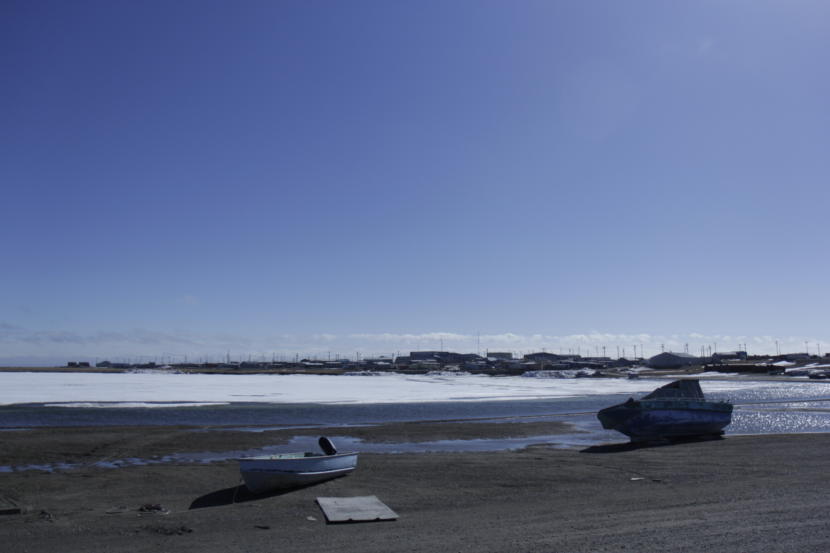
Kaktovik sits on an island in the Arctic Ocean on Alaska’s northeast coast. It’s the only village within the Arctic National Wildlife Refuge’s coastal plain, which Congress opened to oil exploration in 2017. (Photo by Nat Herz/Alaska’s Energy Desk)
After Congress opened the Arctic National Wildlife Refuge to oil drilling in 2017, the Kaktovik Iñupiat Corp. (KIC) should have been poised for a new era of prosperity.
Instead, its businesses were mired in lawsuits.
The corporation, which grew out of the 1971 Alaska Native Claims Settlement Act, was designed to generate profits for indigenous Iñupiat shareholders from Kaktovik, on the Arctic coast — the only village inside the refuge boundaries.
The company filed a lawsuit in April to recover the money. But with that case unresolved a month later, KIC’s businesses were facing more than a half-dozen of their own lawsuits from an array of creditors.
Then, John Rubini stepped in.
Rubini is one of Alaska’s most successful investors; his real estate company’s properties include several of Anchorage’s largest buildings, like the downtown offices of oil company ConocoPhillips. Forbes calls him one of the state’s two richest men.
In May, Rubini helped stave off the creditors and, with the corporation and a few other investors, formed a joint venture. The idea is to merge KIC’s local knowledge and proximity to the refuge with the investors’ deal-making experience, Rubini said in a phone interview.
“If there’s going to be development activity, I wanted to make sure that the community of Katovik had the tools and resources to participate fairly and effectively in that process,” Rubini said.
Rubini’s interest in Kaktovik underscores how the coastal plain’s opening has put the village in a new spotlight. It’s still too early to know if petroleum even exists in the refuge in commercially-viable quantities. But if it’s found, Kaktovik’s residents are simultaneously positioned to be among the biggest beneficiaries, and to experience some of the biggest disruptions.
The isolated village, on the oil-rich North Slope, already straddles the divide between traditional and modern. Oil industry taxes have helped pay for infrastructure in Kaktovik that’s lacking in other rural Alaska communities; its homes have flush toilets, and there’s a $16 million new basketball gym. Meanwhile, residents still subsistence hunt for caribou, and some of KIC’s board members double as captains of the boat crews that hunt whales off the coast.
While sharp divisions still exist over oil drilling in the village, a string of recent political and business decisions have increasingly set Kaktovik on a course aligned with development. Last year, Kaktovik’s city council ousted an anti-drilling mayor, Nora Jane Burns.
“We want to make sure that the actual voice of Kaktovik and its people are heard. That hasn’t been the way it’s been in the past,” said Charles Lampe, a KIC board member and drilling proponent.
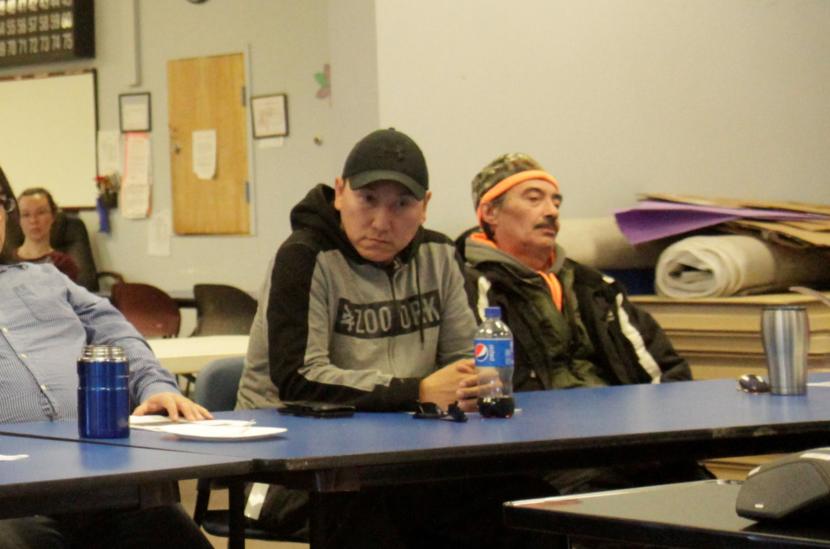
Charles Lampe, a whaling captain and Kaktovik Inupiat Corp. board member, sits at a community meeting in Kaktovik last month. (Photo by Nat Herz/Alaska’s Energy Desk)
Opponents of development, meanwhile, have been increasingly marginalized in Kaktovik — and have turned elsewhere for help.
In December, Burns, the former mayor opposed to drilling, flew to Fairbanks. She was part of a group of Kaktovik residents that also included Evelyn Reitan, another drilling opponent, who was working at the time as the city administrator.
In Fairbanks, the delegation held an unusual meeting with leaders of the Gwich’in people, a different Native group that lives outside the coastal plain. The Gwich’in people, citing possible harm to the caribou they subsist on, have lobbied relentlessly to keep the refuge closed to development — much to the frustration of Kaktovik’s Inupiat drilling supporters, who see the coastal plain as their land to manage.
When Kaktovik’s drilling supporters found out about the summit, it didn’t sit well, since many view the Gwich’in people as adversaries in the fight over the refuge. But Burns, who remains on the city council, said she felt compelled to go, though she knew it would “upset some people.” She and other Kaktovik drilling opponents have the same concerns as the Gwich’in, about the caribou, she said.
“You have to hear what they have to say, because they eat the same animals that migrate into our land,” she said
Bernadette Demientieff, a Gwich’in leader who participated, said she didn’t want to get into the specifics of the discussion, though she called the meeting a “healing and honest conversation.” But the event didn’t help the drilling opponents’ standing in Kaktovik: The village’s new mayor, Amanda Kaleak, subsequently fired Reitan from her job as city administrator.
Kaleak declined to be interviewed about city politics and her own views on development, saying she had to remain “unbiased.” But last year, when Burns was still mayor, Reitan had worked with her and the rest of the city council to issue a statement on Kaktovik’s behalf that called federally-run oil and gas development a “hostile process being imposed by government agencies acting in bad faith.”
Evelyn Reitan, an opponent of oil development in the refuge, worked as Kaktovik’s city administrator until she was fired recently. (Photo by Nat Herz/Alaska’s Energy Desk)
Reitan said she wasn’t given an explanation for her firing. She said she thinks a lot of things went into the decision — though she also said that she saw the move as driven by people she’s clashed with in the village, who support oil development.
The stakes
To understand what’s at stake in Kaktovik, the best place to look is 175 miles to the west — at Nuiqsut, another North Slope Inupiat village that Kaktovik residents on both sides of the drilling debate cite as a cautionary tale.
Nuiqsut sits at the edge of the National Petroleum Reserve in Alaska, an Indiana-sized tract of federal land that’s become a hot oil prospect in the past few years.
Kuukpik Corp., the Native claims settlement corporation that’s Nuiqsut’s version of KIC, owns more than 200 square miles inside the reserve’s boundaries. And it’s leveraged those holdings into lucrative oilfield-service contracts and land use agreements with oil companies. Those deals, in turn, help sustain annual dividends of $30,000 for each of Kuukpik’s shareholders.
The flip side of that? Oil developments have slowly encircled Nuiqsut; a major oil processing facility is visible on the horizon. As much as one-third of the area that residents use for subsistence hunting and fishing has been affected by development, according to Kuukpik. And some residents fear that diminished air quality is affecting their health.
A recent poll of 93 people conducted by Kaktovik’s city government found half in favor of oil development in the coastal plain, 30 percent opposed and the rest undecided.
But even opponents of drilling say they’re frustrated by the way the federal government has thwarted development on Kaktovik’s corporate lands inside the refuge.
On a map, Kaktovik is a dot, on the Beaufort Sea coast midway along the refuge’s northern edge. But residents see a huge swath of the refuge lands to the south, all the way to the Brooks Range mountains, as their territory, too.
The Iñupiaq people have thousands of years of history on the North Slope, and some used Barter Island as a seasonal home to fish, and hunt for marine mammals. When they weren’t along the coast, they were hunting sheep and caribou in the mountains.
Kaktovik sits on Barter Island, on the Beaufort Sea coast. (Photo by Nat Herz/Alaska’s Energy Desk)
“None of this country is wilderness. It never has been. It has been continuously used and occupied by us and by our ancestors for millennia,” Kaktovik residents wrote in “In This Place,” a 1991 manifesto that outlines their views about land and development.
Through the 1971 Native claims settlement act, Kaktovik’s village corporation received a little less than 150 square miles, or less than 10 percent of the area that Congress opened to oil leasing two years ago.
Edward Rexford, pictured in his office in Kaktovik, works for KIC and is an avid supporter of oil development in the Arctic Refuge’s coastal plain. (Photo by Nat Herz/Alaska’s Energy Desk)
Even that comparatively small, corporate-owned area was off-limits to drilling until lawmakers’ 2017 vote. And Kaktovik’s residents, along with everyone else, are barred from driving four-wheelers into the surrounding Arctic Refuge land — unless they have a Native allotment and a special federal permit.
“The federal government took all our property, all the resources in the mountains, and gave us just a sliver,” said Edward Rexford, an avid supporter of oil development who works for KIC. “We felt kind of shortchanged.”
Land already leased
The support for development among Kaktovik residents stems, in large part, from the ample benefits they’ve already derived from oil production in Prudhoe Bay, to the west.
Drilling boosters envision an array of new gains that could come from development on the coastal plain: jobs, cash flowing into the village, new infrastructure like natural gas piped in to heat people’s homes, or even road access.
Those types of ventures — partnering with or working for other, larger businesses involved in the search for oil in the refuge — are likely to yield the most immediate benefits for KIC.
But beyond getting a chunk of the drilling action, more direct benefits to Kaktovik could come from development on the 150 square miles of coastal plain owned by KIC — which is also the area closest to the village. Oil production from those corporate lands could generate a lucrative stream of royalties for KIC and Arctic Slope Regional Corp. ASRC is the regional Native corporation for the entire North Slope, and it owns the rights to the oil beneath KIC’s land.
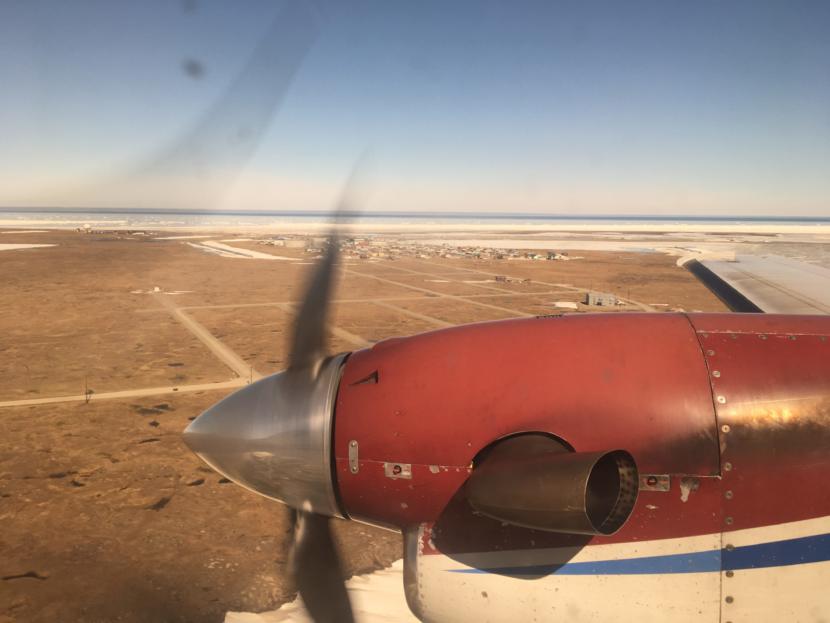
An aerial view of the Arctic National Wildlife Refuge near Kaktovik. (Photo by Nat Herz/Alaska’s Energy Desk)
Congress placed a 2,000-acre limit on oil infrastructure in the refuge in its 2017 vote. But that limit only applies to federal land, not corporate land. And ASRC has already leased its entire 150-square-mile area to oil companies Chevron and BP.
The agreement was signed in 1984, and afterwards, the oil companies spent $40 million on the only oil well ever drilled on the refuge’s coastal plain. The companies have gone to extraordinary lengths to keep the results secret, though a recent New York Times investigation suggested they were not promising.
When the coastal plain remained closed to drilling, ASRC allowed Chevron and BP to suspend their lease payments. But since Congress opened the area in 2017, those payments have resumed, said Teresa Imm, an ASRC executive who works on resource development.
Imm, in a phone interview, declined to discuss the financial details of the lease. But she said ASRC is proceeding cautiously. It’s too late, she added, for companies to make plans to drill exploratory wells next winter; if there was a proposal for the following winter, ASRC would work with Kaktovik to try to provide economic opportunities while minimizing negative impacts on the village, Imm said.
“Everybody thinks there’s this rush to the finish line. But because ANWR’s been sitting there unopened for years and years, there’s lots of work that has to be done to get ready for a program, including on our lands,” she said. “It’s a constant dialogue.”
How close to home?
Not everyone in Kaktovik trusts ASRC to safeguard the village’s interests, given that the regional corporation — Alaska’s largest privately held company, with some 12,000 employees — has its own financial interests at stake.
ASRC is based in Utqiagvik, 300 miles to the west, and that distance means that the corporation’s executives won’t feel the impacts of drilling as acutely as Kaktovik’s residents.
The corporation does, however, stand to receive an unusually large share of any oil revenue: Normally, the Native claims settlement act requires that regional corporations like ASRC share 70 percent of their resource development revenue with the 11 other regional corporations. But that requirement doesn’t apply to the corporate lands outside Kaktovik, because ASRC acquired the oil rights through a special land trade with the federal government.
Carla Kayotuk, a drilling opponent from Kaktovik, described being galvanized when she heard a former North Slope Borough mayor and ASRC board member, George Ahmaogak, talking on the radio. Ahmaogak, Kayotuk said, was vowing to block oil development around Teshekpuk Lake, a different area of the North Slope where he and other Utgiagvik residents have hunting and fishing cabins.
“I’m like, ‘Wait a minute!’” Kayotuk said. “‘You’re willing to open up my homelands for oil development but you don’t want it in your area?’ I’m like, ‘No, I’m not going to be quiet any more.”
Drilling opponents like Kayotuk said there’s already evidence that the village’s needs are being skipped over in the opening of the refuge.
For years, Kaktovik’s residents and institutions pushed for provisions in refuge-related legislation that would protect the village from and compensate it for impacts that arise from oil development. But none were expressly included in the 2017 bill — no Congressionally-mandated provisions to divert any of the oil revenue to Kaktovik, or to accommodate the village’s subsistence practices.
“The political process that led to the final vote to open ANWR required the legislation to be stripped down to its bare financial bones, without any of the meat addressing environmental protections, subsistence use and access, community impact aid and other provisions that define our region’s stake in the venture,” Sayers Tuzroyluk Sr., president of the pro-drilling Voice of the Arctic Iñupiat, wrote in an opinion piece last year.
U.S. Sen. Lisa Murkowski, who led the push to open the refuge to drilling in the 2017 tax bill, was unavailable for an interview, a spokeswoman said.
Kaktovik’s drilling boosters said they have no interest in oil development that would harm the spots residents hunt and fish; they use those areas, too.
“We want to make sure those places are identified and set off-limits, and make sure that the development isn’t going to intrude,” said Lampe, the village corporation board member, who also captains a whaling crew. Opponents of development, he added, “think that we’re trying to make where it’s just going to be a big oil field out there. That’s not what we’re trying to do.”
But Burns, the anti-drilling city council member and former mayor, said she thinks it will be tough for Kaktovik to stop development from happening in the areas that companies find petroleum.
“No matter what we say or do, I think they’re going to try to go where the oil is easily extracted,” she said.
Lampe said KIC is taking steps to keep oil development from dividing the community, namely by issuing a new class of shares.
In Nuiqsut, where the village corporation pays huge dividends stemming from nearby oil production, that dynamic has created something of a generational split: older residents who own shares tend to support development, while younger people who lack them are more likely to oppose it. Kaktovik’s village corporation wants to avoid that problem, and last month, its board decided to roughly double the number of its shareholders.
It’s better to do that, Lampe said, “before one drop of oil is developed, before any money is taken in.”
“We want to make sure that it doesn’t only benefit the original shareholders,” he added. “Because there are so many more of us that are going to be affected by development.”
Ravenna Koenig contributed reporting to this story.
Richard Glenn, left, and Matthew Rexford, tribal administrator for Kaktovik, wait to testify at a 2019 U.S. House of Representatives hearing on drilling in the Arctic National Wildlife Refuge. (Photo by Liz Ruskin/Alaska Public Media)
Richard Glenn is an inconvenient truth for those who want to stop drilling in the Arctic National Wildlife Refuge.
In congressional hearings, he presents a challenge to the narrative prevalent in Washington, D.C., that Native people oppose development in the Arctic. Glenn has been a compelling witness in favor of drilling in ANWR for about 20 years.
Sen. Maria Cantwell, D-Wash., looked past Glenn as he waited to testify in front of the U.S. Senate Committee on Energy and Natural Resources at a 2017 hearing on ANWR. She said she was disappointed there weren’t more tribal members on the witness list.
“Individual tribal members, as we have seen throughout Alaska and throughout the United States of America, don’t support this kind of development because they believe in the wildlife nature that God has given us and that we are stewards of Mother Earth,” she said.
That generalization, from the committee’s top Democrat at the time, put Glenn in a slow burn.
Glenn is executive vice president for external affairs at Arctic Slope Regional Corporation. ASRC and its Iñupiat shareholders stand to profit from drilling in ANWR. When it was his turn to speak, Glenn pointed out he is also a member of a tribe. So were three other Alaska Native witnesses who testified for drilling.
“And I was particularly stung by the ranking member’s comments that she didn’t see tribal members,” Glenn said. “Maybe she just didn’t find enough tribal members that agreed with her position.”
But Glenn doesn’t match the image some senators have in their heads for what a tribal member should look and sound like. In his dark suit and metal-rim glasses, Glenn wouldn’t have looked out of place in an accounting firm.
And he would not let himself be painted as less Native because he supports oil development in ANWR. He’s Iñupiaq with a deep connection to the ice and soil.
Opponents of drilling say the coastal plain of the refuge is sacred land to the Gwich’in people of the Interior. Glenn told the senators it’s all sacred land, north and south. Lands across the North Slope bear the bones of his ancestors, he said. He meant that literally.
“Some of my ancestors’ bones, my grandfather’s grandmother, are in Prudhoe Bay,” he said. “Others are scattered along the coastal plain, from the Canadian border to Point Hope.”
Glenn told the senators that his people depend on sacred land for both food and resource development. Glenn is comfortable with the idea that land can be sacred and produce oil. Synthesizing the knowledge of two worlds is what he’s all about.
Kaktovik sits on an island in the Arctic Ocean on Alaska’s northeast coast. It’s the only village within the Arctic National Wildlife Refuge’s coastal plain, which Congress opened to oil exploration in 2017. (Photo by Nat Herz / Alaska’s Energy Desk)
When Alaska’s Energy Desk inquired to Glenn about profiling him, he and the public relations department of Arctic Slope Regional Corporation declined to participate. They insisted the Energy Desk should first profile a pro-drilling tribal representative from Kaktovik, the only community in the refuge. And it’s easy to see why they might want that. The anti-drilling side sometimes portrays the battle over the Arctic Refuge as for-profit corporations fighting tribes. Money versus culture. Suits versus moose-hide vests.
But from Glenn’s perspective, it’s not that simple. And he has told his story before.
“I was born in 1963, in Mountain View, California,” Glenn said when Karen Brewster interviewed him in 2016 in his home in Utqiaġvik for an oral history project.
Glenn told Brewster his mom is a daughter of the Ahmaogak family from Utqiaġvik, also known as Barrow. His dad is a son of Nebraska, sent to the Arctic to work on the Distant Early Warning Line, or DEW Line — the Cold War-era early warning radar system.
“And in those days, you weren’t allowed to fraternize with the locals,” Glenn said. “But there were a few Barrow people who worked out on the DEW Line station. And they like to say they played cupid for my mom and my dad.”
The young couple left the North Slope when Glenn’s dad took a tech job in what would soon be called Silicon Valley, so Richard was born and grew up in the Bay Area. Richard and his siblings learned Iñupiaq from their mom, and they knew other North Slope families living in that part of California. They also had a stream of visitors going to and from Barrow.
“So we had a communications network,” Glenn said. “Everyone had Eskimo food in their freezer all the time.”
His first trip to Barrow, aside from when he was a toddler, was at age 13. It was a summer of cousins and an introduction to hunting.
“I made a promise to myself that I’d go back, even if my family didn’t,” Glenn said in the interview with Brewster. “So every summer I did, from the day that school was over till the day school started, from seventhgrade on. And it was a great upbringing.”
As he learned to hunt — ringed seal, bearded seal and caribou — Glenn began to learn about ice: how to move on it, how to be safe, how it drifts and breaks off. By his 20s, he was on spring whaling crews and became a whaling co-captain.
He became, he said, obsessed with ice. Infatuated with it. He told Brewster he got to double-dip in ice education, with traditional knowledge and a master’s degree in geology from the University of Alaska Fairbanks. Every ice trail he cuts tells a story, and Glenn reads the details.
“You’re looking at that popcorn junk ice that your pick hates to swing on. Or the mud-rich stuff that was born when the slush was dragging the bottom,” he said. “Or this kind of columnar basalt-looking ice that grew all at once and just stayed that way, from birth to — just a flat, tabular ‘bang,’ hit it with a pick, it all breaks like that.”
A view of the sea ice and the Arctic Ocean near Utqiaġvik, April 16, 2019. (Photo by Ravenna Koenig/Alaska’s Energy Desk).
The Gwich’in say to allow drilling in the Arctic Refuge will destroy their Native way of life. But Richard Glenn sees a fruitful integration. The oil industry pays local taxes, and Arctic Slope Regional Corporation owns some of the subsurface rights in the refuge. As Glenn sees it, oil development provides the cash that allows the Iñupiat to continue to live in the Arctic and teach future generations how to hunt on ice.
“If my DEW Line father and my Iñupiat mother have taught me anything, it’s taught me that there’s these two ways of looking at the world, but they overlap in the middle,” he said at a forum in Washington, D.C. “And if you can find that place where the overlap exists, it’s nothing but pay dirt, as far as good lessons to learn.”