North Slope

As sea ice changes in a warming Arctic, new challenges for polar bear research

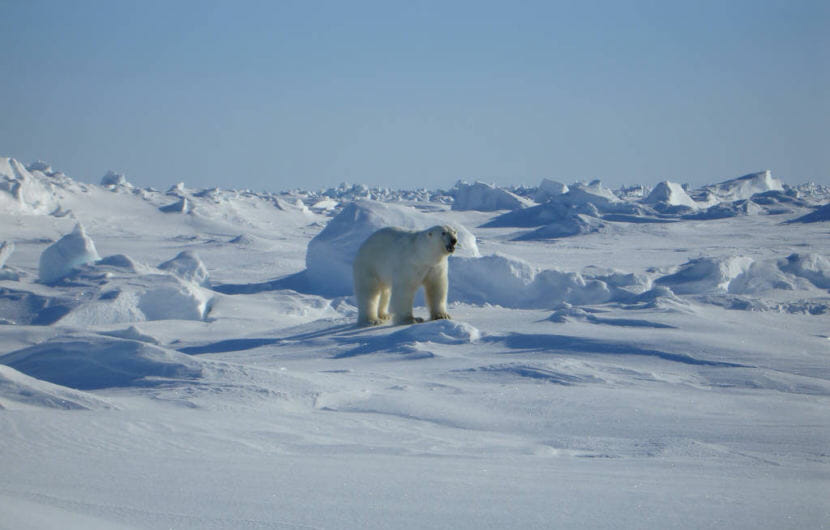
A male polar bear near Kaktovik. (Photo courtesy U.S. Fish and Wildlife Service)

Research on polar bear health and abundance is critical to understanding how the animals are responding to declining sea ice in the warming Arctic.

But changes in the ice are also presenting challenges for researchers, who go out and collect information on the bears. So they’re trying to adapt.

For eight seasons now, wildlife biologist Todd Atwood has been part of a team that’s flown over the Beaufort Sea during the spring in a helicopter, looking for polar bears.

When they see one, and the conditions are right, they dart it with a sedative and land on the sea ice to collect information from the animal. They weigh the bear, age the bear, and collect a variety of biological samples.

Atwood works for the U.S. Geological Survey — one of the agencies that does research on polar bears in Alaska. Their research informs management decisions made by other government agencies.

The information they get through this research helps them come up with an estimate for the bear population. It also helps them determine if the animals are getting enough food, or if they have any other health issues.

But changes in the sea ice are affecting USGS scientists’ ability to do that kind of bear capture research.

“What we’re experiencing more recently is that the ice conditions are just terrible,” said Atwood.

For one, he said they’re increasingly encountering a lot of open water during their research season in March and April. That creates complications for flying, and they also worry about a sedated bear trying to escape to open water and drowning. Ideally, they try to find a large, stable pan of ice where they can spend about an hour getting data from the bear.

Of the ice they do find, a large part of it is now rubble ice — as Atwood put it: “Ice that looks like it just went through a blender.”

Ice is more likely to look like that if it’s first-year ice — meaning it melted completely in the summer and grew back over the course of one winter. First-year ice is increasingly common in the Arctic, where warming has lead to a decline in thicker, multi-year ice.

Atwood said that rubble ice makes it harder to see the bears from the helicopter because they kind of blend into it. It also limits where they can land.

These challenges mean they’re sampling fewer bears, and that will affect the conclusions they can draw from their research.

“There’s probably going to be a greater amount of uncertainty with some of the information that we’re able to provide, because it’s simply not going to be as precise as it used to be,” said Atwood.

USGS is already changing the way they collect data for population estimates. They’re relying more on making observations of bears from the air without landing, and on methods like biopsy darting — where they shoot a dart that collects a small tissue sample from the bear and doesn’t require them to sedate it. They can also collect DNA samples from tufts of hair they snag at hair snare stations.

And other researchers are looking into other methods.

“There’s some interesting work out there that suggests that collecting DNA from tracks left by polar bears in the snow might be a way to move forward,” said Atwood.

But Atwood said that when it comes to things like the bears’ weight, age and detailed health information, there’s still really no replacement for bear capture.
Alaskans push for acceptance of walrus ivory, but there’s an elephant in the room

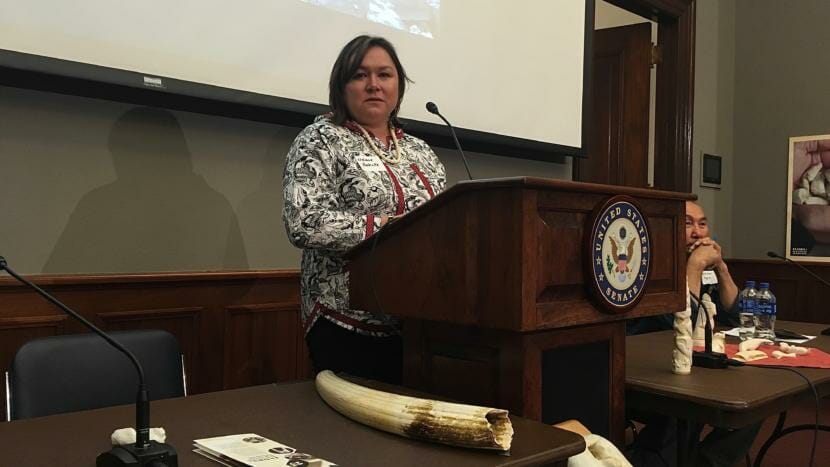
Melanie Bahnke is the president and CEO of Kawerak Inc. She wants to foster greater acceptance of ivory carvings from her region.
Melanie Bahnke is the president and CEO of Kawerak, Inc. She wants to foster greater acceptance of ivory carvings from her region. (Photo by Liz Ruskin/Alaska Public Media)

Federal law prohibits sales of African elephant ivory, but a handful of states have now banned the sale of ivory more broadly. That has repercussions for Alaska Native ivory carvers, who use tusks from legally-hunted walrus.

At a forum in Washington, D.C., this week, leaders from the Bering Straits region said they are frustrated, because they’re not only fighting state laws but also social norms.

Those norms were readily apparent at a weekend craft market near the U.S. Capitol. Stalls sell jewelry made with pearls and semi-precious stones, but shoppers recoiled when asked about ivory.

“No, I would definitely not wear ivory,” Nicole Morgret said, as did almost everyone I asked. “Elephants are intelligent animals and should not be hunted.”

Another woman told me she has some ivory jewelry but doesn’t dare wear it.

“OK, it does look good, but I can’t wear it because it’s part of an elephant, and I don’t want to condone and push wearing ivory,” she said.

Two sisters from Tennessee were shopping for silver pendants. One seemed open to the idea of ivory.

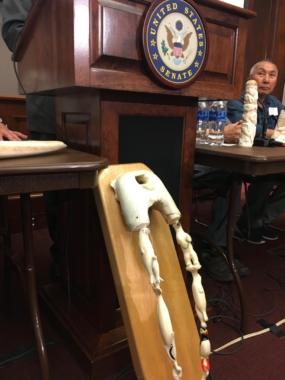
Elaborate ivory carvings were on display for an ivory forum at the U.S. Senate. Artist Sylvester Ayek was one of the speakers. (Photo by Liz Ruskin/Alaska Public Media)

“Like in an earring or something? Mmm-hmmm,” she said.

Then her sister said the “e” word – “elephants” – and a window closed.

“Like, ivory tusks?”

“I didn’t think about that.”

Melanie Bahnke, president of the Nome-based nonprofit Kawerak, said she sees how ivory can disturb people who visit her region.

“The expression of disgust on a tourist’s face when they realize that what they’re holding is made from walrus, and yet they’re walking in with leather shoes, is ironic,” Bahnke said.

She spoke at a forum on Alaska ivory at the U.S. Senate. Congressional staffers and others crowded into a Senate meeting room. Bahnke dispelled misconceptions: Walrus ivory isn’t elephant ivory. Walrus populations are healthy.

“And we are not hunting walrus just for the sake of ivory,” she said. “It is our food source. It is our spiritual connection to our ancestors. And it’s beautiful art. And it shouldn’t be banned.”

Bahnke said it’s expensive to live in villages like Savoonga, and most ivory carvers don’t make a lot of money at it.

“If you’re able to sell some of your artwork, then you’re able to buy more gas or ammunition to harvest more walrus to feed your family,” she said.

Bahnke closed the Capitol Hill forum by asking allies to spread the word, to tell the story of Alaska Native ivory.

And stories are powerful.

Back at the crafts market, vendor Erika Rubel — an artist who makes spice racks and shelves from salvaged materials — carefully considered whether she would wear ivory.

“I might wear an antique ivory bead, but I wouldn’t get anything that was made now,” she said.

How about walrus ivory, harvested by Native people practicing the tradition of their ancestors to feed their families? Rubel warmed to the idea.

“As long as it’s sustainable,” she said.

Rubel’s not at all worried her friends would think she’s exploiting elephants if she were sporting ivory carved by a Bering Sea artist.

“No, because if they did question it, they would probably say, ‘Wow that’s not like you,’ (and) I would explain the story behind it,” Rubel said. “Which is also part of why you buy something from the maker: You’re also buying the story and the history that went into making it.”

That would be music to the ears for the champions of Alaska Native ivory.

ConocoPhillips picks up another oil prospect west of Prudhoe Bay

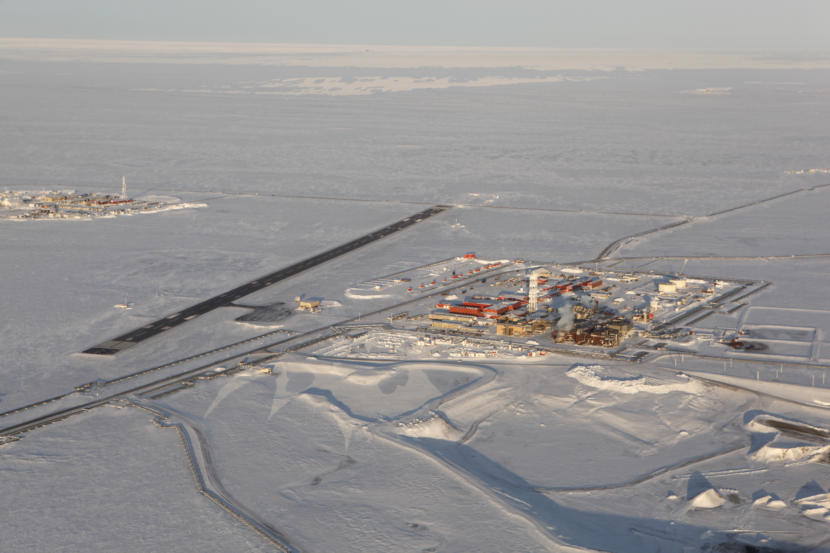
The Nuna discovery is northwest of and adjacent to the Kuparuk River Unit. Shown here is the main camp at the Kuparuk field. (Photo courtesy ConocoPhillips)

ConocoPhillips is picking up another potential oil development on the western North Slope, reaching an agreement with a small, private company that is selling off much of its assets in Alaska.

ConocoPhillips today announced it intends to buy 21,000 acres from Caelus Natural Resources, which includes the Nuna oil discovery.

ConocoPhillips is the biggest player west of Prudhoe Bay, and the oil company has several other major projects in the works.

Nuna is near the Kuparuk oil field, which ConocoPhillips operates. ConocoPhillips can use infrastructure from Kuparuk to develop the field.

“That’s why it makes a lot of sense,” said ConocoPhillips spokesperson Natalie Lowman.

Lowman declined to disclose the terms of the deal. It is contingent on approval by the Alaska Department of Natural Resources.

Caelus had delayed Nuna’s development. In 2014, its CEO told the Alaska Journal of Commerce that he expected oil to begin flowing in 2016.

But the Texas-based Caelus ran into challenges when oil prices plunged. Caelus held off more exploratory drilling at the large offshore oil discovery it announced in 2016, called Smith Bay, partially blaming uncertainty related to the state’s now-eliminated oil tax credit program. According to Caelus Senior Vice President Pat Foley, the company is still trying to secure financing for Smith Bay.

Earlier this year, Caelus also agreed to sell its interest in the Oooguruk oil field to Italian oil company Eni.

State documents show Nuna previously was estimated to contain between 75 million and 100 million barrels of oil. But ConocoPhillips said it will spend the next few years doing its own appraisal of the field before it decides to move forward with the project.

Vote to draw from state savings account to pay for capital projects falls short

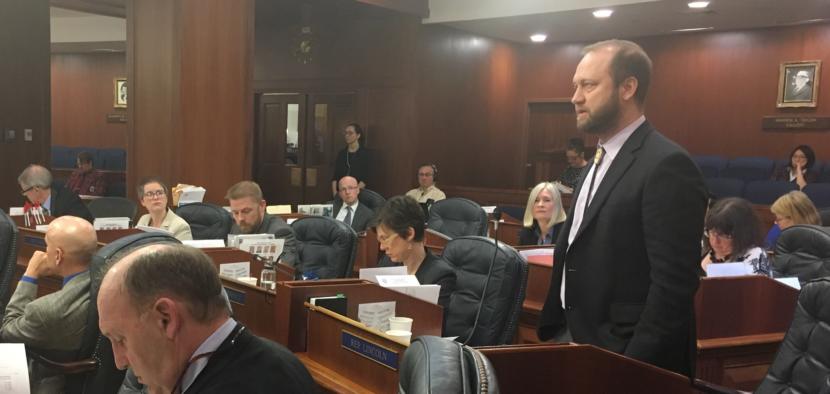
Rep. John Lincoln, D-Kotzebue, speaks about an amendment to the capital budget bill that would pay full, roughly $3,000 permanent fund dividends. The amendment failed on the House floor in the Capitol in Juneau, June 12, 2019. (Photo by Andrew Kitchenman/KTOO and Alaska Public Media)

The Alaska House passed the capital budget Wednesday. But a crucial vote to draw money from the Constitutional Budget Reserve, a state savings account, failed to get the 30 votes needed to pass.

With large differences remaining over permanent fund dividends, that means the special session will likely end Thursday or Friday with more work left to do.

Much of the debate on the capital budget bill, Senate Bill 19, focused on a proposed amendment to pay full PFDs of roughly $3,000.

The amendment was defeated, with 21 votes against it and 15 in favor.

Supporters of paying full dividends say failing to follow the formula set in a 1982 law would violate the trust of the public.

Homer Republican Rep. Sarah Vance supported the amendment. She said dividends help families like hers cover daily costs.

“It has brought heat to our home,” she said. “The first thing we do that week of the check is that we immediately go to Costco and buy the food that will get us through for the winter. We buy the children clothes and we pay on past bills — the $1,000  emergency visit for when my little boy cut his finger and I couldn’t get the bleeding to stop.”

Opponents say the full dividend would violate a law passed last year to limit draws from permanent fund earnings. And that the cost of more than $1 billion would lower the permanent fund forever.

Kotzebue Democratic Rep. John Lincoln said covering the cost of higher dividends will hurt some residents more than others. He noted that Gov. Mike Dunleavy proposed shifting oil property taxes from municipalities to the state to balance the budget.

“There’s some times where — when we’re talking about North Slope oil revenue and all the revenue coming to the state — I feel like we should all be wearing fancy wigs and speaking with a British accent because I feel like I’m participating in a little bit of a … colonizing force,” he said. “I hear a lot of comments about being able to pay a full dividend on the backs of massive transfers of wealth from the North Slope and other communities.”

Thirteen Republican representatives who are in the minority caucus voted against drawing money from state savings to pay for the capital budget. They were unwilling to vote for the draw without the full PFDs. While 23 House members voted for it, 30 members are needed to pass draw from the Constitutional Budget Reserve.

Dunleavy could immediately call the Legislature into a second special session to deal with dividends and the capital budget.


Watch the latest legislative coverage from Gavel Alaska.

Interior: Arctic Refuge lease sale still on track for 2019

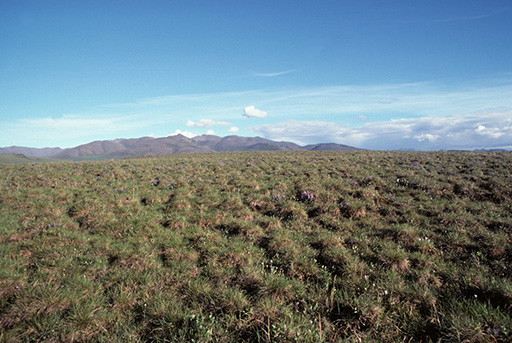
Tussock tundra on Arctic National Wildlife Refuge coastal plain.
Tussock tundra on Arctic National Wildlife Refuge coastal plain. (Photo courtesy U.S. Fish and Wildlife Service)

The Trump administration remains on track to hold an oil lease sale in the Arctic National Wildlife Refuge this year, a top U.S. Interior Department official confirmed Thursday.

Interior is working on a final draft of an environmental impact statement for its oil leasing plan in the refuge’s coastal plain.

Speaking at the Alaska Oil and Gas Association’s annual conference in Anchorage, Interior Assistant Secretary for Land and Minerals Management Joe Balash said he expected that document to be released by August.

“Once we have a final EIS, we will be in a position to issue a record of decision and notice of lease sale,” Balash said. “And that lease sale will happen in 2019.”

Congress legalized drilling in the refuge in 2017, as part of the Tax Cuts and Jobs Act. The legislation required Interior to hold the first Coastal Plain lease sale within four years of its passage.

Interior Assistant Secretary for Land and Minerals Management Joe Balash, a former Alaska Department of Natural Resources commissioner, answers questions from the Alaska Senate Resources Committee on Feb. 28, 2014. (Photo by Skip Gray/Gavel Alaska)

Balash said Interior received over one million comments on its draft plan for leasing in the refuge.

Also at the conference, Alaska Department of Natural Resources Commissioner Corri Feige said the state aims to hold its annual oil lease sale on the same day as the Arctic Refuge oil lease sale.

In his remarks, Balash also commented on a recent court ruling that blocked the Trump administration’s move to reopen large portions of the Arctic Ocean to offshore oil leasing, calling it “really unfortunate.”

The Trump administration appealed the ruling this week. But Balash indicated he had reservations about how the 9th U.S. Circuit Court of Appeals — which has ruled against the Trump administration on several key cases — will respond.

“We have to go through the 9th Circuit, since it was Judge (Sharon) Gleason’s decision. Everybody in this room knows what kind of a hurdle that is,” Balash said. “We have a lot of work in front of us before we are going to know exactly what the future holds for the Arctic OCS.”

Remove your rings and get out your card blanket: A table-side view of one of Utqiaġvik’s most animated card games

From left to right: snerts players Christina Kanayurak, Lilly Kanayurak, Karen Hopson, Clara Oenga and Nora Jane Adams. April 17, 2019. (Photo by Ravenna Koenig/Alaska’s Energy Desk)

There’s a card game played all over Alaska that’s chaotic, competitive and lightning fast. It goes by many names — but on the North Slope it’s known as “snerts.”

And in Utqiaġvik — where a snerts tournament is even part of Piuraagiaqta, the local spring festival, and groups of die-hard enthusiasts play on a regular basis — it’s one of the most popular games in town.

On a sunny evening in Utqiaġvik, six women gather at Karen Hopson’s house to play. Most of them are related to each other, and most of them grew up playing snerts. Lilly Kanayurak — Hopson’s mother — remembers playing with her grandparents and their friends when she was a little kid.

“There would be tea and homemade bread and candy, hard candy on the sides,” she said. “And just a lot of fun and competition.”

This group started getting together to play on a regular basis a few years ago, but the frequency of their games varies. In the winter they might play three games a week; other times they might go a few months without playing; one time they played 14 days straight.

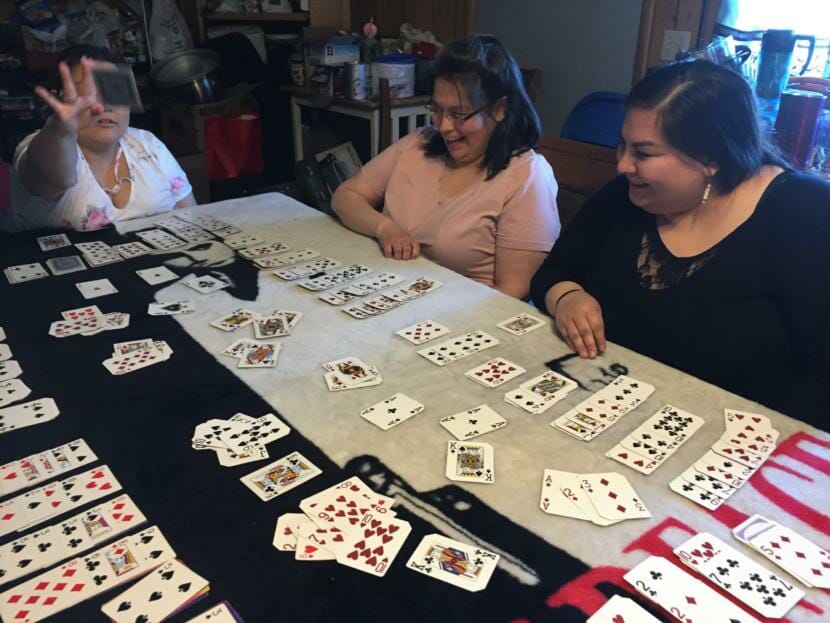
Christina Kanayurak (left) mid-discard during a game of snerts with her mother, Lilly Kanayurak, (center) and sister, Karen Hopson (right). April 17, 2019. (Photo by Ravenna Koenig/Alaska’s Energy Desk)

The first step to playing the game is spreading a blanket over the big kitchen table. This one happens to be emblazoned with Al Pacino’s gun-toting silhouette from the movie “Scarface.” The intention is to keep the cards from sliding all over the place. “We’re going to be throwing the cards very fast,” said Corrine Danner by way of explanation.

The group settles themselves around the table as kids play happily in the background, and each lays out a deck of cards in front of her.

Snerts is a technical game that’s impossible for a casual observer to make sense of. But the easiest way to describe it would be a kind of competitive solitaire, where everyone is playing their hand simultaneously, either with a partner or by themselves.

There are different ways to play it, and a long list of different names it’s known by, including “nertz,” “peanuts,” “squeal,” “scrooge” and “racing demon.”

It didn’t originate in Utqiaġvik, but it’s very much of this place. David Parlett, a card game expert, says it’s a widespread game that’s been played for well over a century — adding that the variety of names is living proof of its popularity. And in Alaska it’s played all over the place — an informal Twitter survey looking for players of the game drew responses from areas in the Northwest Arctic, the Interior and Bristol Bay.

The game is played at high velocity — with people slinging cards across the table and trying to discard ahead of their competitors. And of course, there’s the possibility of some turbulence along with that: “I have to take my wedding ring off because it can scratch somebody really bad,” said Danner.

Different versions dictate different ways to win the round — but you always say the same thing when you do: “Snerts!”

This is one version of the card game known as snerts. It’s the one that Lilly Kanayurak says she grew up playing, and is more commonly played in Utqiaġvik. (Video by Ravenna Koenig/Alaska’s Energy Desk)


This is a variation on the more commonly played Utqiaġvik snerts game, where the game starts with all 52 cards in the deck distributed to seven columns with three floating cards on the bottom. (Video by Ravenna Koenig/Alaska’s Energy Desk)

In Utqiaġvik, it’s mostly women who play. And this group convenes more in the wintertime, during the long stretches of cold and dark. But they get together whenever their schedules allow.

“At times our husbands, or their husbands and their uncles and brothers will be hunting,” said Danner. “We get bored and we try to either sew or play cards.”

Some men do play, said Hopson, “and some of them are really fast.”

“But … they don’t like people to know that they’re playing,” joked Lilly Kanayurak.

“Don’t post it on Facebook!” added Danner.

It’s easy to see why these women love the game: It’s quick and competitive, with lots of opportunities for teasing and laughter.

But it’s also just about seeing each other, getting a chance to catch up and check in.

Sometimes they share happy news or funny stories. But it also helps them get through hard times — like when they lost a close family member.

“I think we found a lot of strength in getting together, and joy,” said Lilly Kanayurak. “Finding that happiness again.”

Again and again they come back to this table, where they sit in a circle facing one another — laughing, sharing stories and talking through what’s going on in their lives, one snerts game at a time.

Site notifications
Update notification options
Subscribe to notifications