An LNG tanker fills up at the ConocoPhillips liquid natural gas export facility in Nikiski, Alaska. When it opened in 1969, it was the only facility of its kind in the U.S. to get a license to export its gas to Japan. For more than 40 years, the state has attempted to develop similar projects to bring natural gas from the North Slope to market, but none of those projects have broken ground. (Photo courtesy ConocoPhillips)
BP and ExxonMobil have committed up to $20 million to the state-run Alaska LNG project.
It’s the first time in years that private industry in the state has pitched in money to move the gasline project forward. Both companies, and ConocoPhillips, were investors in the project but backed out in 2016 citing unfavorable market conditions.
Lt. Gov. Kevin Meyer told a crowd at an oil and gas conference in Anchorage that the money will be used to get the project through the federal environmental review process. Meyer said Thursday that the two companies will also help the state determine whether the project can be more competitive.
“When the governor took office, he made it clear that we needed participants with the credentials and the resources necessary in order to make a project of this scope work. The involvement of BP and Exxon provides confidence that all future decisions regarding Alaska LNG will be rooted in world-class LNG experience,” Meyer said.
The Alaska LNG project would pipe natural gas from the North Slope to Nikiski, then transport it to Asian markets.
Damian Bilbao, vice president of commercial ventures for BP in Alaska, said the company has at least one big reason to put money into the project.
“Alaska gas remains BP’s single largest global undeveloped resource,” he said.
Bilbao said it’s significant that industry and the state are collaborating on the project again.
He credits Gov. Mike Dunleavy’s administration with working to bring private industry back into the process of getting the state’s natural gas to market.
“The governor talks about being open for business, and big businesses like ExxonMobil and BP step forward when both the project and opportunity make sense, but also when the right relationship exists with the sovereign,” he said.
Still, that doesn’t mean that the company believes the Alaska LNG project is more economically viable now than it was when BP stepped away from it.
“The state has made good progress over the last several years. And, working together with Exxon and (the Alaska Gasline Development Corporation), we think we can unlock some additional opportunities. But we’ll just have to see in a few months — after some work gets done — where the project is relative to other opportunities around the world,” he said.
The state’s gasline corporation will have about $23.5 million in the bank at the end of the current fiscal year. But corporation spokesperson Jesse Carlstrom wrote in an email that it will likely cost about $30 million to get through the environmental review with the Federal Energy Regulatory Commission. If that process stays on schedule, the state could get the final federal go-ahead by 2020.
Still, the project needs final engineering and design work as well as investors and customers to be economically viable.
The Beaufort Sea, one of the areas the Trump administration would like to re-open for oil drilling. Now Trump will have Alaska’s support in court. (Public domain photo by Harley D. Nygren/NOAA)
The Trump administration Tuesday appealed a federal court decision that blocked plans to reopen vast portions of Alaska’s Arctic waters to oil drilling.
In March, U.S. District Court Judge Sharon Gleason ruled that the president exceeded his authority when he issued an executive order undoing an Obama-era ban on oil leasing in large parts of the Beaufort and Chukchi seas.
An U.S. Interior Department spokesperson, Molly Block, declined to comment. The case will now go to the 9th U.S. Circuit Court of Appeals.
The Interior Department had pushed to hold an oil lease sale in the Beaufort Sea as soon as this year.
But a coalition of environmental groups sued. They argued the 1953 law that gives presidents the power to permanently bar offshore oil development in some areas does not allow a subsequent president to reverse such a decision.
The March ruling has led to significant uncertainty about how the Interior Department will proceed as it prepares a new, five-year offshore oil and gas leasing plan for the U.S. At stake is about 128 million acres of the Arctic and Atlantic oceans, an area twice the size of Colorado.
In a statement Tuesday, League of Conservation Voters President Gene Karpinski said conservation groups, “look forward to defending the district court’s decision at the 9th Circuit.”
“Offshore drilling and the associated threat of devastating oil spills puts coastal economies and ways of life at risk,” Karpinski said.
Alaska’s political leaders and the oil industry argue that Arctic offshore drilling can be done safely, saying that Gleason’s decision prevents development of what could be billions of barrels of oil in the outer continental shelf.
“One president should not have the power to lock up Alaska’s resources in perpetuity,” Gov. Mike Dunleavy said in a statement shortly after the March decision.
Oil Search Alaska President Keiran Wulff. (Photo by Elizabeth Harball/Alaska’s Energy Desk)
The federal government has given a key approval to a large North Slope oil project.
Papua New Guinea-based Oil Search announced Thursday that it received a permit from the Army Corps of Engineers for its Pikka development, planned west of Prudhoe Bay.
While important, the Army Corps’ permit isn’t the final word on the project’s future — the company still needs more approvals before it can move forward.
Oil Search estimates the project could produce approximately 120,000 barrels of oil per day. The Trans-Alaska Pipeline System currently pumps some 500,000 barrels daily, so state analysts think Pikka has the potential to contribute significantly to Alaska’s future production.
“It’s a really important project to the state,” Oil Search Alaska President Keiran Wulff said in an interview earlier this year.
To produce that much oil, Oil Search plans to build up to three drill sites, about 25 miles of roads, about 35 miles of pipelines, a central processing facility, two bridges and an operations center with beds for 200 workers. During construction, the company says it could employ thousands.
Pikka would be on state and Native-owned land, as close as seven miles to the village of Nuiqsut.
One of the main questions about the project is how it will affect subsistence hunting and fishing for Nuiqsut residents. Oil Search has made several changes to the project to address the village’s concerns, like relocating infrastructure and planning a new boat ramp for residents on a nearby river.
“We are committed to close collaboration with the people and organizations of Nuiqsut,” Wulff said in a statement accompanying Thursday’s announcement.
But an Oil Search spokesperson said the company is still in talks to reach a land-use agreement with Kuukpik Corporation, the Alaska Native village corporation for Nuiqsut. And the company will need dozens more state and local permits before it can begin construction.
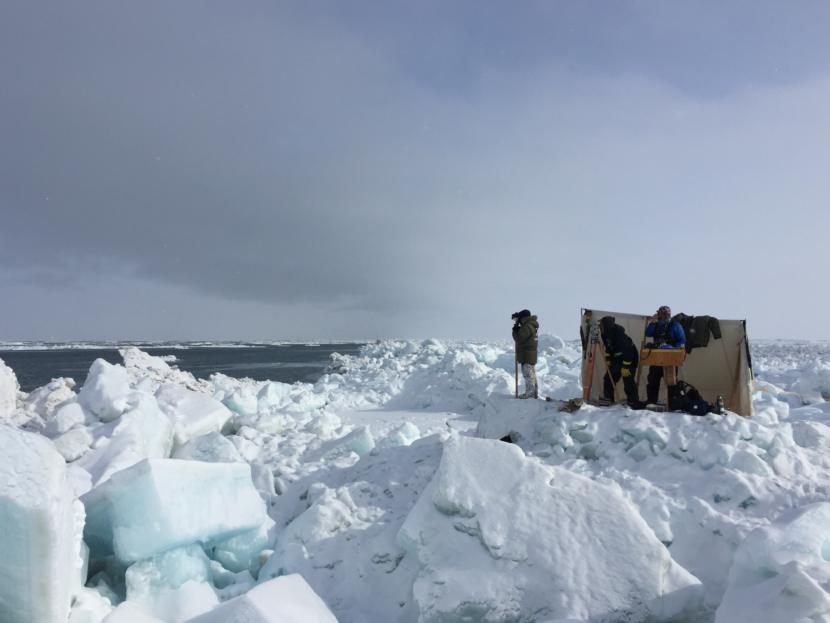
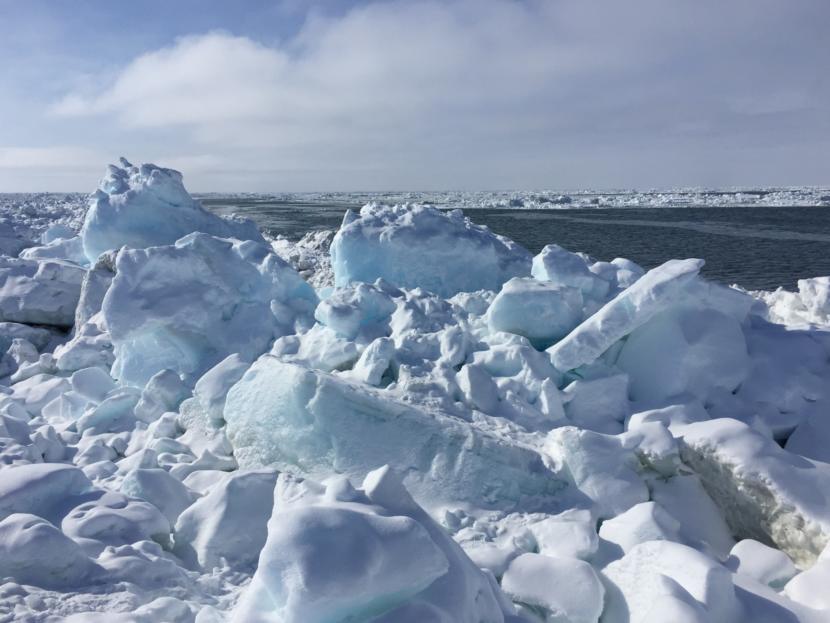
The “perch,” which from which rotating shifts of observers look for whales as part of the North Slope Borough’s bowhead whale census, April 16, 2019. (Photo by Ravenna Koenig/Alaska’s Energy Desk)
This spring, the North Slope Borough conducted a census — not of people, but of the western Arctic bowhead whale population. They do the count with their own eyes out on the sea ice off Utqiaġvik, where surveyors have to remain on high alert for polar bears and shifts in weather and current that might break up the ice under their feet.
It’s one of the best ways scientists have to get a whale count that helps forms the basis of Alaska Native hunters’ subsistence quota.
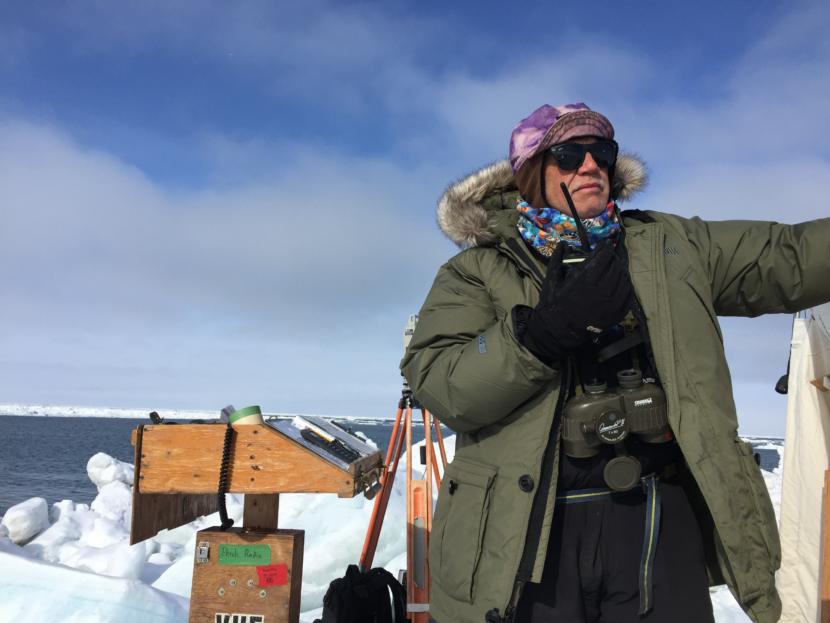
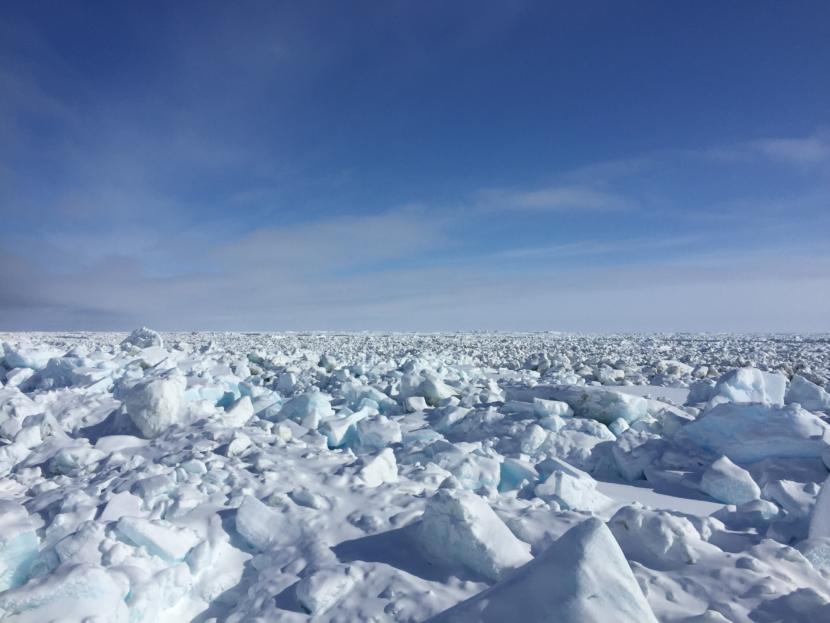
Craig George stands high up on a mound of sea ice overlooking the Chukchi Sea, his back to a moonscape of white and blue shards of ice. He’s scanning the horizon with a pair of binoculars and using a small wooden podium to write down weather conditions and whale sightings.
So far this shift, he’s seen exactly zero whales.
“Pretty quiet guys, I’m surprised,” he says to the other two men standing next to him at the perch.
“Seeing some seals,” says Darren Kayotuk.
“Yeah let’s start counting seals,” George jokes dryly.
George is a wildlife biologist with the North Slope Borough, and the census coordinator. He’s been participating in the census a long time — the first one he helped with was all the way back in 1980.
Craig George has been working out on the ice as part of the whale census since 1980. April 16, 2019. (Photo by Ravenna Koenig/Alaska’s Energy Desk)
The census started back in the 1970s, when the international commission that regulates whaling was concerned that there weren’t enough whales to support a traditional subsistence hunt.
In those early days, there were a lot of things scientists didn’t know about how the whales behaved. That made it hard for them to get an accurate count.
For example, says George, they didn’t know that whales could swim under heavy ice cover and would also travel far offshore where they couldn’t be seen.
“That was a real eye-opener,” says George, “realizing that there’s times when we only see a small fraction of the whales.”
Scientists learned about that and other whale behaviors from Iñupiaq whalers. And they documented it by putting hydrophones down in the water — which meant they could show that whales were going by, even when they couldn’t see them.
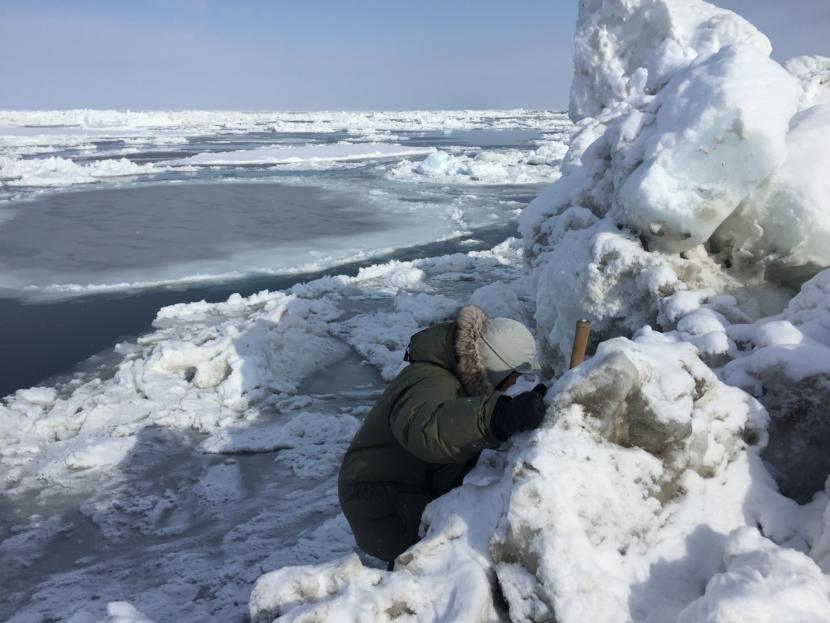
They still use those techniques today. As George stands looking out at whale-free water, Kate Stafford, an oceanographer at the University of Washington, clamors down to the edge of the ice and drops a microphone below the surface. Sure enough, she can hear bowheads off in the distance.
Kate Stafford climbs down to the water edge to put a hydrophone into the water and listen for whales, April 16, 2019. (Photo by Ravenna Koenig/Alaska’s Energy Desk)
In addition to whale behavior, there was a whole other set of lessons the census takers needed to learn — namely, how to stay safe on the ice. And that, says George, is almost impossible to figure out anywhere but out on it.
“There’s not like a formal Iñupiaq classroom, you sit down, ‘Today we’re going to discuss the principles of sea ice and sea ice safety,'” he says. “That doesn’t happen. It’s like, ‘Malik,’ you know? ‘You follow.'”
Over the decades, George has spent many, many hours out on the ice learning from whaling captains about how the ice forms, how it moves, how to recognize when it’s safe, and when it’s about to get dangerous.
“You don’t learn anything unless something goes wrong,” he says. “I mean, that’s not entirely true, but that’s where you really learn.”
He’s seen plenty of things go wrong. The most memorable, he says, was back in 1985, when a heavy piece of ice floating out on the ocean hit the shore-fast ice a considerable distance from where they were camped.
“The force transmitted through the ice, and then suddenly this big pan we were on — I don’t know, quarter-mile wide — it started breaking up,” he remembers. “And it shattered, broke down the middle. … It kept breaking up more and more, and then it started folding and water was rushing up between the pieces.”
Scary as that sounds, they did make it to safety.
George refers to this event pretty nonchalantly — he says it was a good learning experience.
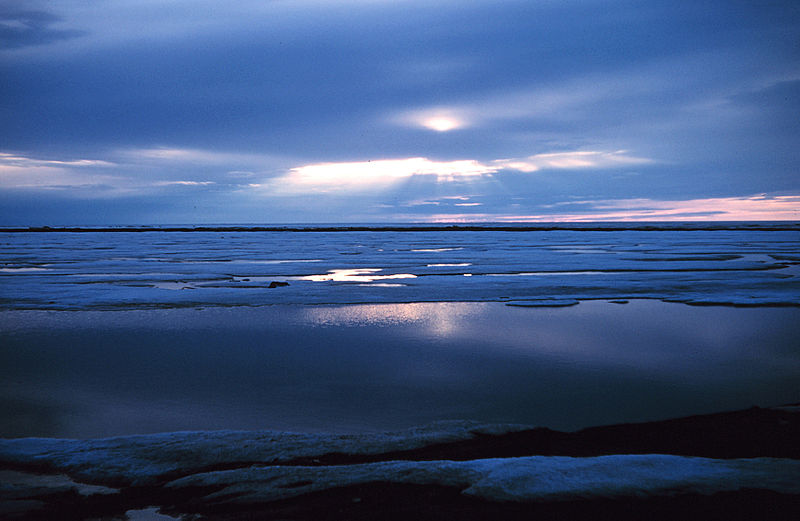
The view of the ice and the ocean from the “perch,” April 16, 2019. (Photo by Ravenna Koenig/Alaska’s Energy Desk)
It also helps that they stay in regular communication with the whalers who are out on the ice doing their spring hunt.
“If we see something happening, we get on the radio, on the whalers’ channel … or they call us,” he says. “We become part of the community on the ice when we’re out here.”
If things get dicey, the group pulls back. That, along with weather and ice conditions that sometimes get in the way of seeing whales, means that some census years they don’t get a good estimate out on the ice.
“One out of 3 of these counts actually works,” says George.
But the estimate plays a critical role in northern Alaska communities’ continued ability to whale.
Subsistence hunters have a quota, and even though they only harvest an average of 40 whales out of a population that was estimated at around 17,000 the last time they did the count, the quota is dependent on a good population estimate every decade.
There are other ways to do that count, like aerial surveys. One is actually being done independently by the federal government this summer. It was planned as sort of insurance — in case the ice-based census didn’t yield a good count. But the ice-based method is more precise, so they’d like to have both.
Plus, despite the fact that being out here requires some vigilance, it’s also really beautiful.
The view of the ice looking back toward shore, April 16, 2019. (Photo by Ravenna Koenig/Alaska’s Energy Desk)
And for George, it’s the best part of the job. He loves watching bowhead whales.
“They’re just so graceful and beautiful. Every time I see a whale I get excited,” he says. “I’ve seen thousands and thousands,” he goes on, “it’s always like seeing a bowhead for the first time.”
The ice is changing as temperatures warm in Utqiaġvik, and George says he doesn’t know exactly what the census will look like in the years ahead. They may shift to using more aerial techniques as the ice gets less stable, or maybe they’ll figure out how to do a count using satellite images.
But for now at least, the census remains part of the “community on the ice.”
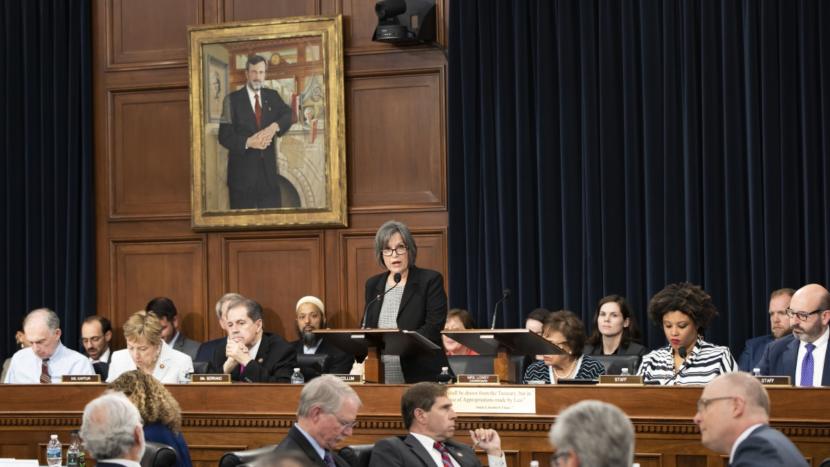
Rep. Betty McCollum, D-Minn., addresses the U.S. House of Representatives Committee on Appropriations, Wednesday, May 22, 2019. (Photo courtesy Office of Rep. Betty McCollum)
Democrats in Washington, D.C., are still hoping to block drilling in the Arctic National Wildlife Refuge. The latest attempt surfaced at a U.S. House of Representatives committee meeting.
Rep. Betty McCollum, D-Minn., said she’s just trying to hold Republicans to what they said when they put ANWR drilling in their 2017 tax bill.
“The first lease sale was supposed to raise $1 billion. That was all part of the tax bill — to make it work,” she told the House Committee on Appropriations on Wednesday. As an Appropriations subcommittee chair, McCollum drafts the bill that funds the U.S. Department of the Interior.
Half the lease revenue is supposed to go to the state of Alaska, and half to the federal treasury. So McCollum’s bill says the Interior Department can’t hold a lease sale unless it sets a minimum per-acre bid high enough to raise half a billion dollars.
“If the (Interior) Department leases a minimum of 400,000 acres, as required by law, then all they need to do is put out a lease sale that requires companies to bid $2,500 per acre,” she said.
That’s an enormous amount. The highest bids in the National Petroleum Reserve in Alaska, west of ANWR, haven’t even crested $100 per acre in years.
Republicans tried to remove the ANWR hurdle.
“I have an amendment that’s supported by the entire — unanimous support of the Alaskan congressional delegation,” said Rep. Ken Calvert, R-Calif., making a little joke about the fact that Alaska has just one House member: Republican Congressman Don Young.
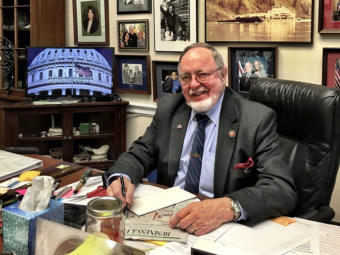
Rep. Don Young, R-Alaska, in his Washington, D.C., office. (Photo by Liz Ruskin/Alaska Public Media)
Young isn’t on the House Appropriations Committee, so Calvert made the case to remove McCollum’s restriction on ANWR leasing. Calvert pointed to government estimates saying there’s probably a lot of oil up there.
“In addition to creating jobs, opening the area will allow us to reduce our dependence on foreign sources of oil and increase our exports of oil,” he said.
Calvert’s amendment failed, so the ANWR stumbling block remains in the Interior spending bill. The House Appropriations Committee approved the bill, sending it to the full House.
Democrats and environmental groups are trying to draw attention to the refuge, to keep the issue alive and to do what they can to slow the Interior Department’s progress toward leasing there. But the chances of this provision becoming law are minimal.
The author of the Senate version of the spending bill is Sen. Lisa Murkowski, R-Alaska, and she’s eager to see oil development in the Arctic Refuge.
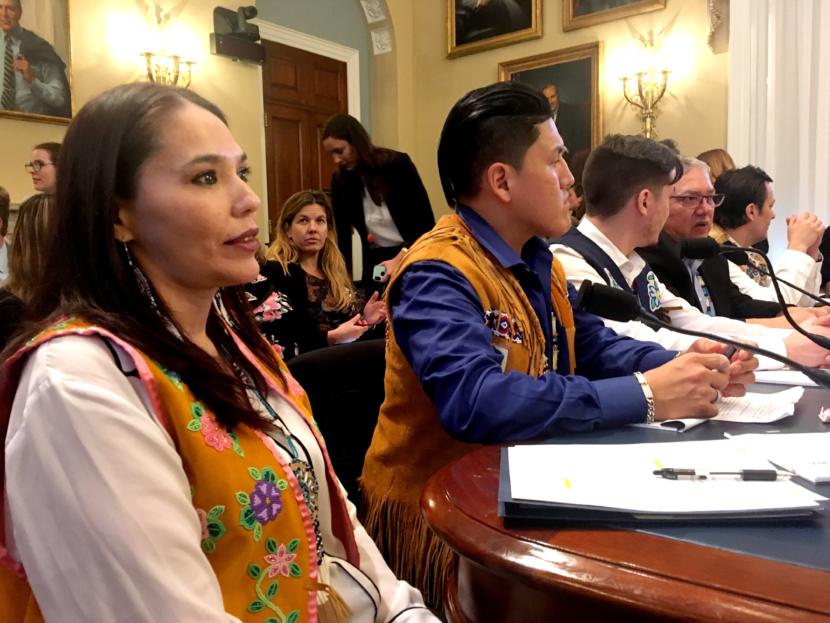
Bernadette Demientieff, director of the Gwich’in Steering Committee, waits to testify at a U.S. House hearing on the Arctic National Wildlife Refuge. (Photo by Liz Ruskin/Alaska Public Media)
A small crowd shouting “BP, back off!” marched on BP’s American headquarters in Denver on Monday, demanding the oil conglomerate not drill in the Arctic National Wildlife Refuge.
It’s part of a larger effort by environmental groups to target oil companies and also banks.
While the demonstration in Denver was underway, an architect of the broader strategy was on a long-distance train, traversing the length of the United Kingdom.
Sierra Club campaign representative Ben Cushing is normally based in Washington, D.C., but BP’s annual shareholder meeting this year is in Aberdeen, in northeastern Scotland, so that’s where he was headed.
With him was Bernadette Demientieff, an anti-drilling activist from Fort Yukon. They or other ANWR drilling opponents will be at the annual meetings of four major oil companies.
Cushing said they’ve set their sights on lenders, too.
“Wells Fargo, JPMorgan Chase, Citi, Bank of America, Goldman Sachs and Morgan Stanley. We’ll be attending the shareholder meetings of all six of those banks this shareholder season and asking them point-blank if they will commit to not investing in Arctic Refuge drilling,” Cushing said.
Cushing said they’ve got proxy status, thanks to a few owners of stock who agreed to let the activists represent their shares. It allows them to confront company executives directly, in the Q&A portion of the shareholder meeting.
“I know it’s hard for people who live in a city like Houston to understand what our lives are like, or why this place means so much to us,” Demientieff said in Texas last week, as she made her case to ConocoPhillips’ chief executive officer at that shareholder meeting.
Demientieff is the executive director of the Gwich’in Steering Committee, a U.S.-Canadian Indigenous advocacy group. The Gwich’in leaders argue drilling in ANWR could devastate the Porcupine caribou herd that’s central to their culture and subsistence lifestyle.
Kara Moriarty, president and CEO of the Alaska Oil and Gas Association, testifies in the House Finance Committee in the Alaska Capitol on April 11, 2018. (Photo by Skip Gray/360 North)
“We have lived in this area for thousands of years. Don’t take that from us,” she pleaded. “You have the ability to stop this, or at least you not going in there.”
ConocoPhillips CEO Ryan Lance was polite and didn’t show his cards. He said he understands the importance of subsistence hunting and told Demientieff ConocoPhillips has a good record in the Arctic.
“Appreciate your coming today. Appreciate your passionate plea as well, so thank you,” Lance told her.
Alaska Oil and Gas Association President Kara Moriarty said if oil companies were scared off by demonstrators and activists, Alaska would not have had an oil industry to start with.
“Companies make decisions on where they want to invest and develop on a variety of factors, and (the Gwich’in Steering Committee’s) demonstration of their position is nothing new,” Moriarity said.
Demientieff said she believes drilling opponents will make a difference at the meetings, in part by getting the attention of shareholders.
Close
Update notification options
Subscribe to notifications
Subscribe
Get notifications about news related to the topics you care about. You can unsubscribe anytime.