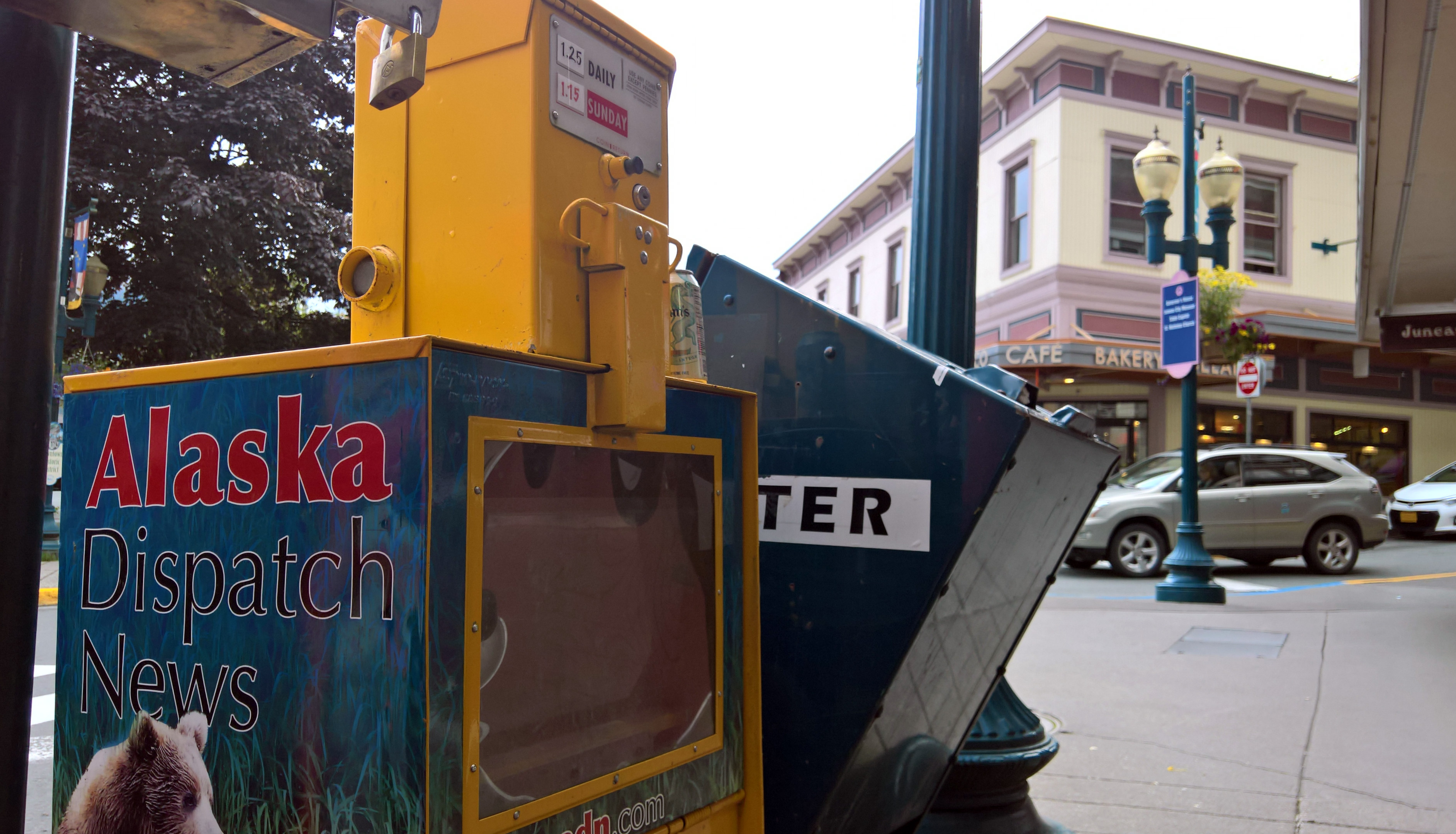
On Aug. 14, 2017, the sidewalk near the corner of Front and Seward streets had one of the few Alaska Dispatch News vending machines in Juneau. In September that year, the paper was purchased and later rebranded back to the Anchorage Daily News. (Photo by Jeremy Hsieh/KTOO)
The Anchorage Daily News’ owners have bought three other small Alaska newspapers.
That’s according to Jason Evans, the former owner of those papers: the Arctic Sounder, Bristol Bay Times/Dutch Harbor Fisherman and Homer Tribune. All three were published by Evans’ company, Alaska Media, LLC.
Evans said he also gave up an ownership interest in the ADN. He said the separation was amicable and that the papers will mutually benefit.
“I think there’s just more synergies of doing the sale, and allowing them to be merged into the Anchorage Daily News operations,” Evans said. “You know, just a team of really highly qualified people to kind of focus not just on their own newspapers but also on ours. And so I thought it was just a great fit going forward to continue to provide community news out into these rural regions.”
Evans said his newspapers and the ADN had maintained content sharing agreements for years, pre-dating the Binkley Company’s purchase of the ADN in 2017. Evans declined to disclose dollar figures and circulation numbers.
“We also kind of kept things a little quiet until we figured out what the plan was,” Evans said. “And as the plan came together, you know, I shared it with folks on my team. I think they’re excited to be a part of a larger news organization with additional resources that we as a small company didn’t have.”
Evans said he’s thankful and that it’s been an honor to serve the communities over the last eight years.
ADN CEO Ryan Binkley could not be reached for comment but was quoted in the ADN:
“Our family is thrilled to add the Arctic Sounder, the Bristol BayTimes/Dutch Harbor Fisherman and the Homer Tribune to the ADN’s lineup of publications. These kind of community publications are so vital to life in the areas they cover, and being part of a larger organization will help ensure they have the resources they need to continue the important work they’re doing. Life in these communities is unique, and they deserve a healthy and robust source of local news.”
The Binkley Company also owns the Alaska Journal of Commerce and the Chugiak-Eagle River Star.
If you ask anyone at BP about its 3D seismic program at Prudhoe Bay this winter, they’ll tell you it’s a big deal for the oil company.
Take Richard Beavers, a seismic health, safety and environment expert at BP who is helping oversee the program. He said he’s considering getting a tattoo on his arm to remember it by.
“I’m going to get a polar bear,” Beavers said, with “seismic imaging in the polar bear.”
If you’ve heard the term “3D seismic” lately, it was probably in the context of the controversy over oil exploration in the Arctic National Wildlife Refuge. There were plans to do 3D seismic in the Refuge this winter, but those plans didn’t pan out.
But you might still be wondering: What is 3D seismic? And why do oil companies do it?
This winter, a visit to already developed state land next door to the Arctic Refuge provided a good primer on what 3D seismic technology is all about.
The basic purpose of 3D seismic is to look for oil, so it might seem odd that BP is doing it in a place where oil was discovered long ago. But today, Prudhoe Bay is sending a lot less oil down the pipeline than it did when it started up over four decades ago. BP, which operates Prudhoe Bay, has worked hard to flatten production there after years of decline.
The 3D seismic survey is part of the effort to keep the oil field alive for decades to come.
“We’re looking for small pockets of oil that haven’t been produced yet,” said BP’s Robert Pool.
Pool is a seismic acquisition specialist for BP. And on a not-too-chilly March day, Pool acted as a North Slope tour guide, showing a group of reporters how 3D seismic works.
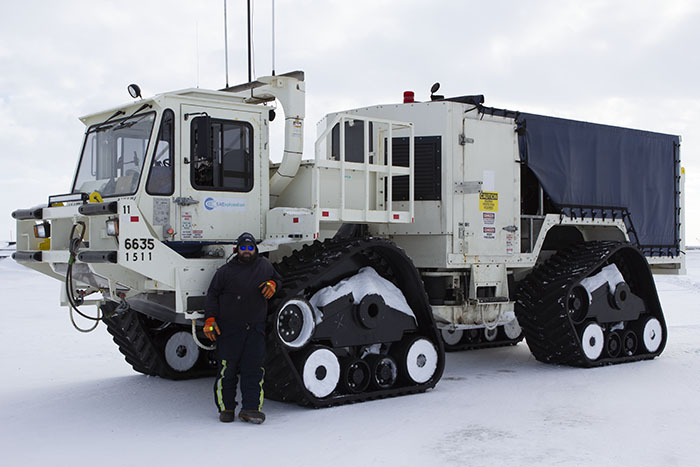
A worker stands in front of a vibe truck being used as part of BP’s 3D seismic program at Prudhoe Bay this winter. (Photo by Elizabeth Harball/Alaska’s Energy Desk)
We exited a bus and stepped on to a snow-covered gravel pad near the heart of Prudhoe Bay. On the flat horizon, there were pipelines, drill rigs and a big olive-green pump station facility. Here, we got an up-close view of one of the key pieces of equipment used with 3D seismic: a vibe truck.
It’s about the size of a cement truck, weighing in at 93,000 pounds. Instead of tires, it’s on wide tracks designed to help protect the tundra. It rolled along at 3 miles per hour. And every 110 feet it stopped, and that’s when the action happened.
A big, flat metal platform slowly descended from the belly of the truck and made contact with the ground. Pistons above the platform began moving faster and faster. Eventually, standing right next to the truck, we could feel the ground vibrating below our feet — a tingling sensation coming from beneath our boots.
“We’re sitting on six feet of gravel,” said Pool. “When we’re out on the actual tundra, you can feel it a little more.”
The vibe trucks perform just one step in a much bigger process. In fact, there are well over 100 workers in vehicles and stations all around the trucks. Some travel in front of the vibe trucks, checking for hazards. Others set up a grid of receiver devices around where the trucks are working. Others, in mobile blue buildings on tracks, direct the trucks and begin the process of downloading the data.
The vibe trucks create sonic energy that travels thousands of feet below the ground, echoes off the rocks below and gets picked up by the receivers that record the data.
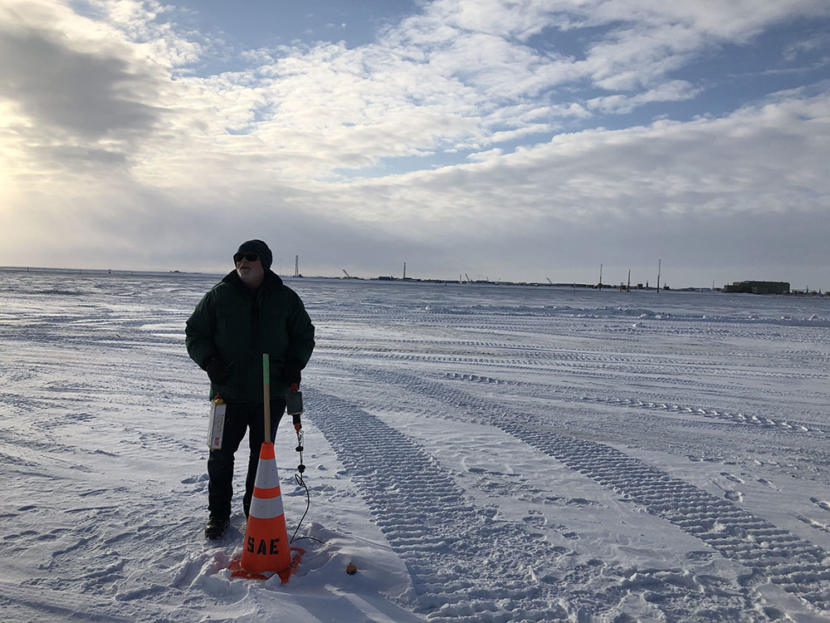
“As the energy wave goes through the subsurface, the rocks are in layers, and the layers are based in hardness,” Pool explained, standing over a receiver marked by an orange traffic cone. “A harder layer, the sound wave goes through faster. And a softer layer, it goes through slower.”
The receivers pick up those differences in the sound waves bouncing back. The array of receivers work together to measure the wave front as it blossoms to the surface. BP processes that data with computer programs to create a “cube” of seismic information — that’s the 3D part.
“Our cube is going to be 400 square miles big, of data,” Pool said.
Using the data they collect, BP can piece together a detailed picture of the geology below, helping the company find hidden pockets of oil they haven’t drilled yet. The contractor doing the work for BP is SAExploration, the same company that had been planning on doing a survey in part of the Arctic National Wildlife Refuge this winter.
BP’s Richard Pool stands next to a receiver, which picks up sonic waves sent by the vibe trucks. (Photo by Elizabeth Harball/Alaska’s Energy Desk)
According to Pool, this winter’s survey at Prudhoe Bay is the biggest of its kind ever done in the Arctic. It will ultimately sweep over 450 square miles.
“It’s an impressive project,” Pool said.
From January until April, the vibe trucks are traveling back and forth — and back and forth and back and forth — making passes from west to east, all across Prudhoe Bay.
By March 27 — the day of the reporter tour — Pool said the crew had driven a total of 39,800 miles.
“That’s more than once around the world,” Pool said.
The team is working in shifts, pretty much nonstop, 24 hours a day, seven days a week. They even bring fuel out to the vehicles as they work.
That’s so they can squeeze the whole project in to a single winter season. The state only allows the company to do this work when the tundra is frozen and covered with a certain amount of snow, to minimize damage.
“A winter seismic survey does mitigate a lot of your general environmental concerns and impacts,” said Chrissy Pohl, BP’s permitting and regulations adviser for wildlife and environmental studies. “By having these heavy trucks on snow and ice rather than directly on the tundra, you’re hopefully walking away with no visible sign that a survey ever occurred.”
BP works to cut down on other environmental impacts during the 3D seismic program, such as impacts to wildlife.
Because Prudhoe Bay area is polar bear habitat, BP needed federal authorization to conduct 3D seismic there. Before the program started, the oil company did two aerial surveys using infrared technology, searching for potential polar bear dens. Had the company found a polar bear den — which they did not — there would have been a one-mile buffer zone around the den where no 3D seismic would have been allowed.
BP did find three grizzly bear dens in the project area, and those dens have buffer zones, too.
Environmental groups have voiced strong opposition to the prospect of 3D seismic work in the Arctic National Wildlife Refuge, especially when it comes to potential impacts to polar bears. Such opposition has not materialized for BP’s work at Prudhoe Bay.
“Seismic operations in areas that are already industrialized, such as near Prudhoe Bay, are not of great concern,” explained Lois Epstein, Arctic program director with the Wilderness Society in Anchorage. “To us, it makes sense to produce additional oil from areas that already have been adversely impacted by oil development.”
Epstein said her group is against to seismic operations “on sensitive, wild public lands” like the Arctic Refuge’s coastal plain or ecologically rich areas in the National Petroleum Reserve-Alaska.
As for Richard Beavers’ polar bear tattoo, he’s not completely sure he’s going ahead with it. But that’s not the only way he’s commemorating the 3D seismic effort. He’s also growing a beard for the duration of the project, even though he said he’s not really a beard guy.
“I’m done with it. Soon as the survey’s over: April 16, the beard gets shaven off for sure,” Beavers said.
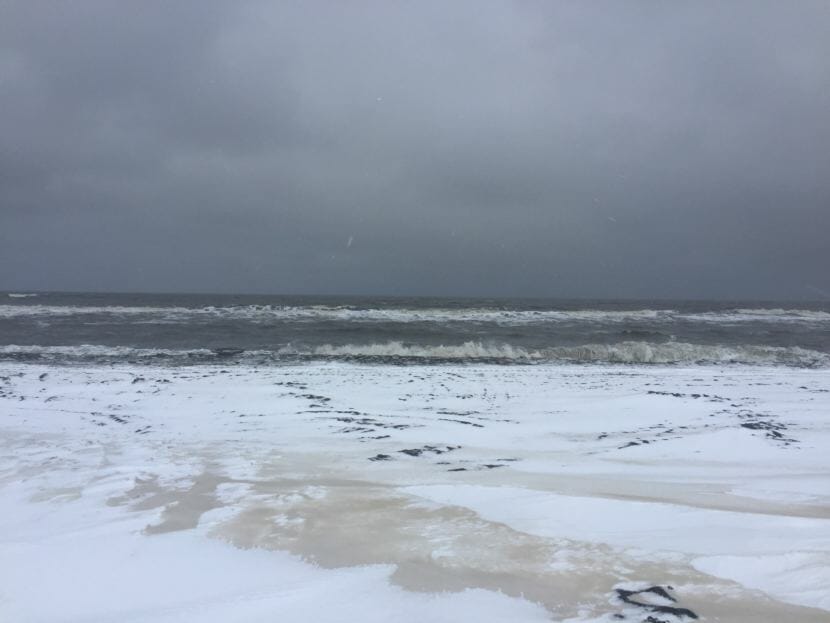
The view of the Chukchi Sea from the Utqiaġvik coastline, October 26th, 2018. (Photo by Ravenna Koenig/Alaska’s Energy Desk)
The long-running saga of offshore oil development in Alaska has taken a new twist: A court ruling handed down late Friday blocked the Trump administration’s plans for oil lease sales in large portions of Arctic waters.
U.S. District Court Judge Sharon Gleason, in an opinion released late Friday, said President Donald Trump exceeded his authority by issuing an executive order in 2017 that reopened large parts of the Beaufort and Chukchi seas to offshore oil leasing.
Former President Barack Obama had banned development in those areas in his second term, saying they were too environmentally sensitive to drill.
But Friday’s decision once again blocks oil development in some 128 million acres of the Arctic and Atlantic oceans, an area twice the size of Colorado. It elicited cheers from conservation groups and condemnation from Alaska’s oil and gas industry boosters, who had hoped for lease sales as soon as this year.
“As of today, the law of the land is that the vast majority of the Arctic Ocean is permanently off-limits to oil and gas leasing. So that’s a really big deal,” said Erik Grafe, an Earthjustice attorney who helped argue the case. “It’s a great victory, and it was one of the great conservation actions of the Obama administration to take the vast majority of the Arctic off the table.”
Alaska Oil and Gas Association President Kara Moriarty said her group is disappointed by the ruling. The trend of on-again, off-again lease sales in Arctic waters isn’t attracting oil and gas investment to the state.
“The message that this sends is that maybe America isn’t open to having this awesome federal opportunity available for lease,” Moriarty said.
She added that she’s hopeful the decision can be appealed and overturned, saying there’s “huge potential” in offshore Arctic waters.
The lawsuit hinged on a single line in the Outer Continental Shelf Lands Act, which governs offshore leasing: “The President of the United States may, from time to time, withdraw from disposition any of the unleased lands of the outer Continental Shelf.”
Environmental groups argued that that language gave presidents the power to withdraw offshore areas from oil development, but not the other way around. The Trump administration argued that the language gives the president implied authority to put offshore areas back on the table.
Gleason, an Obama appointee, ruled in favor of the environmental groups’ interpretation.
“Had Congress intended to grant the President revocation authority, it could have done so explicitly,” Gleason wrote in her decision.
With Democrats now in control of the U.S. House of Representatives, it’s unlikely Congress will act to give Trump that power any time soon. Rep. Raúl Grijalva, D-Ariz., chairman of the House Committee on Natural Resources, praised Gleason’s order in a statement, calling it a “reckoning” for Trump.
But in an interview Monday, Republican Sen. Lisa Murkowski called the ruling “wrong as a matter of law and wrong as a matter of policy.”
“I do understand that there is some ambiguity within the law — I think she has seized on that,” Murkowski said, referring to Gleason. “But I would imagine that this is going to be appealed, and my hope is that they will make the right determination.”
The Trump administration has not said whether it will try to get a higher court to overturn the decision. An Interior Department spokeswoman, Molly Block, declined to comment Monday.
Gleason’s decision was the second one she released Friday in favor of environmental groups. In a different lawsuit, she rejected a Trump administration effort to facilitate construction of a road through a national wildlife refuge on the Alaska Peninsula.
This story has been updated. Reporters Liz Ruskin and Nat Herz contributed.
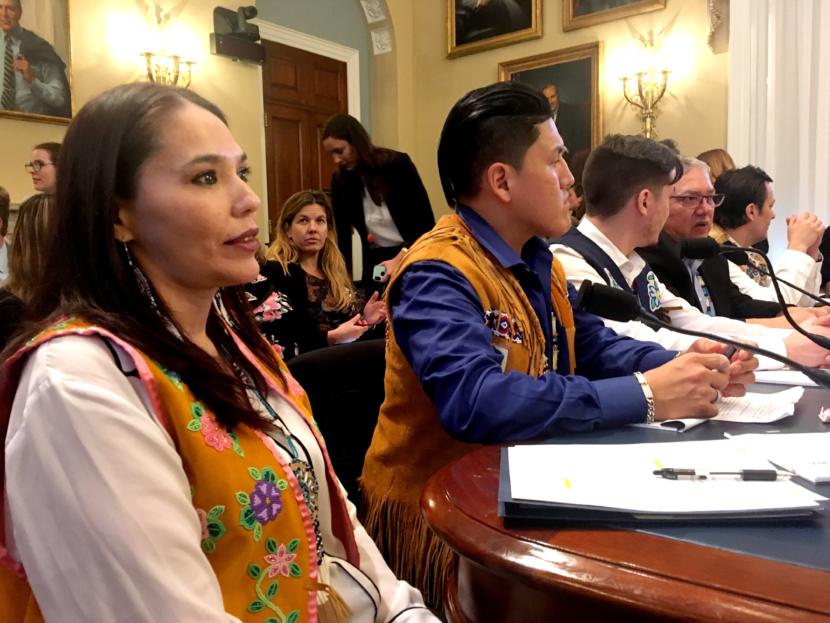
Bernadette Demientieff, director of the Gwich’in Steering Committee, waits to testify at a U.S. House of Representatives hearing on the Arctic National Wildlife Refuge. (Photo by Liz Ruskin/Alaska Public Media)
A bill in Congress would reverse the 2017 decision to open the northernmost part of the Arctic National Wildlife Refuge to oil drilling. A hearing about it in the U.S. House of Representatives Tuesday became a debate — sometimes an angry one — over which Alaska Native people should have the ear of Congress.
Congressman Don Young told his colleagues not to listen to some of his constituents: the Gwich’in residents of Interior Alaska, who had come to testify against drilling in the refuge. Young, Alaska’s sole member of the House, instead pointed to the witnesses from the North Slope: the Iñupiat, who favor drilling.
“These are the Alaska Natives directly impacted. Not the Gwich’in,” Young said. “That’s my tribe. My wife was Gwich’in. My daughters are Gwich’in. We have a few Gwich’in that make a living out of this. By promoting something that’s wrong, by saying, ‘We want to take away from their brothers.’ That’s wrong.”
Young was born in California, but his first wife was Gwich’in. Unlike the late Lu Young, most Gwich’in leaders ardently oppose oil development in ANWR. They say it could disrupt the migration and calving of the Porcupine caribou herd that is central to their culture.
Young suggested some of the Gwich’in witnesses have no business talking about the culture.
“Not someone who’s living in Fairbanks. Not someone that has not killed a caribou in 10 years and probably doesn’t have a license. That’s wrong,” Young said, his voice growing in emotion. “Think about that when you say ‘We want to save the culture.’ Save the culture of the people! Not those that are foreigners or living away from the area. These are not the Natives directly affected.”
Gwich’in leader Sam Alexander, who lives in Fairbanks now, wasn’t having it.
“Mr. Don Young does not represent the Gwich’in. He does not represent the Gwich’in, our voice,” Alexander said.
“I represent Alaska! I represent Alaska!” Young shouted over Alexander. “I don’t represent you! Because you don’t represent the Gwich’in!”
Alexander kept going.
“I am here because the Elders have sent me to be here, so I want to be clear on that,” he said.
Arctic Slope Regional Corporation Vice President Richard Glenn and Kaktovik Village Tribal Administrator Matthew Rexford were two of the witness who spoke in favor of oil drilling in ANWR. (Photo by Liz Ruskin/Alaska Public Media)
Alexander also rejected the accusation that people like him are traveling the world, living high off of the environmental groups who will pay as long as the Gwich’in keep saying the right lines.
“Somebody’s telling me I get to take a trip around the world? I got that invitation years ago,” Alexander said. “It’s called the U.S. Army, when I did my three tours in Iraq. So I’ve seen plenty of the world.”
Alexander said he paid for his trip with his veterans disability pay, adding that he’d rather be home with his infant son.
The refuge protection bill, sponsored by Rep. Jared Huffman, D-Calif., cites the caribou and the needs of the Gwich’in. It doesn’t mention the Iñupiat of the Arctic Slope, or Kaktovik, the only village inside the refuge. Their Native corporations would like to drill for oil on land they own that’s bound up in the fight over the refuge.
Fenton Rexford of Kaktovik was angry the bill doesn’t consider the needs and well-being of his people. Rexford said environmental groups and their supporters want to assert their own interests on Kaktovik land.
“This school of thought amounts to nothing more than green colonialism, a political occupation of our lands in the name of environment,” Rexford said.
Arctic Slope Regional Corporation Vice President Richard Glenn told the committee oil development has allowed the Iñupiat to continue to practice their culture while also providing warm homes, sanitary water and sewer systems, better education outcomes, good health and substantially longer lives.
Kaktovik Village Tribal Administrator Matthew Rexford seemed to aim his remarks at the authors of the Democratic bill.
“You say you are concerned about Arctic culture,” he said. “You’ve ignored our culture. You completely disregarded us!”
The witnesses were passionate, but for the Congress members from the Lower 48, there were hints that it wasn’t so much about the needs of Native people but a proxy war: development vs. environment. One of the biggest hints was the mispronunciations.
Words like “Kaktovik,” “Iñupiat” and “Tanana” were mangled repeatedly by members of both parties.
Rep. Paul Gosar, R-Ariz., expressed outrage that the Democratic bill “makes no mention — not one — of the village of Kaskovik.”
The bill to close the refuge to oil drilling could pass the House, but it has virtually no chance in the Senate. Still, each side said it’s important to make the case, keeping the argument fresh in the minds of their political base.
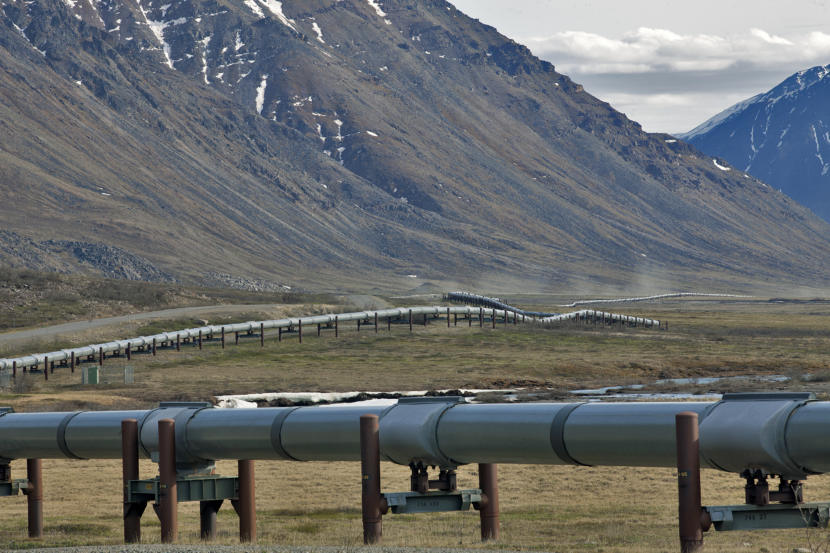
An above-ground section of the Trans-Alaska Pipeline System near the Toolik Field Station in the North Slope Borough. (Photo by Rashah McChesney/Alaska’s Energy Desk)
The Alaska state government is forecasting that oil prices this year and next year will be slightly higher than it projected in the fall. And it said oil production will be slightly lower.
Combined with some other changes, the state’s Department of Revenue now projects that the state will have $89 million less for the budget that ends in June. And it will have $39 million more for the budget that begins in July.
The price per barrel is forecast to be $68.90 this year, roughly a dollar higher than the last forecast. And the price is forecast to be $66 next year, which is $2 higher than before.
But oil production is projected to be about 15,000 fewer barrels per day this year than previously forecast, falling from 526,787 barrels per day in the fall forecast to 511,460 barrels in the update. And it’s projected to be nearly 4,000 fewer barrels per day next year, from 533,197 forecast in the fall to 529,459 forecast in the spring update.
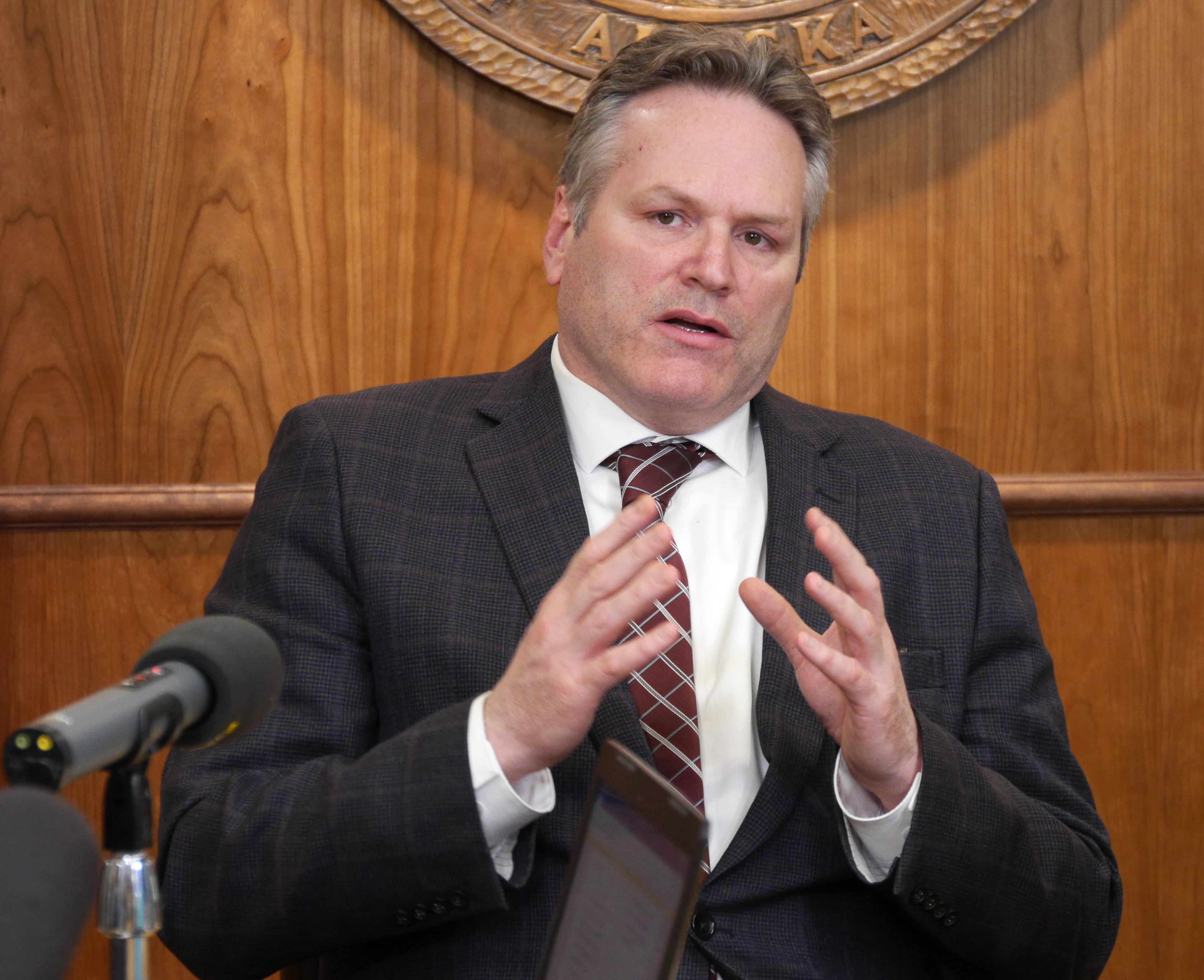
Gov. Mike Dunleavy talks to reporters at a press conference on March 8. He announced at the meeting that he would be traveling to Texas to attend CERAWeek, an annual energy conference. (Photo by Skip Gray/360 North)
Gov. Mike Dunleavy’s administration plans to work with oil companies to determine in the next 60 days whether the Alaska gasline project makes economic sense. The time frame was laid out by Brett Huber, Dunleavy’s senior policy adviser on energy issues.
“We’ve just entered into a cooperative agreement with the companies to take a look at this and … to try to get an economic answer, that viewpoint — within the next 60 days,” Huber said, adding: “It could be sooner than that.”
Huber was with Dunleavy and other senior administration officials at CERAWeek, a conference for oil executives and investors in Houston, Texas. Huber said investors need more information on whether the project pencils out.
“You have to really breach that economic hurdle before you can have serious, substantial investor talks,” he said. “All investors are going to expect us to have done that due diligence, and they’re certainly going to do it on their own.”
Huber and Dunleavy spoke to reporters in a conference call on Thursday. The governor said he didn’t hear much interest in Alaska’s gasline at the conference.
“The supply appears to be greater almost daily in terms of gas,” he said. “And there’s so much volume down south here that in some locales, it’s difficult moving the gas.”
Dunleavy said he did hear interest from companies in investing in North Slope oil.
Close
Update notification options
Subscribe to notifications
Subscribe
Get notifications about news related to the topics you care about. You can unsubscribe anytime.