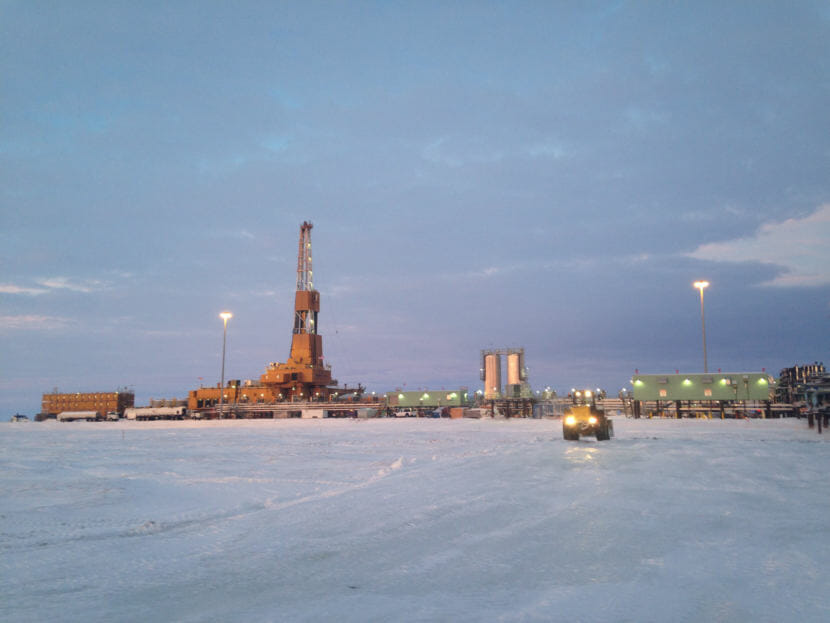
ConocoPhillips’ CD5 drill site is producing far more oil than initially estimated. The company thinks there’s more oil potential farther west. (Photo by Elizabeth Harball/Alaska’s Energy Desk)
Alaska’s oil production has remained relatively flat in recent years, but there could be changes on the horizon as new fields come online on the North Slope.
The state House Finance Committee heard an update from the Department of Natural Resources on Wednesday. They were told that the legacy fields — those that are currently producing oil — are still the backbone of the state’s oil production.
“But as we go out, you know, five-to-six years out, projects that are expected to come online beyond this fiscal year begin to play a more important role,” said DNR Commercial Analyst Maduabuchi Pascal Umekwe.
There are new projects coming online, like Hilcorp’s Milne Point Moose Pad, ConocoPhillips’ CD5 expansion and Greater Mooses Tooth 2. There are also new discoveries in development, like Oil Search’s Pikka.
But just how much oil those new fields will bring to the state over the next several years is difficult to predict.
Over the next two years, the state is forecasting that new fields will bump production up to more than 533,000 barrels per day on the North Slope by 2020 — that could translate to more than $2 billion for the state.
Still, production from those legacy fields is declining. Umekwe told lawmakers that it’s not easy to predict when a new field will come online, or how much oil they will produce. That means the range of predictions gets more uncertain in the future. By 2027, the state could be producing close to 700,000 barrels per day, or fewer than 400,000.
The production forecast is primarily used by the Alaska Department of Revenue to predict how much money the state will get over time. Lawmakers use that to build the budget.
DNR has been forecasting oil production for the state since 2016. Before that, the state used a private contractor.
But during its first year on the job, DNR was criticized after it predicted an unprecedented — and inaccurate — drop in oil production.
That prediction was better last year: Umekwe showed the House Finance Committee its forecast of last year’s production. It was off by fewer than 1,500 barrels.
Watch the latest legislative coverage from Gavel Alaska:
The Arctic Slope Regional Corporation’s corporate headquarters in Utqiaġvik, Alaska. January 2018. (Photo by Ravenna Koenig/Alaska’s Energy Desk)
An influential Alaska Native corporation has joined the list of critics of a proposal from Gov. Michael Dunleavy that would strip some of the taxing power of cities and boroughs.
The legislation would deprive the North Slope Borough of a major revenue source: property taxes on oil and gas infrastructure. Wednesday, the Arctic Slope Regional Corporation, or ASRC, joined the borough in a joint statement that called the bill “an attack on communities across the region.”
In a written statement, ASRC president and CEO Rex Rock Sr. said: “Trying to balance a state budget on the backs of the Iñupiat people across the Arctic Slope is a wrongsided attack on our region.”
The criticism is noteworthy because it comes from one of the governor’s allies: ASRC endorsed Dunleavy back in October, citing, among other things, his enthusiasm for oil and gas development.
The joint press release yesterday also included a statement from North Slope Borough Mayor Harry Brower Jr.
“For decades, we have supported safe and responsible natural resource development on the Arctic Slope because of the economic benefits the industry brings to our communities,” said Brower. “As written, Senate Bill 57 makes us question that support. Is this what the governor is intending to do with this legislation – pit the Iñupiaq people of the Slope against industry?”
The governor’s plan would cost the North Slope Borough nearly $400 million in property tax revenue.
Before it can take effect, though, it would have to be approved by the Alaska Legislature. House Speaker Bryce Edgmon gave Dunleavy’s House version of the bill a cool reception yesterday by sending it to three different committees for vetting — often a step that the speaker takes to delay or derail legislation.
—Nathaniel Herz contributed reporting from Anchorage.
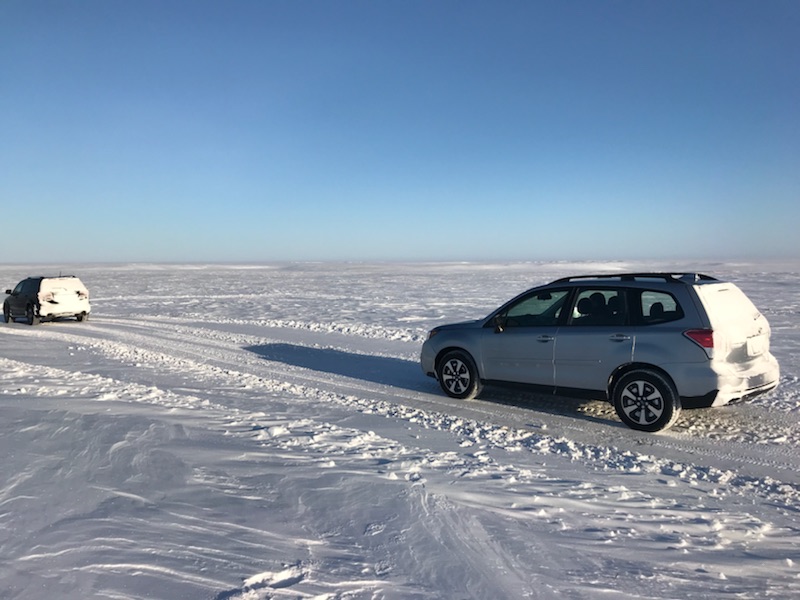
Last April, Robin Mongoyak drove his family’s new Subaru Forester from Prudhoe Bay to Utqiaġvik, using a new trail provided by the North Slope Borough. (Photo courtesy Robin Mongoyak)
If you live on the North Slope of Alaska, you have limited options when it comes to bringing in goods from down south — especially big things like cars, appliances and lumber.
Some of the communities can get those things through a seasonal ocean barge service. Others are only served by air cargo. But there’s a third option some people take to try to save money: driving over the tundra.
Now the North Slope Borough is testing a pilot network of winter snow trails, which they hope will make that a safer choice.
Ten years ago, Robin Mongoyak bought a new truck in Anchorage and drove it up the Haul Road with a buddy. That road ends in Deadhorse.
“We were stubborn,” said Mongoyak. “We thought, ‘Oh, everybody’s making it across … the Slope to Barrow from Deadhorse. We got an F-150 (with) four-wheel drive. I think we got no problem making it too,'” he said.
But once they were out on the open tundra, they hit some bad weather.
“We had total white-out,” he remembered. “You felt like you were 30,000 feet in the air. I mean, the wind was blowing that hard.”
The snow piled up rapidly around the truck, and they constantly had to get out and dig.
“Holy cow, man. There were so many times where we almost gave up and abandoned our vehicle,” he said.
They did eventually make it home to Utqiaġvik. But Mongoyak told himself he would never attempt that drive again.
Then last year… he did.
Out past the airport, where the view south is miles and miles of flat, snow-covered tundra, Mongoyak gestures at a spot just to the side of the road.
“That’s where we came in from,” he said.
Robin Mongoyak at the southern edge of Utqiaġvik, next to the spot where he arrived last year as part of a caravan escorted by North Slope Borough staff that drove a snow trail from Prudhoe Bay. Jan. 30, 2019. (Photo by Ravenna Koenig/Alaska’s Energy Desk)
Instead of braving the tundra independently, when Mongoyak wanted to bring up a second car for his wife last April, he joined an organized caravan of cars, escorted by North Slope Borough staff and specialty equipment to help people if they got stuck in the snow.
They made their way from Prudhoe Bay to Utqiaġvik along a snow trail built by the borough.
Mongoyak said that even though the caravan was slow, since they often had to stop and wait for borough staff to pull out cars that got stuck, it did feel less risky.
He estimated he saved hundreds of dollars taking the car up that way. He might have saved more if he’d driven the car up from Anchorage to Prudhoe Bay himself, instead of paying someone else to do it.
It also gave him peace of mind to get the car up from Anchorage quickly, instead of having it sit in a lot for months, waiting for the summer barge service.
The borough’s Community Winter Access Trails — or CWAT — project is in its second year. It’s a project to build trails and then lead organized trips — like the caravan Mongoyak was with — between several North Slope villages and Prudhoe Bay.
Gordon Brower is the director of the borough’s Planning and Community Services Department, which is overseeing the project. He said that residents of the borough have been driving over the tundra on their own for years, and that has resulted in people frequently getting stuck in the middle of nowhere and needing rescue, which can be expensive for the borough.
“In some cases in the past, people … have broken down a hundred miles in either direction,” he said.”Near-deaths and freezing, running out of gas are some of the issues surrounding being able to go between communities,” he added.
Brower said this year the borough anticipates they’ll be able to connect Utqiaġvik, Atqasuk, Wainwright and Anaktuvuk Pass with chaperoned pathways to Prudhoe Bay and the Haul Road.
They have a permit for five years — counting this year and last year — but will be making the decision year-to-year whether to continue the project.
The borough is keeping track of how many people use the road, what kinds of goods they’re bringing in, and collecting feedback from the community about the trails.
“It’s a proof of concept to measure the impact to the economy,” said Brower. “What kind of impact does it have when you’re connected for just several months?”
Brower said that information could help inform a larger state of Alaska project to identify regional infrastructure and connectivity needs — a chronic issue for the North Slope.
That’s the Arctic Strategic Transportation and Resources — or ASTAR— project. While the state said they still haven’t determined what the specifics of it are, it could include a network of year-round gravel roads between some of the North Slope communities.
Right now, crews are out working on the trails to two of the villages. Others will begin when weather conditions allow.
The borough said that once the trails are open, ideally they’ll be usable until the end of April or early May.
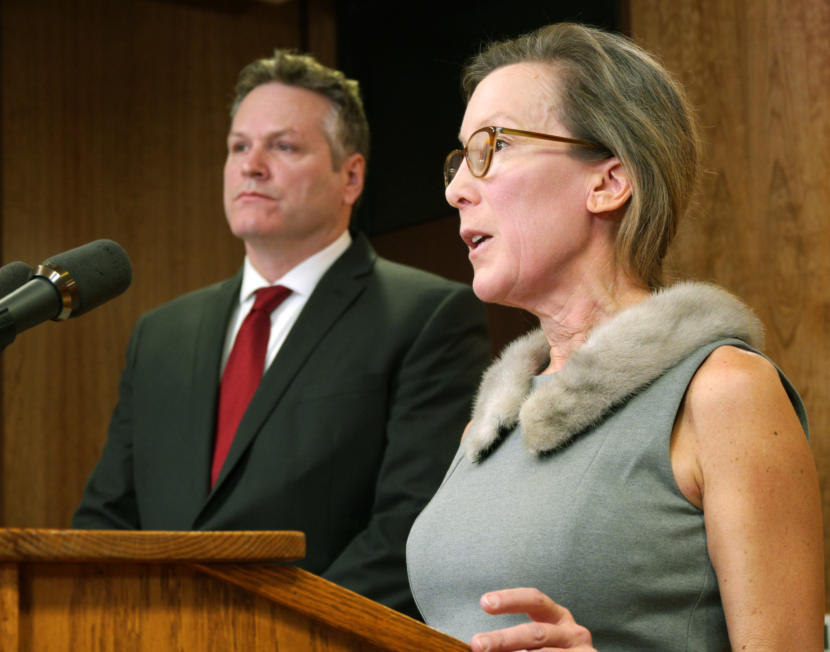
Office of Management and Budget Director Donna Arduin helps Gov. Michael Dunleavy explain various aspects of his proposed state budget at a press availability in the Capitol on Wednesday. (Photo by Skip Gray/360 North)KTOO and Alaska Public Media’s Andrew Kitchenman spoke with Alaska Public Media’s Casey Grove about this story:
Gov. Michael Dunleavy’s amended budget proposal would cut spending across many state-funded programs. Public schools, the university, Medicaid and the ferry system are among the areas hardest hit.
Dunleavy said at the budget announcement Wednesday that the changes are needed to stabilize the state’s future. He said his budget makes sure the money the state spends matches the money it brings in — without drawing down savings, raising new taxes or making cuts to PFDs.
“We have to have a robust discussion, which I am looking forward to, as to what are our needs versus our wants,” he said. “What are the needs that impact the majority of Alaskans? And how do we want to pay for this going forward?”
The budget stability would come at a big cost — a $1.15 billion reduction in how much the state spends on the portion of the budget controlled by the Legislature. In addition, municipalities with oil infrastructure would receive $400 million less in property tax. That money would instead go to the state.
The amount public schools receive for each student would drop by $300 million, or more than a quarter. Many smaller school programs aimed at supplementing classroom learning would be eliminated.
Rep. Josh Revak watches Gov. Michael Dunleavy unveil his latest budget proposal on Wednesday, Feb. 13, 2019, in Juneau, Alaska. (Photo by Rashah McChesney/Alaska’s Energy Desk)
The state’s portion of the university budget would fall by $155 million, which would fall on the three main parts of the university: the various campuses of the University of Alaska Fairbanks, University of Alaska Anchorage and University of Alaska Southeast. That cuts nearly half of state funds. There actually would be an increase to the separate, local community campuses.
Medicaid would see a $271 million reduction, about a 40 percent state funding cut. The state is negotiating with the federal government how that would happen, with a focus on cutting payments to hospitals, doctors and other health care providers, and paying less for medical care to the roughly 48,000 Alaskans who receive health care from the Medicaid expansion that former Gov. Bill Walker implemented.
The Alaska Marine Highway System funding would be cut by $96 million, with funding ending at the end of the summer.
Dunleavy said he focused on funding services that affect most Alaskans. But certain services that benefit rural and coastal Alaska would see steep cuts.
The budget “is going to touch all Alaskans, no matter where they live, and no matter what they do,” Dunleavy said. “It’s going to be a different way of budgeting, and all Alaskans are going to have to pull together to make sure that we get through this process.”
Rural and coastal lawmakers — as well as education advocates — are already pushing back on it.
“It deepens the divide between the haves and the have-nots,” says Sen. Donny Olson, a Golovin Democrat, in a written statement. “It strikes rural Alaskans more acutely, forcing them to leave their communities and head to the metropolitan center. Many of these Alaskans will become homeless in Anchorage, adding to that socially marginalized population.”
State funding for the Alaska State Council on the Arts — as well as all money for public radio and public television — would be eliminated.
Arnold Liebelt, a staffer in Rep. Sara Hannan’s office, looks over a newly-released budget from Alaska Gov. Michael Dunleavy’s administration with Ken Alper, former state tax division director and staff for Rep. Chris Tuck on Wednesday, Feb. 13, 2019, in Juneau, Alaska. (Photo by Rashah McChesney/Alaska’s Energy Desk)
The budget could be problematic for the state’s economy in the short term, according to economist Mouhcine Guettabi of the Institute of Social and Economic Research at the University of Alaska Anchorage, or ISER. ISER has studied the effect of various plans, and Guettabi said a $1.15 billion budget cut could reduce the number of jobs in Alaska by more than 10,000. That wouldn’t include the cut to municipal revenue through the oil property tax change.
The negative effects could be partially offset by about a 3,000-job increase from Alaskans having more money to spend from PFDs. Dunleavy has proposed a $920 million increase in PFDs, which Dunleavy considers to be separate from the budget. Dividends would be roughly $3,000, about $1,000 more than in any of the previous 37 years. On top of that, Dunleavy has proposed another $1,000 dividend payment to pay residents the amount vetoed by Walker three years ago.
The combined impact of the changes could eliminate 3 to 4 percent of the jobs in the state, Guettabi said.
Dunleavy said stabilizing the budget would help investment and grow the economy.
Guettabi agrees there will be benefits, but perhaps not on the scale as the losses. And while the Legislature works on the budget, he expects problems for the economy.
“It’s going to freeze it,” Guettabi said of the economy. “A lot of players that matter are going to sit on the sidelines, meaning there’s not going to be any hiring. Households are not going to be spending money. And so, because people are going to be waiting for that final (budget) number, and who’s going to actually feel the brunt of the pain.”
The Senate will start its work on the budget Thursday. The House still isn’t organized, but having the budget may put more pressure for that to happen. The governor’s office is unveiling a wide variety of bills and administrative orders to make structural changes to state government, to accompany the budget.
Watch the latest legislative coverage from Gavel Alaska:
Explore the table below or the map above to see the amount of one-time funding each school district expected to receive and how some planned to use the $20 million that could be cut from a supplemental budget.
[toggles style=”default”][toggle color=”Default” title=”Click to expand — Table: How Alaska school districts planned to spend $20 million”]
School District
Amount*
Plans
Anchorage School District
$5,772,609
Matanuska-Susitna Borough School District
$2,619,784
Fairbanks North Star Borough School District
$2,016,261
Equivalent to 18 teachers’ salaries. The district will honor those contracts and pull from reserves if necessary.
Equivalent to 10 certified teaching positions, with benefits.
Juneau Borough School District
$671,008
Designated for deferred maintenance and infrastructure projects. Local funding is tied to state funding; a reduction in state funding would result in reduced local funding.
Lower Yukon School District
$563,553
Bering Strait School District
$557,468
Northwest Arctic Borough School District
$547,548
Designated for deferred maintenance and infrastructure projects. Local funding is tied to state funding; a reduction in state funding would result in reduced local funding.
North Slope Borough School District
$456,526
Reserved for unexpected, one-time expenditures, such as losing a boiler in teacher housing.
Kodiak Island Borough School District
$399,023
Reserved for unexpected, one-time expenditures, such as losing a boiler in teacher housing.
Ketchikan Gateway Borough School District
$387,274
Galena City School District
$322,539
Yukon-Koyukuk School District
$215,425
Funds would help offset increased health care costs.
Sitka School District
$212,318
District expected to receive $187,000 based on lower than expected actual enrollment. Funds were to be used for two teaching positions. District does not have sufficient funds in the general fund balance to cover the proposed loss. If cut approved, district will make significant cuts to programming, likely impose a spending freeze at all schools.
Southwest Region School District
$178,283
Delta/Greely School District
$133,595
Yupiit School District
$128,114
Lake & Peninsula Borough School District
$127,035
Funds planned for construction fund, which has a negative balance. Superintendent Ty Mase: “We have carpets peeling up, roofs leaking and doors that are rusted through” in need of repair.
Nome Public Schools
$122,937
Alaska Gateway School District
$117,311
Part was designated for an elementary school reading teacher’s salary, part to transition a principal/teacher to a full-time principal. If cut approved, district would cut majority of summer maintenance like heating system upkeep, painting, deep cleaning.
Valdez City School District
$116,492
Planned to fund a teaching position.
Nenana City School District
$115,245
Kuspuk School District
$113,797
Denali Borough School District
$108,388
Yukon Flats School District
$101,865
Dillingham City School District
$95,372
Funds planned for professional development and student support through trauma-informed practice and counseling services.
Petersburg Borough School District
$95,225
Iditarod Area School District
$88,989
Copper River School District
$88,430
Unalaska City School District
$80,644
Funds factored into district’s decision to hire two additional teachers for the 2018-2019 school year.
Kashunamiut School District
$79,650
Southeast Island School District
$77,127
Aleutians East Borough School District
$74,796
Annette Island School District
$68,611
Cordova City School District
$66,742
Craig City School District
$65,632
Funds would support increased costs of staff, insurance, heat and supplies.
Wrangell Public School District
$58,143
Mount Edgecumbe
$56,252
Chatham School District
$50,688
Saint Mary’s School District
$46,261
Chugach School District
$45,747
Funds would go toward increased teacher salaries and increased costs of health insurance, fuel and energy.
Haines Borough School District
$44,272
Would have gone to personnel.
Klawock City School District
$36,177
Hoonah City School District
$33,898
Kake City School District
$32,047
Bristol Bay Borough School District
$26,860
Hydaburg City School District
$25,326
Skagway School District
$21,627
Pribilof School District
$21,571
Aleutian Region School District
$16,946
Yakutat School District
$15,333
Funds would go to a STEM summer camp. If cut approved, camp may be canceled.
Tanana City School District
$14,303
Planned to pay a part-time tutor’s wages.
Pelican City School District
$7,606
Funds would support salaries and facility operation.
That money would have come on top of the regular funding formula that provides school districts with state funding. That formula, the Base Student Allocation, has seen modest increases over the last decade but has not been raised at all for the past three years.
But, when you account for inflation, flat-funding education “ultimately is a reduction in funding” — a budget cut — to schools. That’s according to Chris Reitan, superintendent of the Craig City School District. And there are lot of other superintendents in the state who agree with him.
Reitan’s district is among the smallest in the state, with three schools and a correspondence school on Prince of Wales Island. He said his district’s share of the $20 million would have gone toward covering rising costs of supplies, heat and utilities, as well as increased staff costs.
The proposal came as a surprise to Sen. Gary Stevens, chair of the Senate Education Committee, who noted the one-time funding was “hard fought” last year, and making the cut now, halfway through the school year, would create a hardship for many school districts. He said wants to look forward, not back.
“We’ve got to face an issue of less funding than we need in the future,” Stevens said. “But let’s the look at the future, not the past budgets.”KTOO’s Zoe Grueskin spoke with Alaska Public Media’s Abbey Collins about this story:
It also surprised superintendents across the state, who werenot consulted about the proposal. Superintendents like Scott MacManus of Alaska Gateway School District were already planning for the money. His district, which is based in Tok and covers 28,000 square miles from the Alaska Range to the Yukon River and Canadian border, was estimated to receive $117,311. With that expectation, the district hired an elementary school reading teacher and transitioned a staff member who did double duty as teacher and principal to a full-time principal.
MacManus, like many other superintendents, felt assured by the Legislature that the funding would arrive. “We were told what we could count on,” he said.
Alaska’s 53 school districts planned to use the one-time funds in a variety of ways. Some districts, like the Juneau School District and the Lake & Peninsula Borough School District, intended to use the money for maintenance and construction. Lake & Peninsula superintendent Ty Mase said, “We have carpets peeling up, roofs leaking and doors that are rusted through that are all in need of repair.”
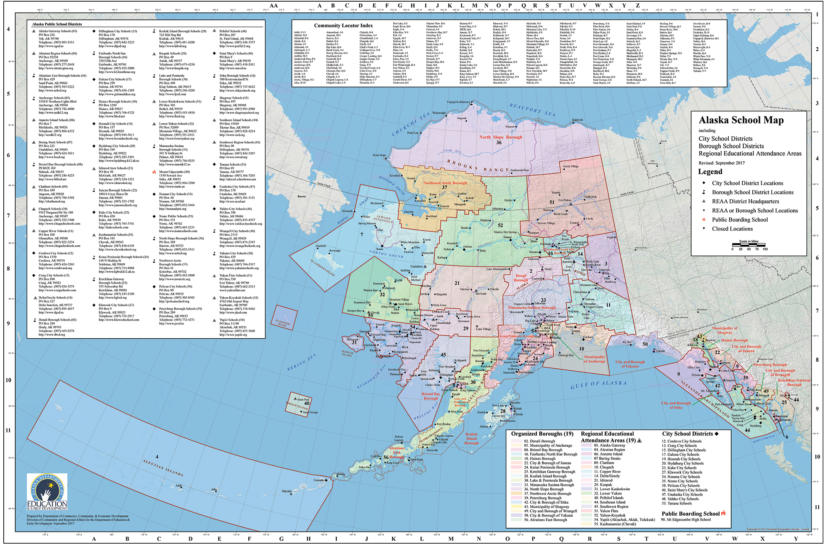
A map showing the boundaries between every school district in Alaska. (Map courtesy Alaska Department of Education and Early Development)
Other districts planned to fund special programs. The Dillingham School District planned to supporttrauma-informed counseling and training for staff. And plans are already way for a summer STEM camp at the Yakutat School District, where superintendent Patrick Mayer says “additional opportunities are scant” for hands-on science learning.
Some districts, like Unalaska, Sitka, and Delta/Greely, used the assurance of funding to raise teachers’ salaries or hire new staff. School districts are bound by law to fulfill their contracts with staff for the remainder of the school year, so if the cut is approved, they will need to find other ways to make up the loss this year.
Most school districts have enough money in their general fund balance to cover the loss, although they are limited in how much they can reserve for unexpected costs. Many superintendents are more concerned about what this proposal heralds for the future.
“We can sustain that for the coming year, but remember, we have nowhere else to turn,” said Delta/Greely superintendent Laural Jackson.
The Sitka School District does not have sufficient savings to cover the amount it would lose if the proposal is approved. Superintendent Mary Wegner said instead the school district would have to make “significant adjustments” for the rest of the school year. That might include freezing all funding to schools and departments, meaning “no field trips, no paper,” she said.
She also said sometimes the district can save as much as $20,000 on heating costs if it’s a warm winter, “but we are not going to save enough to cover a $187,000 deficit.”
Many superintendents said it will be easier for large school districts to weather the cut, if approved, because they tend to have more funds reserved.
Pelican School District, which operates a single school in Southeast Alaska, expected to receive $7,606 from the one-time funding, the smallest amount to any district.
“Because we are so small, every penny is vital to our continued operation,” said superintendent Norma Holmgaard.
KNOM’s Katie Kazmierski, KTOO and Alaska Public Media’s Andrew Kitchenman, KUCB’s Laura Kraegel and KHNS’s Claire Stremple contributed reporting to this story.
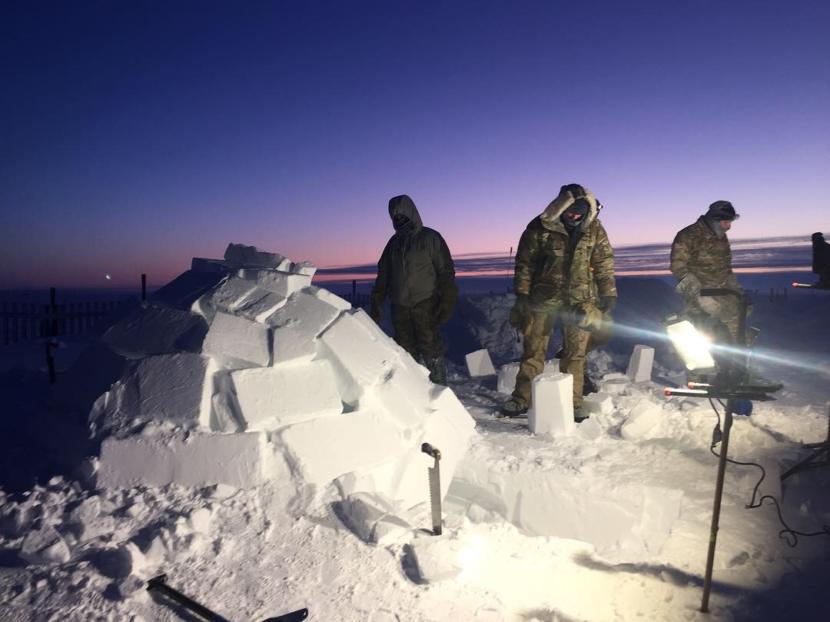
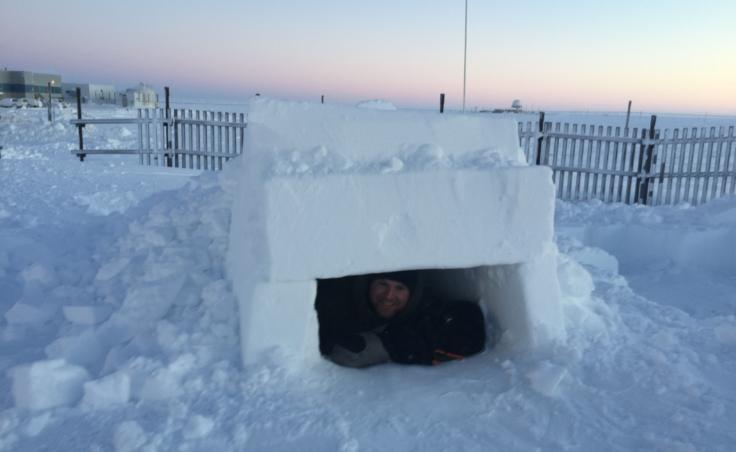
Trainees in an U.S. Air Force barren lands survival course stand next to an igloo shelter that was built as part of the training. Jan. 30, 2019. (Photo by Ravenna Koenig/Alaska’s Energy Desk)
On any given day, pilots in the U.S. Air Force might be flying in the airspace above any environment on Earth. Desert, open ocean, the tropics… or the Arctic.
So they have to be prepared to survive in any one of those places in case they get stuck there for some reason — and in the Arctic especially, that requires some unique training, like one that recently took place in Utqiaġvik.
Mid-morning, a handful of men stood around a domed igloo under a still-dark sky, watching an instructor add the last snow bricks to the structure.
“It’s kind of like a puzzle,” Sgt. Garrett Wright, another instructor, explained to me as we listened to the snow bricks creak and screech like Styrofoam. “You have to have the proper pieces to fit in the spaces, or it’s all going to collapse.”
The trainees had been out there the past two days and nights in temperatures that dipped to 15 below zero and winds that gusted up to 30-plus miles an hour.
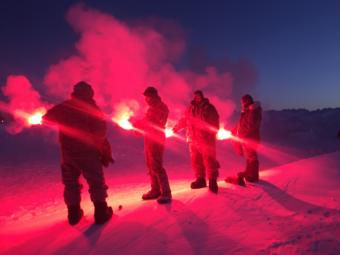
Students in the course learn how to signal for help with flares. Jan. 30, 2019. (Photo by Ravenna Koenig/Alaska’s Energy Desk)
“They don’t go back inside after they come out here and begin the training,” said Wright.
The men were learning how to build shelters, flag down help and just generally survive in an incredibly forbidding environment.
Wright, who works out of Eielson Air Force Base close to Fairbanks, said that there are U.S. aircrew flying throughout region, and if anything goes wrong they need to be prepared to hunker down and survive until help can get to them.
This training had six students. Even though the course is typically geared at the Air Force, most of the trainees were Army survival instructors from the Fairbanks area.
Of everything they got training on, the igloo-building was probably the most sophisticated.
They also learned basic things, like how to recognize and prevent frostbite and how to think through the logistical challenges of the Arctic that complicate normally simple tasks. For example: pulling down a plastic tab on a flare.
“What do you think you have to be careful of?” Wright asked during a flare demonstration.
“Brittle,” a couple of the guys said.
“Super brittle in the cold temperatures,” Wright agreed.
But they managed to set off the flares successfully, the tundra echoing with cracks and the air filling with red smoke.
Sgt. Jess Evans is the lead instructor for this course. He’s been a survival specialist with the Air Force for about 14 years.
“I fell in love with the cold environment,” he told me. “I fell in love with Alaska as a whole.”
He teaches cold-environment survival in the Fairbanks area, and periodically “barren lands” courses like this one — basically anywhere above the treeline where you don’t have access to fire-building.
And while Evans sees living outside in these conditions as a serious challenge, he also thinks it can be kind of fun. He loves working with snow, for example.
“It seems funny, but if your imagination can picture it in your head, you can figure out how you can shape the different angles and make pretty much anything out here,” Evans said.
He recounted that, with a different group a few weeks ago, they actually used building snow sculptures as a way to deal with the psychological stress of a potential crash and the boredom of waiting a long time for help.
“They got pretty elaborate with it: polar bears, penguins, you name it,” he said.
After the course in Utqiaġvik, trainees will hopefully know how to stay alive in one of the harshest environments in the world. And maybe also build a polar bear out of snow.
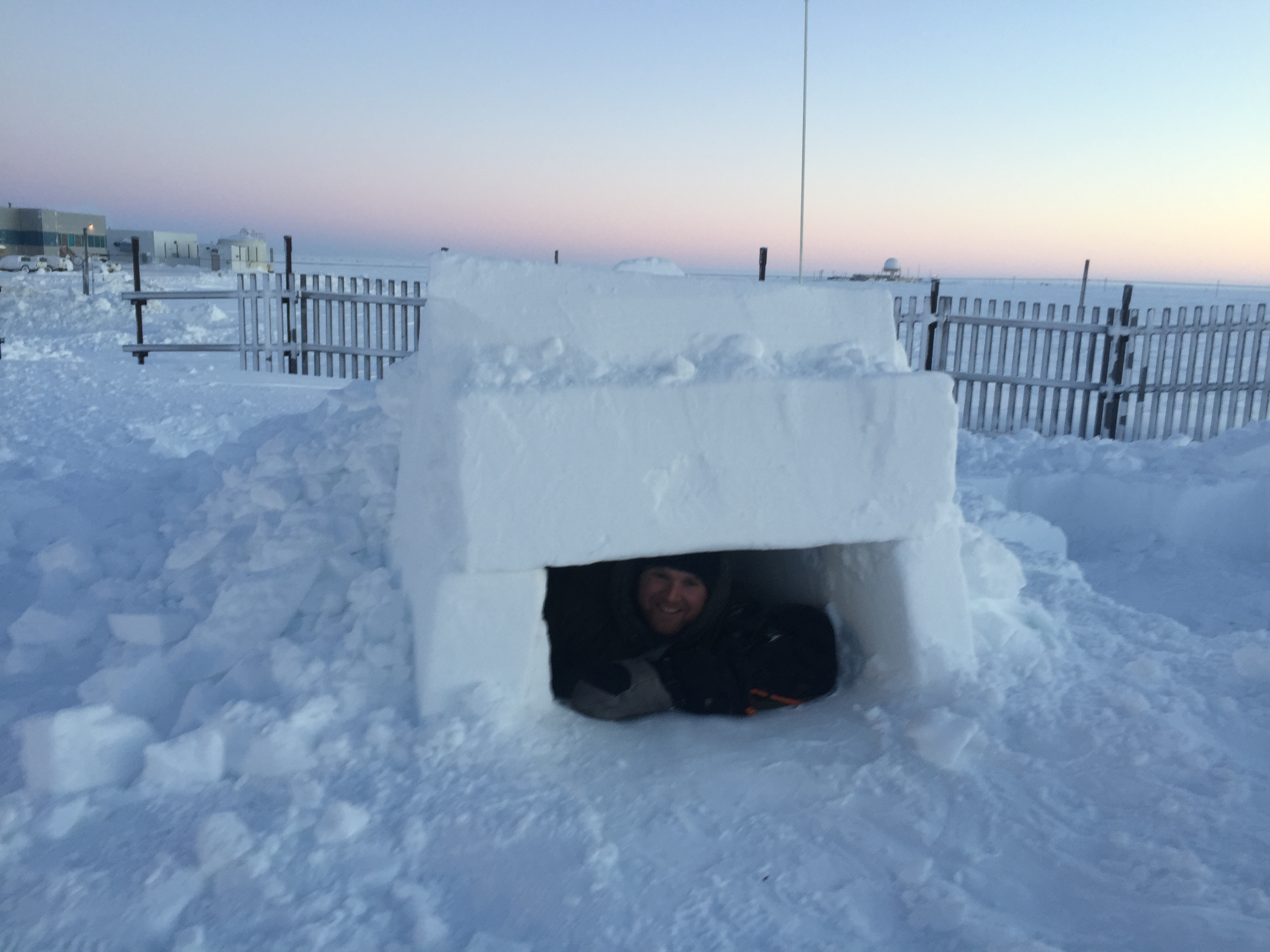
The "fighter trench" is one of the easier shelters that students learn how to build in the course. Jan. 30, 2019. (Photo by Ravenna Koenig/Alaska's Energy Desk)
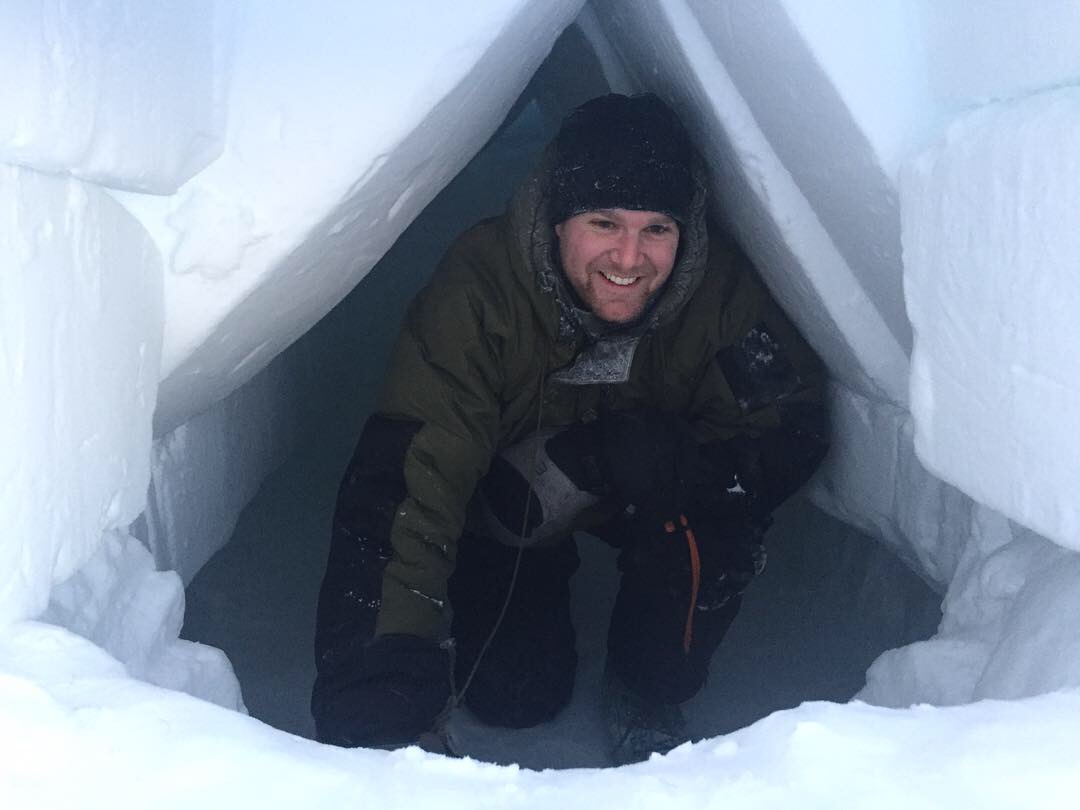
Sgt. Jess Evans — the course's lead instructor — in a "fighter trench" shelter built from snow. Jan. 30, 2019. (Photo by Ravenna Koenig/Alaska's Energy Desk)
Close
Update notification options
Subscribe to notifications
Subscribe
Get notifications about news related to the topics you care about. You can unsubscribe anytime.