The Anchorage man was in his 70s, according to the Alaska Department of Health and Social Services. He’s the 25th Alaskan whose death is linked to the infectious disease.
A spokeswoman with the state health department said Monday that it’s unknown if the man had any underlying medical conditions. Based on the information the state has, COVID-19 was a factor in the death.
The state reported about a dozen of its total deaths in June and July as the number of infections in Alaska also climbed.
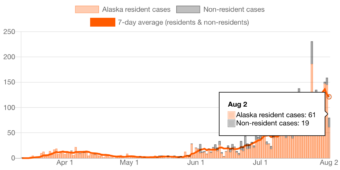
On Monday, Alaska’s number of known COVID-19 cases rose by 80. Sixty-one of them are residents who tested positive, most from Anchorage.
Of Alaska’s 4,064 COVID-19 cases since March, about 70% — nearly 3,000 — are still considered active. That includes cases among residents and visitors.
The average percentage of daily positive tests for the past three days is 2.27%.
The City and Borough of Juneau reported one new individual with COVID-19 in Juneau on Monday. Since March, Juneau has had 91 residents and 63 nonresidents test positive for COVID-19.
ConocoPhillips’ Alpine facility on the North Slope. Conoco’s Scott Jepsen says a new processing facility in NPR-A would be about the same size. (Photo by Elizabeth Harball/AED)
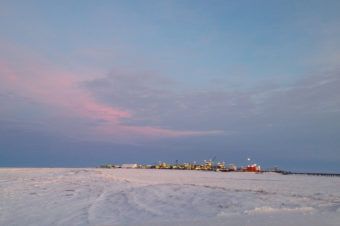
Two people at a major North Slope oil field have tested positive for COVID-19, according to a spokesperson for ConocoPhillips. The two workers were flown to Anchorage from the Alpine oil field, near Nuiqsut.
In an email, ConocoPhillips Alaska spokesperson Natalie Lowman said that all employees who were in contact with the positive cases have either been moved to Anchorage or are being quarantined at a separate area at the Alpine camp. The two cases were confirmed as of July 30. Lowman did not have information about how many test results are still pending.
Lowman also couldn’t provide information about whether the workers were state residents or whether they showed COVID-19 symptoms prior to being tested. Employees arrive at Alpine oil field by air, but board at a separate company terminal at the Anchorage Airport. Workers have their temperatures taken prior to boarding and are required to wear masks while on board.
Lowman says the Alpine camp has capacity for about 400, but it is running with about 275 workers.
She says that the company is working with the state with its response.
The Alpine field is eight miles away from the Inupiaq village of Nuiqsut.
An above-ground section of the Trans-Alaska Pipeline System near the Toolik Field Station in the North Slope Borough. (Photo by Rashah McChesney/Alaska’s Energy Desk)
The state Department of Natural Resources is giving Italian oil giant ENI a six-month break on a nearly $3 million rent payment for oil and gas leases on the North Slope.
It’s the third time DNR has granted such an extension in the past three months, citing the coronavirus pandemic’s impact on the oil industry.
Sean Clifton, a policy and program specialist with the state Division of Oil and Gas, said he’s not aware of the department ever allowing similar extensions for oil and gas leases before this year.
“But,” he said, “these are pretty extraordinary times.”
Falling demand driven the pandemic, paired with an oil-price war earlier this year, led to a glut of oil on the market. Crude prices tanked, and oil companies cut spending and suspended drilling across the globe, including in Alaska. Hundreds of oil field service workers lost their jobs in the state.
In a letter on May 21 to Natural Resources Commissioner Corri Feige, ENI asked for a one-year extension on its payments for 110 exploration leases encompassing about 275,000 acres southeast of Prudhoe Bay. ENI said the economic impact of the pandemic and the unforeseen drop in crude prices “significantly curtailed” its cash reserves. The company said it needed time to budget and reevaluate its business plans for the leases.
Oil companies must make annual rent payments to the state on their oil and gas leases. Under state law, Feige has authority to grant extensions if she finds “reason of war, riots, or acts of God” have prevented them from paying.
ENI’s bill for the exploration leases was originally due by Aug. 1. Now, the company has until Feb. 1 to pay about $2.7 million, Division of Oil and Gas Director Tom Stokes said in a response to ENI in early June.
Stokes said President Donald Trump and Gov. Mike Dunleavy have declared states of emergency over the pandemic. The restrictions, he said, “have placed an unanticipated burden on Alaskan businesses that justifies an extension of time within which to make payments.”
In May, DNR also granted months-long extensions to Accumulate Energy Alaska and Burgundy Xploration for about $4.6 million in rent payments on leases. And, in late April, it granted an extension for nearly $90,000 in lease payments for the struggling Mustang oil project.
Clifton underscored that, in Alaska, the state will still collect the companies’ lease payments in the current fiscal year — it’s not lost revenue — and “has the upside of keeping our North Slope oil producers in business during these unprecedented times.”
Point Thomson is approximately 60 miles east of Prudhoe Bay. (Photo courtesy Exxon)
A big piece of one of Alaska’s largest oil industry deals is set to quietly close by the end of the day Tuesday.
Hilcorp Energy Company will take over BP Alaska’s oil and gas leases within Point Thomson, Milne Point and the massive Prudhoe Bay oil field. The transfer is expected to happen around midnight, and marks the close of a major part of the $5.6 billion deal first announced by the oil companies last August.
It follows an announcement from state commissioners late Monday afternoon that they’d approved the sale of BP’s oil field assets to Hilcorp after a months-long analysis of the transaction and after stress testing Hilcorp’s finances.
“Today’s announcement represents a major milestone in the BP-Hilcorp review process,” Gov. Mike Dunleavy said in a statement Monday about the commissioners’ approval.
The sale will launch Hilcorp into the position of Alaska’s second largest oil producer, and the privately-owned company will become the operator of Prudhoe, the largest oil field on the North Slope and one of North America’s most productive. It will also move BP one big step closer to exiting the state after more than 60 years.
Meanwhile, the second key piece of the sale remains under review.
The Regulatory Commission of Alaska is still assessing BP’s sale of its pipeline assets, including its interest in the 800-mile trans-Alaska pipeline. The RCA has said it will reach a final decision by the end of September.
Sean Clifton, with the Alaska Division of Oil and Gas, said the two companies alerted the state in April about plans to split the deal into two parts. The companies also publicly announced several other changes to the transaction as an oil-price war and the coronavirus pandemic sent crude prices plummeting.
“This is not something DNR needed to approve, being a business decision among private parties,” Clifton said about the decision to divide the deal.
BP and Hilcorp said little publicly Tuesday about closing the first chunk of that deal. There didn’t appear to be any large events planned by the companies to mark the transfer.
A BP spokeswoman confirmed Tuesday that the company anticipated closing the first part of the sale by the end of the day. She declined to comment further. A Hilcorp spokesman also declined to comment.
Mark Myers is a geologist and energy consultant, who has served as a DNR commissioner in Alaska and as the national director of the U.S. Geological Survey. He said one of the biggest changes some Alaskans may first notice is Hilcorp’s smaller workforce.
“They’re a leaner company,” he said in a phone interview Tuesday. “So they’re going to do it with less people.”
Over the nearly year-long review of the sale, Hilcorp has faced criticism for its safety and environmental record and received praise for its innovation and ability to revive aging infrastructure, including at Milne Point.
Myers said he didn’t expect any immediate changes to oil production out of Prudhoe Bay.
Hilcorp, he said, will be working with two other main partners: ExxonMobil and ConocoPhillips, which each own a roughly one-third stake in the field.
Myers said he anticipated Hilcorp will first focus on training its employees, transitioning the hundreds of BP workers it has hired and learning more about the complexities of the oil field.
“There are a lot of opportunities, but they’re going to have to compare them within that field and run the economics on them as well,” he said.
BP has said up to 50 of its employees who planned for early retirement will help with Prudhoe Bay operations for 90 days after the sale closes.
Pipelines stretch toward the horizon in the National Petroleum Reserve-Alaska. (Photo by Elizabeth Harball/Alaska’s Energy Desk)
The Trump administration is proposing to open millions of additional acres to oil and gas development in the National Petroleum Reserve-Alaska, a move blasted by environmental groups and praised by Alaska’s governor and other state and federal officials.
The Interior Department’s Bureau of Land Management released its final environmental impact statement Thursdayfor a new management plan for the 23-million-acre reserve, which sits west of Prudhoe Bay.
The plan would make 82% of the area available for drilling, up from the 52% that’s open under an Obama-era document. The Trump proposal would expand leasing into another 7 million acres that’s currently protected from development — an area just larger than the state of Vermont.
The reserve is estimated to hold about 8.7 billion barrels of oil, according to the U.S. Geological Survey.
But it’s also home to important habitat for birds and caribou, including the Teshekpuk Lake area in the reserve’s northeastern corner. And conservation groups point to the 1976 Naval Petroleum Reserves Production Act, which directs the interior secretary to uphold environmental and subsistence values in NPR-A.
Those groups decried the new plan Thursday, describing it as reckless, rushed and shameful, as well as a threat to the Teshekpuk Lake area, subsistence and the climate. The area was off-limits to drilling in the Obama-era document, and would become completely open under the Trump administration plan — though there would be limits on when and how development could occur.
“This is really giving away vital habitat for caribou and migratory birds and will only exacerbate the climate crisis,” Nicole Whittington-Evans, Alaska program director for Defenders of Wildlife said in a phone interview. “So, we feel this is bad for the Western Arctic and it’s bad for the planet.”
In a statement, the Interior Department described the reserve as critical for “American energy dominance and national security.” And it said the plan has stipulations to protect the Teshekpuk Lake area, including “timing limitations” for major construction.
“We’ve looked to open up some additional areas to leasing based on new information while also using management prescriptions to protect important wildlife, habitat and subsistence uses,” Bureau of Land Management Alaska State Director Chad Padgett said in the statement.
The BLM released its draft environmental impact statement last fall.
But the preferred alternative announced Thursday was not part of it. Some conservation groups criticized the agency Thursday for not allowing communities to provide input on the option.
In its statement, the Interior Department said public comment led to the creation of the new and preferred alternative.
Gov. Mike Dunleavy thanked Trump’s administration for proposing to open more land to development, calling it a better balance than the Obama-era plan. Alaska’s congressional delegation also praised the decision.
The BLM will next prepare a final Record of Decision, which could be published as early as late July and will guide future lease sales in the reserve.
Alaska’s Energy Desk reporter Nathaniel Herz contributed to this report.
Correction: This story has been corrected to show that the Bureau of Land Management will produce a final record of decision in at least not next 30 days, not within the next 30 days.
The Alaska Federation of Natives logo on a podium during the organization’s annual convention on Oct. 15, 2016. (Photo by Mikko Wilson/KTOO)
The Alaska Federation of Natives, which represents 191 federally recognized Alaska Native tribes and 11 regional corporations, has announced the date and theme of their annual convention.
This year’s theme will be “Good Government, Alaskans Decide.” A release from AFN says the theme highlights “the challenges and opportunities the Native community and all Alaskans face, including responding to and recovering from the pandemic and resulting economic downturn.”
The keynote speaker for the convention will be Alaska House Speaker Bryce Edgmon, the first Alaska Native Speaker of the State House. Edgmon is an independent from Dillingham, currently serving his second term as speaker.
This will be the first convention without the participation of the Arctic Slope Regional Corporation, who withdrew from AFN at the end of last year. The corporation is the largest in the state, representing Inupiaq shareholders primarily from the North Slope region.
The convention will be held October 15th through the 17th at the Dena’ina Center in Anchorage.
Close
Update notification options
Subscribe to notifications
Subscribe
Get notifications about news related to the topics you care about. You can unsubscribe anytime.