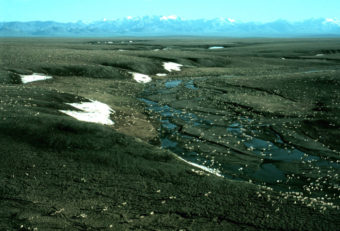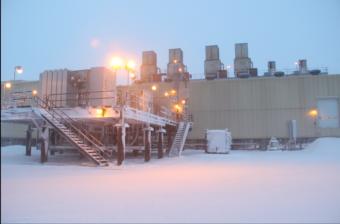
A unit at the edge of ConocoPhillips’ Kuparuk oil field, on Alaska’s North Slope. (Photo by Rachel Waldholz/Alaska Public Media)
Next year’s budget hasn’t been approved yet, but ConocoPhillips Alaska is planning to restart some of its drilling projects on the North Slope.
The company’s president, Joe Marushack, outlined plans at the annual Resource Development Council conference on Wednesday in Anchorage. Marushack said by the end of this year, the company plans to restart some drilling on the North Slope.
And, they plan to build up operations next year.
“By the end of 2021, there will be four rigs running between [Great Mooses Tooth] 2, Alpine and Kuparuk. Each rig normally employees about 100 people and each of those jobs support multiple jobs throughout the state economy,” he said.
It has been a challenging year for the oil industry.
Marushack said 2020 was supposed to be the company’s largest exploration and winter construction season ever.
“We came into the year very excited. It was also slated to be a big drilling year with the startup of the Doyon extended reach drilling rigs at Kuparuk and robust drilling programs in the core fields of Alpine, Prudhoe and Kuparuk,” he said.
As COVID-19 spread, the company saw a steep drop in demand, followed by a collapse of oil prices. First, it suspended development in 2020 and then cut production from the North Slope.
Thousands of workers left the North Slope as the company tried to reduce the risk of a large outbreak of the virus. Marushack said they worried it could overwhelm health facilities there. The company also asked staff in its Anchorage offices to work from home.
Now, Marushack said that for the first time since its fields were brought online, Prudhoe Bay, Kuparuk River and Alpine have no rigs running in them. But, the plan is to have rigs working on two of those fields by the end of 2021.
One other thing, while the company is planning to continue operating next year — Marushack isn’t. After more than 30 years with ConocoPhillips, he said he’s retiring in January.
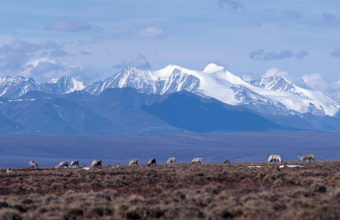
Caribou graze on the coastal plain of the Arctic National Wildlife Refuge, with the Brooks Range as a backdrop. (USFWS)
Starting Tuesday, oil and gas companies can pick which parts of the Arctic National Wildlife Refuge’s coastal plain they’re interested in drilling. It’s the latest push by the Trump administration to auction off development rights in the northeast Alaska refuge before President-elect Joe Biden takes office.
The official “call for nominations” launches a 30-day comment period. It will also allow the Bureau of Land Management to move forward with a lease sale, which it must announce 30 days in advance. The exact timing is not clear, but it raises the possibility that a sale might happen just days before Biden’s inauguration.
“It’s been quite a lot of work to get to this point,” said Kevin Pendergast, Deputy State Director for Resources with the BLM in Alaska. In a separate statement, the agency said the lease sale will be a historic move “advancing this administration’s policy of energy independence.”
In a dramatic shift after nearly four decades of protections, a Republican-led Congress in 2017 approved legislation that opened up part of the refuge to oil development. It called for two lease sales in the coastal section of the Arctic Refuge within seven years, with the first one to be held by the end of 2021.
But conservation groups are blasting the Trump administration’s decision to move forward with the first lease sale now, just a couple months before Inauguration Day, saying it’s rushing the process “to open one of the nation’s most iconic and sacred landscapes to oil drilling.”
The Arctic Refuge’s coastal plain is about 1.6 million acres — an area roughly the size of Delaware that makes up about 8% of the vast refuge. It’s a place where caribou migrate, polar bears den and migratory birds feed. It’s also an area believed to hold billions of barrels of untapped oil.
“This timeline indicates that they’re trying to cram this through in a way that would cut out consideration for public concern,” said Brook Brisson, senior staff attorney at Trustees for Alaska, an Anchorage-based environmental law firm.
Trustees for Alaska is among several groups, and a coalition of 15 states, that filed lawsuits earlier this year aimed at derailing drilling plans for the Arctic refuge. The suits are still winding their way through the court system.
The American Petroleum Institute, a national trade association, welcomed the call for nominations on Monday, saying in a statement that development in the Arctic refuge is long overdue, will create good-paying jobs and provide more revenue for Alaska. It said the industry will work with wildlife organizations and local communities, and use new technology “to safely and responsibly develop these important energy resources.”
Alaska’s all-Republican congressional delegation is also celebrating the news of the government taking another step closer to a lease sale. U.S. Sen. Lisa Murkowski said a sale could be held as soon as January.
“While we face headwinds, from global economic conditions to an organized effort to prevent leasing, the Department’s rigorous environmental review has provided a solid framework to ensure responsible exploration and development,” Murkowski said in a statement. “We are now within sight of the first-ever lease sale on the Coastal Plain, and I appreciate the continued good work of (Interior) Secretary Bernhardt and his team to help us reach this point.”
Residents of the villages closest to the coastal plain are split on the development issue, with some seeing opportunity from drilling while others decry the impact on wildlife, most notably the Gwich’in, whose culture and diet revolve around migrating caribou.
“Any company thinking about participating in this corrupt process should know that they will have to answer to the Gwich’in people and the millions of Americans who stand with us,” said Bernadette Demientieff, executive director of the Gwich’in Steering Committee, in a statement.
But it’s not clear how much interest there will be in drilling. For one thing, it’s expensive in such a remote area.
“There’s a lot of potential oil there that could be harvested,” said Andy Mack, a former Alaska commissioner of natural resources who’s pushed for the refuge’s opening.
“The real trick,” he said, “is doing the math around the marginal cost of producing a barrel of oil in that area of the world.”
Other challenges are low oil prices, the coming change in administration, and the risk of more litigation over environmental concerns. Some investors have also said they won’t fund new oil and gas projects in the Arctic.
Meanwhile, Biden says he plans to permanently protect the Arctic refuge and ban new oil and gas permitting on all public lands and waters.
If drilling leases are finalized before Biden takes office, they could be difficult to revoke, said Mack. But even if not, Biden would still face that federal law that mandates a lease sale by the end of 2021.
Still, Mack said, the next administration could impose restrictions.
“What they would try to do is make it so difficult and so onerous to get the array of permits,” he said, “that the companies just say, ‘Well, we’re not going to spend 10 years just trying to get a simple permit, we’re going to put our money and our investment elsewhere.’”
The bone arch in Utqiaġvik, made of bowhead whale jawbones. This year, Alaska whalers got a rule change they were hoping for in how their whaling quota is renewed. (Arctic Council Secretariat / Kseniia Iartceva)
The North Slope city of Utqiagvik passed several new COVID-19 restrictions at a Wednesday city council meeting that included a unique punishment for rule-breakers: producing public service announcements on the dangers of the coronavirus.
Mayor Fannie Suvlu said there are several reasons the city chose that punishment. The first is the recognition that some residents aren’t educated on the reasons for coronavirus precautions. The PSAs can take the form of voice recordings for radio, video clips, or flyers, which would help educate the rule-breaker and the public.
“If you do a flyer regarding it, that’s not only educating the person that violated it, but once we hang the flyer up … you’re spreading that within the community,” Suvlu said.
Another reason is the tradition of public-facing punishment in the majority-Inupiat community.
Suvlu says that traditionally, people who committed sexual offenses were marked so that they were identifiable. More recently, rule-breakers who are banned from public buildings are forced to face a public reckoning.
“Whether it’s a child or if it’s an adult, they come to the city council meeting and publicly apologize. So it was kind of along those lines that we were looking at,” she said.
Suvlu noted that if the rule-breakers choose to make flyers, they won’t necessarily have their name revealed. But for videos and voice recordings, she said the public disclosure could play a powerful social role.
For the second violation, rule-breakers have to perform community service. For subsequent violations, they could be subject to fines.
The new ordinance changes many of Utqiagvik’s existing recommendations about masking and quarantining into mandates. People who arrive in Utqiagvik are required to quarantine for 14 days, and masks are required in all public places.
Utqiagvik is experiencing a rapid uptick in cases in recent days. According to the Arctic Slope Regional Association, 12 cases were reported in Utqiagvik between Wednesday and Thursday at noon.
ConocoPhillips’ undeveloped Willow prospect, pictured here, is still being explored. The company announced this week that it’s selling a one-fourth stake in Willow and other projects in Alaska. (Photo courtesy ConocoPhillips)
The Trump administration has approved ConocoPhillips’ development plans for its massive oil project in the remote National Petroleum Reserve-Alaska, on the western North Slope.
Interior Secretary David Bernhardt signed the record of decision for the Willow project on Monday, earning praise from Alaska’s Republican Congressional delegation and governor, and condemnation from environmental groups.
The decision allows Conoco to construct up to three drill sites, plus an oil processing facility, pipelines, roads and other infrastructure.
The Willow project would be the North Slope’s westernmost oil field, and the Department of the Interior says the project could produce up to 160,000 barrels of oil a day, over 30 years.
U.S. Sen. Dan Sullivan said in a statement celebrating Willow’s approval that “the NRP-A is slated to be among the hottest energy prospects in the world.” Bernhardt said in a statement that the project will help keep oil flowing down the trans-Alaska pipeline, and will lead to hundreds of jobs.
“President Trump made his administration focus on American energy independence and the freedom it provides from day one of his term,” Bernhardt said.
But environmental groups are blasting the project, and say it poses significant risks to wildlife, including caribou and polar bears, and is a threat to the Teshekpuk Lake area, one of the Arctic’s most important habitats. Also, they say, it will further contribute to climate change in an already rapidly-warming region.
“The world remains mired in a global pandemic and the oil markets are experiencing continued volatility, yet this administration has once again opted to barrel forward with unnecessarily aggressive oil and gas development,” said a statement from Kristen Miller, conservation director at Alaska Wilderness League.
Conoco described the federal government’s approval of the Willow project as a “key milestone” and says construction could begin as early as next year. The company says it’s planning for oil production to begin in 2026, though it has also said the project could be delayed if Ballot Measure 1 passes, which supporters of the measure say they don’t believe.
More drill sites could be later added at Willow. The Interior Department says it will decide later on whether Conoco can add two additional drill sites. The oil and gas company requested the deferral on that piece of its proposal so it could do more community outreach, according to the federal agency.
ConocoPhillips’ Alpine facility on the North Slope. (Photo by Elizabeth Harball/AED)
Alaska voters will decide next month whether to raise taxes on Alaska’s largest oil fields.
Ballot Measure 1 — dubbed the “Fair Share Act” by its sponsors — is an initiative that supporters say would fix Alaska’s oil tax law and fill the state’s deficit. But those opposed argue it would lead to less investment in Alaska and jeopardize the state’s economy.
In short: The two-page ballot measure is contentious and complicated, with each side citing its own set of facts.
As the Nov. 3 election approaches, here’s some of what we do know about the ballot measure and, if it’s approved, how it could impact Alaska.
What would Ballot Measure 1 actually do?
It would amend some of Alaska’s oil tax law.
Ballot Measure 1 would apply solely to North Slope oil fields that have pumped more than 400 million barrels and that are still producing more than 40,000 barrels a day.
Right now those are Prudhoe Bay, Kuparuk and Alpine. The main oil producers at those fields are ConocoPhillips, ExxonMobil and Hilcorp, which bought BP’s North Slope assets.
If voters approve the ballot measure:
The oil companies at those three fields would pay the state more in production taxes. That’s in part because the ballot measure would eliminate a per-barrel tax credit for those three larger fields.
The documents that companies submit to the state to calculate those production taxes would become “a matter of public record.” Right now, those documents are confidential.
A so-called “ring fence” would be created around the three oil fields, which would bar the companies from reducing their taxes on those larger fields using deductions earned at smaller fields.
(Read the entire two-page ballot measure here. And the state’s summary here.)
Who’s backing the ballot measure?
A group called Vote Yes for Alaska’s Fair Share that’s chaired by Robin Brena, an Anchorage attorney.
Anchorage attorney Robin Brena and other supporters of the initiative to raise oil taxes pose for a photo on January 16, 2020. Supporters of the initiative to raise oil taxes pose for a photo on Jan. 16, 2020. From left to right: Les Gara, Jane Angvik, Robin Brena, David Carter and Harry Crawford. (Nat Herz/Alaska’s Energy Desk)
Others listed as officers of the group include: Jane Angvik, a former Anchorage Assembly chair and former member of the commission that wrote the charter for the Municipality of Anchorage. Former state Rep. Les Gara, an Anchorage Democrat, is also supporting the ballot measure alongside Anchorage Democratic Sen. Bill Wielechowski and Ken Alper, who worked as director of the state’s tax division under former Gov. Bill Walker, an independent.
OneAlaska—Vote No on One, a group that’s getting almost all of its money from oil companies. The group is chaired by Chantal Walsh, former director of the state’s Division of Oil and Gas under Walker.
OneAlaska chairwoman Chantal Walsh, a petroleum engineer and former director of the state’s Division of Oil and Gas, addresses the crowd at a OneAlaska rally on Thursday, Feb. 13, 2020 at Delta Constructors in Anchorage. (Tegan Hanlon/Alaska Public Media)
Its other leaders include former state Rep. Jason Grenn, an Anchorage independent, Crawford Patkotak, chairman of the board for Arctic Slope Regional Corp., Kara Moriarty, head of the Alaska Oil and Gas Association and Bill Popp, head of the Anchorage Economic Development Corp.
The group has raised a ton of money so far: about $18.5 million. It’s major contributors are Conoco, Exxon, BP and Hilcorp. The Alaska Chamber is also running attack ads against the measure and has raised about $2 million more from Conoco and Hilcorp.
Why did initiative backers bring forward this ballot measure now?
Because of Alaska’s budget crisis, says Vote Yes for Alaska’s Fair Share. “Ballot Measure 1 is the only revenue option that can be implemented in time to save Alaskan jobs,” the group says.
Meanwhile, OneAlaska counters that the ballot measure would lead to fewer oil jobs, jeopardize new projects and only fill a small slice of the state’s budget hole. It says the measure goes too far.
How much additional revenue would Ballot Measure 1 bring into the State of Alaska?
It’s hard to say for sure, said Mouhcine Guettabi, an associate professor of economics at the University of Alaska Anchorage. That’s because calculating new revenue requires assumptions about both the price of oil and the amount of oil produced in the future, he said.
“Uncertainty around price, uncertainty around the production response and, obviously, uncertainty around future investments — all three of those things make it difficult to know exactly what the amount is,” he said.
The state Department of Revenue has provided a window into what revenue might look like if oil production stays the same next fiscal year, and if companies’ investment doesn’t change. With prices at $45 a barrel, production taxes would total $191 million under the current law and nearly triple under Ballot Measure 1, growing to $564 million.
That’s a little more than half of Alaska’s current deficit, which is roughly $1 billion, but less than a fourth of the deficit if lawmakers decide to pay a larger Permanent Fund dividend under the historical legal formula.
The state Department of Revenue has provided estimates on Ballot Measure 1’s on oil taxes. It says the estimates in the chart are based on the Spring 2020 revenue forecast for Fiscal Year 2022 and “assumes no changes in produced oil volume or company investment because of the tax change.” (Screenshot of Oct. 2, 2020 presentation)
How would the ballot measure, if approved, impact oil and gas companies’ investment in Alaska?
It depends on who you ask.
Moriarty, the campaign manager for OneAlaska, said there’s no question that higher taxes would lead to less investment and less drilling in Alaska and have dire impacts on the industry that underpins the state’s economy. Conoco has threatened that if the ballot measure passes, projects like the Willow discovery on Alaska’s western North Slope would be delayed.
“Oil companies have a hundred other places that they can invest their money. And they won’t leave Alaska right away, but they just won’t spend more,” Moriarty said. “Things will start to die off here. And they’ll go move somewhere else, and they’ll take their employees with them.”
At Vote Yes For Alaska’s Fair Share, campaign manager David Dunsmore said the state cannot subsidize the oil and gas industry any longer. Senate Bill 21 — a controversial piece of legislation passed in 2013 that cut oil taxes — is not working, he said. Oil companies will still make money in Alaska even if they pay more taxes, he said.
“It’s still going to be a very profitable place for them to continue doing business,” he said.
Guettabi, the economist, is less sure. He said the question of how sensitive oil production is to tax changes is one of the most studied questions in economics, “and we don’t really have a definitive answer.” It’s especially hard to study the potential impacts of Ballot Measure 1 in the middle of a pandemic, with multiple business sectors struggling and with low oil prices, he said.
“It just makes a messy situation even messier,” he said.
And what about making more documents public and ring fencing? What do the two sides say about those?
Dunsmore, with Vote Yes For Alaska’s Fair Share, said Alaskans deserve to see the information in the documents so they can make informed decisions about managing the state’s natural resources. That includes details about how much in profit oil companies are making, he said. He said ring fencing will eliminate a tax loophole in SB21, and companies shouldn’t be able to take expenses from other fields to lower their taxes at the “three large, incredibly profitable fields.”
On the other side, Moriarty, with OneAlaska, said oil companies and the smaller companies they do business with will lose their competitive advantage by making expenses and pricing public. She said it’s unprecedented. And, she said, ring fencing eliminates incentives for companies to expand into an area that’s not yet producing oil because companies are more likely to invest money when they know they can deduct their expenses from taxes on fields that are currently active.
If voters do pass Ballot Measure 1, can the state Legislature later change the language in it?
According to Alaska’s constitution, the Legislature could amend it at any time, but couldn’t entirely repeal it for two years.
Have Alaska voters weighed in on oil taxes before?
The Trans-Alaska Pipeline runs alongside the Dalton Highway, carrying oil from Prudhoe Bay to Valdez. (Abbey Collins/Alaska Public Media)
In April, oil prices fell to historic lows, briefly dipping into the negatives for the first time ever. Since then, prices have stabilized but remain modest, and they’ll likely stay that way for the foreseeable future.
While Alaska’s economy is less dependent on oil prices than it once was, there is still a lot at stake for the state financially. And as impacts of the COVID-19 pandemic linger around the world, it’s unclear if or when prices will be high again.
In the spring, a few major things happened at the same time, causing oil prices to plummet. There was a price war between Russia and OPEC. And the COVID-19 pandemic fundamentally changed the way people around the world live their lives. People stopped traveling and spent less time driving.
All of that led to really weak demand on a global scale. Suddenly there was way too much oil and gas in the world, and producers had to adjust.
“Basically oil producers have cut back on how much they’re producing,” said Clark Williams-Derry, an energy finance analyst at the Institute for Energy Economics and Financial Analysis. He says cutting production allowed oil prices to stabilize. But they stalled out around $40 per barrel for much of the summer.
“What the oil markets are facing is every time the oil prices creep up a little bit, more producers are able to come back into the market, bring back oil that had been taken offline, and keep prices back down,” said Williams-Derry.
Williams-Derry says he hesitates to make predictions about what prices will look like in the future. But what we do know is that, even as pandemic disruptions let up some, demand for oil is returning very slowly.
“This now filters into sort of a slow and sluggish economy, unemployment and some difficult times for the economy just picking up, not just in the U.S. but around the globe.” said Williams-Derry. “So there is a real risk that we’re going to be in a slow growth for oil demand scenario for the next good little while.”
On the supply side, Williams-Derry says companies have curtailed production and cut back on or halted drilling.
That includes companies on Alaska’s North Slope.
Oil revenue is a critical part of Alaska’s economy and has big implications for the state’s budget. Though, Dan Stickel, the chief economist at the Alaska Department of Revenue, says the state is not as dependent as it once was.
“We’ve been using a portion of Permanent Fund earnings beginning with fiscal year 2019,” said Stickel. “And that’s actually the biggest source of unrestricted revenue now, which provides some stability.”
Stickel says there are several unknowns that could impact what prices look like in the future. Right now, he notes that global oil demand has rebounded some as economies reopen.
Even so, all of this is happening in an already struggling Alaska economy.
Larry Persily is a long-time observer of the oil and gas industry. He says, the state was hurting before prices crashed this spring. And now prices are still really low.
“It’s better in that it covers the cost of actually producing the oil,” said Persily. “But it doesn’t cover the investments you made in exploring and developing that field. It doesn’t produce enough cash flow for the companies to invest in next year’s oil, produce this year’s oil, pay dividends, pay down debt.”
Persily says weak demand persists — that was apparent earlier this month, when prices fell below $40 per barrel for the first time in months.
Persily says this high $30- to low $40-per-barrel range could be the new normal for some time. The world will always need oil, he says, but there are big questions about what the industry’s long-term future looks like.
“Does it get back into the 50s or 60s where companies could start investing and looking at substantial new projects?” said Persily. “Does it do that? Or does demand never return to where it was in 2019? Are we seeing the start of the decline of oil consumption around the world?”
As for the short-term outlook, industry observers are waiting to see when drilling will pick up, whether new projects will begin and whether new investments will be made.
And right now, amid a world of uncertainty and unpredictability, investors are still hesitant. Williams-Derry, in Seattle, says they’re standing by the sidelines, waiting for a clearer picture of the future.
Close
Update notification options
Subscribe to notifications
Subscribe
Get notifications about news related to the topics you care about. You can unsubscribe anytime.