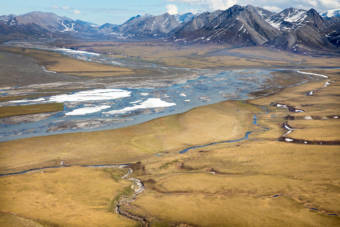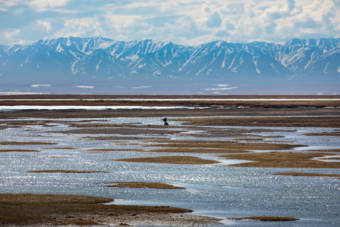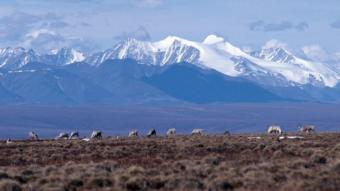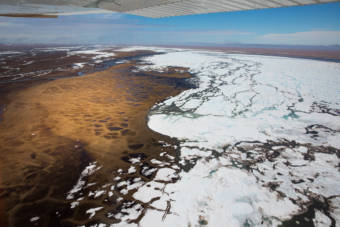
Research biologists pause among the wetlands of the coastal plain, with the Brooks Range in the background. (Lisa Hupp/USFWS)
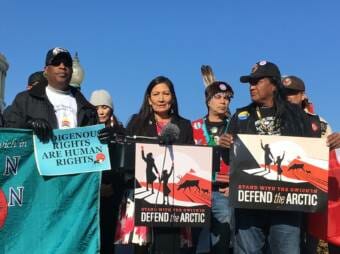
The Gwich’in Steering Committee, village councils and more than a dozen conservation groups on Tuesday asked a federal judge in Alaska to step in and block the upcoming sale of oil drilling rights in the coastal plain of the Arctic National Wildlife Refuge.
Their motions for a preliminary injunction come in three ongoing lawsuits that challenge the Trump administration’s controversial oil leasing program for the refuge.
“We will not stand idly by while the Trump administration auctions off the wildest place left in America at bargain basement prices,” said a statement from Adam Kolton, executive director at Alaska Wilderness League.
The Trump administration has scheduled the first-ever lease sale in the refuge’s coastal plain for Jan. 6, and it’s moving toward allowing seismic work in the area this winter.
But the groups behind the recent court filings are asking a judge to prevent the administration from doing both until the ongoing lawsuits are resolved.
The legal standard for getting an injunction is higher than it is for winning a normal legal case.
Brook Brisson, a senior staff attorney at the Anchorage law firm Trustees for Alaska which represents the Gwich’in and several conservation groups, said she believes they can prove there will be irreparable harm unless an injunction is issued.
“Exploration, drilling, gravel mining, road building, building pipelines. Those are all very clearly incredibly harmful to the coastal plain and its resources,” she said.
The Bureau of Land Management, which is conducting the lease sale, counters that it’s following the law and has made science-based decisions to determine where and under what conditions oil development can occur.
The groups opposed to the sale are asking the court to decide whether to grant the requested injunction by Jan. 6.
If the court does decide to step in, it could push a decision on the lease sale into the next administration. President-elect Joe Biden takes office Jan. 20 and opposes oil development in the refuge.
This story has been updated with information on a third motion for a preliminary injunction filed Tuesday on behalf of the Native Village of Venetie Tribal Government, Arctic Village Council and the Venetie Village Council.
Caribou graze on the coastal plain of the Arctic National Wildlife Refuge, with the Brooks Range as a backdrop in October 2010. (Public domain photo by U.S. Fish and Wildlife Service)
Gov. Mike Dunleavy wants the state government to sever its ties with financial institutions that won’t finance oil and gas development in the Arctic.
Dunleavy announced in a news release Monday that his administration will introduce a bill during the upcoming legislative session that would require state departments and agencies to end any existing relationships with the businesses.
The proposed move by Dunleavy follows a string of announcements from major banks and lenders that say they won’t invest in oil and gas projects in the Arctic. Those companies include Wells Fargo, Bank of America, Goldman Sachs and JPMorgan Chase.
Environmental groups trying to block drilling in the Arctic National Wildlife Refuge have lobbied the banks to rule out investing in Arctic oil development.
Monday’s news release from the governor’s office said the proposed legislation would “protect Alaska’s economy.”
“It makes no sense for Alaska to allow financial institutions to benefit handsomely from Alaska’s financial activities on one hand, while working against our interests on the other,” Dunleavy said.
The exact impact Dunleavy’s proposal would have on state agencies wasn’t immediately clear.
Jeff Turner, the governor’s spokesman, said the scope of the change would be included in the draft legislation, and he said that document was not yet available Monday. He also said he did not have a list Monday of the financial institutions that the proposal would bar state agencies from using.
Alaska Wilderness League, a vocal opponent of drilling in the Arctic, swiftly criticized Dunleavy’s plans to introduce the bill, saying the governor is missing the broader point that “speculative, high cost projects in places like Alaska’s Arctic are no longer attractive to investors, especially with the realities of climate change and as more lucrative opportunities in renewable energy or unconventional oil plays down south exist.”
The federal government plans to hold its first-ever oil and gas lease sale in the Arctic refuge’s coastal plain on Jan. 6.
A 3-D rendering of Hilcorp’s proposed Liberty project represented in the Bureau of Ocean Energy Management’s environmental impact statement. (Image courtesy BOEM)
A federal appeals court has overturned approval for Hilcorp’s Liberty Project, an oil prospect six miles from shore in the Beaufort Sea.
A three-judge panel of the 9th Circuit Court of Appeals agreed with environmental groups, saying the agency’s review of drilling impacts was inadequate.
The judges said the Bureau of Ocean Energy Management should have quantified the greenhouse gas emissions from the oil that would go overseas. They also faulted the Fish and Wildlife Service for not estimating the non-lethal impact the drilling would have on polar bears.
Liberty was a BP project. Hilcorp became the sole owner when BP sold its Alaska assets. The development plan calls for building a 24-acre gravel island in shallow waters east of Deadhorse. Liberty is estimated to hold 120 million barrels of oil that could be extracted.
The court decision sends the case back to the Bureau to try again.
The Porcupine Caribou herd in the Arctic National Wildlife Refuge’s coastal plain. (Photo courtesy U.S. Fish and Wildlife Service)
In a last-minute push, the Trump administration announced Thursday that it plans to auction off drilling rights in the Arctic National Wildlife Refuge in just over a month, setting up a final showdown with opponents before President-elect Joe Biden takes office.
The sale, which is set for Jan. 6, could cap a bitter, decades-long battle over whether to drill in the refuge’s coastal plain, and it would seal the administration’s efforts to open the land to development.
“We’ve followed a very logical and fairly lengthy, certainly very involved and public-oriented process to get us to this point. And this is the next logical step,” said Kevin Pendergast, deputy state director for resources with the Bureau of Land Management in Alaska.
But conservation and tribal groups who oppose oil and gas development in the coastal plain strongly disagree. And they blasted the administration on Thursday, saying it’s cutting corners so it can hand over leases to oil companies before Biden, who opposes drilling in the refuge, is sworn in and can block it.
“You’re one mile from the finish line and you decide to take a shortcut is what this screams to me, and you hope you don’t get caught,” said Matt Newman, a senior staff attorney at the Native American Rights Fund in Anchorage. He represents three Gwich’in tribes who live near the refuge and oppose drilling on the coastal plain.
“This just smacks in the face of a normal procedure,” he said.
BLM’s announcement of a sale date Thursday came just about two weeks into its “call for nominations,” a 30-day window when oil companies and others can tell the government which tracts of land they’re interested in bidding on.
Typically, once that period ends, confidential comments are analyzed to inform which pieces of land will be offered in a lease sale — and then the date of a sale is announced, said Athan Manuel, a lobbyist for the Sierra Club, which is opposed to drilling.
“The oil and gas program is usually more scheduled and systematic and by the book,” Manuel said. “That’s not happening with this case.”
Pendergast countered that the government is following regulations, including providing a 30-day notice of a lease sale.
A statement about the sale will be posted online Monday, detailing which areas the government will offer for leasing. The call for nominations ends 10 days later, on Dec. 17.
“We’re allowing for the various steps of the process to take place,” Pendergast said. “We can put those together in different ways at different times.”
Matt Lee-Ashley, a former deputy interior secretary under President Barack Obama, described the Trump administration as “hell-bent on selling off the Arctic Refuge on its way out the door, rules and laws be damned.”
“This whole boondoggle can and should be tossed in the trash by the courts or the next administration,” Lee-Ashley, who’s now a senior fellow at the Center for American Progress, a left-leaning think tank, said in a prepared statement.
Already, conservation and tribal groups, as well as a coalition of 15 states, have filed lawsuits challenging the Trump administration’s environmental reviews. Opponents have also secured pledges from an array of banks that say they won’t finance oil development in the refuge.
“Today we put the oil industry on notice,” said a statement Thursday from Jamie Rappaport Clark, head of Defenders of Wildlife. “Any oil companies that bid on lease sales for the coastal plain of Arctic National Wildlife Refuge should brace themselves for an uphill legal battle fraught with high costs and reputational risks.”
The coastal plain, also known as the 1002 Area, covers about 1.6 million acres; it’s roughly the size of Delaware.
It represents about 8% of the vast refuge. And while it’s home to polar bears, caribou and other wildlife, it’s also thought to hold billions of barrels of oil.
The Arctic National Wildlife Refuge’s coastal plain is shown in orange. The area covers about 1.6 million area, roughly the size of Delaware, and makes up about 8% of the refuge. (USGS map)
In a dramatic shift after nearly four decades of protections, a Republican-led Congress approved legislation in 2017 that opened up the coastal plain to oil development. It required two lease sales within seven years, the first scheduled for no later than the end of 2021.
In Kaktovik, the only community inside the coastal plain, some residents greeted Thursday’s news with enthusiasm. Matthew Rexford, Kaktovik’s tribal administrator, said drilling could boost the local economy.
“We have watched oil and gas development on the North Slope for almost 50 years,” he said in a phone interview. “And we believe that through the stringent regulatory environment and the oversight of our home rule borough, the North Slope Borough, all impacts from exploration and development can be mitigated to preserve the area.”
Alaska’s Congressional delegation, which has pushed to open the coastal plain to drilling, also praised Thursday’s announcement, saying development will create jobs. Kara Moriarty, head of the Alaska Oil and Gas Association, said it’s also good for the industry.
“Having a lease sale is the first step of getting access to responsibly developing resources that are needed to meet global demand,” Moriarty said.
Moriarty said she would not call the administration’s process rushed, since drilling in the refuge has been debated for decades. But she did say oil companies will have less time to prepare their bids than they normally do.
It remains unclear who might participate in a coastal plain lease sale. Oil and gas companies aren’t talking publicly about whether they plan to bid.
BLM says the sale will be conducted by video livestream.
Alaska Public Media’s Nat Herz contributed to this story.
Caribou graze on the coastal plain of the Arctic National Wildlife Refuge, with the Brooks Range as a backdrop. (USFWS)
The battle over oil drilling in the Arctic National Wildlife Refuge’s coastal plain has dragged on for decades.
And now, the Trump administration is close to auctioning off drilling rights for the land in northeast Alaska — potentially just days before President-elect Joe Biden takes office in January.
But there’s a big, unanswered question looming over the idea of a sale: To what degree will the industry actually participate?
Oil and gas companies aren’t talking publicly about whether they’d bid. And Kara Moriarty, head of the Alaska Oil and Gas Association, said that’s not surprising.
“Participation in lease sales is one of the most competitive and secretive things between companies,” she said. “So I don’t know who is interested in participating in a state lease sale, any more than I know who is interested in participating in the next NPR-A lease sale, or in the coastal plain of ANWR.”
The Arctic National Wildlife Refuge’s coastal plain is shown in orange. The area covers about 1.6 million area, roughly the size of Delaware, and makes up about 8% of the refuge. (USGS map)
Moriarty said the public likely won’t have the full picture of industry interest until the federal government unseals the bids on the day of a sale. A sale date has not been announced yet, but the way the government’s timelines work, one could be held just before Inauguration Day.
And while oil and gas companies are mum, industry experts and analysts do have a read on what a lease sale might look like.
“My view is that any response will be fairly lukewarm,” said Rowena Gunn, an analyst for the energy research firm Wood Mackenzie.
Alaska politicians and industry groups have long fought to get drill rigs on the coastal plain, which is thought to hold billions of barrels of oil, but Gunn and others say there’s currently a layer of uncertainty and risk that could lead to limited interest in a lease sale if one happens within the next couple months.
“They’ll probably get some bids,” said Larry Persily, an oil industry observer and former federal coordinator for Alaska gas line projects under President Barack Obama. “But even at fire-sale prices, there probably won’t be a rush of interest.”
That’s for a number of reasons, he said.
One of them is money.
The coronavirus pandemic and an oil price war have both hit the oil industry hard. Oil prices are still low, and it’s expensive and difficult to explore for oil in the Arctic, said Mark Myers, a geologist and former natural resources commissioner in Alaska.
“The prices have fallen down to a level that leaves very little capital for exploration in these companies,” Myers said. “So that’s one of the biggest negatives.”
Also, there’s the opposition, Gunn said, which may weigh more heavily on publicly-traded companies.
“There’s a certain amount of public opinion that it wouldn’t necessarily be good PR for them to be seen as drilling in the Arctic or drilling in environmentally-sensitive areas,” she said.
While some, including Alaska’s congressional delegation, have celebrated the prospect of a lease sale as a way to create more jobs and revenue for the state, others are fighting to keep oil and gas companies out of the refuge, citing concerns about impacts on ecosystems, Indigenous people and the climate.
Indigenous and conservation groups have already filed multiple lawsuits that aim to block drilling in the coastal plain. They’re asking major insurers to not support any oil and gas projects in the refuge. And an array of big banks have already said they won’t fund new oil and gas projects in the Arctic.
There’s a list of other reasons too why some analysts say they wouldn’t expect a deluge of bids.
That includes future demand for oil.
Colorado-based energy economist Philip Verleger said he thinks a lease sale in the refuge 15 years ago would have been “terrifically successful,” but, he said, he thinks the time to develop the coastal plain has passed.
“I do not think ANWR is ever going to be produced,” he said. “The cost of going there and developing and putting the resources in is too high, particularly since the production would last a long time, and we don’t know if demand would last as long.”
Gunn also said some of the larger oil companies operating in Alaska are busy with other projects, such as ConocoPhillips’ work in the NPR-A and Hilcorp taking over oil fields at Prudhoe Bay.
Both companies declined to say whether they had plans to participate in a lease sale in the refuge, if one is held. ExxonMobil also declined to comment for this article.
Chevron said it would consider it “in the context of its global exploration portfolio.” Oil Search said it is “focused on developing the Pikka project and exploring our current leases.”
Perhaps the biggest uncertainty of all that the industry is facing is the changing administration.
Biden has said he opposes drilling in the refuge.
Andy Mack, another former Alaska natural resources commissioner, said even if the Trump administration issues leases before leaving office, Biden’s administration could delay the permits that companies need to search for oil and build their infrastructure.
“What they would try to do is make it so difficult, so onerous, to get the array of permits that the companies just kind of say, ‘Well, we’re not going to spend 10 years just trying to get a simple permit, we’re going to put our money and our investment elsewhere,’” Mack said.
However, Mack said, it’s also possible companies could secure leases and just wait for the administration to change again.
He and Myers underscored that the flip side of all this is that the refuge is still thought to hold a whole lot of oil. And, for some companies, that payoff could outweigh any risk or uncertainty.
Josiah Patkotak is the representative-elect for Alaska’s House District 40 seat. (Photo courtesy of Josiah Patkotak)
As lawmakers begin to figure out what the makeup of various legislative caucuses will look like, Josiah “Aullaqsruaq” Patkotak is in a slightly different position than most other representative-elects.
With unofficial results coming in two weeks after the general election, Patkotak emerged victorious in the race for House District 40, which includes the North Slope, the Northwest Arctic Borough and several Interior Alaska villages.
While Republicans hold a slim majority in the state House, Patkotak, an independent, says he hasn’t committed to joining a legislative caucus yet. However, he says there are several programs he wants to ensure receive funding.
“As I lump them together, as I’ve had to talk to people over the last couple days, I call them PPT and PCE — petroleum property taxes and Power Cost Equalization,” Patkotak said. “Those are on the list of priorities. There are other things that I’m interested in looking out for, and I’m making sure those are involved in my decision making moving forward.”
With many of the Republicans who’ve been elected to the Legislature in favor of large cuts to funding for state services, Patkotak says he’s opposed to joining a caucus that would cut programs like PPT and PCE.
“Anybody that’s going to look at attacking programs or services that are going to affect my district negatively, that’s not something I’m going to be in favor of, obviously,” Patkotak said.
Gov. Mike Dunleavy proposed transfering oil property taxes from municipalities like the North Slope Borough to the state government last year. He didn’t repeat the proposal this year. And Dunleavy and some Republican lawmakers proposed eliminating the Power Cost Equalization Fund last year. It’s not clear whether Dunleavy will propose a similar change in the budget he introduces in December.
For now, Patkotak isn’t committing to any legislative caucus. He says he hopes to take his role as an independent lawmaker seriously.
“I have this deep belief that a lot of things that I’ve learned going whaling can be applied throughout my life,” Patkotak said. “That’s one of the things. You know when to strike the whale and you know when not to. And I think I’m just applying that same principle here. Like I said, I haven’t committed to anybody. All options are on the table.”
The Division of Elections expects to officially certify the results of the election next week, with lawmakers set to arrive in Juneau in January.
Close
Update notification options
Subscribe to notifications
Subscribe
Get notifications about news related to the topics you care about. You can unsubscribe anytime.