North Slope

A flurry of lawsuits aim to stop drilling plans in Alaska’s Arctic. So what’s next?

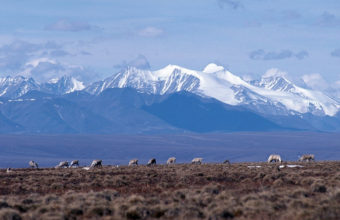
Caribou graze on the coastal plain of the Arctic National Wildlife Refuge, with the Brooks Range as a backdrop in October 2010.
Caribou graze on the coastal plain of the Arctic National Wildlife Refuge, with the Brooks Range as a backdrop. (Public domain photo by U.S. Fish and Wildlife Service)

Alaska Native groups, environmental groups and, most recently, a coalition of 15 states have filed a flurry of lawsuits over the past month that aim to derail drilling plans for Alaska’s Arctic National Wildlife Refuge and National Petroleum Reserve.

These are separate lawsuits over separate pieces of land — a lot of land — and it’s a lot to keep track of.

Listen to the interview or read the transcript of Alaska Public Media’s Tegan Hanlon and Casey Grove trying to sort through it all.

[GROVE]: Well, let’s just get right into it. Can you briefly summarize what triggered these lawsuits?

[HANLON]: Yes. So there have been two big, recent developments when it comes to oil and gas drilling on Alaska’s North Slope.

Number one: The Trump administration announced in August its official plan for opening up part of the Arctic Refuge to oil and gas development. It’s an area called the coastal plain, and it sits to the east of Prudhoe Bay. The coastal plain makes up about 8% of the whole refuge. But the whole refuge is massive, so 8% of it is about the size of the state of Delaware.

It’s a place believed to hold billions of barrels of untapped oil, but it’s also an area where caribou migrate, polar bears den and migratory birds feed. And environmental groups have long fought to keep drilling rigs out.

And so, this official plan for oil and gas development on the land comes out in August, and Interior Secretary David Bernhardt says that the federal government could auction off drilling rights in the coastal plain to oil and gas companies by the end of the year. (Once leases are issued, it will be harder for a future president to reverse course.)

All of it is a very big deal.

[GROVE]: OK. I got that part. So, what’s number two.

Significant development number two: On the other side of Prudhoe Bay, to the west, sits Alaska’s National Petroleum Reserve, also called the NPR-A. There’s already some oil and gas development going on in the NPR-A, but there’s also land that is off-limits to drilling under the current Obama-era plan for the reserve.

But the Trump administration is working on a new management plan for the reserve, and it released its final environmental impact statement for that plan in June. The proposal would make about 80% of the NPR-A open to drilling instead of the current 50% or so. And that includes opening up the Teshekpuk Lake area — in the reserve’s northeastern corner — to drilling.

The next step is the government issuing what it calls a record of decision — or you might hear it referred to as a “ROD” — basically it’s just the final decision.

Again, all of it is also a very big deal.

And, like the Arctic Refuge, the NPR-A is also thought to hold billions of barrels of oil but it’s also an important habitat for birds and caribou and other wildlife. In both areas, there’s also concerns about impacts to subsistence, the climate and the land.

[GROVE]: And then came the lawsuits, right?

[HANLON]: Yes! And then came an avalanche of lawsuits.

Actually, two of the lawsuits related to development in the Arctic Refuge’s coastal plain were filed Wednesday.

One by a tribal government and two village councils and another by a coalition of 15 states including New Jersey and New York and Washington, but not including Alaska.

Taken together, the lawsuits are hundreds of pages.

At the most basic level the claims very broadly boil down to alleging that the federal government glossed over the impacts that oil and gas development could have on the land, wildlife, climate and subsistence. And, they say, the government failed to follow numerous environmental laws when developing the plans.

Here’s how EarthJustice attorney Kate Glover summarized the claims in one of the Arctic Refuge lawsuits:

“The problem is that BLM is pushing prioritizing oil and gas over all other purposes… all of the claims in the lawsuit are targeting their failure to take into account the impacts on Indigenous communities, wildlife, subsistence and recreational wilderness values of the refuge.”

The Bureau of Land Management counters that its actions are lawful and based on the best available science.

[GROVE]: So what’s the status of the lawsuits currently?

Well, they’re all in U.S. District Court in Alaska, so federal court. We’ve got the two just filed. And there are at least four others that are still really early on in the process.

Lawyers say the NPR-A lawsuits will likely start moving through the court process once the federal government issues its final decision on a management plan.

And, lawyers who filed two other Arctic Refuge lawsuits say they’re now waiting on the federal government to answer the complaint. One lawyer I spoke with said a ruling from the judge may not come for a year or so.

[GROVE]: Can the federal government move ahead with a lease sale with lawsuits ongoing?

[HANLON]: The short answer is: Right now, yes.

The Bureau of Land Management says “there is no legal prohibition” right now for it to move forward with a lease sale, in the case of the Arctic Refuge, or a final decision on a management plan, in the case of the NPR-A.

Then if a judge rules in a way that makes the lease sale or the management plan invalid, well, that’s a whole other conversation for us to have.

Also: I was curious if the filing of the lawsuits would have any impact on oil companies’ decisions on where to drill.

Lawyers who filed the lawsuit are hopeful that’s the case.

But Kara Moriarty who leads the Alaska Oil and Gas Association says she doubts it. She says the lawsuits aren’t surprising.

“Lawsuits have just become a way of life. And it was not surprising to us. If the industry was concerned about lawsuits these days, they’d probably never invest in Alaska anymore in the oil and gas industry. Trying to use lawsuits to keep resources in the ground has become a tried and trued page out of a playbook by groups.”

[GROVE]: Well, to close out: Any ETA at this point on a lease sale or official decision on the NPR-A management plan?

[HANLON]: No, no set date announced publicly at this point. That’s the million-dollar question.

15 states sue to stop drilling plan for Arctic Refuge

Caribou graze on the coastal plain of the Arctic National Wildlife Refuge, with the Brooks Range as a backdrop. (Creative Commons photo by USFWS)

Fifteen states have filed a lawsuit aimed at derailing the Trump administration’s plan to allow oil drilling in the Arctic National Wildlife Refuge.

Their legal challenge joins a growing stack of others from more likely plaintiffs. Gwich’in tribes also filed one Wednesday. They’ve fought to block drilling for decades.

The attorneys general of the 15 states argue that they have standing to sue because what happens in the Arctic Refuge affects their fish, wildlife and physical environment.

New York, for instance, says tundra swans, American golden plovers and whimbrels migrate between the Arctic Refuge and the Empire State, contributing to New York’s $4 billion birdwatching industry.

Michigan says waterfowl hunting is a significant source of income for that state, and some of the targeted species nest in the refuge.

The other states bringing the suit are California, Connecticut, Delaware, Illinois, Maine, Maryland, Massachusetts, Minnesota, New Jersey, Oregon, Rhode Island, Vermont and Washington.

The states say the environmental studies of proposed oil drilling in the refuge underestimate the damage to habitat and the greenhouse gas effect that would result from using petroleum products pumped from the refuge.

They want a judge to overturn Interior Secretary David Bernhardt’s record of decision last month to proceed with an auction of drilling rights. They also want the final environmental impact statement thrown out.

Bernhardt, in his decision, said Interior does recognize that ANWR provides habitat for many species. He said climate change was also taken into account. In an appendix to the final environmental report, the Bureau of Land Management wrote that there is no climate crisis and that past warming didn’t make the planet unlivable.

As COVID-19 spikes on North Slope, mayor orders Utqiagvik to hunker down

City Hall was one of a few places where Utqiaġvik has been incorporated into the official insignia.
City Hall was one of a few places where Utqiaġvik has been incorporated into the official insignia. (Photo by Ravenna Koeniq/Alaska’s Energy Desk/KTOO)

As cases of COVID-19 spike in Alaska’s North Slope Borough, Mayor Harry Brower has issued a two-week “hunker down” order and mask mandate for the region’s hub town, Utqiaġvik.

Brower issued his emergency order Tuesday, requiring the town’s 5,000 residents to stay home except for getting or providing health care, shopping for groceries or other “critical goods” and getting “fresh air.” There’s an exemption for religious services — whether they’re held in cars, outside or in “properly-spaced and ventilated” indoor spaces.

In the order, Brower said he’s imposing the measures in response to “increasing numbers of COVID-19 coronavirus cases in Utqiaġvik.”

“Please encourage each other during this trying time,” the order said.

A borough spokesman said Brower was unavailable for an interview because he was busy butchering a recently-caught bowhead whale for his constituents. But in a prepared statement, Brower said the order was mostly directed at air travelers and private businesses.

“We trust folks will do the right thing and appreciate our business partners in all of our communities. But companies like Wells Fargo, our only bank on the North Slope, must provide the same safeguards they are using in larger Alaskan communities,” Brower’s statement said, suggesting free hand sanitizer and tele-banking for elderly and vulnerable residents who lack internet. He added: “We are far away from Anchorage, but our residents are still your customers. I will do everything I can to protect our residents. God bless you all and please stay safe.”

Utqiaġvik didn’t see its first case of COVID-19 until mid-July, according to state data. But since then, it’s registered 33 cases, including 11 in the past 10 days.

The local tribal health-care provider, Arctic Slope Native Association, said that four Utqiagvik residents tested positive for COVID-19 on Tuesday. All of those cases came from what’s known as “community spread,” ASNA said, which means the source of their infections couldn’t be determined.

Brower’s order says that all residents must wear masks or cloth face coverings when in “communal public spaces,” and when interacting with people they don’t live with.

Masks must be worn in “non-home settings, when unable to maintain a six-foot distance from others for any but a transient interaction.” The mask requirement also applies to taxis, cars and buses.

‘We will give you one heck of a fight’: Lawsuits filed against drilling plan for Alaska’s Arctic Refuge

Caribou graze on the coastal plain of the Arctic National Wildlife Refuge, with the Brooks Range as a backdrop. (USFWS)

The Gwich’in Steering Committee and more than a dozen environmental groups are suing the Trump administration over its controversial plan to open up part of the Arctic National Wildlife Refuge to oil and gas development.

The two lawsuits filed Monday argue that the Bureau of Land Management’s environmental review process failed to follow numerous laws meant to protect wildlife, land, water and people.

“The remedy that we’re seeking is to throw out this illegal decision as well as any lease sale or leases that rely on it,” said Victoria Clark, executive director of Trustees for Alaska, the Anchorage-based firm representing the Gwich’in Steering Committee and other groups.

The lawsuits come a week after the BLM finalized its plans for development in the Arctic Refuge’s 1.6-million-acre coastal plain — an area roughly the size of Delaware that makes up about 8% of the vast refuge. It’s a place where caribou migrate, polar bears den and migratory birds feed. It’s also an area believed to hold billions of barrels of untapped oil.

Interior Secretary David Bernhardt has said the federal government could auction off drilling rights in the coastal plain by the end of the year.

That’s why the groups had to quickly move forward with their lawsuits, Clark said. Once leases are issued, it could be more difficult to reverse course.

“We have an administration that is just steamrolling along trying to get these decisions made,” she said.

The BLM’s development plan stems from legislation approved by Congress in 2017 that called for two lease sales in a coastal section of the Arctic Refuge within seven years.

In response to the lawsuits, the BLM released a statement Monday saying that its plan for where and when development can take place “includes extensive protections for wildlife, including caribou and polar bears.”

“This is a congressionally mandated energy development program that leaves 92% of the refuge completely off-limits to development,” it said.

But the lawsuits argue that the BLM is downplaying the impacts of drilling and that oil and gas development will cause irreparable harm to wildlife, the tundra and the climate.

“Developing Alaska’s last wild places would be a death sentence for polar bears and other threatened Arctic species. The oil industry just doesn’t belong in the Arctic National Wildlife Refuge,” said a statement from Kristen Monsell, a senior attorney at the Center for Biological Diversity, a group behind the second lawsuit.

On a call with reporters Monday, Gwich’in Steering Committee’s executive director Bernadette Demientieff said the Gwich’in people feel attacked by the government.

“We are not asking for anything but the ability to continue to live and thrive off the land that has sustained us for thousands and thousands of years,” she said.

Demientieff is from the Yukon River community of Fort Yukon, and she’s one of the highest profile leaders among the Gwich’in, an indigenous group spread between Alaska and Canada whose members harvest caribou that give birth in the Arctic Refuge.

Demientieff described the coastal plain as pristine and sacred and vowed to protect it.

“We will give you one heck of a fight,” she said.

COVID-19 cases grow at North Slope oil fields, Anchorage Pioneer Home, as state confirms 86 positives

Alpine
ConocoPhillips’ Alpine facility on the North Slope. (Photo by Elizabeth Harball/AED)

State and oil company officials confirmed 13 cases of COVID-19 between two different North Slope oil fields, as Alaska reported 86 new cases of the virus Thursday.

To date, eight people have tested positive for COVID-19 at ConocoPhillips’ Alpine camp on the western North Slope, all of whom were flown to Anchorage for isolation, spokeswoman Natalie Lowman said in an email this week. That’s up from two cases announced earlier this month.

Separately, at the huge Prudhoe Bay field operated by Hilcorp, five workers have tested positive, and 11 more close contacts are now in quarantine, the Anchorage Daily News reported Thursday.

Anchorage municipal officials, in a weekly memorandum, also confirmed four more cases of COVID-19 at the city’s Pioneer Home for the elderly, bringing the total number at that building to 16 — three employees and 13 residents.

The city also released a new tally of the total number of workers who tested positive for COVID-19 at an Anchorage fish processing plant operated by Copper River Seafoods. That’s up to 99 out of 135 employees — 56 cases had been confirmed at the plant previously.

Meanwhile, state health officials reported Thursday that they’d identified 86 new cases of COVID-19: 84 residents and two nonresidents.

That brings the total number of cases among Alaskans to 4,520 and non-residents to 812. Among Alaska residents, there are 3,163 active cases and 1,328 have or are presumed to have recovered.

Among nonresidents in the state, there are 627 active and 185 recovered or presumed to have recovered.

There were no new deaths reported in Alaska, leaving the total at 29.

New resident cases reported in Southeast Alaska include four from Juneau, one from Douglas, and one from Ketchikan.

New cases elsewhere in the state include 41 from Anchorage, 10 from Fairbanks, four from Palmer, four from Wasilla, three from Kotzebue, two from Eagle River, two from Kenai, two from Kodiak, two from Utqiagvik, two from Bethel, one from North Pole, one from an unidentified community in the Valdez-Cordova Census Area, one from an unidentified community in the Yukon-Koyukuk Census Area, one from Big Lake, one from Houston and one from Nome.

The non-residents include one in Juneau and one in an unknown location.

The total number of COVID-19 related hospitalizations during the pandemic is 187 for residents and four for nonresidents. There are 45 people currently in the hospital who have tested positive for COVID-19 and another six who are suspected to have the disease and awaiting test results. Six of those 51 people are on ventilators.

A total of 312,647 tests have been administered in the state, up 1,798 from Wednesday’s report.

In other data, hospitals reported that 920 inpatient beds are occupied, while 518 are available, 87 of 153 ICU beds and 28 of 285 ventilators are in use by both COVID and non-COVID patients.

Tegan Hanlon contributed reporting.

Trump administration finalizes plan for oil drilling in Arctic Refuge

Caribou graze on the coastal plain of the Arctic National Wildlife Refuge, with the Brooks Range as a backdrop. (USFWS)

Interior Secretary David Bernhardt today announced the official decision to proceed with oil drilling in the Arctic National Wildlife Refuge. The decision opens up the entire coastal plain — 8 percent of the refuge — to drilling. It does not set a date for holding the first auction for drilling rights, but Bernhardt said that could happen soon.

“I do believe there certainly could be a lease sale by the end of the year,” he said.

Once drilling rights are sold, it will be harder for a future president to reverse course.

Sen. Lisa Murkowski called today’s action a “capstone moment.” She and every member of Alaska’s congressional delegation has pushed to allow drilling in the area since the law creating the refuge was signed in 1980.

Environmental groups have fought to keep rigs out of the Arctic Refuge for just as long.

The Wilderness Society, among other groups, said the fight is not over.

Site notifications
Update notification options
Subscribe to notifications