Northwest

Appeal challenges Alaska’s exclusion of village residents from juries

View of the jury box on Oct. 5, 2017 in the Christopher Strawn trial. (Photo by Matt Miller/KTOO)
The jury box in a Dimond Courthouse courtroom in Juneau on Oct. 5, 2017. (Photo by Matt Miller/KTOO)

The Alaska Court of Appeals heard arguments Thursday in a case that could have huge implications for how Alaska village residents are included — or excluded — as jurors in trials.

At the center of the dispute is an appeal by Teddy Kyle Smith, 50, who was convicted of attempted murder and sentenced to 99 years in prison for shooting two men near his home village of Kiana in 2012.

Smith’s trial was in Kotzebue, the closest courthouse to Kiana but still more than 50 miles away. In general, Alaska jurors are only assigned to criminal trials from communities within 50 miles of the courthouse where the trial is held.

Smith’s lawyers say he was not tried by a jury of his peers, because the trial judge denied their request to expand the jury pool.

Smith’s attorney for the appeal, Kelly Taylor, was in court Thursday in Anchorage and argued that decision infringed on villagers’ rights as well.

“This court will have to decide whether the right to participate in jury service of village residents is violated by their categorical exclusion from the jury panel in this case, and whether Smith’s right to a fair cross-section was violated, where the people who share his experience of living day to day in a remote village location was violated,” Taylor said.

Taylor and others, including the American Civil Liberties Union and Native American Rights Fund, say there is also a racial inequity component to jury selection in Alaska, because villages tend to have a higher proportion of Alaska Native residents.

“Alaska Natives are underrepresented on juries and it means that non-Native residents are over-represented on juries,” Taylor said. “Being on a jury means applying the law. Your vote is an application of the law, and that discrepancy means Alaska Native residents get fewer votes.”

Among other claims, Smith’s lawyers say villagers would have better understood his comments when he said he thought he was shooting at enukin: a name for the “little people” of some Alaska Native legends.

But state attorney Ann Black argued that legend is also shared by people who live outside of villages, including some Kotzebue residents. Likewise, Black and the state court system say jurors from Kotzebue are not so different from residents of villages as to be unfair to a defendant.

The state also says the cost of getting jurors to a courthouse more than 50 miles from where they live presents a logistical and financial burden for the court system.

In court Thursday, Black argued that selection of jurors in Smith’s case was fair according to a past decision by the Alaska Supreme Court.

“The Supreme Court recognized mile radiuses need to be drawn. It’s going to happen,” Black said. “And so long as those lines are drawn in a manner that does not deny a defendant a fair cross-section of the community on his jury venire, then they’re constitutionally sound.”

A three-judge appellate court panel heard both sides’ arguments. It’s unclear when they will hand down a decision.
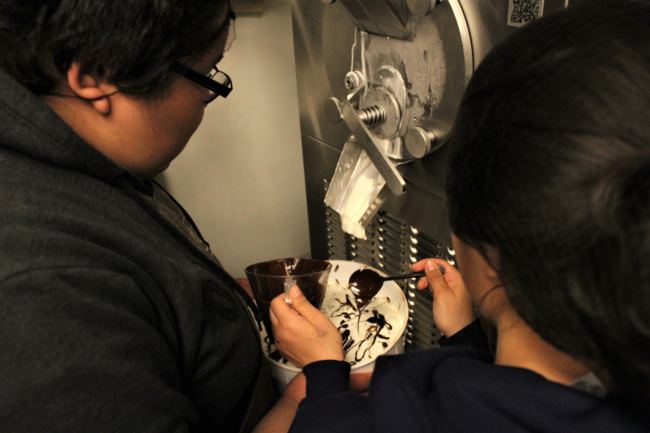
Muktuk and ice cream: Exchange brings Noorvik students to Juneau

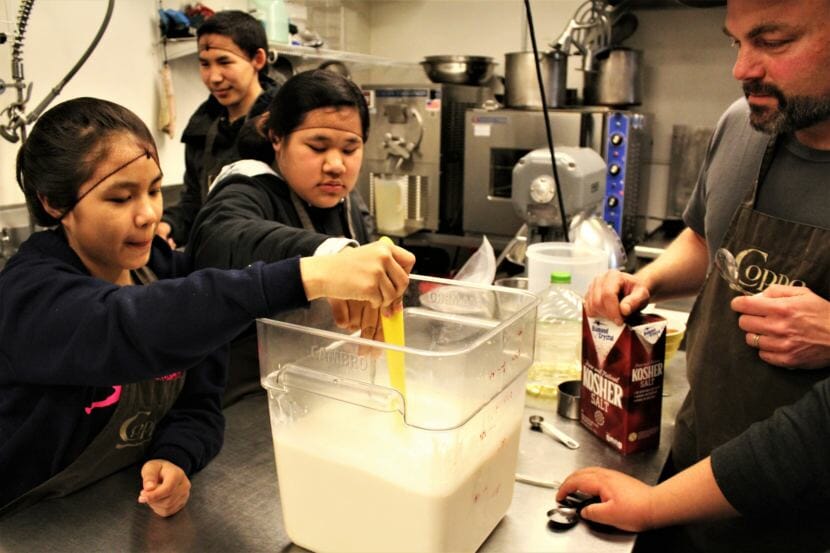
Students on a cultural exchange trip from Noorvik Aqqaluk School make ice cream with Marc Wheeler in the kitchen at Coppa in Juneau. (Photo by Adelyn Baxter/KTOO)

Four middle school students from Noorvik Aqqaluk School visited Juneau this week as part of the statewide Sister School Exchange program.

The program promotes understanding between Alaska’s rural and urban communities by setting up cultural exchanges for middle and high school students. The Northwest community of Noorvik was paired with Dzantik’i Heeni Middle School.

On Thursday, the Noorvik students paid a visit to Coppa where owner Marc Wheeler taught them how to make ice cream. They got to choose the flavor — mint chocolate ice cream.

“What else do you think we need in there?” Wheeler asked the group as one student stirred in the mint.

“The chocolate!” said eighth grader Lindsay Schuerch.

Student from Noorvik Aqqaluk School mix together mint ice cream and chocolate at Coppa during a cultural exchange visit. (Photo by Adelyn Baxter/KTOO)

Wheeler’s own daughter Celia, a middle school student at Dzantik’i Heeni, got to travel to Noorvik recently to experience life in rural Alaska.

“She came back and was just talking so much about riding on snow machines and eating muktuk and all the basketball they played there. She had a great time,” Wheeler said.

The group arrived Sunday and is staying with host families.

Besides class, they’ve made the rounds of all the Juneau sites — a tour of the Douglas Island Pink and Chum, Inc. hatchery, a visit to the Alaska State Museum, the state capitol and cultural lessons at Sealaska Heritage Institute. They even met Gov. Bill Walker and Lt. Gov. Byron Mallott and had a pizza party at the Governor’s Mansion.

Jeffrey Robinson is the teacher traveling with the group. He and other exchange leaders from across the state attended a training in November.

“I think it’s just exposure and building relationships. So my students up in the villages are, obviously, a little bit more isolated and have a certain paradigm that they have,” Robinson said. “Bringing them down into the cities, it’s kind of an eye-opening experience for them. But it’s still in the same state.”

Later on, the Noorvik students would return to the shop for an ice cream social with the students from the Juneau exchange.

The four students will leave Friday after a whale watching cruise.

E. coli outbreak comes to Alaska, first confirmed cases are Nome inmates

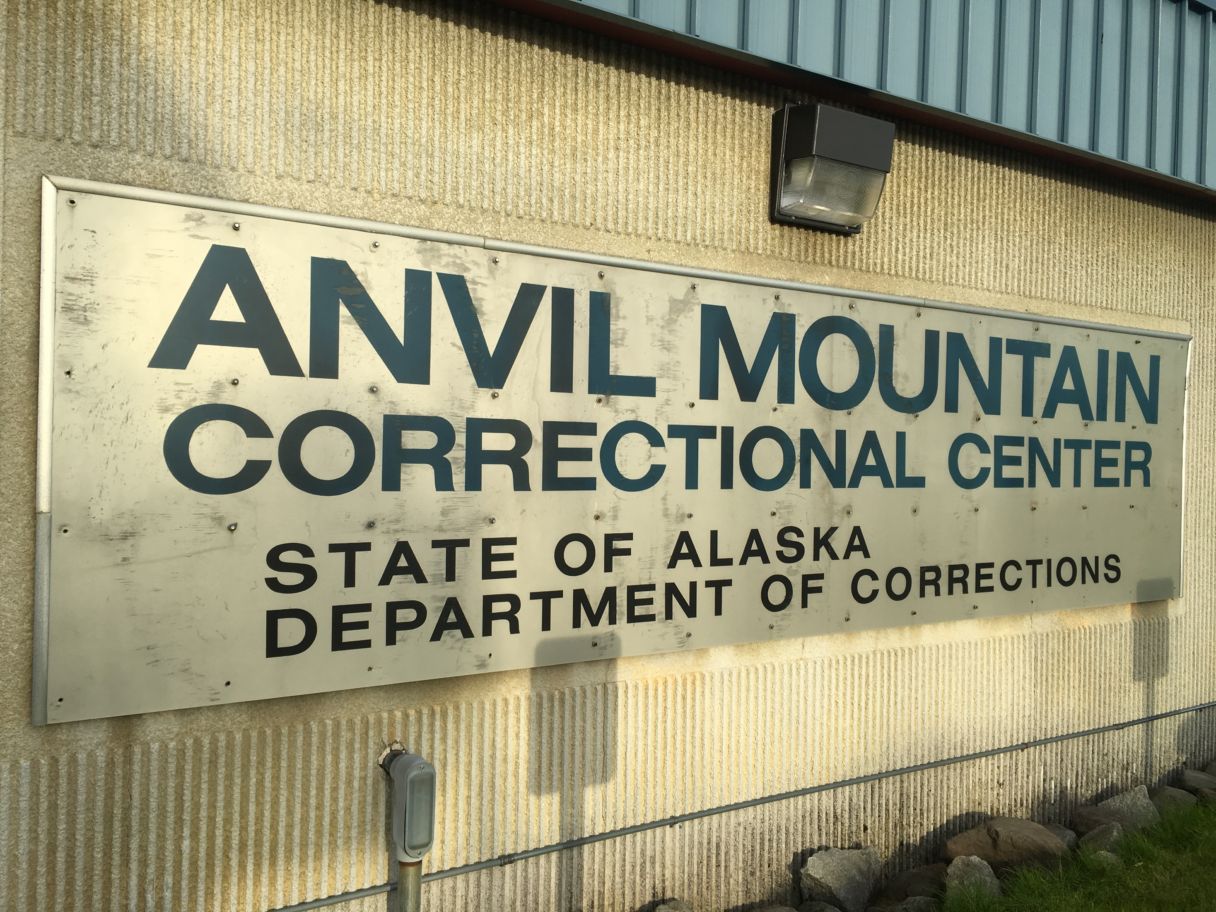
Anvil Mountain Correctional Center. (Photo by Margaret DeMaioribus/ KNOM)

Eight Nome correctional center inmates contracted a strain of E. coli from eating romaine lettuce.

The confirmed cases are the first in Alaska related to a national outbreak.

No other cases have been reported at Anvil Mountain Correctional Center or the rest of Alaska.

“What we’re talking about here is a type of E. coli, a shiga-toxin-producing E. coli. It can be pretty damaging to people,” epidemiologist Louisa Castrodale said. “It can cause some severe illness, vomiting, diarrhea and bloody diarrhea.”

State and national experts continue to investigate more than 50 E. coli cases across 16 states.

By collaborating with those entities, Castrodale said they have determined that the infectious lettuce came from Yuma, Arizona, but don’t know which specific farm.

“We also work very closely … with our partners in Food Safety,” Castrodale said. “The Department of Environmental Conservation, they’re working with FDA and the CDC to help figure out where did this lettuce come from? What farm, can they trace it back? How far can they trace it back?”

Alaska Department of Corrections staff and medical support implemented rigorous hygiene requirements — like more frequent hand-scrubbing — in order to control the outbreak within Anvil Mountain, a spokesman said.

“Outbreaks like this in a prison setting can be a little stressful, because everybody lives so close together; everybody interacts so closely all the time,” Castrodale said. “So we really do have really good medical staff, and really good staff at Anvil, because they had to go into overdrive to make sure that this incident was contained.”

Corrections public information officer Megan Edge said lettuce was taken off the menu temporarily, but Anvil Mountain will start serving the leafy green vegetable from another grower, to avoid further infections.

“we do have a correctional farm out in Mat-Su that we’re getting ready to head into growing season,” Edge said. “That’s always a huge relief for us, because we can take a lot of products that we are growing ourselves and use them at our facilities.”

According to Edge, none of the inmates were hospitalized, and all of them are back within the general population at the correctional facility.

The Center for Disease Control recommends Alaskans avoid eating any romaine lettuce unless you can verify it is not from Yuma, Arizona.

Alaska Native leaders imagine divergent ‘Arctic futures’

Leaders of Arctic communities discuss possible scenarios for the future of the region at the Arctic Futures conference (Photo courtesy of Kenton Media)
Leaders of Arctic communities discuss possible scenarios for the future of the region at the Arctic Futures conference (Photo courtesy Kenton Media)

The Arctic is changing, and the people living there are trying to change with it.

Alaska Native community leaders discussed the challenges — and opportunities — facing an evolving Arctic at the Arctic Futures conference at University of Alaska Fairbanks Northwest Campus, Nome.

Arctic Domain Awareness Center, which does research and community engagement for the U.S. Coast Guard, hosted the conference.

Leaders of Alaska Native communities have very different ideas about where the Arctic is headed. But they generally agree on one thing:

“We are now in the time where we are living two lives,” said Don Long, former mayor of Utqiagvik. “One, trying to be a subsistence hunter, and the other one, trying to be working the 8-5 type of work that job requires today.”

That tension was front and center of the discussion.

About 50 people from the Bering Straits region and the Northwest Arctic and North Slope boroughs were in Nome for the two-day workshop.

They compared scenarios for 20 years into the future based on different variables, including how much ship traffic increases and how much erosion worsens.

On top of erosion, the land is also changing due to mining projects popping up throughout the Arctic. For some, it’s a way to make a living.

“In my family, I have gold miners,” Nome elder Perry Mendenhall said. “They make a living gold mining just like other people. Even when they were told not to mine, they mine, to feed their people.”

Arlene Soxie is against mining.

“It grieves me to see how disrupted our land is. All the digging that was done looks very ugly to me,” the elder from White Mountain said. “There are areas where we used to go pick berries, but it’s not available anymore, because the land has been destroyed.”

The ocean is in flux, too.

This winter saw the second-lowest Arctic sea ice extent on record. Last year saw the lowest.

“Back in 1992, I used to feel comfortable going to Barrow by May the 10th to participate in whaling,” Nome elder Charlie Brower said. “The last few years, if I’m not there by the third week of April, I’ve missed most of the migrations of the whales.”

There are some upsides to more development in the Arctic, like better health care and fiber-optic communications.

Gordon Brower, who directs planning and community services for the North Slope Borough, hopes to see more improvements like those.

“With a housing crisis because of lack of opportunity — it’s like a cycle that we need to break, with economics,” Gordon Brower said. “Economic is the buzz word.”

Gordon sees responsible resource development in the Arctic as a way to break that cycle. And he wants to make protecting oil reserves in the Beaufort Sea a national security priority.

Elim elder Robert Keith said designing infrastructure around how nature behaves could help communities avoid the worst consequences — and price tags — of a changing climate.

But he says that kind of knowledge only comes with years of experience living in the Arctic.

“We’ve always been very adaptable people. We’ve had to live like that,” Keith said. “That’s part of our nature. We’re going to survive, but I don’t think some of the places we live at will.”

For now, Nome will move forward with exploring a deep-draft port that would bring more ship traffic through the Bering Strait.

Down the coast, people like Keith will watch the sea ice retreat and the coast continue to erode.

Iditarod checkpoint enforces ordinance to control loose dog population as mushers arrive

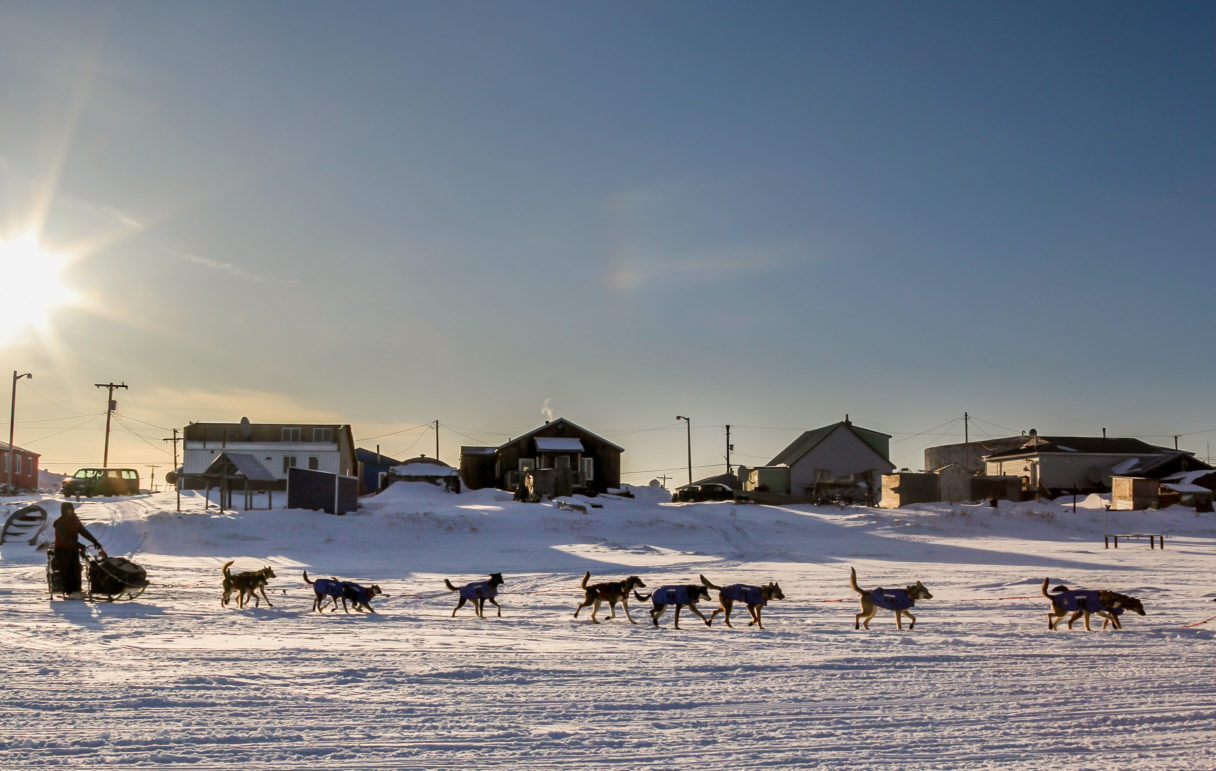
Nic Petit mushes out of Unalakleet on Sunday. (Photo by Zachariah Hughes/Alaska Public Media)

Coinciding with the Iditarod sled dog race, Unalakleet issued an emergency ordinance to address loose dogs running free around the community.

Many residents complained about a problem,  and not everyone is happy with the solution:

Interim City Manager Davida Hanson explained why the City Council voted in January, before the 2018 Iditarod began, to allow local law enforcement to catch loose dogs with or without collars.

“One of the reasons that the city decided to do an emergency ordinance was because there were so many loose dogs in town and also because Iditarod was going to be coming through,” Hanson said. “With the problem we were having, we didn’t want that to affect Iditarod, and we didn’t want to have loose dogs running around during Iditarod, with all the dog mushers coming through.”

Another concern, according to Hanson, was that the growing population of foxes in the area could carry a risk of rabies and potentially infect one of these loose dogs, which would be even more of a concern to deal with.

If dogs with collars are found, then they are held in a public dog pen for 24 hours, where their owners can pick up the dogs for a fine of $50.

Hanson said the city then contacts the pet owner and allows them time to get their pets, but if the 24 hours is up or the dog is found without a collar, then something more drastic happens.

“If the dogs don’t have a collar on them, then we are assuming that the dog doesn’t belong to anybody, and can be, according to the ordinance, all uncollared dogs will be caught and dispatched immediately in a humane manner,” Hanson said.

According to Hanson, it’s up to the Unalakleet police department to determine what qualifies as a humane way to dispatch un-collared dogs.

Local resident Charaleigh (Chara) Blatchford said their methods have not been exactly humane.

“I have had pets before that I’ve never collared, we don’t believe in tying our pets up,” Blatchford said. “Mom had let the dog out to use the bathroom, tried to call him back in, within a 20-minute period, and the dog never came back, so we figured he was just running around, he’d be fine, it has happened before.”

The next day after her dog didn’t return, Blatchford found her pet had been dispatched or shot and disposed of, then left at the community dump.

Blatchford knows of at least two local family’s dogs, including her own pet, who have been shot and killed in Unalakleet.

She would like to prevent that from happening to more pet owners in the community.

“I think that they could have kept putting the dogs inside the kennels, with or without a collar. I don’t understand the difference between the two,” Blatchford said. “It’s a small enough community where you know who everyone’s pets are, and just simply asking somebody if you don’t know, somebody in the neighborhood is going to know.”

To people like Blatchford, who have found their pets deceased in the local dump, Hanson said the city of Unalakleet apologizes, but the local government felt it needed to do something to control the number of untethered dogs.

“It seems to be working, and we hope that the community will continue to keep their dogs tied up,” Hanson said. “If you are out walking your dog, walk it with a leash. And if this is your pet and you don’t want something to happen to it, then everybody should take care of their pets.”

The Unalakleet City Council will meet in tonight, and Hanson said the loose dog issue is on the agenda.

This emergency ordinance is set to expire nine days from now, on March 22, after all the Iditarod mushers have come and gone.

Mixing science with traditional knowledge, researchers hope to get seal oil on the menu

Chris Dankmeyer displays a sample of seal oil from a series of experiments working to get seal oil approved for state-licensed facilities. (Photo by Anne Hillman/Alaska Public Media)

There’s a traditional foods movement happening in Alaska. Dieticians, administrators, and others are trying to get more wild foods like moose, berries, and beach greens into health care facilities and schools.

In Kotzebue, the long-term care facility is leading the way with their state-certified meat processing building, the Siġḷauq.

Things like caribou and trout are regularly on the menu.

But there’s one food that elders really, really want, and they aren’t allowed to have: seal oil.

“Seal oil has been implicated in a lot of botulism outbreaks in Alaska,” explained Chris Dankmeyer, the environmental health manager at Maniilaq Association in Kotzebue. “There’s a long record. In fact, some of the earliest records of botulism were from our region back in the ’70s.”

Botulism is bacteria that causes nausea, vomiting, blurry vision, even muscle weakness and death. “I mean, this is a very potent toxin,” he said.

Alaska has significantly more cases of botulism than other states, mostly because of fermented foods and sometimes because of seal oil.

So serving seal oil in nursing homes and schools is illegal except during potlucks.

Chris’s colleague Cyrus Harris, the Hunter Support program manager, said that’s a problem because seal oil is a necessary condiment in his culture.

“It’s a delicacy. It’s what our elders are really needing. That’s what they were raised with,” he said.

So together Chris, Cyrus, and others are developing a plan to certify seal oil.

Standing in the Siġḷauq, Cyrus opens up a chest freezer and points out bags of slick grey and black spotted frozen seal skins.

“My job was to get some seals, seal skins with blubbers,” he explained. “They’ve got the blubbers attached to them. So there’s four of them in here.”

Cyrus has been making seal oil his entire life.

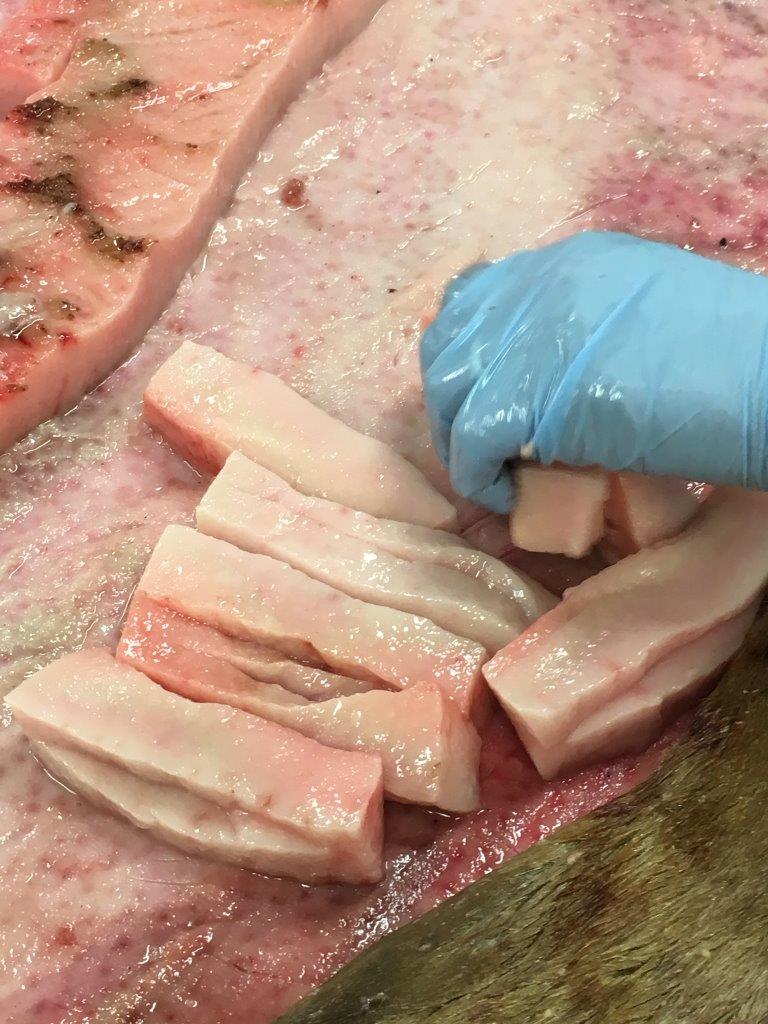
He cuts the blubber from the skin, chops it into small pieces, and puts it into a container to let it render into oil.

Sometimes he stirs it. Sometimes he adds older seal oil to speed up the rendering.

But now, when he does it inside the Siġḷauq, instead of at hunting camp, every part of the process has to be documented.

That’s where Chris, the food safety expert comes in.

Seal blubber being cut from skins in Kotzebue. (Photo courtesy Maniilaq Association)

Chris points out the new scientific tools in his tiny lab.

“The most important piece of equipment that we got right now is the pH meter,” he said.

In order to serve seal oil at the long-term care center or at hospitals around the state, Chris and Cyrus have to develop a food safety plan. It’s never been done before for seal oil.

“No one’s ever really documented scientifically what’s going on from the transition of seal blubber into oil,” Chris said.

They’re working with scientists from the University of Wisconsin and the Kodiak Seafood and Marine Science Center to figure out what makes seal oil potentially dangerous.

They’re measuring temperatures, water content, and pH. They’re sending samples to labs out of state to document the microbiology.

Chris will even film the weeks-long rendering process with a time-lapse camera. They think that as long as the seal oil gets down to a pH of 5 or less and doesn’t have any water in it, then it’s safe to eat, but they have to prove it first.

“It’s the hot-button item that’s prohibited, but everybody eats,” he said, referring to people in the northwest arctic and other coastal communities. “There’s a safe way of doing it, and that’s what we’re just trying to prove.”

They’ve been working on the project for three years now — seeking collaborators and designing and running the controlled experiments.

They’ve played with ideas like adding lactic acid to lower the pH or trying traditional methods, like jump-starting the rendering process with older oil as Cyrus suggests.

But all of those options could affect the taste, so they’ll face another necessary hurdle.

“There’s going to be a taste test in the end for the elders over there to get their seal of approval on our seal oil,” Chris said.

Once the process is fully documented and a food safety plan is laid out, Chris will apply for approval from the state.

Then their plan could be used as a model for other facilities that want to serve seal oil and as guidance for seal oil rendering at home.

Hungry for more Solutions Desk stories? Subscribe to the podcast on iTunesStitcherGoogle Play, or NPR.

Site notifications
Update notification options
Subscribe to notifications