A Coast Guard MH-60 Jayhawk rescue helicopter in Kotzebue. (Photo by Petty Officer 3rd Class Walter Shinn/U.S. Coast Guard)
U.S. Coast Guard is on the ground and in the air in northwest Alaska for the summer.
Coast Guard opened Saturday its forward operating location in Kotzebue for the 10th year of Operation Arctic Shield.
Arctic Shield is intended “to support Coast Guard missions in response to increased maritime activity in the Arctic,” according to a news release.
Two MH-60 Jayhawk helicopters and crews are stationed in Kotzebue and will assist with search-and-rescue operations and other maritime emergencies.
In addition, three Coast Guard icebreakers based out of Dutch Harbor will engage in missions in the Bering Strait and Chukchi and Beaufort seas.
The Coast Guard says it will also conduct what it calls Operation Arctic Guardian: meeting with community responders in the Arctic to teach and plan for basic oil-spill response.
Rear Adm. Matthew Bell said the forward operating location helps overcome some of the challenges of the Arctic, including “the environment, vast distances and limited infrastructure.”
Coast Guard conducted 20 search-and-rescue missions last summer as part of Arctic Shield, saving 20 lives and assisting 27 others. The mission this year will continue through October.
Rep. Don Young is trying again to renew the Magnuson-Stevens Act.
The nation’s fundamental federal fisheries law hasn’t been reauthorized since 2006. Young’s bill would allow more flexibility for regional fisheries management councils, but for villages near the mouth of the Kuskokwim River it is notable for what’s not included.
Since the 1990s, towns and villages along the western Alaska coast, from Norton Sound to the Aleutians, have had a stake in the lucrative Bering Sea fisheries, through the Community Development Quota program. The communities, divided into six CDQ groups, are allocated a portion of the fishing quota, which they can fish themselves or lease to the fishing industry.
By most measures, the program has been a success. In total, the six CDQ groups have amassed more than a billion dollars in cash and assets. The larger groups spend more than $30 million a year to help their regions, with service programs, job training, scholarships and local employment.
But the largest group, called Coastal Villages Region Fund, says it’s getting a raw deal. The group is known as CVRF and serves the Kuskokwim Delta, including villages from Scammon Bay to Platinum. More than 9,000 people live in that area, amounting to 35 percent of the total CDQ beneficiary population. However, they say they are allocated just 15 percent of the fish in the CDQ program.
Art Severance, corporate counsel for CVRF, said other groups have far fewer people and get the same or even more fish.
“Right now the allocations are set the way Congress locked them in place in 2006, which was a result of political influence in the 1990s,” Severance said.
And, Severance said, the people in the 20 villages of the CVRF area have a higher poverty rate, less infrastructure and fewer opportunities.
“The household size alone in our communities is about twice as high as in the Aleutians,” he said. “There’s no real opportunity to buy houses, and so you have multiple generations living together, not necessarily because they want to, but because they don’t have any other choice.”
CVRF has been asking Congress for years to change the Magnuson-Stevens Act to include a CDQ formula based on population.
Congressman Young isn’t persuaded.
U.S. Rep. Don Young
“They just want more money,” he said.
Young said the CDQ groups themselves agreed what the rules would be, and now one of them, Coastal Villages, is lobbying Congress to change the allocation criteria.
“There’s no way I’m going to be involved in taking fish from one Native group and giving it to another Native group,” he said. “That was their agreement. And until they have a solidified position and say, ‘This is what we’re going to do,’ it’s not going to happen.”
Larry Cotter is retiring as the CEO of one of the small CDQ groups, Aleutian Pribilof Island Community Development Association, or APICDA. He said the Coastal Villages Fund is off base.
“This program was never based on population,” he said.
APICDA has about 400 people and gets 20 percent of the CDQ allocation.
The means — as the Coastal Villages Fund sees it — APICDA has been able to deliver benefits of $750,000 per person over the past decade, while CVRF, because of its much larger population, has been able to spend less than $40,000 per person.
Cotter said the residents in the APICDA area — from Nelson Lagoon to St. George and Atka — are closer to the fish, and he said that’s significant.
“It belongs to the people who live there,” he said. “And if you look around the world, that same concept comes into play: The folks closest to the resource are the ones that are in a position to benefit most from utilizing that resource.”
And, Cotter said, Coastal Villages is doing quite well. CVRF has more than $270 million in cash, fishing vessels and other assets. Cotter calls it an “economic juggernaut.”
Young’s fisheries bill doesn’t reallocate the CDQ fish, but it does change the rules for the umbrella association that speaks for the CDQ groups. The panel has been operating by unanimity, and Young said that essentially gives any single group veto power. His bill would allow the panel to make decisions with only five of the six groups in agreement.
Severance, of the Coastal Villages Fund, said that would allow the other CDQ groups to steamroll his.
The House is supposed to vote on Young’s fisheries bill, HR 200, after the July 4 recess.
University of Alaska Fairbanks research vessel Sikuliaq docks at Nome’s port. (File photo by Emily Russell/KNOM)
Jellyfish have been a natural part of the Bering Sea ecosystem for decades. In recent years, their population numbers in the region have dramatically increased.
A research team funded by the National Science Foundation is in Nome to find out what the cause and implications might be.
“There are certainly fish that do feed on jellyfish: some of the salmon do, some other fish,”said Mary Beth Decker, a research scientist from Yale University. “But in this part of the world, not this many fish feed on jellyfish.”
Decker is part of a three-person research team sailing to Slime Bank in the southern Bering Sea this week, north of the Alaska Peninsula.
Having jellyfish around has minimal benefits.
Few types of fish eat them, and these species aren’t exactly edible for humans, either.
When it comes to potential consequences of having more jellyfish, though, Decker said that’s a different story.
“They have impacts on the ecosystem, because they feed on things that fish eat. They’ll eat small crustaceans, zoo plankton, that are prey for other seabirds and marine mammals. And also fish, both young fish and some older fish, like herring.”
The National Marine Fisheries Service (NMFS) has been recording jellyfish numbers in the Bering Sea for the past 40 years using their trawls, according to Decker.
The populations have fluctuated up and down throughout that period for multiple species of jellies, including larger ones like Pacific sea nettle, but Decker also points out there are smaller types that are harder to see or even catch in trawl nets.
New Jersey teacher Joanna Chierici is onboard this research voyage to educate and reach out to groups about the types and numbers of jellyfish present in the Bering Sea.
“I’m going to be there observing and taking part in the cruise,” she said. Then I take that information and turn it around to classrooms, to community groups — basically any audience that I can find — and just make people more aware of what’s going on with the jellyfish population in this area.”
In order to study jellyfish reproductive capacity and the potential for their populations to increase even more in the Bering Sea, the research team will be using small mesh nets to capture plankton, a food source for jellyfish, along with the jellies themselves.
Besides their scientific resources, Decker and the research team will also rely on human observations to track jellyfish:
“I really appreciate how the people I’ve met up here, how they have their eyes on the water and are even looking for jellyfish,” Decker said. “Frankly, I think a lot of people across the world I’ve spoken to don’t care about jellyfish, but it’s been refreshing for me to be here and hear people get excited about jellyfish.”
The research team will be on board the University of Alaska Fairbanks vessel Sikuliaq for the next couple weeks. You can follow along on their voyage and learn more about their findings on polartrec.com.
The village of Selawik lies near Kotzebue Sound in northwest Alaska, pictured here on Aug. 24, 2006. (Public domain photo by Steve Hillebrand/USFWS)
Recent reporting in the Anchorage Daily News has exposed a long-standing problem in Alaska of rural communities hiring village police officers with past criminal convictions. That includes some who later committed crimes while they were officers — as the ADN headline puts it — going from “criminal to cop and back again.”
Alaska Public Media’s Lori Townsend discussed the stories with ADN reporter Kyle Hopkins. Listen here:
TOWNSEND: Your story on this issue centers on a 2015 death in Selawik. Tell me about that case.
HOPKINS: It got my attention in part because I had been to Selawik years earlier as an Anchorage Daily News reporter and had done a story called, “No Law In Sight.” It was about how Selawik often would have no police officers, and about how that village was indicative of something that happens in dozens of villages around the state, where there’s, at times, no village police officer, there’s no tribal police officer, certainly no VPSO or trooper. So when I saw that there had been a death in the village, and that the person who was arrested for causing the death, not actually charged with manslaughter or murder, but charged with giving alcohol to and raping this 16-year-old girl was a village police officer, I was interested in how he had been hired because one of the first things, of course, that we do when we report on a serious case like that, is we look at the person who’s been charged, and we look to see what their criminal record is. And in that case, it was clear this was someone who’d been convicted previously as a bootlegger. And it just raised questions about how he had been hired as a village police officer, or to be specific, he was called what that local government called a city patrolman, but the duties are overlapping.
TOWNSEND: You found other village police officers with criminal records that had gone on to commit crimes while they were VPOs. Is there something systemic going on here?
HOPKINS: What this story looks at is the idea that no one really knows who the village police officers are in Alaska. There’s a framework that was created decades ago that acknowledges the idea that, in a small community that needs policing, there might not be a large field of applicants, that maybe you don’t have the same requirements that you have for a state trooper, but that there’s some vetting, that there’s some effort to make sure that the person being hired to protect his or her neighbors is not a criminal themselves. And that’s where the state and arguably local governments are kinda falling down. No one is really vetting these officers, despite the fact that they do what a police officer does in any city. Sometimes they carry guns, not often, but they have access to the jails. They arrest people. Theoretically, someone should be looking to make sure they’re not themselves criminals. What we found is that, generally, that’s often not happening. It’s part of a long-standing problem, and one that was really well described in a lawsuit by the Native American Rights Fund back in 1999-2001. They fought to try and solve this issue. They lost in court. And here we are almost 20 years later, and the issue is as bad as ever.
TOWNSEND: During your reporting on the death of Lois Cleveland, the young girl in Selawik who died, you came across a recording of an Alaska State Trooper’s interview with her mother. Her mother’s name is Minnie. It’s a hard bit of audio to listen to, but here’s a short clip of it.
MINNIE: They’re supposed to be helping, not hurting and taking her life …
OFFICERS: You’re right.
MINNIE: Who’s his boss? Who hired him?
TOWNSEND: What’s the answer to that question? And how did he get hired as a convicted bootlegger?
HOPKINS: When Minnie Cleveland, the mother of the girl, who you just heard … when her mother filed a wrongful death lawsuit against the city, it was initially filed against the city and John Doe. And John Doe was the city administrator because they didn’t know who the person was who had hired Norton. And when I tried to learn a little bit more about that process and talk to the current city administrator, I got a “no comment,” no one was willing to talk to me about that. The city of Selavik also refused to name their current VPOs. In terms of how was he hired, why was he hired, this incident that happened in Selawik. It’s hard to point a finger at any one community because you have local government officials who are asked to wear many, many hats. Sometimes they come in and it’s unclear what some of the requirements are, so you’re hiring multiple people, you might not even know that there’s this requirement that you have to vet your VPO, or send the name off to the state for certification and stuff. So, how that happened remains a little unclear, but the main takeaway for me was that it wasn’t unusual. It’s not surprising that that would happen. In fact, it happens a lot.
TOWNSEND: Kyle, what was the state’s response as you were reporting this? Who did you talk to and did they offer solutions for fixing this problem that’s been going on for a very long time, as you noted?
HOPKINS: The reason I’m doing this story now, beyond the fact that there’s this wrongful death suit that just really shines a light on a specific case, is that when I spoke to the Alaska Police Standards Council and I said, “So, how many VPOs are there, and where are they?” the answer was, “Oh. We have no idea.” And that’s despite a framework within state regulations that necessitates that they do know, and that they certify, and that these officers be certified. So that was the point at which it felt like the system seems broken for whatever reason. So the response from the state was they would definitely like to know more about who the officers are, they would like to make sure that regulations are being followed. The director of the Police Standards Council said that one problem is there’s kind of widespread noncompliance with those requirements, that is that an unfunded mandate, is that asking something of city governments that they’re not prepared to do, or don’t have bandwidth to do because they’re asked to do many other things? And that’s where you quickly come back to the lawsuit from 10-20 years ago that said there is this two-tiered system of justice in rural Alaska, where if you’re born in rural Alaska, you’re not afforded the same protections as you are in the city. And why is that? And whose responsibility is that? Is that the state or the feds? And that issue was never resolved, and I think you kind of quickly come back to that larger question of who should be doing more. And it certainly doesn’t seem fair to put it all on the shoulders of local governments.
The Bering Strait separates Alaska’s Seward Peninsula, right, from Siberia, left, in this June 3, 2002, satellite image. (By Jacques Descloitres/NASA)
North and southbound lanes, speed limits, areas to be avoided — those are just some of the safety measures in place in the world’s busiest waterways. In the Bering Strait, though, there’s nothing regulating where ships can go and what they should avoid.
But new standards were recently introduced to protect transiting vessels and the marine environment in the waters off Northwest Alaska.
Ask Sharm Setterquist what the Bering Strait is like to sail through when conditions are good, and he’ll smile.
“When you got a beautiful calm night and everything’s flat and you’re just out in the middle of nowhere driving, it’s kind of fun,” Setterquist explained.
Setterquist is a captain for Cook Inlet Tug and Barge. He’s made between 60 to 80 trips through the Bering Strait.
“But when you’re in a storm and nothing is going right,” Setterquist said, “it’s not as much fun.”
Setterquist got his start fishing the Bering Sea, but now captains tugs that pull barges filled with things like freight or fuel.
Sharm Setterquist is a captain for Cook Inlet Tug and Barge. He’s made between 60 to 80 trips through the Bering Strait. (Photo by Emily Russell/Alaska Public Media)
Tugs plan their delivery schedule around the sea ice.
“At the start of the season you chase the ice north,” Setterquist explained. “You start working in Bristol Bay, then the Kuskokwim and then Norton Sound and then after Norton Sound you make your northern push up to Kotzebue, Wainwright, Kivalina, Point Lay, Point Hope.”
Finishing out in Utqiaġvik and Prudhoe Bay.
Most of the ships sailing through the Bering Strait are doing what Setterquist does, delivering goods to ports along Alaska’s Northwest Coast.
Unlike other international waterways, though, the Bering Strait doesn’t have safety measures in place. There are no designated shipping lanes or shallow areas to be avoided. That’s in part because, on average, the strait sees the same amount of traffic in one season that the English Channel sees in a day.
Still, that hasn’t stopped environmental organizations from lobbying for regulations for years.
Elena Agarkova is an Arctic shipping adviser for the World Wildlife Fund.
“One accident in this region could lead to catastrophic results,” Agarkova said.
“The amount of wildlife, the diversity of wildlife,” Agarkova said of the Bering Strait. “The fact that there are local communities that subsist on the marine mammals, and the fact that some of them are starting to be oil and gas tankers that Russia is sending to Asian markets.”
All of those things, plus the lack of permanent emergency response infrastructure, make the region ripe for disaster.
Agarkova said at first, Russia wouldn’t agree on regulations for the Bering Strait, claiming the U.S. was trying to control vessel traffic. But now Russia is trying to capitalize on the shorter route to Asia, so Agarkova said they saw the value in making the seaway safer.
“The fact that U.S. and Russia have managed to come to an agreement on these measures despite broader political discord is really heartening,” Agarkova said.
The agreement is detailed out on a map of the Bering Strait. The map shows the north and southbound lanes laid out on either side of the Diomede Islands. It also highlights St. Lawrence, Nunivak and King Island as areas to be avoided.
The International Maritime Organization regulates shipping worldwide and approved the standards. But like a lot of international law, they’re voluntary.
Tug captain Sharm Setterquist said that actually doesn’t matter that much.
“It’s like a car,” Setterquist explained. “If you have a bunch of DUIs, no one wants to insure you. If you’re a shipping company that has a bunch of problems, no one wants to insure you. That’s why they have these standards and that’s why people are held to those standards.”
Those standards go into effect in the Bering Strait on Dec. 1.
Gambell, Alaska, is on St. Lawrence Island in the Bering Sea. On clear days, Siberia is visible in the distance. People have lived on the island for thousands of years and developed subsistence hunting strategies and traditions that are still being passed down. (Photo by Kiliii Yuyan for NPR)
On Aug. 24, 1952, the Silook and Oozevaseuk families of Gambell, Alaska, welcomed a baby girl into the world and introduced her to the island that had been their home for centuries.
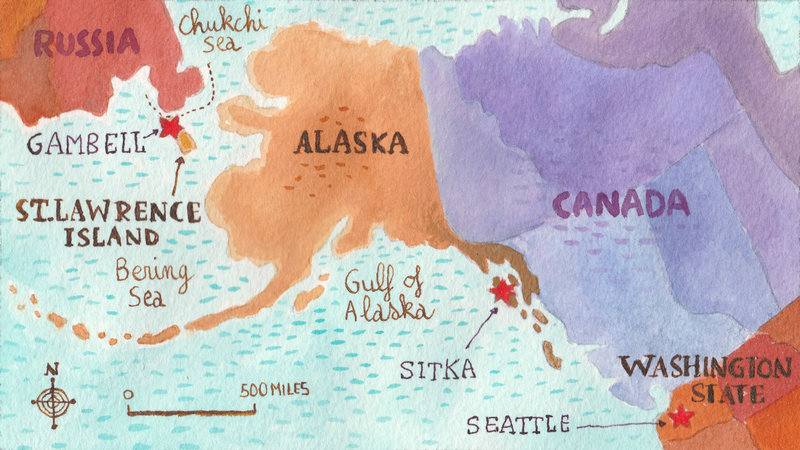
Gambell is at the western edge of St. Lawrence Island in the Bering Sea. When the weather is clear, you can see Siberia in the distance.
Baby Constance was born into a culture that was rich and well-adapted to the exceptionally harsh environment. Her ancestors had passed down skills for surviving — ways of reading the ice to know when walruses, seals and whales could be caught and methods of fishing in the cold water. Families worked together; subsistence hunting does not favor the greedy. Most people spoke the Alaska Native language, Yupik, with Russian and English words mixed in. That is the language Constance’s mother, Estelle, taught her daughter.
But things were changing. Earlier in the century, missionaries had made it to the island, and World War II had brought soldiers to a base near the village. The distance between the people of Gambell and the federal government was diminishing, and as it did, a wave of cultural destruction that had already torn through American Indian communities across the U.S. and mainland Alaska was bearing down on the community. It would hit Gambell’s children the hardest.
When Constance was in middle school, she was forced by the federal government to leave her family and move to a boarding school operated by the Bureau of Indian Affairs, part of the Department of the Interior. Mount Edgecumbe High School in Sitka, Alaska, was 1,200 miles away. Classes were in English, the teachers were mostly white, and the students were forbidden to speak the languages they had grown up with.
St. Lawrence Island is more than 1,000 miles from Sitka, where many Native Alaskan children, including Constance Oozevaseuk, were sent by the federal government to attend boarding school. (Graphic by Nathalie Dieterle for NPR)
The goal of the boarding school program was simple and destructive. A founder of the program, Army officer Richard Pratt, explained in 1892, “A great general has said that the only good Indian is a dead one. In a sense, I agree with the sentiment, but only in this: that all the Indian there is in the race should be dead. Kill the Indian in him, and save the man.”
Constance Oozevaseuk was taught to hate a lot of things about her culture and, by proxy, about herself. The food she grew up eating, the clothes her family wore, the way they hunted and fished, the stories they told, the songs they sang and the very words they spoke were inferior, she was taught. It was traumatizing.
Constance’s daughter Rene remembers how her mother was affected. “They told her how to dress, how to speak, how to hold herself,” says Rene. “She said there was a lot of sexual abuse, a lot of physical abuse. If you got up late or you didn’t clean how you were supposed to clean, you were beaten.”
As an adult, Constance never seemed to recover a strong sense of whom she was or whom she could aspire to be. She died in 2005, but Rene remembers noticing contradictions in her mother’s identity. When Constance was away away from Gambell, “she would cry to be at home,” Rene says. “But when she was at home, she’d be miserable.”
A 2005 study on the long-term effects of boarding schools on Alaska Natives found that many students suffered from “identity conflicts” and later struggled when they had children of their own, in part because they had been separated from their own parents at such an early age and had never fully learned family traditions and subsistence skills.
“My mother was very harsh. Nothing was ever good enough,” remembers Rene. “She never used kind words. She didn’t show her love that way.”
This is the root of what sociologists call intergenerational trauma. A family goes through something cataclysmic — in this case, a war on their culture. The family survives, but the effects of the trauma are passed down in the form of addiction, domestic violence and even suicide.
Alcohol numbed some of Constance’s pain, at least temporarily. “Both my parents drank,” Rene says. “And then they were drunk and she’s yelling at him about something. They fought a lot.”
Rene Schimmel has worked to give her son a Native Alaskan identity, while struggling herself with the lingering effects of cultural destruction that traumatized previous generations of their family. (Photo by Mike Kane for NPR)
It was a hard childhood. Her mother’s trauma was always present. Rene reacted by working extra hard in school. She wasn’t sure what she was striving to do exactly; she didn’t know anyone who had been to college or left their community for work, except for seasonal oil jobs on the North Slope. But she was good at science and naturally excelled in high school, and when she graduated, she applied to college at the University of Washington, in Seattle, with the help of young man from Pennsylvania named Jeremy Schimmel, whom she had met and fallen for.
“I had just moved out of my parents’ house and gotten my first phone number, so of course I wanted to give out my number,” she laughs. “And he was someone I wasn’t related to, which was new.”
Jeremy had just graduated from college in California and ran a wilderness guiding business in Alaska. They started dating off and on. Rene enrolled in college, moved away from her family and slowly started to build an intellectual identity for herself. She was interested in teaching, she decided.
Meanwhile, the same dynamic that had made Rene’s childhood difficult was playing out across her extended family. Alcohol abuse, drug abuse and domestic violence swept through Gambell. The suicide rate spiked.
And then, in 2000, Rene and Jeremy found out she was pregnant. Rene was then 24. She had just graduated from college.
Sam Schimmel spent much of his childhood with his mother’s family. His great-grandmother Estelle Oozevaseuk taught him stories and songs from her childhood. (Photo courtesy Rene Schimmel)
“I was terrified,” Rene says. “So scared. How was I going to take care of a child? I wasn’t ready. We didn’t have a place to live. We weren’t married. My family couldn’t help. My own mother was so dependent on me.”
Sometimes her mother would call her, drunk, late at night, and talk until Rene insisted she needed to study. Rene knew that her son would need what his grandmother had lost: a strong cultural identity, grounded in the traditions of their family. Rene just didn’t know how she could give that to him while also protecting him from the trauma that had been passed down to her.
This child is OK
From the moment he opened his eyes, Sam Oozevaseuk Schimmel was precocious. He starting talking at 6 months, walked at 9 months and hated sleeping.
“He was a pain in the ass,” laughs Jeremy. “He exhausted you. When he was a little kid, I would read books to him. I’ve never read more books in my life. “Frog and Toad” would last, like, a minute. So then you’re on to “Dr. Doolittle” and “The Little Prince,” and by the time, you’re done, you’ve read nine books and it’s, like, ‘Oh my god.’ And he’s still awake. You just couldn’t satiate his need for listening and for knowledge.”
Jeremy and Rene had moved back to Alaska, in part so Sam could be born at the Alaska Native Hospital where Rene had health coverage. As a child, Sam spent most of his time outside with his parents and with Rene’s family.
“He never was inside. He hunted and fished,” says Jeremy. “He was catching fish when he was 2 — off the dock.” Sam watched and listened to his family in Gambell with the same intensity he gave to books. He memorized old songs and stories his great-grandmother sang and told. She would hold his little body close and press her cheek to his, as if to convey: “You are one of us.”
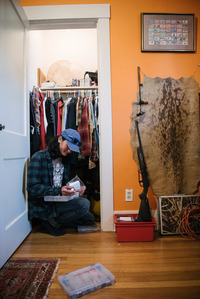
Sam pestered his relatives to let him hunt seals with them. When Sam was 5 or 6 years old, they handed him a low-powered rifle and told him to start practicing; if he could shoot a ground squirrel “through the eye,” he could hunt with them. For a couple weeks, he shot all day, every day. By the end, he was ready to accompany his family out to the seal blind.
Sam’s cultural education was going well.
Rene Schimmel celebrates her master’s degree in education with Sam. She became a teacher at the public elementary school that he would also attend. (Photo courtesy Jeremy Schimmel)
Rene breathed a small sigh of relief and refocused on her own goals. She decided to get a master’s degree in education. The family started splitting their time between Alaska and Seattle, where she was in school. When she graduated in 2004, she got a job at one of the best public elementary schools in the city. “I was so happy,” she remembers.
Her classroom was different from those of some of the older teachers, who put desks in rows and told children to speak only when they were spoken to. “In my classroom, it was more like everybody’s working together. We’re a team. We’re going to teach each other,” Rene remembers.
When Sam turned 5, he entered kindergarten at the same school.
“Oh, I love that boy. Sam was just full of energy,” remembers teacher Kathy Coglon. “I could tell he was smart.” Coglon would ask her students what their favorite activities were. “If they can tell you a lot about the thing they’re interested in, that’s a good sign,” she says.
When she asked Sam what he liked to do, he said he loved fishing and then listed dozens of fish and lures and nets he had used with his family in Alaska.
But school was difficult. Sam didn’t like sitting still and didn’t understand why he needed to follow so many rules about when to talk and what to say. He started getting in trouble in class.
Jeremy Schimmel, with his son Sam, says of Sam’s childhood in Alaska: “He never was inside. He hunted and fished.” (Photo by Kiliii Yuyan for NPR)
Rene and Jeremy would meet with school administrators. Some teachers and counselors suggested Sam had a learning disability or a behavioral disorder. His parents entertained that possibility but explained that Sam was growing up in a different environment than his peers. The family still spent summers in Gambell. No one else at the school was from a subsistence hunting culture. Might it make sense that Sam would learn differently from most other students?
“They didn’t listen,” says Jeremy, standing at his kitchen table in Seattle and picking through a box of old progress reports from the time. “They told us: ‘You need to go back to Alaska. Go back to the village.’ It was terrible.”
“I remember one teacher told me I wouldn’t go to college,” Sam adds from the couch. He’s 18 now, lanky in a baseball cap with a fish pattern on the front. “Who says that to a child? Like, if another kid says, ‘Your shoes suck,’ you can just tell them, ‘Well, your shoes suck, too.’ But you can’t deflect like that when an adult is mean to you.”
Sam Oozevaseuk Schimmel, 18, has grown up in both Alaska and Washington state. He is an advocate for Native Alaskan youth. (Photo by Kiliii Yuyan for NPR)
As hurtful as it was for Sam, that period was even more destructive for Rene. As she continued to advocate for her son, she felt something change in how the school viewed her as a teacher. She felt that her parenting and her teaching were being belittled, as if she and her son had less of a right to be at the school than others did.
“It went right to how my mother would treat me,” she says. “I was left with nothing, and I couldn’t stop it. I couldn’t mentally say ‘I’m not that.’ ”
Rene Schimmel’s mental health spiraled downward. In 2014, the Schimmels and the Seattle Public School District settled a lawsuit related to Rene’s teaching, the details of which are confidential. Asked for comment, a district spokesperson said that Rene had resigned in November 2011 and that school administrators from the time no longer worked for the district.
But the effects of Sam’s elementary school years didn’t go away. Rene and her son reacted very differently to the pain of feeling like they didn’t belong. He bounced back. She did not.
Freedom to learn
In sixth grade, Sam’s parents transferred him to Seattle Academy of Arts and Sciences, a private independent day school that gave him a scholarship. Alana Bell was assigned to be his mentor that year, 2006, and her first memory of Sam is a class field trip to do a beach cleanup.
“As soon as we arrived, he was just gone,” she laughs. She spent the entire afternoon trying to make sure she could still see him, while she supervised dozens of other kids who were tentatively moving along the beach. “I’ll always have this image of him, this little dude with this shaggy hair and this walking stick. So happy, so curious, and there was this notion that he could handle it, whatever it was.”
Sam was still different from his classmates. The other boys liked television, comics, soccer and tennis. Sam liked fishing, hunting and sport shooting — in fact, he was on his way to winning back-to-back state shooting championships in the two states he split his time between, Washington and Alaska. Plus, his new school attracted a lot of richer families, so, in addition to being the only Alaska Native student at the school, there was a socioeconomic gap between him and a lot of his peers.
Sam Schimmel prepares fishing gear at his home. An accomplished fisherman and competitive shooter, he learned traditional Arctic subsistence hunting techniques from relatives in Alaska. (Photo by Kiliii Yuyan for NPR)
But Seattle Academy was different from his previous school in some key ways. It was more flexible, both about behavior and about how he learned. Sam hadn’t liked reading very much, but he discovered he loved audiobooks and started listening to everything he could get his hands on. He was assigned to a teacher who helped him keep his assignments organized. He learned that he loved to debate.
There were still some bumps. At least once (accounts vary), Sam caught a pigeon and set it loose in the teacher’s lounge at school, but he didn’t get in big trouble.
As Sam made his way through middle school into high school, Jeremy saw new skills emerging in his son.
“He was terrible at handwriting” in elementary school, remembers Jeremy, which masked Sam’s skill as a writer. “But now he’s able to get his thoughts [out]. He verbalizes, that’s what he does, and he’s a beautiful writer. His writing is very direct, raw and alive.”
As Sam got older, he started to use his writing and speaking skills to work on things he believed in. His sense of identity and connection with Gambell and the city of Kenai, where his mother went to high school, had only grown stronger as he matured. He saw some of his cousins struggling with alcohol abuse and suicidal thoughts, and he heard from his family in Gambell about how climate change made it difficult to pass down hunting traditions and to catch enough food to survive.
“I see that, among my peers, I am much less likely to fall prey to alcoholism and much less likely to be suicidal as a result of being brought up in the laps of my elders, listening to stories and being engaged on a cultural level,” Sam explains. “What I’ve seen is that when youth are not culturally engaged, you see higher rates of incarceration, higher rates of suicide, higher rates of alcoholism, higher rates of drug abuse — all these evils that come in and take the place of culture. We’re talking about my cousins and my family members.”
In the past four years, Sam has become something of an all-star when it comes to advocating for Alaska Native youth. He was a youth delegate to the Tribal Nations Conference, a Center for Native American Youth awardee, a youth representative at the Alaska Federation of Natives conference and a member of Alaska Gov. Bill Walker’s climate team. This spring, he interned for Alaska’s congressional delegation in Washington, D.C.
Sam has turned into exactly the kind of person his parents hoped they would raise.
“Oh god, ‘proud’ isn’t even the word,” gushes his middle school mentor, Alana Bell. “I’m just so honored and blessed to see a kid evolve in the way that he has.”
“In a lot of ways, Sam is a unicorn,” says Stacie Cone, an adviser at Sam’s school who has worked with him throughout high school. “There’s no one like him. And that’s really cool. Everyone loves a unicorn.”
“But,” she continues, “the thing about unicorns is, there’s only one. I think it’s lonely, in a lot of ways, to be different.”
Lingering trauma
As Sam has flourished, his mother has struggled. When she resigned from her teaching job, she fell apart. “I didn’t get out of bed for days on end. I didn’t shower. I didn’t eat,” she says. “I thought about suicide a lot. Like, every day.”
Her marriage collapsed. Rock bottom was last year. Sam had won an award for being a Native Youth Leader, and he was supposed to travel to Washington, D.C., for a ceremony.
A few days before, Rene nearly killed herself. Sam was in the back of the car doing chest compressions on his mom on the way to the hospital. Neither of them wants to talk about the details — it’s private and painful, and they’re both trying to figure out what their relationship will look like going forward. Rene says she is more stable now. She is teaching again, at an elementary school south of Seattle, and loves her job. Sam is spending the summer in Alaska, guiding with his dad.
Sam traces his mother’s pain back to the same forces that his cousins are dealing with today in Alaska: cultural isolation and intergenerational trauma.
“Her parents’ generation were all sent off to boarding schools,” Sam explains. He is talking, of course, about his grandmother, Constance Oozevaseuk.
“Nothing was put in the place of where culture was. I think some of that trauma was passed onto my mother. I’m not as deeply affected as she was, of course. But I am affected by it, because she wasn’t able to be a mother for a portion of my childhood, because she had to take care of herself.”
Rene agrees, although the fact of her family’s traumatization doesn’t make it any easier to deal with the guilt she feels over breaking down. “I wish I had been stronger,” she says. “We tried the best we could. I’m so proud of him.”
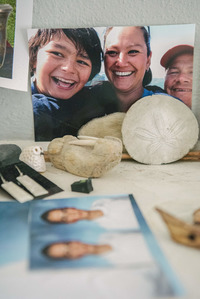
Sam Schimmel, pictured with parents Rene and Jeremy, says time spent with relatives in Alaska helped to shape his cultural identity. (Photo by Kiliii Yuyan for NPR)
She and Jeremy both say they think Sam has drawn strength from the challenges he has faced. “He has this rock-solid sense of who he is and what he believes,” says Jeremy. “That’s never changed.”
Sam says his cultural identity — formed during all those hours hunting and fishing with his family — is something to fall back on when things get difficult, a source of resilience.
“You’re sitting in a seal blind, you’re talking to your uncles, you’re telling stories — you’re disseminating culture, is what’s going on,” he explains. “It’s not only hunting, it’s passing down traditions, stories and ways of life that would otherwise not have a chance to be passed down.”
So, will he be able to pass down the same traditions to his children?
Sam grins, looking like the teenager he still is. “Well, I don’t have any kids,” he says. “That’s, like, a really existential question.”
But he keeps turning it over in the back of his head, and a few minutes later, he circles back to the question. “I think having children must be really rewarding, and probably really scary,” he says. “I hope I’m able to be the one who stops the passing down of my family’s traumas. But I don’t know. We can only hope.”
NPR researcher Katie Daugert contributed to this report.
Copyright 2018 NPR. To see more, visit http://www.npr.org/.
Close
Update notification options
Subscribe to notifications
Subscribe
Get notifications about news related to the topics you care about. You can unsubscribe anytime.










9(MDEwMjQ0ODM1MDEzNDk4MTEzNjU3NTRhYg004))