The Innoko Flats wood bison herd is going into its first winter in the wild.
The Alaska Department of Fish and Game transported 130 wood bison to Shageluk by air and barge earlier this year, in an effort to reintroduce the species to Alaska.
Wood Bison in Portage game facility. (Photo courtesy of Alaska Department of Fish and Game)
Fish and Game Wood Bison Project Leader Tom Seaton reports that the vast majority of the herd is staying close to where they were originally released.
“As of Friday, there was a group about 10 miles north of Shageluk and another group about 10 miles south of Shageluk. And then there are two more groups kind of spread out between Holy Cross and Shageluk, so kind of a north-south transect through that whole flats area.”
Nevertheless, some brave bison have broken away from the herd to scout out new habitat. A young bull was sighted close to Galena in September – more than 150 miles from the release site. And a lone cow ventured down to the Kuskokwim River and back – a round trip of almost 180 miles.
Overall, Seaton feels like the bison reintroduction has gone very well, with a normal rate of mortality. But the real test of their survivability is coming up.
“Really, winter is going to be the true test. Especially late winter deep snows. If we could avoid late winter deep snows just with luck we are going to go through the winter pretty well. If we get really deep snows late this winter when the bison are still learning their habitat, I think we could have some difficulty.”
Deep snow would make it harder for the bison to get to the grasses and plants that they need to eat all winter long.
There has been no evidence of bison deaths by predation or disease thus far.
Based on experiences with reintroducing wood bison elsewhere, Seaton predicts that it will take predators such as wolves and bears a few more years to figure out how to take down a bison, and already he has seen bison and bears grazing in close proximity without incident.
The wood bison are being monitored by airplane on a regular basis, and a few bison were fitted with satellite trackers that allow biologists to record their movement by computer.
Tongass National Forest (Creative Commons photo by Xa’at)
The U.S. Forest Service has released a new plan for managing timber lands on the Tongass National Forest in Southeast Alaska. It puts a timeline on the transition from young- to old-growth logging and it attempts to make it easier to develop hydro projects on forest land.
The draft Environmental Impact Statement document for the forest plan amendment is over 1,000 pages. It reflects this year’s unanimous recommendation by the 15-person Tongass Advisory Committee on transitioning to a harvest of younger, second-growth trees on areas that have already been logged. That was directed by the Secretary of Agriculture in 2013.
Forest Supervisor Earl Stewart said the agency’s analysis shows that transition is possible in 16 years. “In going to a young system, it’s going to require both accuracy and precision in the product availability and the ability to go to areas that have been harvested in the past,” Stewart said. “That’s certainly going to cause some concern from some parties as to what that represents in the meantime but recognize that this is the draft Environmental Impact Statement.”
The preferred alternative in the plan would see a harvest of 46 million board feet annually. In the first decade, 37 million of that would be continued harvest of old-growth trees. The old-growth harvest would drop to just 5 million board feet by the 16th year of the plan. To compare, harvests on the Tongass over the past decade have averaged around 36 million board feet a year.
Proposed timber sales that are already in the planning stages, involving old growth or young growth, will continue forward. The plan does not propose any new wildlife conservation strategies, wilderness areas or wild and scenic river designations. It does recognize changes from this year’s transfer of Tongass land to Sealaska Corporation.
The plan also proposes making renewable energy projects on Tongass lands easier to develop. “It really seeks to try and provide a better economic outcome for parties and communities across Southeast Alaska by allowing access for hydropower or other uses, to help supply those,” Stewart said. “If you’re familiar with some of those communities that are currently challenged by having to utilize diesel generation or anything like that, this is one of those opportunities to look at the landscape in a broader context, to provide a more renewable resource and use of energy production for those communities.”
While the plan does not recommend new lands for permanent protection, it would reduce the acreage that could be logged. Environmental groups are happy to see lands around some Southeast salmon streams would no longer be in the timber base. Southeast Alaska Conservation Council Deputy Director Emily Ferry says there’s both good and bad in the updated plan.
“And the good is that we’re very pleased to see that some of the salmon strongholds that we’ve working for years to protect, places like Port Houghton, Castle River and East Kuiu are no longer considered in the suitable timber base,” Ferry said. “The unfortunate part is that the Forest Service missed a huge opportunity to put the controversy associated with clear-cutting old growth behind them.”
Ferry said the plan does not transition out of old growth logging soon enough. She said concerns over impacts to fish and wildlife habitat, recreation opportunities and climate change will continue with logging old growth forests.
For the timber industry, the young growth available wouldn’t keep Southeast sawmills operating. Alaska Forest Association Executive Director Owen Graham doesn’t think the transition recommended by the Tongass Advisory Committee will work.
“For one thing there’s not enough young growth to support a round log export business for any length of time,” Graham said. “For a few years you could, but after that, there’s just not enough acres. The second concern is, right now the logs are too small for the saw mills to utilize and if you cut ‘em now then 30 years from now, when they would have been mature, they’re not going to be mature timber. And so, the only way to keep the sawmills operating is to continue harvesting old growth and we don’t want to be stuck with just one good sawmill. We want to have a number of mid-size saw mills and a number of small mills.”
The draft documents are available online. A 90-day public comment period is underway and ends February 22nd. The Forest Service plans to hold public meetings on the plan in Southeast communities.
A new Pacific trade deal could make Alaska sockeye a little more affordable in other countries.
The Trans-Pacific Partnership is an agreement between 12 countries, including the United States, Japan and Vietnam — among others, though notably not China — that will eliminate some trade barriers over the next several years.
Alaska Seafood Marketing Institute Executive Director Alexa Tonkovich said if the agreement is enacted, it could be good news for Alaska seafood exports, including Bristol Bay sockeye.
“Currently the sockeye salmon tariff to Japan is 3.5 percent. With the TPP, it will be eliminated immediately for both fresh and frozen. For other types of salmon, it’s also 3.5 percent, and it will be gradually reduced and then eliminated in the sixth year.”
Tonkovich said 3.5 percent might not sound like much, but it adds up.
“When you think about the volumes of sockeye that go to Japan, it really is one of our main stable markets for sockeye salmon, in particular Bristol Bay sockeye salmon, which is a lot of the volume of export. That could be, over the course of the season or over the course of several years, quite a bit of money,” Tonkovich said.
Alaska salmon isn’t the only product that may see a boost. Tonkovich said it could also increase the repackaging of pollock, salmon and other Alaska seafood that occurs in Vietnam, and help other exports.
The 2,700-page agreement was recently released, and still must be signed by the president and approved by Congress.
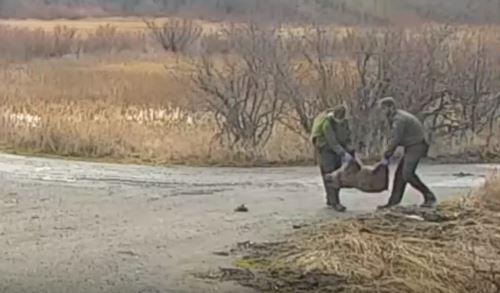
Katmai wildlife technicians collect the body of 451’s spring cub to send it out for necropsy at a lab in Madison, Wisconsin. (Video still courtesy Explore.org)
A lab has identified a possible cause of death for one of the two brown bears that died in front of the high-traffic bear cams in Katmai National Park last month.
After thousands of viewers watched a spring cub die in late October, the animal’s remains were sent to a lab in Madison, Wisconsin, for a necropsy.
Roy Wood, the Chief of Interpretation at Katmai, said the cub tested positive for canine adenovirus, an infection that is also found in cats, dogs and wolves.
“It’s called canine infectious hepatitis, and it causes liver damage, lesions in esophagus and nose,” Wood said. “And when the symptoms present themselves, they do present similar to what we saw with the cub – loss of motor skills, lethargy, ultimately convulsions and seizures leading to death.”
This is not the first time this disease has been found in bears in Southwest Alaska. A 1998 study showed 14 percent of brown bears on Kodiak Island and the Alaska Peninsula had been exposed to infectious hepatitis.
In the recent Katmai case, Wood said they can’t be certain that the hepatitis is what actually killed the cub, but tests show the virus was present. And that means it could spread to other animals.
“When you spend time around bears, one thing you notice is they go up and smell and lick anything unusual. They will go sniff a pile of feces or sniff where another bear has urinated,” Wood said. “So even without consuming the flesh, it’s possible that a number of other bears may have come into contact with the pathogen.”
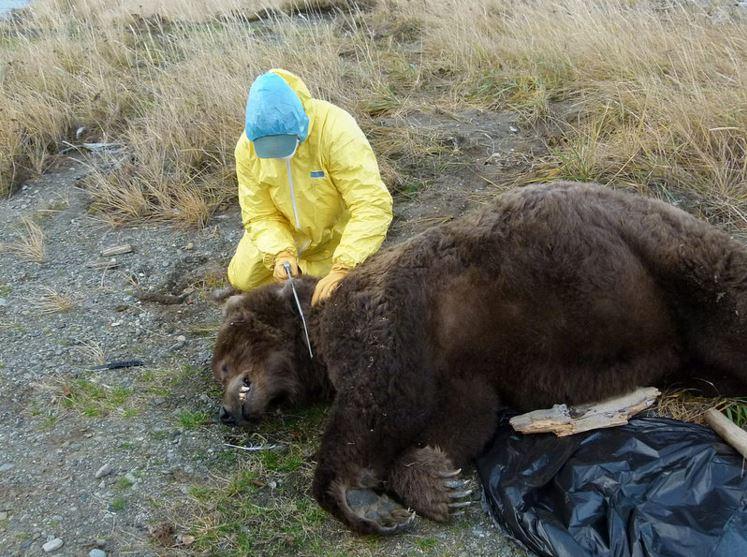
Within days of the cub’s death, a large male bear also lay down and died within view of the cameras. Wildlife technicians went out and dissected the body in the field to collect samples. And Wood invited the army of viewers along to help investigate.
“I posted the photos with disclaimers,” Wood said. “… so don’t go there if you’re likely to be upset. But for those of who are who are interested in viewing the science, here’s the link. I said, now, nobody talk about it for 30 minutes. Then we’ll come back and see if – examining photos and looking at your notes – we all come back with the same identification for the bear.”
Wood figured no more than a handful of people would be interested in studying gory photos in the name of science. But as it turned out, the photos got a huge amount of web views within the 30-minute window Wood had allotted.
“I think there were close to 2,000 views, and those were not the 100-or-so people that were on the cams chatting with us and were very, very upset… These were a whole additional group of people that we hardly ever interact with.”
Together, viewers and rangers identified the deceased as bear 868, an adult male known to the bear cam community as one of the ‘Wayne Brothers.’
The tissue samples from 868 came back negative for infectious hepatitis as well as rabies. But Wood said that’s about all they were able to test for, because the samples were too decayed by the time they reached the state veterinarian in Fairbanks.
“We suffered some of the same sorts of delays that we’re used to when we ship stuff from Anchorage out to our homes in the Bush,” explained Wood. “You just miss a flight, and it doesn’t make it on the next one, and now you’ve got a box of mold instead of the lettuce you thought you were getting. And we had that happen; there were some delays getting it all the way to Fairbanks. So we missed out on some test opportunities.”
Wood said biologists aren’t overly concerned at the moment, but they do plan to test for hepatitis among other things in a study next summer.
For now, the cameras at Brooks Camp are down due to ice and snow that covered the solar panels and caused an outage. Wood isn’t sure whether Explore.org will get them turned back on this winter or just wait until spring.
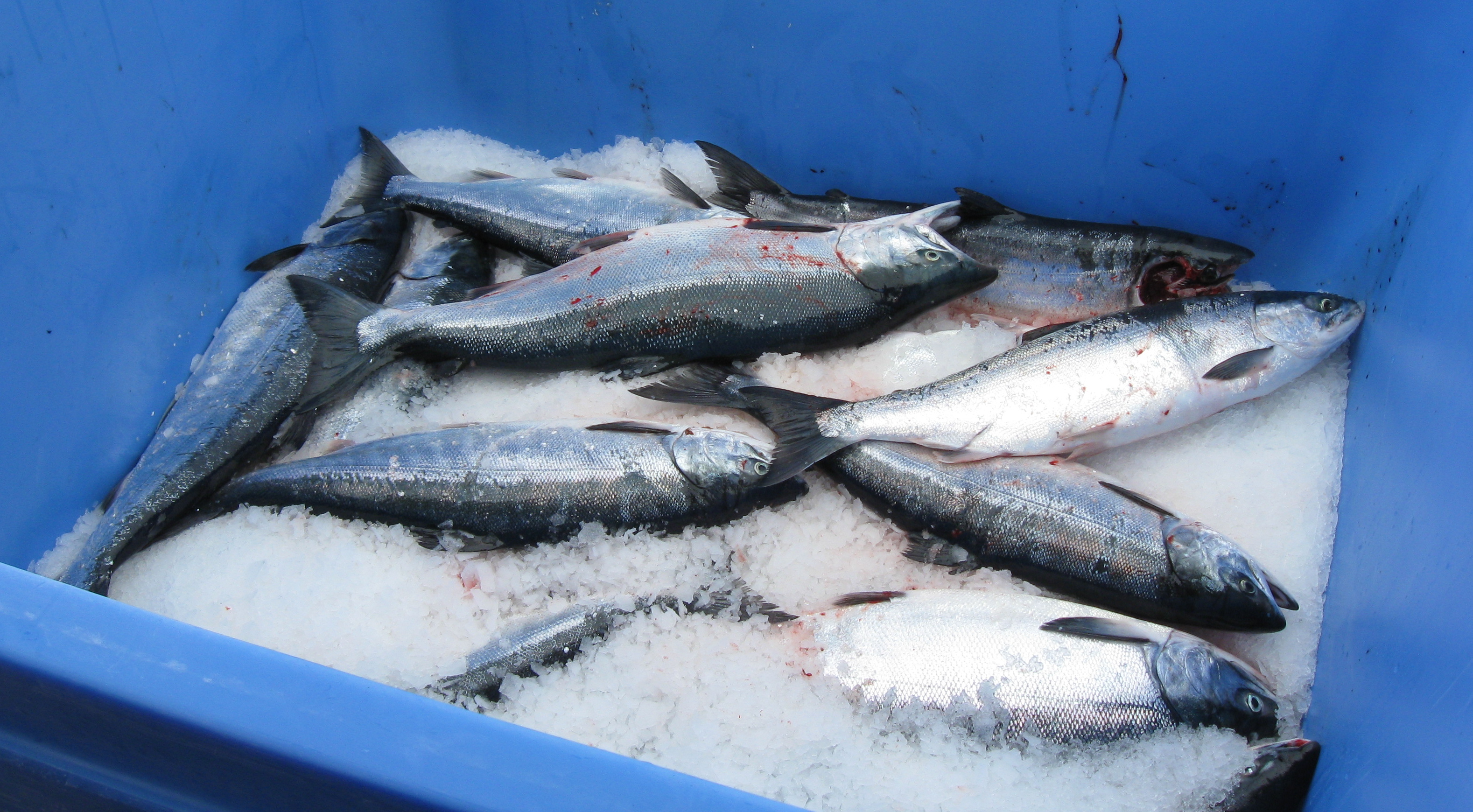
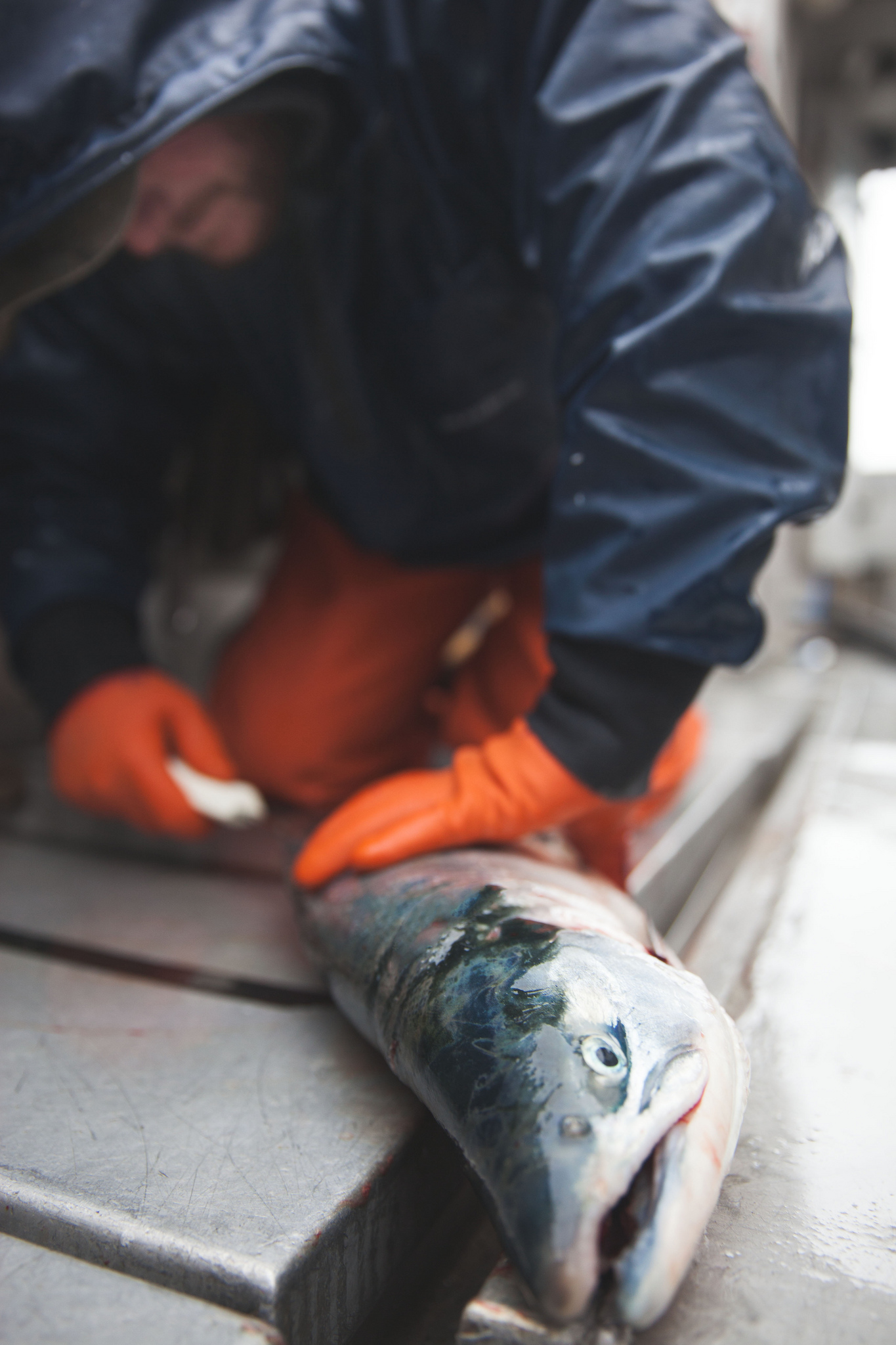
A commercial fisherman and salmon in Bristol Bay in July 2013. (Creative Commons photo by Chris Ford)
Next July, a commercial fisherman will land the 2 billionth salmon caught in Bristol Bay’s 133-year fishing history.
Since the inception of Bristol Bay’s canned salmon industry in 1884, its fishermen have landed 1.99 billion salmon, 93 percent of which were sockeye. Fishermen will achieve the 2-billion-salmon milestone when they catch another 9.5 million.
This will happen next season, based on the Alaska Department of Fish & Game’s recently released forecast for a harvest of almost 30 million sockeye in 2016.
Catching the 2 billionth salmon is an opportunity to reflect on Bristol Bay’s salmon resources, their value to fishermen and the state, and the reasons for their health.
Two billion salmon is about 12 billion pounds of high-quality protein that is in demand around the world. Fishermen earned $5 billion from that catch, and its wholesale value is two or three times that. It is the product of a fishery that is healthy and sustainable.
The success of the Bristol Bay salmon fishery can be attributed to the region’s tremendously productive natural habitat, the science-based management of the resource, and the shared commitment to stewardship by the state, fishermen, and seafood processors.
Salmon elsewhere around the world have not fared as well. On the Atlantic Coast and in the Pacific Northwest, salmon stocks have suffered from overfishing, dams, loss of habitat and pollution.
Bristol Bay wasn’t immune from such threats. Stocks were overfished in the early years and hammered by foreign high-seas fleets. In the 1950s, Bristol Bay catches sank.
Then came Alaska statehood, bringing a constitutionally mandated commitment to sustainability. Fish and Game took that charge seriously, applying new science and management tools.
Processors supplemented that work by funding the University of Washington’s Fisheries Research Institute. The University of Alaska and the locally-funded Bristol Bay Science and Research Institute added to those efforts.
Rebuilding salmon runs didn’t come easily. It required sacrifices on the part of fishermen and processors that were hard on many. But it paid off. Combined with favorable natural conditions, it resulted in the unprecedented harvests Bristol Bay produced in recent decades.
It took 95 years for Bristol Bay to produce its first billion. The 2 billionth salmon will come just 38 years after that.
That 1 billionth salmon was caught on the afternoon of June 28, 1978, in the Nushagak River district.
At the end of the 1977 season, the combined Bristol Bay catch stood at 998 million salmon. The 1978 season started slowly as fishermen and processors haggled over sockeye prices.
Early in the season, 700,000 salmon were landed but fishing ground to a halt as price talks dragged on. Fishermen and processors finally reached a settlement on June 27 and the fleet went out.
In 12-hour openings that day in the Naknek/Kvichak and Egegik districts, fishermen landed 900,000 salmon, boosting the total to 1.6 million.
The Nushagak district opened the following morning. When it closed at 6 p.m. June 28, another 660,000 salmon had been landed, including the billionth fish.
It was probably a sockeye, but one in five salmon landed that day on the Nushagak was a chum. It also could have been a Chinook. The 1978 season was pretty good for king salmon, but only 3,000 were landed that day.
Rarer still, it could have been a pink salmon. 1978 would be a record year for pinks in Bristol Bay, but that day only five were landed.
Whoever catches the 2 billionth salmon will never be known. Fishing will probably be fast and furious when next year’s catch tops 9.5 million. Anyone could claim credit for catching the 2 billionth salmon. And everyone should.
Management and preservation of a resource as valuable as Bristol Bay is a shared long-term responsibility of fishermen, processors, and the state and federal governments.
While we celebrate this milestone of history, we should keep our focus on Bristol Bay’s future.
Because challenges remain. Climate change, warming ocean temperatures and increased acidification pose potential threats to the high seas survival of salmon. The state’s current budget woes threaten support for needed research and management efforts.
With continued scientific management of the salmon resource, maintaining the fish’s natural habitat and a little good luck, Bristol Bay fishermen might look forward to catching its 3 billionth salmon in 2054.
Bob King was news director of KDLG radio from 1978 to 1994. He recently served as adviser on fishery issues to U.S. Senator Mark Begich.
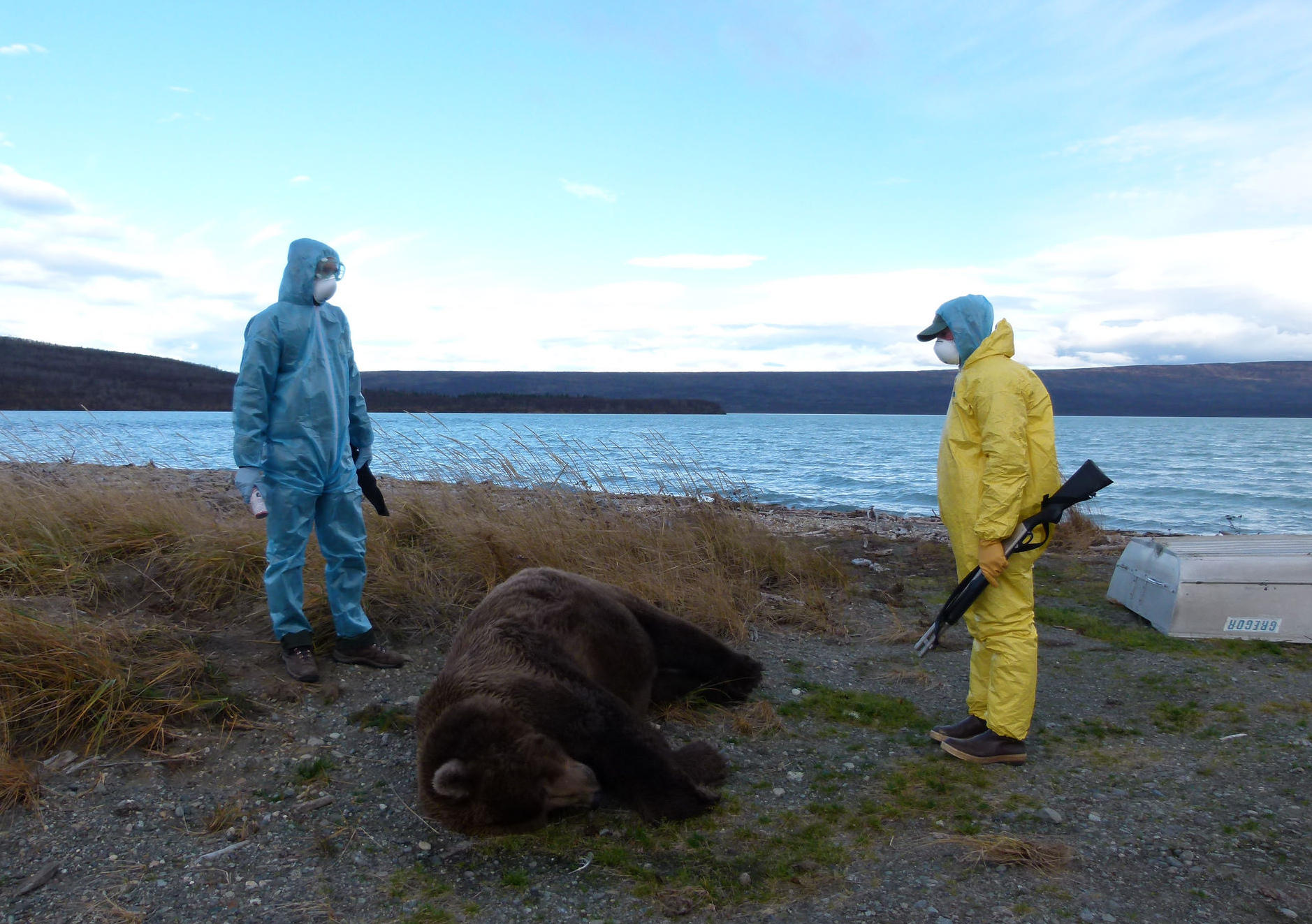
Katmai wildlife technicians prepare to conduct a field autopsy on an adult male that died of unknown causes in late October. (Photo courtesy National Park Service)
Last month at Katmai National Park, the final hours of two brown bears played out in front of an online audience of thousands. The two animals laid down and died within days of each other.
Bear cam viewers are acting as both eyewitnesses and detectives in this curious case.
Oct. 21 started as a normal fall day at Brooks Camp. Bears were fishing, preparing to den up. A sow and two cubs wandered in front of a camera close to Naknek Lake.
Then something strange happened, something that might have gone unnoticed if it weren’t for the thousands of bear cam fans who are always watching.
“We could see the cub stumbling, and its legs not really working, and then it kind of collapsed,” said Diana from Maryland, a 3-year veteran bear cam watcher who goes by the online name LovetheCams.
She was paying close attention when spring cub started acting strange. That evening, she said the comment board was swirling with confusion.
“Like, what’s happening to this cub, what’s going on? The first day the cub moved a little, but it didn’t ever return to its feet,” she said.
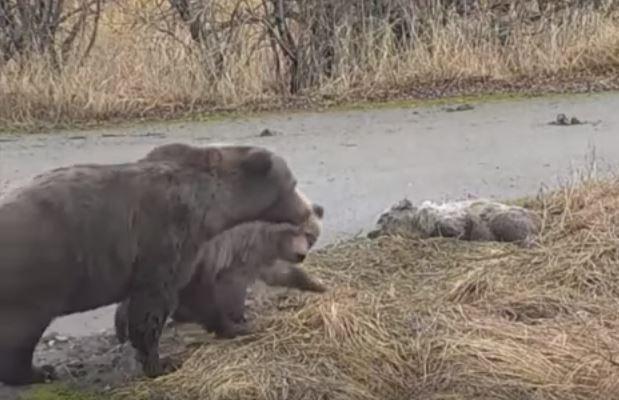
The mother bear, 451, returns with her healthy cub to where her female cub, right, lay dying or dead. (Video still courtesy Explore.org)
Diana said she took careful notes, counting each respiration. The cub took its last breath on Oct. 23.
Troy Hamon is the chief of resource management for Katmai National Park & Preserve. The staff decided to have the cub autopsied, so a few of his colleagues boated out and collected the 60-pound carcass.
“Which is surprisingly heavy,” Hamon said.
Katmai wildlife technicians collect the body of 451’s spring cub to send it out for necropsy at a lab in Madison, Wisconsin. (Video still courtesy Explore.org)
They shipped it to the National Wildlife Health Center in Madison, Wisconsin. This is uncharted territory for Katmai rangers. Hamon says they’ve never had a bear necropsy done, because they’ve rarely, if ever, witnessed a bear die of an unknown cause.
“We see bears being killed by other bears, we also see occasionally adult bears killing each other … but our understanding of the non-traumatic deaths is fairly uncommon,” he said.
From a biologist’s point of view, this was a unique opportunity to learn about bear mortality.
And as Hamon described, they were about to get twice the opportunity.
“The situation is, when our staff pulled up to collect the cub, there were some webcam viewers that clipped images from the video of our people arriving,” Hamon said.
This compulsive documentation paid off when a few hours later, viewers looked at that same location, and saw a big, dark, bear-shaped blob where there hadn’t been a dark blob before.
By comparing the before and after photos, they could pinpoint just when the dark shape had parked itself out on a sand spit. Hamon said this caught people’s attention.
“Not because the bear laid down, but because it was still there the next day and the next day,” Hamon said. “We have bears that lay down and sleep for 6 hours, or even sleep for a day, but when a bear lays down for two days, it’s dead.”
Rough weather kept the wildlife staff from returning to the second body for a few days, but Hamon said he and other rangers soon determined that the deceased was an adult male. They knew because they’d watched another mother with cubs who walked by, took one look at the bear on the ground and bolted. Hamon said this is a telling reminder of bear social dynamics.
“The bear hierarchy system is very funny – a very important bear remains very important even after death,” Hamon said.
Meanwhile on the comment board, people now had two bears to grieve – and two mysterious deaths to investigate. As viewers hashed over details and reconstructed a timeline of events, Diana says they were in full-on speculation mode.
“I’ve read everything from, you know, foul play – has someone poisoned them?” she said. “Could it have been something chemical that leaked from a boat or left by a park visitor? Is it the plants, is it the mushrooms? Could it be disease? Could it be neurological?”
Ranger Michael Saxton is one of the bear technicians who collected the cub’s body. He says so far only a few things have been ruled out by the lab in Wisconsin.
“Rabies is negative, toxoplasmosis is negative as well — that’s just a contagious disease they check for,” Saxton said.
Samples from the adult male were sent to a state veterinarian, but the tissue was too decayed to do most diagnostic tests.
Wildlife technicians collected samples from the adult male’s remains, including the head and some internal organs, to send to a state veterinarian for testing. (Photo courtesy National Park Service)
Diana said many bear cam watchers were deeply affected by the deaths, especially the spring cub’s. And there’s a tension in the comments, between those who are mourning the bears as you might a pet, and those who see themselves more as citizen scientists.
Diana is hungry for more information. But her mind keeps returning to certain moments, like when the sow and her healthy cub returned to where the cub lay dead.
“She would sniff near the cub and approach the cub near its muzzle, and seemed to be checking for things. And as a mom, I understand that. Checking for things, looking for clues as to what’s wrong. And I would like to have some answers to that,” she said.
Those answer may or may not come with the results of the necropsy.
Close
Update notification options
Subscribe to notifications
Subscribe
Get notifications about news related to the topics you care about. You can unsubscribe anytime.