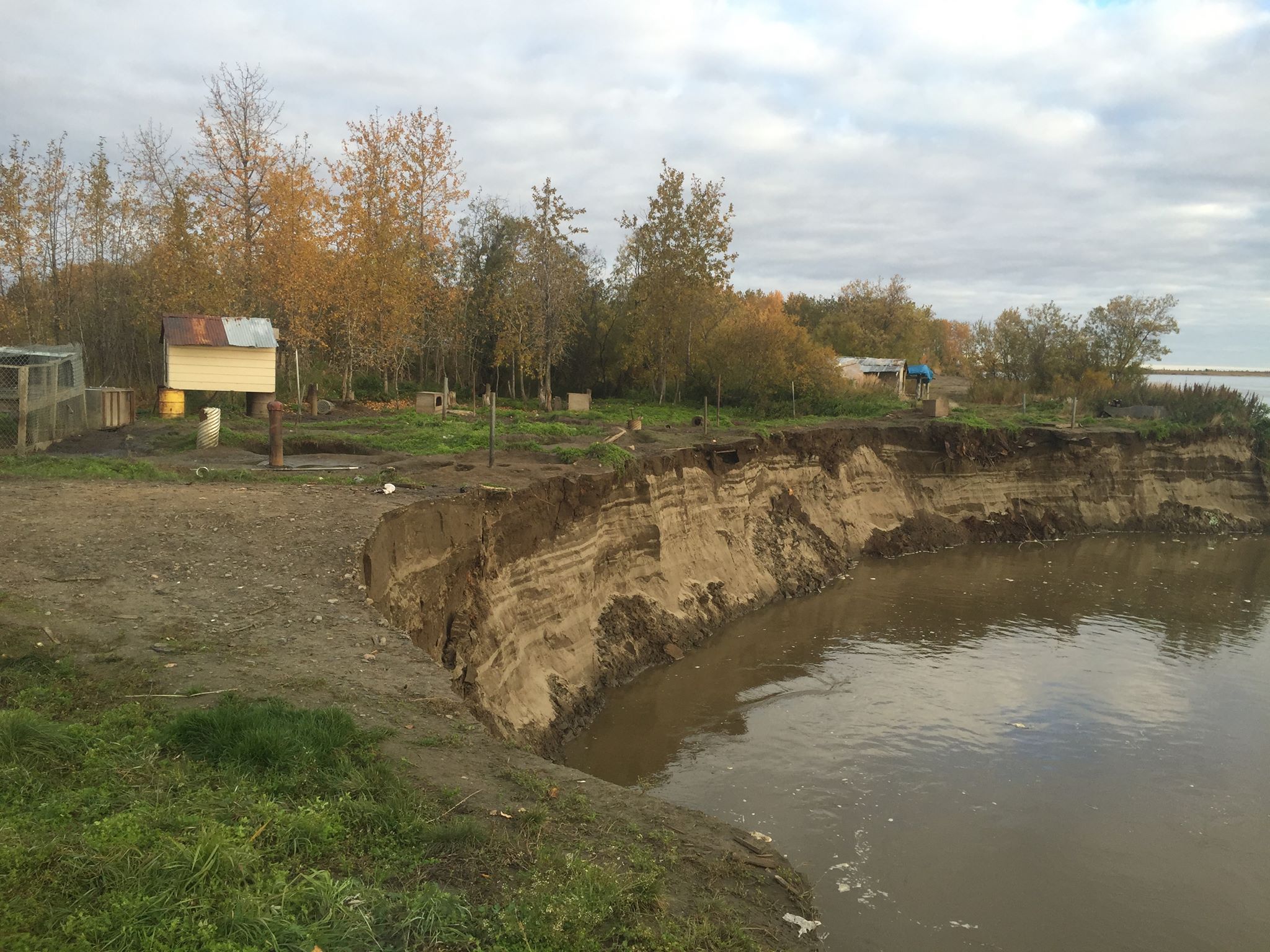
Approximately 50 feet of land that eroded from Mike Williams’ backyard. (Photo courtesy of Mike Williams)
Just as it was getting dark Saturday evening, Akiak resident and dog musher Mike Williams Sr. stepped outside to see his kennel falling into the Kuskokwim River and seven of his 60 sled dogs being pulled along with it.
The dogs were hanging by their chains, their bodies dangling over the eroding banks.
“They were beginning to choke,” Williams says, “but they’re alive, they’re okay now. [We] got them just in time.”
A relative stepped outside to check on Williams’ 60 dogs when he realized something wasn’t right.
The lot was falling into the riverbank, and quickly.
“This is about the most I’ve seen in recent times in Akiak,” Williams said.
He was able to rescue and relocate all of his sled dogs, but lost a refrigerator that stored dog food. Over the next few hours he also lost about 50 feet of land.
“These are tough times for all of us, and hopefully a lot of erosion projects will be funded to help fix all of this stuff,” he says.
What Williams experienced is called mass erosion.
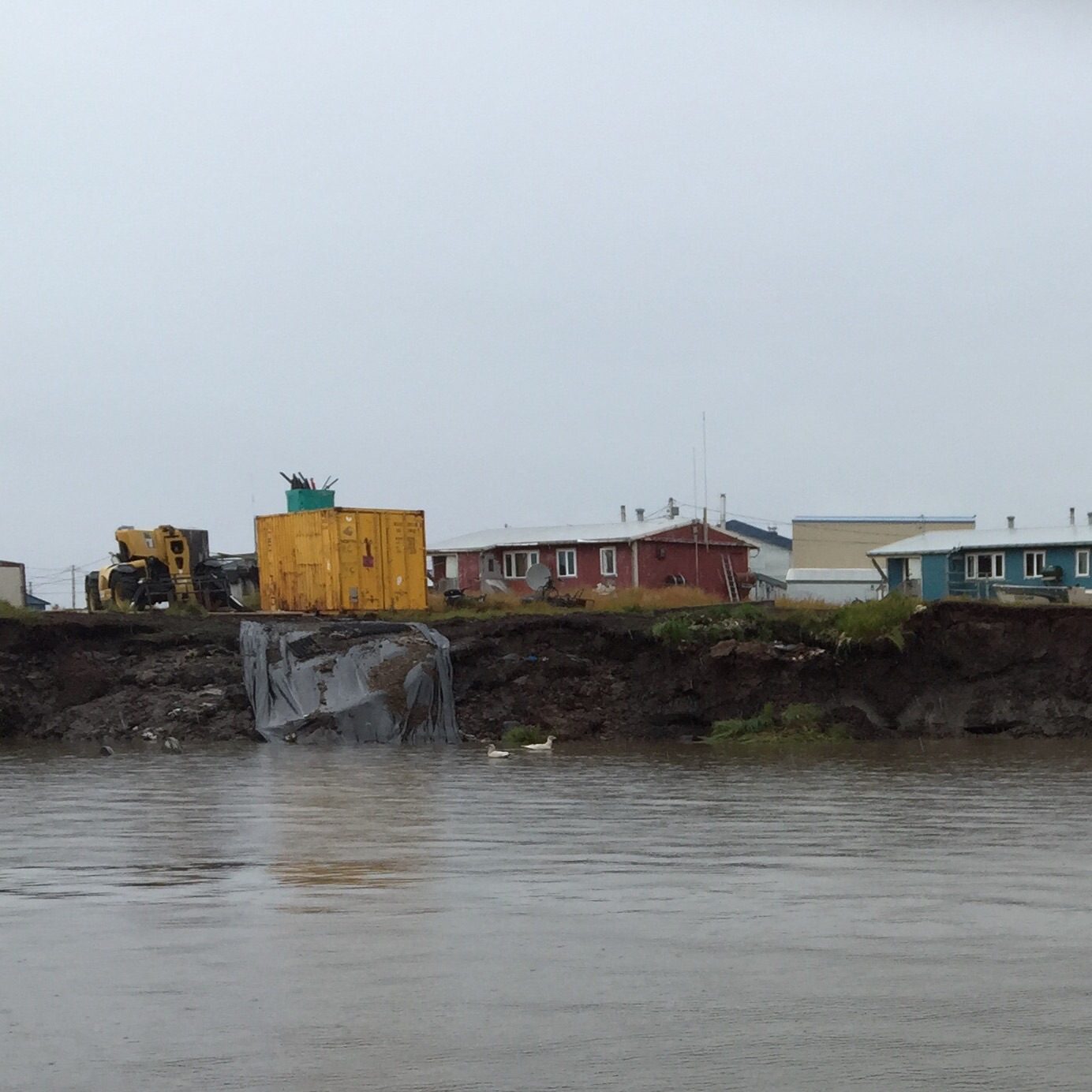
Erosions is common along the Kuskokwim, especially in an era of climate change. But in Akiak, erosion commonly occurs during breakup season when the river flows faster, not in late September.
Chris Maio, an Assistant Professor of Geology at the University of Alaska Fairbanks, studies coastal geography and says Saturday’s erosion is abnormal.
“I certainly think that is what I’d categorize as an extreme erosional event,” Maio said.
Maio says the event is a result of three elements: the river’s natural composition, warmer weather and high rainfall.
The sediment in communities along the Kuskokwim is composed primarily of silt, a fine gradient, and it’s held together by permafrost.
When the temperatures rise, the permafrost melts, weakening the riverbanks. When a heavy rain comes, it can tear the land away.
Williams says it had been raining a lot before the mass erosion, raising the river, but he says the weather Saturday night wasn’t particularly windy or intense.
In 2009, the U.S. Army Corps of Engineers conducted an erosion assessment of almost 200 Alaskan communities.
According to the assessment, Akiak is losing about an acre of land a year, and the village’s communications hub will be lost within 30 years to erosion.
Researchers concluded that potential damage could cost more than $18 million.
Akiak City Administrator Ivan Ivan says the city has developed a mitigation plan, and recently applied for a disaster relief grant through FEMA. If awarded, the grant will help relocate about nine homes that are close to the river.
Locals say the “Nignlick” riverbank has been eroding since the 70s. (Photo by Charles Enoch/KYUK)
Residents in the small coastal village of Newtok in Southwest Alaska have been preparing to move as erosion eats away at their village. A dispute over who has tribal authority slowed the process, but now it’s since been decided by federal courts and a new set of tribal officials are getting the relocation effort underway again. With climate change accelerating the erosion, many are getting anxious that the move can’t happen soon enough.
Newtok resident Nathan Tom lives in the house closest to the eroding shoreline. This isn’t the first interview for the 31-year-old. In a piece by The Guardian, he explained he wasn’t too concerned, but that was two years ago.
“Last time I said I wasn’t worried, but now I am,” said Tom.
That’s because now the home he grew up in is about a hundred feet away from the water. Increased storm surges and warming permafrost are washing away between 50 and 75 feet of land each year. Tom predicts he has a couple of years before his house is literally on the brink, and like most residents he says the move can’t come sooner.
“We don’t exactly don’t know how they’re going to do it. I don’t want to lose this house because it was my grandma’s house, who raised me since I was a baby,” Tom said.
His house was one of more than 20 that were inspected and deemed stable enough to be relocated 9 miles south to the new site called Mertarvik located across the Baird Inlet. In Yup’ik it means “a place to pack water.” Getting there won’t be easy, as there are no connecting roads in the region.
This time of year people get around on foot or ATVs, all while navigating a system of sinking boardwalks barely able to keep them out of the mud.
You wouldn’t notice the sense of urgency, as many from the village are out hunting moose or picking berries on the tundra. However, the village has been waiting for a decision on a legal dispute between the old tribal council called the Newtok Traditional Council, and the new one called the Newtok Village Council.
The old council was in charge of the move since its inception in the 1980s. As state and federal funding became available, many in Newtok began to wonder if their leaders were properly managing the relocation process.
A Newtok resident of 49 years, Teddy Tom, says residents were eventually fed up with the way the old council was running things.
“We started to ask questions, ‘When’s this road project going to happen?’ and they say ‘It’s going to happen next year,’ and it doesn’t and they say, ‘We’re going to move next year, too’ and [it] never happened. We got tired of being lied to,” Tom said.
Tom and many others say villagers petitioned the old council to hold an official election. The council never followed up.
With the help of state agencies, Newtok residents held their own vote in October 2012 to elect a new council. The results would have swept the old leadership away, but they said that election wasn’t valid. This left funding agencies with no clear tribal entity to work with.
The conflict was resolved in August of this year when the Interior Board of Indian Appeals upheld a 2013 Bureau of Indian Affairs ruling and sided with the new village council providing the new leadership with tribal legitimacy.
Now the Newtok Village Council is spearheading the effort, and they say the groundbreaking project is coming together. Romy Cadiente is the council’s tribal coordinator. He says there is little room for error this time around.
“You look at the eroding shoreline and the imminent flood. We don’t have very much time; we need to get this thing right. We need to get it right this time,” he said.
Cadiente says they are currently re-establishing connections with state and federal agencies to provide funding for the move. The U.S. Army Corps of Engineers estimates the move could cost upward of $80 to $130 million. Cadiente says there are plans to use barges to transport the buildings though nothing is concrete yet.
The new tribal administrator, Thom John, says it will be a relief when it happens.
“This new site has beautiful scenery, especially on a clear sunny day. The view is very beautiful, and it’s on higher ground. [We] wouldn’t have to worry about high floods,” John said.
The new site already has six houses. Plans include two intersecting airport runways, plots for houses, a wind farm, a water plant, a small boat harbor and a community garden; facilities that Newtok residents do not currently have.
There is also a foundation for what was supposed to be an evacuation and community center, a critical piece that would have served as a multipurpose building during the move if it were completed. John says without access to the old council’s documentation it’s hard to know exactly what happened.
“The council dissolved the [memorandum of agreement] with the Department of Transportation and Public Facilities, and from there it seemed like everything stopped,” John said.
According to an audit done by the State of Alaska Division of Community and Regional Affairs, the legislature awarded $4 million to the project in 2010, and $2.5 million again in 2011. The audit highlighted questionable spending and poor accounting practices. The FBI has made inquiries into the matter, according to the Alaska Dispatch News.
John says only about $1.9 million is left and no one knows for sure how the other part was spent.
KYUK contacted several former officials with the Newtok Traditional Council, but they declined to be interviewed.
Back at John’s home in Newtok, his wife Bernice John says it will be hard to move for some since it has been their home for a long time, but she adds it could have some benefits.
“Oh, it’ll be a good time for sorting my house out anyway,” said Bernice.
According to locals, Newtok’s Yup’ik name, Nugtaq, means “the village that moved,” a reference to the relocation effort in the 50s and 60s to move the community closer to a barge landing. Bernice says moving has always been a part of her ancestor’s lives.
“They’ve always been adapting because they’re always moving back and forth. In springtime, they disperse to their fishing and hunting grounds, and by wintertime they would head back to a whole village site,” said Bernice.
But she hopes this move is permanent. It won’t be decided by the seasons, but rather the Newtok Village Council’s ability to win and manage government funding. They hope to begin moving some homes as early as 2018, but given the setbacks it could be later.
Former KYUK News Director Daysha Eaton contributed to this story.
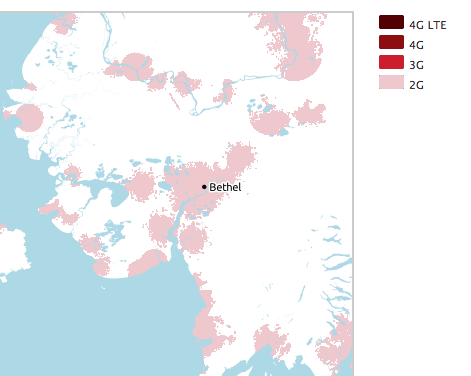
GCI Network coverage map. (Image courtesy of GCI.com)
A San Francisco-based law firm is now working with two Bethel attorneys who filed a class action lawsuit against GCI for their marketing practices in the YK Delta.
“We’re hoping that we can have some resolution or go to try within the next year,” said Bethel Attorney Dave Henderson. He and fellow attorney Jim Valcarce filed the lawsuit.
“GCI sold wireless services for voice and data plans and promised that they’d be reasonable and reliable and the services were not reasonably functional and reliable,” Henderson said.
Four Bethel residents filed the class action lawsuit against in April of last year.
The lawsuit alleges that the data plan GCI enrolled thousands of customers in rarely worked. Clients commonly experienced slow data and dropped calls, the lawsuit claims.
Henderson said the case is taking a lot of work and energy.
“We’re fighting against a company that has almost unlimited resources and there’s hundreds and hundreds of thousands of pages of discovery and documents we need to go through about the service that was provided,” Henderson said.
Henderson and fellow attorney Jim Valcarce teamed up with San Francisco-based law firm of Gerard Gibbs to work on the case. The law firm specializes in class action lawsuits.
“Given the facts here, we thought it made sense to work with Dave and Jim to represent the users of GCI services during the time period the case covers,” said Dan Gerard, the managing partner at the firm.
The case focuses on GCI services from 2010-2014. The plaintiffs are seeking to get their money back on grounds of fraud and misrepresentation and breach of contract.
David Morris, GCI VP of corporate services, wouldn’t say much about the ongoing case right now.
“All I can say is that the lawyers are still playing bat mitten on the legal issues and it just goes back and forth,” Morris said.
The case is currently in the middle of hearing and depositions. It has not been decided if the lawsuit will go to trial.
Three are confirmed dead after a de Havilland Otter floatplane taking off from East Wind Lake in Iliamna early Tuesday morning crashed shortly after takeoff. The pilot and six others onboard survived with injuries.
The aircraft took off before daybreak, using Iliamna’s East Wind Lake.
At about 6:15 a.m., Alaska State Troopers were notified that the plane, operated by the Rainbow King Lodge, had crashed some 300-400 yards from the water’s edge.
One of two investigators arrived on scene Tuesday afternoon. Clint Johnson heads up the National Transportation Safety Board’s regional office in Alaska.
“My understanding is the airplane is roughly about a thousand yards from the departure end, in a stand of trees,” said Clint Johnson, head of the National Transportation Safety Board’s regional office in Alaska. “Obviously [there is] substantial damage to the aircraft, and that’s really all we know at this point.”
The NTSB began its investigation Tuesday, but Johnson would not speculate on the cause of the crash.
One factor that will be considered is that the plane took off in the darkness of the early morning, an uncommon practice.
Bristol Bay’s many sport fish lodges compete to get clients to a handful of rainbow trout hotspots first, often aggressively.
Staff at other Bristol Bay lodges said Tuesday they never fly clients in the dark, yet the Rainbow King Lodge plane sat wrecked an hour and a half before sunup.
“Departure time, weather conditions, daylight conditions, water conditions, there’s a whole host of things we’re going to be looking at,” Johnson said. “It’s way too early to draw anywhere near a conclusion.”
Killed in the crashed were Tony Degroot, 80, and James Fletcher, 70, both from California, and James Specter, 69, of Pennsylvania. Some of the surviving seven passengers were injured severely, authorities said.
Trooper Joseph Minnick is based in Iliamna and received the call reporting the crashed plane. Minnick said volunteers from two nearby villages came in a hurry to help.
“With an amazing show of support, most of the community of Iliamna-Newhalen were on scene to hike the roughly 400 yards through the tundra to get to the crash site,” he said. “With their efforts, we were able to transport the injured from the site and get them to the local clinic for treatment.”
Sue Anelon, a longtime community health aide, was among the many helping hands who aided in pulling the wounded from the plane.
“We had to load them on gurneys and get them packed out,” she said, noting that the ATVs proved unhelpful.
Two of the wounded were able to walk away from the wreck site, and the rest were carried to the village clinic. An Air National Guard C-130 transported them to Anchorage.
Emma Hill lives just across East Wind Lake and could see the crumpled wings sticking up when she woke up this morning.
“Everybody is sad, I mean, it’s just tragic and even if we don’t know the people, it’s still lives taken and people hurt,” she said. “And the people who have to respond to such an emergency, it really affects them. It’s just sad.”
The Rainbow King Lodge could not be reached for comment Tuesday. Next of kin of the deceased have been notified.
Update 5:52 p.m.
The names of the three deceased passengers have been released. The bodies of Tony W. Degroot, 80 of Hanford, California; James P. Fletcher, 70 of Clovis, California; and James Specter, 69 of Shavertown, Pennsylvania have all been recovered and will be transported to the State Medical Examiner’s Office for autopsy. The NTSB will conduct an investigation into the cause and circumstances of the crash.
Original story
Three are confirmed dead after a de Havilland Otter float plane taking off from East Wind Lake in Iliamna early Tuesday morning crashed shortly after takeoff.
The Otter was operated by the Rainbow King Lodge and had 10 passengers onboard. At about 6:15 a.m., Alaska State Troopers were notified that the plane had crashed some 300-400 yards from the water’s edge.
The surviving passengers are reported to be injured, but details on their conditions has not been released.
Officials believe plane had the pilot plus a mix of fishing clients and guides on board.
Illiamna-based Trooper Joseph Minnick was on scene Tuesday morning and described an incredible volunteer response from residents and other nearby lodge staff.
“It was an amazing show of support. Most of the community in Iliamna-Newhalen was on scene to hike the roughly 400 yards through the tundra to get to the crash site,” Minnick said. “And, with their efforts, we were able to transport the injured from the site and get them to the local clinic for treatment.”
Minnick says two of the injured passengers were able to walk out and the rest were assisted. All of the injured were medevaced by a Rescue Coordination Center C-130 back to Anchorage before noon.
Emma Hill lives just across East Wind Lake from the crash site and could see the crumpled wings sticking up when she woke up this morning.
“Everybody is sad. I mean, it’s just tragic and even if we don’t know the people, it’s still lives taken and people hurt,” she said. “And the people who have to respond to such an emergency, it really affects them. It’s just sad.”
Rainbow King Lodge could not be reached for comment Tuesday morning. The identities of the deceased have not been released.
More than $18,000 has been raised for the daughters of Seth Fairbanks, the pilot from Bethel who died after a plane crash in early August.
After learning of her friend’s death, Bethel resident Nikki Corbett hosted an online auction on Facebook. The funds went to a trust fund for Seth Fairbanks’ twin daughters.
“When something like this happens every one kind of comes together and helps the families,” Corbett said. “It’s been an amazing outpouring of support.”
Corbett was out of town when she heard about the accident but still felt a call to action. She got the OK and began planning.
“I didn’t think it would turn out to be so big,” Corbett said. “I was only thinking there would be about 30 items because that’s how it started out. I think it ended up being over 50, 60 items.”
Donation items included everything from handmade children’s clothing and pottery to canned salmon and handcrafted artwork. Donations came mostly from the Bethel region and Anchorage area, with some items coming as far as Arizona.
“Now’s the fun part where we have to get everything ready and process it and send it out,” Corbett said.
Corbett and Fairbanks’ mother will cover the cost of shipping and they hope to send items out soon.
Fairbanks, who was 29 and living in McGrath, died with passenger Anthony Hooper after his plane crashed in the Knik Arm River. He was traveling to Anchorage for his sister’s wedding reception.
“I’ve just known him since grade school. We were great friends through high school,” Corbett said. “It was amazing to see him evolve from when his daughters were first born. He was a great dad.”
A 2014 general election sample ballot in Gwich’in from the State Division of Elections website.
In a historic settlement, the state has agreed to provide increased language assistance for voters whose primary language is Yup’ik or Gwich’in.
The federal lawsuit was filed in 2013 by two Alaska Native voters and several tribal governments. The plaintiffs claimed the state doesn’t do enough to serve voters who speak Alaska Native languages.
“The choices that were made in the settlement open the door for Alaska Native access to the polls in a way that we have not seen before,” Landreth said.
The centerpiece of the settlement is translating the state’s official election pamphlet into Gwich’in and up to six different dialects of Yup’ik. The pamphlet contains pre-election information on how to vote, biographical information on candidates and explanations of ballot measures.
The state agrees to provide outreach workers with standardized training and translations, which Landreth calls significant. The settlement also creates more partnerships with tribal governments, establishes Gwich’in and Yup’ik dialect glossaries of election terms and calls for a full-time state elections employee in charge of language assistance activities.
Originally called Toyukak v. Treadwell, the case had been in negotiations for about nine months. Lt. Gov. Byron Mallott inherited the case.
“I am pleased to put the issues that were the basis of complaint behind us (and reach) an agreement going forward that I think strengthens Alaska’s election procedures and processes,” Mallott said.
“The obligations on the division and its director going forward to implement the settlement are going to be hugely significant and it was on that basis that we felt new leadership would be required,” Mallott said.
Bahnke, the outgoing city manager of Nome, is scheduled to begin in October.
The settlement between the state and the plaintiffs was filed Tuesday in U.S. District Court. The state is expecting a final judgement on it in the next few weeks.
Close
Update notification options
Subscribe to notifications
Subscribe
Get notifications about news related to the topics you care about. You can unsubscribe anytime.