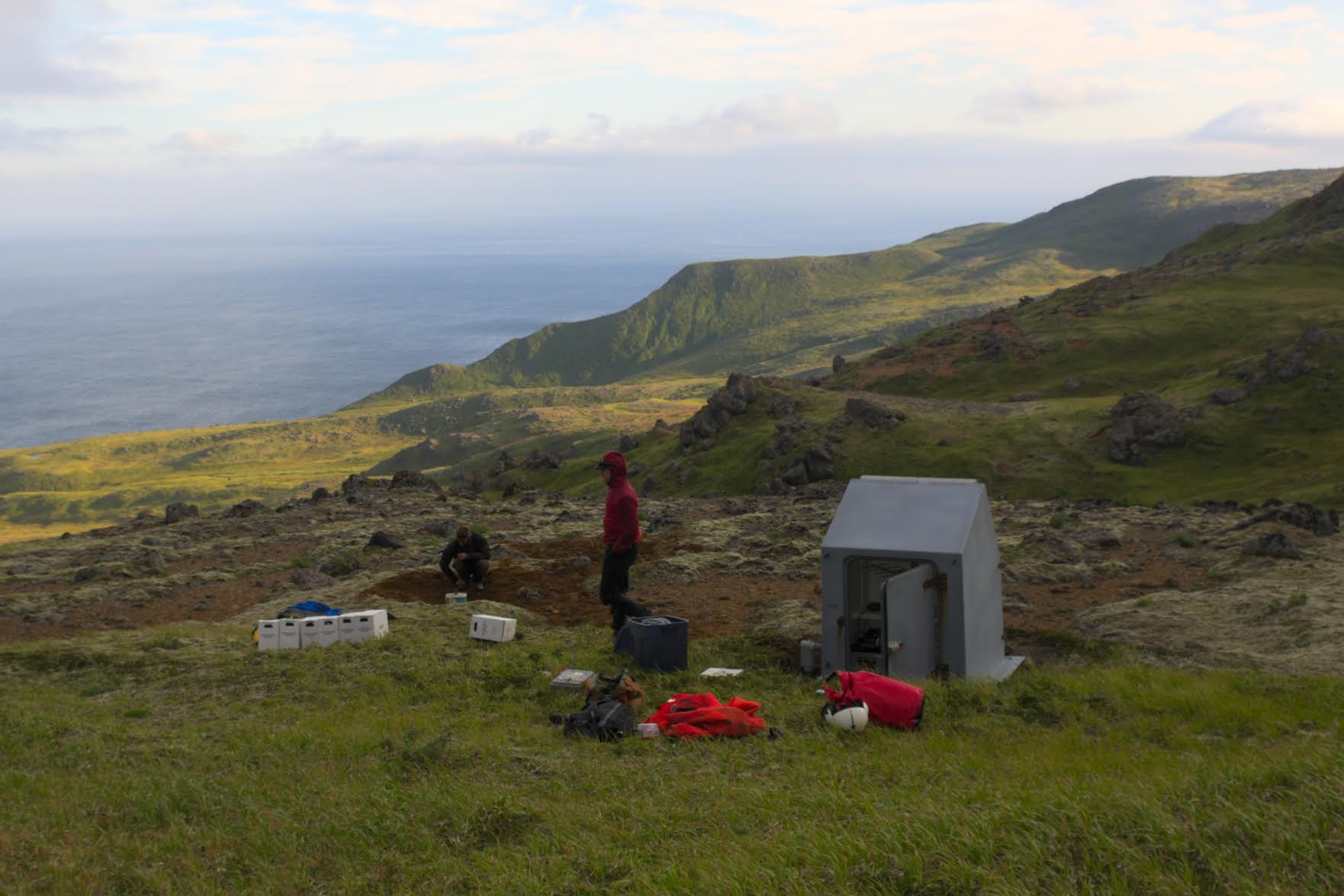
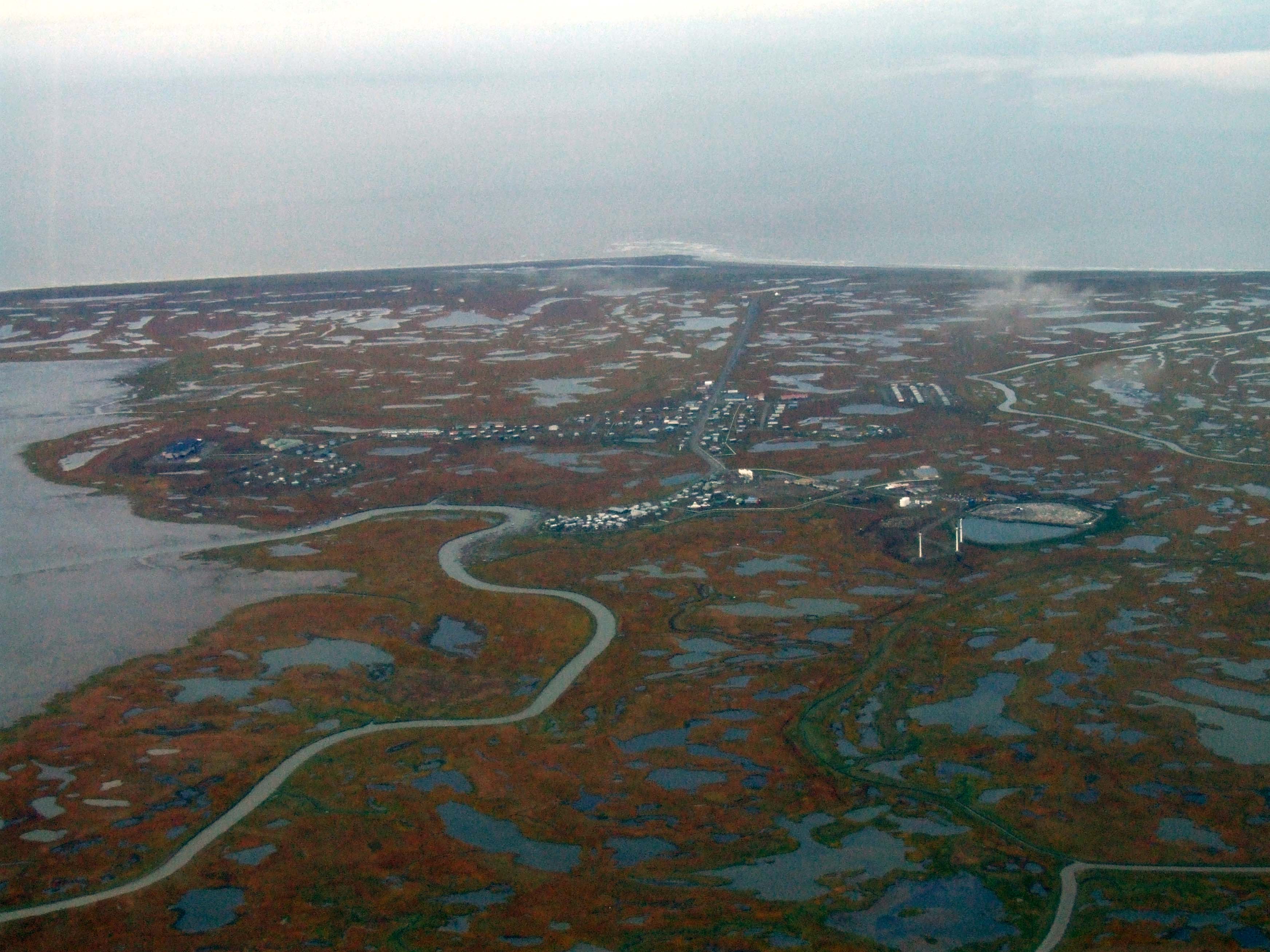
AVO seismologists work to repair a seismic station on Little Sitkin Volcano in the western Aleutians Islands. (Photo courtesy USGS)
This summer, Alaska Volcano Observatory scientists embarked on an ambitious project to repair seismic monitoring equipment at active volcanoes around Southwest Alaska. Now 176 of the Observatory’s 216 seismic stations are in working order.
A backlog of deferred maintenance and a lack of funding, coupled with the extreme environment, have caused some of the seismic monitoring stations to quit working over the past several years.
This summer, crews were able to repair stations at a handful of sites in Southwest Alaska.
“We were able to visit, importantly, Aniakchak Volcano on the Alaska Peninsula, restored some ground-based monitoring at the volcano there,” said Janet Schaefer, with the Alaska Volcano Observatory. “And we also did seismic repairs at Gareloi, Tanaga and Westdahl Volcanoes – those are in the Aleutian Islands.”
Shaefer says AVO was also able to fix stations at the recently-active Shishaldin Volcano.
Funding came from the U.S. Geological Survey’s Volcano Hazards Program.
Future funding is uncertain. But Schafer says the goal is to get more of their stations up and running.
“Wrangell Volcano is an example. It has been active recently,” Schaefer said. “And those stations are difficult to get to, so it would be nice to get there.”
A volcanic eruption is often preceded by hours, or even months, of seismic activity, which Schaefer says provides AVO with valuable data.
“So that we can detect those very small, small magnitude earthquakes that indicate fluid movement, either from an active hydrothermal system or gas or magma beneath the surface,” she said. “So, those are the first signs of unrest and those are what really help us to be on guard.”
And as more stations are brought back on line, AVO can more reliably monitor volcanoes and issue more accurate warnings to the public as hazards to communities and passing air traffic become apparent.
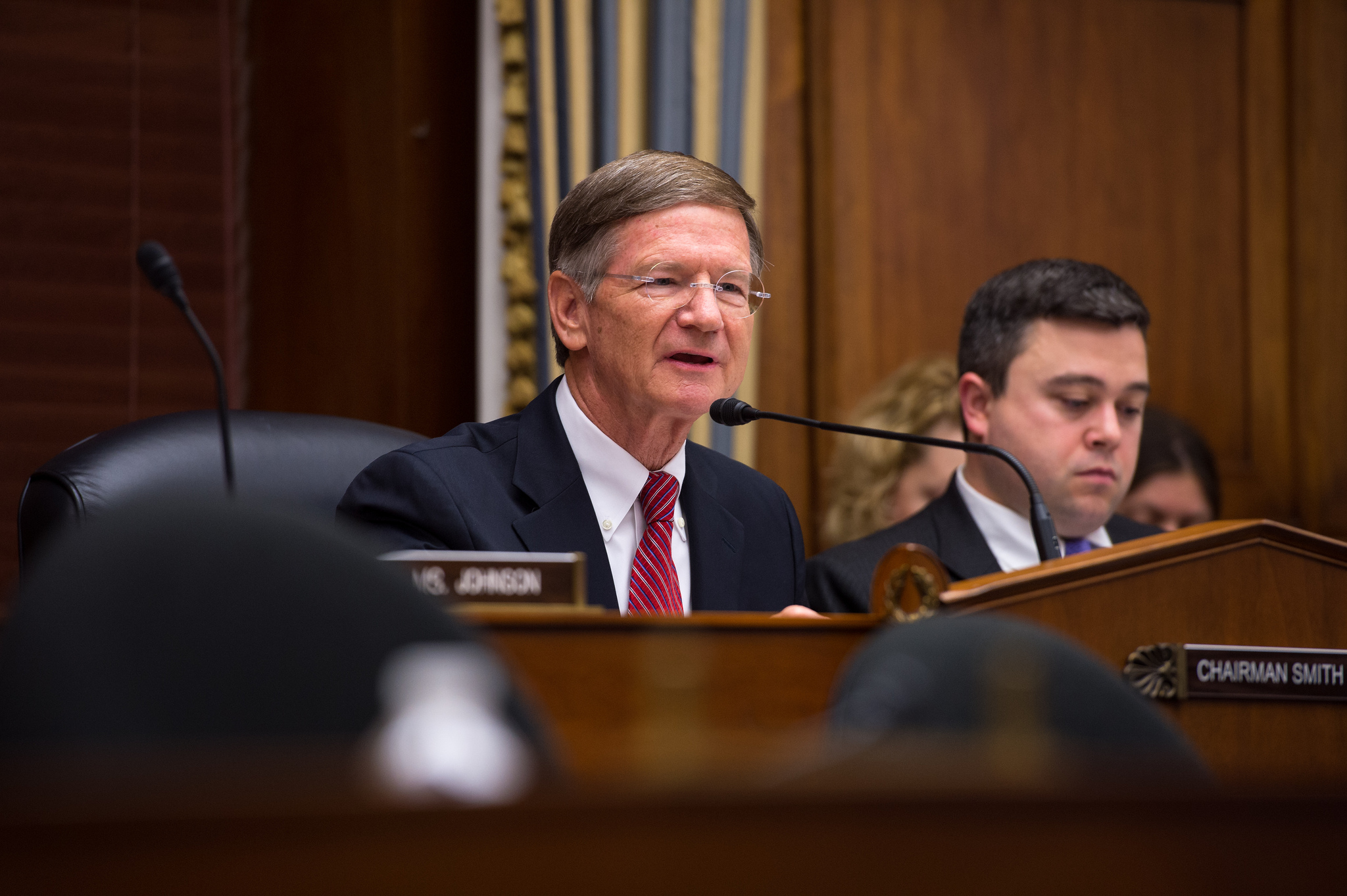
Congressman Lamar Smith, R-Texas, chairing the Committee on Science, Space, and Technology at the Rayburn House Office Building in Washington, D.C., in July 2014. (Createive Commons photo by Aubrey Gemignani/NASA)
A U.S. House Committee plans to examine whether the EPA unfairly blocked the Pebble Mine in Southwest Alaska with a so-called “pre-emptive veto,” before the mine has even applied for permits.
The Science, Space and Technology Committee, chaired by Republican Lamar Smith of Texas, has invited consultant William Cohen as a witness. Cohen, a former Defense secretary hired by Pebble, says the EPA’s actions suggest the agency may have rigged the process to reach the position it wanted to take against the mine.
Mine opponents, though, say the EPA followed a rigorous process and used valid science to conclude the mine would endanger the headwaters of Bristol Bay and its rich salmon runs.
The congressional hearing is scheduled for Nov. 5. It’s unclear if the EPA’s Northwest regional director, Dennis McLerran, will be a witness at the hearing. Chairman Smith wants McLerran to answer questions from committee staff beforehand about the process the EPA followed.
The only witnesses named so far are Cohen and another consultant who worked on the report he authored.
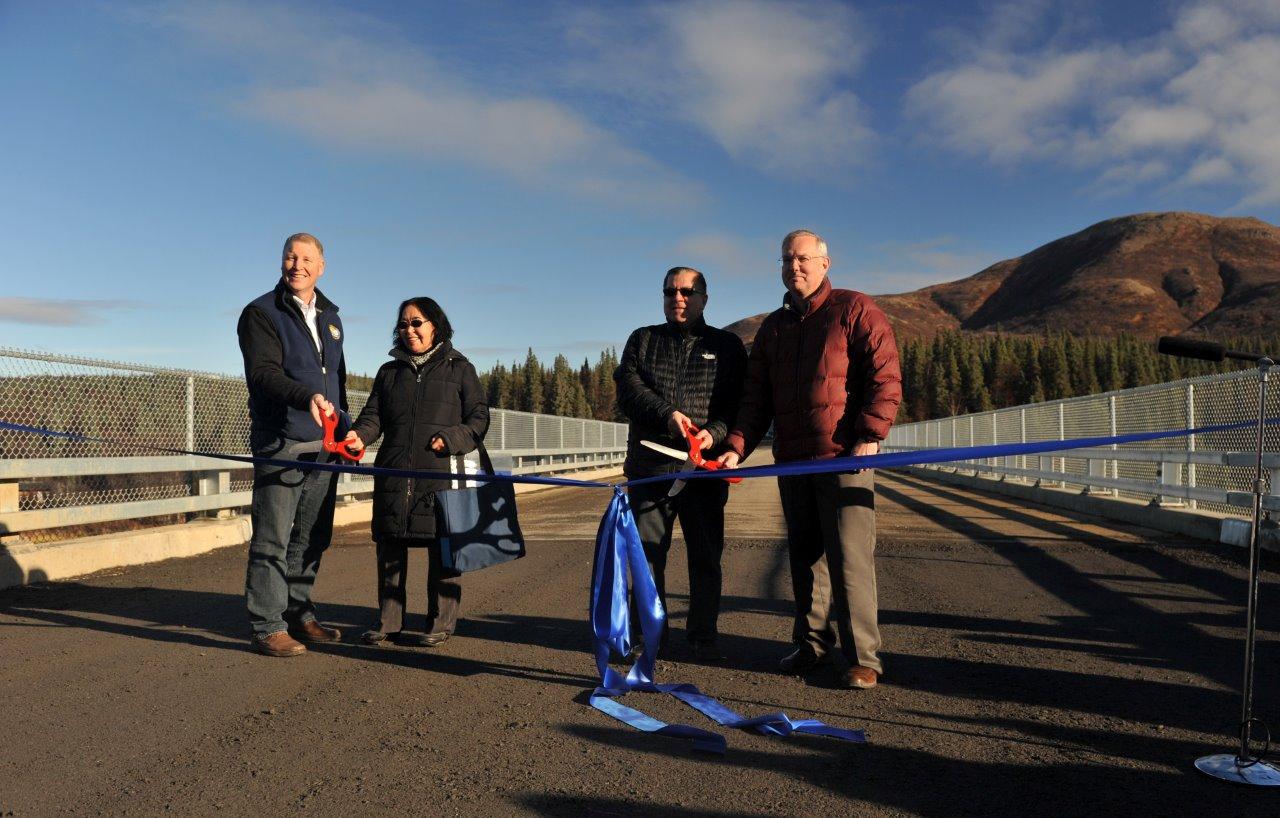
DOT Commissioner Marc Luiken, Aleknagik Mayor Jane Gottschalk, Sen. Lyman Hoffman and Rep. Bryce Edgmon cut the ribbon on the Aleknagik Wood River Bridge on Tuesday. (Photo by Misty Nielson)
On a bluebird fall day, it was the youngest residents of Aleknagik who took the first steps across the newly-opened Aleknagik Wood River Bridge as they raced one another across it.
Fitting, as it’s the youth of Aleknagik who have faced daily crossings for decades, just to get to school.
“I remember as a child in ’56 when I started school the only transportation we had was to walk across the lake,” recalled Aleknagik Mayor Jane Gottschalk during the ribbon cutting ceremony on Tuesday. “We walked through storms, below zero weather. And it seems like it took forever to cross by foot. And when breakup came, there was always somebody to take us across in the skiff.”
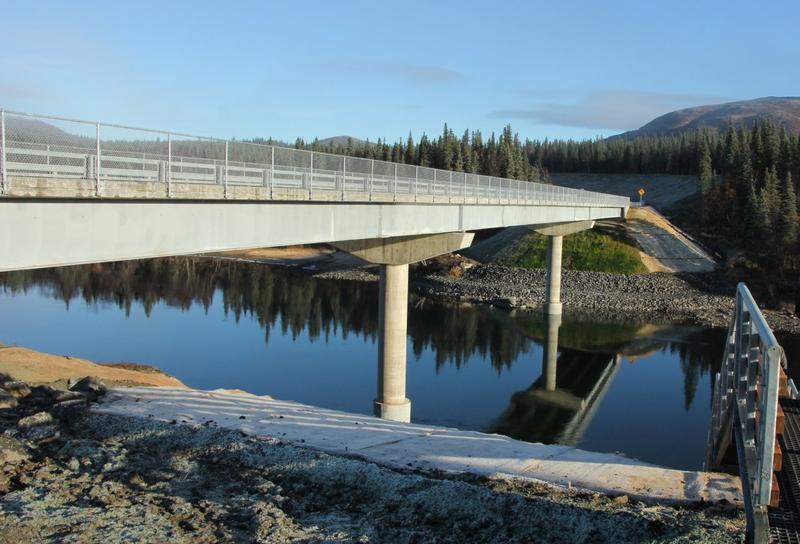
The 440-foot Aleknagik Wood River Bridge connects the south and north shore communities. (Photo by KDLG)
About 150 people turned out to celebrate the new 440-foot bridge, 40 feet above the Wood River, a mixture of Aleknagik and Dillingham residents and visiting dignitaries. Molly Chythlook said the two sides of the lake have been separated her whole life.
“But now with this bridge, the connection is going to be so prominent for both sides,” she said on Tuesday. “And like Mayor Gottschalk said, it’s going to be safe. Not only for school kids, but for everybody crossing.”
“We built our home here when we got married in 1967, but with our two young kids and Joe working in Dillingham, there was no way for us to just go back and forth crossing the lake with the boat during summer and snow machining around the lake, it was just, no way.”
Chythlook moved from Aleknagik to Dillingham with her husband, Joe, and their two young children in the 1970s, in part because of concerns about crossing the water every day.
The town has long been divided between the north and south shores of Aleknagik, water or ice between. Elementary students crossed to the north to get to the Aleknagik School. Older students crossed to come south and bus to Dillingham.
At times, the crossing can be deadly; more than a dozen lives have been lost.
And so, for years, there was talk of a bridge.
In the early 2000s, an earmark from then-Sen. Ted Stevens helped spur action on the project, said state Department of Transportation Commissioner Marc Luiken during Tuesday’s ceremony. Local lawmakers Rep. Bryce Edgmon, D-Dillingham, and Sen. Lyman Hoffman, D-Bethel, kept pushing the project forward according to those who spoke Tuesday, resulting in a $20 million appropriation from legislature in 2008 that funded much of the actual construction.
“This is a great example of the coordination and consistency and collaboration, and really the tenacity, between the city, the tribes, the Alaska native corporations, and probably most importantly, these two gentlemen over here, who have been really strong advocates for this bridge,” Luiken said, referring to Edgmon and Hoffman.
Left unsaid during the ceremony were concerns about what new problems connectivity could bring to the small town. But afterward, watching the first traffic jam on the north shore of Aleknagik, some said they had been told to start locking their doors, worried about trespassing. But for the most part Tuesday, those concerns largely took a backseat to the celebration that at least the daily crossings would be safer.
In her remarks, Gottschalk also thanked those involved in the project locally over the years–from a long list of former Aleknagik mayors and residents to DOT Engineer James Amundsen, who designed the span, and project manager Tim Hutton who saw it through construction this summer and fall, as well as other individuals and entities involved along the way.
Then, after a blessing, Edgmon and Hoffman, Gottschalk and Luiken, all stood together to cut the ribbon on the new bridge. And after posing for a photo, the youth crossed first, some walking, some sprinting, leading the way back to the school gym to celebrate.
The village of Hooper Bay has suffered another loss. A fourth person has died by suicide.
Alaska State Troopers received a call that 21-year-old Carl Dominic Robert Joe had died from an apparent suicide Saturday afternoon, according to an online trooper dispatch.
Joe’s death comes less than a week after three other young adults have died.
In late September, 26-year-old Noel Tall died from suicide. Less than a week later, 24-year-old Eric Tomaganuk died by suicide, according to troopers.
Troopers believe the deaths are related.
Two days later, the village suffered another loss. Twenty-year-old Miranda Seton died by suicide after becoming distraught over Tomaganuk’s death, according to the online trooper dispatch.
The remains of all four victims were sent to Anchorage for autopsy.
Mental health experts say suicide is a complex issue and is not typically related to one event.
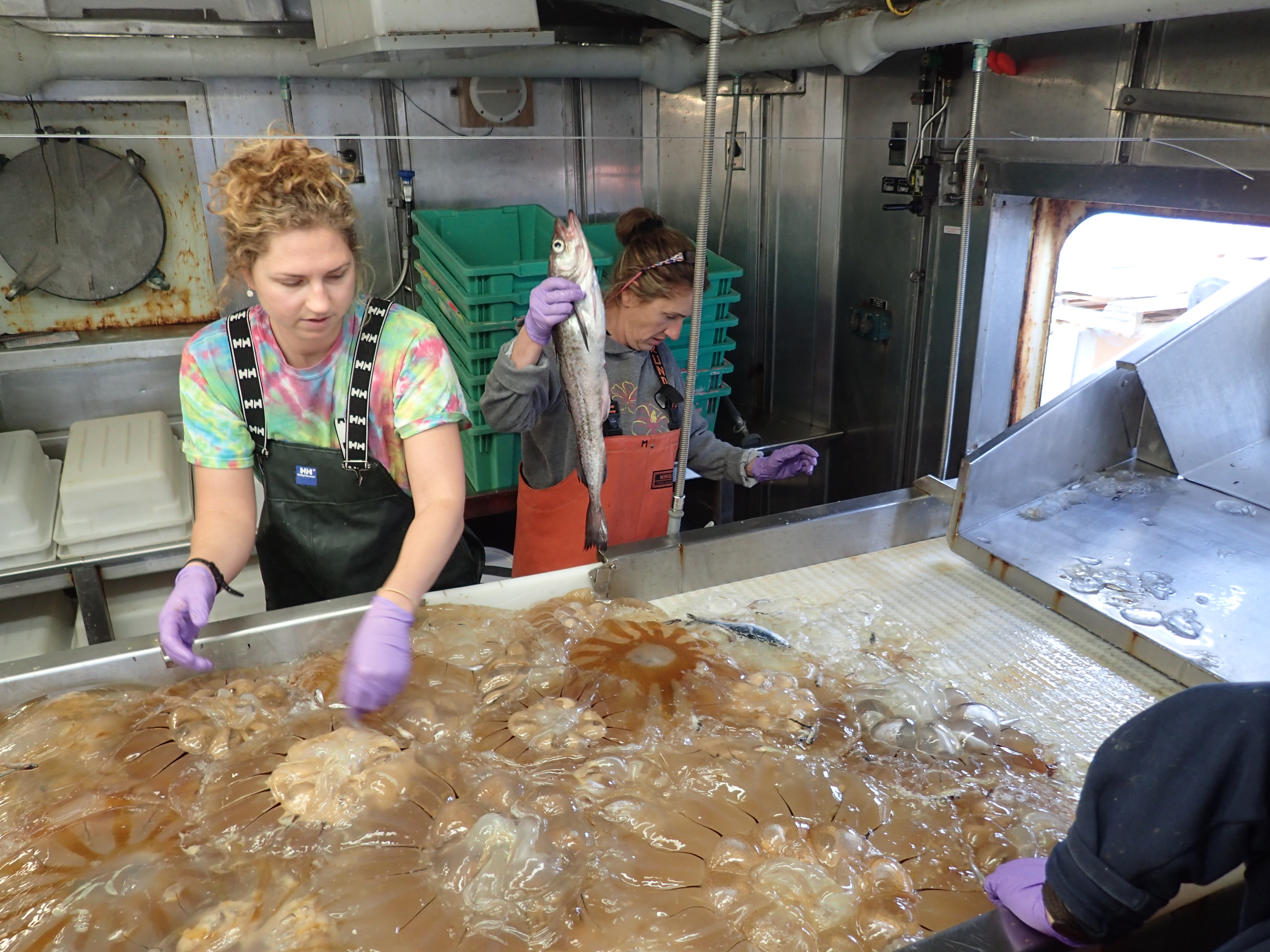
Researchers sort a catch from the trawl net, holding a walleye pollock over brown jellyfish. (Photo by Alex Andrews/NOAA)
On Tuesday, researchers wrapped up a month-long cruise through the unusually warm waters of the Bering Sea. They’re investigating how the second year of a warming pattern is affecting the ecosystem, including the nation’s largest fishery, pollock.
Onboard the research vessel Oscar Dyson, a dozen scientists have been trading 12-hour shifts as the ship traced a grid over the eastern Bering Sea Shelf from Unimak Island up to about 60 degrees north.
Janet Duffy-Anderson is a research biologist with NOAA’s Alaska Fisheries Centers. Her co-lead on the Bering Sea project is Phyllis Stabeno, an oceanographer at NOAA’s Pacific Marine Environmental Laboratory.
Stabeno explains at each stop, the ship’s researchers take both physical measurements — temperature, salinity, nutrients – and biological samples.
“So you pull in your last net, fish and everything comes in and you begin sorting them,” she says. “But the ship now is moving to the next station, takes about 2-3 hours to get to the next station. … So everybody is madly running all their samples so they can be ready to do this again.”
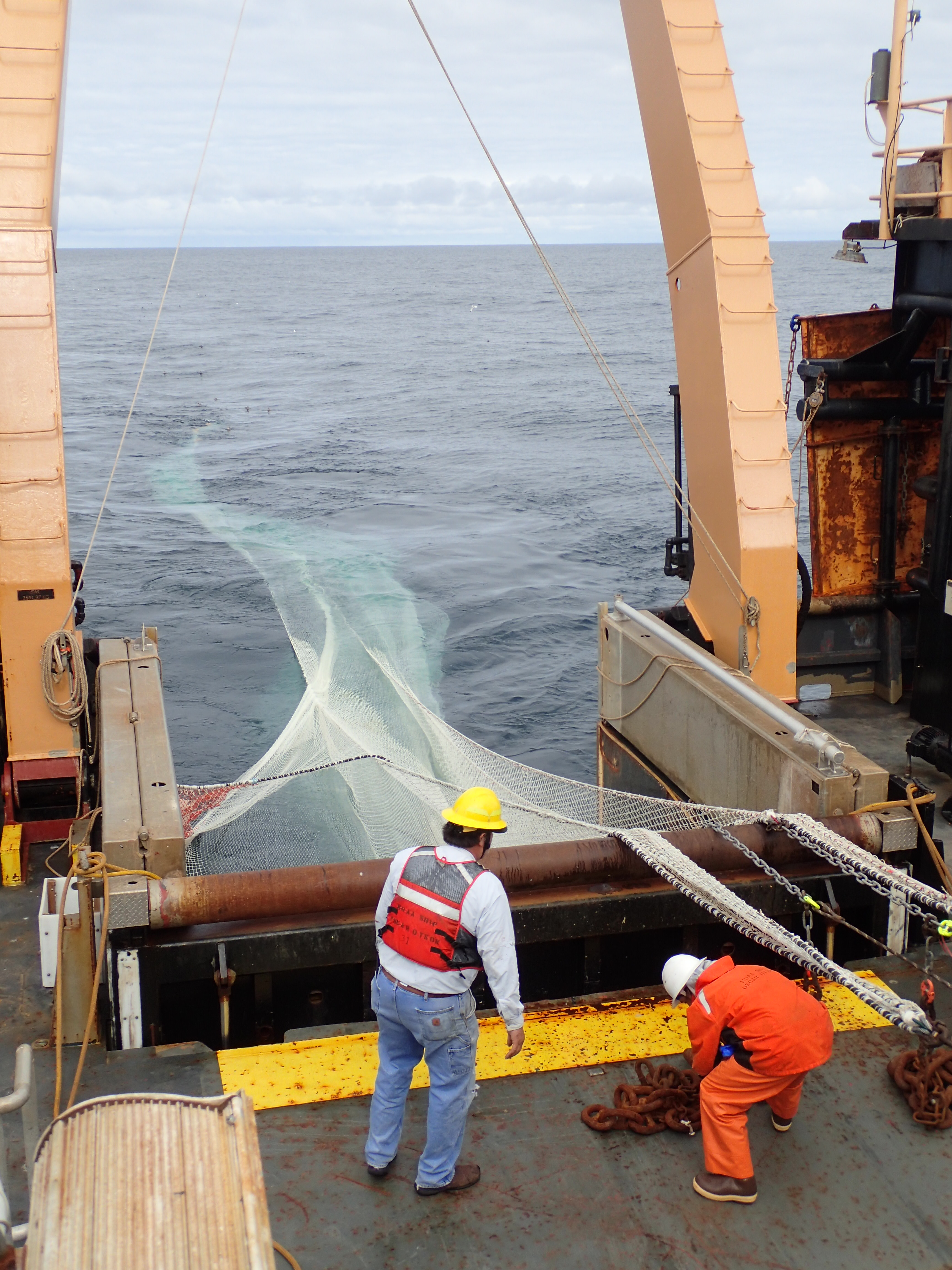
Crew deploy the fishing net aboard the research vessel Oscar Dyson. (Photo by Alex Andrews/NOAA)
The goal of this daily hustle is to study the effects of an unusual phenomenon in the Bering Sea: Last year the waters warmed dramatically after a 7-year cold spell.
This sudden warming bodes ill for some species, including walleye pollock. Duffy-Anderson says the last time there was an extended warm spell was between 2001 and 2006, and it was a very poor period for pollock.
The poor pollock return, she says, is due to a deficiency in the fish’s food source. During warm years the plankton, or copepods, that pollock eat are not as fatty and nutritious as plankton during cold years.
“And what we see is the fishes that eat that prey base are also in worse condition in warm years than in cold years. They’re not getting this high-fat diet. They’re getting kinda more like a potato chip diet, I guess,” she says.
Duffy-Anderson says this skimpy warm-weather diet results in skinny pollock that have a hard time surviving the following winter.
In contrast, pollock during a cold spell are eating fat-rich plankton.
“And so by the end of the summer they’re short and fat and they can make it through the winter much more successfully than the long-skinny guys in warm years,” she says.
Duffy-Anderson says the warm years cause another disturbing trend: an increase in cannibalism among pollock.
“In the warm years, when the nutrient base is poor, they go after each other. A drop in pollock survival may be the biggest economic impact of this new warm spell,” she says. “But these scientists say the changes go much deeper than a single species.”
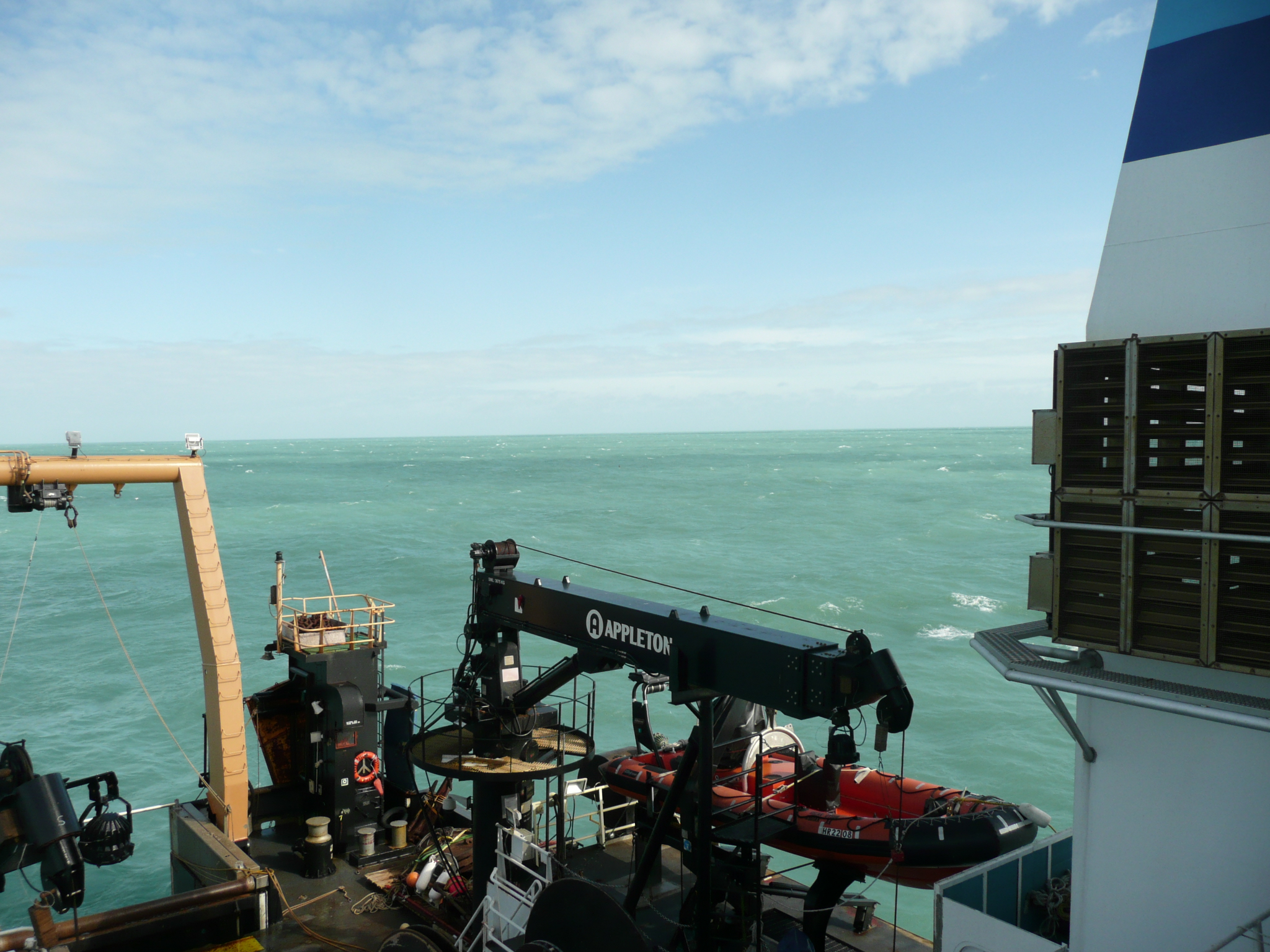
Coccolithophores cause the milky turquoise water color. (Photo by Peter Proctor/University of Washington and NOAA)
Stabeno says historically, Bering Sea temperatures would fluctuate randomly from year to year – a warm year, followed by a cold, followed by a medium year and so on.
But over the last 15 years, those brief highs and lows have stretched out into five, six or even seven-year periods. Stabeno says this could signal a big change in the region’s climate patterns.
“The Bering Sea shifted from this high year-to-year variability to a more stanza – where you have groups of warm and groups of cold, which would have profound impacts on the ecosystem if it happens,” Stabeno says. “And we don’t know … is this a random occurrence? Statistically, it’s looking less and less like it.”
With the warm mass of Pacific water known as the Blob and El Niño in the forecast, continued warm conditions are expected.
The Oscar Dyson completed its Bering Sea cruise and returned to Dutch Harbor on Tuesday. Duffy-Anderson and Stabeno say a “snapshot” of data will be provided to NOAA fisheries managers and the North Pacific Management Council within a month.
A more thorough analysis of the data will be released in about a year.
Yup’ik and English “I Voted” stickers from Bethel’s municipal election. (Photo by Anna Rose MacArthur/KYUK)
In a Bethel advisory vote, most voted yes to the city supporting a liquor license application for a liquor store, but voted no for a bar, club, restaurant or eating establishment, according to unofficial results from Bethel’s municipal election Tuesday.
The majority voted no on another advisory question asking for blanket support of liquor sales in Bethel.
Bethel voters also raised sin tax rates in binding propositions.
For proposition 1, asking whether or not to increase alcohol sales tax from 6 to 12 percent, the majority voted yes at 64 percent in favor.
For proposition 2, asking whether or not to increase marijuana sales tax from 6 to 15 percent, the majority voted yes again, this time at 69 percent.
Official results will be issued Thursday after the ballot is canvassed.
Close
Update notification options
Subscribe to notifications
Subscribe
Get notifications about news related to the topics you care about. You can unsubscribe anytime.