Western

Gambell National Guard members to receive Alaska Heroism Medal for 1955 rescue

The broken-off tail of an old plane lying on the tundra
Part of the Lockheed P2V-5 Neptune wreckage still remains in Gambell. (Photo courtesy of Gay Sheffield/UAF Northwest Campus and Alaska SeaGrant)

The Alaska National Guard and the Alaska Office of Veterans Affairs plan to award the Alaska Heroism Medal to the families of 16 members of the Alaska National Guard in Gambell. The awards are being presented for the rescue of a downed Navy air crew almost 70 years after the event.

On June 22, 1955, a U.S. Navy patrol plane took off from Kodiak with a crew of 11.

The crew’s mission was to patrol U.S. airspace, check navigational aids and document sea ice, according to Verdie Bowen, director of the Alaska Office of Veterans Affairs.

About 200 miles west of Nome, the crew encountered two Soviet MiG-15 fighter jets, which fired on them. They attempted to hide in the cloud cover, but the MiGs managed to disable one of the patrol plane’s engines, and the crew crash-landed on St. Lawrence Island about 9 miles south of Gambell.

David Assard, the navigator, described the landing in an interview with Alaska Dispatch News in 2015.

“The landing was as beautiful as you could imagine, with the notable exception that, because we had no wheels and there were a lot of boulders and rocks on shore, they ruptured the center tank,” Assad said.

He said the fuel ignited, causing a fire inside the plane.

“As the plane decelerated, the fireball didn’t, and it rolled forward and burned everybody,” Assard said.


June Walunga, daughter of one of the National Guard members who responded to the crash, remembers being in Gambell and watching the plane come down.

“I was seven years old, and I remember the sound and the plane going over Gambell,” she said. “It was thundering to us. You know, we never heard that kind of sound back then. And it’s right there very close to your head. And shortly after that, I saw smoke.”

None of the crew died in the crash, but all of them sustained injuries, including burns, shrapnel and bullet wounds.

Staff Sgt. Clifford Iknokinok and three other members of the Gambell First Scout Battalion were seal hunting nearby and made their way to the crash site despite the Soviet fighters continuing to circle overhead. Upon realizing that they didn’t have the necessary equipment to help the air crew, Iknokinok set off for Gambell to gather additional assistance. Before he made it to Gambell, though, he ran into several of his fellow National Guard members, who were already on their way to help.

The National Guard members used umiaks to transport the injured air crew back to Gambell. June Walunga remembers them arriving in town.

“I remember I was holding my mother’s hand, and we were walking towards the beach where the boats were coming in, and they were carrying these people on stretchers going up the beach. Some had bandages wrapped on them and their arms; some of them were halfway up on their shoulders,” Walunga said.

After arriving in Gambell, the crew’s injuries were treated. A team from Elmendorf Air Force Base retrieved them two days later. Bowen says it was only due to the quick action of the Gambell First Scouts that all 11 members of the air crew survived.

But if this all happened in 1955, why is the National Guard awarding medals in 2022? There’s a simple reason, according to Bowen.

“In 1955, there (were) no peacetime medals in the active military or in the National Guard,” he explained.

Brigadier General John Noyes presented the members of the Gambell First Scout Battalion with letters of commendation for their actions.

“For that time, that was appropriate for 1955 and, in reality, that was the only thing that he really had in his awards branch to provide,” Bowen said.

In November of that year, the U.S. Navy also recognized the Gambell First Scouts by awarding Honorary Naval Aviator Designations to Master Sergeant Willis Walunga and Staff Sergeant Clifford Iknokinok, the senior members of the unit. The other members received letters of appreciation from the Navy.

After a review by Major General Torrence Saxe, the current adjutant general of the Alaska National Guard, the awards were upgraded to the Alaska Heroism Medal, currently the highest award for heroism in the Alaska National Guard. The medals will be presented to the families of the members of the Gambell First Scout Battalion and Cpl. Bruce Boolowon, the only surviving member.

The full list of recipients is as follows:

  • Master Sgt. Willis Walunga
  • Staff Sgt. Clifford Iknokinok
  • Sgt. Herbert Apassingok
  • Sgt. Ralph Apatiki Sr.
  • Cpl. Bruce Boolowon
  • Cpl. Victor Campbell
  • Cpl. Ned Koozaata
  • Cpl. Joseph Slwooko
  • Pfc. Holden Apatiki
  • Pfc. Lane Iyakitan
  • Pfc. Leroy Kulukhon
  • Pfc. Woodrow Malewotkuk
  • Pfc. Roger Slwooko
  • Pfc. Vernon Slwooko
  • Pfc. Donald Ungott
  • Pvt. Luke Kulukhon

The award ceremony was originally scheduled for July 9, but due to inclement weather, personnel from the Office of Veterans Affairs and the Alaska National Guard were unable to land in Gambell that day. The National Guard and the Office of Veterans Affairs say they will work with the community and family representatives to reschedule the event.

Click here to watch the full Strait Science presentation focusing on the Gambell National Guardsmen and their heroic rescue mission from 1955.

Chum fishing will remain closed on the Yukon amid projections for another low fall run

""
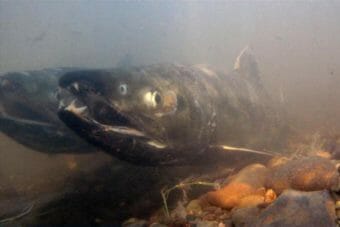
Chum salmon (NOAA photo)

Fall chum are expected to begin entering the Yukon River soon, and the Alaska Department of Fish and Game is projecting another low run for the species after 2021’s record low return. To conserve the salmon, government fishery managers will keep fishing for fall chum closed unless an unexpected surge of the species arrive.

Fish and Game is projecting that less than 300,000 fall chum will return to the Yukon River. That’s fewer than the state’s drainage-wide escapement goal of 300,000 to 600,000 fall chum reaching the spawning grounds. On average, 1 million of these fish return to the Yukon River each year.

To help the fraction of fall chum expected to arrive have a chance to spawn, managers are keeping chum fishing closed.

“I just want to let fishermen know that we’re really sorry that we don’t have better news,” Fish and Game fisheries manager Christy Gleeson said during a weekly teleconference about Yukon salmon hosted by the Yukon River Drainage Fisheries Association. ”These fish counts are devastating for people trying to live along the Yukon River. We know that it’s been a really difficult fishing season so far with these salmon closures. But we really appreciate everyone coming together and doing continued cooperation during these times of salmon conservation.”

That conservation has led to no salmon fishing for chinook or chum along the river for the second year in a row.

2021 saw the lowest fall chum run on record. This year’s chinook and summer chum runs have continued the same trend from last year. Neither are expected to meet escapement goals set by state and federal fishery managers. The continued closures are economically and culturally straining Yukon River residents.

“We long to taste our fish that we smoked and dried. This is our food, our livelihood,” Russian Mission resident Sandra Kozevnikoff said during the Yukon River salmon teleconference.

Fishing will remain open for other species on the river, including red, pink and coho salmon, along with non-salmon fish.

Another Russian Mission resident, Basil Larson, said during the teleconference that pink salmon are passing by in “full force.” In a six-hour stretch, he and his brother caught enough pinks to feed their dogs for three to four days.

“There’s some pretty good, healthy looking ones that we’re taking and eating, along with the whitefish,” Larson said.

Upriver in Huslia, Lisa Bifelt said that local fishermen were making a 75-mile round-trip to a slough to target sheefish.

“People were having some luck down there, not much though. I think seven was the most caught,” Bifelt said.

But when she boated there with her mother, she said that they didn’t catch anything.

Meanwhile, other callers said that berry picking season had begun, a hopeful abundance of local food amid the historic declines of salmon.

Amid lowest chinook run ever, no end in sight for Yukon River subsistence closures

""
Skiffs line the Yukon River bank near the Kwik’Pak fish plant in Emmonak, Alaska on June 15, 2019. (Photo by Anna Rose MacArthur/KYUK)

Subsistence fishing for Yukon River chinook and summer chum salmon will likely remain closed through the end of the season.

It’s a possibility that fishery managers had warned could happen since before the salmon arrived.

Now, with both runs past their midpoints, fisheries officials say there’s no indication that there will be enough fish to meet the goals managers set for fish to escape to their spawning grounds.

“So unless these runs are abnormally, exceptionally, extremely late, it’s unlikely that we’ll get enough fish coming in the last part of this season,” said Alaska Department of Fish and Game Yukon River Fishery Manager Deena Jallen. Jallen gave the update during a weekly salmon teleconference hosted by the Yukon River Drainage Fisheries Association.

Only about 20% of the average amount of chinook and summer chum have returned to the lower river, according to data from the Pilot Station sonar. It’s the lowest chinook run ever, and the second lowest summer chum run, just barely more than what returned last year.

“So we know that it’s incredibly disappointing,” said Jallen. “It’s extremely hard to see these runs come back so low. It’s hard to have fishing be closed, but that’s unfortunately what we have to do when the runs are this small.”

A caller who identified herself as Ruby in Eagle said that she couldn’t provide a subsistence report during the teleconference since no one had been fishing.

“It’s very, very quiet at the public boat landing in town,” she said. “Almost eerily quiet.”

The community is facing other challenges as wildfires burn across the Alaska Interior.

“Very dry, very hot, lots of smoke. We haven’t had any measurable rain for a very long time, probably a month,” Ruby said.

Downriver, in Russian Mission, a caller who identified herself as Olga said that an elder has been asking her for a taste of fish.

“Then I told her that it’s not us that’s saying that they can’t fish; it’s just a regulation from way up high. And then she was practically crying and said, ‘Well, tell those people not to go shop for four weeks in their store. They have it easy to go to the store to get what they want to eat,’” Olga said.

Pink salmon counts are picking up in the lower river. Subsistence users can target pink and red salmon with 4-inch mesh set nets, 60 or fewer meshes in length, along with other gear types.

U.S. Fish and Wildlife Service Fishery Manager Holly Carroll asked fishermen to move their nets if they’re catching a lot of summer chum or chinook. She said that it’s important that each of those fish makes it to the spawning grounds.

“We have had years like this before, certainly for chum in 2000 and 2001, and we recovered. And I have faith that we can recover again and we’ll be fishing that species again, but just not this year,” Carroll said.

She also referenced the moratorium in 2013 and 2014, prohibiting all chinook harvest, and the rebound that followed. She acknowledged that prohibiting fishing for both summer chum and chinook is a compounded hardship.

“So while it may be hard right now, I’m just trying to put out a message for hope that if we let these fish go by now, we will be fishing on them again in five years time, four years time for the chum. That’s my hope. Maybe even less for the chum; maybe two or three years we could see these runs rebound,” Carroll said.

In the meantime, fishing for summer chum and chinook remains closed on the Yukon River for the second consecutive year.

The East Fork Fire is no longer threatening lower Yukon River communities

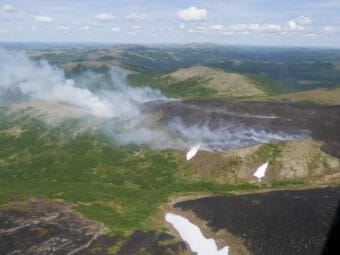
An aerial view of smoldering tundra

Federal fire officials determined that the East Fork Fire is no longer a threat to lower Yukon River villages as of June 25, 2022. (BLM photo)

Federal fire officials say that the East Fork Fire is no longer threatening lower Yukon River communities.

The 166,587-acre fire has burned for nearly a month near the communities of St. Mary’s, Pitkas Point, Pilot Station and Mountain Village. The fire stopped growing south toward the communities over a week ago. In recent days, it’s also stopped growing north and even begun retreating downhill.

In an online update, fire officials say that several Native allotments along the Andreafsky River remain at potential risk from the fire, but the nearest cabin sits 5 miles away. Firefighters have buffered these allotments to reduce the risk of fire, and crews can provide additional protection if needed.

Cooler, moist weather forecast in the coming days is expected to reduce the fire risk even more.

Fire crews determined that another fire that had been burning nearby, the Apoon Pass Fire, is no longer active.

Firefighters remain in the area and are demobilizing equipment like pumps and hoses around St. Mary’s.

Smoke from the fire will continue to persist. Residents can monitor air quality from a sensor at the St. Mary’s Elementary School.

Alaska’s majority-Native districts had uneven voter turnout in 2020, analysis finds

Campaign signs in Nome, seen on Oct. 2, 2020, urge votes for a slate of Democratic candidates. The Nome Census Area had a 50% turnout in the 2020 election, close to average for majority-Native districts around the nation but lagging the overall U.S. turnout of 67 percent, according to an analysis by the National Congress of American Indians’ Policy Research Center. (Photo by Yereth Rosen/Alaska Beacon)

Among all the nation’s majority-Native voting districts, one in Alaska had the highest turnout in the last presidential election, while others in Alaska had some of the lowest turnouts, according to an analysis by the National Congress of American Indians Policy Research Center.

The majority Yup’ik Yukon-Kuskokwim Census Area of southwestern Alaska posted a 75% turnout rate in 2020, topping those of all county or county equivalents where Indigenous residents comprise at least half of the voting-age population, according to the analysis.

In contrast, the Northwest Arctic Borough, where 83.8% of voting-age residents are Indigenous, had a turnout of only 38% in the 2020 election, near the bottom among the nation’s majority-Native counties or county equivalents. The Lake and Peninsula Borough, with 43% turnout, and Kusilvak Census Area, with 44% turnout, were also near the bottom.

The average voter turnout for the 28 analyzed majority-Native regions across the nation was 53%, according to the Policy Research Center’s findings, which were presented at the NCAI midyear convention held this week in Anchorage.

That average lagged the 67% national voter turnout, the analysis noted. The majority-Native region with the second-highest 2020 voter turnout was Arizona’s Apache County, at 72%, according to the analysis, while the lowest voter turnout was in South Dakota’s Oglala Lakota County, at 37%

The percentages are only estimates that rely on multiple sources of data, as states and local governments “do not collect voter data by race and ethnicity,” the analysis cautioned. Still, “these rates may better inform voter mobilization rates in these regions of the country, as well as provide evidence to continues barriers to voting on reservations and in locations with high numbers of AI/ANs,” it said, referring to American Indians and Alaska Natives.

To Mike Williams Sr., chief of the Akiak Native Community and a longtime Yup’ik leader, the biggest impediment to boosting voting in Alaska’s rural, majority-Native areas is skepticism about whether those votes matter since “urban centers are where the most people are.”

“I think the major issue that I notice is, ‘Does my vote count? Because urban areas have the biggest population, why should I vote?’” he said Thursday, at the close of the National Congress of American Indians midyear conference in Anchorage.

Another issue is ensuring that voting information and instructions are readily accessible to rural voters, including those for whom Yup’ik is the primary language. “I think we need to continuously educate the poll workers,” he said.

The advancement of Yup’ik candidate Mary Peltola as one of the top candidates in Alaska’s ranked-choice U.S. House election, Williams said, should stimulate more Native voting interest. Peltola, a former state legislator, has valuable political experience, he said. “I think she knows how to do the campaigns and how to get the votes,” he said.

Nationally, increased Native voting participation is a priority of the Biden administration, Interior Secretary Deb Haaland said in her address to the conference.

“This administration believes that voting is the most fundamental American right, and we are doing everything in our power to ensure that every American, whether you agree with us or disagree with us, who wants to vote is able to vote,” Haaland said Wednesday by teleconference.

Smoke from Western Alaska wildfires blankets much of the state

A smokey sunset over Anchorage over the weekend (Photo by Matt Faubion/Alaska Public Media)

Smoke from dozens of wildfires in Western Alaska began spreading across the state over the weekend, covering the skies with a reddish tinge and leading to unhealthy air in some regions.

Forty-five active wildfires in Western Alaska had burned more than a quarter-million acres as of Sunday, according to the state Division of Forestry. They include the 150,000-acre East Fork Fire, one of just three fires in the area that are being manned.

Smoke from those fires reduced air quality from the Kenai Peninsula to the Seward Peninsula and the Brooks Range, with some of the worst particulate concentrations in Fairbanks as of Monday morning.

The concentration of smoke particles in the air in downtown Fairbanks was measured in the unhealthy range on Monday, according to the state Department of Environmental Conservation monitors. 

That means people with asthma and children should avoid prolonged outdoor exertion.

Smoke is expected to start clearing by Monday afternoon in Interior and Southcentral, said National Weather Service meteorologist Bobby Bianco.

But the shift in winds that’s clearing the smoke is also expected to bring warmer temperatures and lightning strikes to the Interior.

“There’s a danger of dry lightning starting new fires across the Interior,” said state fire spokesperson Sam Harrel.

Harrel said a lack of lightning in the Interior so far this season has resulted in fewer wildfires in the region, but over the weekend, crews did start work on two new human-caused blazes off the Steese Highway north of Fairbanks. Harrel said a fire investigator is looking into the source of both starts.

In Southcentral, southerly winds are expected to start clearing smoke Monday evening as well. National Weather Service meteorologist Ray Christensen said that the improvement will be moderate at first.

“It won’t completely go away but I think you will see improvement over Southcentral over the next day or two,” he said.

As of  Sunday 460,000 acres had burned statewide in Alaska, the second-highest amount at this point in the wildfire season, in the past 30 years.

Site notifications
Update notification options
Subscribe to notifications