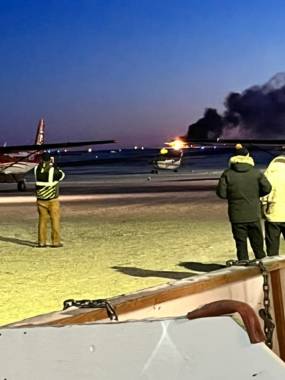
A Yute Commuter Service Cessna 207 caught fire on the Bethel runway on Saturday, Nov. 20, 2021. (Courtesy of Leslie Hunter III)
A Yute Commuter Service airplane caught fire over the weekend at the Bethel airport. The pilot and passengers are uninjured, according to the airline, but the plane and the luggage on board went up in flames.
A YCS Cessna 207 departed from Bethel sometime after 5 p.m. on Nov. 20, according to the airline’s director of operations, Terry Cratty. Cratty said that there were six people on board: the pilot and five passengers. He did not say where the plane was going.
About 10 minutes into the flight, the pilot detected an issue in the aircraft.
“What he had was smoke in the cockpit. And we think it might have been related to the contents in the aircraft in some way,” Cratty said.
He declined to elaborate or say what was onboard the aircraft. Once the pilot detected smoke, Cratty said that he was able to control the situation.
“He brought the aircraft back to Bethel, safely landed it, and then proceeded to get his passengers off safely uninjured. And the aircraft caught on fire on the ground,” Cratty said.
He said that an Alaska Department of Transportation crew stationed at the Bethel airport put out the fire, but not before most of the plane and the contents inside burned up.
Cratty said that YCS will reimburse the passengers for their lost luggage, and he said that the airline made sure the passengers had a place to go after the fire.
“We brought them from the aircraft. We took them to the hospital, every one of them to include the pilot, to get checked. We provided them housing, we took care of them in any way we could,” Cratty said.
Cratty said that YCS has now transported the passengers to their intended destination.
The National Transportation Safety Board is investigating the cause of the fire. NTSB Alaska Chief Clint Johnson said that a preliminary report could be expected in early December.
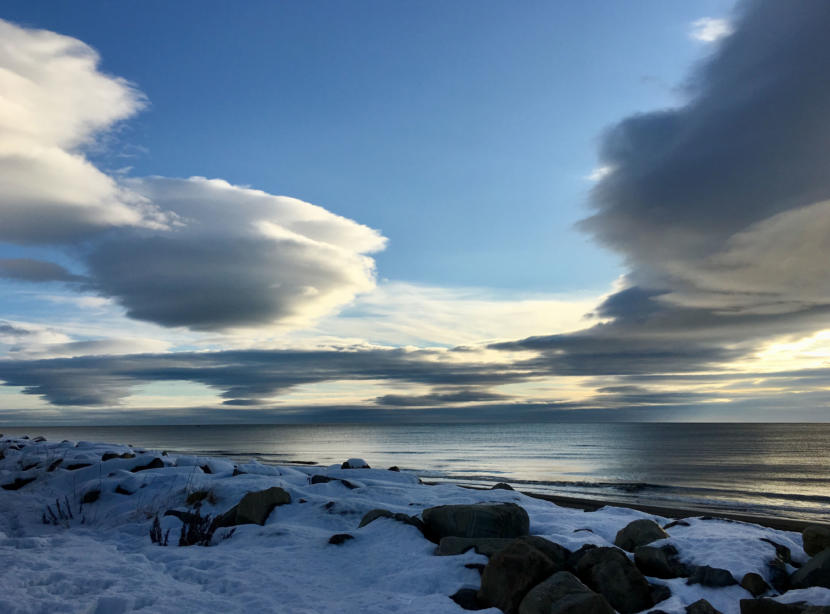
The Bering Sea coastline near Nome in October 2017. (Zoe Grueskin/KNOM)
Salmon abundance is down and population distributions have changed, according to NOAA’s 2021 surface trawl survey. Besides focusing on salmon, the survey also examined aspects of Bering Sea life such as zooplankton, sediment, sharks, marine birds, pacific herring, capelin and saffron cod.
Like the bottom trawl presentation on Zoom earlier in November, the top trawl presentation examined decreasing fish populations occurring in several Bering Strait species.
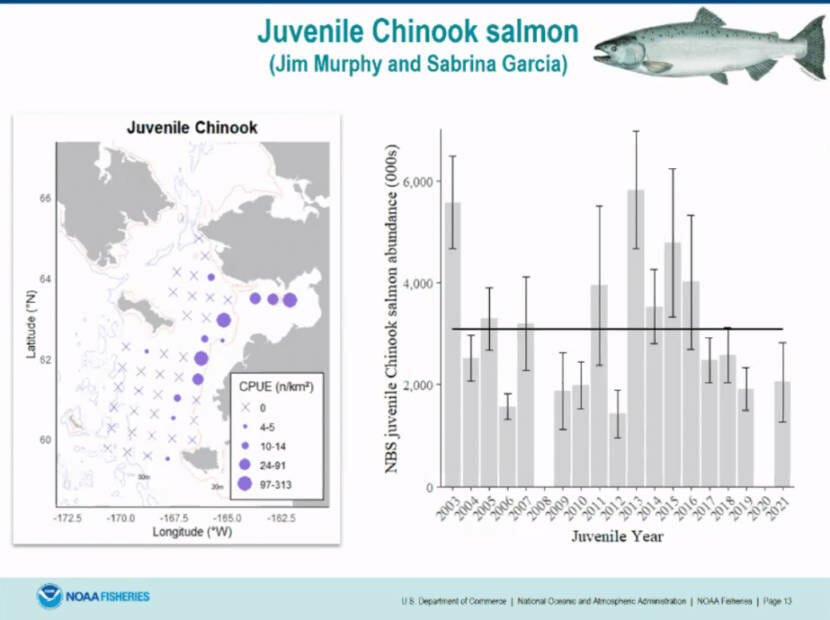
According to the survey’s preliminary estimates, young Yukon River chinook salmon populations continue to be low.
“Juvenile abundance was below average in 2021 and has been below average since 2017,” research biologist Jim Murphy said.
Besides lower populations, Murphy also noted the distribution of chinook salmon observed this year was unusual. While one typically finds chinook salmon distributed throughout the Bering Sea area, the area which NOAA typically surveys, most chinook salmon were found near Alaska’s shores.
Graphs on juvenile chinook salmon. (Courtesy of NOAA)
Like chinook salmon, Murphy’s team observed chum salmon almost exclusively near Alaska’s shores.
“And this is even more atypical for chum salmon as they tend to be much more broadly distributed than chinook salmon,” Murphy said.
Juvenile chum salmon populations have actually been above average since 2018, according to Murphy. 2021’s population is estimated to be one of the largest juvenile populations seen since then. A large juvenile fish population usually correlates with a large returning adult population.
But past observations, the correlation between adult and juvenile chum salmon tends to be more variable than the relationship between juvenile and adults in other fish species, Murphy said.
To illustrate, he pointed out that there was a large population of juvenile chum salmon in 2016 but a significantly low adult population. Murphy and his team postulated that this is because chum salmon are dying at greater rates later in their lifecycle. That would explain the great decline of chum salmon in the Yukon River, despite the high juvenile populations observed in the survey, Murphy said.
Pink salmon saw the same kind of low numbers and near-shore distribution during 2021. Murphy noted that his team combined pink salmon from Norton Sound and the Yukon River into the same graph because of their genetic similarity.
“With this model we are expecting to see low numbers of pink salmon returning to the region in 2022,” Murphy said.
In contrast, NOAA’s preliminary biomass index of coho salmon was close to the highest in the history of the survey. Hopefully, this means a strong run of coho in North Bering Sea salmon next year, Murphy said.
Besides salmon, multiple fish populations surveyed were found to be lower than average. These species include capelin, saffron cod, young pollock and cod and pacific herring.
In general, forage fish populations are low.
NOAA conducts both its bottom and surface trawl surveys annually to study the status of marine life in the Bering Sea.
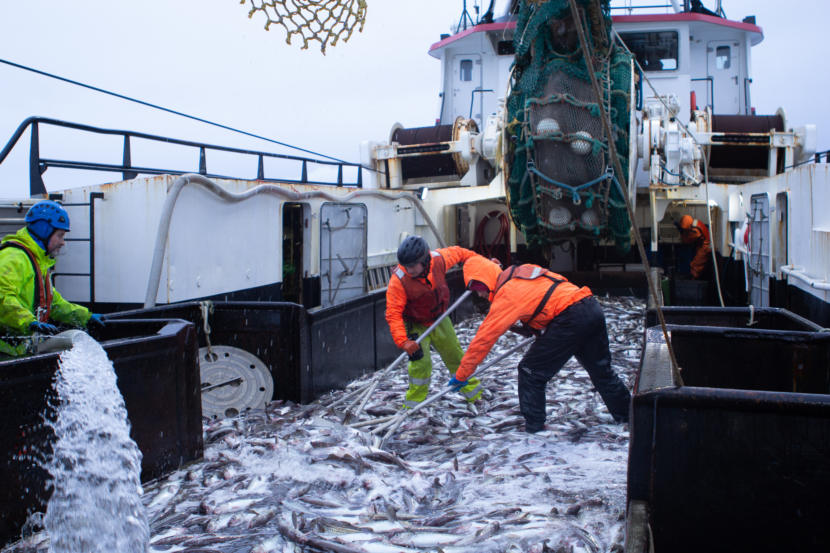
Crew members shovel pollock on the deck of a fishing vessel after a harvest on the Bering Sea in 2019. (Nat Herz/Alaska Public Media)
It is still a mystery to state biologists why king and chum salmon numbers are decreasing in Western Alaska. But ask any local fishermen on the Kuskokwim, and they’ll likely tell you commercial fishing trawlers in the Bering Sea are the problem.
“We have these restrictions for, like, almost 10 years and the fish count is always low every year,” said Kotlik subsistence fisherman Patrick Black in a June meeting of the Kuskokwim River Salmon Management Working Group, which advises state fishery managers.
“It doesn’t seem to get any better with these restrictions. Why not just go out there and deal with the other half of the problem,” Black said. “The trawlers, the pollock big fleet fisheries.”
Black is not the only one pointing fingers at trawlers.
“Everybody on this river is talking about that this summer,” said Mary Peltola on KYUK’s Fish Talk in June. Peltola is a member of the state’s Kuskokwim River Salmon Management Working Group and executive director of the Kuskokwim River Inter-Tribal Fish Commission.
“We are definitely concerned about bycatch and trawlers,” Peltola said. “It is definitely our number one priority going forward.”
In its last meeting on Nov. 11, the state working group took multiple actions to try to reduce the amount of bycatch salmon that ends up on trawlers. To do so, local tribal managers would have to convince federal managers to tighten restrictions. The North Pacific Fishery Management Council, a federal body, manages commercial trawlers in the Bering Sea.
The Kuskokwim River Inter-Tribal Fish Commission wrote a letter to the council with two main asks: eliminate salmon bycatch from trawlers completely and add seats on the council for Alaska Native tribes to have a say in commercial trawling in the Bering Sea.
Akiak’s Mike Williams Sr., a member of the state’s working group and chairman of the Kuskokwim River Inter-Tribal Fish Commission, was one of dozens of Y-K Delta residents who made the plea to the North Pacific Fishery Management Council at its last meeting.
“On the Yukon there was zero fishing this summer,” Williams said. “And we haven’t met our levels of harvest on the Kuskokwim River for the last 10 years either. So we’ve been really struggling along, and now I think the council needs to take action.”
Federal managers were resistant to the subsistence fishers’ requests. In a separate interview, Dr. Diana Stram, a senior scientist with the North Pacific Fishery Management Council, said that only a small percentage of the Chinook salmon bycatch in the Bering Sea would be headed toward Western Alaska rivers.
“About 16% is from coastal West Alaska, and less than 1% is from the upper and middle Yukon. And the vast majority of the rest of it is of Asian origin,” Stram said.
Tribal fishery managers say they have several problems with that explanation. They say the data being used to determine whether the salmon are from Western Alaska is outdated, and it’s not measuring the amount of chum salmon bycatch from Western Alaska. With record low chum runs across multiple rivers, they want to know that information, too.
The state’s local advisory group is adding its support for these requests. During its Nov. 11 meeting, the Kuskokwim River Salmon Management Working Group passed a motion to write a letter to federal managers supporting the Kuskokwim River Inter-Tribal Fish Commission’s requests to eliminate salmon bycatch and to include tribal representation. The state’s working group’s membership overlaps with the Kuskokwim River Inter-Tribal Fish Commission.
In the same meeting, the state’s working group passed a resolution asking the Alaska Department of Fish and Game to get the latest data on how many Chinook and chum salmon from Western Alaska trawlers catch by gathering new genetic samples from salmon caught on trawlers and in Western Alaska rivers.
This was actually the second time the group made this request. Back in July, the working group sent a letter to Gov. Mike Dunleavy requesting this genetic sampling work to be done. The state’s response did not provide a yes or no answer to this request, much to the disappointment of Peltola and the working group.
“You know, maybe we can just remind the commissioner and the governor of our initial questions,” Peltola said.
In the end, the state working group is an advisory body and has no legal authority over state or federal managers.
Members of the working group acknowledged that commercial trawlers are likely just one part of the reason that salmon numbers are depressed. The working group has also asked the North Pacific Fishery Management Council to examine how climate change is impacting salmon.
Russian Mission in 2018. (Dept. of Commerce, Community, and Economic Development)
A suspect in a shooting in Russian Mission had been on the loose for months when state troopers say he went on another rampage last week, allegedly assaulting, threatening and attempting to rob members of the community. Alaska State Troopers finally arrested him five days later.
It began on July 28. According to the Alaska State Troopers, 20-year-old Tyler Housler, 21-year-old Jalen Minock, and a 14 year-old ambushed a group of boaters in Russian Mission, shooting and injuring one man. Troopers said the three also fired a gun into a house full of adults and children. No one was hurt in that later shooting.
Troopers went to the village the next day on July 29 but could not find the suspect. Troopers went back multiple times, checking fish camps and sloughs outside of the village by boat and four-wheeler.
After a week, on Aug. 4, they found and arrested one of the suspects, Jalen Minock. Minock is charged with attempted murder and assault.
Throughout the summer, people called troopers saying they had seen one of the suspects, Tyler Housler, in Russian Mission, Marshall and Pilot Station. Troopers responded to those calls but could not find Housler.
On Oct. 25, troopers located the 14-year-old suspect in Russian Mission. The teenager is also charged with attempted murder and assault.
Then, on Nov. 10, troopers received a report that Tyler Housler and two others, 32-year-old Stephan Duffy and 18-year-old Bryce Housler, were terrorizing residents of Russian Mission.
Troopers said the three men assaulted and strangled at least three victims in separate incidents while trying to rob them. According to reports, Tyler Housler stole a gun from one victim, rammed his snowmachine into the front door of a house trying to get in and threatened to kill everyone inside.
The next day troopers arrived in Russian Mission, but the suspects fled and evaded capture.
On Nov. 15, five days after the initial report, troopers traveled to Russian Mission again and found the suspects at their homes.
All five suspects are in custody, either at the Yukon Kuskokwim Correctional Center or the Bethel Youth Facility, and all five face multiple felony and misdemeanor charges for incidents spanning the four months that some of them evaded troopers.
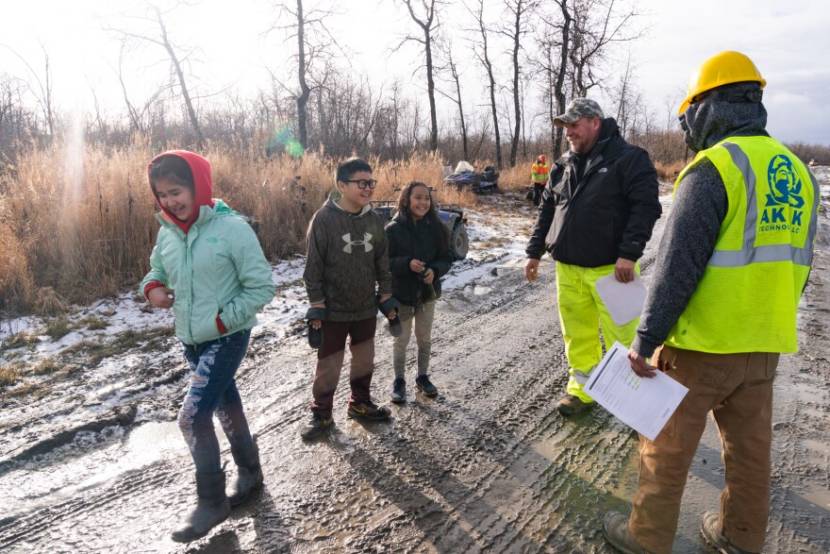
Akiak is the first community in the Yukon-Kuskokwim Delta to bring high-speed broadband internet to all its residents. Youth talk with engineers and technicians about which house they will be installing an antenna on next on October 19, 2021 in Akiak, Alaska. (Katie Basile/KYUK)
After four months of construction and years of waiting, the village of Akiak turned on high speed internet for all its residents on Nov. 15. It’s the first community in the Yukon-Kuskokwim Delta to bring broadband to all its residents.
Akiak Chief Mike Williams Sr. said that the first thing his son-in-law did that morning was to download a movie.
“He said he did it in one minute,” Williams Sr. said.
He said that the same task would have taken tens of hours with the internet service they had before.
“We’re ready to do celebration today in our community, and everyone is invited,” Williams Sr. said.
Akiak will be offering the service to residents for free for the first year. The village is paying for its broadband project with coronavirus relief funding. After the first year, internet service will still cost a fraction of what it did before, and it’ll be over twice as fast.
Akiak’s broadband is powered by low Earth orbit satellites. It’s a newly available technology that can deliver high-speed internet to rural areas that cables can’t reach.
Although Williams Sr. and the tribe have been talking about broadband for years, the construction project began and was completed in a single summer.
“I’m very excited and very, very proud of what we’ve been able to do as a tribal government,” Williams Sr. said.
He said that Akiak will now turn its attention to helping other Y-K Delta tribes bring high-speed internet to their communities.
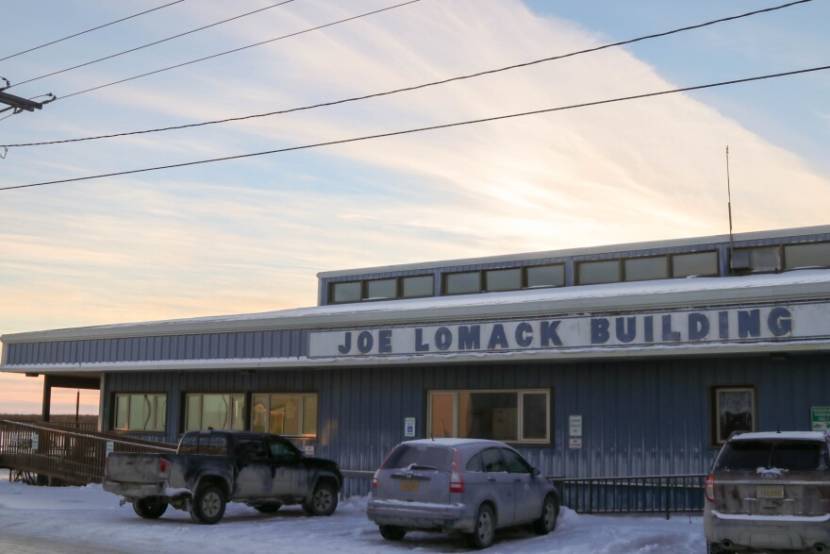
The Association of Village Council Presidents office building in Bethel. AVCP is requiring all employees to get fully vaccinated against COVID-19 by Jan. 4, 2022 or receive a medical or religious exemption. (Elyssa Loughlin/KYUK)
The Association of Village Council Presidents has implemented a COVID-19 vaccine mandate for employees. Under the policy, all employees must be fully vaccinated against the virus by Jan. 4, 2022. The timeline gives employees over six weeks to comply.
“Due to the safety of our employees and our community, along with the Occupational Safety and Health Administration (OSHA)’s new regulation regarding mandatory vaccination for employers with over 100 employees, AVCP has officially instituted a mandatory COVID-19 vaccination policy,” AVCP Communications Director Gage Hoffman wrote in an email.
A U.S. appeals court has stayed this federal regulation issued by OSHA, temporarily blocking it from taking effect. The Dunleavy administration, along with other states, private employers and religious organizations, have joined the legal challenge against the OSHA requirement.
Association employees can receive a medical or religious exemption instead of getting vaccinated. Exempted employees will be required to get tested for COVID-19 weekly.
AVCP employs 313 workers.
The Yukon-Kuskokwim Health Corporation and the City of Bethel have also implemented COVID-19 vaccine mandates for employees.
Close
Update notification options
Subscribe to notifications
Subscribe
Get notifications about news related to the topics you care about. You can unsubscribe anytime.