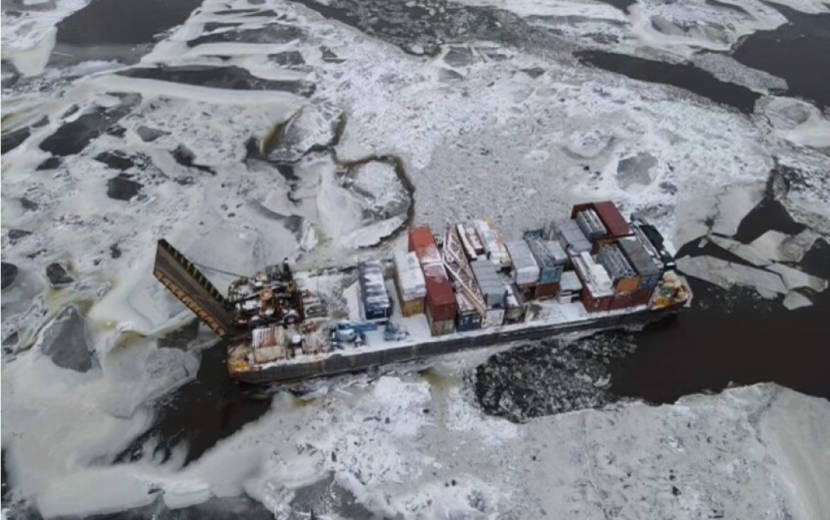
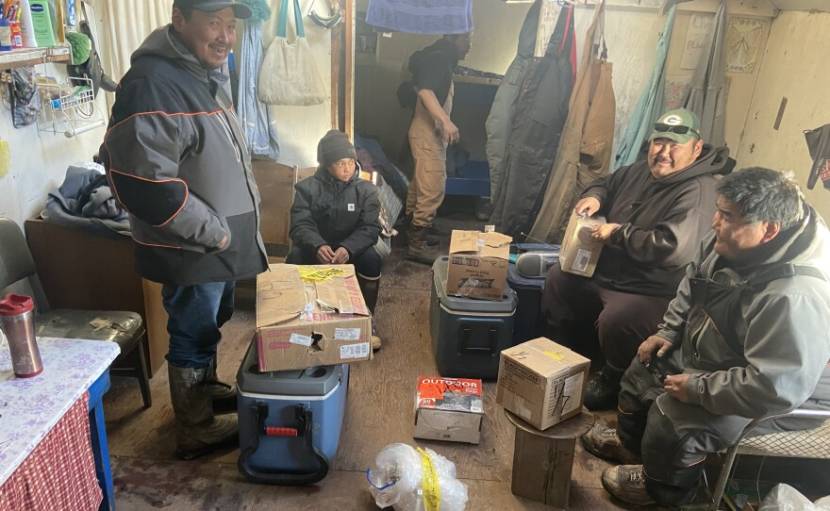
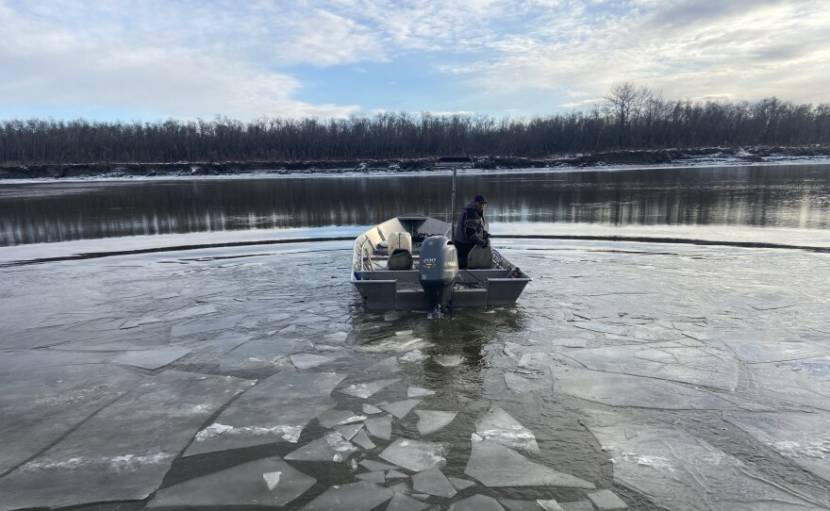
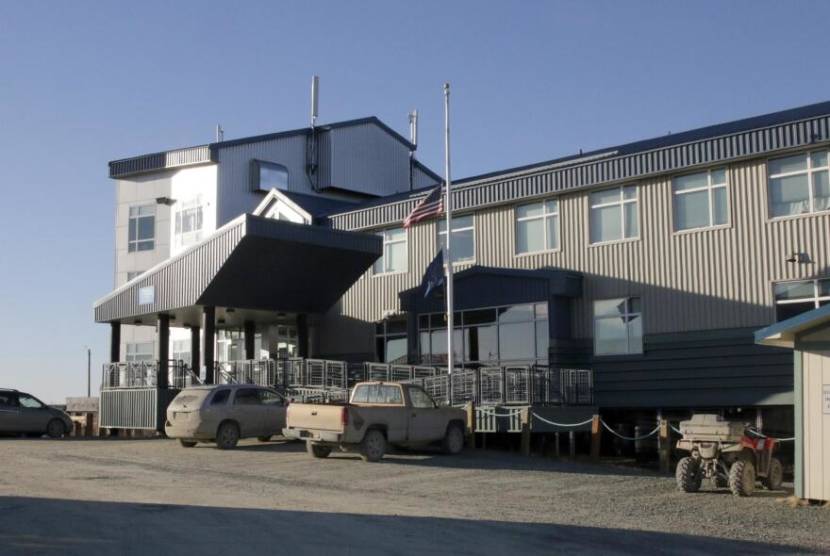
Alaska Logistics’ barge, the Madison Rose, frozen into the Eek River in October. (Courtesy John Foster)
A company is once again leaving its barges in the frozen Kuskokwim River over the winter. Two years ago, Alaska Logistics abandoned a gravel barge near Aniak during freeze up and retrieved it after breakup in the spring. The company is preparing to do the same with two more barges this year.
In late October, a barge called the Madison Rose was heading to Eek, a community of about 400 about 10 miles up the Eek River, a tributary of the Kuskokwim. It was supposed to be the last barge delivery of the year for Alaska Logistics. General Manager Allyn Long said that the weather changed suddenly once the barge entered the Eek River.
“It got very cold the day we got there. It got down to, like, single digits, and ice came out of the mountains and rivers and sloughs everywhere,” Long said.
He said that Alaska Logistics has moved barges through the Kuskokwim into mid-November for the past decade. The early freeze-up this year caught the company off guard.
“It was a cold year. North wind for three weeks straight, and it just froze things and it froze things fast,” Long said.
The crew of four operating the barge in Eek found themselves surrounded by ice on all sides.
“And we just needed to, we had to get out of there,” Long said.
The crew detached the tugboat from the barge to break ice and forge a path back toward the Kuskokwim River. Long said that the crew has made it safely to Naknek in the Bristol Bay region. However, the barge and its cargo remain stuck in the ice near Eek.
“We wanted the safety of our crew to come first, obviously,” Long said.
The barge was carrying school construction supplies to Eek and Scammon Bay when it got stuck two miles from Eek. Long said that the company is looking at transporting the construction equipment to Eek by helicopter, but he said that the supplies that were headed to Scammon Bay will likely sit on the barge until spring.
The Lower Kuskokwim School District said that even if materials are delayed, it would not slow down construction of a new school in Eek. However, new teacher housing units in Scammon Bay would be delayed by several months for the Lower Yukon School District.
There’s another Alaska Logistics barge that’s stuck near Georgetown, far up the Kuskokwim River. Long said that it was empty, on its way home from a project near McGrath. The company abandoned this barge in early October, before the ice became a major factor.
“The water levels were starting to go down a little bit and one of our engines was overheating, and we just didn’t want to push it,” Long said. “So we just decided to park it, basically, or moor it up there.”
The U.S. Coast Guard is investigating both of these incidents. If they find wrongdoing on the part of Alaska Logistics, they could fine the company for obstructing waterways.
Long is hoping to retrieve both of his company’s barges in the spring, and this time without issue. In 2020, Alaska Logistics left a barge unsecured near Aniak over the winter. In the spring, it floated over 100 miles down the river before the company was able to retrieve it.
“You live and learn a little bit. So we’re gonna have a snowmobile or something, drop an anchor on there and tie it off to the barge, and hopefully that secures it,” Long said.
He said that the lesson that he’s learned this year is that the company should consider ending its barge season earlier.
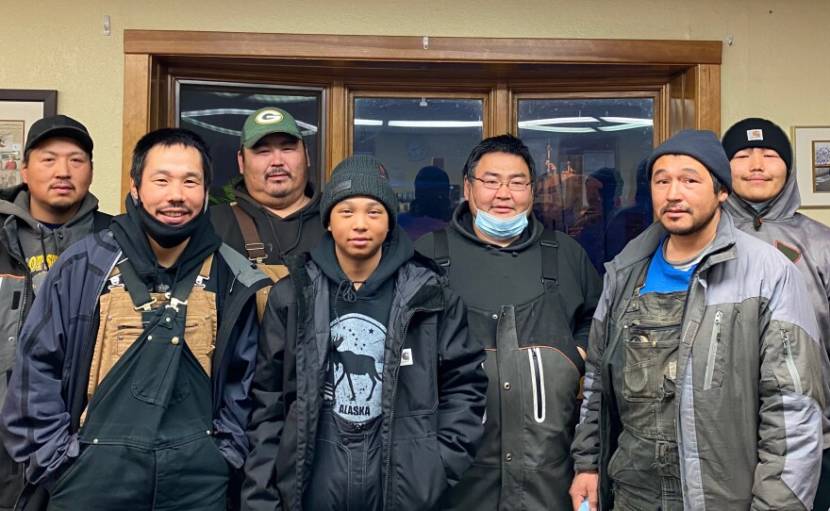
The seven Pilot Station hunters wait for a charter plane at the Bering Air terminal in Nome on Nov. 6, 2021. The group removed their masks for the photo. From left to right: Andrew Makaily III, Neil Makaily, Robert Myers, Andrew Makaily IV, Ronnie Paul, Rex Nick, Dimitri Nick. (Anna Rose MacArthur/KYUK)
Seven subsistence hunters from Pilot Station in Southwest Alaska spent seven nights stranded at a fish camp after the lower Yukon River unexpectedly froze, blocking their way home.
On the eighth night, Thursday, the U.S. Coast Guard airlifted them out and flew them north to Nome.
The next morning, at the hotel where the group had stayed the night, two of the hunters walked to the lobby. Signs said masks were required, and a hotel worker asked them to put theirs on.
The men said they’d been stranded on the Yukon for a week and didn’t have any masks. They’d left the fish camp with the clothes on their backs and what they could fit in their pockets, which meant their phones and GPS.
They were wearing the same clothes they’d worn for a week and a half.
“Same socks, same shorts,” said Rex Nick, one of the hunters laughing and stretching out his legs, which were covered in torn, black Carhartt bibs.
“It was really good to take a shower,” said Robert Myers, another hunter. “I feel clean, but my clothes are dirty.”
The men had left Pilot Station 12 days earlier to boat down to the coast to hunt seal and beluga whale. Nick originally wanted the hunting trip to be over a weekend for students in the village.
“Some of the kids don’t get a chance to go out hunting, or some of their parents might not have a boat or a father-figure type,” Nick said.
The group delayed the trip for weeks waiting for a break in the weather. Finally, it cleared on Oct. 25. Because it was a Monday, they didn’t take students out of school, but one hunter brought his 14-year-old son. There were two brothers and two father-son pairs in the group. The rest are friends.
“Nobody is starving,” Nick said. “But it’s good to have that extra food for the winter ahead.”
Nick is 43 years old. Myers is 38. They’ve made this trip many times in their lives, often multiple times a year. The seven hunters loaded into two boats and made the three-hour trip to the coast. The plan was to go down Monday, hunt Tuesday and return Wednesday.
And, at first, the plan worked out. They went down and took three seal and two beluga.
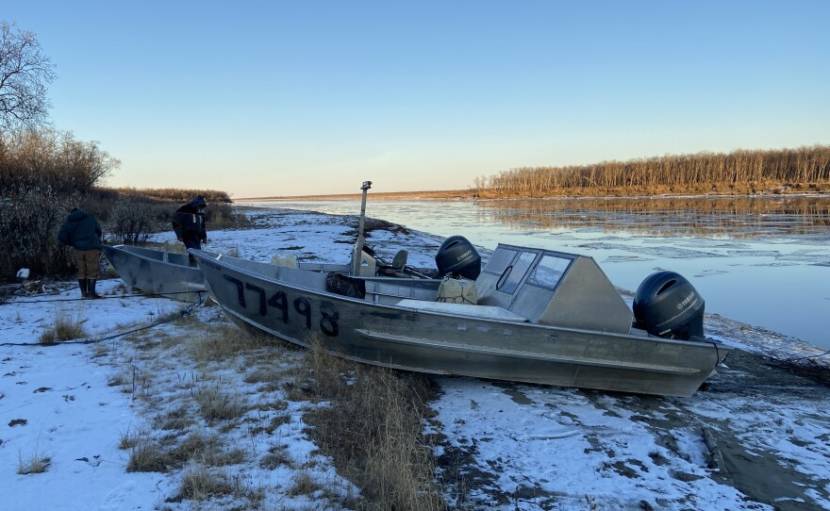
The hunters pulled their boats onto the shore at the fish camp where they stayed for seven nights. (Rex Nick)
But on Wednesday, Oct. 27, when they were set to return home, they awoke to a frozen river.
“The ice was so thick flowing down the river. It was forming so fast. It was freezing so fast. Just amazing. I’d never seen anything like that,” Nick said.
From all their years on the river, they never expected it to freeze so early or so quickly. There had been no ice when they left home. Using an axe, oars and their body weight, they hacked the boats free and used the weight of the skiffs to push open a path upriver to Alakanuk. A trip that would’ve taken an hour and a half in open water took five hours.
They stayed the night in Alakanuk.
The next morning, Oct. 28, ice was flowing downriver, but other boats were moving between the sheets. The hunters decided to head home. Everything was fine until they reached a narrow part of the river near Emmonak.
The ice jammed, turned jagged and began crashing into the boats.
“That’s the first time I really got scared,” Nick said, “when I thought the ice was going to either damage my boat and sink my boat or flip my boat over. I’ve never been scared like that by ice before.”
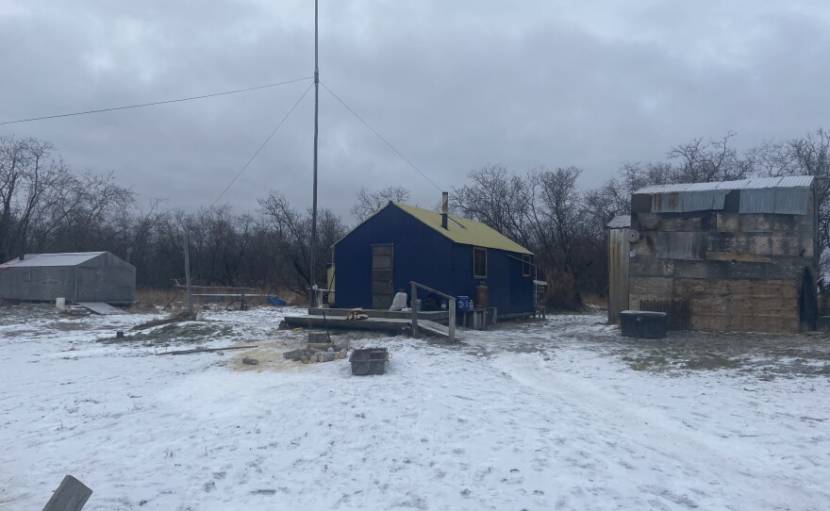
The hunters stayed at a fish camp about 20 miles east of Emmonak for seven nights after the Yukon River unexpectedly froze. (Rex Nick)
Nick is second-in-command of Pilot Station Search and Rescue. He said he knew that it was too dangerous to keep going. The group decided to stop and found a friend’s nearby fish camp, about 20 miles east of Emmonak. The hunting group would remain there for the next seven nights.
“God bless the family that had that fish camp,” Nick said.
The camp had containers of frozen rain water, a wood stove, firewood and food.
“Oatmeal, coffee, some noodles, dry eggs, things like that,” Nick said.
The group also had their seal and beluga meat and food from their camping trip. Another friend had a fish camp just a five-minute walk away. It had a cell phone booster and a generator. They used it to contact their families.
The group also had a VHF radio and a Garmin inReach satellite device. The first day at the camp, they texted nearby friends about their situation, but no one could come overland or by river to help. The trails were not yet fully frozen. Their friends contacted Alaska State Troopers.
On day three at camp, Oct. 31, 2021, Alaska State Troopers flew over and dropped food, supplies medicine and Halloween candy for the hunters. (Rex Nick)
On day three at the camp, Oct. 31, the troopers flew over and dropped food, supplies and medication needed by one of the hunters.
And to Nick’s relief: Copenhagen Fine Cut Snuff. With tobacco, he said, he eats less. There was another treat too.
“We got some Halloween candy. They left a note on there [saying], ‘Happy Halloween,’” Nick said.
The group stayed together in one of the fish camps in a single room about 12 feet by 20 feet, sleeping in sleeping bags from their camping trip. Staying together conserved firewood and concentrated heat. Also, Nick said, “There’s safety in numbers.”
Each day they rationed their food, water and firewood, only burning wood before going to sleep and a bit when waking up. During the day, they created their own entertainment.
“We took out our .22s and started killing mice. We probably killed about 50 mice,” Nick said.
One day a hunter killed a beaver, which they boiled into soup. Another day they found a fox in a snare that had been set by the owner of the fish camp and killed it. Once they set a net in the river but didn’t catch anything. Time moved slowly.
On the fifth day at the camp, Nov. 2, a pilot twice tried to land. In a video Nick took on his phone, the small red and white plane swoops close to the beach. Nick urges it on.
“Come on. You can do it. Land. Come on,” he said in the recording.
When the wheels look a few feet above the snowy riverbank, it veers back up and flies away. A trooper spokesperson said that 20-knot crosswinds prevented a landing.
Emmonak Search and Rescue coordinated another food drop for that day. This one contained ground beef and other hearty food.
The hunters set a net near the camp but did not catch any fish. (Rex Nick)
By now, the hunters had become frustrated with the rescue response. State troopers were coordinating the effort, but Nick said that they would not hear from them for entire days at a time.
Trooper spokesperson Austin McDaniel said troopers “maintained consistent and frequent contact with the group directly via a satellite communications device and through their communication with third parties that the group was communicating directly with.”
McDaniel also said, “We had our search and rescue coordinator, who was a lieutenant here in Anchorage, working on this day in and day out. We had a trooper out in Emmonak working on trying to find solutions to get these folks out of there every single day.”
The hunters said they had heard planes flying every day they were at the camp. Flight logs show planes landing each day in nearby Emmonak, except for one day that the hunters were stranded.
Nick said he expected a quicker rescue. The longer someone is stranded, he said, the more likely that person will be in danger. He’s helped look for many people with his village’s search and rescue group.
“The very first day we find out somebody is missing, we’re working on trying to get him home. We’re out there looking day or night, storm or clear skies,” he said.
He questioned whether the response was slowed because the group had supplies to survive the elements. McDaniel, the troopers spokesman, said no.
“The amount or quantity of supplies played no role in the efforts made by troopers to respond to extract the group,” McDaniel said.
Nick also questioned if because the group was all Alaska Native that slowed the response.
“Well, that’s absolutely not the case,” McDaniel said. “We perform search and rescue missions across the state, and there’s never any consideration given to the race, gender, any of those. None of those questions ever come up when we’re planning a response to a search and rescue operation.”
Regardless, Nick said, being stranded for a week took a toll on the hunters, as well as their wives, children, friends and community.
“All these years you help people so much, and when it comes down to needing help, it’s like it’s not there. Just beat you up inside. It just hurts,” Nick said, his voice cracking.
One of the hunters missed his cousin’s funeral. Nick missed his daughter’s 12th birthday. He said that the worst part of the ordeal was the worry it placed on his wife.
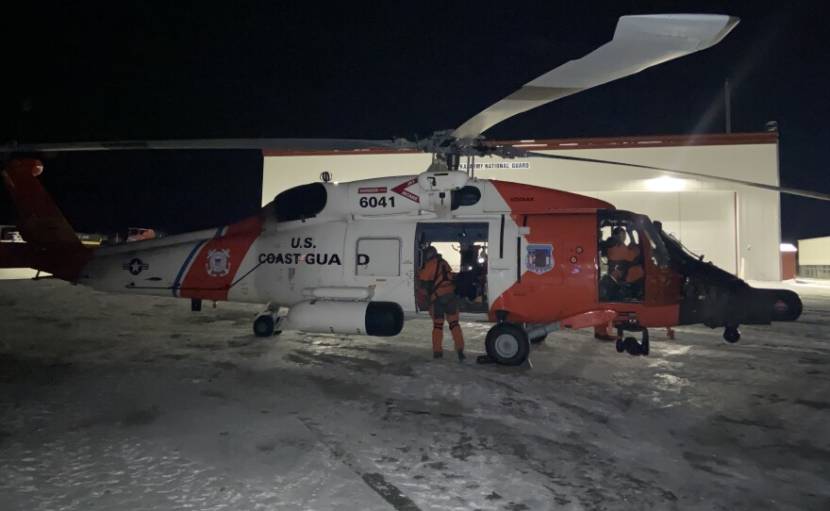
On the eighth day at the camp, Nov. 4, the hunters were about to burn the last of the firewood when they saw a U.S. Coast Guard plane overhead. It dropped food and a handwritten note that said to bring the radio with them when the H60 picked them up and to enjoy the pizza. The bag contained seven slices. The note ended with a big smiley face.
They turned on the VHF. The pilot told them to stay on channel 16. A helicopter was coming. Hours later, past 8 p.m. on the eighth night at the camp, they heard the chopper.
“It was getting louder and louder, and we’re like, ‘Where is it? Where is it?’ Then all of a sudden, we see lights,” Myers said.
The U.S. Coast Guard landed in Nome with the seven hunters on Nov. 4, 2021. (Rex Nick)
The helicopter circled and landed. The hunters climbed aboard. They left behind their boats, supplies and seal and beluga meat. They said that everything is well stored, and they’ll return in spring to gather their belongings. The Coast Guard flew them north to Nome.
The hunters said that everyone in the group was healthy, but the Coast Guard told them they’d be taken to the hospital to be checked out. A Coast Guard spokesperson said that it’s not required for paramedics to accompany rescue missions.
When they landed in Nome, Nick said that a trooper picked them up and then asked them where they wanted to go. They never went to the hospital.
“We were freaked out when they asked us where we wanted to go. We thought they had a place for us. We didn’t know what to say. They asked if we had family or friends. We don’t know nobody here,” Nick said.
A trooper spokesperson didn’t respond to a question by publication of this story about why the officer didn’t have a plan to house the men.
The trooper took them to a hotel, where the hunters paid $450 plus tax for two rooms for the night. The next day, a trooper spokesperson told KYUK that the troopers would cover the hunters’ lodging and airfare home.
Troopers and the Coast Guard said that they rescued the hunters as soon as their resources and the weather allowed. The helicopter had to fly from the Coast Guard base in Kodiak.
On Nov. 6, after spending two nights in Nome, a plane flew the group to Pilot Station. They landed around 1:15 p.m. It had been 13 days since they left home.
The hunters thank everyone who helped them, especially the owners of the fish camps where they stayed.
KYUK reporter Olivia Ebertz contributed reporting to this story.
Technicians and engineers install antennae receivers on Lena Foss’ home in Akiak, Alaska. Internet speeds will double in the town later this month, when it gains access to broadband internet. (Katie Basile/KYUK)
Listen to this story:
Lena Foss thought she got lucky when she salvaged a dryer from the dump in Akiak, a Yup’ik village in Western Alaska.
She knew it was broken, but figured she could fix it by looking at tutorials online.
“First thing I did was YouTube how to replace a belt,” Foss said. “But the internet was so slow and I thought it was wasting gigabytes so I turned that off before I completely finished how to fix the dryer.”
Akiak sits along the Kuskokwim River, which transforms into a frozen highway in the winter. The only other way to get there is on a four-seater plane.
The village’s remote location has made high-speed internet, which is typically delivered through cables, a fantasy for its 460-some residents. Now, it’s about to become a reality in Akiak and rural communities around the nation, thanks in part to the pandemic.
For Shawna Williams, getting broadband will mean being able to see her teachers and classmates. During the pandemic, Williams decided to get her college degree, while holding down her full-time job as a childcare worker, and raising five kids. She has the fastest internet plan available in Akiak, but she says it can’t handle video all the time, which means she attends her remote classes by phone.
“The internet is so unreliable, and it’s usually too slow, especially in the evenings when I get off of work, to load even a PowerPoint,” Williams said.
She says she pays $314 a month for internet service now. But once Akiak gets high-speed broadband later this month, Williams’ bill will become a quarter of what it is now, according to the tribal government, and her internet speeds and data limits will more than double.
Similar advances in broadband access are happening across the nation, largely because of COVID, says Blair Levin, a broadband expert and nonresident fellow at the Brookings Institution, says the main reason is COVID.
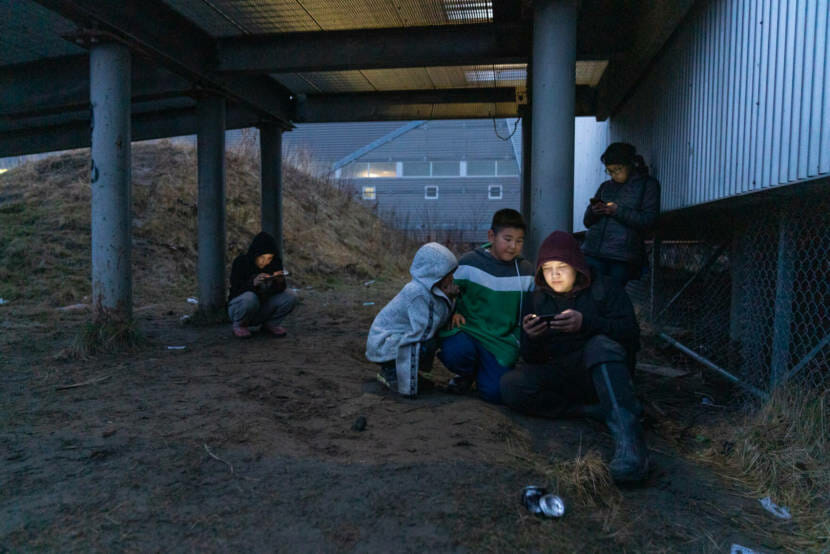
Youth hang out near the school in Akiak, Alaska to access wireless internet through their phones. Homes in Akiak do not currently have access to high-speed internet, but all of that will change later this fall when the village gets connected to broadband internet through low Earth orbit satellites. (Katie Basile/KYUK)
“It really focused the mind of everyone, Democrats, Republicans, governors, senators, on the importance of getting broadband everywhere and making sure that everybody can afford to get on,” Levin said.
Since the pandemic hit, the federal government made billions of dollars available to expand broadband. It dedicated a large portion of the money to rural tribal lands, which are some of the least connected areas in the country. Akiak used the coronavirus relief funding to pay for its broadband project.
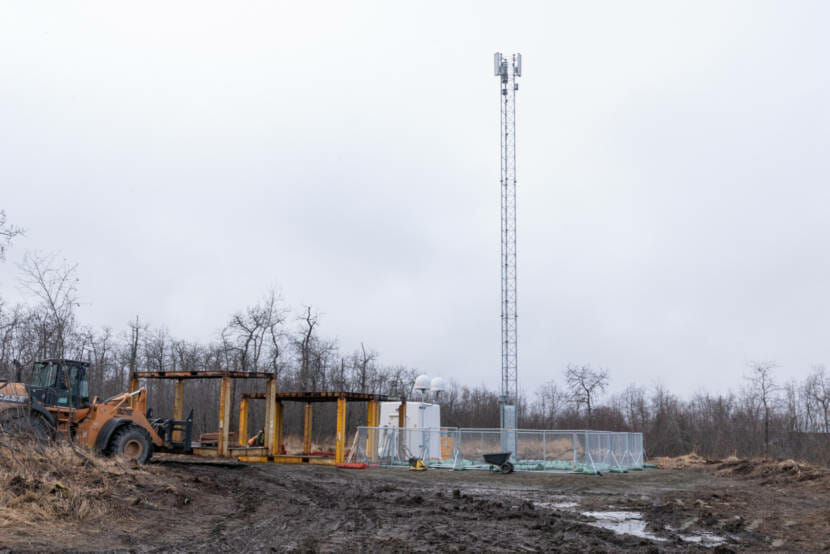
But money was only one piece of the puzzle for the village. The tribe is also relying on satellite technology that just became available in Alaska this year. Low-Earth orbit satellites, operated by a company called OneWeb, can deliver high-speed internet to rural areas that cables can’t reach.
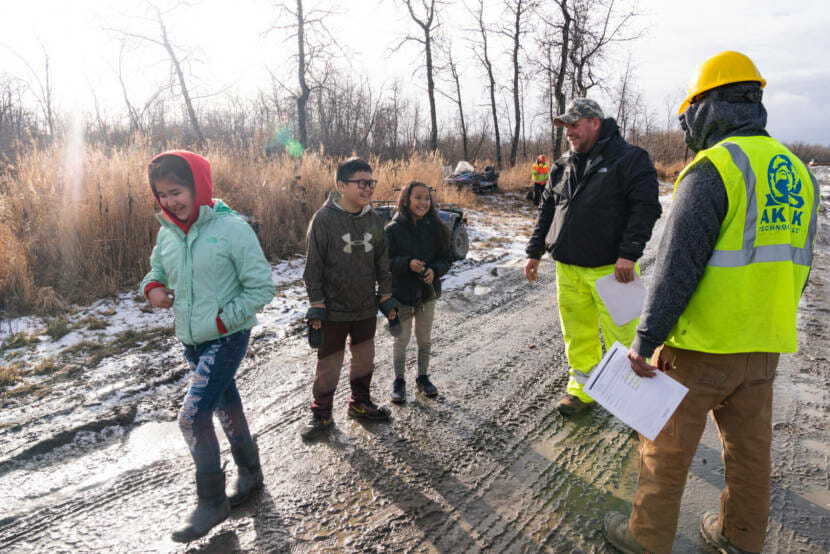
Akiak will be the first community in the Yukon-Kuskokwim Delta to bring high-speed broadband internet to all its residents. Akiak youth talk with engineers and technicians about which house they will be installing an antenna on next. (Katie Basile/KYUK)
Shawna’s father and Akiak Chief Mike Williams Sr. said that the tribe was motivated to act quickly on these opportunities after seeing the pandemic’s effect on learning in the village.
“The kids have lost between year and year-and-a-half of their education because of no technology, no internet at the home, and no remote learning,” Williams Sr. said. “We may be forced to do a lockdown again, but we’re going to be prepared this time.”
Akiak will be the first community in the YK Delta to bring broadband internet to all its residents, but it won’t be the last. At least 16 tribes in the region are following Akiak’s blueprint to install broadband in their villages.
As technicians install broadband receivers in Foss’ living room she watches eagerly, standing next to her broken dryer.
“When I have internet, everything I need for this dryer will be ordered,” Foss said.
Akiak is a small Yup’ik community on the Kuskokwim River in Western Alaska. The rural village has never had access to affordable high-speed internet, but all of that will change this fall when every resident gains access to broadband internet through low Earth orbit satellites. (Katie Basile/KYUK)
She said that she could learn to repair her neighbors’ broken appliances too.
“All this broken stuff would probably be fixed by YouTube. I would probably start a small business, calling it ‘YouTube-Fix-It-All,’” Foss said.
That’s just the beginning of her online goals. Foss wants to be able to google the laws around her Native allotment lands, research grants for her village, and file her taxes online.
“Internet will open my eyes, I think. I know it will,” Foss said.
For decades, the YK Delta has been left behind in the digital revolution. People here are excited to catch up.
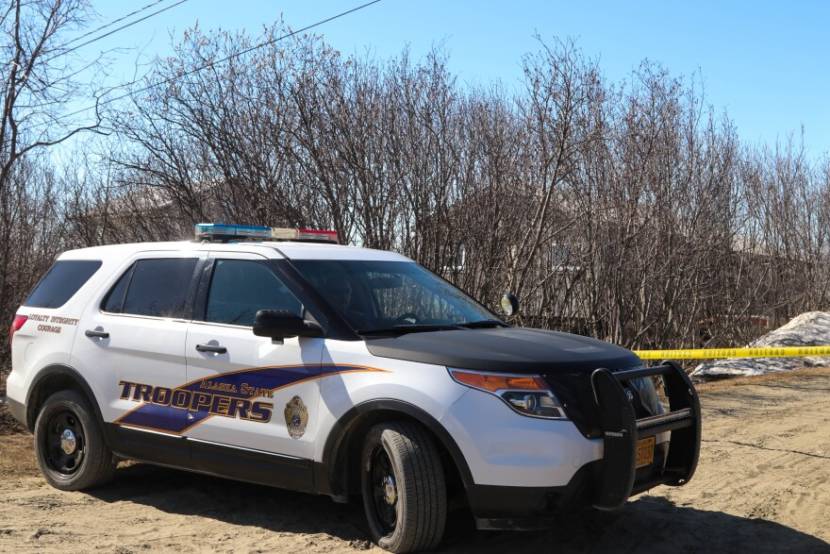
An Alaska State Troopers vehicle in Bethel. (Elyssa Loughlin/KYUK)
Alaska State Troopers in Western Alaska are understaffed.
A study published in 2020 found trooper posts around Kotzebue, Nome, Bethel, Dillingham and Kodiak were, together, understaffed by about 22%. The study was commissioned by the Alaska Department of Public Safety. The state refers to the troopers in those five regions as the “C Detachment.”
“The C Detachment of the troopers really is working at capacity all the time,” said Troy Payne, one of the study’s authors. Payne is the director of the Alaska Justice Information Center, and a professor of criminal justice at the University of Alaska Anchorage.
Payne said that troopers in Western Alaska get more calls than they can respond to with the number of officers they have. Trooper sergeants in the area told Payne that the understaffing comes with serious consequences.
“At least one of the sergeants told us that some types of crime were just not being investigated due to lack of staffing. So, for example, alcohol- and drug-related crimes, and some property crimes. They also talked about delayed response times, or sometimes no response at all to requests for service,” Payne said.
Sergeants said that sometimes trooper investigations take so long that witnesses stop cooperating, leading to District Attorney’s office dropping some of the cases. Eventually, Payne said, communities often just give up on trying to get law enforcement to respond.
“If you’re in a community and something occurs, and you think the police need to be there, and you call and the police say, ‘Yeah, we’re not coming,’ eventually you stop calling,” Payne said.
Additionally, Payne said that understaffing prevents troopers from being able to attend training.
“You can’t have troopers doing service training if there’s nobody to backfill for them when they’re in training,” he said.
One sergeant said that there is a lack of troopers trained to handle sexual assault cases. Troopers that aren’t trained to conduct interviews for these types of cases can risk harming the victims, according to the study.
When there is only time to put out the fires, Payne said, troopers can’t build relationships with the communities they serve.
“One of the sergeants described the current state of Community Relations and Outreach as, and this is a direct quote, ‘The only time villagers ever see a trooper is when we fly in to arrest someone.’ And that’s not a set of conditions that leads to folks being satisfied with the policing services that they receive in general,” Payne said.
While Payne and his co-authors laid out the problems associated with trooper understaffing in Western Alaska, the study does not examine solutions beyond increasing the number of troopers. Payne said that research prior to this study has shown that involving village police officers, tribal police officers and village public safety officers leads to more prosecutions over time.
Payne also said that what communities want from their law enforcement is of critical importance. But this study had to be curtailed before that could be probed, and wasn’t a factor in the recommendation to increase trooper staffing.
“We intended to talk to communities,” he said. “Unfortunately, this study was in the field at the same time as COVID-19.”
Yuut Elitnaurviat and Alaska Pacific University are partnering to offer Alaska’s only licensed practical nursing certificate program in Bethel. (Dean Swope/KYUK)
A new nursing program is coming to Bethel, and it’s the only one in Alaska. The program is to earn a licensed practical nursing certificate, and applications are being accepted for the inaugural class.
Alaska Pacific University has teamed up with Yuut Elitnaurviat, the workforce development center in Bethel, to start the program. APU is providing the faculty and curriculum. Yuut Elitnaurviat is providing the facilities.
There are many tiers in the nursing field. A licensed practical nurse, or LPN, certificate is a step above a certified nursing assistant and below an associate’s degree in nursing.
“So you’re going to see them usually taking vital signs, administering medications and giving injections, and also just getting patients ready for their medical exams and surgeries and recording a lot of medical information and medical records. So they really work in all areas of health care,” APU Director of Admissions Toni Riley said, explaining the role of an LPN.
The COVID-19 pandemic has highlighted the need for health care workers in rural areas. A quick search on the Yukon-Kuskokwim Health Corporation website shows 25 job openings for LPNs in Bethel alone.
“The average salary for an LPN right now in Bethel is starting a little over $30 an hour,” Riley said.
APU has been expanding its nursing program in recent years, and it saw a potential partnership in Bethel. Yuut Elitnaurviat operates a six-week certified nursing assistant program. That program can act as a prerequisite for the clinical training required for the new LPN program. Other occupations can also provide that required clinical background.
“Anyone that’s a medical assistant or a health aide, paramedic, EMT, or even, like, a dental health aide, all of those kind of count as that proof of clinical experience,” Riley said.
Other application requirements include an online application form, passing an anatomy and physiology class, a high school or GED transcript, a background check, and an interview with nursing faculty.
“Just to learn more about them, know more about them, and definitely connect with them to see, you know, what their background is and what their experiences are, and really why they want to get involved in in health care,” Riley said, expanding on the interview requirement.
The LPN program will run two semesters over the course of one year. Lectures will be delivered online, and students will have in-person classes to practice clinical skills every other week on Tuesdays and Wednesdays.
Applications for the inaugural class are being accepted until Nov. 30. Classes start on Jan. 10.
“We’re just really excited. We know that it’s a new program and there are lots of questions. So I think the biggest thing is just to feel free to reach out to us,” Riley said.
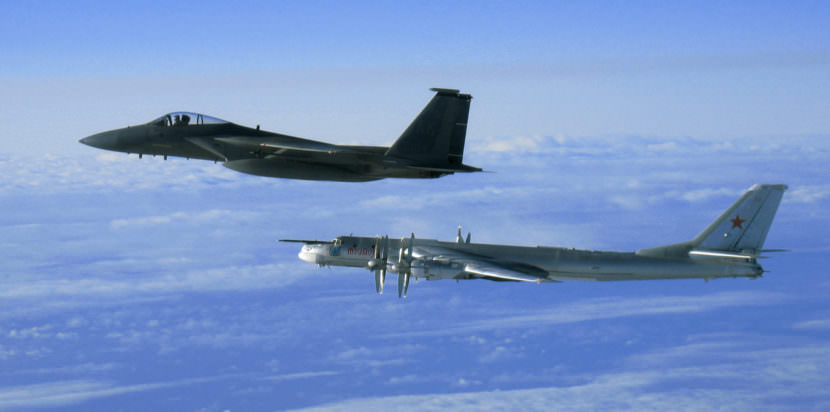
An F-15 Eagle from the 12th Fighter Squadron at Elmendorf Air Force Base, Alaska, flies next to a Russian Tu-95 Bear Bomber on Sept. 28, 2006, during a Russian exercise near the west coast of Alaska. A pair of Tu-95 bombers were among the five Russian planes that flew near Alaska last week. (Public domain photo courtesy U.S. Air Force)
Members of an Alaska Air National Guard unit at Joint Base Elmendorf Richardson detected and tracked five Russian aircraft that flew near Alaska last week.
The Alaska Air National Guard’s 176th Wing identified the Russian aircraft on Oct. 21 when they entered international airspace off Alaska.
A news release issued by the wing Monday says its Air Defense Squadron continued tracking the aircraft as they flew through the Alaska Air Defense Identification Zone, then relayed that information to the North American Aerospace Defense Command, or NORAD.
A NORAD news release says the Russian aircraft entered the identification zone at about 6 p.m. Thursday and left about 90 minutes later. The news release didn’t say from which direction the aircraft approached Alaska.
The Air National Guard’s news release says the 176th Air Defense Squadron’s surveillance and weapons teams identified the Russian aircraft with help from the JBER-based 611th Air Operations Center. The Russian formation included an AWACS-type reconnaissance and control plane, two Su-35 Flanker jet fighters and two Tu-95 Bear long-range bombers.
It’s unclear whether U.S. fighters were scrambled to escort the Russian aircraft through the identification zone. That’s what the Air Force did more than dozen times last year to intercept more than 60 Russian planes that had entered the identification zone off Alaska and Canada.
Observers say last week’s Russian aircraft incursion off Alaska was the first since January.
Lieutenant General David Krumm, who heads the Alaskan Command, said that was the busiest spate of Russian aircraft incursions since the fall of the Soviet Union in 1991.
Correction: An earlier version of this story misspelled Lt. Gen. David Krumm’s name. It is David Krumm, not David Crumm.
Close
Update notification options
Subscribe to notifications
Subscribe
Get notifications about news related to the topics you care about. You can unsubscribe anytime.