Community

Rural Trump voters embrace the sacrifices that come with support

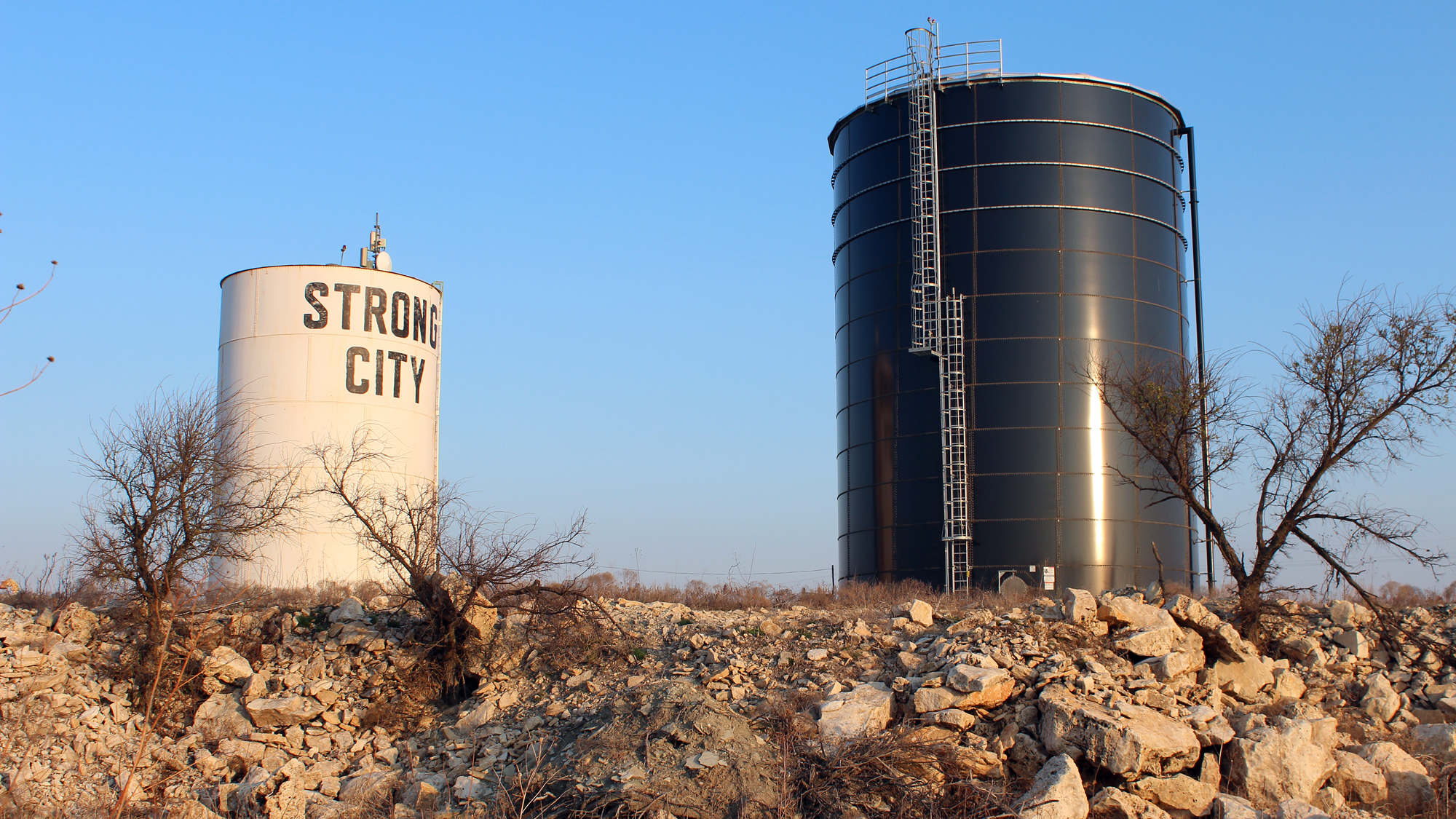
A new water tank in Strong City, Kansas, (at right) sits next to one that was part of an old leaky system on a hill just outside the city limits. (Photo by Frank Morris/KCUR)

Some of President Trump’s proposed spending cuts would cripple programs that benefit communities full of his rural supporters, but at least in Strong City, Kan., some say they are ready “to bleed a little bit.”

Strong City is a former railroad town of about 460 people, less than half the size it was in 1890. Trump’s proposed budget aims at killing the program that threw a lifeline to the town’s water system.

Shari DeWitt, the city clerk, says a couple of years ago, even its water treatment plant was dying. DeWitt says the plant was built 40 years ago inside the town’s abandoned high school, but the plant kept breaking down.

“Water’s very important and a lot of people don’t realize it until they don’t have it,” she says.

Strong City banded together with Cottonwood Falls, the town next door, to build a $6 million water treatment system. It serves only about 500 homes and businesses.

The treatment plant is paid for, and it started operation about a year ago. More than $2.7 million in federal grants made it possible.

“Oh, it would have been inconceivable. We couldn’t have done it. People couldn’t afford for us to do it,” says Larry Sigler, who works at the plant.

Many of the proposed budget cuts would hit places where Trump got lots of votes: isolated, rural communities, says Johnathan Hladik, who heads the Center for Rural Affairs in Nebraska. “Bewildering might be the best way to describe it,” Hladik says. “The more remote you are and the more rural you are, the worse you’re going to have it, as a result.”

If passed as-is, the budget would kill programs that train workers, back small town startups and help pay for roads, sewers and broadband in some of the nation’s poorest counties.

Tom Vilsack, secretary of agriculture under President Obama, says the Trump administration is packed with urban political operatives and needs an advocate for rural communities “so that someone is pounding the table, as I had to when I was secretary of agriculture, to make sure that people understood how things would impact and affect rural Americans.”
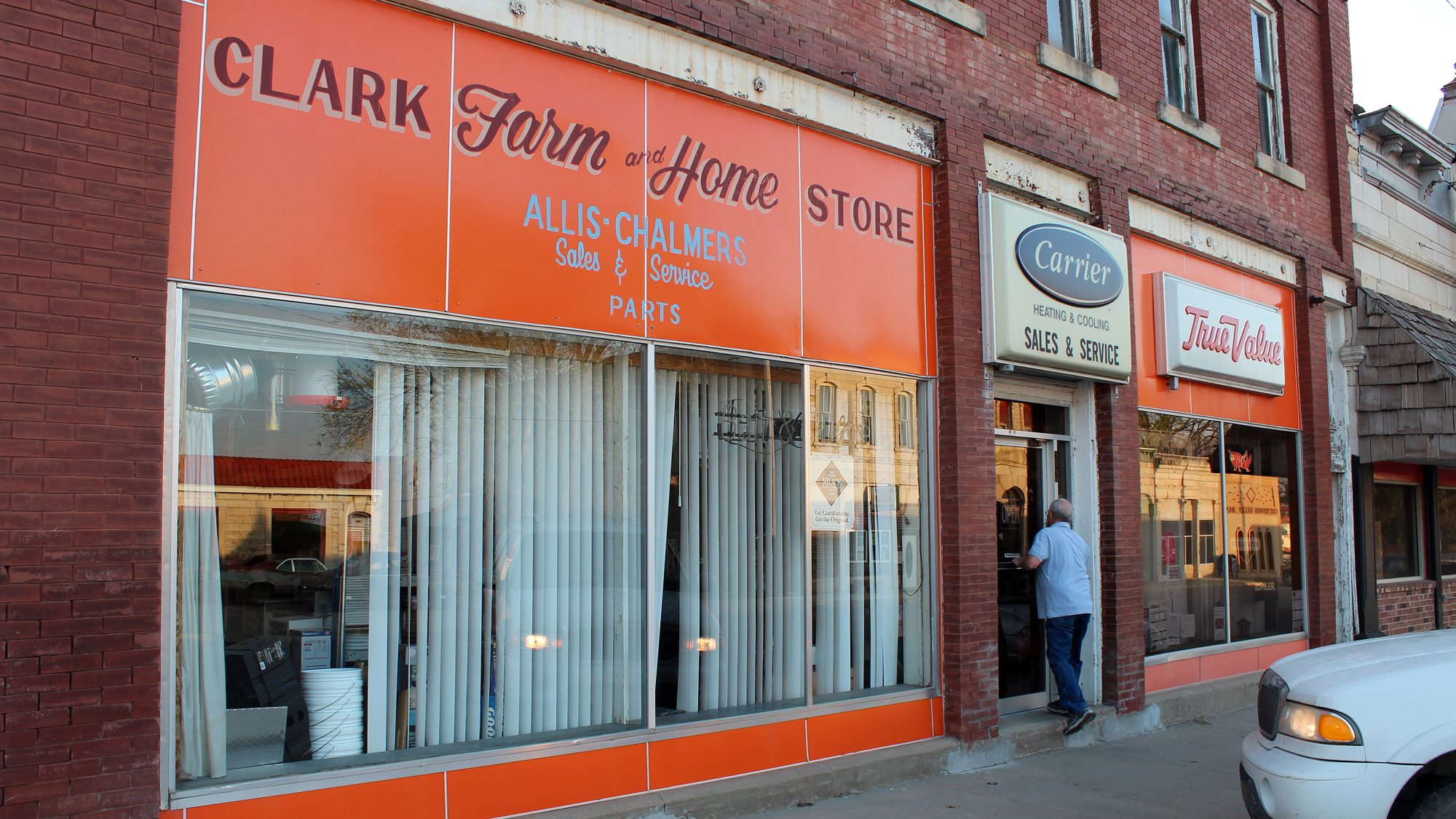
Customers come to the Clark Farm and Home Store in Strong City, for everything from Scotch tape to tractor parts and regularly swap stories about government waste. (Photo by Frank Morris/KCUR)

Some governors are pounding the table pretty hard.

And Al Cross, who runs the Institute of Rural Journalism and Community Issues at the University of Kentucky, says lawmakers and powerful farm state senators are also fighting for key programs, like the 50-year old Appalachian Regional Commission.

“We’ve already seen Mitch McConnell lay down the law that not only is the Appalachian Regional Commission not going to be eliminated, its budget is not going to be cut,” he says.

But for all the anger and anxiety over possible budget cuts in policy circles, in Strong City, quite a few people actually embrace those cuts.

“They’ve got to make cuts somewhere. Somebody’s going to get cut, somebody’s going to bleed a little bit. That’s just a fact of life, but to get things back into balance,” says Jim Fritch, who works at Clark’s Farm and Home Store.

Jim Fink runs the store, and he agrees. Both Fritch and Fink voted for Trump.

“If you ask me would I rather see the money go for our water plant, or to possibly try to control our borders and the security of our nation, the security of our nation is more important to me,” Fink says.

Rural communities do have their own pressing needs. Wages tend to be lower and health care harder to find. Opioid addiction and suicide are much more common. Federal programs address rural ills but quietly enough that they can be overlooked by people historically leery of anything coming from Washington.

Copyright 2017 KCUR-FM. To see more, visit KCUR-FM.

Alaska Department of Corrections denies reports of Douglas expansion

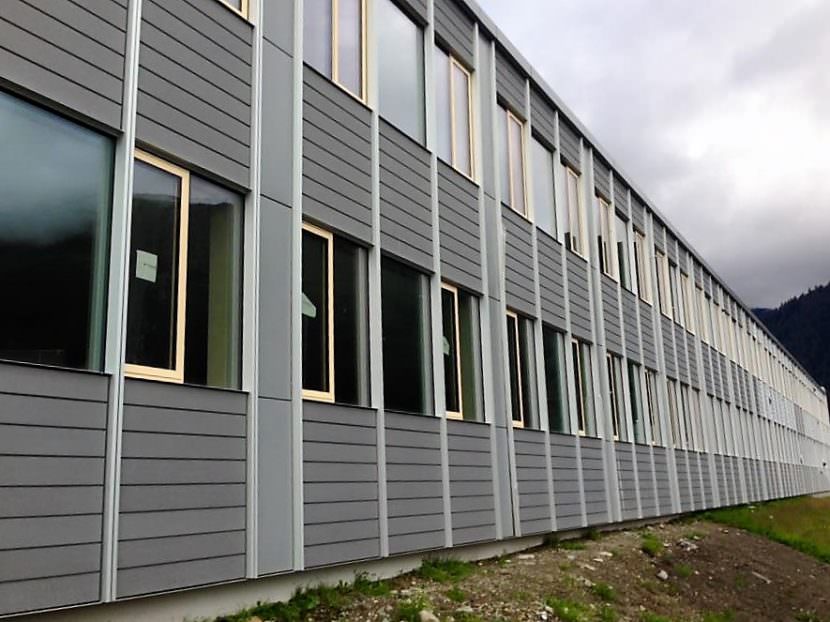
Alaska Department of Corrections houses administrative staff in the state’s Douglas Island Building, which recently underwent extensive renovation. (Photo by Ed Schoenfeld/CoastAlaska News)

Alaska Department of Corrections officials say Senate Bill 91 mandates expanded supervision of parolees who would otherwise be incarcerated. Rumors that a downtown Douglas office building could be the future processing facility has a neighborhood association alarmed and a state lawmaker demanding answers.

The Alaska Department of Corrections administrative presence in the capital city has long been in a Third Street office building in central Douglas. Recent building activity including the installation of what appeared to be reinforced glass caught the attention of nearby residents, many of whom have been calling their legislators.

“The public should know what the heck is going on,” Sen. Dennis Egan (D-Juneau) said. His office has been trying to get answers from the Commissioner of Correction’s office. “Now we’re hearing all these rumors. Some of these communications we get are totally different because — you know what happens with word-of-mouth — things change.”

The Department of Corrections is so far only saying where Juneau’s new facility won’t be.

“We are looking for suitable space but it will not be in Douglas,” Department of Corrections spokesman Corey Allen-Young said by telephone from Anchorage. He explained that Senate Bill 91 mandates closer supervision of parolees that have been diverted from prison.

The 2016 legislation was designed to reduce Alaska’s inmate population and create alternatives to prison.

“It’s a whole new section of Corrections, which means we have to set up a pre-trial in Juneau, Anchorage, Fairbanks, Mat-Su Valley, Kenai,” he said. “As part of that you have to have new offices, you have to have new UAs (for urinalysis) because pre-trial is basically something we’re working with the court system, law enforcement, attorneys.”

Sen. Egan said he and other legislators have recognized that SB 91 was rolled out faster than much of the state’s bureaucratic machinery could keep pace.

“Problem was, we implemented all of this stuff way before the departments had an opportunity to institute what we required them to do,” he said.

Plans for Juneau remain vague and there are still many decisions left to make, the Corrections spokesman said.

There will be a pre-trial in Juneau because we have to — a law gets passed — we have to follow the law,” Allen-Young said. “But determining where it is — it’s not going to be in Douglas.”

And that’s as much as the department is willing to divulge, he said, without a formal public records request. KTOO filed a freedom of information request; the agency replied Tuesday it would respond within 10 days.

The Douglas Island Neighbors Association is also seeking answers.

There was concern that a pre-trial service in that vicinity might be too close to other uses of those surrounding properties by other residents,” said Robert Sewell, association president.

State facilities are normally exempt from local zoning. Still, community members are digging in with this issue being the sole topic on next week’s agenda.

“One of our reasons to be is to work on a plan into the future for … Douglas as a community,” he said.

The meeting of the Douglas Island Neighbors Association will be held at 6 p.m. April 4 in the Douglas branch of the public library. The Department of Corrections has been invited to attend.

AEL&P crews attack avalanches before they strike

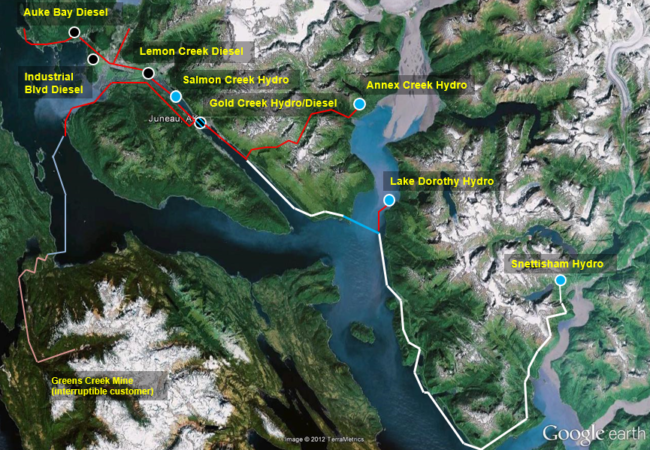
Most of Juneau’s power is hydroelectric. Getting that power to the community requires transmission lines that traverse miles of avalanche country. That’s why Alaska Electric Light and Power Company (AEL&P) uses helicopters to trigger slides to prevent destructive avalanches from knocking out the power.

Flying at about 4,000 feet in a chartered AStar helicopter, AEL&P’s avalanche forecaster Mike Janes gives the lay of the land.

“This is all power coming from Snettisham where we’re headed and the Lake Dorothy project is over there,” he points to high tension power lines that traverse an area across from Taku Inlet southeast of Juneau.

Extreme swings in temperature — blame it on climate change — have made the snowpack in the mountains less stable. That’s kept avalanche control crews busy.

“In the time that I’ve been doing this we’ve had record snow years at alpine and record low snow years at alpine all within a few years here. If anything it’s making it more extreme,” he said.

The bird’s-eye view has its limitations and the helicopter touches down near the summit of 3,300-foot Arthur Peak.

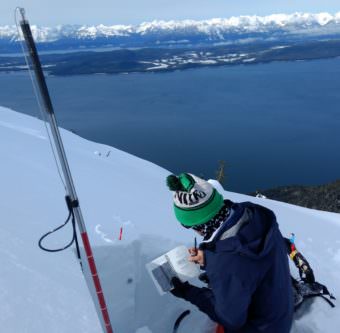
Avalanche technician Kanaan Bausler runs a simple test on the snowpack.

Avalanche technician Kanaan Bausler records the results of a stability test he’d run March 21 on the snowpack on Arthur Peak above AEL&P’s transmission line. (Jacob Resneck/KTOO)

“Basically we cut out a block in the snow and try to see how the energy, that we are putting on the snowpack by tapping on it with our shovel, how that transfers through the block,” he explained.

“Sudden collapse! Wow, that’s pretty exciting.”

Warmer conditions that bring rain or wet snow can form a weak layer on top of a snowpack. When the weight from a top layer exceeds the strength of an underlayer, it fails — triggering an avalanche. These readings mean this snowpack is unstable.

“This test definitely was a red flag for stability conditions from what we just saw here,” Bausler said.

It’s not long before Mike Janes returns in the helicopter. Dangling about 150 feet below is a device called a Daisybell. Fully loaded,  it weighs about 1,000 pounds.

The Daisybell creates a concussive blast by blending oxygen and hydrogen, then adding a spark that ignites the mix.

“You can see the flash,” Bausler says from the ground as he acts as a spotter. “It creates quite a nice explosion – a pretty good punch for the snowpack.”

Gone are the days of throwing explosives from the air. This is a cheaper — and safer — solution.

Hovering at just a hundred feet the pilot of the helicopter positions the Daisybell just a few feet over snowpack that’s layered into a natural cornice on the cliff’s edge.

There hasn’t been much movement. Then the radio crackles as the crew realizes they’d triggered something big.

“You can’t see it but we got probably 100-foot wide — it looks like it’s down on that layer,” Janes tells the crew. “I don’t know which shot it happened on. But it pulled about 20 feet below one of the shots we already made.”

After 45 minutes of firing the crew’s work is done — for now.

Modern avalanche control is often more methodic than dramatic. There haven’t been any huge slides this afternoon but the area has been secured.

“Any day that we can come out and trigger some snow off the slope that isn’t just stacking up there and waiting for a bigger slide to come — then we feel pretty good about that,” Bausler said.

Juneau was cut off from hydro power for 45 days in 2008 after a massive slide knocked out transmission lines. AEL&P had to burn diesel to keep the lights on.

It was as environmentally unfriendly as it was expensive for the company and ratepayers.

Much of Alaska Electric and Power Company’s power grid running from its hydro plants to the Juneau community traverse remote Avalanche-prone terrain. (Courtesy AEL&P)

After that experience, the utility invested millions into its avalanche control program. With the help of state grants, the company erected barriers to protect its most vulnerable transmission towers.

Avalanche crews will work through spring to keep nearly 60 miles of overhead transmission lines protected from slides. That should keep hydropower flowing to Juneau’s households and businesses during even the snowiest months.

Alaska high school students address gun violence and prevention

Kodiak student council members Solomon Himelbloom, Beatriz Recinos-Pineda and Esmerelda Lopez with their advisor Lindsey Glenn (Photo by Caroline Halter/KTOO)

High schoolers from across the state wrapped up an annual student government conference at Juneau’s Thunder Mountain High School this week. This year, they tackled a serious topic: gun violence at school.

Mark Barden addressed the auditorium full of students from across Alaska by video.

“In 2012, I lost my sweet little son Daniel in the Sandy Hook School Shooting in Newtown, Connecticut,” he told them. “Daniel was just seven years old, and the youngest of our three children.”

Following his loss, Barden founded an organization called Sandy Hook Promise.

“Through my work with Sandy Hook promise, I have learned that Daniel’s death was preventable and that so many deaths to gun violence and other forms of violence are preventable, if we know the signs.” he said.

Barden’s address was part of a presentation by Paula Fynboh, Sandy Hook Promise’s field director. Fynboh spoke to the students in person about preventing social isolation and recognizing the warning signs of violence.

“Most school shootings are planned at least six months ahead of time. And in 4 out of 5 cases, the attacker told somebody their plans before it happened,” she explained.

After the presentation, students headed to the cafeteria to have dinner and discuss.

Lillian Martin attends Hutchinson High School in Fairbanks, and she said she thought the presentation was “pretty cool.”

She said it’s possible to feel lonely even when you’re surrounded by peers.

“When I’m sitting in a big group it seems like sometimes I’m not really ‘in’ the group and I don’t really have anyone to talk to,” she said.  “So I think it’s a really good idea to just go to someone who’s sitting alone and just sit with them because it really helps out.”

Simple acts, such as making sure no one eats lunch alone, are what Sandy Hook Promise teaches kids to do. That’s in addition to speaking up about typical warning signs of violence.

Students at Kodiak High School have already started. In February they participated in Sandy Hook Promise’s “Start With Hello” week– 5 days of events designed to foster inclusivity at school.

“On Monday, we decided to greet all of the students, and it went so great that we ended up staying for the rest of the week. Every morning, student council members would come in early in the morning and say hi,” said student council member Esmerelda Lopez.

Lopez noticed some changes after the week was over.

“I’ve had a couple students come to me about a particular student. It reached administration… everybody’s starting to speak up and that’s what we needed,” she said.

Solomon Himelbloom, the sophomore class secretary, put together a video to share with the conference attendees. In it, student council members at Kodiak High School give high fives to students as they walk onto campus before school starts.

“It had a positive impact on our school. And I hope that other schools, not only in Alaska, but other schools throughout the nation and maybe the world they echo what happened,” said Himelbloom.

The Kodiak students say they will do more events in the future.

Work resumes on South Franklin Street

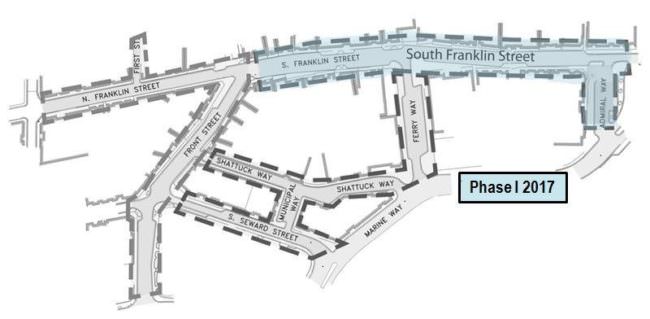
The first phase of downtown street improvements will be to South Franklin Street. (Courtesy City and Borough of Juneau)

After several weeks of delay due to snowy weather, the City and Borough of Juneau’s revamping of South Franklin Street resumed Monday with crews expected to continue work through June, the city said in a news release.

It’s the first phase of a project to add new sidewalks, lighting and drainage improvements to a stretch of the historic thoroughfare.

The project will progress a block at a time starting from Manila Square to Ferry Way. From mid-April the work is slated to move from Ferry Way to Front Street. There will be no on-street parking where crews are working and pedestrian access will be limited to one side of the street.

Crews are scheduled to work from 7 a.m. to 5 p.m. every day except Sunday. On some days work may be extended as late as 9 p.m., the news release said. This first phase is projected to cost $1.2 million and is funded by a combination of marine passenger vessel fees, sales tax and water utility funds.

Short on volunteers, Salvation Army’s ‘warming center’ winds down

red kettle (Photo courtesy of Salvation Army)
(Photo courtesy of Salvation Army)

A shortage of volunteers means Tuesday is likely the last night the Salvation Army operates its downtown warming station.

The emergency center opened Friday inside the Salvation Army’s downtown church following the city’s condemnation of the historic Bergmann Hotel.

Scores of tenants were displaced in freezing temperatures with 24 hours’ notice after the city ordered the evacuation of the residential hotel over numerous health and safety code violations in the 104-year-old building.

A total of 14 people spent the night in the Salvation Army shelter on Monday, which was originally slated to be the fourth and final night in the Salvation Army’s pilot program.

But the charity’s Lt. Lance Walters says extreme weather conditions and space shortages in Juneau’s downtown shelter caused them to extend the program.

“We decided to do one more day just to give people an opportunity to do more search for housing,” Walters said, “as well as some of those people that are unable to go into the Glory Hole to be able to get out of this weather that we’re experiencing.”

A shortage of volunteers has meant the warming center will likely not reopen this week until the Salvation Army finds people willing to help supervise the shelter overnight.

“We’re dependent on volunteers because my wife and I are currently finding that we just can’t not have sleep,” he said, “and we have to be there because we don’t have approved volunteers.”

The Salvation Army hopes to reopen the warming station soon from 11 p.m. to 6 a.m. on nights with dangerously low temperatures.

To volunteer, call the Salvation Army in Juneau at 586-2136.

Site notifications
Update notification options
Subscribe to notifications