The sun rises on the North Slope between drill rigs, Nov. 6, 2012. (Creative Commons photo by Kevan Dee)
Anvil Mountain Correctional Center, or AMCC, was the latest correctional facility in Alaska to host a North Slope Training Cooperative (NSTC) course for its inmates today. This eight to nine-hour training includes safety handbooks, course evaluations, and, of course – cups and cups of coffee.
Rus Bilak, a health and safety instructor for Environmental Management Incorporated began the class by informing the 23 all-male group that in order to work jobs on the Slope, they will need to be safe at all times. Bilak says, “If you can’t work safely, you can’t work here.”
NSTC training is comprised of six different learning modules, also called a “six-pack,” along with a newer addition focused solely on working around hydrogen sulfide (H2S). Bilak warns this deadly gas smells like rotten eggs.
“Hydrogen sulfide is a gas that is flammable, and it is toxic; it’s present on the Slope just like as much as it’s present anywhere where there is natural decomposition of organic material happening in anaerobic environments. It could be in storage tanks, it could be in the sewer, it could be in the swamp, which is another name for it; it’s a swamp gas,” stated Bilak.
After completing the day of modules, and after filling out the necessary paperwork, the inmates will receive an NSTC card. Bilak says that employees working jobs on the Alaska gas pipeline in the North Slope area must have an NSTC card, so this sets up the inmates for potential job success after they finish their time.
“I think once they are still here it’s easier to get them all together and provide this training, rather than hoping that once they get out they will seek this training on their own,” said Bilak, “…at that point, they will probably have to pay out of their own pocket.”
Currently, the “6-pack” training costs $190 and takes 8-9 hours to complete, then the hydrogen sulfide (H2S) course costs $15 and could take another hour. This training is only available in Alaska and is not taught online.
Even with the NSTC card in hand, this group of inmates is not guaranteed job placement on the Slope; they must still go through the application process after their release from AMCC. Bilak says he does not know how many employees work on the Slope, nor how many of them were former convicts.
I celebrated my first Thanksgiving in 2002. I’d arrived in the United States in August of that year to start graduate school at the University of Missouri, Columbia. A few months later, I was invited to my first Thanksgiving dinner at a house shared by two Indians, one American, two New Zealanders and their sweet black Labrador, named Willow.
There was no turkey. The couple from New Zealand — the cooks in the house — were vegan, so they made tofurky and lots of vegetables. It was a delicious meal. We stuffed ourselves, shared stories, laughed a lot and eventually faded into a food coma.
I fell in love with the holiday right away. How could I not? I was so far from home and my family in India. Just a few months into my stay in America, I was struggling to understand American friendliness — everyone was quick to smile, say hello and joke around, but there were barriers to getting closer to people. Invitations to people’s homes — a deep part of the culture back home in India — weren’t common. There were invisible but strict boundaries to friendships that I was just starting to decipher.
I’d been missing my family terribly and was homesick. But over that first Thanksgiving meal, I forgot my homesickness. This coming together of a random group of people from different backgrounds and different corners of the globe, all away from their own families, momentarily cured my longings for home. I suddenly felt as if I belonged.
The food was different from any I’d ever had before. And yet, the experience felt familiar. It reminded me of all the religious festivals back home, because they too involve people gathering over food.
My first Thanksgiving reassured me that I was going to be alright. A shared meal seems to help erase differences between us and remind us of the things we have in common, like generosity, kindness, the need for love and the company of others.
At the Thanksgiving meals I’ve since taken part in, I’ve been impressed by how welcoming the table is to foreign dishes.
Years later, when I lived in Boston, I was put in charge of bringing, of all things, mango lassi, a cold, sweet drink made with mango pulp, sugar and yogurt, at the Thanksgiving dinner hosted by an American Jewish friend of mine and his Lebanese wife. My friend Ari and his wife, Ghinwa, both love the drink and thought its taste and rich orange color would be the perfect fit for this fall festival. My lassi joined Middle Eastern dishes like fatoush and tabbouleh and apple strudel, brought by a German friend.
I have come to love this holiday so much that when I moved to New Delhi in 2013, I didn’t want to give it up. I co-hosted a Thanksgiving dinner with an Indian friend of mine who’d spent a decade in the U.S. We couldn’t find a turkey, so my friend Anannya made chicken as well as stuffing and some roasted vegetables. She invited a Canadian colleague who’d recently bought an oven (still a novelty in Indian kitchens!) and was excited to make a pie. The Indian pumpkin wasn’t the right texture for pumpkin pie, so she made a chocolate pie instead.
My contribution wasn’t mango lassi — in India, it’s traditionally a summer drink. So I made mojitos. It’s also a summer drink, but rum is a well-loved winter alcohol in India. The mojitos were so popular that I remember making glass after glass till we almost ran out of rum. You can guess how happy everyone was even before they started the big meal.
A year later, I was invited to a proper American Thanksgiving with American expats, hosted by the India correspondent of the Washington Post, Annie Gowen. She had gone to great lengths to find a turkey, buying one at the American Embassy school for $145. “Tradition doesn’t come cheap!” Annie recently reminded me in a Facebook message.
To me, Thanksgiving is a holiday that gives stray ones — like me that first year in America — a sense of home, warmth and family. It has also come to symbolize something I so love about this country – how people from disparate backgrounds, geographies and languages can gather and become friends, taking the place of family members who are far away.
My love for this holiday is certainly in keeping with its global roots. After all, it was started by immigrants in a new land, trying to create a new life and a sense of family in their adopted homeland.
And I also love the way Thanksgiving traditions can change with the times. Even now, when I see Ari and his family, they tell me how much they miss my mango lassi at their Thanksgiving meal!
Copyright 2016 NPR. To see more, visit http://www.npr.org/.
Thanksgiving dinner. (Creative Commons photo by churl han)
I asked around the office this year, “What are you thankful for?” Here’s what people said.
Annie Bartholomew
“I’m thankful for Sharon Jones and the Dap Kings.”
Christy Ciambor
“I’m thankful for sunny Juneau days. I’m also thankful for the OT, speech therapists, para-educators and all the people that work with our autism community here in Juneau.”
Sarah Schaefer
“I’m thankful for getting a shower back after not having a shower for probably three months. So that’s what I’m really, really thankful for, that house renovations are almost complete. And that I’m getting heating installed in these cold days very soon.”
Jeff Brown
“I’m thankful for my friends and my family.”
Elasonga Milligrock
“I am thankful for just being alive today, and being able to enjoy the sunshine and the possible winter wonderland coming to Juneau, Alaska, for Christmas.”
DJ Thomson
“I’m thankful for a job, and food on my table and a warm house, and friends, and great coworkers because not everybody has those things.”
Sheli Delaney
“I am very thankful for my mom. This year more than ever and every year as I get older, I’m more and more thankful for her. She is my rock, she’s always there for me, she gives me great advice. And she’s a lot of fun. And she’s come to visit me every year since I moved to Juneau, Alaska. She comes to visit from Indiana.
“And I’m thankful for KTOO. I recently started working here. I’m thankful for the opportunities they’ve provided me. So far, it’s been a lot in a short amount of time. And in general, I’m thankful that they exist in Juneau, they’re a great source for news and entertainment. And I listen all the time — even when I’m not working.”
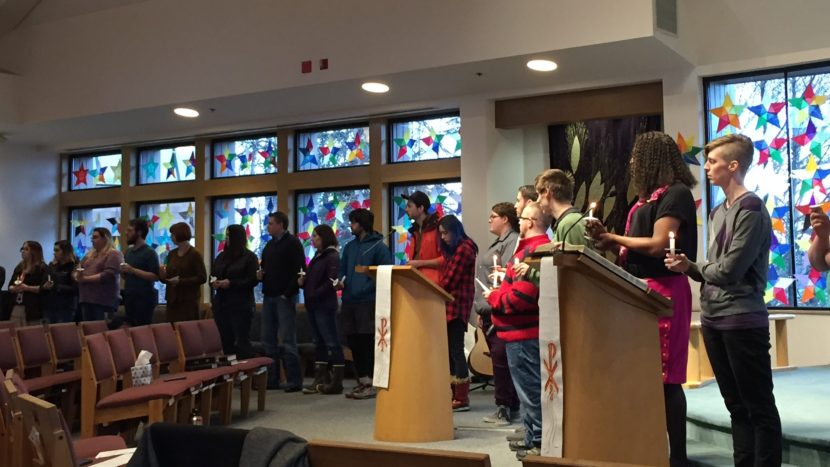
Community members gather for the Transgender Day of Remembrance on Nov. 20, 2016. (Photo by Anne Hillman/Alaska Public Media)
Standing in a wide circle around the edges of the sanctuary at St. Mary’s Episcopal Church on Sunday afternoon, more than 80 community members held candles and read the names of some of the transgender individuals from around the world who were killed this past year.
International Transgender Day of Remembrance honors those who lost their lives because of transphobia. The Trans Murder Monitoring project reports that at least 295 transgender and gender-diverse people were killed in the last 12 months worldwide, however that number is “just the tip of the iceberg.” According to the organization, which tracks the data, the number is far from complete because it only includes cases where the victims are identified as trans in the reports of their deaths. The organization says most countries don’t track murders of transpeople, and in some places trans-identities are not openly acknowledged.
The walls of the sanctuary at the Anchorage event were covered with 295 brightly colored paper stars. Christina Eubanks-Ohana came up with the idea of covering the walls with stars and purposefully chose bright colors to honor how families will remember those who were lost.
They were “lost in such a tragic way,” she said, “and yet they will always be to (the families) those toddlers and those rambunctious children. I really liked that this was a vibrant way of remembering them.”
Event organizer Jessica Greene said the Day of Remembrance is about more than just acknowledging the victims. It’s also a call to action for the wider community to recognize and support trans people.
“It’s about using that privilege — whether it’s white privilege, male privilege, cisgender privilege — it’s using that privilege that we just get because we’re some way to really advocate for those who don’t get that privilege,” she said.
Antonette Harper, who spoke during the ceremony, said the best way to fight violence against the transgender community is to increase awareness because violence stems from fear of the unknown. “So for the rest of the transworld, my suggestion is don’t start hiding now, and silence is no longer golden.”
She said people need to know one basic thing: “That we are human. We are not some alien beings, you know, that are out to molest and abduct your children or steal your husbands. No, we are human beings,” she stated. “We live just like everyone else. We have jobs. We pay taxes. We vote.”
You can find out more about being transgender here.
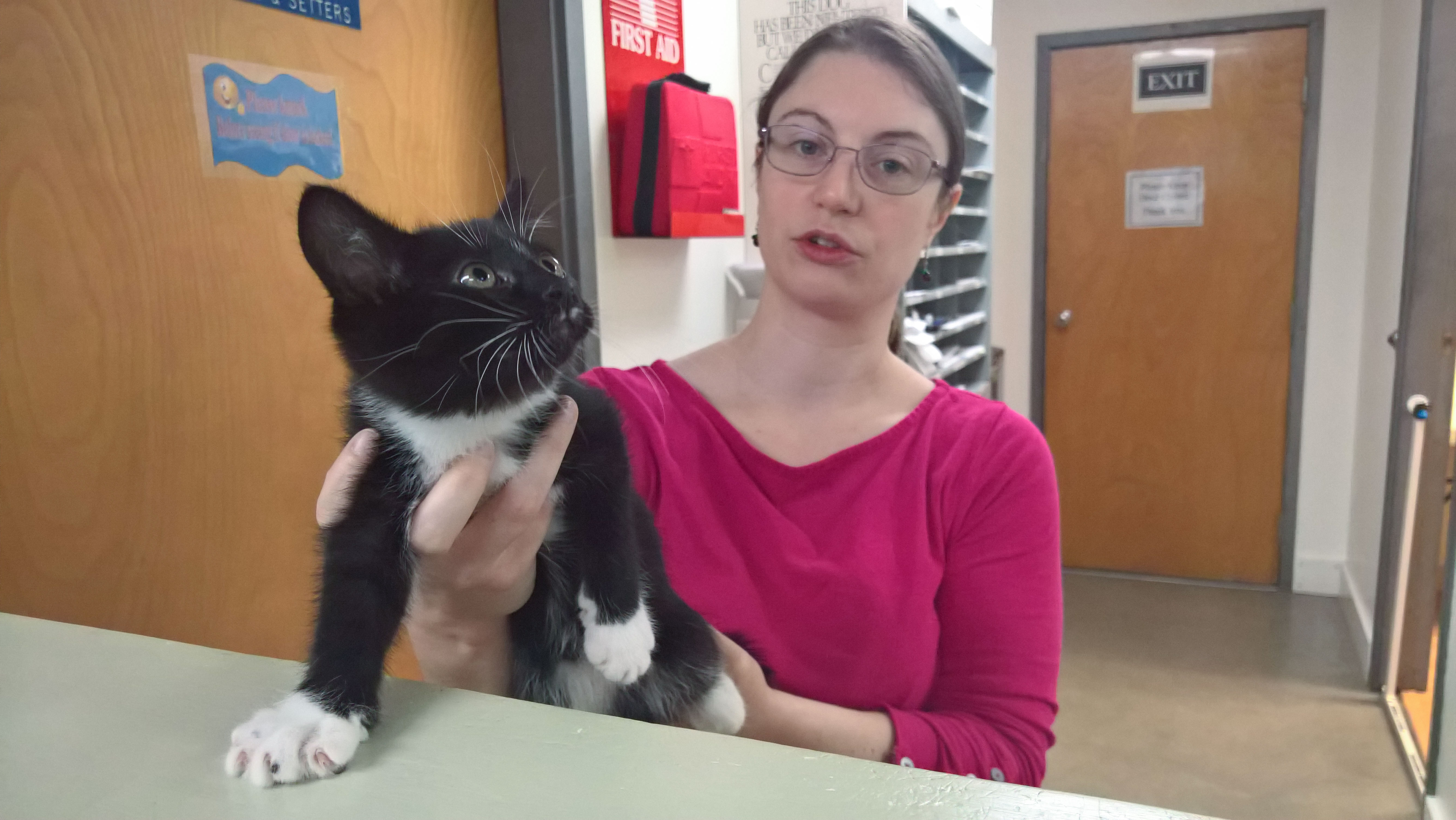
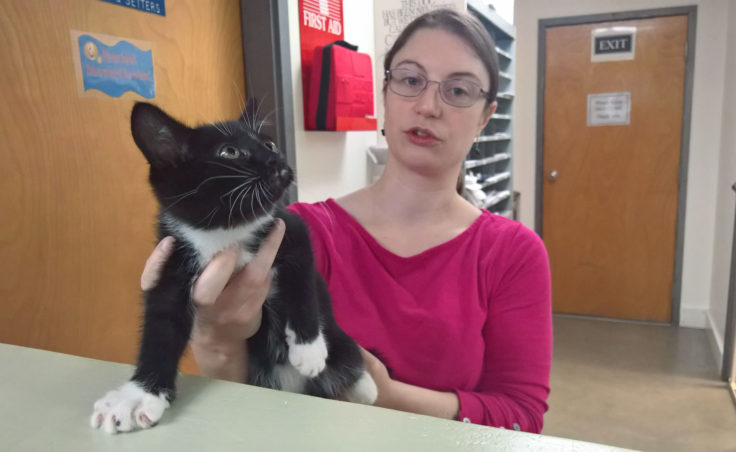
Rachel Trapp holds Sushi the kitten at Gastineau Humane Society in Juneau, Nov. 19, 2016. (Photo by Jeremy Hsieh/KTOO)
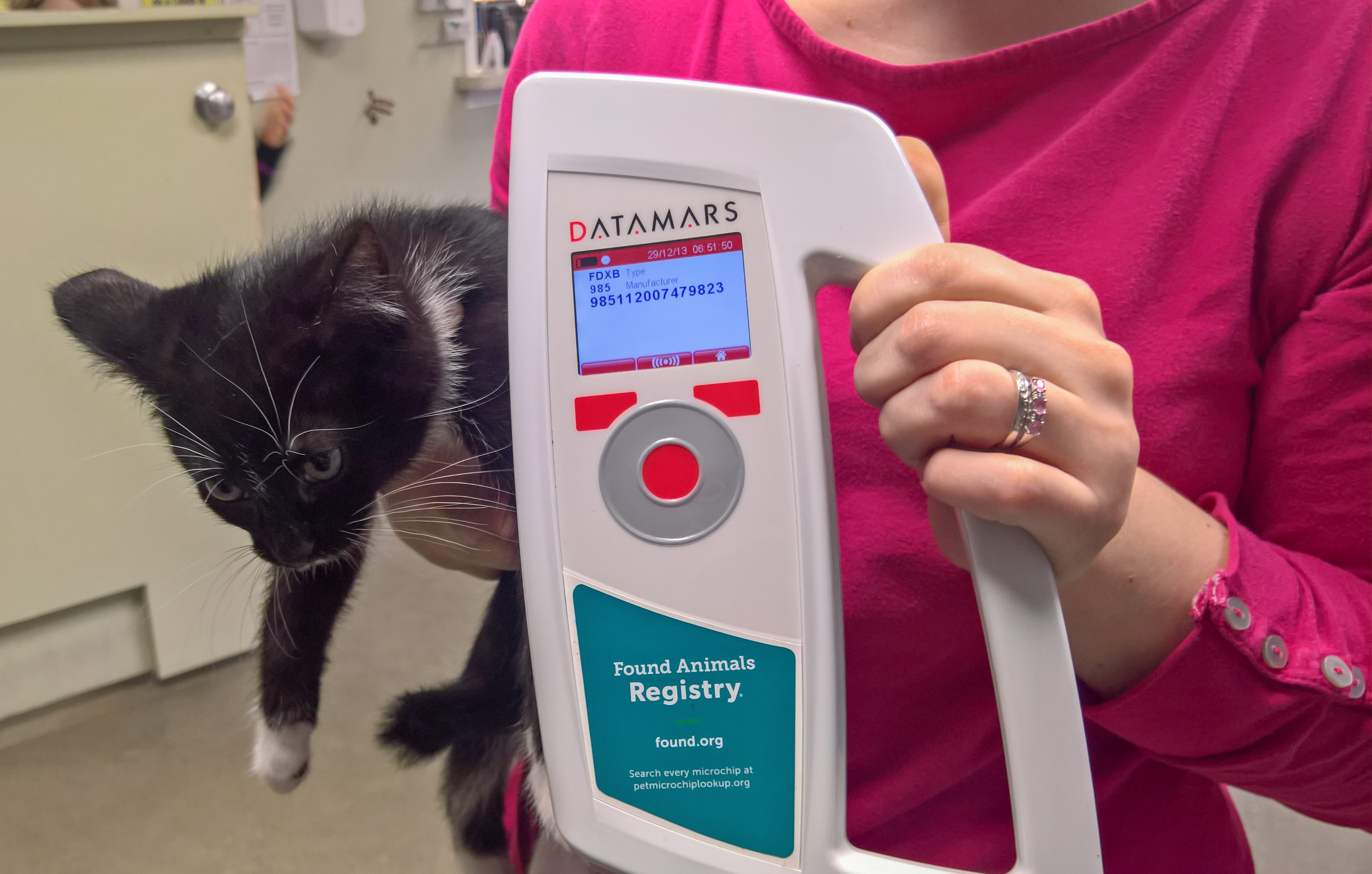
Rachel Trapp shows the readout on a microchip scanner at Gastineau Humane Society in Juneau, Nov. 19, 2016. The number comes from a rice grain-sized chip inside of Sushi the kitten. (Photo by Jeremy Hsieh/KTOO)
Sushi is a super cute, black and white kitten that Rachel Trapp holds in one hand. In the other, she holds a gadget over the kitten. The device beeps twice and then a long identification number shows up on its readout.
“Mmhmm, yep. That’s Sushi,” says Trapp, who works the front desk at Gastineau Humane Society.
The number comes from a rice grain-sized microchip under Sushi’s skin. The chips aren’t tracking devices, but when scanned, they positively identify a specific animal, which is helpful when lost pets are found – or when problematic ones are wrangled.
Juneau’s animal control officials want mandatory microchipping of pets they deem “potentially dangerous or dangerous,” and the Juneau Assembly is considering an ordinance with the microchipping requirement at the committee level on Monday.
Sushi probably doesn’t fit the legal definition of a “dangerous” animal, but the humane society chips animals in its care as a matter of course and encourages pet owners to do it voluntarily. At Gastineau Humane Society, it costs $40. Veterinarians also offer microchipping service.
Gastineau Humane Society handles the city’s animal control services under contract. In a memo to assembly members, executive director Matt Musselwhite says the microchipping requirement and other proposed changes to pet codes are in response to “an incident involving a dangerous dog or compliance issues with the animal’s owner.”
Violators would be subject to fines and citations issued by animal control officers.
According to Musselwhite, many other states have similar microchipping requirements for dangerous dogs. In California, New York and several western European countries, microchips are required for all dogs.
The ordinance is on the agenda for Monday’s Juneau Assembly Committee of the Whole. It meets at 6 p.m. at city hall.
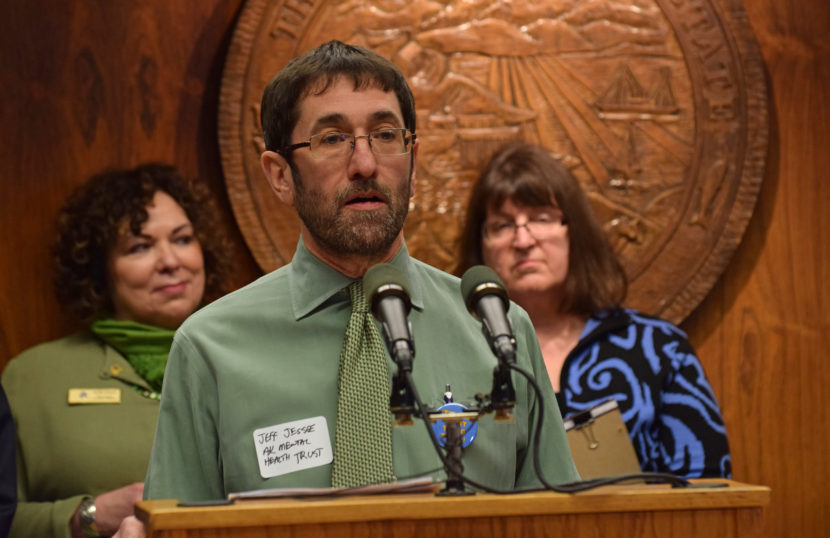
Jeff Jessee has officially resigned as CEO of the Alaska Mental Health Trust and will take a new position as a program officer. Photo taken on March 17, 2015. (Photo by Skip Gray/360 North)
The change in leadership at the Alaska Mental Health Trust Authority was made official on Thursday. Many trust advisory boards and beneficiaries expressed concerns about the Board of Trustees’ unexpected October decision to hire retired Trust Land Office Director Greg Jones as the interim CEO.
Former long-time CEO Jeff Jessee officially resigned his position and will take a new post as a program officer.
The governor’s office signed an official memorandum on Tuesday allowing for the change, though Jones may only be hired on an interim basis.
In an email to concerned advisory board members and citizens, Deputy Chief of Staff John F. Hozey III wrote the changes were approved “on the condition that final decisions regarding a permanent CEO require consultation with the supporting boards.”
He also wrote that the governor will consider the concerns when deciding who to appoint to the board in the coming weeks. Trustee Larry Norene’s term expires March 1, 2017. He is eligible for reappointment.
“It is through the appointment process that the Governor can affect the direction of any board,” Hozey wrote. “It is not appropriate for the Governor’s office to micro-manage individual actions that are within the legal responsibility of any board.”
During Thursday’s Trust board meeting, Trustee Jerome Selby asked the board to reconsider the decision.
“I’m gravely concerned, Mr. Chairman, because I think we heard some good input yesterday from a number of folks [during public comment] that maybe we need to step back, slow down a little bit,” he said. “We’re moving too fast. Our house is not in order.”
The seven-member board voted along the same 4-3 split as the original decision to replace Jessee.
Jones, the new CEO, was not present at the meeting because of a previously planned trip.
During an interview, board chair Russ Webb said shifts in leadership are normal and often make people feel anxious and uncertain, but things will quickly smooth over. He said they listened to the community’s comments with interest.
“I think unfortunately there’s much of the issues related to this are not a matter that can be made of public record,” Webb said.
Other board members, during and after the October 26 meeting, said they thought the decision-making process to change the CEO indicated potential violations of the Open Meetings Act.
Webb said those allegations “are neither true nor correct.”
“I won’t further address allegations made by anyone,” he said. “I think it’s frankly beneath me to do so.”
The Board of Trustees has authorized up to $35,000 to be spent on a facilitated training session on the Ethics Act and the Open Meetings Act, and a discussion of the reorganization of the Trust Authority. It will be led by the Trust’s independent counsel, Nelson Page, through a separate contract.
Close
Update notification options
Subscribe to notifications
Subscribe
Get notifications about news related to the topics you care about. You can unsubscribe anytime.



9(MDEwMjQ0ODM1MDEzNDk4MTEzNjU3NTRhYg004))