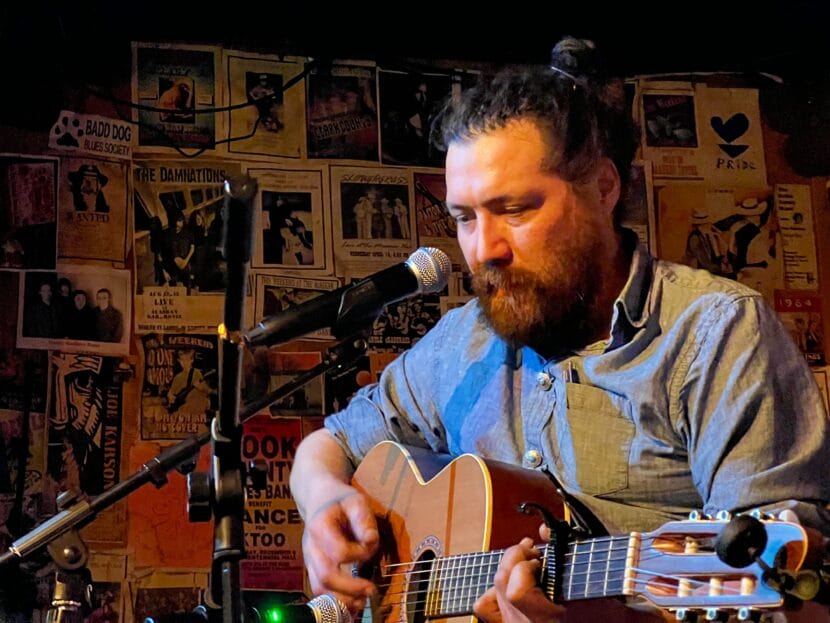
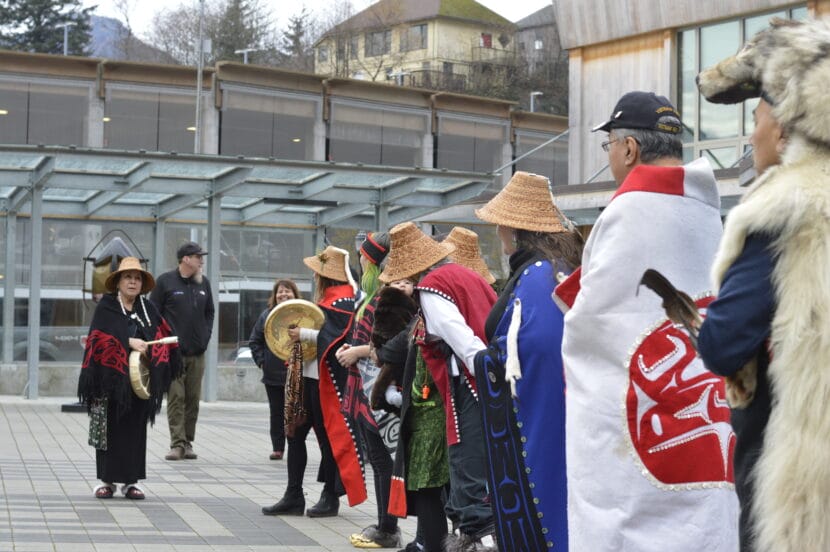
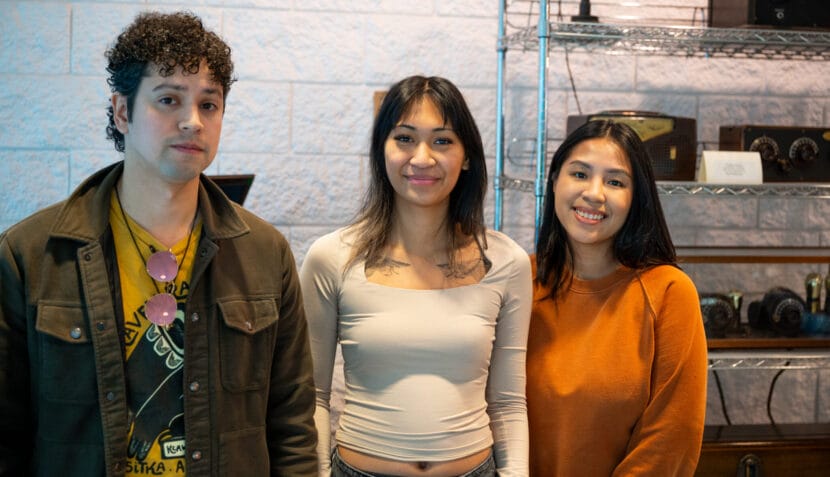
Daniel Firmin playing at the “Unceded” event at the Alaskan Hotel and Bar in April 2023. (Photo courtesy of Tripp Crouse)
Alaska-based storytellers will take the stage Wednesday at the Crystal Saloon to share what diaspora and belonging mean to them. The event, called “Displaced,” will feature writers of color from Juneau and Anchorage.
The idea came to Juneau musician Daniel Firmin about 10 years ago, in a poetry workshop. While his friend wrote about displacement of water, he immediately thought of his experience growing up in both Fairbanks and Fort Yukon, having a white father and an Alaska Native mother.
“I’m not quite sure what everyone else is going to do,” he said. “What I want to do is to talk about that feeling of not being accepted between two worlds that really are one.”
Firmin said that he never quite felt like he belonged — that he wasn’t ever white enough or Native enough for either community. After Unceded, an event this spring that featured musicians of color, Firmin pitched organizer Tripp Crouse the idea of doing a storytelling event.
For Crouse, the idea struck home, too. They’re Ojibwe and grew up in Illinois with the non-Native side of their family. Now, they’re in Alaska, with friends who have their own experiences with diaspora.
“A friend of mine calls Juneau the Island of Misfit Toys,” Crouse said.
Crouse says this mix of identity and belonging fosters Juneau’s rich arts scene.
“It’s a place where we all sort of get together and hang out and do fun things and put on really cool events,” they said.
Crouse said there’s no cover because they want anyone to be able to come without a financial barrier. Any donations will go to the artists.
They haven’t reviewed any of the stories or poems the speakers will read, either, and there’s just one rule: It must be original.
“I really want it to speak from who you are,” they said.
Other storytellers will include Ernestine Shaankaláx̱t Hayes and Na Mee. Displaced is Wednesday at the Crystal Saloon at 8 p.m.
Editors note: Tripp Crouse is a former KTOO employee.
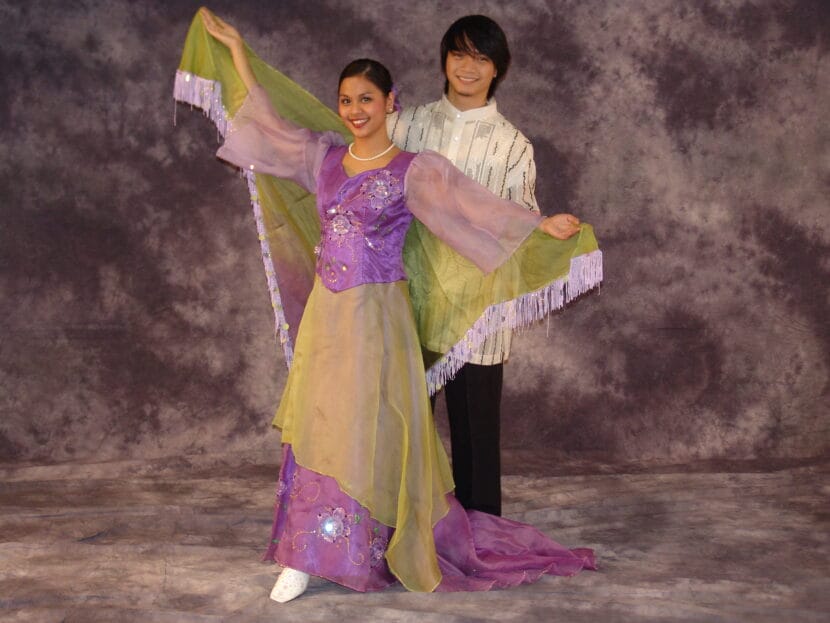
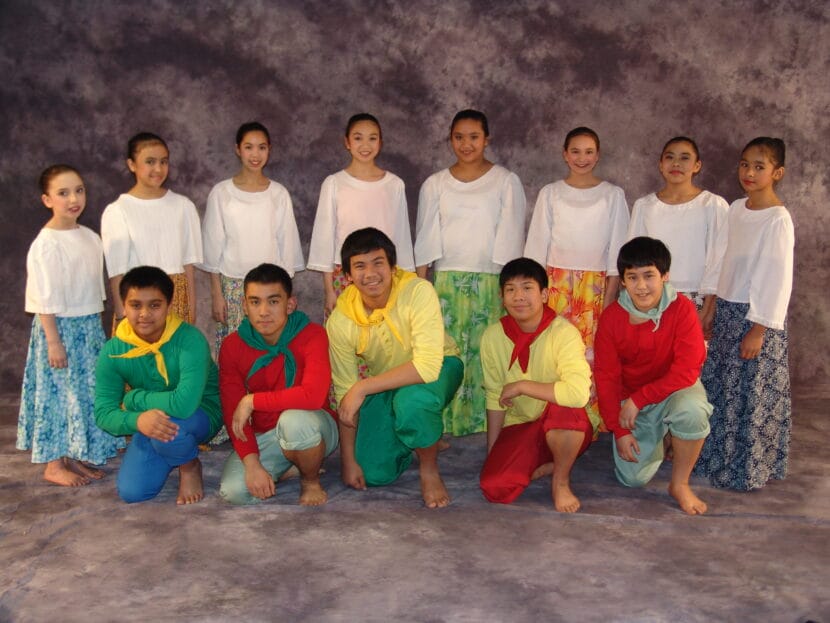
Members of Juneau’s Alitaptap Folkloric Dance group pose in traditional costumes. (Photo courtesy of Filipino Community, Inc.)
In its heyday, the Alitaptap Folkloric Dance group was a spectacle of Filipino culture both in Juneau and across Alaska.
Filipinos, from elementary schoolers to elders, learned and shared the story of Filipino history through dance. But it’s been more than a decade since those dancers took the stage.
Kaye Roldan doesn’t really recall joining the group with intention.
“When I joined, it was like we didn’t really get the full picture of what we were actually doing,” she says. “I just did it because my mom told me to.”
Many Filipinos who grew up in Juneau had a similar experience. But years later, they can appreciate the chance they had to connect with the culture their parents and grandparents came from before arriving in Alaska.
In the fifth and final episode of Mga Kuwento, Anna Canny brings us the story of those who once danced under the careful instruction of their elders, who are now searching for spaces to reconnect and pass down Filipino culture.
Members of Juneau’s Alitaptap Folkloric Dance group pose in traditional costumes. (Photo courtesy of Filipino Community, Inc.)
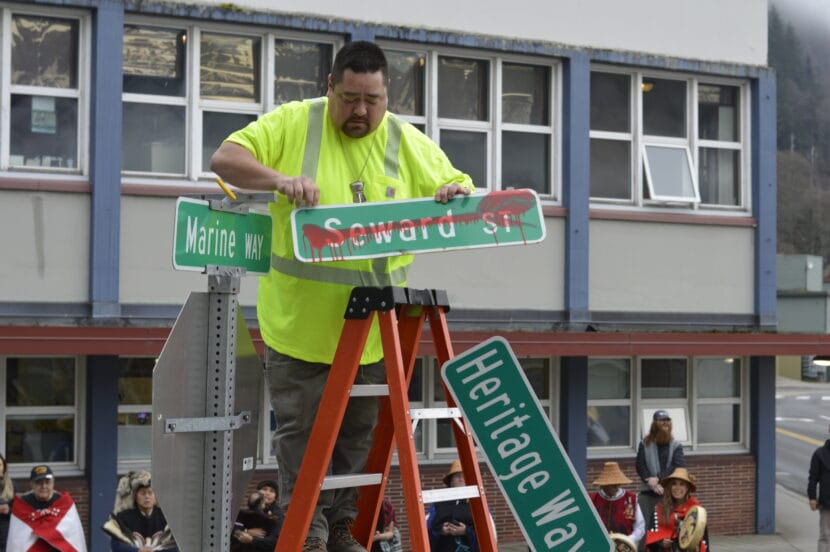
City and Borough of Juneau public works employee Randal Jim replaces the “Seward St.” sign with one the reads “Heritage Way” on Nov. 1, 2023. (Photo by Yvonne Krumrey/KTOO)
Standing on a ladder, Vicki Soboleff painted a red streak across a street sign reading “Seward Street.” A City and Borough of Juneau public works employee climbed up next, and under the pressure of dozens watching, swapped the painted sign for one that says “Heritage Way.”
On Wednesday, one of downtown Juneau’s central streets was renamed. Sealaska Heritage Institute President Kaaháni Rosita Worl proposed the change in April.
“Today, we celebrate the removal of this stain in our history,” Worl said at the renaming ceremony. “And we celebrate reclaiming our history with a new street name, Heritage Way.”
Heritage Way runs between Front Street and Marine Way, and until this week, it was called South Seward Street. City Hall, SHI’s Walter Soboleff building and the recently-bought SHI building between the two are the only addresses that will be changed.
“If we need to continue to buy our way into this historic mining district just to do small things like this, we’ll continue doing that,” said Sealaska Board Director Joe Nelson.
Deputy Mayor Michelle Hale spoke on behalf of the city.
“I am so pleased to right perhaps one small wrong and rename this part of the street as Heritage Way,” Hale said.
She said she’s seen the impact Sealaska Heritage Institute has had on revitalizing Southeast Alaska Native culture.
Yées Ḵu.oo Dance Group performs at the Heritage Way renaming ceremony at the Sealaska Heritage Institute arts campus on Nov. 1, 2023. (Photo by Yvonne Krumrey/KTOO)
The Juneau Assembly unanimously agreed to support the change in May. Worl thanked the city for its support.
“We would not have been able to accomplish the many things that we have done, like our arts campus, like the Walter Soboleff building, like the Totem Pole Trail, without the support of the city,” Worl said.
Seward Street’s namesake, William Seward, was the secretary of state when the U.S. bought unceded Alaska Native land from Russia. Worl said Seward referred to Indigenous people as “uncivilized” and “savages.”
“In sharp contrast to his view of Alaska, as a land of great beauty and riches, he saw Alaska Natives not as owners of the land, but as laborers who would support the colonization of Alaska,” Worl said. “We’ve come a long way in now, where the public joins with us in celebrating our culture.”
The ceremony also served as a dedication for a bronze mask made by Metlakatla artist John Hudson. The “Capturer of Souls” mask now sits in a corner of the Sealaska arts campus, facing the middle of the plaza.
Hudson said the mask is named for shamans who would bring souls back to those who had lost them.
“I believe, metaphorically, it really represents what Sealaska is also doing here with this magnificent building,” he said. “The street name change and all the totem poles are all getting a little piece of our soul returned to us.”
Hudson said he’s proud to have a carved piece near one his father made inside the Sealaska building.
October is Filipino American History month, commemorating the arrival of the first Filipinos to modern-day California in 1587.
A new exhibit launched at the Anchorage Museum Saturday chronicles an oral history of Filipinos in the state. Mana is the Tagalog word for “inheritance” and the name of the project, founded by Shayne Nuesca, Tasha Elizarde and Joshua Albeza Branstetter.
Nuesca says the three of them had independently chronicled Filipino history, and the project took off when they came together to collaborate.
Listen:
The following interview has been edited for length and clarity.
Shayne Nuesca: We wanted to tell the stories of elders, Filipinos in Alaska, whose stories would otherwise go untold in mainstream forums. And so these are stories that were passed down orally. It’s how our stories are really told, from generation to generation, within our culture. We also had some elders who had passed away, and that motivated us to get this project going and to record the stories of the elders that we have still with us.
Wesley Early: Josh, the project covers a wide swath of the state. You’ve got Anchorage and Kodiak, and then up to Fairbanks and down to Juneau. Did you find that people were open to telling their stories? Did you find that there was maybe some hesitation?
Joshua Albeza Branstetter: There was hesitation at first. A lot of the elders hadn’t met us, they didn’t even know that I was Filipino American when we first reached out. A lot of these elders have had diverse, lengthy histories and stories that they’ve never shared with anyone. And a lot of that has to do with not feeling like they can share those stories. There’s a wonderful word that Shayne taught me just a few days ago. It’s “hiya”. So many Filipino words are entire essays, but it kind of takes this concept of this shame around like, don’t talk too much, don’t share too much. And our elders have the stories that they have felt like they couldn’t share. They didn’t have a platform to. They needed to trust us first. And once they did, we learned… I learned so much. So much about myself and our community.
WE: Tasha, all of you are Filipino. And while you all have backgrounds in various forms of media, be it filmmaking, writing, photography, journalism, I imagine there haven’t been a lot of big opportunities to do large projects about people who look like you. Did you find any additional pressure, any additional excitement about doing a project like this?
Tasha Elizarde: I was very excited, just because there’s not a lot of opportunities to be able to share the stories of our community, just in whatever spaces exists for media creation in Alaska. For example, there’s only one book on Filipinos in Alaska that’s ever been published, by Thelma Buchholdt. And that book is currently out of print. And so I think that says a lot about what kind of opportunities are available to be able to share the types of stories. She had written that book because at one point, she was just like, “Why do we have no archive?” And so we’re kind of repeating that question back and saying, “Why is there still, after so many years — that book was published, like I think 30 years ago — after so many years, we still don’t have an elaboration of that archive?” And so what we’re doing with Mana is creating a larger archive. Talking to people that exist here now, making these connections to even longer into the past. And that’s something that… it’s just not an opportunity that a lot of people go for. But we had to create that opportunity by ourselves. And that’s why I was so excited to be working with both Shayne and Josh is because we’re able to create an opportunity to share stories that are so important. You see people when we interview them, they’re just so excited to finally feel like they’re recognized and have relationships with young people that remind them we care about your stories, and other people will care about them too.
WE: Josh, you know, you got the opportunity to travel to a lot of parts of the state to meet different people and share their stories. Were there any that maybe surprised you, you learned something new or really resonated with you?
JAB: I would say one that really resonated with me was the story of Camila Cook. She is an elder here in Anchorage. And she would always call me “darling,” and I love that. But when I interviewed her she lit a cigarette and she put it in her mouth backwards, so the lit end in. And I said, “Lola, what are you doing?” And she’s like, “it’s just a thing, darling. We all did this when I was a kid, and so I still do it today.” And I think the specificity of our stories really creates a universality among our community. Because we already have the exhibit up and one of our team, she had never seen it and she went there yesterday. And she said she stopped at Camila’s, and when she saw that backwards cigarette before she’d even read the story, she said, “Josh, it sent me back 40 years, because I remember how all the kids would do that.”
WE: So Shayne, I think my last question is, what do you hope the goal of this project is? Do you see it as more of a resource for a wide audience to learn about their fellow Alaskans — their neighbors — or do you see it as a personal resource to help Filipino people learn about their own history?
SN: I definitely see it as both. So it is an avenue for the wider community to learn about our elders and the history of Filipinos, or a glimpse of the history of Filipinos in Alaska. But it’s also an opportunity now for Filipinos in Alaska to look within themselves, I hope, and to look at their families and open the door for those discussions about you know, the stories that came before them. For me, and I can’t speak for the rest of my team, this was a very healing project for me. I had immigrated here when I was six years old and had dealt with you know, the loss of my birth culture, in a sense straddling two different cultures. And so, hearing these elders speak about their experiences, and then correlating that with with mine as a child, it felt like those experiences were validated. And every emotion that I felt, all of the sort of hardships I had as a child, it felt like I was getting a hug from people that weren’t even in my family, and they were telling me they were validating my experience without even knowing.
“Mana: The History We Inherit” opened at the Anchorage Museum on Saturday, Oct. 27. The exhibit will run at the museum through January.
Editor’s note: Shayne Nuesca is a former KTOO employee and Tasha Elizarde currently works at KTOO. KTOO is not affiliated with the exhibit.
When Filipino men migrated to Juneau in the early 20th Century, they came as bachelors to work in canneries alongside Alaska Natives. Because they were segregated together, the Filipino and Alaska Native communities intermixed. Many Alaskeros married and built families with Alaska Native women.
The word “mestizo” means “mixed” in Spanish. In Alaska, it refers to someone who has both Alaska Native and Filipino heritage, since the Philippines were colonized by Spain. Not everyone who shares these identities chooses to use this word, but many in Juneau do.
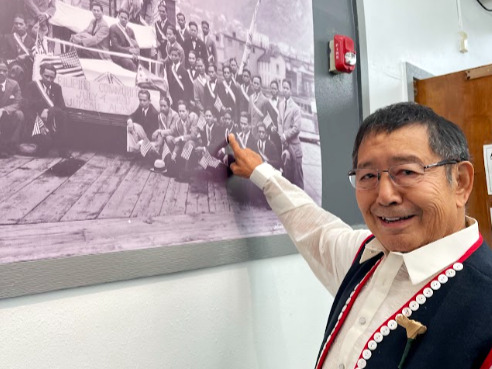
Marcelo Quinto points to his father in an old photograph during an event at the Filipino Community Hall in October 2023. (Photo courtesy of Agnes Elizarde)
“When we were born half Filipino and half Lingít, it was difficult for us to decide — where do we belong? Because we knew we didn’t belong in a white society,” says Marcelo Quinto, who grew up in Juneau in the 40s and 50s.
After the 1965 Immigration Act, it became possible for Filipinos to migrate with a partner, and intermarrying between the two communities slowed. Eventually, Juneau’s Filipino Community Hall became less welcoming to the Alaska Native women who had helped fundraise to purchase it, leaving their children and grandchildren to find their own place in the greater Filipino community.
“I really feel my Lingít connection to Áaní, to the land here and in our home, but I haven’t experienced that with the Filipino part of me,” says Kai Monture, an artist in Juneau.
In the fourth episode of Mga Kuwento, Yvonne Krumrey tells the story of a community with historic roots in Juneau and how some mestizos are trying to reconnect with their Filipino side.
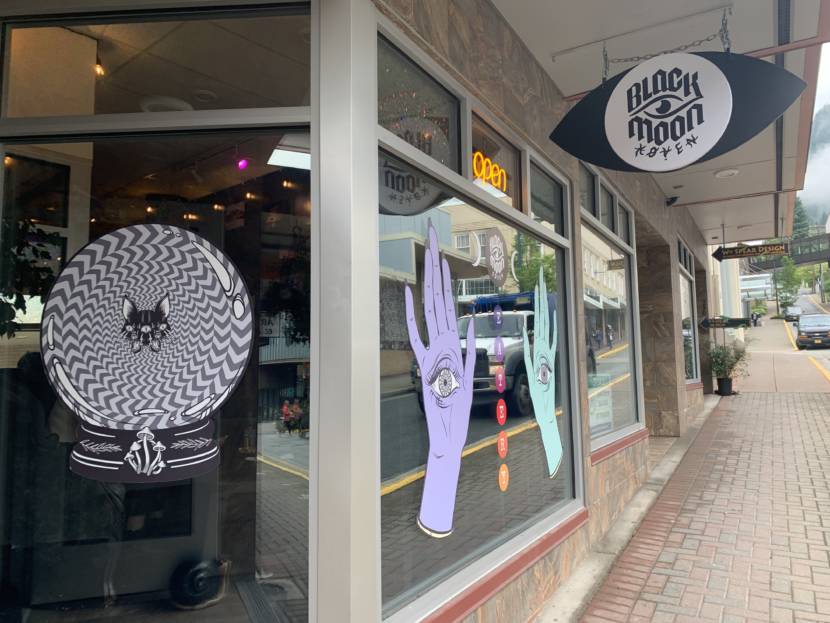
Aims Villanueva-Alf at her restaurant, Black Moon Koven, in Juneau. (Yvonne Krumrey/KTOO)
Three years ago, Aims Villanueva-Alf was out for a run in downtown Juneau when she saw a small restaurant space for rent on Seward Street.
Its walls were painted what Villanueva-Alf called “bumblebee yellow,” but she could already envision what would eventually become Black Moon Koven: a dark but cozy nook adorned with taxidermy and skulls, with coffins and three-eyed cats painted on black walls.
“When somebody is walking past the window, they don’t know what’s going to happen. They don’t know if you’re going to get a curse, they don’t know if you’re going to get some hexing,” she said. “I wanted them to be curious enough to risk it — and then maybe get a banh mi.”
Black Moon Koven opened in April 2021, offering sweet and savory waffles for breakfast and sandwiches and noodles for lunch. On the northern end of the block between Second and Third Streets, it was just outside of the tourist-centric core of downtown. Locals stopped by year-round.
Last week, it closed. Starting next month, Villanueva-Alf will train to become a death and grief doula.
“When I think about grief in general, it’s not even those who have passed,” she said. It can also include “grieving a friendship or closing a restaurant.”
Before Black Moon, Villanueva-Alf spent five years running GonZo, a restaurant in Auke Bay. It was a “loud and all-over and adventurous” place that took up all of her time, Villanueva-Alf said.
The outside of Black Moon Koven. (Lyndsey Brollini/KTOO)
“I’d never had a trauma like that happen,” she said. “I had lots of friends who’ve had restaurants and had people that have violated them, but not in this way, and so it felt very lonely.”
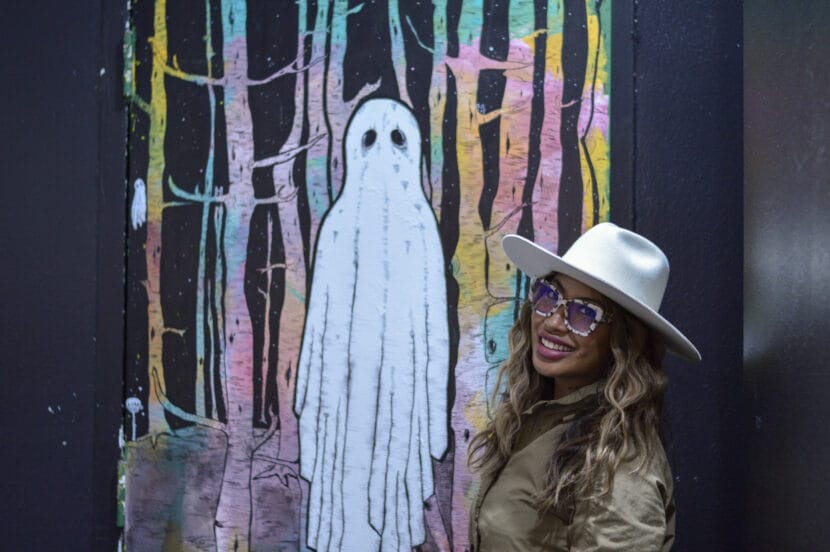
Villanueva-Alf went into what she called a “cocooning phase.” She signed a lease for the new space downtown. She invited friends to paint ghosts and coffins on the walls. She collected taxidermy. She said she was inspired by the Latin phrase “memento mori,” which means “remember you must die.”
“How many times have we had to shed certain skins, and how many times have we had to build on these skins that we can’t shed because we’re too scared?” she said
The first thing she cooked in her new kitchen was bone broth, honing her recipe to make the flavors even deeper. Black Moon Koven offered bone broth seasoned with ginger, garlic, scallions and cilantro meant to be sipped. It was also the base of their noodle bowls.
Much of the menu was vegan or vegetarian. Villanueva-Alf had been disappointed by much of the vegetarian and vegan food she’d tried in the Pacific Northwest. A tour of restaurant kitchens in Ojai, California, showed her it could be done differently.
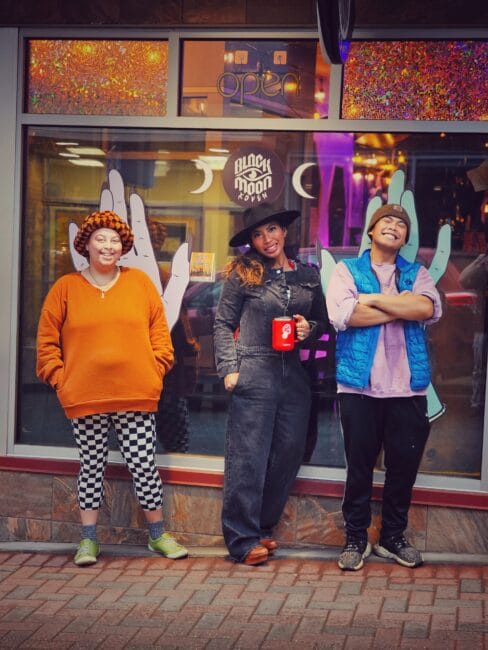
Store managers Sam Martinez (left) and Clark Bolaños (right) with Aims Villanueva-Alf (center) outside Black Moon Koven. (Photo courtesy of Aims Villanueva-Alf)
“You can eat nutritious food without having to be like, ‘Where’s the flavor?’” she said.
Customers could also sign up for food subscriptions to fit their dietary preferences and pick up their orders at Black Moon. Villanueva-Alf said she’s continuing the food subscription program after the closure.
Like any restaurant in downtown Juneau, inflation drove up the price of everything from eggs to takeout containers. Villanueva-Alf juggled orders from local suppliers like Juneau Greens and shipments arriving on Alaska Airlines. Parking downtown was a challenge for customers and staff alike.
But unlike GonZo, Black Moon Koven wasn’t all-consuming for Villanueva-Alf. She started studying yoga, sound healing and spiritual psychology around the time she opened Black Moon. A question from one of her instructors led her to her next move: becoming a death doula.
“It was, ‘If you could be something for yourself when you were a child, what would you be? What would you need? And can you bring that out right now?’” she said. “And I was thinking about how badly I would have wanted somebody to explain grief to me.”
At age 9, Villanueva-Alf experienced the unexpected death of a loved one. The shock of the loss was followed by confusion about how to process it.
Now, she wants to help people at the end of their lives – and their loved ones – experience death and grief in a healthy way. Like birth doulas, death doulas do that by providing emotional and spiritual, rather than medical, support.
“I want to give people life recipes on how to suffer well,” she said.
For now, she’s grieving the closure of Black Moon Koven. She’d spent the last few days gifting decorations to friends and her staff of seven. Pretty soon, it would be time to paint the black walls white.
Unlike GonZo, Black Moon is closing on Villanueva-Alf’s own terms, out of excitement for the future rather than ties to the past.
Close
Update notification options
Subscribe to notifications
Subscribe
Get notifications about news related to the topics you care about. You can unsubscribe anytime.