Community

On 40th anniversary, Southeast’s smallest city remains defiant

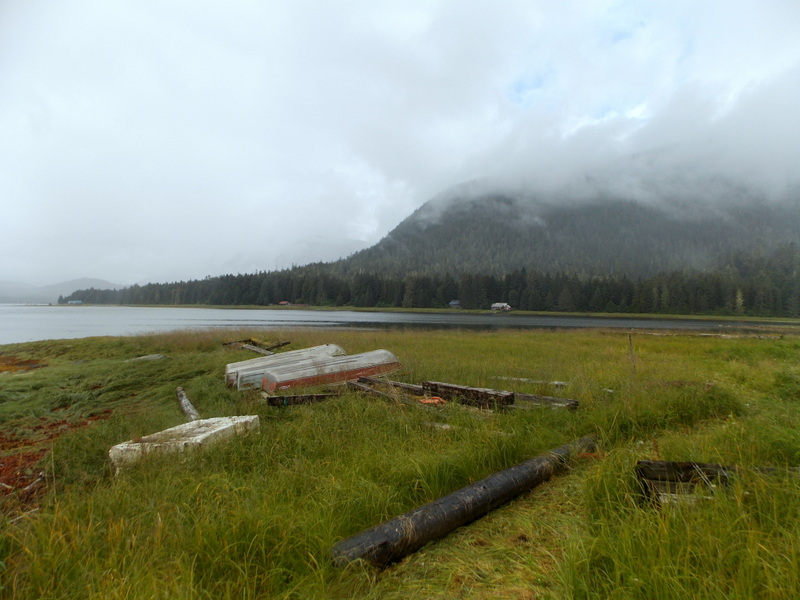
The view over to Kupreanof from Sharon Sprague’s house on Sasby Island. (Photo by Joe Sykes/KFSK)

Most people in Petersburg don’t give much thought to the handful of houses which sit on the other shore of the Wrangell Narrows.

But to the people who live there it’s a place they are proud to call home. It’s name is Kupreanof and with just 24 residents it’s Southeast’s smallest, and Alaska’s second smallest, city. And this week it turns 40. It’s a community still proud of their little piece of Alaskan independence and unified against their older brother across the water.

When Sharon Sprague and her husband Dick moved to Sasby Island, in the middle of the Wrangell Narrows in 1975, they had to build a life from scratch.

“We started with nothing. There was no electricity, there was no water here. Nothing,” Sprague said.
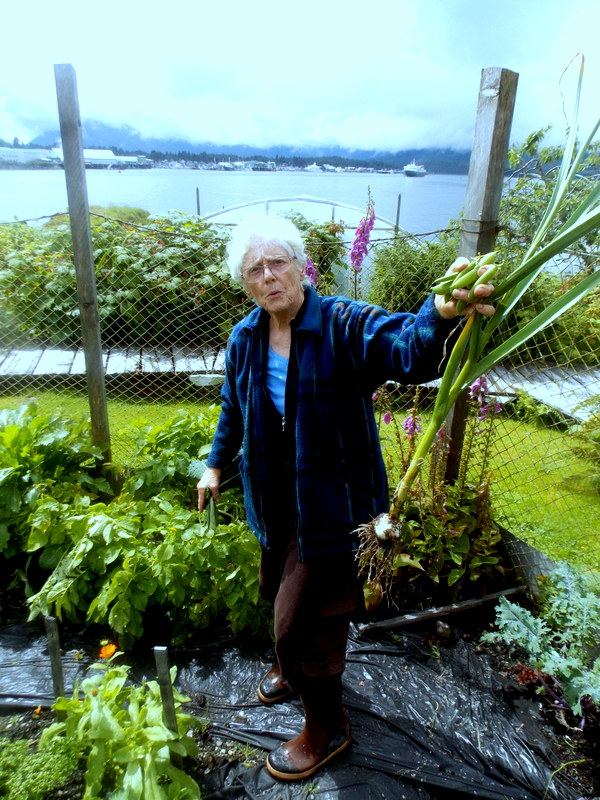
Sharon Sprague picks vegetables in her garden on Sasby Island. (Photo by Joe Sykes/KFSK)

Since then they’ve created what some might call a homestead. They have their own hydroelectric power system, chickens run around in the garden, and plump fruit hangs off trees ripe for picking.

They came here to get away and live out on their own. And together with a group of other isolation inclined individuals they helped found the city of Kupreanof, the smallest city in Southeast Alaska.

It sits on the shore of Kupreanof island just next to the Sprague’s house and on the opposite side of the narrows from Petersburg.

It began when residents who lived on the island decided they were sick of Petersburg and so organized themselves into an independent city. And the Spragues went with them.

And Sharon Sprague says Petersburg and Kupreanof are separate for a good reason.

“The two communities are so opposite,” she told me.

That opposition still simmers and boiled over in 2013 when Kupreanof fought the establishment of the Borough of Petersburg. They lost that battle meaning they had to pay more money into Petersburg’s coffers but retained their status as a city.

At a recent council meeting, jokes at Petersburg’s expense flew over breakfast of watermelon slices, sausages and eggs.

“Has the assembly over there every provided you with breakfast?” Kupreanof Mayor Tom Reinarts quipped as he offered me my share of their Saturday morning spread. In a city so small the mayor is not just the mayor.

“I’m also the police chief and the fire chief,” he said.

Everyone has to play a hand in Kupreanof.

Butch Anderson’s been living here for about eight years. He turned up to the council meeting one day just to see what was going on.

“There was an extra seat open. So they voted. I got one vote,” he said. “I got in by a landslide, one vote was all it took.”

He likes it here because he can kind of do what he wants.

“I’m a hermit. I live alone and enjoy life. I don’t like heat. In my house, it will get down to 25 inside. Then I’ll go light the fire,” he said.

They’re idiosyncratic. They keep to themselves and because of that sometimes it’s hard to remember just how many people actually live here.

“Our official population is 24, I think,” Tom Reinarts said.

“I thought it was 25. I read 25,” Butch Anderson jumped in.

“Maybe 25, I concede,” Reinarts replied.
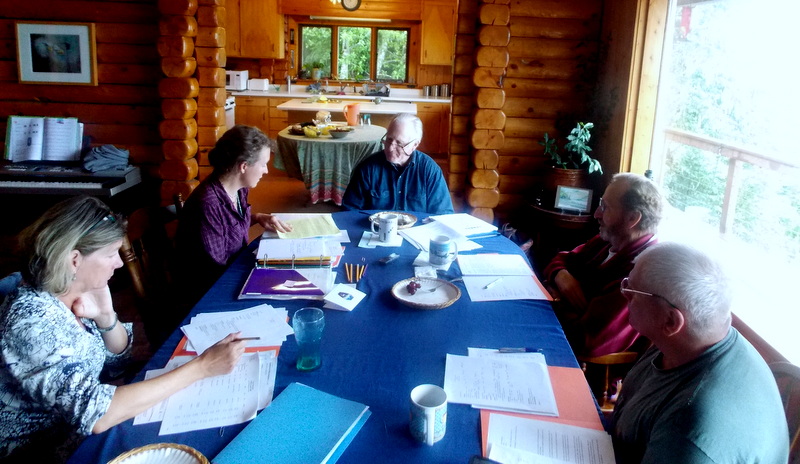
Kupreanof Mayor, Tom Reinarts, heads up a meeting of the Kupreanof City Council. (Photo by Joe Sykes/KFSK)

Either way, their six-member council makes up about a quarter of their population. And while they say they’ve not always seen eye to eye, they do have a common bête noire: The Borough of Petersburg.

“We’re like Petersburg’s red-headed step-child. They’re like ‘we want you guys to follow our rules. So we can tell you how to live your life over here, ” Anderson said.

So now it’s their 40th anniversary and they’re determined to show Petersburg they’re here, they’ve been here for a long time and they are here to stay.

“I think we need to make a big splash for our friends across the bay in Petersburg East,” Reinarts announced at the meeting.

He says he calls them Petersburg East because people in Petersburg often refer to Kupreanof by its original name, Petersburg West.

They’re proud to be Kupreanof and they know with so few people it will always be a struggle to survive. But Sharon Sprague, standing on her dock looking out over both communities has the answer.

“If you’ve got a group of people and they have one goal and they all feel the same and they’re a unit, they have strength,” she said.

I ask her what she thinks that goal should be:

“To keep it as it is,” she says. “This is a jewel.”

And it’s a jewel that will always be a bugbear to Petersburg.

“They hate us, they hate us. We’re a thorn in their side. They just wish we’d go away. But we’re not going to,” Sprague tells me with a glimmer in her eye.

They’re not going anywhere and if it was up to Sharon Sprague they’d be a thorn in Petersburg’s side for another 40 years to come.

LGBT discrimination claims still not valid in Alaska

The Rainbow Flag is a symbol of LGBT pride. (Creative Commons photo by torbakhopper)

The U.S. Equal Employment and Opportunity Commission ruled in late July that sexual orientation discrimination in the workplace is illegal because it is a form of sex discrimination, which is already prohibited.

Some of the most common types of discrimination LGBT people face are in the workplace and in housing. Despite this, Alaska’s statewide and Anchorage anti-discrimination commissions don’t offer protections for gay, lesbian, bisexual or transgender people. The commissions are not legally required to do so, and some activists see that as an injustice.

“Just imagine if you couldn’t call the fire department because you were LGBT. If you are LGBT you should be able to call any state agency and get the same service,” says attorney Caitlin Shortell. She represented the same-sex couples that sued the state for the right to marry. “This is an injustice that needs to be corrected.”

In December, Attorney General Eric Holder announced that the Department of Justice would treat gender identity as protected under Title VII of the Civil Rights Act of 1964.

In early February, the U.S. EEOC Director of Field Programs sent a memo saying that complaints of discrimination based on gender identity should also be accepted under the Civil Rights Act. Federal and state employees already have these workplace protections.

And late last month, the federal commission ruled in a 4-2 vote that sexual orientation discrimination in the workplace was illegal, too.

But the Alaska State Commission for Human Rights and the Anchorage Equal Rights Commission refer LGBT discrimination complainants to a toll free number for the federal EEOC.

When I called the toll-free number, I was directed through nearly three minutes of call options. To speak with a federal EEOC employee, on one particular day the wait was approximately 60 minutes.

Both the state and Anchorage commissions have work-sharing agreements with the EEOC and receive a portion of their budget from the federal agency. However, the funding does not require commissions to enforce civil rights laws as the EEOC interprets them.

“There’s a basis and a duty to already be taking these complaints and the commission should be doing that, without even amending our state and municipal human rights law,” Shortell said.

In initial interview requests for this story, the commission’s directors — Paula Haley for the state and Pamela Basler for Anchorage — both refused to be recorded and would not answer questions directly. Neither director responded to subsequent interview requests.

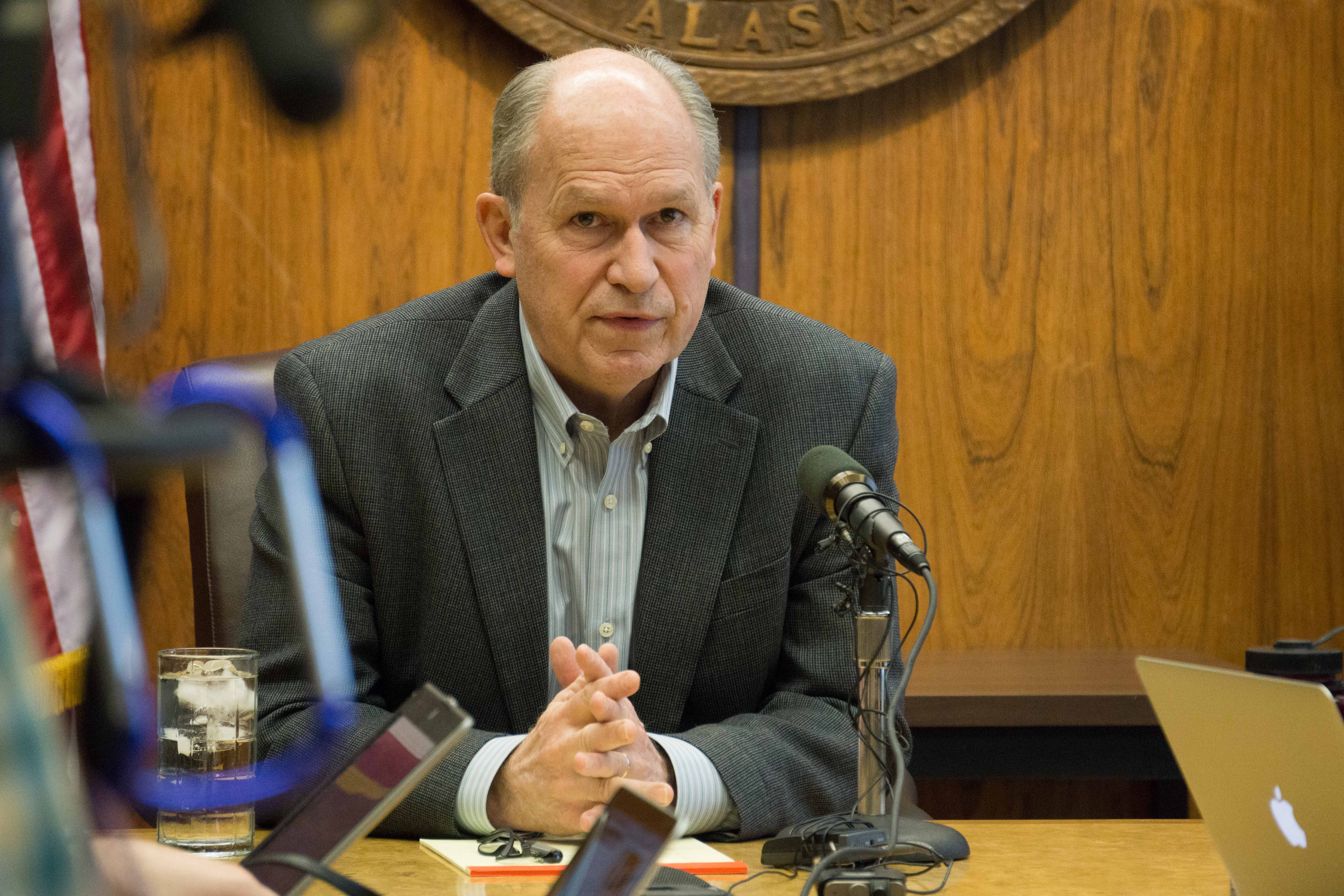
Gov. Bill Walker on April 18. 2015. (Photo by Jeremy Hsieh/KTOO)
Gov. Bill Walker on April 18, 2015. (Photo by Jeremy Hsieh/KTOO)

Gov. Bill Walker says he “[doesn’t] like any form of discrimination, at all.”

But disliking discrimination doesn’t mean he’s willing to change up the state commission members and director, who serve at his pleasure.

“At this point we don’t intend to address this issue. That shouldn’t be a surprise,” Walker said.

Walker says his administration will not introduce legislation on this issue or any other social issue. He says he’s not reviewed the priorities of the state’s human rights commissioners or the commission’s executive director.

“I don’t want to be judgmental about what the Human Rights Commission is or isn’t doing, but I will say that we are working on that issue ourselves,” Walker said. “It’s come up in the past, the issue of them having some venue to report, record circumstances where they feel they have been discriminated against.”

In an earlier written statement the governor said he’d leave it to the commission to decide whether to accept LGBT discrimination complaints, or complaints from any other class.

In other words, the state commission is actively choosing to not provide coverage.

Only two of the seven board members on the state Human Rights Commission could be contacted. Although neither would agree to be recorded, one stated that discussion surrounding LGBT discrimination protections has only come up a few times in the past few years.

The federal EEOC canceled an interview and declined to reschedule. In a written statement, an agency spokeswoman says neither the state or Anchorage commissions are required to accept claims that they don’t have jurisdiction over. And jurisdiction is based on their own assessment of the law, independent of the EEOC’s positions.

In an interview with KYUK’s Elllie Coggins in May, state commission director Paula Haley didn’t include LGBT people in her organization’s duties.

“So we have a very broad area of coverage and we protect people from discrimination based on race, sex, disability, age, marital status, so there’s a lot of coverage. Pretty much everyone in Alaska is protected by our laws,” Haley said.

Later in the interview, Haley said most of the complaints the agency receives deal with employment discrimination—a type of discrimination transgender people are most at risk for, according to a 2012 Anchorage survey on LGBT issues.

In a previous story for KTOO, Paula Haley said she’s only seen a handful of cases over the years.

“Very few people contact us because they’re concerned about discrimination based on lesbian, gay, transgender, queer issues, because they know we don’t cover those. So they don’t reach out to us because we don’t have the ability to help them.”

Anchorage mayor Ethan Berkowitz. (Photo from ethanforanchorage.com)

In the Human Rights Campaign’s 100-point 2014 Municipal Equality Index, Anchorage scored the highest at 35, Juneau at 33 and Fairbanks the lowest at 24.

Anchorage Mayor Ethan Berkowitz says he, “everyone who lives in Anchorage has equal protection under the law.”

But later in the interview, Berkowitz said he was unsure of how the Anchorage commission currently handles these complaints and didn’t mention any specific plans to address the issue.

“Stop the Violence” walk asks Anchorage to pay attention

The attendees of the Stop the Violence rally pose for a photo. (Photo by Anne Hillman/KSKA)

After two recent shooting deaths of local teenagers, more than 60 people marched through the rain in East Anchorage Sunday afternoon to raise awareness of violence in the community.

The crowd sang “Keep calm everybody, and put your guns away. Stop the violence!” The sentiment was echoed on their matching black t-shirts as they marched near the site where 19-year-old Preston Junior Clark Perdomo was shot dead last week.

Among the crowd was resident Allie Hernandez, who moved to Anchorage in 1997 because it was a safe place to raise her kids. She says now, she’s scared.

“This is why we’re walking,” she says between deep breaths. “We have a lot of parents here walking because we’re scared for our kids. We don’t want to see them dead. We don’t want to bury our kids no more. So if we have to walk five miles or six miles, even though I’m not in shape, girl, we’re doing it!”

Summer Yancy walked wearing a set of charms representing friends and family who were impacted by violence. She said Anchorage is so close-knit that everyone is affected by the recent shootings. One way to stop it is to speak candidly with youth about gun violence.

“Let’s have real scenarios of what this looks like when you’re in a real situation,” she said. “With[in] a group of kids and there’s one person in that group that wants to be irresponsible with their gun and all the sudden everybody is sucked in … it can happen to very good kids as well.”

Nineteen-year-old Brennan Gregiore-Girard said he grew up on the east side of town and gun violence doesn’t faze him.

“I mean when I hear about it, it doesn’t shock me anymore, which is sad to say because we shouldn’t be in an environment where kids should feel that way, but it’s the sad truth,” he says.

He said he thinks kids need to take responsibility for their actions and for the situations they place themselves in.

“I’ve always felt like I could talk things out. My mom raised me that way and my dad raised me that way. And I’ve always wrestled and done combat sports, so it’s not one of those things where I’m scared and all that,” he explained. “But why should I put my hands on someone to stop the violence? Because when you kill someone, you’re not only killing them.” You’re killing a piece of everyone they knew, he said.

The community group We Are Anchorage organized the walk to show a unified front for saying no to violence. They hope to encourage people to start actively watching out for their communities and speaking up.

Share your story with KTOO

A protester waves an American flag and a rainbow flag in support of gay marriage in Miami in 2014. Secretary of State John Kerry announced Tuesday the appointment of a special envoy for the human rights of LGBT persons. Joe Raedle/Getty Images

We’d like to hear your story, your personal, first hand experience living in Alaska.

This month, we’d like to hear from Alaska’s LGBT community. Please tell us:

  • What is something you’ve experienced that an LGBT Alaskan growing up in the future won’t have to?
  • What do you still have to put up with today because of who you are?

Please share your stories through audio, by calling (720) 50STORY (720-507-8679). The call will go straight to voicemail. Listen to the instructions and then record your message. You’ll have 2 minutes to response to one or all of the above questions. Please make sure there is no background noise while you are recording. All messages will be considered for publication.

Prefer writing instead? Email a response (400 words or less) to lakeidra@ktoo.org

Got of a photo? Even better, send one to lakeidra@ktoo.org and we’ll include it with your story.


Governor’s annual picnic is Friday at UAS

Gov. Bill Walker and first lady Donna Walker at the governor's picnic in Fairbanks, June 7. (Creative Commons photo by Alaska Governor Bill Walker)
Gov. Bill Walker and first lady Donna Walker at the governor’s picnic in Fairbanks, June 7. (Creative Commons photo by Alaska Governor Bill Walker)

Gov. Bill Walker is carrying on the annual community picnic tradition in Juneau on Friday.

Gov. Walker, first lady Donna Walker, Lt. Gov. Byron Mallott, second lady Toni Mallott and members of the administration will be mingling and serving up salmon and hot dogs at Friday’s free picnic, which runs from 4:30 p.m. to 7 p.m.

“I think it’s a great opportunity for people to get to know our state leadership and for them to get to know Juneau better,” says Bruce Botelho, who’s part of the volunteer team organizing Juneau’s picnic.

Unlike in years past, the picnic will be held on the campus of the University of Alaska Southeast. Botelho says the venue change from Sandy Beach is to showcase the university and put more emphasis on education and children.

“It’ll be primarily outside, though there will be booths located inside in the Egan Library,” he says. “There’ll be some children’s activities, various state departments will also have booths, as they have in the past. Outside, we’ll have an opportunity for gold panning.”

Besides the food, which is all donated by local businesses and organizations, he says costumed mascots like Smokey Bear will be there.

Alaska’s governors have held annual summer picnics for at least 20 years, usually only in Anchorage. Walker’s predecessor, Gov. Sean Parnell, was the first to make it annual in Juneau when he took office in 2009.

Picnics in Fairbanks and Anchorage have already been held this summer.

Anchorage Governor's Picnic
The Anchorage Governor’s Picnic on Aug. 1. (Creative Commons photos by Alaska Governor Bill Walker)

Photos from the Fairbanks Governor’s Picnic on June 6.

06.07.2015 - Governor's Picnic, Fairbanks
The Fairbanks Governor’s Picnic on Jun. 6. (Creative Commons photos by Alaska Governor Bill Walker)

King of fermentation brings together microbiology, food & community

Author and fermentation expert Sandor Katz. (Photo by Sean Minteh)

A fermentation specialist recently visited Homer. He’s making his way through Alaska, teaching about the crossover among food preservation, microbiology and community. He taught an intensive fermentation workshop on a local farm.

It’s a sunny day over the Caribou Hills. A group of more than 50 people are milling around a large, green farm, lunch plates piled high with pungent food that saturates the summer breeze.

Sandor Katz is sitting on a log near some chickens, wearing a white shirt with a pattern of bright red radishes. He’s the King of Fermentation.

“I ended up being given the nickname ‘Sandorkraut’ because I was always showing up with sauerkraut and evangelizing about the healing powers of sauerkraut,” says Katz.

Yes, sauerkraut.

“You can make it in dazzlingly bright colors, or contrasting colors, or different sizes and shapes of cutting up your vegetables. It’s actually an incredibly versatile food,” says Katz.

Despite the teasing for always being that guy, the one who brings fermented food to a dinner party, he truly has a deep passion for this process. Through his eyes, the complex world of microorganisms and bacteria at work take on new and beautiful life.

“Before I see anything, I smell this delicious sourness,” says Katz. “I taste this sourness that speaks to me in this very deep way. What I see is last season’s garden that’s still feeding us and nourishing us. It’s actually never occurred to me that sauerkraut could be ugly.”

And his art is gaining popularity. In the pushback against processed and packaged foods, do it yourself preservation methods are becoming more popular.

“People are waking up to the fact that a lot has been lost by severing our connection with producing food and so they’re interested in figuring out how they can play a role in producing their own food,” says Katz.

Charles Meredith, who goes by Chaz, is active in the local farmers market and independent growing community. He says he’s seen a resurgence of traditional food ways, like canning, pickling, dehydrating and fermenting.

“I feel like in rural places, in general, the older traditions stick around more and are more appreciated by people in those areas,” says Meredith. “So, I think it’s partially holding onto the past where you can obviously see it slipping away.”

Like many people in Homer, he’s comfortable with lots of types of food preparation. Over by the picnic tables, Marcee Gray is scooping up sticky sourdough starter with a spoon.

She finishes packing it into a mason jar, picks up some lunch at the buffet and settles down in the shade with friends.

“In our culture we do have a little bit of a fear of things like mold and bacteria,” says Gray.

Gray’s friend, Mary Lou Kelsey, says she likes the mystery of fermentation.

“I was somebody who asked him, ‘So how do you know what organisms are in there?’ If you were really worried about trying to identify all the organisms, it would be difficult … so you kind of have to [accept] that it tastes good and it’s a great mystery,” says Kelsey.

Katz says in fermentation, microorganisms exist in communities — kind of like the people who are once again taking an interest in these complex processes.

“If you think the baker and the cheesemaker and the sauerkraut maker as some archetypal fermenters, and we can’t forget the beer makers, then these are all products that give rise to exchange and informal barter and economies of community,” Katz says. “I think the revival of local food systems is all about building and strengthening community ties.”

That revival can be seen in Katz’s own work. He brings people with common interests together, to eat communal meals, to trade containers of their homemade concoctions, and he does it all through his teaching of the art of fermentation and one jar of sauerkraut at a time.

Site notifications
Update notification options
Subscribe to notifications